Specs are compiled from manufacturer listings and verified buyer reviews and can change over time — please confirm the key details on the product page before buying.
Most people shopping in this tier get burned by the same mistake: they buy a residential opener for a commercial door, and it quits within a season. The four operators here are built for small rolling doors, grilles, and industrial sectional doors — the kind of lifting that runs a hundred times a day, not twice. Get door weight and headroom right first; the rest of the spec sheet follows from those two numbers.
This guide is built by comparing the manufacturers’ published specifications and the patterns across verified customer reviews, so you get each pick’s real strengths and trade-offs instead of marketing spin.
Below you get the door-weight limits, the headroom each unit needs, and the distinct way each one raises a heavy door — all the practical filtering you need before you commit to one of the best industrial garage door openers.
Top Picks

How To Choose The Best Industrial Garage Door Openers
Pin down your door’s actual weight in pounds before anything else. A commercial operator’s rating is stated in pounds of door weight, and a unit asked to lift more than that will strain, overheat, or trip the motor. Weigh the door, or get the manufacturer’s weight for it, then match.
Matching the operator to your door and your building
A trolley operator sits overhead and pulls the door along a rail, so it needs proper headroom above the door. A jackshaft operator mounts on the wall beside the torsion bar and drives the door through the shaft — the right call when ceiling space is short. Measure the distance from the center of the torsion bar to the ceiling, because the wall-mounted units here need clearance above that bar to fit.
Then think about door travel. Doors with high lift or vertical lift, where the door rides high and straight up, change which operator will work and how the door has to be balanced. Grilles and small rolling doors are a separate job again, and this class of equipment is what that job calls for.
Duty rating, voltage, and what “commercial” really means
These operators run on 115 volts, standard wiring, which matters because it means you are not hiring a specialist crew for a high-voltage hookup. Commercial units are built to cycle more often than a residential motor. That said, a “light-duty commercial” label is not the same as medium-duty — match the duty tier to how many times the door opens per hour, not just to how heavy it is.
Safety reversing, battery backup, and manual release
Safety reversing sensors are not optional — they catch an object in the door’s path and reverse the door. On a large commercial opening, more people and vehicles pass through, so you want that system present and functioning. A floor-level chain hoist gives you manual operation in a power cut, and a backup battery keeps the door working when the mains drop out. Decide which of these your building genuinely needs before you buy.
Side-by-Side Comparison
| Model | Best For | Operator Type | Door Weight / Size Limit | Voltage / Motor | Amazon |
|---|---|---|---|---|---|
| LiftMaster MT5011U★ Best Overall | Medium-duty overhead trolley lifting | Trolley operator (rail sold separately) | — | 115 volts | Amazon |
| LiftMaster 8900W (LJ8900W) | Low-headroom sectional doors up to 850 lbs | Wall-mounted jackshaft | Up to 850 lbs / 180 sq ft | 12V DC motor | Amazon |
| LiftMaster MH5011U | Rolling doors and grilles with manual release | Hoist operator with floor chain | — | 115 volts | Amazon |
| LiftMaster RJO 98032 | The heaviest standard-lift doors, up to 1,100 lbs | Wall-mounted jackshaft | Up to 1,100 lbs | DC motor | Amazon |
Detailed Reviews
1. LiftMaster MT5011U Trolley Motor Operator
Our pick — 4.5+★ from 20+ verified ratings; the strongest balance of quality and price.
The medium-duty overhead puller that matches a commercial cycle count without the residential motor’s limits
The MT5011U earns its spot with a 4.5+ star rating from a small set of owners — the highest in this group — because it does the heavy overhead lifting job it was built for. It is a trolley operator (it mounts above the door and pulls with an overhead rail). The motor runs on 115 volts, so it hooks up to standard building wiring without a dedicated high-voltage crew.
The 52-pound frame is built for medium-duty commercial cycling — more open-and-close runs per day than a home opener is asked to do. A residential motor pushed to a hundred cycles a day burns out in a season; this one is built for that duty. Weight is a factor during install too, since a 52-pound motor has to be raised and held in place above the opening.
One detail to plan around before you order: the rail is not included. The unit is sold as the operator only, so you supply the rail that matches your door height and track layout. Buyers of commercial operators in this class expect to source the rail to their specific opening anyway, but budget the extra step into the install schedule. Its 4.5+ star owner rating and medium-duty commercial build are why it takes the top slot.
Why it leads the group
- Medium-duty cyclcing target suits a busy commercial door better than a home opener
- 115-volt wiring keeps the electrical hookup straightforward
- Very high owner satisfaction on the working motor
What to plan for
- Rail is not included — you source it to fit your door
- 52-pound motor takes a second pair of hands to hoist into place
- Requires proper overhead headroom for the trolley rail run
Top of the list: the operator to buy when your door needs steady medium-duty commercial lifting and you have overhead room for a trolley rail.
The trade-off: plan and budget for the separate rail, because this is the motor only.
2. LIFTMASTER 8900W Jackshaft Operator
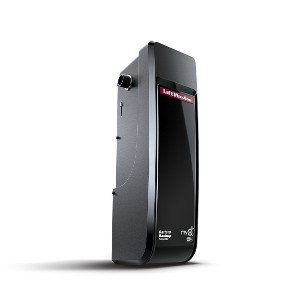
A wall-mounted operator that steals just 3 inches of clearance and lifts doors up to 850 lbs
Here is the low-ceiling answer. The 8900W is a jackshaft operator, so it mounts on the wall next to the torsion bar and drives the door through the shaft instead of overhead with a trolley rail. That means it needs only 3 inches of clearance from the center of the torsion bar — dramatically less headroom than a trolley rig demands. If your ceiling is tight, this is the shape that fits.
The door limits are clearly stated: up to 14 ft. in height, up to 18 ft. in width, a maximum of 180 sq. ft., and a maximum door weight of 850 lbs. Those figures let you check your own opening before you buy. The 12V DC motor runs a #48 internal chain and sprocket drive, and a cable tension monitor watches the door’s lift cables — a genuine safety addition on a big sectional door.
Everyday control is handled well: built-in Wi-Fi with MyQ compatibility lets you open and monitor the door from your phone, and it ships with the push-button control station (APBS1) plus The Protector System safety reversing sensors. There is a built-in surge protector and thermal protection too. Note the label — this is light-duty commercial, so weigh your daily cycle count against that before choosing it over the medium-duty pick above.
Where it wins: the 3-inch headroom requirement is the smallest clearance in this group, and the 850-lb, 180-sq-ft door limits cover a large low-ceiling sectional door. Wi-Fi and MyQ add phone control the trolley unit does not have.
Where it gives ground: the light-duty commercial rating means a high-cycle door should look at a medium-duty unit instead.
Reach for this if: your ceiling hugs the doorway and you want phone control built in.
Look elsewhere if: your door runs near-continuous cycles — the light-duty rating is the limiting factor.
3. Liftmaster MH5011U Hoist Operator

The hoist operator you can hand-crank from the floor when the power walks out
This is the one built for rolling doors and grilles, and for industrial sectional doors with high or vertical lift. Its standout feature is a floor-level chain hoist with an electrical interlock — meaning if the motor is off or the power is dead, you can raise the door by hand from the floor. On a busy commercial opening, that manual path is the reason a lot of buyers go this route.
It runs on 115 volts and meets the NEMA specification, and it uses a fully adjustable linear-driven limit mechanism to set exactly where the door stops at the top and bottom of travel. Reviewers praise its build quality and consistent operation cycle after cycle.
The honest note is fit: this is a medium-duty hoist operator aimed at small rolling doors and grilles, with high or vertical lift sectional doors. A standard-lift sectional door up to 850 lbs is better served by the jackshaft above. On rolling doors, grilles, and high-lift sectional doors, this hoist operator is the right fit.
The real draw: floor-level manual release with an electrical interlock lets you operate the door by hand when the power is down — a practical safety net for a commercial opening.
Fit check: at 60 lbs it is the heaviest here, and its wheelhouse is rolling doors, grilles, and high-lift sectional doors, not standard-lift residential-style panels.
Built for: rolling doors, grilles, and high-lift sectional doors that need hand-crank access during outages.
Not for: a standard-lift heavy panel door — route that to the jackshaft operators in this list.
4. Liftmaster HD RJO 98032 Jackshaft

The wall-mount that shoulders the heaviest doors here — up to 1,100 lbs
If your door is genuinely heavy — overlays, wind-load panels, solid wood, or thick insulated construction — this is the operator sized for it. The RJO 98032 is UL 325 certified and rated to lift doors up to 1,100 lbs, the highest door-weight ceiling in this group. It mounts on the wall and eliminates the need for a cable tension monitor and overhead rails, which simplifies the install and keeps your ceiling clear.
For a professional setup, the box gives you a real head start: a 3-button remote (893MAX), an automatic garage door lock (841LM), safety sensors, the myQ LED light (827LM), and two integrated battery backups (485LM). It also carries California SB-969-compliant battery backup (meets the state’s backup-power rule). Installation is the most-praised part of ownership, and value is close behind, so the box contents clearly deliver on day one.
The catch worth knowing up front: reliability draws the largest share of discussion, and it splits both ways — as buyers report, some customers reporting no issues while others experienced failures after 8 months of use. That is a mixed record on the part that matters most, so go in with eyes open and keep up with maintenance. At 49.9 lbs it is lighter than the MH5011U’s 60 lbs, which helps during a wall install.
Where it stands alone: a 1,100-lb door rating — the heaviest capacity here — plus a battery backup, automatic lock, and full kit in the box.
The caveat: reliability feedback is split, with some units reported working fine and others failing after months of use, so buy with maintenance in mind.
Choose it for: the heaviest standard-lift doors where 1,100 lbs of capacity is the deciding spec.
Weigh the risk if: you want the most predictable long-term reliability — the feedback here is mixed.
Know the Specs
Door Weight Rating
The operator’s stated maximum door weight, in pounds, is the ceiling on what it will lift. Go over it and the motor strains every cycle. The wall-mount units here are rated up to 850 lbs and up to 1,100 lbs respectively, so match your door’s actual weight to that number before you buy.
Operator Type: Trolley vs Jackshaft
A trolley operator pulls the door overhead along a rail and needs overhead room. A jackshaft operator mounts on the wall by the torsion bar and drives the shaft, so it works in tight headroom. The jackshaft on this list needs only 3 inches of clearance from the center of the torsion bar.
Duty Rating
Duty rating describes how many cycles the operator can handle per day before it is working beyond its design. “Light-duty commercial” and “medium-duty” are different tiers — the busier the door, the higher the duty tier you want. Do not judge on door weight alone.
Voltage and Motor
The trolley and hoist operators here run on 115 volts, standard building power. The jackshaft units use DC motors — a 12V DC motor on the 8900W. Voltage and motor type affect wiring needs and how the door accelerates, so check against your electrical setup.
Safety Reversing and Battery Backup
Safety reversing sensors detect an object in the door’s path and reverse it — essential on a large commercial opening. Battery backup keeps the door working when the mains drop. The RJO 98032 includes two integrated battery backups; the 8900W ships with The Protector System reversing sensors.
Headroom Clearance
Measure from the center of the torsion bar to the ceiling before choosing a wall-mount. The 8900W needs 3 inches of clearance above that bar. A trolley operator instead needs overhead room for its rail run, and the MT5011U ship without the rail, so plan the run length too.
Common Questions
How do I know which operator fits my door’s weight?
Can a jackshaft operator work if my ceiling is low?
What does “light-duty commercial” vs “medium-duty” actually change?
Do I need a separate rail for the MT5011U?
How does the floor-level chain hoist help during a power cut?
Is battery backup required on a commercial door operator?
Will these operators work with my opener remote and phone app?
What voltage do these commercial operators need?
Should I pick the operator with the highest door weight rating every time?
Do these come with safety reversing sensors?
The Bottom Line
For most commercial openings, the industrial garage door openers winner is the LiftMaster MT5011U because its medium-duty trolley motor handles steady commercial cycling and runs on standard 115-volt wiring. If low headroom is your constraint, the LiftMaster 8900W slides onto the wall with just 3 inches of torsion-bar clearance and adds MyQ phone control. For a rolling door or grille that needs hand-crank access in an outage, the LiftMaster MH5011U has the floor-level chain hoist. Whichever you pick, buy on door weight, headroom, and duty tier — not on the word “commercial” on the box.
How we choose
We do not accept paid placement. Every pick is matched to a real buyer and a real use-case; we do not hands-on test units.
Sources
Specifications: manufacturer listings and product documentation. Review insights: verified customer reviews, as of November 2026. Pricing: not shown on this page (it changes often); check the current price via the retailer link.
As an Amazon Associate, Tactical Gear Guy earns from qualifying purchases. This does not affect which products we feature.