Specs are compiled from manufacturer listings and verified buyer reviews and can change over time — please confirm the key details on the product page before buying.
If you are cutting firewood, dropping a few trees, or clearing storm damage, the fastest way to waste a weekend is a saw that will not start or a bar that binds halfway through a trunk. A gas chainsaw solves that with its own fuel supply and no cord to trip over. The real decision is engine size and bar length versus the weight you will carry all afternoon.
This guide is built by comparing the manufacturers’ published specifications and the patterns across verified customer reviews, so you get each pick’s real strengths and trade-offs instead of marketing spin.
Below you will find picks separated by how much timber you actually cut, from a lightweight limb saw to a full logging powerhead. Our full breakdown of the best Steel Chain Saw covers bar length, engine size, and the weight trade-off so you can match a saw to your woodpile.
Top Picks


How To Choose The Best Steel Chain Saw
Buying a chainsaw is really a matching exercise: the saw has to match the wood you cut most often. Too small, and you will stall the chain in a big trunk. Too big, and you will be tired before the truck is loaded. Here is what actually decides that match.
Match the bar length to the trunk, not the catalogue
The bar is the metal blade the chain, and its length sets the widest cut you can make in one pass. A 12-inch bar suits limbs and pruning work. A 20-inch bar is the common middle ground for firewood. A 28-inch or 36-inch bar is for felling big timber.
Longer bars also demand more engine power to keep the chain moving under load. A big bar on a small engine just bogs down in the cut.
Engine size in cc is the real muscle figure
The engine displacement — measured in cubic centimetres, or cc — tells you how much fuel-air mixture the motor moves per stroke. More cc usually means more torque to keep the chain spinning when it bites deep. Small top-handle saws sit around the mid-20s in cc. Big logging powerheads run past 90cc.
Weight is the spec you feel by hour three
A saw on the shelf feels fine. A saw held out at arm’s length for an afternoon is a different animal. Anything near or above 19 pounds wears you down fast unless you are working at ground level. If you climb or prune overhead, an 8-pound saw is a very different experience.
Chain pitch, gauge, and the safety brake
Pitch is the distance between chain drive links and gauge is the width of the slot the chain sits in. These need to match the bar so the chain sits properly and does not jump. The chain brake stops the chain in a kickback, so make sure the saw has one that engages via inertia.
Side-by-Side Comparison
| Model | Best For | Bar Length | Horsepower | Weight | Amazon |
|---|---|---|---|---|---|
| Husqvarna 460 Rancher★ Best Overall | All-round firewood and felling | 24 inches | 3.6 hp | 13.2 pounds | Amazon |
| SUPMIXTOOLS 62ccBest Value | Big cuts on a tighter budget | 20 inches | 4.2 hp | 14 pounds | Amazon |
| NEO-TEC NCS2500Limbing Specialist | Climbing and limbing | 12 inches | 1.2 hp | 8.2 pounds | Amazon |
| Husqvarna 120 Mark III | Home garden trimming | 16 inches | 1.88 hp | 10.7 pounds | Amazon |
| FARMMAC F380W | Heavy felling on a mid budget | 28 inches | 4.8 hp | 33 pounds | Amazon |
| NEO-TEC NS892V1 | Professional timber work | 36 inches | 7 hp | — | Amazon |
| NEO-TEC NS8105 | Big-log milling and clearing | 36 inches | 6.5 hp | — | Amazon |
| ECHO CS-590-20 | All-day firewood duty | 20 inches | 3.9 hp | 9.12 kg | Amazon |
| ECHO CS-355T-14 | Arborist and climbing work | 14 inches | 5.3 hp | — | Amazon |
Detailed Reviews
1. Husqvarna 460 Rancher Gas Powered Chainsaw, 24 Inch
Our pick — 4.5+★ from 550+ verified ratings; the strongest balance of quality and price.
The rancher that pairs a 24-inch bar with a 60.3cc engine and stays civil about it.
If you cut a few cords a year and drop the occasional dead tree, the 460 Rancher gives you the most bar length without stepping up to a big professional powerhead. Its 24-inch bar is the longest here outside those pro saws, and its 60.3cc X-Torq engine (a Husqvarna design that squeezes more power from each tank of fuel) is rated at 3.6 hp. That is enough engine to pull a full 24-inch bar through hardwood without the chain stalling mid-cut.
Set it beside the Husqvarna 120 Mark III below and the size gap is obvious. The 460 measures 16.9″L x 8.8″W x 11.8″H, while the 120 runs 29.4″L x 9.25″W x 10.7″H — a longer overall body for a shorter bar. The 460 also carries the company’s Smart Start system and a combined choke/stop control, which is the difference between three pulls and twenty on a cold morning.
The comfort engineering is where this saw earns its place. A 7-degree offset front handle angles your wrist more naturally, and LowVib dampeners cut the vibration that turns a two-hour session into a two-hour punishment. Air Injection throws dust away from the filter before it clogs, so the saw keeps breathing during a long run of cuts.
What wins people over
- 60.3cc X-Torq engine rated 3.6 hp pulls the full 24-inch bar without bogging
- Inertia-activated chain brake kicks in on kickback to cut injury risk
- 7-degree offset front handle and LowVib dampeners ease wrist strain and fatigue
- 2-year manufacturer warranty backs the powerhead
Where it asks for care
- Weight sits at 13.2 pounds, so overhead work tires you faster than a top-handle saw
- At 24 inches, this bar is longer than a home-garden user really needs
- Proper fuel mix discipline matters — neglect it and the engine life shortens
Built for: Firewood cutters and smallholders who want one saw that handles felling and bucking without stepping up to a logging powerhead.
Worth knowing: The saw is long-bodied and 13.2 pounds, so if your main job is pruning overhead in a tree, a lighter top-handle model serves you better.
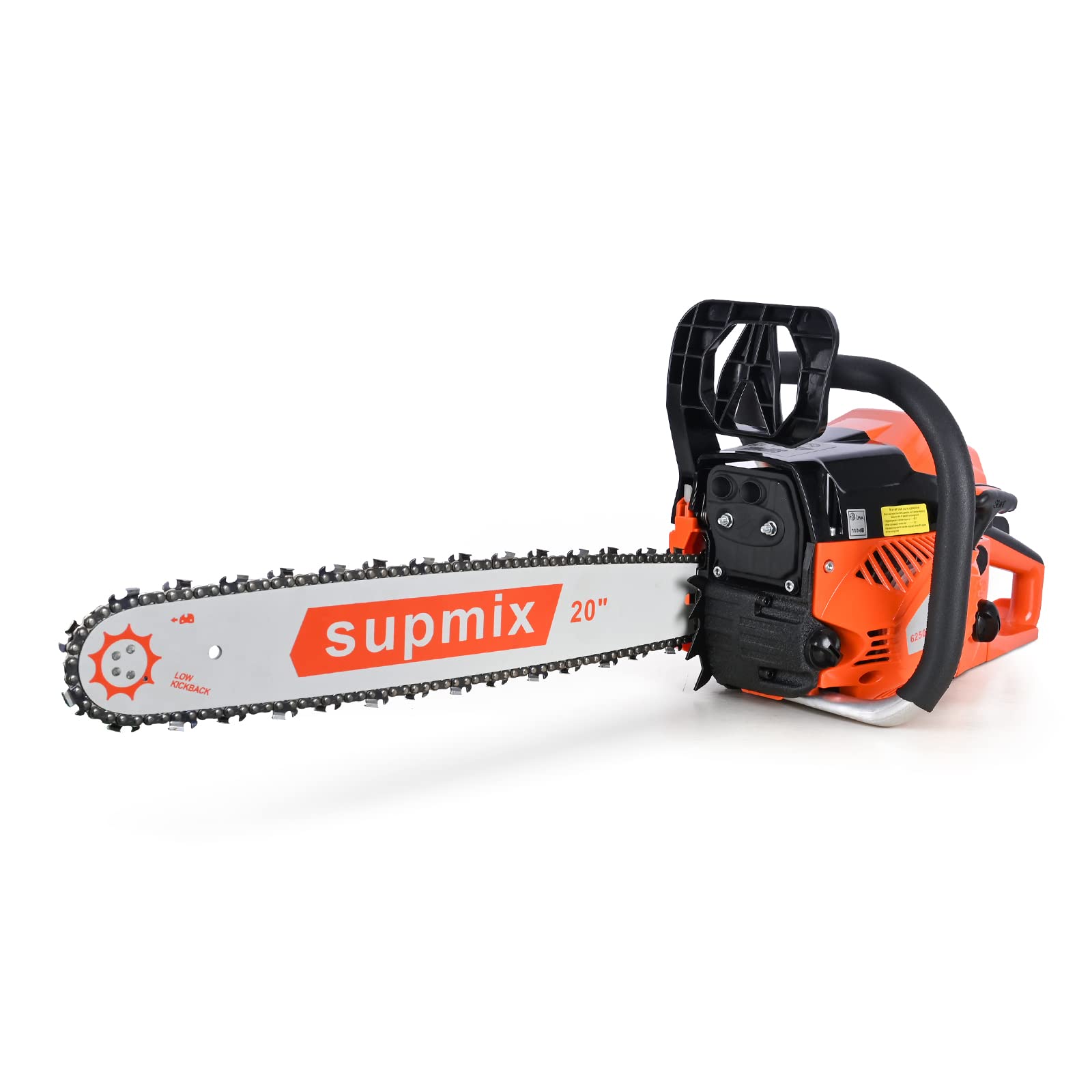
2. SUPMIXTOOLS 62cc Gas Chainsaw 20 Inch 2-Cycle Petrol
A 62cc motor swinging a 20-inch bar for a whole lot less than the brand names.
A 62cc engine in a 20-inch saw is a strong pairing on paper. This SUPMIXTOOLS runs a full-crank two-stroke motor rated 4.2 hp with a chain speed of 8500 RPM, which means it keeps the chain moving fast enough to clear chips rather than grind them. It is the lightest way into real cutting power without paying the premium tier.
A low-kickback chain comes on the 20-inch bar to reduce the chance of the saw grabbing and bucking back at you. There is also a safety switch against accidental starts and a quick-stop chain brake. Add the spring-assist pull start and cold-morning starts become a far less sweary affair than on older saws.
Balance is the detail that keeps this saw usable through a long session. Its well-balanced ergonomic layout cuts operator fatigue, and the full-crank construction smooths out vibration compared to cheaper engines. Weighing 14 pounds, it is one pound heavier than the Husqvarna 460 Rancher but swings a shorter bar — a trade most firewood cutters barely notice.
The value read: You get a lot of cutting hardware for the money: a 62cc motor at 4.2 hp, an 8500 RPM chain speed (how fast the chain travels, so cuts stay quick), and a low-kickback chain (built to reduce the saw kicking back toward you). On paper it undercuts the brand-name saws while matching them on raw power.
The honest limit: It is a consumer-grade build. Some buyers report failures after a short run, so treat the break-in period with care and keep the fuel mix exact.
Pick this for: Firewood cutters who want a 20-inch bar and 62cc of grunt without paying brand-name money.
Think twice if: You want a saw you can hand to a professional crew and forget about — this is home-and-garden grade, not commercial.
3. NEO-TEC 25.4cc 12 Inch Top Handle Gas Powered Chainsaw
An 8.2-pound top-handle saw small enough to climb with and start one-handed.
This is the featherweight of the group, and the numbers show it. The NEO-TEC weighs 8.2 pounds against the SUPMIXTOOLS’s 14 pounds — a hair under half — and swings only a 12-inch bar. That combination makes it a climbing and limbing saw, not a firewood saw. The one-hand operation and a metal lanyard ring to clip it to a harness are what make it a genuinely different tool.
The 25.4cc two-stroke engine puts out 1.2 hp and spins to 12,000 RPM, with a wrap-around handle that soaks up vibration so your grip stays fresh through a long climb. Against the Husqvarna 460 Rancher’s 3.6 hp, this saw is not trying to compete on muscle — it is built for reach and control.
The spring-assisted ignition takes one pull to fire after setup, so you are not hanging off a branch wrestling a cold engine. The precision carburetor is tuned to squeeze more cutting time out of each tank. For pruning, limbing during a climb, and small felling jobs, this is the saw you can carry where a 24-inch bar simply will not go.
Why arborists reach for it
- 8.2 pounds and a 12-inch bar make one-handed climbing cuts realistic
- Spring-assisted ignition fires on a single pull after setup
- 12,000 RPM top speed with a vibration-damping wrap handle
- Metal lanyard ring lets you clip the saw to a harness
The honest trade-off
- 1.2 hp in a 12-inch bar means big trunks are out of its league
- The handle is the weak point — report it failing under hard use
- Top-handle saws are built for trained climbers, not general ground work
Your saw if: You climb, prune, or limb trees and need a saw light enough to work one-handed overhead.
Not your saw if: Your job is bucking firewood on the ground — the 12-inch bar and 1.2 hp will slow you to a crawl in a big trunk.
4. Husqvarna 120 Mark III Gas Chainsaw, 16 Inch

A light 16-inch saw for the yard jobs you keep putting off.
Not every buyer needs 24 inches of bar. If your work is limbing a downed tree, trimming around the property, and cutting a bit of firewood, the 120 Mark III is the right size. Its 38cc X-Torq engine delivers 1.88 hp through a 16-inch bar, and at 10.7 pounds it is lighter than the 460 Rancher by a noticeable margin.
Starting is where this saw is meant to shine. An air purge system and a combined choke/stop control cut the risk of flooding the engine, and the inertia-activated chain brake backs up the safety side. LowVib dampeners keep vibration down over the recommended 14 to 18-inch bars, and the centrifugal air cleaning system keeps dust out of the filter.
Cutting performance and value are the parts owners talk about most favorably. The honest catch is a tougher one to size: quality and reliability feedback splits down the middle, with some saws running like a workhorse and others stalling out. The chain also draws criticism for popping off and not staying seated on a small share of units. Buy it as a home-garden saw on a premium brand name, not as a pro tool.
Where it fits: A 16-inch bar, 38cc engine, and 10.7-pound frame make this a trim-and-tidy saw for weekend yard work.
Size the risk: Reliability is genuinely mixed in the feedback, so buy from a seller with a clean return path and run the saw hard during the first week.
Best served: Homeowners with a yard full of fallen limbs who want a trusted badge without stepping up to a 24-inch saw.
Hold off if: You plan to fell big trees or cut serious firewood volume — a larger engine and bar do that job with less stalling.
5. FARMMAC F380W 72cc Gas Chainsaw, 28 Inch Bar
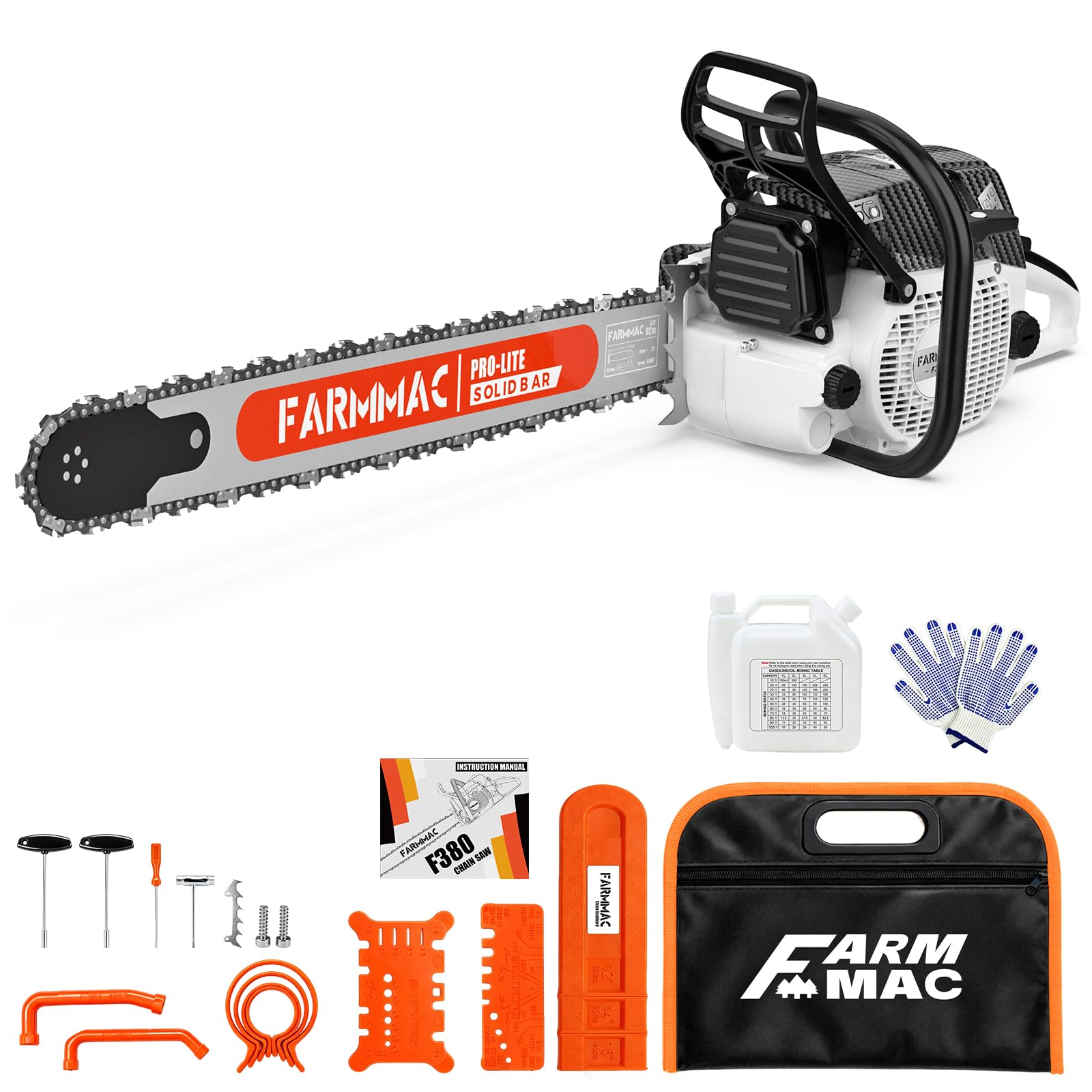
72cc and 4.8 hp turning a 28-inch bar — big-saw numbers on a mid-range ticket.
The engine here is the story. A 72cc full-crank two-stroke rated 3.6KW / 4.8HP drives a 28-inch solid alloy bar, and a fast air-cooling system fights the overheating that comes with long sustained cuts. Against the NEO-TEC 2500 below, this is roughly four times the horsepower (4.8 hp versus 1.2 hp) spread across a bar that is more than double the length. This is a felling and logging saw.
The chain spec is note because it uses a professional pattern: 3/8″ pitch, 0.063″ gauge, and a 12.1mm tail mount, all low-kickback. A high-quality HLHIC carburetor handles fuel metering and atomization so starts are cleaner and fuel goes further. The magnesium alloy crankcase keeps the body light for its size while staying stiff under load.
It is a compatibility play, too. The powerhead is designed to fit Stihl MS381, MS380, and 038 parts, which matters if you already own spares or want a familiar platform. Be aware of two practical limits: the saw weighs 19.8 pounds bare, and the listing notes it is not CARB certified, so it cannot ship to California. The oil reservoir also draws reports of leaking, so check fittings before you fill.
The case for the F380W
- 72cc engine at 4.8 hp has the torque to drive a 28-inch bar through big timber
- Solid alloy bar with 3/8″ pitch and 0.063″ gauge chain in a pro pattern
- Parts compatible with Stihl MS381, MS380, and 038 platforms
- Magnesium alloy crankcase for strength without excess bulk
The catches to plan around
- Not CARB certified and restricted from California addresses
- 19.8 pounds bare weight makes ground felling the only realistic use
- The oil reservoir draws reports of leaking, so inspect before use
- Start behaviour is mixed — some fire readily, others resist restarting
Suits: Fellers and small logging operations that need 28-inch reach and 4.8 hp without the premium branding.
Look elsewhere if: You live in California or need a saw you can carry up a ladder — this one cannot ship there and weighs 19.8 pounds.
6. NEO-TEC NS892V1 92cc Gas Chainsaw, 36-Inch Bar
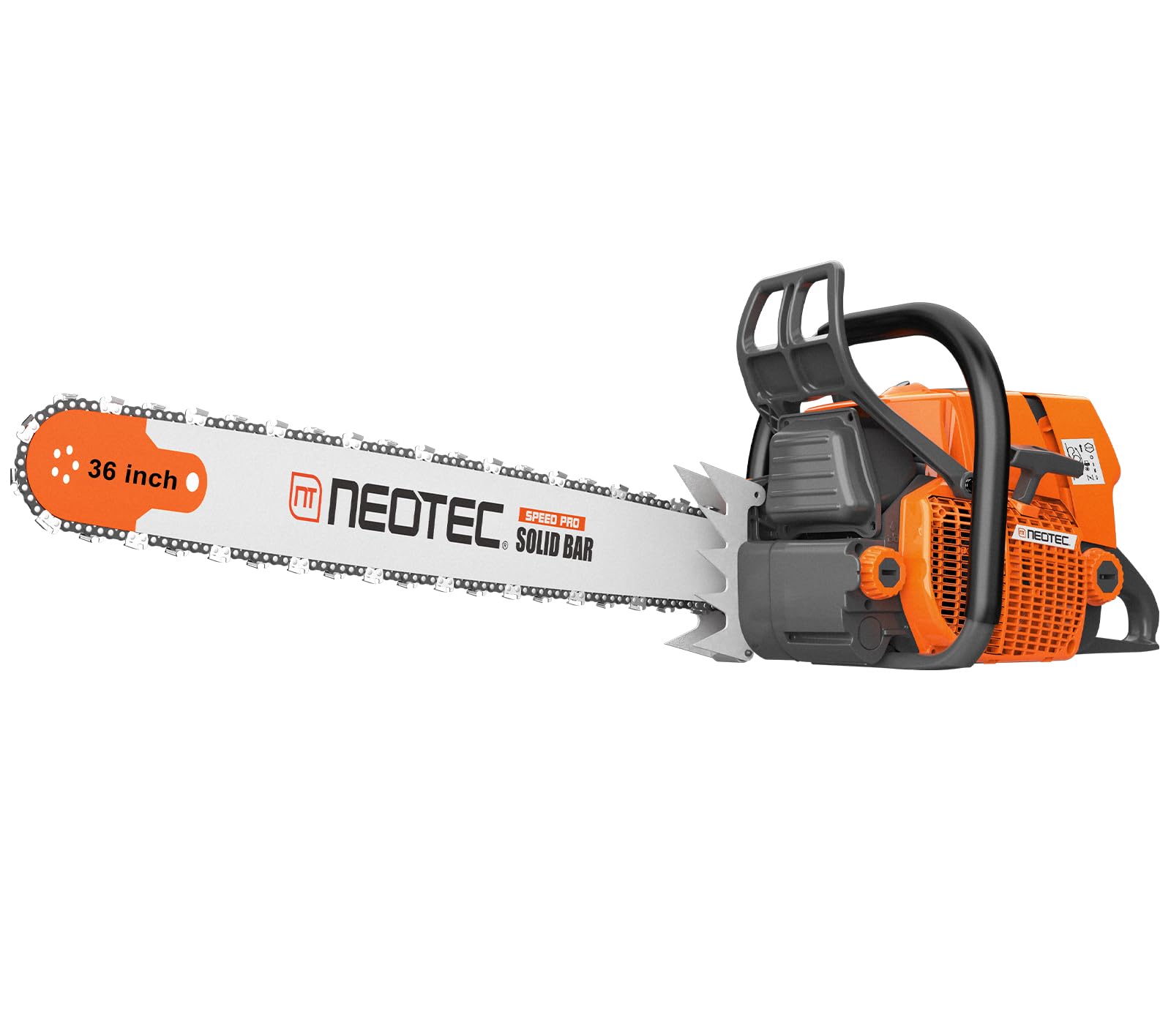
A 92cc powerhead with 7 hp of pull behind a 36-inch bar.
This is professional timber territory. The NS892V1 runs a 92cc full-crank two-stroke air-cooled engine rated 5.2kW (7 hp), and that is the highest horsepower figure in this whole group. It is built to accept a 36-inch guide bar with a 3/8″ pitch, 0.063″ gauge spec and a full-chisel chain — a fast-cutting combination for felling large trees and prepping firewood in volume.
Against the NEO-TEC NCS2500’s 1.2 hp, this is a different league, and against the Husqvarna 460 Rancher it gives up nothing on bar length while gaining 3.4 hp. Magnesium alloy parts instead of plastic give it impact resistance, faster heat dissipation, and stiffer energy transfer. In logging use, that rigidity is what stops the saw flexing under a heavy cut.
Premium spark plugs and a high-quality carburetor are aimed at quicker ignition and better fuel atomization, so the saw starts cleanly and burns efficiently. A quick-stop chain brake engages on kickback, and a safety switch blocks accidental starts. It ships as two separate packages — powerhead and bar/chain — so expect a two-delivery arrival.
The headline spec: 92cc, 7 hp, and a 36-inch bear of a bar means this saw eats big timber that smaller saws would stall on.
The practical catch: It is a professional-grade tool that demands proper technique, fuel discipline, and the strength to work a 36-inch bar all day.
Step up for: Professional loggers, forestry teams, and serious firewood cutters who need 36-inch cuts and 7 hp of torque.
Not for you if: You cut weekend firewood — a 36-inch bar and 92cc engine will tire you out on limbs that a small saw would finish in minutes.
7. NEO-TEC NS8105 105cc Gas Chainsaw, 36-Inch Bar
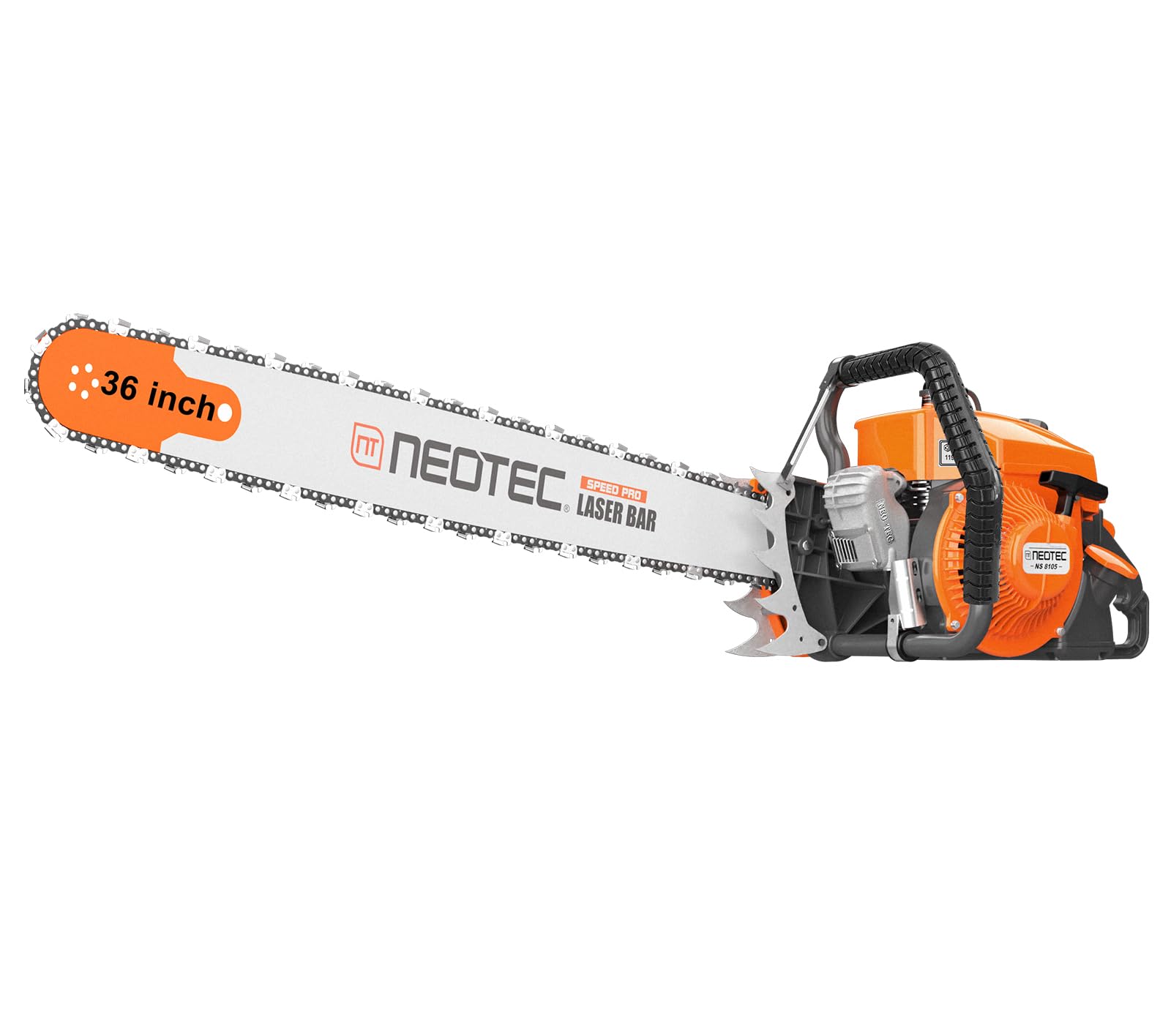
105cc of commercial-grade muscle that swallows heavy timber whole.
The largest engine here belongs to this NEO-TEC. The 105cc two-stroke puts out 6.5 hp (4.8kW) and is built for a 36-inch bar running 0.404″ chain pitch at a 0.063″ gauge. That pilot spec is what makes it a big-timber saw — the larger pitch drives bigger, heavier teeth that clear a wide cut in dense hardwood without bogging.
The powerhead is compatible with the G070, 070, and 090 platforms, so it slots into a familiar parts ecosystem for logging crews already running those saws. A quality spark plug and a 2200GS flywheel are meant to give quick ignition and reduce the pull-start effort on a cold engine. A precision carburetor holds the fuel mix at 1:25 to keep power steady and protect the engine.
Magnesium alloy instead of plastic gives the body impact resistance, fast heat dissipation, and rigidity for efficient power transfer under heavy load. It is a saw for ranch, farm, forestry, and clearing work. Two practical notes: the powerhead and bar ship separately, so keep the box until both arrive, and this is a big, heavy saw that is meant to be run by someone used to the weight.
Why a logger would step up
- 105cc engine rated 6.5 hp has torque for the heaviest timber
- 36-inch bar with 0.404″ pitch and 0.063″ gauge for wide, dense cuts
- Magnesium alloy body resists impact and dissipates heat fast
- Compatible with G070, 070, and 090 parts
Weigh before you commit
- Designed for a 36-inch bar, which is more saw than most homeowners need
- The 1:25 fuel mix requires discipline — no cutting corners on ratio
- Shipped as two packages, so plan for a two-delivery arrival
The right buyer: Forestry and ranch crews cutting big timber who want 105cc of torque and a 36-inch bar in one powerhead.
The wrong buyer: Cottage owners with a stack of branches — this saw is sized for timber, not tidy-up.
8. ECHO CS-590-20 Gas Chainsaw, 20-Inch Bar, 59.8cc
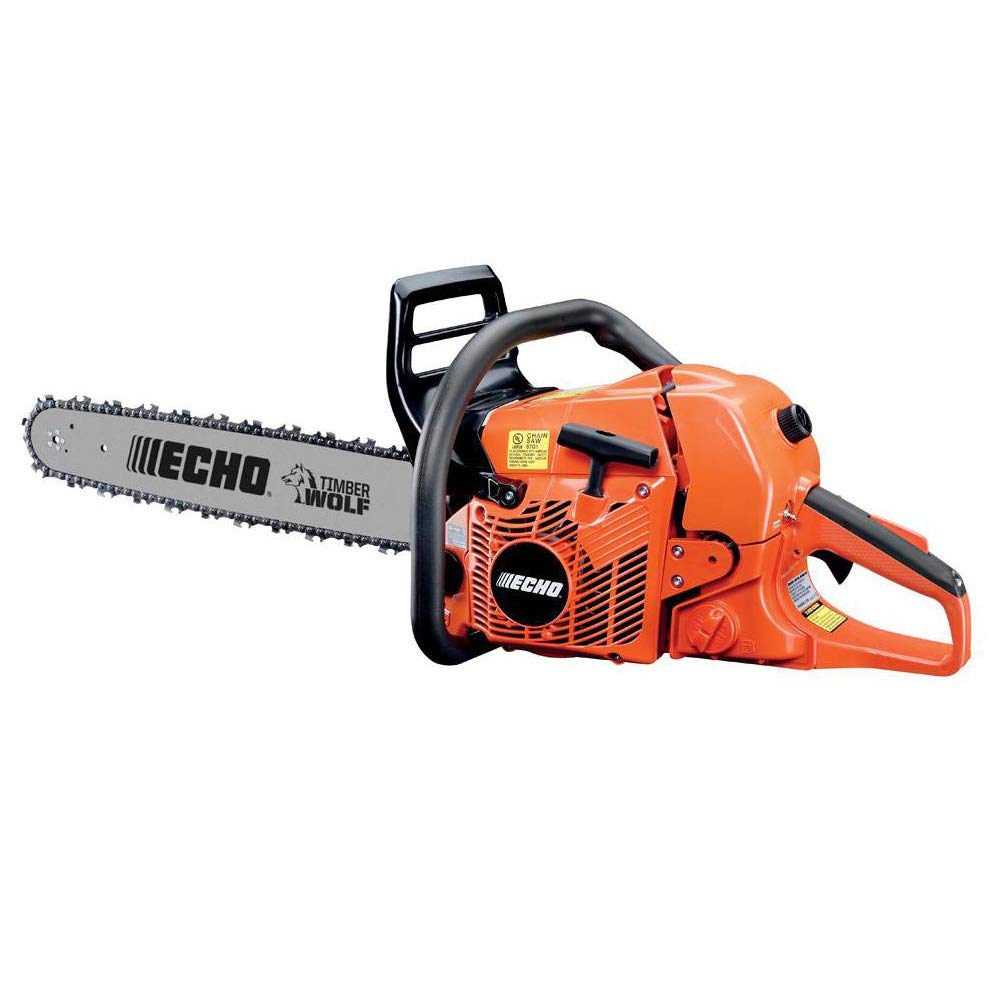
A 59.8cc pro-pattern saw with a 20-inch bar and a proper adjustable oiler.
For someone who cuts firewood all season and wants one saw that does not need babysitting, the ECHO CS-590 is a serious mid-tier contender. Its 59.8cc engine is rated 3.9 hp, and it carries a 20-inch bar fed by an automatic, adjustable chain oiler — you can tune the oil flow to match how hard you are working the chain. A 21.8 oz fuel tank keeps you cutting longer between fills.
Against the Husqvarna 460 Rancher, this is the shorter bar: 20 inches versus 24. But it runs 3.9 hp versus 3.6 hp, so the CS-590 turns its shorter bar with a touch more muscle. It is also the saw with an anti-vibration handle and a genuine pro-style parts list — the replacement chain spec is listed right on the product, so you are not hunting for the right chain online.
Owners describe it as the best bang for the buck in its bracket, and its performance is the most-praised trait. Starting is the honest weak spot: reports split between saws that fire easily and units that flatly refuse. If you get a good one, you have a saw that takes on anything; if you get a difficult one, the return window matters.
Why it earns a slot: 59.8cc, 3.9 hp, and a 20-inch bar with an adjustable oiler is a well-rounded firewood saw that many owners call the best value in its class.
Where to hedge: Starting is consistently the sticky point. Test it in the first week and keep the box until you know it fires reliably.
Reach for this if: You want a mid-size saw with an adjustable oiler and 3.9 hp that works all season without fuss.
Skip your attention if: You want guaranteed easy starts — this is a saw that benefits from learning its own choke-and-pull rhythm.
9. ECHO CS-355T-14 Top Handle Chainsaw, 14-Inch Bar

A top-handle arborist saw built to be worked one-handed up in the canopy.
The CS-355T is the tool that tree crews reach for, and the form tells you why: it is a top-handle saw with a 14-inch bar. A top handle sits on the upper curve of the body so you can grip it from above, which is what lets an arborist work one-handed while hanging from a harness. The 5.3 hp rating puts real power in a short bar, and the 14-inch length keeps it nimble in tight canopy space.
This saw’s quality and reliability are what owners talk about most highly, and it starts right from the start in most reports. Light weight and plenty of power show up repeatedly in the feedback. The short bar and the top handle together let you cut limbs that a rear-handle saw could not reach from a rope.
Durability here is the honest caveat. Some saws hold up over years, while a small share report the top handle failing very early. The 1-year commercial / 5-year consumer warranty is the real reassurance on the consumer side — but check that you are buying on the consumer warranty, not commercial use terms.
What puts it in arborist hands
- Top-handle design lets you grip from above for one-handed climbing work
- 14-inch bar with 5.3 hp for real power in tight canopy space
- Light weight and easy starting reported from the start
- Warranty runs 1 year commercial / 5 years consumer
Where it will let you down
- Top-handle saws are made for trained climbers, not ground work
- A small share of units have failed at the top handle early
- 14-inch bar limits how big a limb you can take in one pass
The right hands: Arborists and tree crews who climb and need a light top-handle saw with 5.3 hp of power.
Not the right hands: Ground-level firewood cutters — a rear-handle saw with a longer bar handles that work far better.
Know the Specs
Engine Displacement (cc) and Horsepower
Displacement is the volume of the engine’s cylinder, and it is the honest measure of how much cut the saw can sustain. A 25.4cc top-handle saw (a small saw you grip with one hand) is a limb saw. A 60cc-class saw cuts firewood. A 90cc-plus powerhead fells big timber. Horsepower gives you a second read — a 72cc engine at 4.8 hp is a stronger saw than a 59.8cc at 3.9 hp, and the two figures together tell you how hard the chain will hold up under load.
Bar Length, Chain Pitch, and Gauge
The bar is the guide the chain rides on, and its length sets the biggest cut you can make. Pitch is the spacing between drive links and gauge is the thickness of the slot the chain sits in. Get them wrong and the chain will not seat, will pop off, or will not cut true. A full-chisel chain at 3/8″ pitch cuts aggressively in hardwood; a low-kickback chain is gentler to use for home owners. Always match pitch and gauge to the bar the saw comes with.
Weight and Vibration Control
A saw’s weight is the number you live with after the first hour. Ground saws in the 13-14 pound range are manageable for bucking. A 33-pound logging saw is a two-handed ground tool. Vibration damping matters just as much — spring or rubber dampeners between the engine and the handles are what keep your hands from going numb after a long session.
Fuel Mix and Engine Break-In
Gas chainsaws run on a two-stroke engine, which mixes oil into the fuel to lubricate the internals. The correct ratio varies by saw — one listed here runs a 1:25 mix — and getting it wrong damages the engine. Run a new saw through a careful first tank at reduced load. That is also the window to catch any starting or nuisance problems while the return window is still open.
Common Questions
How do I know what bar length my chainsaw needs?
What does chain pitch and gauge mean on a chainsaw?
Is a top-handle chainsaw safe for a homeowner to use?
How much does a gas chainsaw weigh and does it matter?
Why does my chainsaw not want to start when cold?
What fuel mix ratio should I use in a two-stroke chainsaw?
Do I need a chain brake on a gas chainsaw?
How long does a gas chainsaw engine last?
Can I put a longer bar on a smaller chainsaw?
What is the difference between a rear-handle and a top-handle chainsaw?
The Bottom Line
For most buyers, the right saw is the Husqvarna 460 Rancher. Its 60.3cc X-Torq engine, 3.6 hp rating, and 24-inch bar handle a full firewood season of felling and bucking. The LowVib handles (built to soak up vibration) and Smart Start (a pull-start that takes less effort) make it far less punishing than older gas saws. If you want a big-bore feller without the premium name, swing at the FARMMAC F380W — 72cc, 4.8 hp, and a 28-inch bar for serious timber. And if your work is up in the canopy, the ECHO CS-355T-14 top-handle saw gives you 5.3 hp on a 14-inch bar you can actually climb with. One honest nudge: the top-handle NEO-TEC NCS2500 is the safest way to test the small-saw format before you commit to a bigger powerhead — its 8.2-pound frame and one-pull start make it the least intimidating gas saw for anyone moving up from electric tools.
How we choose
We do not accept paid placement. Every pick is matched to a real buyer and a real use-case; we do not hands-on test units.
Sources
Specifications: manufacturer listings and product documentation. Review insights: verified customer reviews, as of November 2026. Pricing: not shown on this page (it changes often); check the current price via the retailer link.
As an Amazon Associate, Tactical Gear Guy earns from qualifying purchases. This does not affect which products we feature.