Specs are compiled from manufacturer listings and verified buyer reviews and can change over time — please confirm the key details on the product page before buying.
Stacking rabbit cages sounds simple until you try it. A wobbly stack, a tray that jams halfway out, or wire gaps a kit can squeeze through will ruin your setup faster than any rabbit will. The cages below all stack vertically, and each one solves a different part of that problem — some win on build quality, some on price, some on size. Our top pick earns its spot on the strength of its metal frame, its pull-out tray, and its 0.8-inch bar spacing (the gap between wires, which is what keeps small rabbits safely inside).
This guide is built by comparing the manufacturers’ published specifications and the patterns across verified customer reviews, so you get each pick’s real strengths and trade-offs instead of marketing spin.
You will see what separates a stack that lasts from one that sags under its own weight, from bar spacing to tray design to how many cages one frame will hold. Below are the five builds worth considering for stackable rabbit cages.
Top Picks

How To Choose The Best Stackable Rabbit Cages
The mistake most first-time buyers make is shopping by cage size alone. A stack is only as good as the frame under it and the gaps in its wire, so those two things decide whether your setup holds up. Get them right and the rest — trays, doors, footprint — falls into place.
Bar spacing is the one number that protects your rabbit
Bar spacing is the distance between the wires on the cage walls. A tighter gap keeps small breeds and young rabbits from pushing a head or leg through. A wider gap suits bigger animals but leaves room for a kit to slip out. Check the gap against your smallest rabbit, not your biggest.
How a stack actually holds together
Some cages stack directly on each other, and others need a dedicated frame kit to sit safely in a vertical column. Confirm which design you are buying before you plan a breeding wall. A cage that lists a frame kit as a separate item will not stack on its own.
Traps, trays and daily cleaning
A deep pull-out tray with a waterproof bottom is the difference between a quick scoop and a full teardown. Look for trays that slide on real tracks rather than resting loose, because a tray that jumps its rail turns cleaning into a two-person job.
Indoor wire versus outdoor wood
A metal wire cage with a plastic tray belongs indoors, where the climate is stable and the tray stays dry. A wood hutch with an asphalt roof is built to sit outside and shed rain. Match the material to where the cage will actually live.
Side-by-Side Comparison
| Model | Best For | Bar Spacing | Item Weight | Stacking Method | Amazon |
|---|---|---|---|---|---|
| HOMESTEAD 24 Inch Rabbit Cage★ Best Overall | Everyday indoor stacking | 0.8 inches | 17.6 pounds | Stacks directly | Amazon |
| Pet Lodge Wire Rabbit HutchBest For Breeding Walls | Long-term breeding walls | 2.4 inches | 8.1 pounds | Frame kit sold separately | Amazon |
| PawHut 54″ 2-Story Wooden Hutch | Outdoor two-level housing | 4 inches | 46 pounds | Two stacked levels built in | Amazon |
| PawHut 54″ 2-Story with Enclosed Run | Separating rabbits by level | — | 40 pounds | Two stacked levels built in | Amazon |
Detailed Reviews
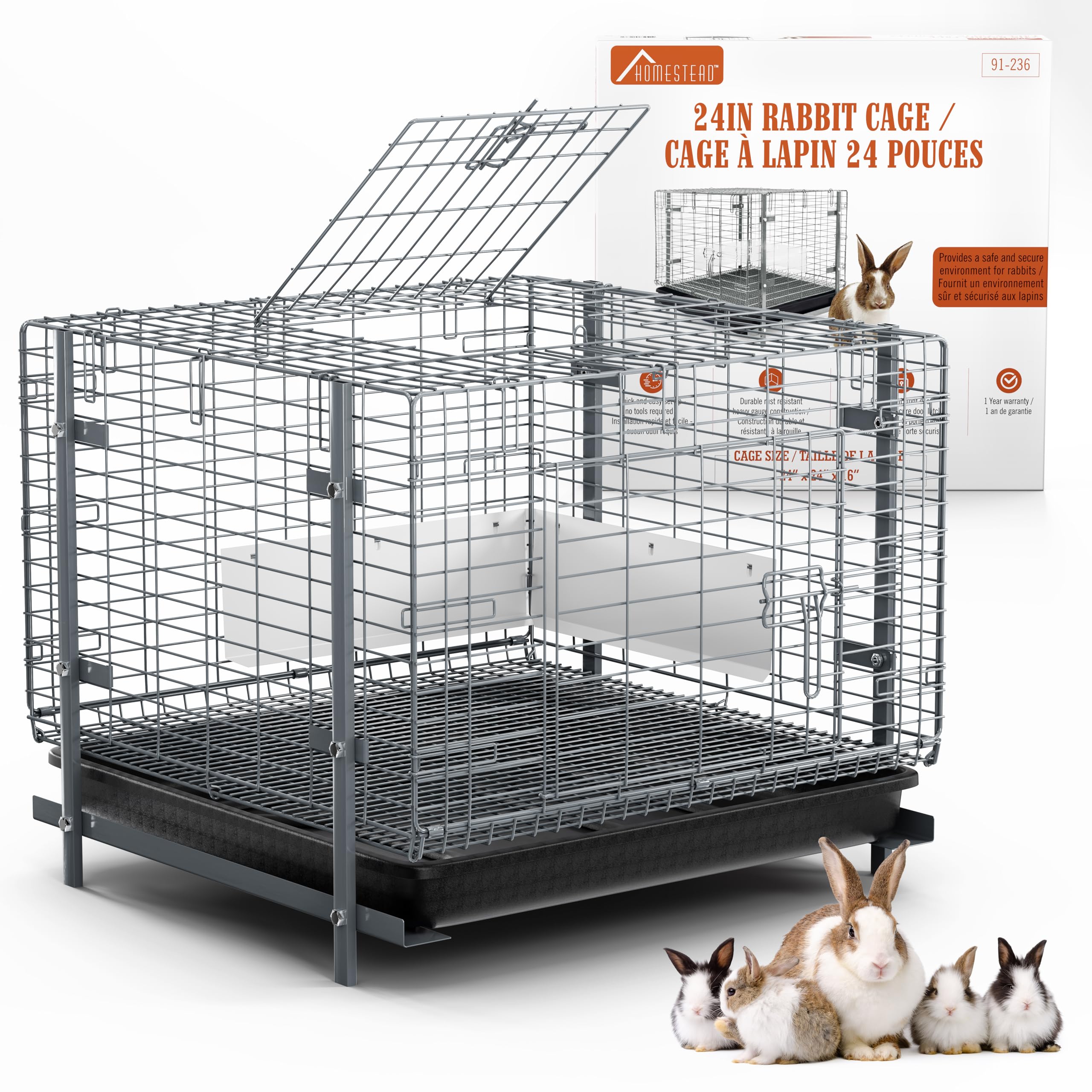
1. HOMESTEAD Rabbit Cage 24 Inch
Our pick — 4.0+★ from 100+ verified ratings; the strongest balance of quality and price.
The metal breeding cage that keeps small rabbits in and cleanup down to one slide.
Start with the gap that matters. This cage runs 0.8-inch bar spacing, the tightest wire gap of anything here — the Pet Lodge above it in this list sits at 2.4 inches and the PawHut wood hutch opens up to 4 inches. For a breeding setup with does and kits, that tight spacing is the difference between a secure cage and one you check twice a night.
The inside gives you a 24 x 24 x 20.5 inch floor, which is a comfortable amount of room for one adult rabbit to move around without crowding. Two doors make the routine easier: a top door for dropping in feed and a front door for reaching in to handle or clean. The frame is metal and the listing calls it rust resistant, so it should hold up to tray moisture over time.
The tray is the part that earns the price. It is a deep pull-out tray with a waterproof bottom and a urine guard, so liquid stays in the tray instead of working its way under the frame. Slide it out, dump it, slide it back — that is your daily clean.
Build quality is what wins people over here, with assembly close behind — owners consistently describe it as sturdy and quick to put together. The honest catch is the sizing. Some buyers expected a smaller footprint and found the guards smaller than they wanted, so measure your shelf or wall space before you commit to a stack of them.
Where It Pulls Ahead
- 0.8-inch bar spacing — the tightest gap in this guide — keeps kits and small breeds inside.
- Deep pull-out tray with a waterproof bottom and urine guard keeps leaks off the floor.
- Two doors split the job — top for feeding, front for handling and cleaning.
- Stacks vertically to turn one wall into a breeding row.
What To Measure First
- The 24 x 24 x 20.5 inch interior is a one-rabbit space, not a group space.
- Some buyers found the urine guards smaller than expected.
Reach for this if: you want a metal cage that stacks cleanly, cleans fast, and keeps small rabbits safely behind tight wire.
Look elsewhere if: you need a multi-rabbit floor plan or a larger footprint per level.
2. Pet Lodge Wire Rabbit Hutch 24 X 24
A bare galvanized wire box that goes four high and weighs almost nothing to hang.
If you are laying out a breeding wall rather than a single pet home, this is the cage built for it. Up to four of these hutches can be stacked on top of each other, which is more vertical capacity than any single unit here offers. The catch: the Pet Lodge Rabbit Hutch Frame Kit (Item No. AHFK30) is sold separately, so the stack needs that frame before it is safe.
Weight tells you how different this is from the wood hutches. This hutch is 8.1 pounds against the PawHut 54″ 2-Story at 46 pounds — roughly a 5.7x gap. That is a cage you can lift off a frame by hand when a rabbit needs to move, instead of calling for help.
The body is galvanized steel mesh, which the listing says resists rust over time, and the door carries a protective vinyl covering so a rabbit does not catch itself on the edge as it goes in and out. It is built for indoor or outdoor placement. Assembly needs some work and includes wire clips — pliers are not in the box, so have a pair ready.
What people praise most is the size, and the spaciousness for large rabbits comes up just as often. The recurring friction is the assembly and the door. Wire clips and a specialty tool slow the build down, and the spring latch on the door has a habit of coming undone or letting the latch drop off entirely. Budget a little time to bend or reinforce that latch before a rabbit tests it.
Built For A Wall Of Them
- Stacks up to four hutches high with the frame kit, the tallest column here.
- Galvanized steel resists rust indoors and out.
- 8.1 pounds is light enough for one person to lift off the frame.
- Vinyl door guards protect rabbits as they enter and exit.
The Catches To Plan Around
- The frame kit is a separate purchase — the cage will not stack without it.
- Assembly needs wire clips, patience, and pliers you supply yourself.
- The spring door latch can come undone, so check it and reinforce it.
Best matched to: breeders and multi-rabbit keepers who want a tall, light, rust-resistant stack and do not mind buying the frame separately.
Think twice if: you want a cage that arrives ready to use — between the frame kit, the clips, and the door latch, this one asks for workshop time.
3. PawHut 54″ 2-Story Rabbit Hutch Orange
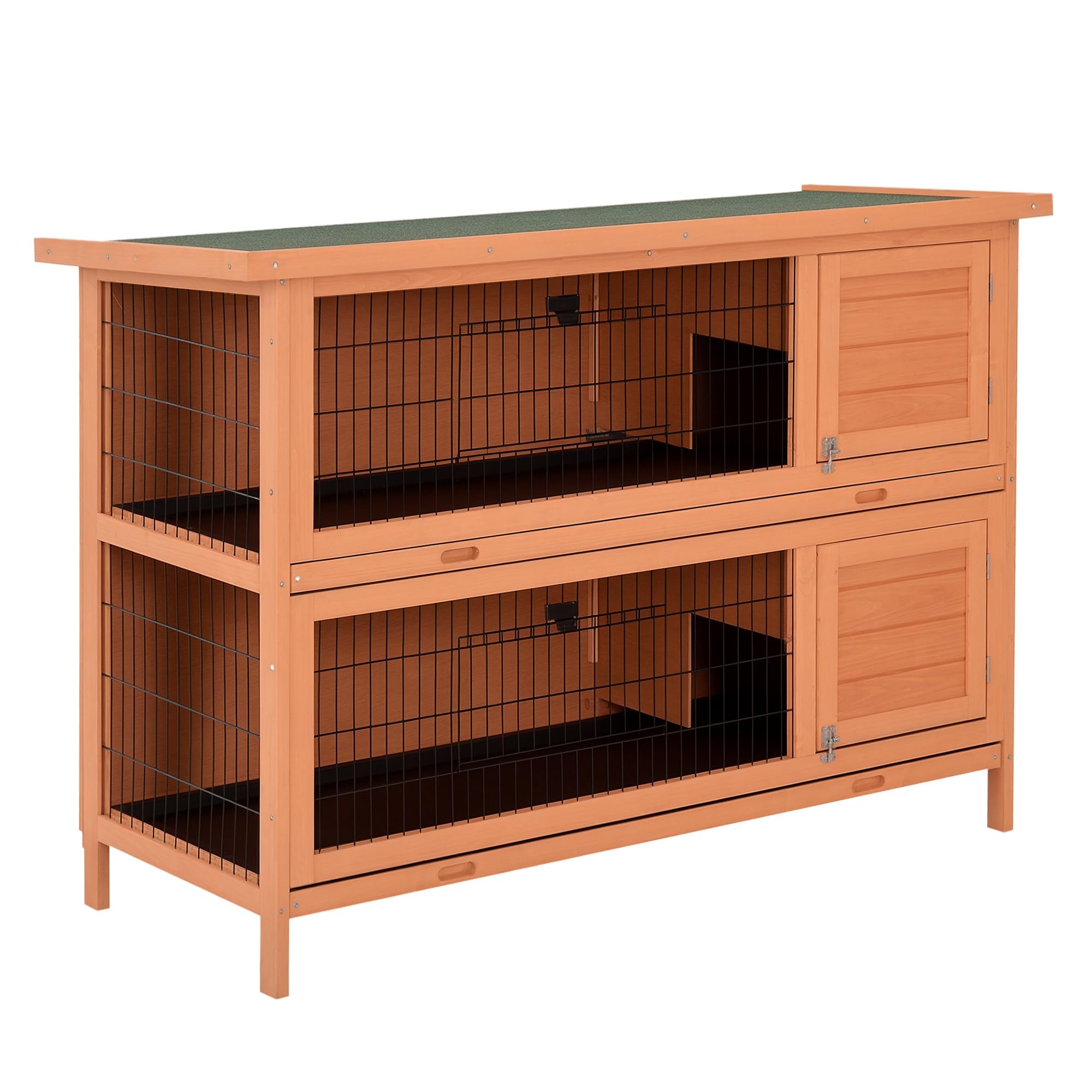
A long wooden two-story home that gives rabbits a rest floor upstairs and a play floor below.
This is the floor plan people picture when they hear “rabbit hutch.” The upper level is a sheltered spot for resting, and the lower level opens up for play. Because the two cages come already stacked into one unit, you get vertical housing without bolting anything together yourself. The overall dimensions run 53.75″ L x 19.75″ W x 36.5″ H — long and narrow, so it lines up along a wall instead of jutting into a yard.
Contrast the footprint with the solid-wood AMZOSS lower in this list. This PawHut measures out far longer on its short side than that hutch’s 15″L x 36″W x 36″H layout, and the extra length is what buys the separate upstairs and downstairs spaces.
Getting in and out is straightforward. Multiple side doors open and close, plus two pull-out trays let you clean, feed, and reach the inside. The roof is composite asphalt, which sheds rain and shades the cage on sunny days. The frame is fir wood with metal wire and comes in a brown finish meant for outdoor or indoor use.
Where this one shines for buyers is assembly — owners regularly report getting it up in under an hour — and the sheer amount of room inside. The trade-offs are real but manageable. Fir wood left out in the weather loses its fight over time, and the tray has a tendency to jump its tracks. Keep it under a covered spot and seat the trays gently, and you sidestep most of the frustration.
The draw: a two-level wooden hutch that assembles quickly and gives rabbits separate rest and play floors without a separate stacking frame.
The weather note: the asphalt roof handles rain, but prolonged outdoor exposure wears on the wood — a covered location will keep it in shape far longer.
Pick this one when: you want an outdoor-capable two-story hutch that goes up fast and gives your rabbits real room to move.
skip it if: you need a tall multi-cage column for a breeding setup — this is a wide two-level unit, not a four-high stack.
4. PawHut 54″ 2-Story Rabbit Hutch Enclosed Run
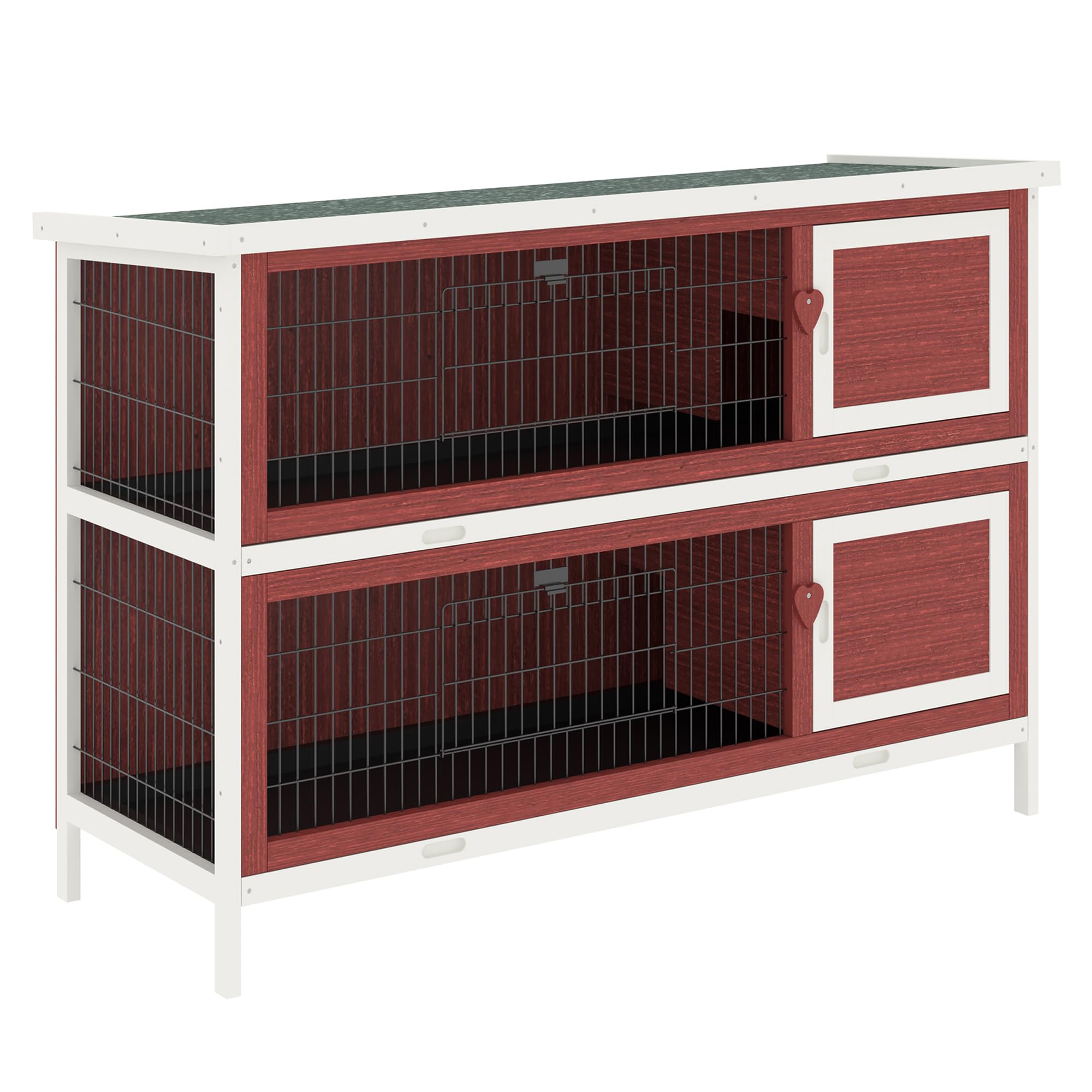
Two rabbits who should not share one space each get their own floor here.
The standout feature is how this hutch splits. One side of each level is enclosed for privacy and rest, while the other side stays open for play, so you can house rabbits on separate levels and keep them apart. If you are managing introductions, a recovering rabbit, or simply two animals that do not get along, that built-in division saves you from buying two separate cages.
The footprint is the same space-saving idea as the other PawHut above it: 53.75″ L x 19.75″ W x 36.75″ H, long and shallow so it hugs a wall. At 40 pounds it is 6 pounds lighter than the lockable-door PawHut, a small edge if you plan to shift the unit around your yard or run.
Access is well thought out. Multiple side doors open and close, two pull-out trays handle cleaning and feeding, and the roof is water-resistant composite asphalt over a fir wood body. That roof keeps rabbits dry in rain, and it opens, which makes reaching in from above easy when a rabbit will not come to the front.
Buyers like the look of it and find it straightforward to assemble, and it does its job of housing animals well. The honest limit is that fir wood and a water-resistant roof are not the same as a weatherproof build — this is a cage that rewards being kept under cover. The trays can also fight you at cleaning time, so slide them evenly rather than yanking.
Why it earns a spot: the enclosed-versus-open layout on each level is a genuinely useful design for keeping rabbits separated while still giving each one room — and the openable roof makes top-down access painless.
The fit to weigh: it is built for indoor or sheltered outdoor placement. Set it in full weather year round and the wood will age faster than the rest of the unit.
Your call if: you keep two rabbits that need their own floors, or you want a run-style level for play plus a private level for rest.
Look past it if: you need a four-high breeding stack — this is a two-level unit with a fixed layout.
5. 2 Story Solid Wood Rabbit Hutch Grey

The lowest-cost way to get two stacked 36″ L x 17.7″ W rooms into a small corner.
This is the entry point into a stacked setup. Its compact, low-footprint design fits two separate cages into a tighter space than the long PawHut units, which makes it the natural first hutch for a small room or a compact patio. Overall dimensions are 36″ L x 17.7″ W x 33.5″ H, more square than the 54-inch hutches and easier to tuck into a corner.
Assembly is where it earns its keep. Buyers report getting it up in roughly 15 minutes, several by themselves, and the number who mention how easy the build is runs higher than for anything else in this category. Multiple side doors — 3 in total — open wide for interacting with your pet, and each of the two main compartments has its own pull-out tray for cleaning and feeding.
The material is fir wood painted with a waterproof varnish, and the roof is designed to keep the weather off. It handles mild conditions fine. What it will not do is shrug off a hard winter or constant rain — the wood and paint are the first things to show wear when the unit sits exposed.
There is an honest size ceiling here. The rooms suit small rabbits and guinea pigs, and the listing itself tells buyers to determine how many pets fit based on breed and size. Treat this as a starter or a small-pet home, not a long-term breeding cage.
Where The Money Goes
- Two stacked main rooms in a 36″ L x 17.7″ W x 33.5″ H footprint that fits a tight corner.
- The quickest build here — around 15 minutes and no specialty tools.
- 3 side doors plus two removable trays make feeding and cleaning simple.
- Waterproof varnish and roof cover it for light outdoor use.
Know Before You Buy
- The rooms are sized for small rabbits and guinea pigs, not large breeds.
- Fir wood and paint wear fastest when left out in the weather.
A sensible first buy: a small-space starter for a young rabbit or a guinea pig pair, with a build so quick you will not lose an afternoon.
Not the long game: for full-grown large rabbits or a breeding program, step up to a metal cage or a taller stack.
Know the Specs
Bar Spacing
Bar spacing is the gap between the wires, measured in inches. Tighter gaps protect small rabbits and kits from slipping through; wider gaps suit larger breeds. On the cages here it ranges from 0.8 inches on the HOMESTEAD up to 4 inches on the PawHut wooden hutch, so match the gap to your smallest animal.
Stacking Method
Some cages stack directly on each other, while others need a dedicated frame kit. The Pet Lodge, for example, stacks up to four high but needs a frame kit sold separately. The paired wood and metal cages have their levels built in. Confirm which design you are buying before planning a vertical row.
Item Weight
Weight tells you how portable a cage is. A wire cage like the Pet Lodge comes in at 8.1 pounds; a wooden two-story hutch runs from 31.4 to 46 pounds. Lighter cages move around easily and hang on frames; heavier wood hutches stay put on the ground.
Tray Design
A pull-out tray with real tracks slides cleanly for quick cleaning; a tray that sits loose can jump its rail. Deep trays with waterproof bottoms and urine guards keep waste inside. Seat trays evenly and check the track alignment when you assemble the cage.
Common Questions
What bar spacing keeps a baby rabbit from escaping a stacked cage?
Do all stackable rabbit cages need a separate frame?
How many rabbit hutches can stack safely on one frame?
Is a metal wire cage better than a wood hutch for stacking?
How long does it take to assemble a stackable rabbit hutch?
Can I stack rabbit cages indoors and outdoors?
What size rabbit cage do I need per adult rabbit?
Do pull-out trays come out for cleaning on these cages?
How much weight can I put on the top of a stack?
Will a wood hutch survive weather outdoors?
The Bottom Line
The cleanest stack, the one nearly all owners agree on, is the HOMESTEAD 24 Inch Rabbit Cage — 4.0+ stars across 100+ ratings, tightest bar spacing at 0.8 inches, and a waterproof pull-out tray that makes daily cleaning a one-slide job. If you are building a breeding wall and want the tallest reach, grab the Pet Lodge Wire Rabbit Hutch, which stacks up to four high once you add the frame kit. And for two rabbits who need their own floors in a small space, the PawHut 2-Story with Enclosed Run splits each level into a private side and an open side.
How we choose
We do not accept paid placement. Every pick is matched to a real buyer and a real use-case; we do not hands-on test units.
Sources
Specifications: manufacturer listings and product documentation. Review insights: verified customer reviews, as of November 2026. Pricing: not shown on this page (it changes often); check the current price via the retailer link.
As an Amazon Associate, Tactical Gear Guy earns from qualifying purchases. This does not affect which products we feature.