Specs are compiled from manufacturer listings and verified buyer reviews and can change over time — please confirm the key details on the product page before buying.
Buying an oil pan for a small block Chevy is a fitment decision: dipstick side, rear main seal style and sump depth decide whether it bolts up at all. Get the dipstick side, the rear main seal style, and the sump depth wrong and the pan will not clear your crossmember or your starter — and no amount of chrome fixes that. The short answer: if you want a stock-style replacement that drops into a classic 283–400 build, the Assault Racing A9414 is the safest starting point, and the big-capacity Moroso is the one for a serious performance engine.
This guide is built by comparing the manufacturers’ published specifications and the patterns across verified customer reviews, so you get each pick’s real strengths and trade-offs instead of marketing spin.
Below you get the exact capacities, depths, dipstick placement and seal style for each pan, so you can match one to your block before you spend a dime on gaskets. This is the practical shortlist of the oil pan for sbc swaps that actually clear the chassis and hold oil where the pickup can find it.
Top Picks
How To Choose The Best Oil Pan for SBC
A small block Chevy pan has to do three jobs at once: bolt to your block without leaking, clear everything under the car, and keep the oil pickup covered. Miss any one of those and you are pulling the engine again. Work through the four checks below in order, because each one can rule a pan out entirely.
Check the rear main seal style first
The rear main seal is the crank seal at the back of the engine, and Chevy used two designs across the small block years. Early blocks take a two-piece seal; later blocks take a one-piece seal. The Assault Racing A9414 is built for a one-piece rear main seal, while the CFR Performance pan is designed for the two-piece configuration. Buy the wrong one and the pan rail will not seal against the block.
Match the dipstick to the side your chassis expects
The dipstick is the blade you pull to check oil level, and its tube lives on either the driver side or the passenger side depending on the pan. The Assault Racing and Speedway 5-quart pans put it on the passenger side. The CFR Performance and the Speedway chrome kit use the driver side. If your exhaust manifold or headers already crowd one side, that placement matters more than the finish.
Decide how much oil you want to carry
Stock-capacity pans hold 4 quarts in the Assault Racing and CFR Performance designs. The Speedway 5-quart pan and the finned aluminum pan both list 5 quarts with the filter included. The Moroso holds 7 quarts. More oil means more heat capacity and a bigger margin when the pickup briefly sucks air, but a deeper sump hangs lower under the car.
Measure your ground clearance before you buy deep
Sump depth is how far the pan drops below the block, and it decides both oil capacity and whether you scrape on speed bumps. The Speedway chrome kit is built around a 7-inch pan depth, the finned aluminum pan runs 7-3/4 inches, and the Moroso runs 8-1/4 inches. A lowered car or a truck with a low crossmember needs that number checked against the chassis before ordering.
Side-by-Side Comparison
| Model | Best For | Oil Capacity | Sump Depth | Dipstick Side | Amazon |
|---|---|---|---|---|---|
| Assault Racing A9414★ Best Overall | Stock-style daily builds | 4 quarts | — | Passenger | Amazon |
| Speedway Chrome 5-QuartShow-Stopper Finish | 1980–1985 SBC dress-up | 5 quarts | — | Passenger | Amazon |
| CFR Performance Black EDP | Classic 283–400 restorations | 4 quarts | — | Driver | Amazon |
| Speedway Chrome Kit | Driver-side dipstick builds | — | 7 inches | Driver | Amazon |
| Finned Aluminum Pan | Show-car engine bays | 5 quarts | 7-3/4 inches | Driver | Amazon |
| Milodon 30700 | Stock replacement, made in USA | 5 quarts | — | — | Amazon |
| Moroso 20190 | High-capacity performance builds | 7 quarts | 8-1/4 inches | — | Amazon |
Detailed Reviews
1. Assault Racing A9414 Oil Pan
Our pick — 4.5+★ from 50+ verified ratings; the strongest balance of quality and price.
The stock-capacity chrome pan that keeps its oil where the pickup can reach it.
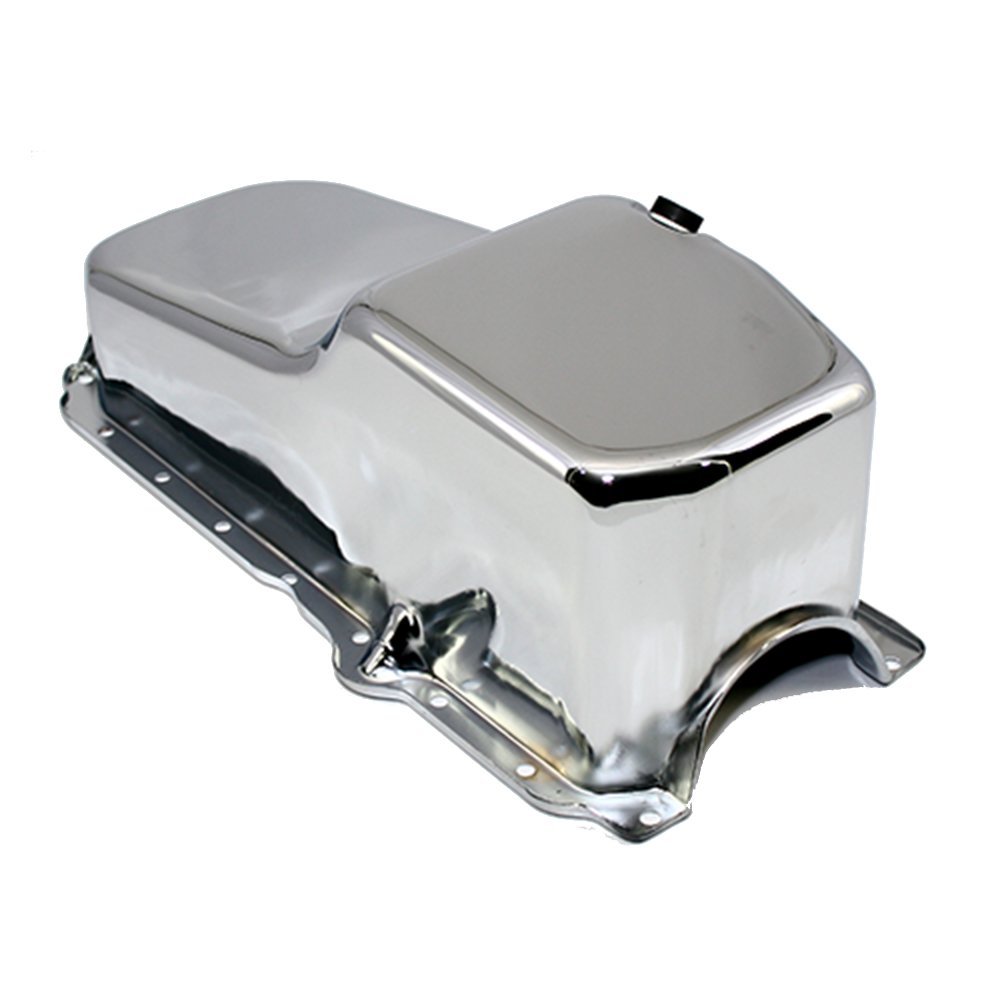
This is the pick for the guy with a Vortec-era 305 or 350 who wants a straight replacement pan, not a race sump. It carries a stock 4-quart capacity and it is baffled, meaning there are internal walls and trap doors that slow the oil from sloshing away from the pickup when you brake hard or launch. That single feature is what separates it from a plain stamped pan. It bolts to blocks using a one-piece rear main seal, and the dipstick sits on the passenger side.
Staying at stock 4 quarts is the deliberate trade here. If you were cross-shopping the Moroso, you would be giving up its 7-quart reserve — the Assault holds 4 quarts against the Moroso’s 7, a real difference in heat capacity on a long highway run. But you also keep the factory ground clearance, which the 8-1/4-inch Moroso sump does not offer. For a truck or a daily-driven classic that sees speed bumps, that is the right side of the trade.
The chrome finish is the part that will divide you. It looks sharp in an engine bay and it resists corrosion, but chrome needs a careful hand at the pan rail so the gasket seats clean. Do not overtighten the bolts chasing a leak — a light, even torque pattern is what keeps these dry. Buy it if you have a one-piece rear main block, want the baffle without the race-pan bulk, and are fine checking oil on the passenger side.
What earns its place up top
- Baffled sump keeps the pickup fed under hard braking and cornering
- Stock 4-quart capacity means factory-correct oil level and clearance
- Passenger-side dipstick matches late-model Vortec layouts
Where it asks a little of you
- Chrome rail needs careful, even torque to seal cleanly
- Only fits one-piece rear main seal blocks
Go here if: you want a bolt-in baffled pan for a one-piece rear main 305 or 350 without changing ground clearance.
Keep looking if: your block runs a two-piece rear main seal, because the pan rail will not match.
2. Chrome Oil Pan 5-Quart
A quarter more oil than stock, wrapped in chrome that cleans up the whole engine bay.
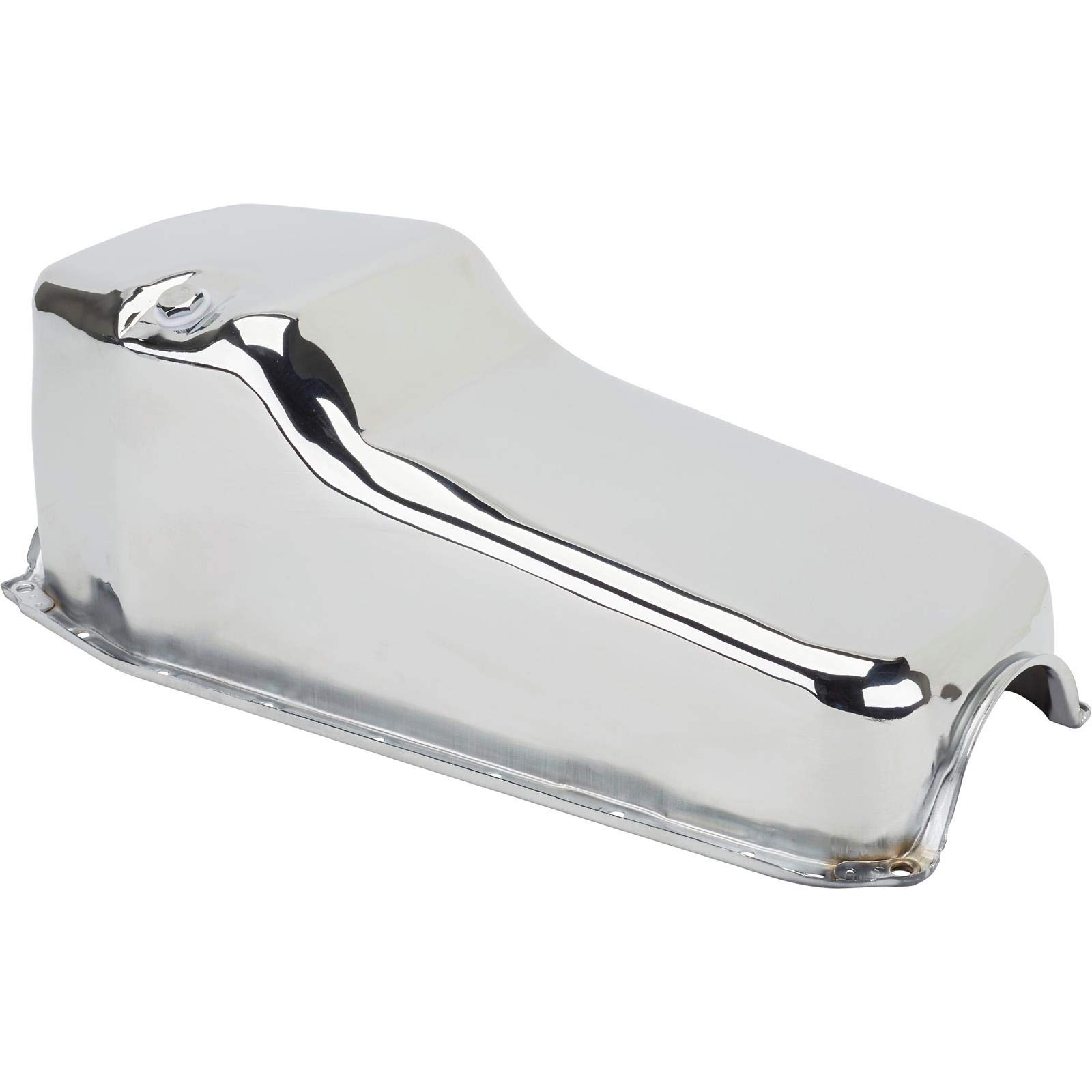
If your small block is a 1980 to 1985 casting, this pan was drawn for your chassis specifically, and that is the whole reason to start here. That extra quart buys you more oil in circulation, which means more heat absorbed on a hot cruise. The dipstick is on the passenger side, and it is a wet sump design, the standard layout where oil drains back into the pan under the crank.
The build is stamped steel with a chrome finish at 10 pounds. Chrome does two jobs at once on a pan: it brightens the underside of the engine bay and it adds a layer that fights rust and corrosion. The Speedway part number and model number both read 91017702, so replacement parts and gaskets are easy to look up.
One honest note on fitment: this pan is pinned to the 1980–1985 window on purpose. If your block is an earlier two-piece rear main casting, you want the CFR Performance pan instead, because the rail geometry differs. Check your block casting number before you order and you will save yourself a return shipping label.
Capacity call: 5 quarts with the filter beats the 4-quart stock-style pans here and gives you more oil to move heat on a long drive.
Fitment caveat: the 1980–1985 year lock is real, so confirm your casting number before buying.
The right buy for: an early-’80s SBC that wants extra oil capacity and a chrome bay.
Wrong buy for: pre-1980 blocks, which need a different rail and seal setup.
3. CFR Performance Steel Oil Pan
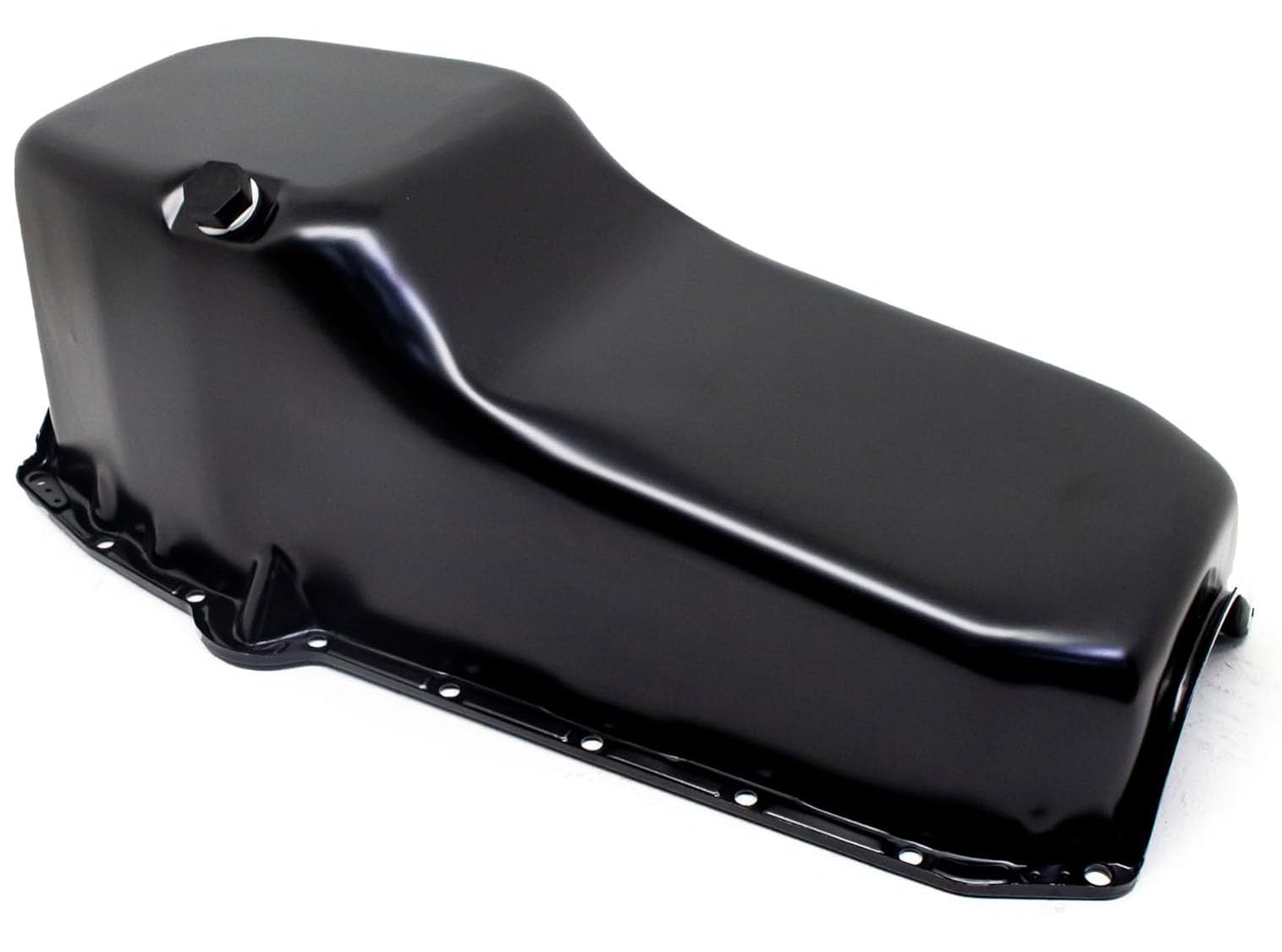
The factory-correct black pan built for two-piece rear main classics from 1958 to 1979.
Restorers, this is your pan. It is designed for the 1958–1979 small block range — 283, 305, 327, 350 and 400 — and it is configured for a two-piece rear main seal. It keeps the factory 4-quart capacity and the driver-side dipstick, so you are restoring the original oiling geometry rather than changing it. If you are putting a classic back to stock, that correctness is the entire point.
Steel weight lands at 6.74 pounds, which makes this the lightest pan on this list by a wide margin — the Moroso tips the scale at 12.6 pounds. That is partly a build difference: stamped steel versus a heavier performance pan. For a stock-style rebuild, the lighter stamped pan is what the factory would have used anyway.
The black finish does the corrosion work and disappears under the car in a good way. Buyers rate the stamped-steel build quality highly, and most report it drops in clean on a stock restoration. The recurring honest note is alignment: a few builds find the bolt holes need a touch of persuasion to line up. It is the sort of thing a careful dry-fit before final torque catches early. One important check first: this pan does not fit 1962–1967 Chevy II Novas with steering behind the crossmember, Vega or Monza V8 swaps, or 302 high-performance builds.
Why restorers keep coming back
- Factory-correct 4-quart capacity and driver-side dipstick placement
- Built for two-piece rear main seal classic blocks
- Light stamped-steel build at 6.74 pounds
Check before you commit
- Some builds find the bolt holes need a bit of alignment work
- Excluded from certain Nova, Vega, Monza and 302 applications
Ideal for: a stock restoration where original dipstick side and capacity must be preserved.
Not for: Nova, Vega, Monza or 302 performance builds listed in the fitment exclusions.
4. Chrome Oil Pan Driver Side Dipstick
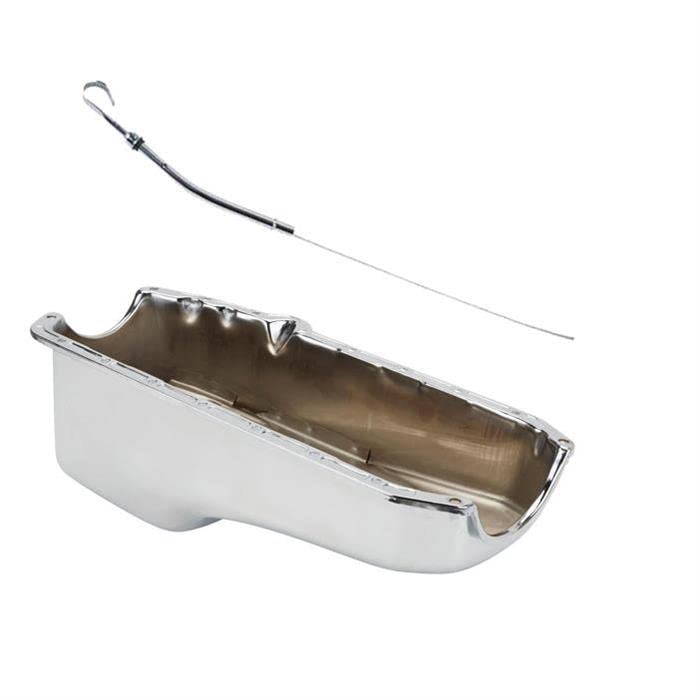
Pan and dipstick sold as a matched pair, so the tube and the blade agree on the fill line.
Here is the practical case: a mismatched dipstick tube is a quiet way to overfill or underfill an engine, because the blade reads against a tube that was never seated for this pan. This kit ships the chrome steel pan and the matching chrome dipstick assembly together, both chromed, so the reading is built to match. The tube has a positive seating shoulder, a lip that stops the tube at the correct depth so the fill marks land where they should.
Fitment runs 1957–1979 small block Chevys with a driver-side dipstick, and the pan is built around a 7-inch depth. That depth number is the one to check against your chassis. If you are running headers that crowd one side, the driver-side tube is the deciding factor. Material is alloy steel, and the whole thing is a direct fitment — no adapting.
Two things to know. Chrome on both pieces means both need a light hand at the pan rail for a clean gasket seal. And this is a finish-and-fit kit rather than a capacity upgrade, so if you are chasing extra oil volume you would want the larger-capacity Moroso instead. What this kit gives you is a coordinated, correct-reading top end with no hunting for a dipstick that actually fits.
The dipstick advantage: a matching tube with a positive seating shoulder removes guesswork from checking oil — you get a correct fill mark, not an approximate one.
Depth check first: the 7-inch pan depth has to clear your chassis and headers before you commit.
Choose this when: you want the pan and dipstick as a matched set for a driver-side 1957–1979 block.
Pass if: you need added oil capacity, since this is a fit-and-finish kit rather than a bigger sump.
5. Aluminum Oil Pan Polished Finned

Polished cast aluminum with cooling fins — the pan you open the hood to show off.
On a show car, the polished fins are the part people notice under the hood. It is one-piece cast aluminum with external fins — raised ribs that increase surface area so heat sheds off the sump faster — finished in a polished shine. It holds a stock 5 quarts including the filter at a depth of 7-3/4 inches, and it fits 1955–1979 small block Chevys with a left-hand dipstick. The drain plug and mounting bolts come in the box, so you are not chasing hardware on install day.
Cast aluminum is the material argument. It shrugs off cracking and warping better than thin stamped steel, and it dissipates heat more readily. That is a real advantage on a panic-built engine that runs warm. The trade is weight: at 12 pounds it is close to the Moroso’s 12.6 pounds, and noticeably heavier than the 6.74-pound stamped CFR pan. If you are counting pounds, that is a few of them.
Buyers consistently praise the polished finish and the heft of the cast piece. Fit is the mixed note: it aligns perfectly for most, but owners of SBC 350 crate engines have run into compatibility trouble, so confirm your crate engine’s pan rail before ordering. One more detail that catches people out: this pan needs a thin front seal oil pan gasket to seal properly, so budget for the correct gasket, not a generic one.
The case for the finned pan
- Polished cast aluminum with fins for heat dissipation and show-car looks
- Resists cracking and warping better than stamped steel
- Drain plug and mounting bolts included in the box
The fine print
- Requires a thin front seal gasket for a proper seal
- Heavier cast build at 12 pounds; some crate-engine fits need checking
Made for: a show-quality engine bay that wants polished aluminum and cooling fins on a left-hand dipstick SBC.
Think twice if: you run a 350 crate engine whose rail geometry has not been verified.
6. Milodon 30700 Oil Pan
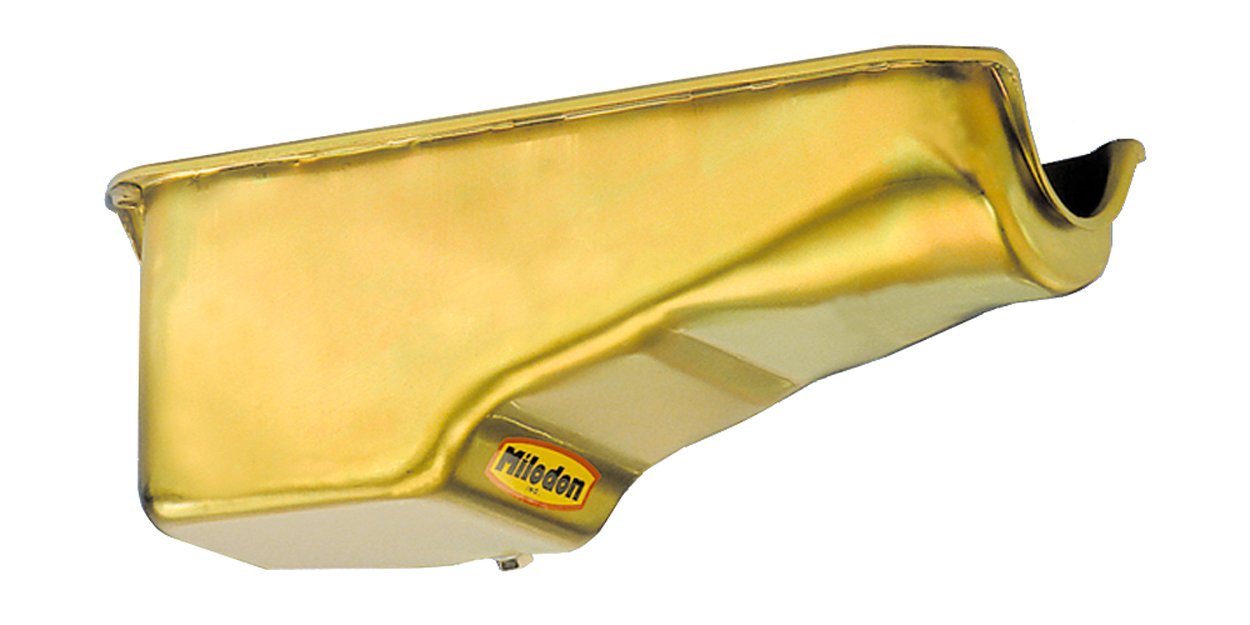
A stock-style pan welded and plated in America, for engines that just need a fresh one.
This one is aimed square at the builder who is not racing. It is a stock replacement, 5 quarts, gold zinc plated steel — the zinc is a corrosion coating that keeps the pan from rusting out under the car. Milodon builds in some improved interior oil control over a plain factory pan, which helps keep the pickup fed a bit better than bare stock. It is welded and plated in America, and it is the answer when you want a well-made stocker rather than a race sump.
The catch, and it is spelled out in the product details, is that it needs a stock or Milodon pickup oil pump, and a crushproof oil pan gasket is recommended. Do not assume your existing pickup works with it — match the pickup to the pan or you can starve the pump. The warranty is listed at 30 days, so inspect the pan on arrival and dry-fit it before the clock runs.
Who is this for? The truck or classic running a mild small block where reliability matters more than oil capacity or show shine. For a 7-quart reserve, step up to the Moroso 20190; for a chrome showpiece, the Speedway chrome pan. If you need a correct, gold zinc plated stock pan and will buy the matching pickup, it holds up.
What it is: a plated 5-quart stock replacement with improved oil control and American welding.
The requirement: it needs a stock or Milodon pickup pump plus a crushproof gasket — plan for both.
Reach for this if: a stock-style, corrosion-protected pan is what your non-racing small block needs.
Look elsewhere if: you want extra capacity or a shiny finish — this is a plated stocker by design.
7. Moroso 20190 8.25″ Oil Pan for Chevy Small-Block Engines

Seven quarts and an 8-1/4-inch sump, for the small block that gets worked hard.
When oil volume is the goal, this is the heavyweight. It is a wet sump pan — the standard layout where oil drains back under the crank — holding 7 quarts at a depth of 8-1/4 inches. Against the 4-quart Assault Racing pan, that is 7 quarts to 4, well over half again the oil in circulation. More oil means it absorbs more heat and holds a bigger buffer before the pickup runs dry on a hard launch. In practical terms, the 8-1/4-inch sump is deeper than the 7-3/4-inch finned aluminum pan, so check ground clearance and crossmember clearance before you order.
The build is aimed at real engines. It accepts up to a 3.80-inch stroke with steel rods, and it is compatible with most starter and flywheel combinations, which saves the classic starter-relief headache. It fits most chassis except the 1962–’67 Chevy II, V8 Vega and Monza — the same group of swaps that trip up several pans here. At 12.6 pounds it is the heaviest pan on the list, and that weight is the price of the capacity and the extra steel.
If your build is a stock cruiser, the 7-quart reserve is more than you need and the deep sump is a clearance risk. On a track-driven or hard-worked engine, the 7-quart reserve is the margin the 4- and 5-quart pans cannot give you. Just run through the fitment exclusions against your chassis first, because this is not a universal pan.
Where it leads the field
- 7-quart wet sump holds the most oil of any pan on this list
- Accepts up to a 3.80-inch stroke with steel rods
- Compatible with most starter and flywheel combinations
The trade-offs to plan around
- 8-1/4-inch sump hangs lower and needs clearance checked
- Heaviest pan here at 12.6 pounds; excludes some Chevy II, Vega and Monza swaps
Best suited to: a hard-worked or track-oriented small block that needs a 7-quart reserve.
Skip if: you are on a stock cruise build, or your chassis clearance is already tight.
Know the Specs
Oil Capacity
Capacity is how many quarts the pan holds, and it changes how much heat the engine oil can absorb and how much margin you have when the pickup briefly pulls air. Stock pans here list 4 quarts; larger pans list 5 or 7. A bigger number means more reserve, but usually a deeper or larger sump, so it is a balance with clearance rather than a free upgrade.
Sump Depth
Depth is how far the pan drops below the block, and it sets both oil volume and ground clearance. A shallower pan clears speed bumps and low crossmembers; a deeper one carries more oil. The pans here range from a 7-inch depth up to 8-1/4 inches. Measure your chassis before you commit to a deep sump.
Dipstick Side
The dipstick is the blade you pull to check oil level, and its tube sits on the driver or passenger side of the pan. Some chassis and header combinations crowd one side, so matching the side your build expects avoids a tube that will not clear. This is a fitment spec, not a performance one — but getting it wrong means the wrong pan.
Rear Main Seal Style
Chevy small blocks use a one-piece or two-piece rear main seal at the back of the crank. The pan rail has to match that seal design to bolt up and seal correctly. Some pans here are built for the one-piece configuration, others for the two-piece. Check your block before ordering — this is the check that rules a pan out fastest.
Baffling
A baffle is an internal wall or trap door that stops the oil from sloshing away from the pickup during hard braking or cornering. A baffled pan keeps the pump fed; a plain pan can let the pickup suck air under load. Not every pan here lists baffling, so treat it as a feature to look for if the engine sees hard use.
Material and Finish
Stamped steel is light and factory-typical; cast aluminum resists warping and sheds heat but weighs more. Chrome and gold zinc both add corrosion protection and looks. The common thread: any plated or chrome pan needs careful, even torque at the pan rail so the gasket seals clean.
Common Questions
How do I know if my small block Chevy needs a one-piece or two-piece rear main seal pan?
Will a deeper sump like the 8-1/4-inch Moroso fit my car without scraping?
Does the dipstick side actually matter, or can I run either one?
Is a baffled pan worth it for a street-driven small block?
Do I need a special gasket with some of these pans?
Can I use the Moroso 20190 on a classic Chevy II, Vega or Monza V8 swap?
What is the difference between a stamped steel and a cast aluminum pan?
How do I stop a chrome or plated pan from leaking at the rail?
Is 7 quarts overkill if my small block is basically stock?
Which oil pan is the safest all-around pick for a first-time SBC build?
The Bottom Line
For most daily-driven small blocks, buy the Assault Racing A9414. It gives you a baffled 4-quart sump (a 4-quart oil pan with internal walls that keep oil around the pickup during hard turns) and a passenger-side dipstick, all in a stock-footprint pan (it fits the same space as the factory pan) for one-piece rear main blocks (engines that use a single-piece rear crankshaft seal). If you are restoring a 1958–1979 classic to factory spec, the CFR Performance pan keeps the two-piece seal geometry (the seal layout those older blocks use) and the driver-side dipstick correct. For a hard-worked engine that wants the biggest oil reserve, the Moroso 20190 holds 7 quarts, so check your ground clearance before you fit it. Confirm your rear main seal style and dipstick side before you order anything on this list — that check is the one that saves you a return.
How we choose
We do not accept paid placement. Every pick is matched to a real buyer and a real use-case; we do not hands-on test units.
Sources
Specifications: manufacturer listings and product documentation. Review insights: verified customer reviews, as of November 2026. Pricing: not shown on this page (it changes often); check the current price via the retailer link.
As an Amazon Associate, Tactical Gear Guy earns from qualifying purchases. This does not affect which products we feature.