Specs are compiled from manufacturer listings and verified buyer reviews and can change over time — please confirm the key details on the product page before buying.
If you only remember one thing: tiny bits snap because of how you hold the tool, not just because of the bit. A 0.3mm drill is thinner than a sewing needle, and it will break the moment you push it sideways. So the right set is the one that matches your tool holder, your material, and your patience level. This guide lines up nine real micro bit sets by exactly those three things.
This guide is built by comparing the manufacturers’ published specifications and the patterns across verified customer reviews, so you get each pick’s real strengths and trade-offs instead of marketing spin.
A quick note on fairness: this list uses flexible, human-like matching for micro bit sizes, so not every pick is the exact number you searched — the nearest same-type size serves the same purpose. Pin vise owners, PCB cutters, and miniature painters all need different shanks, and the picks below are sorted by those needs. These are the Tiny Drill Bits worth your bench space.
Top Picks
How To Choose The Best Tiny Drill Bits
Buying micro bits is not like buying a normal drill index. You are not choosing the biggest cutting tool; you are choosing the smallest one that still survives your job. That flips the usual shopping logic on its head, and it is why so many people end up with a set that snaps on the first hole.
Match the shank to your tool, not the bit to your wish list
Every micro bit has two ends. The point cuts the hole; the shank is the smooth end your tool grips. A 2.35mm shank (roughly 3/32 inch) fits a dedicated mini drill pen and most pin vises. A 1/8 inch shank is the standard for CNC router collets. If the shank does not fit your chuck, the bit is useless no matter how sharp it is.
Hand drilling with a pin vise is the gentlest option for the thinnest sizes. A powered rotary tool spins fast and cuts cleanly, but it also snaps a 0.3mm bit the instant you lean on it. Decide which one you will actually use before you buy.
Read the size format before you read the price tier
Sets come labeled three different ways: wire gauge numbers (#61 through #80), metric diameters (0.3mm to 3.0mm), and inch fractions. A #80 bit is 0.343mm — the thinnest in a standard gauge set. A #61 is 1.016mm. Confusing a gauge number for a diameter is the single most common beginner mistake in this category.
Pick the bit material for your material
Carbon steel (CS) bits are tough and take intricate work where accuracy matters, but they wear faster in hard metal. High-speed steel (HSS) holds an edge longer and handles harder jobs. Tungsten carbide is the hardest of the three and the most brittle — great for circuit boards, unforgiving if you wobble.
Think about what you drill, not what sounds best. Resin and plastic are forgiving. Soft metal and PCB reward the harder materials. Amber, beeswax, and jewelry work sit somewhere in between.
Side-by-Side Comparison
| Model | Best For | Piece Count | Size Range | Material | Amazon |
|---|---|---|---|---|---|
| Gyros 20 Pcs #61–#80 Dome Case★ Best Overall | All-round bench set | 20 | #60 to #80 | Carbon Steel | Amazon |
| Gyros 12 Pcs #63 Micro SetBest for Repeat Jobs | One-size repeat drilling | 12 | 0.94 mm | High Speed Steel | Amazon |
| The Army Painter 10 Sizes 0.7–3.0mmBest for Miniatures | Miniature pinning | 10 | 0.7mm to 3.0mm | — | Amazon |
| Lothee 30 Pcs Tungsten Carbide | PCB and engraving | 30 | 0.1mm to 3.0mm | Tungsten Steel | Amazon |
| ARROWMAX 10 Pcs Size-Collar Set | Fast size pickup | 10 | 0.5mm to 2.3mm | Titanium-Coated HSS | Amazon |
| Vinsot 95 Pcs with Pin Vise | Everything-in-one kit | 95 | 0.1mm to 2.0mm | Alloy Steel, Tungsten Carbide | Amazon |
| CML Supply Mini Micro Set + Pin Vise | Jewelry and watch work | 31 | up to 3 mm collet | High Speed Steel | Amazon |
| Genmitsu PD30A PCB Set | CNC router work | 30 | 0.1mm to 3.0mm | Carbide Alloy Steel | Amazon |
| Tamiya 74044 Drill Bit Set | Plastic scale models | 5 sizes | 0.3mm to 0.8mm | Coated | Amazon |
Detailed Reviews
1. Gyros 20 Pcs Mini Twist Drill Bit Set
Our pick — 4.5+★ from 750+ verified ratings; the strongest balance of quality and price.
Twenty numbered sizes in a dome case, built for the tinkerer who drills a hundred different holes a month.
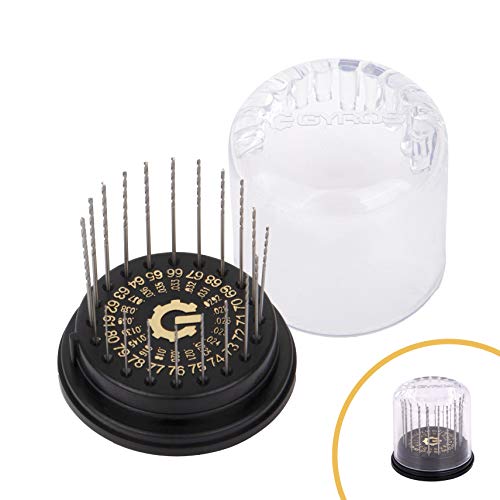
This is the set to buy when you do not yet know which micro size you need. It spans #60 at 1.016mm down to #80 at 0.343mm — twenty wire-gauge diameters, one of each, all in a clear dome case with a pressure-fit stand. The stand has a printed numeric gauge guide, so you grab the right bit instead of squinting at a loose pile. That alone saves real time on a jewelry or model-making bench.
The bits are carbon steel with a 135-degree cutting angle (a wider point that resists wandering on hard surfaces) and two flutes (the spiral grooves that clear chips out of the hole). Carbon steel gives you a mix of hardness and toughness, which is why this set works on gold, silver, wood, hard and soft metal, plastic, PVC, beads, and jewelry. The same bits are also used for cleaning emulsion tubes and jets in small carburetors — the wire-gauge sizes line up almost exactly with jet bores.
Owners praise the Gyros bits’ build quality above all, with how well the bits cut a close second. The honest trade-off is size selection. A handful of buyers find the small end too tiny for their work — which is true of every #70-and-up bit on the market. The thinnest bits in the set are also the ones that break, so treat #75 through #80 as a careful, low-pressure tool. What you get in return is a full gauge range that will outlast the trend of whatever single size you bought last time.
What earns its place
- Twenty sizes from #60 (1.016mm) to #80 (0.343mm) cover almost any micro job
- Printed gauge guide on the dome stand makes bit ID instant
- 135-degree carbon steel point handles jewelry, plastic, and soft metal
- The dome case keeps bits upright and protected between jobs
What to know before you buy
- The smaller gauge sizes are genuinely tiny — expect to work carefully
- Carbon steel wears faster in hard metal than HSS or carbide
- Needs the Gyros adaptor chuck to run in most powered rotary tools
Pick it for: the hobbyist or jeweler who wants one complete spread of micro sizes with clear labeling and a case that actually organizes them.
Think twice if: you only ever drill one hole diameter — a single-size set will serve you better.
2. Gyros 12 Pcs #63 Micro Drill Bit Set, High-Speed Steel
Twelve identical 0.94mm bits, so a snapped drill costs you one instead of the whole set.
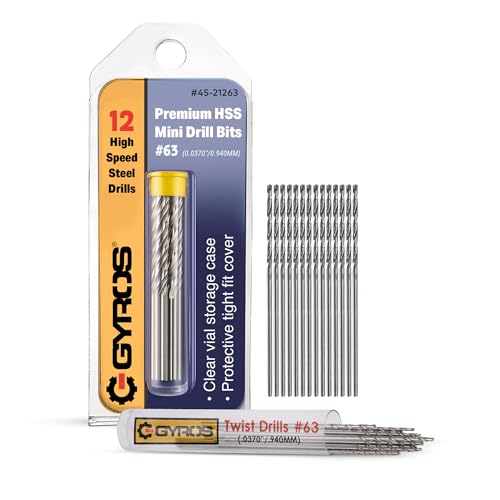
If you have ever run out of #63 halfway through a carburetor jet job, this is the fix. Twelve identical bits at 0.94mm cutting diameter, all HSS with a 135-degree point, in a clear vial with a tight-fit cap. One size, twelve backups. That is the entire value proposition, and for anyone drilling the same tiny hole over and over, it is a good one.
HSS gives you a step up in edge retention over carbon steel, which is why this set works well in hand drills. The 135-degree point bites without wandering, and the straight shank drops into a wide range of tool holders. You can run it in the Gyros Mini Adaptor Chuck for powered rotary tools or the Gyros Swivel Head Pin Vise for hand drilling. The 0.94mm size is the same as a #63 gauge, so it matches most jewelry and model work that calls for that specific bore.
What sells it is the sharpness and consistency. Owners consistently rate it as better than most alternatives and effective for punching very tiny holes. The recurring gripe is durability — the bits break easily, and a few people lose several during a single project. The honest read is this: tiny HSS bits snap when you push, not when you drill. Run it slow, let the flutes clear, and you get real mileage. Expect to consume a bit or two per heavy project. The upside is the price-per-bit math when you buy in a dozen.
The size reality check: 0.94mm is small enough to be nearly invisible in the vial. That is not a defect — it is the point. If you have never worked under 1mm, this is a reasonable place to start.
How it compares: the Lothee set above gives you thirty bits, but this Gyros gives you twelve of one size.
Best for: carburetor work, jewelry pin holes, and any job where you drill the same tiny diameter repeatedly.
Look elsewhere if: you need a range of sizes — this set is one size by design.
3. The Army Painter Drill Bits Pack of 10
Ten metric sizes from 0.7mm to 3.0mm, aimed straight at the pinning and magnetizing crowd.
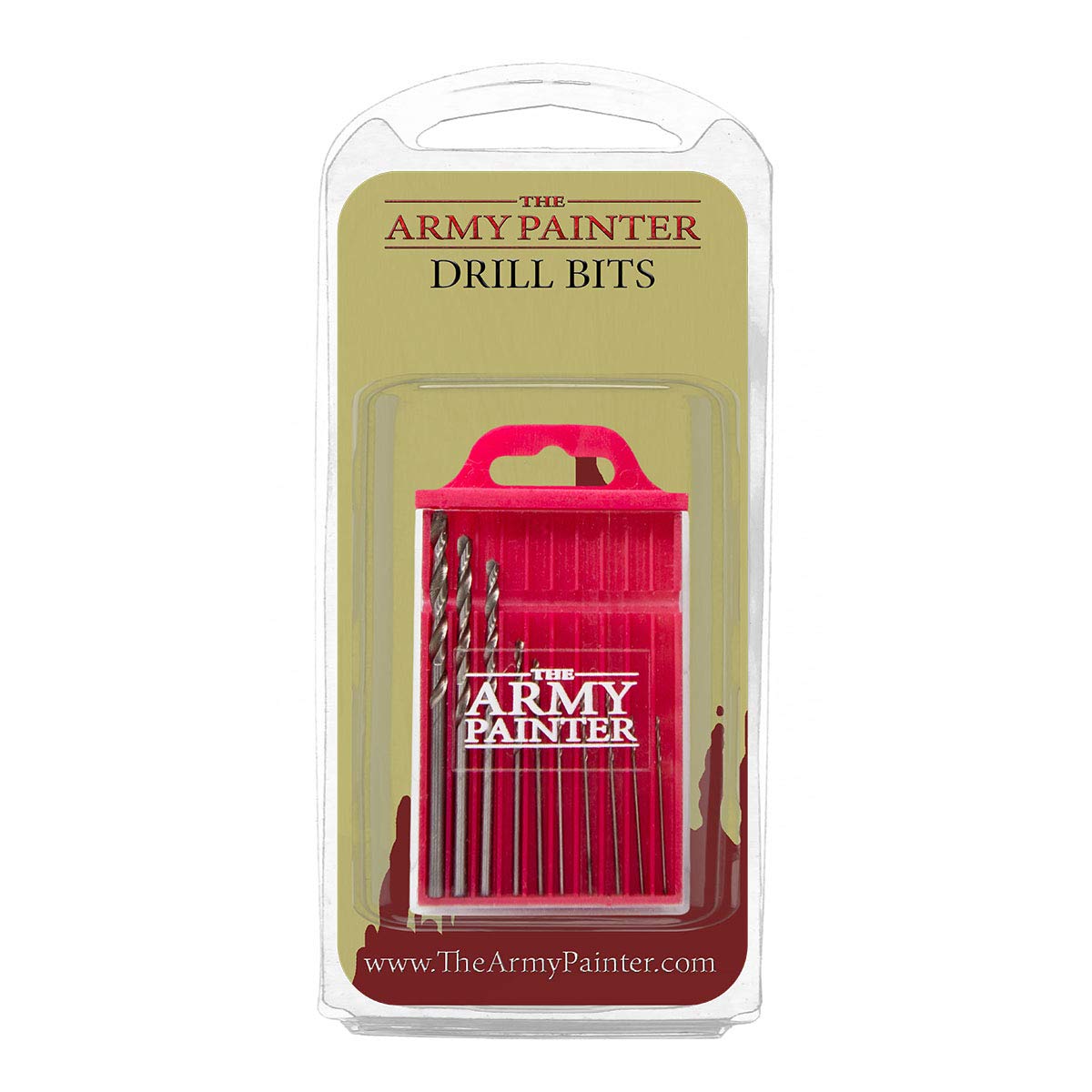
Scale-model painters know the drill: you need a 0.7mm hole for a gun barrel, a 1mm hole for a pin, and a 3mm hole for a magnet. This set covers exactly that arc in ten steps. The 3mm bit fits the small magnets in The Army Painter Miniature & Model Magnets set, which means you can magnetize arms and weapons instead of gluing them permanently. That one feature is worth the buy for anyone building an army they intend to repaint later.
The bits are designed to pair with The Army Painter Miniature and Model Drill, a manual pin vise. The company also lists them for scale models, dioramas, terrain, and jewelry. Cutting capacity in metal tops out at 3mm. With no readable material spec in the listing, treat these as a hobby-grade set — sharp and well-made for plastic, resin, and light metal work, not a production shop tool.
Owners praise the Army Painter bits as well-made and reliable, with cutting performance a close second. Durability is the honest split: some find them very tough, others report the drills are fragile. The reality is that 0.7mm and 0.9mm drills are thin by definition, and they reward a light touch. A note on price-to-value: the set includes 10 bits in a compact 3.8 by 2.8 by 1 inch box, which keeps the whole thing in a pocket of your hobby bag. If you only paint and never pin, you can skip this one.
Why it stands out
- Ten metric sizes cover gun barrels, pinning, and magnet wells in one box
- The 3mm bit matches the brand’s own magnet set for quick loadout swaps
- Sharp enough to drill clean pilot holes without wandering
- Compact box fits a standard hobby tote
The honest caveat
- The smallest sizes are fragile — count on a gentle touch
- Manual-drill pairing means slower work than a powered rotary tool
- No stated material spec, so treat it as hobby-grade
Chosen by: Warhammer, D&D, and Gundam builders who magnetize and pin their miniatures.
Not the pick for: anyone drilling circuit boards or hard steel — the material spec does not back it.
4. Lothee 30 Pcs Micro Drill Bits Set

Thirty carbide bits from 0.1mm up, with the widest size spread of the whole lineup.
This is the set that goes lower than anything else here. The smallest bore is 0.1mm — that is thinner than a human hair, and it is why this set is built for PCB work, amber and beeswax, and CNC jewelry engraving. For scale: the cutting diameter tops out at 3.0mm, so you get 30 different widths from 0.1 to 3.0, packaged in three boxes of ten. That is 3.2 times the size spread of the Gyros 12-piece #63 set, which is a single 0.94mm diameter.
Tungsten carbide (a very hard metal) is the hardest bit material you can buy at this tier. The spiral cutting edge is designed to reduce cutting force and prevent breakage while improving accuracy, which is why the company claims no burrs or debris. The blade has an anti-vibration design that keeps it stable through engraving. That is a real advantage on a CNC router (a computer-controlled cutting machine) where the tool moves faster than your hand ever could. But carbide is also the most brittle option in this guide, and the honest cost of that hardness shows up in the reviews.
Buyers of the Lothee set most appreciate that the bits cut cleanly, with the 0.1–3.0mm size range a close second. The recurring issue is breakage — thinner bits are brittle, and the smallest sizes snap under light loads. That is the honest trade-off of carbide, and it is why so many PCB drills are sold in packs. A practical note: 0.1mm and 0.2mm are not general-purpose bits. Buy this set if you actually cut PCBs or engrave jewelry; skip it if you only need to open a plastic model’s hole a fraction.
Built for circuit boards: the 118-degree point is a narrower angle than the 135-degree Gyros bits, which suits the softer, fibrous cut of PCB laminate.
The honest math: with 30 bits across three boxes, you break one or two without running out of that size.
For: PCB makers, amber and jewelry engravings, and CNC router users who want the widest spread of sizes.
pass on it if: you hand-drill at slow speeds with a pin vise — carbide will not reward the wobble.
5. ARROWMAX 10Pcs HSS Micro Drill Bit Set, 2.35mm Shank

Each bit wears a printed collar, so you grab 1.5mm on sight without reaching for calipers.
Every other set in this article asks you to read tiny stamped numbers or guess from the pile. This one gives each bit a black collar with the size printed in clear text — 0.5mm through 2.3mm in ten steps. The collar also acts as a physical depth stop, which means you can drill to a consistent depth without eyeballing it. For repetitive craft work, that is a bigger deal than it sounds.
The bits are HSS with a titanium coating. Titanium holds hardness and wear resistance, and the low-friction surface is designed to keep the bit sharp longer and reduce overheating in delicate tasks. The 2.35mm straight shank is the standard 3/32 inch size, and it is designed to fit the company’s own mini electric drill pens securely. The spiral flutes clear chips quickly, so the bit does not pack up and burn in resin, polymer clay, or acrylic.
ARROWMAX buyers report clean, consistent cuts in resin, acrylic, and softwood. The set is at its best on resin jewelry, epoxy casting, polymer clay, PCB boards, 3D printed parts, plastics, acrylics, and softwood. It is the shortest shank range here — ten metric sizes from 0.5 to 2.3mm, with only one of each. If you break the 0.9mm, you will miss it. The collar is also slightly thicker than a bare bit, which changes the feel in a tight pin vise. Neither is a deal-stopper, but both are worth knowing.
What you will like
- Printed size collars kill the guesswork without calipers
- Collars double as a depth stop for repeat drilling
- Titanium-coated HSS fights overheating on resin and acrylic
- 2.35mm (3/32 inch) shank drops into standard micro drill pens
What to accept
- One bit per size — a break costs you that diameter
- Topping out at 2.3mm means no 3mm magnet work
- Premium coating means premium-tier positioning
Go with it if: you swap sizes constantly and want to grab the right one without measuring.
Pass if: you want backups of your go-to size — this set gives you one of each.
6. Vinsot 95 Pcs Micro Drill Bits Set with Pin Vise Hand Drill

A pin vise plus 94 bits in one box, the closest thing here to a full starter bench.
This is the only pick that hands you the drill and the bits together. You get one black pin vise, 74 micro twist bits in 0.3–2mm, and 20 PCB mini bits in 0.3–1mm — 95 pieces total. The twist sizes step in 0.1mm intervals with three pieces per size, so a snapped bit is a minor inconvenience rather than a project-stopper. For someone starting from zero, this is the most practical opening move in the guide.
The pin vise body is aluminum alloy — solid enough for long use, compact, and hard-wearing. The PCB bits are tungsten carbide, while the twist bits are alloy steel, listed as rust-resistant and non-deforming. Cutting diameter bottoms out at 0.1mm on the PCB side. That makes the kit useful for electronics assembly, model making, winding, and home decorating as well as jewelry and wood crafts like keychains and bracelets.
Vinsot buyers praise the overall quality of the tools and the value of getting 94 bits plus a pin vise in one box. Functionality gets clean marks too, especially on carburetor work and model building. The honest catch is sizing: the bits are not marked with size, so you are counting steps or measuring by eye. The smallest twist sizes also break with light pressure, as all sub-1mm bits do. If you want labeled sizes, look at the ARROWMAX set instead; if you want the best kit-per-buy, this is it.
Where it shines: 74 twist bits with three of each size is a replacement plan built into the box.
Where it stumbles: unmarked sizes slow you down when you are reaching for a specific bore mid-project.
Buy it when: you are outfitting a first workbench and need the drill and bits in one go.
it’s not for you if: you already own a pin vise and want labeled, premium bits.
7. CML Supply Mini Micro Drill Bit Set
Production-grade HSS drills ground from solid blanks, with a hardened-steel-collet vise in the box.
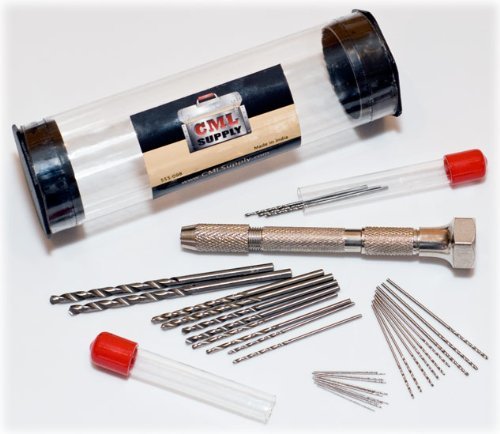
Where the Vinsot kit goes wide, the CML Supply goes deep. Thirty HSS bits are ground from solid steel blanks — production-grade, by the manufacturer’s description — and paired with a bonus swivel head pin vise. The vise holds bits from 0 to 0.125 inch, which is 0 to 3mm, and uses hardened steel collets for grip. That collet range is the widest holding window here, so you can mix and match bits from other sets without a new chuck.
The build quality is what people talk about. The set is described as metalworking-grade and suited to electronics, jewelry, watch making, and general hobby work. The specs show a 118-degree cutting angle, black oxide finish, taper point, and straight shank — all standard for a general-purpose micro set. The two-flute design clears chips well in soft metal, plastic, and wood.
CML Supply owners mention that every included bit cuts as it should and the set earns its keep. Variety is a strong point: the small bits come in handy across a wide range of jobs. The bit-size question is the split one — some buyers find the sizes too small or unmarked, others find them a perfect fit. Durability splits the same way, with the thinnest bits reportedly fragile. The practical read is that the thinner the bit, the more you should baby it, and the collet range means a replacement bit is cheap to source.
The case for it
- Production-grade HSS bits ground from solid blanks
- Collets grip 0 to 0.125 inch (0 to 3mm) — the widest range on the list
- Swivel head pin vise included, so you drill and cut with one buy
- Watch-making and jewelry-grade finish, per the manufacturer
The honest limits
- Sizes are not printed on the bits in a readable way
- The thinnest bits break under sideways pressure
- Premium-tier pricing
Worth it for: watch makers, jewelry repairers, and anyone who wants a properly built vise with a good bed of bits.
Not for: the occasional user who drills one hole a month and will not use the collet range.
8. Genmitsu 30pcs PCB Drill Bits Set, 0.1mm-3.0mm, 1/8″ Shank

A 1/8 inch shank and 30 drill diameters, made to run in a CNC router collet, not a pin vise.
This set belongs to the machine. The 1/8 inch shank is the standard collet size for CNC routers, and the tungsten carbide steel alloy is designed for high wear resistance and high hardness. If you are routing printed circuit boards, engraving jewelry, or cleaning 3D printer nozzles, this is the shank profile you need. The Lothee set above uses carbide too, but the Genmitsu is built around the machine collet, not the hand drill.
The sizes step from 0.1mm up through 3.0mm in thirty individual bits, split into three sets of ten: Set A is 0.1mm to 1.0mm, Set B is 1.1mm to 2.0mm, Set C is 2.1mm to 3.0mm. Each set has its own protective box, so you can carry just the range you need for a job. The spiral flute cutting edge is designed to reduce cutting force, prevent breakage, and improve accuracy, and the seismic blade design keeps the bit stable during engraving.
The honest headline is breakage. The smallest bits are prone to snapping, sometimes with barely any force, and you get one of each size — 30 diameters, one bit apiece. A few buyers also find the size markings hard to read in the box. Set against that, the bits work quickly and cleanly when you run them within their limits. Carbide is hard, and hard means brittle. If your spindle runs true and your feed rate is sane, you will get good mileage. If you jam the bit sideways into the board, you will not.
The comparison that matters: this and the Lothee set both go 0.1mm to 3.0mm in 30 pieces, but the Genmitsu’s 1/8 inch shank is for machine collets — the Lothee’s wider range suits both hand and machine.
Fair warning: one bit per size, so budget for a spare box if you run a lot of fine work.
Made for: CNC router owners cutting PCBs, jewelry, and 3D printer nozzles.
Wrong choice if: your tool is a hand pin vise — the 1/8 inch shank will not fit.
9. Tamiya 74044 Drill Bit Set, 0.3/0.4/0.5/0.8mm
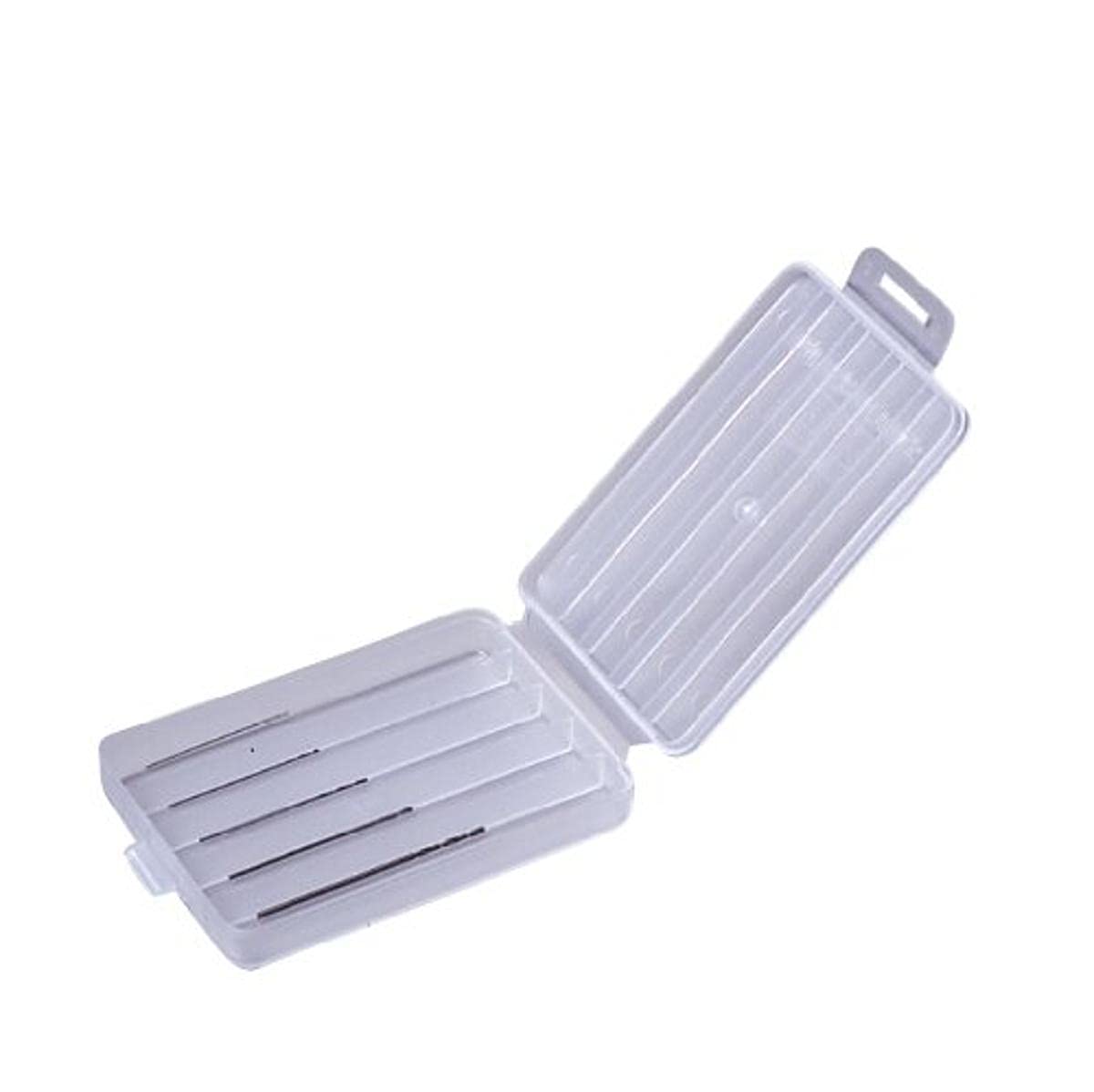
Five sub-millimeter sizes from a name plastic-model builders already trust.
This one is for the modeler who already owns a Tamiya hand drill. It is a five-bit set in 0.3mm, 0.4mm, 0.5mm, 0.5mm, and 0.8mm, in a small storage box. The diameter bottoms out at 0.3mm, so it goes finer than most picks here. The smallest bit in the Genmitsu set is also 0.1mm, but the Tamiya is a much smaller, tighter kit for a purpose — detail holes in plastic scale models.
The specs show a 135-degree point, a coated finish, and three flutes. Three flutes is unusual here — most micro bits run two. A third flute clears chips faster and pulls the bit through soft plastic cleanly, which is precisely what scale building needs. The coated finish helps the bit slide through styrene without building heat. The whole box measures 3.15 by 2.56 by 0.63 inches, so it drops into a model case without a second thought.
The feedback track is narrow and positive: people find the bits useful for miniature modeling and describe them as arriving as advertised. That is the whole picture — a small, well-made kit for a specific craft. The obvious limit is that five bits with one duplicate size is not a working set for PCB or metal work. It is the modeler’s detail drill, and it is best bought alongside the hand drill the brand makes. If you need a full range that handles anything besides plastic, look at the Gyros or Lothee sets.
Reach for it when: you build plastic scale models and want a fine detail bit in 0.3mm to 0.8mm.
Look elsewhere if: you drill metal, PCB, or need larger sizes — this is a focused plastic-model tool.
Know the Specs
Cutting diameter and wire-gauge size
Cutting diameter is simply how wide a hole the bit makes. It runs from 0.1mm at the finest to 3.0mm at the top of this lineup. Wire-gauge numbers are the older way of naming the same thing: #80 is 0.343mm and #61 is 1.016mm, so a higher gauge number means a thinner bit. Match this to the screw, wire, or magnet you need to fit into the hole.
Cutting angle and the point
The cutting angle is the angle of the bit tip, given in degrees. A 135-degree point is wider and less prone to wandering on hard surfaces. A 118-degree point is narrower and cuts more aggressively. Most micro sets use one of the two. For delicate work in plastic or resin, a 135-degree point tends to start cleaner and stay where you put it.
Bit material: carbon steel, HSS, and carbide
Carbon steel is tough and takes intricate work but wears faster in hard metal. High-speed steel holds an edge longer and handles harder jobs. Tungsten carbide is the hardest and the most brittle — excellent for PCB and engraving work, unforgiving if the bit wobbles. None of the three is best at everything; the right one depends on your material.
Shank size and tool fit
The shank is the smooth end the tool grips. A 2.35mm shank (roughly 3/32 inch) fits mini drill pens like the ARROWMAX. A 1/8 inch shank is the CNC router standard, as in the Genmitsu set. Pin vises hold a range, often 0 to 3mm. Buy the shank that fits your tool, because a brilliant bit in the wrong chuck will not turn.
Piece count and size variety
A pack of ten different sizes gives you one bit in ten diameters. A pack of thirty gives you a much wider spread, or repeats of the same size. Neither is better in the abstract — repeat sets are for one-diameter work, varied sets are for mixed jobs. Count the sizes you actually need before you count the pieces in the box.
Storage and labeling
A boxed set with printed size guides saves you time every single job. A loose vial of unmarked bits means counting steps or breaking out calipers. Dome cases, vials, and three-box sets are all common. If you work fast and swap sizes often, labeled storage is worth paying a little more for.
Common Questions
What size bit do I need for a standard jewelry pin?
Will these bits fit a standard rotary tool?
Why do the smallest micro drill bits snap so easily?
Is tungsten carbide better than high-speed steel for tiny drill bits?
Can I use PCB drill bits on wood or plastic?
What is the difference between wire-gauge bits and metric bits?
How long does a micro drill bit last?
Do I need a pin vise to use these tiny bits?
Can I use these micro bits to clean a carburetor jet?
What size bit fits the small magnets in miniature bases?
The Bottom Line
For most benches, the tiny drill bits winner is the Gyros 20 Pcs #61–#80 Dome Case because twenty wire-gauge sizes (numbered drill sizes) with a printed guide cover nearly any micro job you will meet, and the carbon steel handles jewelry, plastic, and soft metal without drama. If your work is one repeated diameter, grab the Gyros 12 Pcs #63 Set — twelve identical 0.94mm bits mean a snap costs you one bit, not a project. And for miniature painting and magnetizing, the The Army Painter 10-Size Set is the one to reach for, since its 3mm bit is built to pair with the brand’s own magnets.
The 20-piece Gyros earns the top spot on its #60–#80 gauge range, a dome case with a printed size guide, and years of hobby-bench use. Buy the range first, then add a single-size dozen for whatever you drill most.
How we choose
We do not accept paid placement. Every pick is matched to a real buyer and a real use-case; we do not hands-on test units.
Sources
Specifications: manufacturer listings and product documentation. Review insights: verified customer reviews, as of November 2026. Pricing: not shown on this page (it changes often); check the current price via the retailer link.
As an Amazon Associate, Tactical Gear Guy earns from qualifying purchases. This does not affect which products we feature.