Specs are compiled from manufacturer listings and verified buyer reviews and can change over time — please confirm the key details on the product page before buying.
Buying a water valve is really about one thing: knowing the water stops when you turn the handle. The right valve seals on the first quarter turn, matches the pipe in your wall, and stays dry at the joint six months later. The wrong connection type turns a ten-minute repair into a second trip to the hardware store. This guide sorts the genuine options by connection type — push-fit, PEX crimp, and threaded — so you can match one to your actual pipe instead of guessing.
This guide is built by comparing the manufacturers’ published specifications and the patterns across verified customer reviews, so you get each pick’s real strengths and trade-offs instead of marketing spin.
Plumbing parts are unforgiving: the fitting either matches your pipe or it does not, and no amount of good intentions fixes a mismatched connection. Below you will find the seven valves worth your time, sorted by how they attach, with the pressure ratings and pipe compatibility spelled out for each one.
The picks below cover the push-fit, PEX crimp, and threaded styles so you can pick the right water valve for your pipe on the first try.
Top Picks

How To Choose The Best Water Valve
Start with the pipe, not the valve. A valve is only as good as the joint it makes, so the first question is always what is already sticking out of your wall or ceiling. Everything else — pressure rating, handle style, port size — comes second.
Match the connection type to your pipe
Push-fit valves slide onto copper, PEX, CPVC, and PE-RT pipe and lock with an internal grab ring, so they need no soldering, glue, or crimp tool. PEX crimp valves need a crimp ring or cinch clamp squeezed on with a tool you probably do not own yet. Threaded valves screw onto a male pipe thread. A push-fit valve will not thread onto iron pipe, and a threaded valve will not crimp onto PEX.
Check the pressure rating against the line you are joining
Pressure ratings on these valves range from 125 psi up to 600 psi, and the number tells you how much line pressure the body and seal are built to hold. A fixture branch feeding a toilet or faucet runs at lower pressure than a main supply line. Match the valve’s rating to the job, and give yourself headroom rather than running a valve at its stated ceiling.
Full port versus standard port
A full port valve has an opening the same size as the pipe, so water passes through without a bottleneck and pressure drop stays minimal. Standard port valves narrow at the ball. On a shutoff feeding a whole bathroom, full port keeps flow and pressure where you want them.
Handle style and hot-cold labeling
A lever handle swings open and shut in a quarter turn and is easy to grab in a hurry. A T-handle is more compact and fits inside a tight cabinet. Red and blue handle sets let you mark hot and cold lines at a glance, which matters when a manifold has four or more valves side by side.
Side-by-Side Comparison
| Model | Best For | Connection | Max Pressure | Pack Size | Amazon |
|---|---|---|---|---|---|
| EFIELD 1/2 Inch Push-Fit Full Port Ball Valve★ Best Overall | Tool-free repairs on mixed pipe | Push-Fit | 200 psi | 2 pieces | Amazon |
| Eastman 1/2 Inch IPS Heavy Duty Full Port Ball ValveHighest Pressure | High-pressure main lines | IPS threaded | 600 psi | 1 valve | Amazon |
| SharkBite Max 1/2 x 1/2 in PTC Ball Valve | Fast repairs in tight wet spaces | Push-to-Connect | 250 psi | 1 valve | Amazon |
| 4pcs 1/2″ PEX Brass Full Port Shut Off Ball Valve | Whole-manifold hot and cold setup | PEX crimp | 400 psi | 4 pieces | Amazon |
| Minimprover 1/2 Inch FIP x 3/8 Inch OD Angle Stop Valve | Faucet and toilet fixture shutoff | FIP x compression | — | 2 pieces | Amazon |
| 1/2-in Brass Pex Ball Valve with White T-Handle | Tight cabinets and small manifolds | PEX crimp | 125 psi | 2 pieces | Amazon |
| HeSun 1/2″ PEX-B Crimp x 3/8″ OD Angle Stop Valve | Whole-house fixture upgrade | PEX crimp x compression | — | 10 pieces | Amazon |
Detailed Reviews
1. 2Pcs EFIELD 1/2 Inch Push-Fit Full Port Ball Valve
Our pick — 4.5+★ from 950+ verified ratings; the strongest balance of quality and price.
The tool-free valve that grips copper, PEX, and CPVC without a crimper or a torch.
You get two push-fit ball valves in 1/2 inch, each rated to hold up to 200 psi (pounds per square inch — the working pressure the body and seal are tested to). The push-fit end grabs copper, CPVC, and PEX, which is the whole point: you can cut out a leaky section and drop one of these in without soldering, glue, or a crimp tool. On a wet Sunday repair, that is the difference between finishing before lunch and calling someone.
What wins people over is how well the valve simply works — it is the most-discussed strength in the feedback, and the build quality runs right behind it. The brass is DZR (dezincification-resistant, meaning the alloy resists the corrosion that eats cheaper brass in damp spots), forged, and lead-free, and it carries a UPC listing. Tug the disconnect clip and the valve comes back off, so you are not committed if you misjudged the length of pipe you had.
Here is the one wrinkle to plan around: the sealing at the joint draws genuinely mixed notes. Some installs are bone dry from the first fill, while a share of owners end up chasing a drip and re-seating the connection. Push-fit joints are fussy about pipe cleanliness and a square cut, so deburr and dry the pipe end before you push — most trouble traces back to that. The two-valve pack means you have a spare if an install fights you.
What works in its favor
- No solder, glue, or crimp tool needed — the push-fit coupling does the work
- Works on PEX, CPVC, and copper pipe, so one valve covers mixed plumbing
- Includes a disconnect clip for clean removal without damage
- Lead-free DZR forged brass, UPC-listed for potable water lines
Where it makes you work
- Joint sealing is hit-or-miss depending on how clean and square your pipe cut is
- 200 psi rating leaves less ceiling than the high-pressure brass picks
Grab this one: if the pipe is already cut and you want the job done without a torch or crimper, especially on copper or CPVC where a push connection shines.
Look elsewhere: if you are joining a high-pressure main line — the Eastman’s 600 psi body is the safer ceiling.
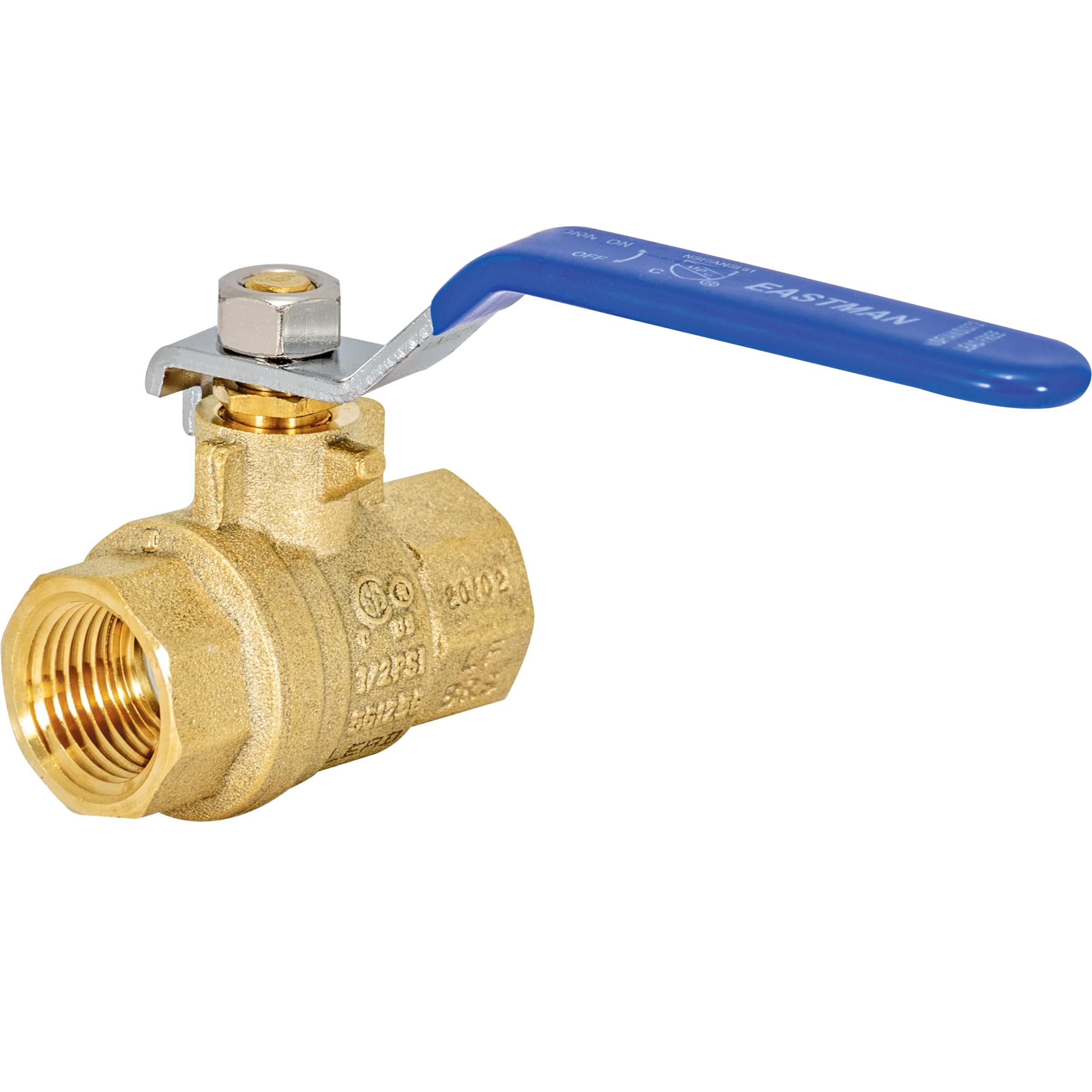
2. Eastman 1/2 Inch IPS Heavy Duty Full Port Ball Valve
A solid brass body rated to 600 psi — the pressure heavyweight of this group.
Where most valves here cap out in the low hundreds, this Eastman carries a 600 psi maximum operating pressure and a 150 PSIG steam working pressure. That is roughly five times the ceiling of the 125 psi PEX valve further down this list, which is why it earns a slot on main lines and heating systems where line pressure climbs. The full port opening matches the 1/2 inch iron pipe size on both ends, so water does not bottleneck at the ball.
The vinyl-coated steel lever handle gives you a real grip for a quarter-turn shutoff, and the body is heavy-duty solid brass with a Teflon seal rated for high temperature and pressure. It is UPC approved, CSA certified, and built to NSF and lead-free guidelines for drinking water. In service, owners describe it opening and closing smoothly after the first cycle, and the durable construction is what draws the most favorable comment.
The honest catch is the threading. It is a 1/2 inch IPS (iron pipe size) threaded connection, and the feedback on thread quality is not unanimous — some joints thread on clean, others take extra tape and patience to seat without weeping. If your pipe is PEX or copper rather than threaded iron, this valve simply is not your connection; go push-fit instead. For a threaded main line, though, the brass work is what people keep coming back to.
The pressure argument: a 600 psi rating and 150 PSIG steam rating put this ahead of every other valve here on raw working ceiling, and the full port design keeps flow wide open.
One thing to know: the IPS threading is the most divided part of the feedback — budget extra pipe tape and a careful hand when you seat it.
Reach for it when: you are tying into threaded iron pipe and want a brass body that shrugs off higher line pressure.
Different pipe, different pick: PEX or copper owners should skip straight to the push-fit options.
3. SharkBite Max 1/2 x 1/2 in PTC Ball Valve

Built for the dripping pipe you need to cap off right now, tools nowhere in sight.
Ease of use is the whole story here, and it is the thing owners praise most by a wide margin. The push-to-connect ends require no soldering, glue, or tools, and the valve installs in a tight or wet space where a torch would never fit. It joins PEX, copper, CPVC, PE-RT, and SDR-9 HDPE pipe, and it needs no PEX tube liner. The reinforced stainless steel collar locks the internal cartridge and reduces insertion force by 50%, so pushing it home takes less muscle than the older style.
The body is DZR forged brass with stainless steel, rated to 200 degrees F and 400 psi, and each valve is inspected for function up to 2,000 psi burst pressure. Compared with the EFIELD above, the SharkBite carries the higher working ceiling at 400 psi versus 200 psi on a push connection, which matters if you are joining a line that runs hot or under more pressure. Owners describe it as super strong, and the leak-proof performance is repeated across the feedback. It comes off with a Disconnect Clip or Disconnect Tongs, both sold separately — worth buying at the same time since removing the valve without them is not happening.
What you trade for that convenience is compatibility on the far end: both connections on this model are push-to-connect, so it is not the pick if you need to thread onto a male pipe or crimp onto a PEX barb. It is a straight run valve, not an adapter.
Why it earns a premium slot
- Installs wet, tight, or awkward spots with no torch or crimper
- 400 psi working pressure with a 2,000 psi burst inspection
- Fits five pipe types — PEX, copper, CPVC, PE-RT, and SDR-9 HDPE
- Stainless steel collar cuts insertion force by 50%
The fine print
- Disconnect Clip or Tongs are sold separately — plan to buy them together
- Both ends are push-to-connect, so it will not thread or crimp onto another fitting
The quick-repair answer: a wet crawlspace or a stubborn joint where you cannot get a tool in — this is the one to reach for.
Not for every joint: if one end needs to thread or crimp, this straight push-to-push body will not adapt.
4. 4pcs 1/2″ PEX Brass Full Port Shut Off Ball Valve

Four color-coded valves so hot and cold never get mixed up at the manifold.
This pack gives you four 1/2 inch brass PEX valves — two with red handles, two with blue — which is exactly what a hot-and-cold manifold wants so you know at a glance which line is which. The valve bodies are full port, rated to a 400 psi maximum, and made of durable brass that resists corrosion and rust. Compare that count with the EFIELD’s two-valve pack: four here versus two there, and for a small manifold that is the difference between one purchase and two.
Installation is by stainless steel clamp or copper crimp ring, so you do need a PEX crimp tool or cinch clamp on hand. Crucially, these do not work on expander fitting systems or the Uponor/Wirsbo expander style, and they are not for PEX-AL-PEX tubing. They do suit all types and brands of standard PEX tubing. Once installed, the handling feedback lands on the easy side and the brass is described as well-made and worth the money.
The trade-off is simply the connection: this is a PEX crimp valve, not a push-fit, so it is only the right buy if your pipe is PEX and you own the crimping tool. If you are working copper or CPVC, the push-fit picks cover you instead.
The manifold view: four full-port valves with red and blue handles at a 400 psi rating makes short work of labeling a hot-and-cold setup.
Tool needed: you must have a PEX crimp tool — and these will not fit expander systems or PEX-AL-PEX.
Best for: a PEX manifold where you want four valves and color coding out of one box.
Think twice if: your system uses an expander fitting or PEX-AL-PEX tubing — this pack is not designed for either.
5. Minimprover 1/2 Inch FIP x 3/8 Inch OD Angle Stop Valve

The angle stop that tucks under a sink and lets you shut off one faucet, not the house.
This is the under-sink valve, not the main-line valve. It takes a 1/2 inch FIP (female iron pipe thread) on the wall side and a 3/8 inch OD compression fitting on the fixture side — the standard pairing for a faucet or a toilet supply. Note that the inlet here is 0.38 inches versus the 0.5 inch inlet on the PEX manifold pack, which is simply a different job: a fixture branch feeding a single fixture rather than a main run. The brass ball mechanism gives a smooth quarter-turn shutoff.
The body is brass with a chrome-plated finish that resists corrosion, and it is rated for working temperatures of -40 to 250 F, so it handles both a cold supply and a hot feed. It is certified to contain less than 0.25% lead, which matters on a line feeding a drinking faucet. What buyers report most is that it functions well — the shutoff works and the valve does its job — with quality close behind.
The fair warning is installation feel. The feedback on tightening is split: some find it installs easily, while others find it awkward to tighten with a wrench in the cramped space under a sink. A short wrench and a little patience handle most of that. Leakage experience is similarly divided, so seat the compression nut firmly but do not over-crank the ferrule.
Where it fits: a 1/2 inch FIP wall stub threaded out to a 3/8 inch OD fixture line, at temperatures from -40 to 250 F.
The tight-space caveat: tightening with a wrench under a sink is the part people either love or fight — go slow on the compression nut.
Pick this if: you are replacing a faucet or toilet angle stop and want a low-lead brass body with a corrosion-resistant chrome finish.
Wrong tool for: a main-line or PEX manifold job — this is a single-fixture stop, not a through-line valve.
6. 1/2-in Brass PEX Ball Valve with White T-Handle

A small forged-brass PEX valve whose compact T-handle fits a cabinet a lever will not.
The white metal T-handle is the defining feature: it turns a quarter turn for shutoff but takes up far less room than a long lever, which is what you want in a tight cabinet or a crowded PEX manifold. The body is forged lead-free DZR brass, conforms to ASTM F1807 for the insert-type PEX fitting system, and meets NSF/ANSI 61 and NSF/ANSI 372 for drinking-water safety plus ANSI Z1157-2014e1 for shutoff ball valves. It is rated to 125 psi. Both 1/2 inch ends fit all types and brands of PEX tubing, and it works with SS cinch crimp rings, pinch clamps, or copper crimp.
Owners find it works as intended and report it holding leak-free, with the solid feel of the brass drawing steady praise and the T-handle shutoff noted for its quick action. The compact build is deliberate — the maker notes the mini handle does not affect quality, and each valve is 100% leak-tested before delivery.
The honest sizing note: the valve is small, and the feedback on size is genuinely split — some find it normal, others were surprised by how compact it is. If you were expecting a big lever, look at the full-size Eastman or SharkBite instead. In a tight cabinet, the compact handle is the reason to pick it.
The fit-in-tight-spots case
- Compact T-handle that clears cabinet walls and crowded manifolds
- Forged lead-free DZR brass with drinking-water listings
- Fits all PEX tube brands and three crimp-ring styles
What to plan for
- Physically small — some buyers were surprised by how compact the body is
- 125 psi ceiling is the lowest here, so keep it to lower-pressure branch lines
It earns the slot: tight cabinet, small manifold, low-pressure branch — the compact T-handle is exactly right.
If space is not the problem: the higher-rated brass valves above give you more pressure headroom.
7. HeSun 1/2″ PEX-B Crimp x 3/8″ OD Angle Stop Valve (10-Pack)

Ten lead-free angle stops for anyone upgrading fixtures across the whole house at once.
Ten valves in one box is the pitch, and it makes sense for a whole-house fixture refresh where one trip covers every sink and toilet. Each is a 1/2 inch PEX-B crimp inlet paired with a 3/8 inch OD compression outlet — the PEX side takes copper crimp rings or stainless clamps, and the outlet takes a 3/8 inch fixture line. The brass is lead-free and meets ASTM F1807, NSF/ANSI 61, and ASSE 1061, and it stands up to temperatures up to 200 F.
The practical win is shutting off water to one fixture during a repair without draining the whole house’s supply, which is the entire reason a fixture angle stop exists. On quality, owners call it good and perfectly suited to their needs, and the value per valve is what draws repeat buyers — the same count mindset as the four-pack above, just aimed at fixture stops instead of line valves.
One honest note: each valve has a single PEX inlet port, so this is a fixture stop, not a through-line valve — do not buy it expecting to run a line in and out of one body. And like any PEX crimp fitting, it needs a crimp tool and a clean cut on the pipe. For a single angle stop, buy one; for a whole-house fixture refresh, the ten-pack is the cheaper way to buy.
The bulk-buy logic: ten lead-free angle stops meeting ASTM F1807, NSF/ANSI 61, and ASSE 1061 cover every fixture in the house from one order.
One-home mismatch: a single PEX inlet makes this a fixture stop, and you will need a crimp tool to install it.
Suits you if: you are re-plumbing fixtures across the house and want one box to cover every sink and toilet.
Keep looking if: you only need one angle stop — a single fixture stop is the smarter buy than a ten-pack.
Know the Specs
Maximum operating pressure (psi)
This is the working pressure — in pounds per square inch — that the valve body and seal are built to hold in normal use. Higher is not always needed, but it gives you a safety margin. A fixture branch feeding a toilet or faucet runs at lower pressure than a main supply line, so a 125 psi PEX valve suits a branch while a 600 psi brass body suits a main. Match the rating to the line and leave headroom rather than running a valve at its stated ceiling.
Full port versus standard port
A full port valve has an internal opening the same size as the pipe, so water passes through without a bottleneck and pressure drop stays minimal. Standard port valves narrow at the ball, which can throttle flow. On a shutoff feeding a whole bathroom or a high-flow appliance, full port keeps pressure where you want it. Check the port size on the box before you buy.
Connection type and compatibility
Push-fit and push-to-connect valves slide onto copper, PEX, CPVC, and PE-RT pipe and lock internally — no tools, no soldering. PEX crimp valves need a crimp ring or cinch clamp and a crimp tool. Threaded valves (IPS or FIP) screw onto a male pipe thread. Confirm the connection type against your pipe before you check any other spec.
Lead-free brass and DZR
DZR stands for dezincification-resistant — an alloy formulated so the zinc does not leach out and leave the brass brittle in damp, long-service spots. Lead-free means the brass is built to stay within drinking-water limits, which matters on any valve feeding a faucet. On potable lines, look for listings such as NSF/ANSI 61 and NSF/ANSI 372, both of which appear on several valves here.
Common Questions
Will a push-fit valve work on copper and PEX in the same line?
What does the psi rating on a water valve actually mean?
Can I use a PEX valve on a hot water line?
What is the difference between a full port and a standard port ball valve?
Do I need special tools to install a PEX crimp valve?
Why is my new push-fit valve dripping at the joint?
Will a PEX valve work with an expander fitting system?
What is an angle stop valve used for?
Is lead-free brass actually required for a drinking water valve?
Can I remove a push-to-connect valve after installing it?
The Bottom Line
For most repairs, the water valve winner is the EFIELD 1/2 Inch Push-Fit Full Port Ball Valve — it drops onto copper, CPVC, or PEX with no torch or crimper, and the two-valve pack gives you a spare. If you are joining a high-pressure main line, take the Eastman and its 600 psi brass body. And for a fast repair in a wet, cramped space, the SharkBite Max with its 400 psi push-to-connect design is the one to reach for. Confirm the connection type against your pipe before you buy, and the rest of the specs fall into place.
How we choose
We do not accept paid placement. Every pick is matched to a real buyer and a real use-case; we do not hands-on test units.
Sources
Specifications: manufacturer listings and product documentation. Review insights: verified customer reviews, as of November 2026. Pricing: not shown on this page (it changes often); check the current price via the retailer link.
As an Amazon Associate, Tactical Gear Guy earns from qualifying purchases. This does not affect which products we feature.