Specs are compiled from manufacturer listings and verified buyer reviews and can change over time — please confirm the key details on the product page before buying.
Most small-pool owners buy a heater that is either too weak for their gallon count or too demanding for their backyard power supply. The fix is simple: match the BTU rating to your water volume, then confirm the unit runs on a standard 110-120V household outlet instead of a hard-wired 208/230V line. This guide covers nine compact heaters and heat pumps so you can pick the one that actually warms your water without an electrician visit.
This guide is built by comparing the manufacturers’ published specifications and the patterns across verified customer reviews, so you get each pick’s real strengths and trade-offs instead of marketing spin.
Your pool’s gallon count and your power outlet decide which heater works. BTU output (how much heat the unit moves into your water per hour), COP efficiency (how much heat you get per unit of electricity), flow-rate needs, and outlet type all matter. Every pick below is sized for a small backyard setup, so the right small pool heating system depends on those two things.
Top Picks

How To Choose The Best Small Pool Heating System
Two numbers decide if a small pool heater works for you: the BTU rating (British thermal units — a measure of how much heat the unit moves into your water per hour) and the gallon count it is rated for. Match them and the unit works. Get them wrong and you either wait days for warm water or burn electricity heating water you are not swimming in.
Match BTU to your gallon count, not to the biggest number on the box
Every heat pump here lists a gallon ceiling for a reason. A 16,000 BTU unit is built for pools in the 5,000 to 5,500 gallon range, while an 18,450 BTU model reaches up to 6,000 gallons. If your pool holds far fewer gallons than the ceiling, a smaller unit heats it just as well for less draw. Measure your water volume first, then read the gallon rating on each listing.
Check the outlet before anything else
Most compact heat pumps run on standard 110-120V household power, which means no special wiring and no electrician. The larger Raypak Crosswind models are 208/230V hard-wired units, so they need a dedicated circuit. Decide which power situation your backyard already has before you fall for a spec sheet, because a plug-in unit you cannot power is useless.
Understand COP before you judge efficiency
COP stands for coefficient of performance — how many units of heat the pump moves for each unit of electricity it uses. The higher the COP, the less you pay to hold your temperature. A unit rated at 4.3 COP moves roughly four times as much heat energy as the electricity it consumes, and the DELLA model publishes a 4.97 COP at 80.6°F. Read the COP alongside the noise rating in dB, because a quiet backyard matters as much as a cheap bill.
Side-by-Side Comparison
| Model | Best For | BTU Rating | Gallon Rating | Power / Weight | Amazon |
|---|---|---|---|---|---|
| Swimming Pool Heater 18450BTU★ Best Overall | Families with 10-14 ft above-ground pools | 18,450 BTU | Up to 6,000 gal | 110-120V / 77.8 lb | Amazon |
| FAFCO Original Solar BearBest Low-Power Option | Sun-belt owners avoiding electricity entirely | — | — | Solar / 20.3 lb | Amazon |
| 16000BTU Heat Pump 110VMost Efficient | Budget-conscious 5,000 gal owners | 16,000 BTU | Up to 5,000 gal | 110V / 74.8 lb | Amazon |
| 5,500 Gallon Heat Pump 110v | Anyone wanting heat and chill in one unit | 16,000 BTU | Up to 5,500 gal | 110V / 74.8 lb | Amazon |
| NATURAQUELL 18,000 BTU N1P | Owners who want long warranty support | 18,000 BTU | Up to 5,200 gal | 110-120V / 73.8 lb | Amazon |
| Della Omi Spark 21,000 BTU | Covered pools up to 7,000 gal | 21,000 BTU | Up to 7,000 gal | 110-120V / 59.5 lb | Amazon |
| 6,500 Gallons Heater 110V | Large above-ground pools needing COP 5.2 | — | Up to 6,500 gal | 110V / 91.8 lb | Amazon |
| Raypak Crosswind 30i | Inground pools wanting heat and chill | 28,000 BTU | Up to 7,500 gal | 208/230V / 59.9 lb | Amazon |
| Raypak Crosswind 40i | Big water volumes up to 9,000 gal | 33,000 BTU | Up to 9,000 gal | 208/230V / 124 lb | Amazon |
Detailed Reviews
1. Swimming Pool Heater for Above Ground Pool 18450BTU
Our pick — 4.5+★ from 200+ verified ratings; the strongest balance of quality and price.
Warms a 10-to-14-foot backyard pool on an ordinary wall outlet.
The headline number here is 18,450 BTU, and it is rated for above-ground pools up to 6,000 gallons. That is the ceiling most small-backyard families land under, so a typical steel-frame or inflatable pool sits comfortably inside its range. It runs on standard 110-120V household power, which means a normal outlet and no electrician. Setup is quoted at under 30 minutes with basic pool hose connections.
What wins people over is the day-to-day function, and the quality read tracks close behind. Owners describe steady water temperature that holds for night swims rather than a quick spike that fades. The unit also draws praise for running quietly — the noise complaints that dog bigger pumps do not show up here. A pure titanium heat exchanger (a corrosion-resistant metal core that touches the water) keeps it compatible with saltwater and chlorine pools.
The one recurring snag is the WiFi. The app control is a genuinely handy extra for adjusting temperature from your phone, but the connection side is the weak link — some owners fight frequent drop-offs from the app. Treat the remote control as a bonus and the physical unit as the product, and you will be happy. At 77.8 pounds, this is also the heavy end of the group, and the verified comparison shows it at 3.8x the weight of the FAFCO solar panel’s 20.3 pounds, so plan a two-person lift into place.
Where It Earns Its Keep
- 18,450 BTU moves real heat into pools up to 6,000 gallons
- Plugs into 110-120V household power — no electrician
- Titanium exchanger handles both saltwater and chlorine water
- Holds a steady temperature for evening swims rather than spiking
What To Weigh First
- The WiFi app is the weak spot — expect some connection drop-offs
- 77.8 pounds means you want help setting it in place
Buy this one if: your above-ground pool tops out near 6,000 gallons and you have a standard outdoor outlet free.
Think twice if: you want the app to be the primary control — set the temperature on the unit itself and treat the WiFi as a convenience.
2. FAFCO Original 4 x 20 Feet Solar Bear Solar Pool Heater
No compressor, no outlet, no electric bill — just the sun and a hose.
This is the odd one out in the best possible way. Instead of a compressor and refrigerant, this is a solar panel that is 4 feet by 20 feet, and it uses the sun to warm the water your existing pump pushes through it. There is no power draw to track and no 110-120V outlet needed. If your pool pump already circulates 24/7 in summer, this slots straight into the loop.
Its real advantage is weight and simplicity. The verified comparison puts it at 20.3 pounds against the 77.8 pounds of the 18,450 BTU heat pump — the difference between carrying a panel up a ladder and needing two hands on a compressor box. A connected tube design and a starter kit ship with it, so you are not hunting for the plumbing parts separately. On a sun-facing roof or rack, it is the lowest-moving-parts way to extend your season.
Where solar stops: the sun has to do the work, so a shaded yard, a cloudy stretch, or an early-season cold snap limits what it can add. Think of it as a season stretcher rather than an on-demand thermostat.
The honest math: this is the entry-level route to warmer water and hands you the smallest footprint of the group, but it only shines where sun exposure is strong and consistent.
Reach for this if: your pool sits in full sun and you would rather skip electricity entirely than chase degrees on command.
Look elsewhere if: you swim on a schedule and need predictable heat on an overcast morning.
3. 16000BTU Swimming Pool Heat Pump Up to 5000 Gallons 110v
A 50 dB heat pump that moves four units of heat per unit of power.
The efficiency figure does the heavy lifting: a COP of 4.3 means it pulls several units of heat out of the surrounding air for every unit of electricity it consumes. It is rated for pools up to 5,000 gallons and runs on 120 volts, so a normal household circuit is enough. The Della Omi Spark holds the larger rating at 7,000 gallons, and the verified comparison shows this unit at 40% fewer gallons — size your pool before choosing between them.
The sound spec is genuinely useful here. Extra soundproofing brings running noise to as low as 50 dB, which is about the level of a quiet conversation, so night heating will not wake the house. It also defrosts automatically, which matters in shoulder-season cold when frost can build on the coil. Buyers report it heats efficiently and is easy to install, with hose adapters sized for both 1.25-inch and 1.5-inch connectors shipping in the box alongside a 118-inch power cord.
Here is the catch the specs spell out: you want a pump pushing 700-1,000 GPH (gallons per hour) and a clear path through the plumbing. Bends, clogged filters, or a bad bypass valve choke the flow and drag heating down. Buyers also report condensation dripping from the bottom, which the maker calls normal during heat exchange and defrost — so give it a spot where a little water on the ground is fine. Do that and the 74.8-pound unit pays off in running cost. Also know that this one shares model number KSPF-005L3R1A1 with the 5,500-gallon unit further down the list.
Cost-per-degree read: 4.3 COP with 50 dB operation is a strong pairing for a small pool — you get climate-friendly running costs without a droning compressor in the yard.
Setup tax: figure out your flow rate before you buy. A weak pump, kinked hose, or a bypass valve you forgot about is the single most common reason these units underperform.
Strong fit for: 5,000-gallon owners with a healthy pump and a wall outlet nearby, especially those sensitive to nighttime noise.
Less ideal for: anyone running a weak or low-flow pump — check your GPH before you buy.
4. 5,500 Gallon Heat Pump Pool Heater
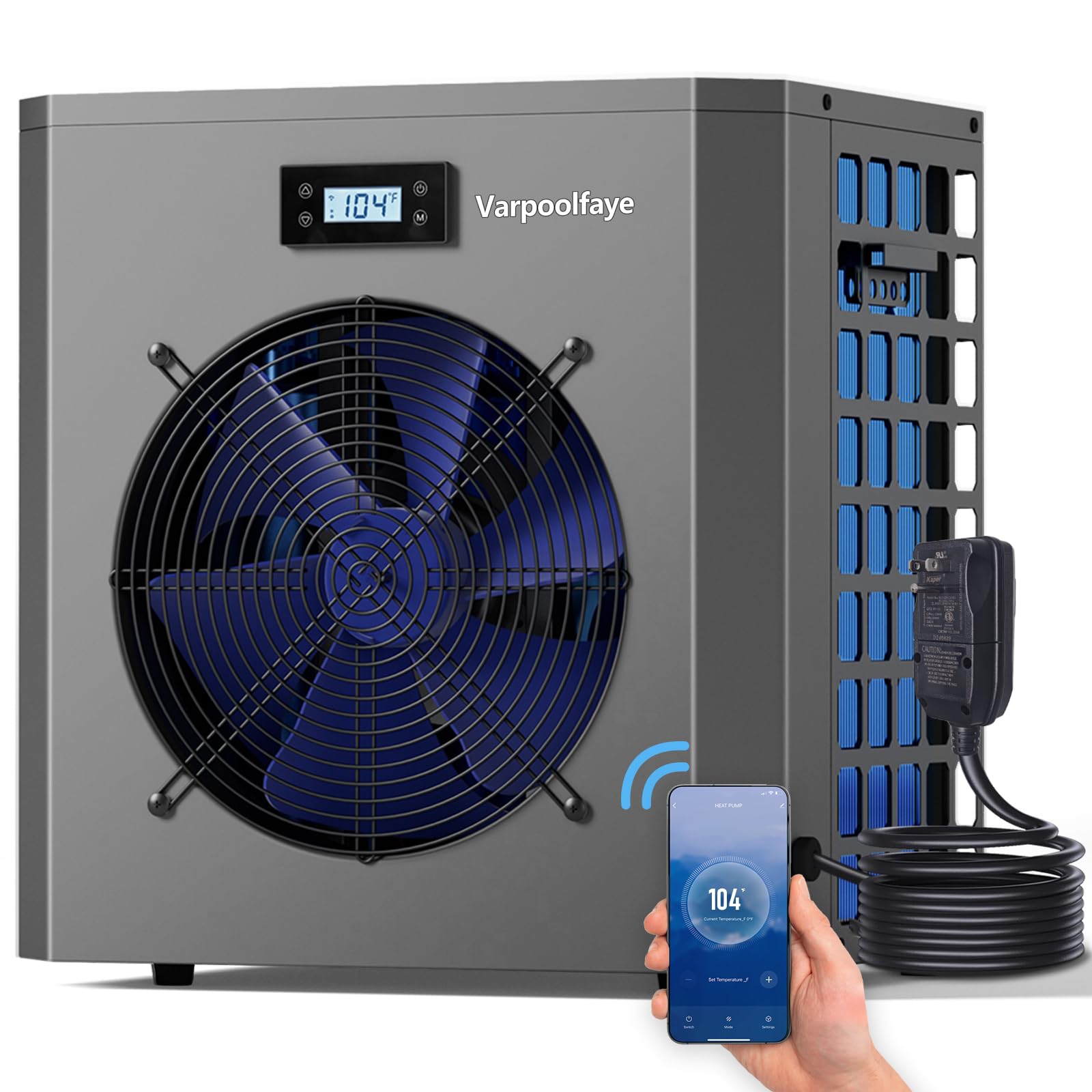
One machine that warms the water to 104°F and cools it to 46°F.
Most heaters only heat, which is fine until a July heat wave turns your pool into a warm bath. This 16,000 BTU unit does both, with a claimed range that runs from 59°F up to 104°F on the warm side and 46-82°F on the cool side. It is rated for above-ground pools up to 5,500 gallons, which covers most family steel-frame pools, and it runs on standard 110V. There is a WiFi app for adjusting temps and setting automatic on/off schedules, plus an advertised 4.3 COP for efficient running.
A titanium heat exchanger handles salt or chlorine water without corroding, and a smart water-electric separation design keeps the electrical side isolated. Sound-dampening insulation brings running noise to a claimed 50 dB, and the hose kit includes two DN32-38 mm universal connectors plus a 118-inch power cord. Connect those, pair the unit with a pump that pushes 700 GPH, and you are running.
The honest catch is the same condensation note you see across this class: water dripping from the bottom is normal during heat exchange and defrost, so choose a spot where damp ground is acceptable. Also plan for a pool cover — the maker and owners both point to it as the biggest single bump to heating efficiency. Keep it covered and this unit’s cooling mode earns its keep in a hot stretch.
Why It Stands Out
- Heating and cooling modes in one 16,000 BTU box
- Rated to 5,500 gallons on standard 110V power
- Titanium exchanger works in salt or chlorine water
- 118-inch cord and universal hose connectors included
Where It Asks More
- Condensation drips from the bottom in normal use
- You need a cover to get the best heating boost
Pick it for: hot climates where you want to take the edge off overheated water as often as you want to warm it.
Skip the cooler if: your pool never overheats — you can put that money toward gallon capacity instead.
5. Swimming Pool Heat Pump, 18,000 BTU, 5,200 Gal, N1P
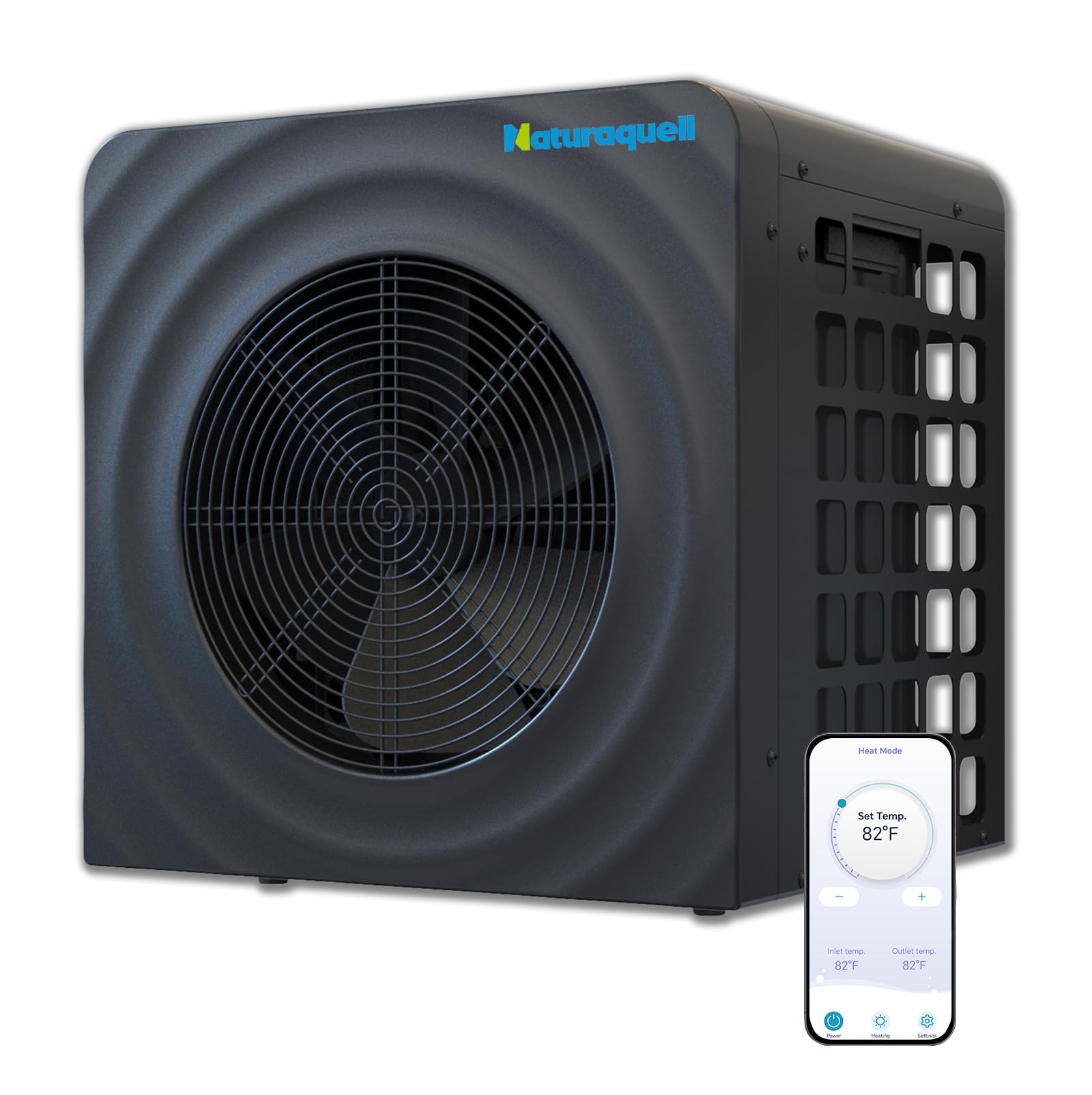
Eight years of after-sales support wrapped around an 18,000 BTU inverter.
This unit gives you a little more power than the 16,000 BTU crowd without leaving the small-pool class: an 18,000 BTU inverter (a compressor that varies its speed to match demand) rated for up to 5,200 gallons. what separates it is the ownership promise: the maker provides 8-year after-sales warranty support for installation questions, troubleshooting, and replacement guidance. A heat pump is a multi-season outdoor investment, so backing like that carries real weight. It runs on 110-120V and keeps the plug-in simplicity a backyard setup wants.
The control setup is a genuine convenience, not a gimmick. A touch panel sits at the unit for anyone standing by the pool, and the mobile app lets you warm the water before you get home. Behind the panels sits a corrosion-resistant titanium heat exchanger built for constant contact with pool water. COP is listed as up to 4.1 with an advertised 45% energy saving under comparable conditions — the efficiency case for a heat pump over a gas line.
The genuine caution the listing flags: confirm your outlet, breaker, pump flow, and local electrical requirements before you install. That is not mindless fine print on a small pool — a mismatched pump or a circuit that trips when the compressor kicks in will derail the whole setup. Sort those out first and the 73.8-pound unit slots neatly into a backyard plan without a gas tap or a hard-wired 220V line.
Why owners stay loyal: the warranty is the differentiator here — 8 years of support turns a heat pump from a gamble into a managed purchase.
One box to tick before buying: check the electrical side first. A wall outlet, a healthy breaker, and steady pump flow are what make this unit run clean.
Choose it for: a 5,200-gallon pool and a buyer who wants service backing they can actually reach.
Only if: you have verified your outlet and breaker situation — confirm those before the purchase, not after.
6. Della Omi Spark 21,000 BTU Pool Heat Pump
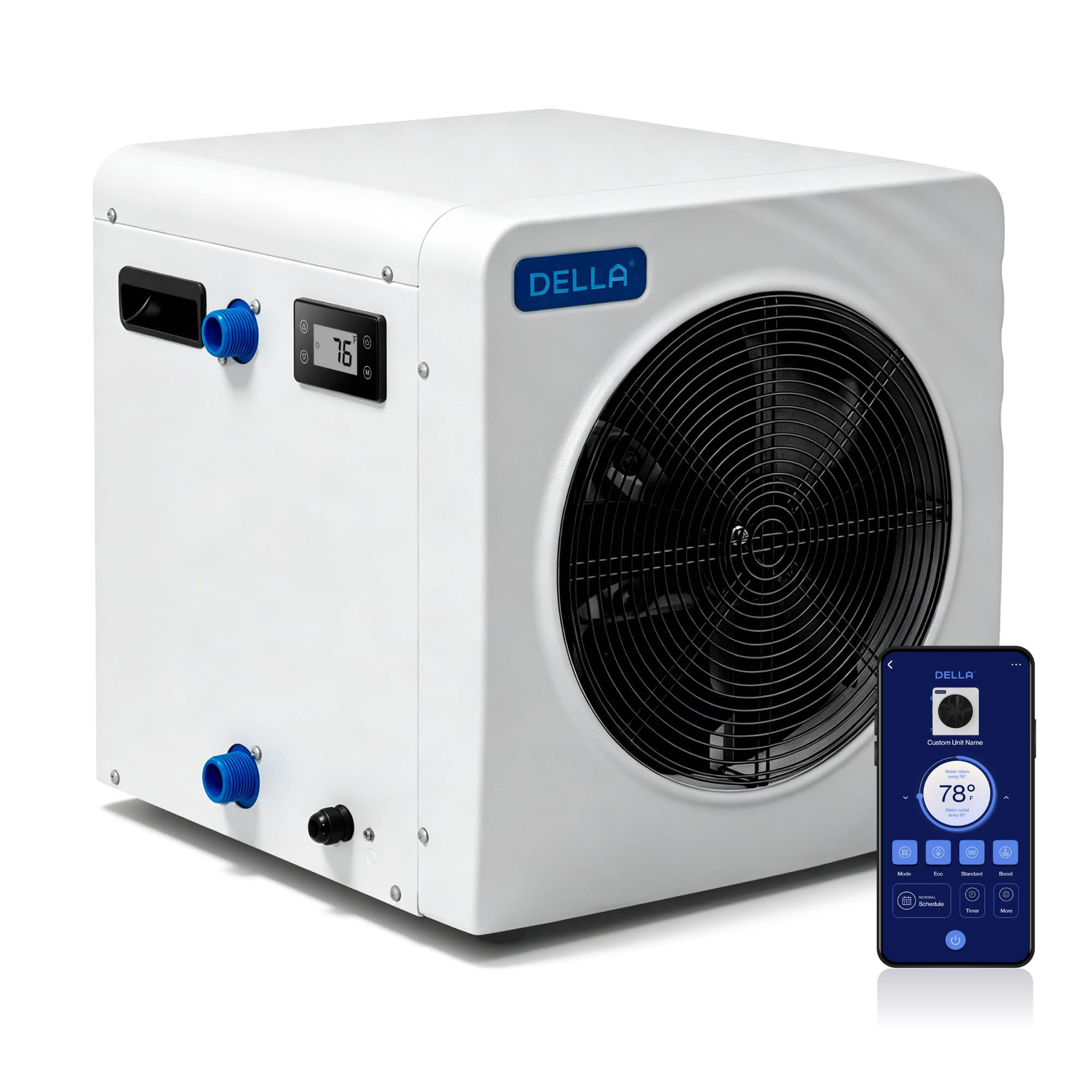
The 21,000 BTU inverter that covers the most water on household power.
If your pool is on the larger side of small, this is the unit that reaches it. It is rated for up to 4,700 gallons outdoors without a cover, or 7,000 gallons with one — and it still runs on 110-120V power. The verified comparison shows it at 40% more capacity than the 5,000-gallon heat pump, and 59.5 pounds of weight makes it the lightest unit in this class. A DC inverter compressor adjusts output to hold temperature rather than slamming on and off, which is why it can carry the bigger gallon count.
The efficiency numbers are the most specific in the group: a certified 4.02 COP at 50°F ambient and 4.97 COP at 80.6°F. Read those as two temperatures on the same curve — warm air means high efficiency, cooler air means lower. The maker pitches up to 80% savings over gas or propane heating. It also chills, dropping water as low as 47°F for refreshing summer dips, and it handles both chlorinated and saltwater pools. Built-in WiFi works with Alexa and Google Home across Heating, Cooling, Auto, Boost, and ECO modes, plus multi-unit sync and RS485 integration.
It runs quiet at 48 dB(A), carries an IPX4 waterproof rating (splash-resistant, not submersible), and claims CEC and FCC certification. One limit worth knowing: it does not heat reliably below 41°F ambient, so this is a three-season unit, not a winter solution. The 2-year parts warranty and 10-year compressor and heat exchanger warranty are a strong support package. This is the pick when your small pool is on the top end and you want the heat and the chill.
Best match for: covered pools in the 7,000-gallon range where heat and cool both matter and you have a standard outlet.
Not for: deep-winter use below 41°F ambient — this is built for three-season comfort.
7. 6,500 Gallons Above Ground Pool Heater 110V
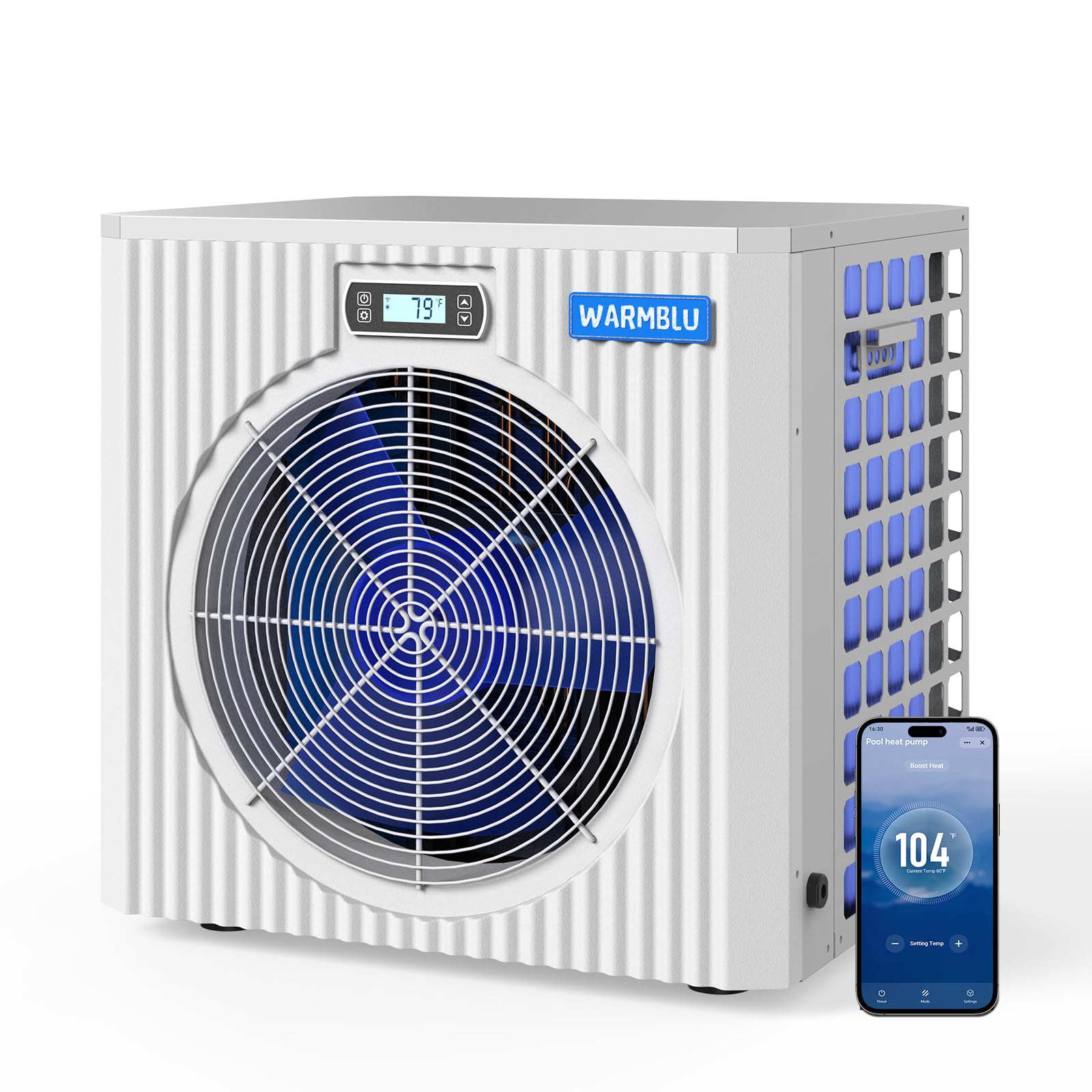
An industry-topping COP of 5.2 for a 6,500-gallon above-ground pool.
A COP of 5.2 is the number that stops your scroll — it is the highest in this list and beats the DELLA’s 4.97 at 80.6°F on the specification sheet. Behind it sits a pure titanium heat exchanger built to resist corrosion, rated for a pool up to 6,500 gallons on standard 110V power. The intelligent inverter chip and dynamic algorithm adjust output constantly to hold your target temp.
It heats and it does not announce itself. Sub-50 dB operation puts it quieter than a standard fridge, so the pool remains the sound in the yard. Water and electrical components are fully separated in the design, and control comes from either a mobile app or a touch panel mounted at the house. The 12-month warranty and the maker’s dedicated support line round out the ownership package. Weight is 91.8 pounds, so plan the install spot before it arrives.
The trade-off is the warranty term: 12 months is shorter than the DELLA’s 2-year parts and 10-year compressor coverage. If efficiency is the priority and you want your monthly running cost minimized, this unit fits a 6,500-gallon above-ground pool well.
Efficiency and quiet: the highest COP in the group paired with sub-50 dB operation is a rare pairing — you pay less to run it and you barely hear it.
What the shorter warranty means: figure out the coverage you are comfortable with before choosing the cheaper-running unit.
It suits: efficiency-first owners with a 6,500-gallon above-ground pool and a solid power outlet.
Reconsider if: you want a long warranty term covering both parts and the compressor.
8. Raypak Crosswind 30i Pool Heat Pump
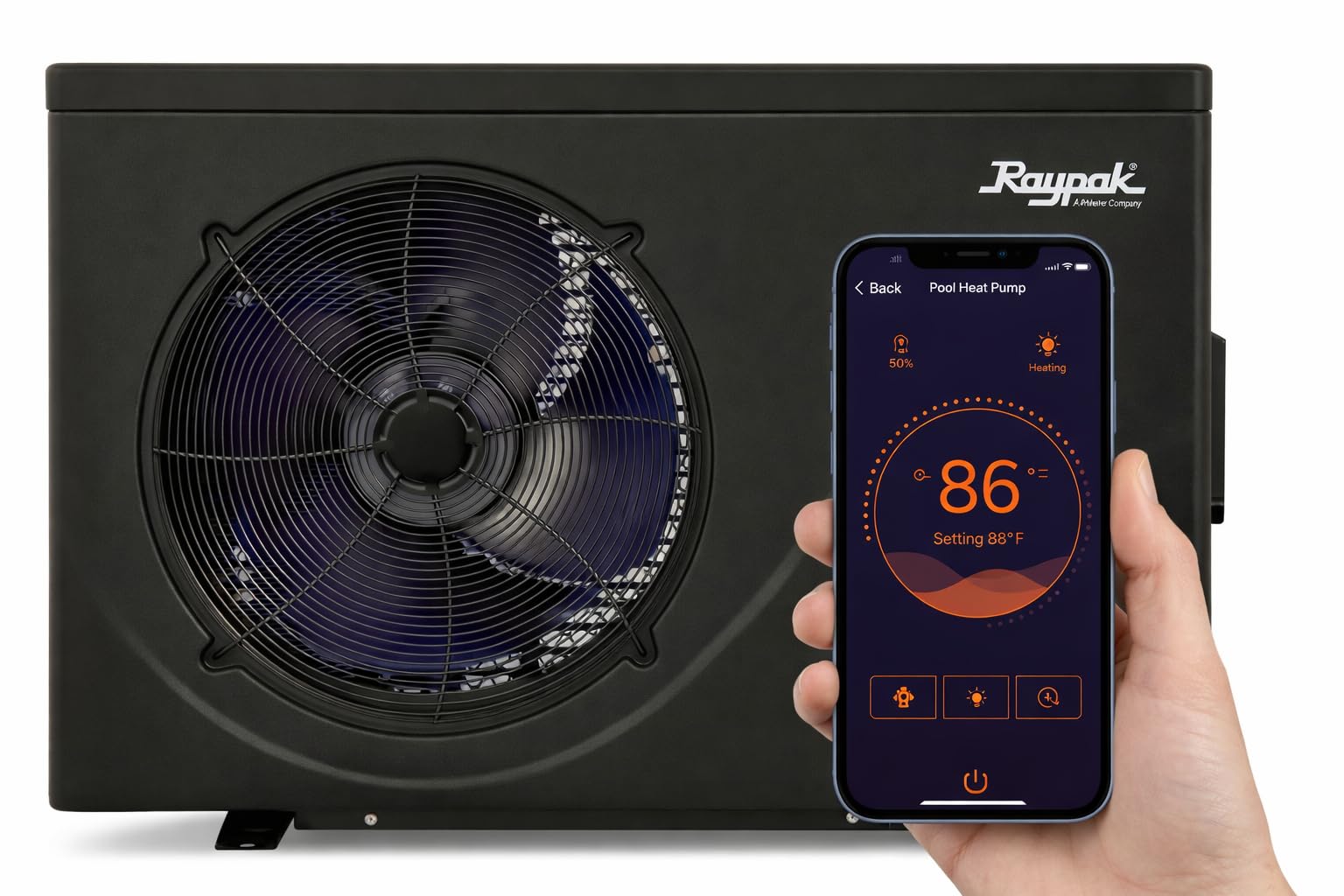
A 28,000 BTU inverter for inground pools that want heat and chill together.
This is when you step up to hard-wired power. The Crosswind 30i runs 28,000 BTU on 208/230V hard-wired service, so this is the point where you plan the electrical circuit, not just plug it in. It is rated for pools up to 7,500 gallons, works as both a heater and a chiller, and uses an inverter compressor with a titanium heat exchanger. If you need to cool southern summer water as much as warm winter water, this unit is in its element.
Temperature control is where it earns its stripes. Owners mention a 13-degree rise across three days, and the unit runs quietly enough that your pool pump dominates the sound. A LCD display with digital control makes the settings legible by the pool. On the effectiveness and quality fronts, it holds up well — the build quality is what gets highlighted most in the pattern of owner feedback, and owners describe it as a great deal for what it does.
The one installation caveat is well worth reading closely: setup guidance is mixed, and some find the directions less than clear. Plan on reading the manual twice and having your electrician line up the 208/230V circuit. That is the right move for a hard-wired heat pump. Get those pieces in order and the 59.9-pound Crosswind 30i earns its spot for an inground pool.
The Case For It
- 28,000 BTU heat and chill on a titanium exchanger
- Rated for pools up to 7,500 gallons
- Holds and raises temperature effectively
- Quiet enough that the pool pump takes over the soundtrack
The Friction Point
- Requires a 208/230V hard-wired circuit and electrician
- Instructions are mixed quality — read carefully
Built for: an inground pool up to 7,500 gallons with a dedicated 208/230V circuit already in play.
Not for: plug-in-only setups — this unit expects a hard-wired line.
9. Raypak Crosswind 40i Pool Heat Pump
The largest-capacity unit here, built for pools the others cannot reach.
The Crosswind 40i is the biggest unit in this guide: 33,000 BTU, rated for up to 9,000 gallons, a step above the Crosswind 30i’s 28,000 BTU and 7,500 gallons. A spiral titanium heat exchanger (a corrosion-resistant coil that transfers heat to your water) plus an inverter compressor and low-speed fan motor handle the load quietly. Like its sibling it heats and chills, runs on a 208/230V hard-wired line, and carries the LCD digital control panel. At 124 pounds, this needs a solid, level pad and some planning.
What rises to the top in owner experience is simple effectiveness. Owners describe it maintaining temperature nicely and raising the water in large inground pools, and the quiet operation is a repeated point — your pool pump’s hum will drown out the heat pump itself. A quick heating speed lands well too, along with a connectivity feature set that owners use with smart home gear. The upside is a unit that handles serious water volume without cutting into the peace of the yard.
Be clear about the audience for this one. It is a hard-wired machine for large inground water, and it wants a dedicated circuit and an electrician on install day. If your pool is above-ground and modest, the lighter 110-120V picks above are the better match. If you have 9,000 gallons and a proper electrical setup, this is the unit that can move the water that others cannot.
Its place in the lineup: 33,000 BTU is the muscle to reach 9,000 gallons — no other unit here goes that far.
The line to read twice: 208/230V hard-wired power and 124 pounds mean this is an install-day project, not a set-down-and-plug-in job.
Right for: a large inground pool with a dedicated circuit and space for a 124-pound unit.
Wrong for: a modest above-ground pool — the lighter plug-in picks are the better fit.
Know the Specs
BTU Rating
BTU stands for British thermal unit — a measure of how much heat the unit moves per hour. Bigger BTU means faster heating of a given water volume. An 18,000 BTU model handles a 5,200-gallon pool, while a 33,000 BTU unit carries 9,000 gallons. Match BTU to your gallon count so you are not paying to heat water you are not swimming in.
COP Efficiency
COP (coefficient of performance) tells you how many units of heat the pump moves for each unit of electricity it uses. Higher is better for your bill. The units here range from 4.1 up to 5.2, and efficiency drops as the outside air cools — the DELLA model shows this clearly with a 4.02 COP at 50°F and a 4.97 COP at 80.6°F.
Outlet Type
A 110-120V unit plugs into a standard household outlet, so no electrician and no dedicated circuit. A 208/230V unit is hard-wired and needs a dedicated circuit. For a small pool, 110-120V is the easy route. Check your outlet and breaker before choosing, because a circuit that trips when the compressor starts will stop you cold.
Flow Rate and Pump Sizing
Heat pumps need steady water flow to transfer heat. The maker guidance on these units calls for a pump pushing 700-1,000 GPH. Kinked hoses, clogged filters, or a failing bypass valve choke the flow and drop heating performance. Confirm your pump’s gallons-per-hour rating before you buy any heat pump on this list.
Common Questions
How many BTU do I need for a small above-ground pool?
Will a 110V pool heat pump run on a normal household outlet?
What does COP mean on a pool heat pump?
Can a solar pool heater replace a heat pump?
What pump flow rate does a small pool heat pump need?
Why is water dripping from the bottom of my heat pump?
Does a pool heat pump also cool the water?
How quiet is a small pool heat pump at night?
Does a pool cover really improve heat pump efficiency?
Can I install a small pool heat pump myself?
The Bottom Line
For most small-pool owners, the small pool heating system winner is the 18450 BTU Above Ground Pool Heater because it matches the typical 10-to-14-foot pool on standard household power, holds steady temperature for night swims, and runs quietly. If efficiency at the lowest running cost is your goal, the 6,500 Gallon 110V Heater carries the highest COP here at 5.2. And if you cannot run power to the pool at all, the FAFCO Solar Bear adds heat with no electricity and a 20.3-pound carry. It holds 4.5+ stars across 200+ ratings, and its plug-in convenience is why most small-pool buyers land there first.
How we choose
We do not accept paid placement. Every pick is matched to a real buyer and a real use-case; we do not hands-on test units.
Sources
Specifications: manufacturer listings and product documentation. Review insights: verified customer reviews, as of November 2026. Pricing: not shown on this page (it changes often); check the current price via the retailer link.
As an Amazon Associate, Tactical Gear Guy earns from qualifying purchases. This does not affect which products we feature.