Specs are compiled from manufacturer listings and verified buyer reviews and can change over time — please confirm the key details on the product page before buying.
You want a soundbar that fits under your TV without hiding the screen or blocking the remote sensor — and still sounds like something worth owning. A slim bar fixes the fit problem; the picks below fix the sound problem too. One honest note before you read: this list uses flexible matching for the ultra-slim / low-profile form factor (thin height, roughly under 2 inches, built to sit below a TV without blocking the screen). So not every pick is the exact size you typed into the search box — the nearest same-type size and wattage does the same job.
This guide is built by comparing the manufacturers’ published specifications and the patterns across verified customer reviews, so you get each pick’s real strengths and trade-offs instead of marketing spin.
Below you’ll see which bars clear a low TV stand, which ones actually produce bass, and which inputs your set needs. The picks below are the strongest ultra slim soundbars for tight TV stands and shallow shelves.
Top Picks


How To Choose The Best Ultra Slim Soundbar
The bar has to fit first and sound good second — that order is not negotiable when your TV sits on a low stand. A bar that covers the screen’s bottom edge or the IR sensor ruins the picture you bought it to improve.
Start with the height, not the wattage
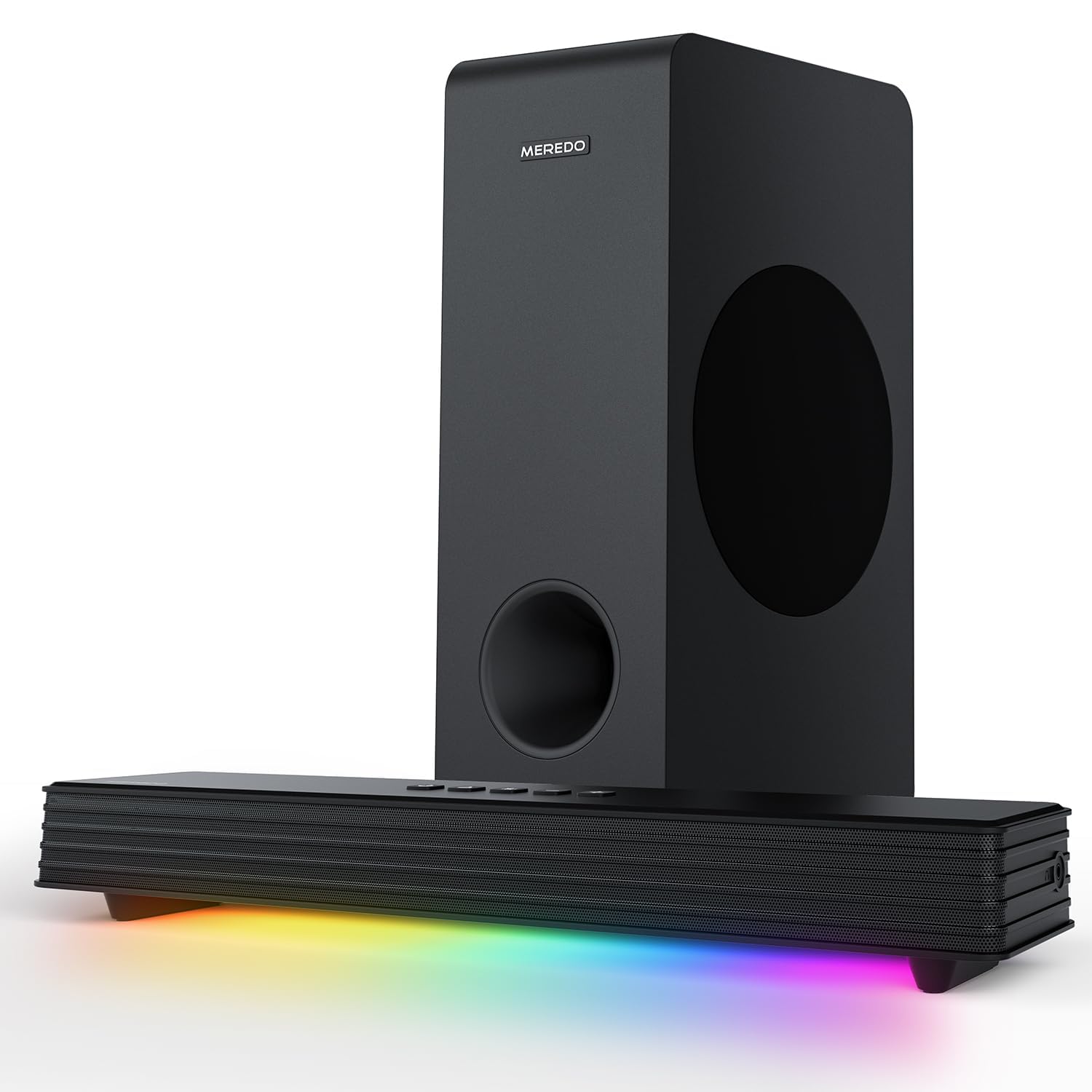
Measure the gap between your TV’s bottom edge and the furniture surface before anything else. A bar around 2 inches tall is the usual ceiling for clearing a screen and its remote sensor. The Polk Signa S2 sits at just over 2 inches; the MEREDO G38 cuts that to 1.6 inches for tighter desks and shelves. Neither number is vanity — it decides whether your TV remote still works.
Decide how much bass you can physically house
Bass needs a box, and the box is never slim. Some bars ship with a wireless subwoofer you can tuck beside the couch, like the Polk Signa S2 and the TCL A65K. Others use a wired subwoofer, like the INFITBO and the MEREDO G38, which means a cable run to wherever it sits. Some, like the JBL Bar 2.0 and both Bose TV Speakers, are all-in-one with no separate subwoofer at all. Pick the arrangement your room can actually accept.
Match the connection to your TV’s ports
HDMI ARC or eARC carries sound both ways over one cable and lets your TV remote control the bar’s volume. Optical is the reliable fallback on older sets. USB audio is the neat trick for desktop PCs and compatible PS5 consoles, since the bar acts as the computer’s sound card. Bluetooth handles phone and tablet streaming but is not the input you want for lip-synced movies.
Read the channel count as a layout, not a score
A 2.0 bar has left and right. A 3.1.2 adds a dedicated center channel, one subwoofer, and two up-firing height channels for overhead effects. More channels mean more drivers and, usually, a taller or wider cabinet. If dialogue clarity is your complaint, a dedicated center channel does more for you than a bigger wattage number.
Side-by-Side Comparison
| Model | Best For | Height / Profile | Channels | Key Connection | Amazon |
|---|---|---|---|---|---|
| Polk Audio Signa S2★ Best Overall | Living-room movies with real bass | Just over 2″ | 2.1 with wireless sub | HDMI ARC, optical, AUX, Bluetooth | Amazon |
| INFITBO Detachable 2-in-1Most Versatile | Gaming desks and small rooms | Just over 2″ in bar mode | 2.1 with wired 12L sub | HD-ARC, optical, AUX, USB, BT5.4 | Amazon |
| MEREDO G38 DesktopDesktop Favorite | Shallow PC desks and shelves | 1.6″ | 2.1 with 5″ wired sub | HD-ARC, optical, AUX, USB, BT5.3 | Amazon |
| JBL Bar 2.0 All-in-One (MK2) | One-box simplicity, no subwoofer | Low-profile compact | 2.0 all-in-one | Bluetooth | Amazon |
| Bose TV Speaker | Hearing dialogue clearly | Just over 2″ | 2.0 all-in-one | HDMI ARC, optical, AUX, Bluetooth | Amazon |
| Bose TV Speaker (2nd Gen) | Speech-first listening with Atmos | Just over 2″ | All-in-one with center tweeter | HDMI ARC, optical, Bluetooth | Amazon |
| TCL A65K by Bang & Olufsen | Full Atmos cinema on a slim bar | 2.05″ | 3.1.2 with wireless sub | HDMI eARC, USB, Bluetooth, Wi-Fi | Amazon |
| Samsung S700D | Samsung TV owners wanting wireless Atmos | Ultra-slim low-profile | 3.1 with wireless Atmos | Wireless Dolby Atmos, Bluetooth, Wi-Fi | Amazon |
| Samsung HW-S801B | Full 3.1.2 Atmos in a white slim bar | Ultra-slim low-profile | 3.1.2 with up-firing channels | Wireless Dolby Atmos, Bluetooth, Wi-Fi | Amazon |
Detailed Reviews
1. Polk Audio Signa S2 Sound Bar
Our pick — 4.0+★ from 21,500+ verified ratings; the strongest balance of quality and price.
Five full-range drivers and a wireless sub, in a bar that clears your screen
This is the bar that stops a slim soundbar from sounding slim. Polk fits five full-range drivers into a cabinet just over 2 inches tall, and pairs them with a wireless subwoofer so the bass comes from a box you can hide across the room. That height matters: it is short enough to sit in front of your TV without covering the bottom edge or the IR sensor, which is where most chunky bars fail.
What wins people over is the sound, which is the thing owners talk about far more than anything else on this bar. Polk’s VoiceAdjust technology works alongside Dolby Digital decoding to pull voices forward, so mumbled dialogue lands where you can hear it. Music streaming arrives over built-in Bluetooth with a 10-meter range — noticeably shorter than the MEREDO G38 at 15 meters, so keep your phone in the same room. Setup is genuinely quick, since the box includes a 5-foot HDMI cable and a 5-foot optical cable, plus both power cords.
The catch is the remote. It is the one part of this package that draws steady criticism, with complaints about range — working only from about 3 feet away — and general fiddliness. Bluetooth is also a mixed bag: phones pair fine, but the subwoofer does not always stay connected for everyone. A few units arrive and stop working altogether, which is the normal risk with any powered audio gear, but it is why reliability reads mixed rather than glowing.
Where the Polk earns its place
- Just over 2 inches tall, so it sits below the TV without blocking the screen or remote sensor
- Wireless subwoofer included — no cable run to the bass box
- VoiceAdjust plus Dolby Digital decoding keeps dialogue intelligible
- HDMI, ARC optical, and AUX inputs plus Bluetooth streaming, with both cables in the box
What to weigh before you buy
- The remote is the weak link — buyers report it only working from around 3 feet
- Bluetooth pairing is fine, but the subwoofer does not always stay connected
- A small share of units fail outright, the usual risk with powered audio gear
Reach for this if: you want a slim bar with genuine bass and a wireless sub you can tuck away, for movies and shows night after night.
Think twice if: you lean on the remote or stream music from across the house — plan to use your TV remote and keep the phone close.
2. INFITBO Detachable Soundbar
One bar that splits into two towers when your desk layout changes
Three shapes out of one box: a 32-inch bar under the screen, two separate speaker towers either side of a monitor, or a wall-mounted bar. It is the only pick here that reconfigures into three shapes rather than just relocating. In bar mode the cabinet is just over 2 inches high, so it still clears many TV screens and IR sensors.
The bass comes from a 12-liter wired subwoofer with a 5.25-inch driver — the same 5.25-inch driver size as the Polk Signa S2, though this one is wired, so you need a cable path from bar to sub. Peak system output is 180W, delivered through racetrack drivers with independent treble and bass controls. Three EQ modes let you flip between movies, music, and games without leaving the couch. The subwoofer’s driver is also slightly larger than the 5-inch unit in the MEREDO G38.
Read the fine print before buying: every connection between the bar sections and the subwoofer is wired, not wireless, which is how it keeps latency (audio delay) low. There is no Dolby decoding (the format most streaming apps send), so set your TV’s audio output to PCM (plain stereo). You get five audio inputs — HD-ARC (the HDMI audio-return channel), optical, AUX, USB audio, and BT5.4 (Bluetooth 5.4) — and USB audio is the standout for desktop PCs and compatible PS5 consoles, because the bar becomes the computer’s sound card with no extra hardware. It suits bedrooms and small living rooms best; owners mention the sound earns praise and the setup nearly universal approval. The honest caveat: a 12L wired subwoofer and cable reach need a plan before checkout.
What the split design buys you: one system that works as a TV bar, a desktop pair beside a monitor, or a wall mount — with 180W peak output (loudness headroom), a 5.25-inch wired sub (the bass driver), and USB audio for PC and PS5.
The part to plan around: no Dolby support and fully wired subwoofer connections, so confirm your TV (or PC) supports ARC or USB audio and measure your cable runs first.
Best fit: gamers and small-room viewers who want one system to serve a TV and a desktop and don’t mind cables.
Not for you if: your TV outputs Dolby-encoded audio and you won’t switch it to PCM, or you wanted a wireless subwoofer.
3. MEREDO Desktop PC Soundbar
Shorter than a keyboard, 1.6 inches tall, and built for a cramped desk
Fifteen-point-nine inches long and 1.6 inches high — that is shorter than a standard keyboard and low enough to slide beneath most monitors without eating desk space.
Gamers and shelf-bound setups get real bass here, and the lighting is a deliberate part of the appeal rather than an afterthought — seven colors, four dynamic modes, and two brightness levels, all on the remote without an app. Left and right Type-C outputs support optional LED light bars that react to each channel’s volume, though those bars must come from the same brand. Inputs cover HD-ARC (the HDMI audio-return channel), optical, AUX, USB audio, and BT5.3 (Bluetooth 5.3), with a 15-meter Bluetooth range that beats the Polk Signa S2’s 10 meters — useful if your phone roams. USB audio doubles as a direct PC sound card, and the same port serves a compatible PS5.
The honest tension is durability. Bass and value earn consistent praise, but a slice of customers note units dying within a few months, and reliability is genuinely split. Set it up with room to breathe and know your return window. The 12-to-18V DC input also suits compatible RV and mobile power setups, and the matte-coated housing keeps it from looking like a cheap accessory on a nice desk.
The case for the G38
- 1.6-inch height and 15.9-inch length fit beneath most monitors and low shelves
- Five drivers including a 5-inch wired subwoofer push 160W peak with bass and treble controls
- RGB lighting with seven colors, four modes, and remote control — no app needed
- USB audio for PCs and compatible PS5, plus 15-meter Bluetooth range
The trade-off to know
- Subwoofer is wired, so plan a cable path to wherever it sits
- No Dolby or DTS support, and ARC needs an ARC or eARC port on your TV
- Durability is the recurring weak spot — a share of units fail within months
Pick it for: a gaming desk or small shelf where every inch counts and you want bass plus lighting without a second power brick.
Look elsewhere if: you need long-term reliability above all, or your TV lacks an ARC port and you don’t want to use optical.
4. JBL Bar 2.0 All-in-one (MK2)

A two-channel bar that tries to do bass without a bass box
If a separate subwoofer simply will not fit in your room, this is the pick that asks you to give one up. It is a 2.0 all-in-one with no separate bass box, driven by a 6.35-centimeter dynamic driver and built-in Dolby Digital for a cinema-style soundtrack. JBL Surround Sound spreads the mix wider without extra speakers, and Bluetooth handles phone and tablet streaming.
Owners consistently call it a smart budget buy, and setup takes minutes. The low-profile cabinet sits in front of the TV as intended. But sound quality is the most-discussed topic here and it splits cleanly: some hear clear, great audio, others say it never sounds like the surround system the marketing implies. Volume draws the same split, with reports of fluctuating levels. And there are almost no adjustment options, with no way to tune the bass at all.
Treat it as a straightforward upgrade over thin TV speakers for a medium room, not a home-theater replacement. If you want adjustable bass or true surround, this bar will frustrate you — those are the exact things it lacks. If you want one compact box, a short setup, and a familiar audio brand name on the front, it delivers that at an entry-level price.
Straight read: a 2.0 all-in-one with Dolby Digital and JBL Surround Sound, valued for its price and easy setup, in a low-profile cabinet that disappears in front of the screen.
Suits you if: you refuse a subwoofer in the room and want a simple, budget-friendly bar that beats built-in TV audio.
Pass if: you expect adjustable bass or genuine surround — this bar has neither, and owners notice.
5. Bose TV Speaker
Two angled drivers tuned to make mumbled dialogue audible again
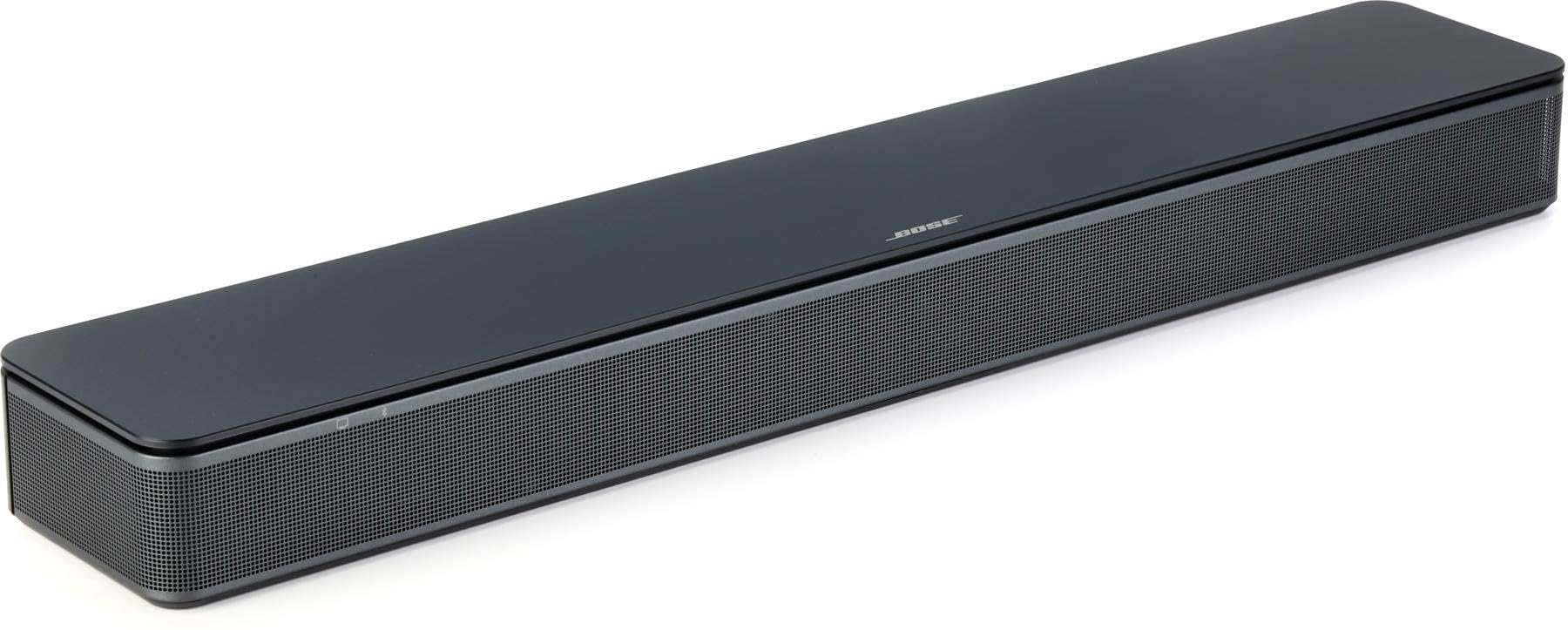
Two angled full-range drivers are the heart of this bar, positioned to spread a wider, more natural soundstage from a cabinet just over 2 inches tall. Bose built it around a single complaint — you cannot hear what people are saying — and the dialogue mode raises speech over background sound. That height also keeps it below your TV’s bottom edge and remote sensor, and you can wall-mount it with brackets sold separately.
What owners praise most is clarity, with dialogue and general TV sound the consistent theme. Setup is genuinely simple: one optical cable (included) or an HDMI cable (sold separately) gets you running, and the bar can hold up to three connected devices, with the first one powered on taking over automatically. Bluetooth streams music and podcasts from your phone. You can add a Bose Bass Module 500 or 700 later for more low end, using a connection cable or a standard 3.5 mm audio cable, both sold separately.
The real caveat is long-term dependability. Reliability is the strongest negative signal on this bar, with reports of units quitting after just a few hours of use, and Bluetooth that disconnects rather than staying paired. That is a meaningful risk on a premium-positioned bar. Owners who get a good unit love it; the ones who don’t are loud about it. Buy from a seller with an easy return path.
What Bose nailed
- Dialogue mode and angled drivers make speech the star
- Just over 2 inches tall — clears the screen and IR sensor, wall-mount ready
- Optical cable in the box; HDMI-ARC or optical for one-cable hookups
- Expandable with a Bose Bass Module 500 or 700 later
What gives pause
- Reliability is the loudest negative — some units stop working within hours
- Bluetooth can drop out instead of holding a steady connection
- No subwoofer included — deep bass means buying a Bose module separately
Choose this when: dialogue is your daily frustration and you want a small bar that makes voices clear without a separate sub.
Look elsewhere when: you need bulletproof reliability or room-shaking bass from the start — this bar is a speech specialist.
6. Bose TV Speaker (2nd Gen)
A dedicated center tweeter that takes speech seriously
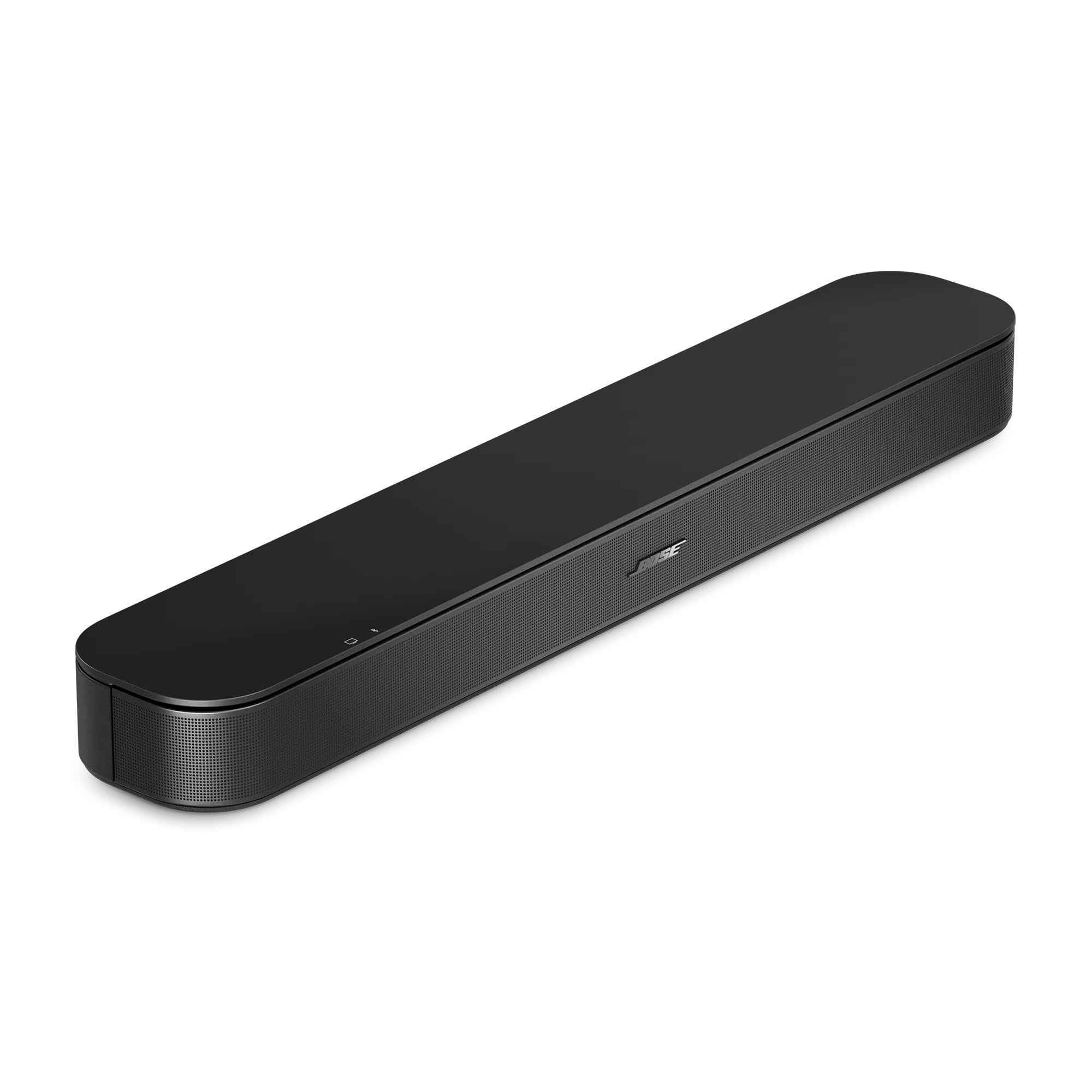
The 2nd Gen puts a center tweeter front and center, with left and right drivers angled out to widen the soundstage and deepen bass beyond the first-generation bar. Bose’s proprietary Dialogue Mode is the headline feature: it lifts vocals above background sound, so a whispered line in a quiet scene still arrives clearly. It is the most focused speech tool on this list, and it throws in Dolby Atmos for good measure.
Owners describe exactly that — speech that cuts through and a sound that improves everyday watching, with setup rated near-unanimous for ease. Use the included HDMI cable and you are running in seconds; optical works too if you supply the cable. Bass boost on the remote adds depth without a subwoofer, and the bar is expandable with a Bose Bass Module 700 or Bose Lifestyle Ultra Subwoofer via a connection cable or standard 3.5 mm cable, both sold separately.
Here’s the honest part: this is the youngest bar in the guide with the smallest track record, so the long-term picture is still forming. It is also an all-in-one, so bass stays modest unless you add a module. For dialogue-first viewers upgrading from thin TV speakers, though, it does one job exceptionally well.
Why it stands out: a center tweeter plus Dialogue Mode makes speech-heavy shows and films easy to follow, with Dolby Atmos and bass boost on the included remote.
The limit to accept: no separate subwoofer and a short review history — deep bass and long-term confidence both require buying or waiting.
Matches you if: clear speech is the whole point and you want Atmos and a slim cabinet without a bass box in the room.
Not the one if: you want proven longevity or serious low end without adding a Bose module.
7. TCL Design Series Bang & Olufsen A65K Sound Bar
Bang & Olufsen tuning and 460W of headroom in a 2.05-inch cabinet
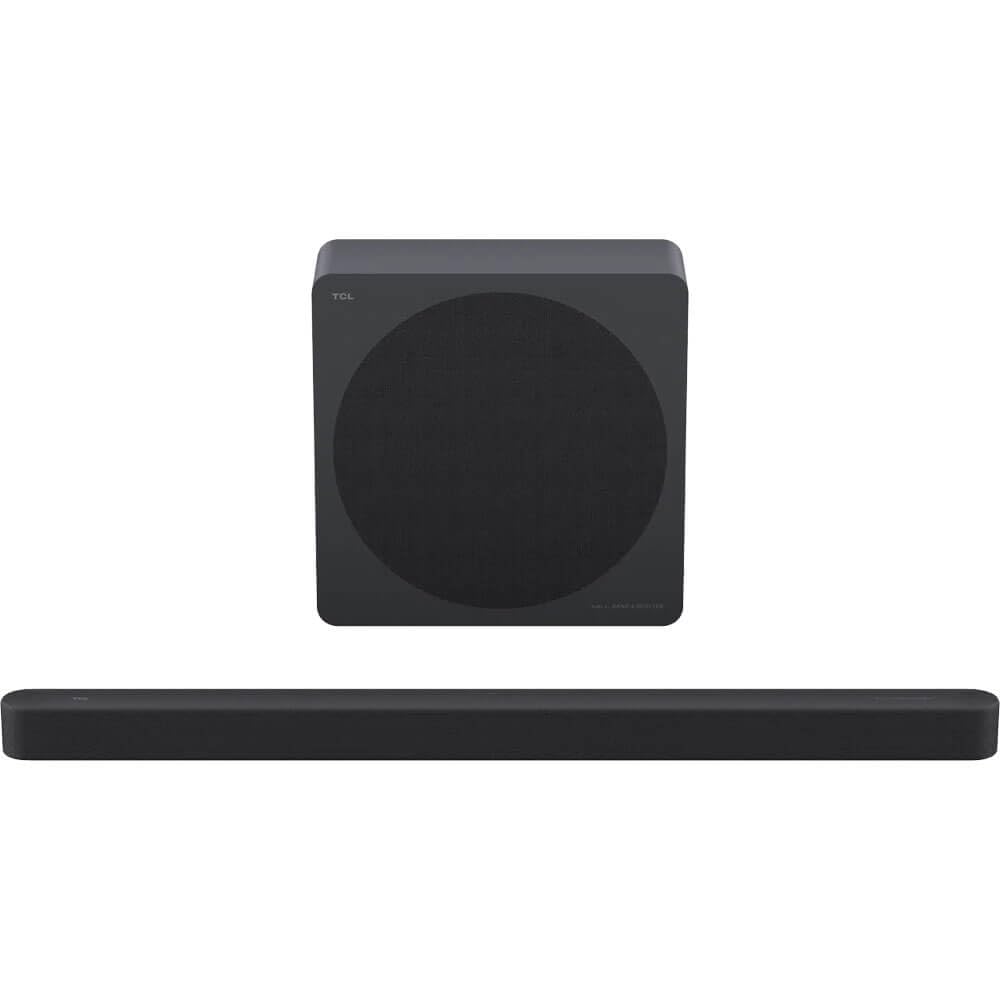
This is a true 3.1.2 layout: dedicated left, right, and center channels, a subwoofer, and dual up-firing height channels that bounce sound off your ceiling for overhead effects. The tuning comes from Bang & Olufsen, and the total system power reaches up to 460 watts — the highest peak figure on this list, by a wide margin. And it still fits at 2.05 inches tall.
Dolby Atmos and DTS:X handle the 3D audio, while the built-in center channel keeps voices crisp and the wireless subwoofer adds low end with a Bass Boost mode. AI Sonic Auto Calibration listens to your room layout and adjusts the audio to suit — handy in an awkward space. Connectivity covers HDMI eARC, USB, Bluetooth, and Wi-Fi, with Bluetooth for phone and tablet streaming. It is the full cinema package in a cabinet that plays nicely with slim, frame-style TVs.
Do note this is the newest bar here with a small review base, so the long-term verdict is still being written. Owners praise the sound and build quality and call it good value for what it delivers, but you are an early adopter of sorts. If you want a genuine spatial-atmos experience from a bar that hides below the TV, it earns the slot.
Performance highlights
- True 3.1.2 channels with dual up-firing height drivers and a center channel
- Bang & Olufsen tuning with Dolby Atmos and DTS:X 3D audio
- Up to 460 watts total power plus a wireless subwoofer with Bass Boost
- AI Sonic Auto Calibration adapts audio to your room
Before you commit
- Newest bar here — the long-term record is still short
- 2.05 inches tall is the deepest profile among the slimmer bars in this guide
- Full Atmos benefits depend on ceiling height and layout
Grab it for: a full Atmos and DTS:X cinema experience in a slim cabinet, tuned by a hi-fi name and calibrated to your room.
Wait if: you want a proven long track record rather than a brand-new model, or your ceiling and layout defeat height effects.
8. Samsung S700D Soundbar

Wireless Atmos that skips the HDMI cable entirely
A 3.1-channel layout with Dolby Atmos, built into a low-profile cabinet designed to blend into your room rather than shout at it. The standout spec is wireless Dolby Atmos: no HDMI cable between TV and bar, so the clutter disappears. If you own a Samsung TV, Q-Symphony lets the bar and the TV’s own speakers work as one — a feature no other pick can offer, because it needs both halves to be Samsung.
SpaceFit Sound Pro analyzes the room and tunes the audio to fit it, while Adaptive Sound pulls dialogue forward even at low volume — useful for late-night viewing. There is a dedicated Game Mode Pro with up-firing speakers and an acoustic beam that syncs with your onscreen action, and Active Voice Analyzer keeps commentary from getting buried. Smart services cover built-in Alexa, Chromecast, and AirPlay 2, and the box includes an HDMI cable, power adapter, remote, battery, and a wall-mount kit.
The honest limit: the biggest smart features only fully pay off inside Samsung’s ecosystem — Q-Symphony, in particular, is a Samsung-TV perk. If you own a different brand, you still get Atmos and Adaptive Sound, just not the speaker-merge trick. Owners praise the sound, especially the bass response, and the setup is reported as straightforward. Weigh it as a Samsung-household upgrade rather than a universal one.
Strongest argument: cable-free wireless Dolby Atmos (height-channel surround) plus Q-Symphony means a Samsung TV and this bar act as one system — the smoothest pairing in this guide.
The caveat to weigh: that headline pairing is Samsung-only, so a non-Samsung TV leaves the best feature on the table.
Ideal for: Samsung TV owners who want wireless Atmos, room-calibrated sound, and zero cable clutter.
Skip the idea if: your TV isn’t a Samsung — you’d pay for Q-Symphony and never use it.
9. Samsung HW-S801B/ZA Soundbar

Two up-firing channels in a white bar that hides in the décor
Where the S700D stops at 3.1, this bar goes full 3.1.2 — three channels, one subwoofer, and two up-firing channels that bounce overhead effects into the room. Dolby Atmos and DTS:X both run here, and the wireless Atmos means no HDMI cable to the TV. Owners are consistently surprised by how much sound comes out of something so slim — the compact size is described as deceiving.
The finish is white, which is unusual and suits light living rooms where black electronics stick out. Q-Symphony syncs it with a compatible Samsung TV, SpaceFit Sound calibrates the upper tones to your room, Game Pro Mode adds 3D audio for gaming, and AirPlay 2 (Apple’s wireless audio standard) pairs to a compatible iPhone or other iOS device for music. Reviewers point out setup as simple, and the box includes a remote, HDMI cable, and wall-mount kit.
The trade-offs are real but sized: this is the highest-positioned pick here, and the fit note is that connectivity draws mixed reports — some hookups work smoothly while others fail entirely. Confirm your TV’s output before you buy. If it pairs cleanly, you get a 3.1.2 Atmos bar (three front channels, one sub, two height channels) in a white cabinet that vanishes into a bright room, and that combination is rare.
Where it wins
- Full 3.1.2 layout with two up-firing channels for overhead sound
- White ultra-slim cabinet suits light rooms where black bars stand out
- Dolby Atmos and DTS:X, plus AirPlay 2 for iOS streaming
- Q-Symphony and SpaceFit Sound for Samsung TV owners
What to check first
- Connectivity splits owners — some pairings fail outright
- Premium positioning for a bar with a modest review base
- Best features tied to a compatible Samsung TV
Reach for it if: you want true 3.1.2 Atmos overheads in a white ultra-slim cabinet that matches a bright room, on a Samsung TV.
Hold off if: your TV brand is different or you want the most proven connection track record.
Know the Specs
Height and the under-2-inch ceiling
A bar’s height decides whether your TV remote and picture survive. When the cabinet sits above roughly 2 inches, it can cover your screen’s bottom edge or block the IR sensor that receives your remote — then the TV looks worse and the remote stops working. The Polk Signa S2 sits just over 2 inches, the MEREDO G38 drops to 1.6 inches, and the TCL A65K measures 2.05 inches. Measure the gap between your TV’s bottom edge and the stand before you commit.
Channels, peak watts, and what each means
Channel count describes speaker layout: 2.0 is left and right, while 3.1.2 adds a center channel, one subwoofer, and two up-firing height channels for overhead effects. Peak watts describe the maximum power the amplifier can push, not loudness you’ll actually hear — the TCL’s up-to-460W figure and the MEREDO’s 160W peak are both peak ratings. A dedicated center channel does more for dialogue clarity than a bigger wattage number ever will.
Wired versus wireless subwoofers
A subwoofer is the box that produces deep bass, and it is never slim. Wireless means it connects over the air, so you can tuck it beside the couch with only a power cord — the Polk Signa S2 and TCL A65K work this way. Wired means a cable runs from the bar to the sub, which locks placement but keeps latency low — the INFITBO and MEREDO G38 take this route. All-in-one bars like the JBL Bar 2.0 and both Bose TV Speakers skip the subwoofer entirely to keep the footprint small.
Inputs: HDMI ARC, optical, USB, and Bluetooth
HDMI ARC or eARC carries audio both directions over one cable and often lets your TV remote set the bar’s volume. Optical is the dependable fallback on older TVs. USB audio lets a bar act as a computer’s sound card — the INFITBO, MEREDO, and TCL all use it for PCs and compatible consoles. Bluetooth handles phone and tablet streaming, but it is not the input for lip-synced movie watching, since audio can drift out of step with the picture.
Common Questions
Will a slim soundbar block my TV’s remote sensor?
Do I need a subwoofer with an ultra slim soundbar?
What is the difference between 2.0, 3.1, and 3.1.2 channels?
Will this bar work with my older TV?
Can I mount a low-profile soundbar on the wall under my TV?
Is a soundbar with a wireless subwoofer worth it over a wired one?
Why does my soundbar cut out or disconnect from Bluetooth?
Do these slim soundbars support Dolby Atmos?
Can I add a separate subwoofer to an all-in-one bar later?
How high should a soundbar sit below the TV?
The Bottom Line
For most rooms, the ultra slim soundbar that gets the balance right is the Polk Audio Signa S2 — just over 2 inches tall, five drivers, and a wireless subwoofer that delivers the bass a slim cabinet cannot. At 4.0+ stars across 21,000+ owners, it earns that rating with sound rather than gimmicks.
If desk space is the real constraint, the MEREDO G38 at 1.6 inches and 15.9 inches long fits beneath a monitor where almost nothing else will. For gamers and small rooms that want one system to split into two towers, the INFITBO is the flexible one. And if dialogue is your daily frustration, the Bose TV Speaker 2nd Gen puts a center tweeter and Dialogue Mode squarely on the job.
One honest nudge before you click: start with height and inputs, not wattage. A bar that fits your stand and matches your TV’s ports will beat a louder one that blocks your screen or needs an adapter you don’t have. Pick the profile that clears your TV, then pick the sound you want.
How we choose
We do not accept paid placement. Every pick is matched to a real buyer and a real use-case; we do not hands-on test units.
Sources
Specifications: manufacturer listings and product documentation. Review insights: verified customer reviews, as of November 2026. Pricing: not shown on this page (it changes often); check the current price via the retailer link.
As an Amazon Associate, Tactical Gear Guy earns from qualifying purchases. This does not affect which products we feature.