Specs are compiled from manufacturer listings and verified buyer reviews and can change over time — please confirm the key details on the product page before buying.
Cold water at the kitchen sink is the small daily annoyance that pushes people to shop for a point-of-use heater, and the fix is simpler than the aisle makes it look. You are choosing between two designs: a small tank that stores hot water ready to pour, or a tankless box that heats water as it flows. Match the wattage to your circuit and the flow rate to your faucet, and you get hot water in seconds. Get them wrong and you will be waiting on a breaker, a plumber, or a lukewarm trickle. One small honesty note before we start: this list uses flexible matching for the under-counter point-of-use form factor, so a pick may be the nearest same-type size or wattage rather than the exact unit you typed into the search bar. Every one of them still mounts beneath a cabinet and serves a sink.
This guide is built by comparing the manufacturers’ published specifications and the patterns across verified customer reviews, so you get each pick’s real strengths and trade-offs instead of marketing spin.
The picks below split cleanly by design and by what each one asks of your breaker panel. The crowd favorite here is a 120V mini tank, not a 240V tankless unit. Here is how to pick the right under counter water heater for your sink, your wiring, and the way you actually use hot water.
Top Picks
How To Choose The Best Under Counter Water Heater
The first fork in the road is tank versus tankless, and it is not a style preference. A mini tank stores hot water in a small reservoir, so the water is already hot the moment you open the tap. A tankless unit heats water as it passes through, so there is no reservoir to run dry but the unit has to be powerful enough for the flow you want. Both fit under a cabinet. They do not fit the same electrical plan.
Check your circuit before you fall in love with a unit
Every heater here is electric, and the wattage number tells you how much power it draws. Mini tanks in this category typically run on 1300W to 1440W and plug into a standard 120V outlet, which is why they are the easy swap for a handy homeowner. The 6kW tankless units need 240V and hardwiring behind a breaker, so they are a job for someone comfortable with a panel. Decide which side of that line you are on first. It eliminates half the list immediately.
Match the flow rate to your faucet habits
Flow rate is measured in gallons per minute, or gpm — how much hot water the unit can deliver in a minute. A tankless unit rated for 1.07 gpm will give you hot water at that draw, and opening the tap wider cools the stream because the same heating power is spread across more water. A tank unit avoids that math because the water is already hot, but its stored supply eventually runs out. Think about whether you wash dishes with the tap wide open or in short bursts. Wide-open draws favor a tank; short bursts suit a tankless unit.
Size the tank to the job, not to the whole house
Tank capacity in this group runs from 1 gallon to 4 gallons. A 2.5-gallon tank is the common choice for a single bathroom or kitchen sink. A 4-gallon tank gives you more reserve for hand washing, food truck use, or an RV where several people wash up in a row. Remember that a tank is a storage device, not an endless source. Once the hot water is spent, you wait for it to recover, which is where a fast recovery rate and good insulation start to matter.
Plan the mounting and the plumbing connections
Most of these units can be wall mounted, and several can also sit on a shelf or the floor. Check the depth of your cabinet before you commit, because a tank with a 12.80-inch depth eats shelf space that a 2.52-inch tankless panel leaves free. On the plumbing side, the standard connection is 1/2″ NPT, which is the ordinary threaded fitting most sink supply lines use. Confirm the connection size and the valve hardware in the box so you are not making a second trip to the hardware store mid-install.
Side-by-Side Comparison
| Model | Best For | Heat Output | Capacity | Flow Rate | Amazon |
|---|---|---|---|---|---|
| CAMPLUX Tankless 6kW★ Best Overall | Endless hot water at one sink | 6 KW | 1.07 gallons | 1.5 gpm | Amazon |
| ThermoMate 6kW TanklessTightest Fit | Tight cabinets and salons | 6000 watts | 1 gallons | 1.07 gpm | Amazon |
| FOGATTI 4.0 Gallon Mini TankBest for RVs | Food trucks and RVs | 1440 watts | 4 gallons | 4 gpm | Amazon |
| Ecosmart ECO MINI 2.5 | Straight swap under a kitchen sink | 1440 watts | 2.5 gallons | — | Amazon |
| ThermoMate 2.5 Gallon | In-line boost to a big heater | 1440 watts | 2.5 gallons | 2.5 gpm | Amazon |
| Ariston Andris Mini Tank | Garages and utility sinks | 1440 watts | 4 gallons | — | Amazon |
| Rheem RTEX-06T | Precise temperature control | 105 °F | 1.4 gallons | 1.5 gpm | Amazon |
| Stiebel Eltron SHC 2.5 | Off-grid and outdoor setups | 1300 watts | 2.5 gallons | 2.5 gpm | Amazon |
| BOSCH Tronic 3000 T | Supplying two sinks at once | 1440 watts | 2.5 gallons | — | Amazon |
| Stiebel Eltron SHC 4 | Bigger reserve in a small box | 1300 watts | 4 gallons | — | Amazon |
Detailed Reviews
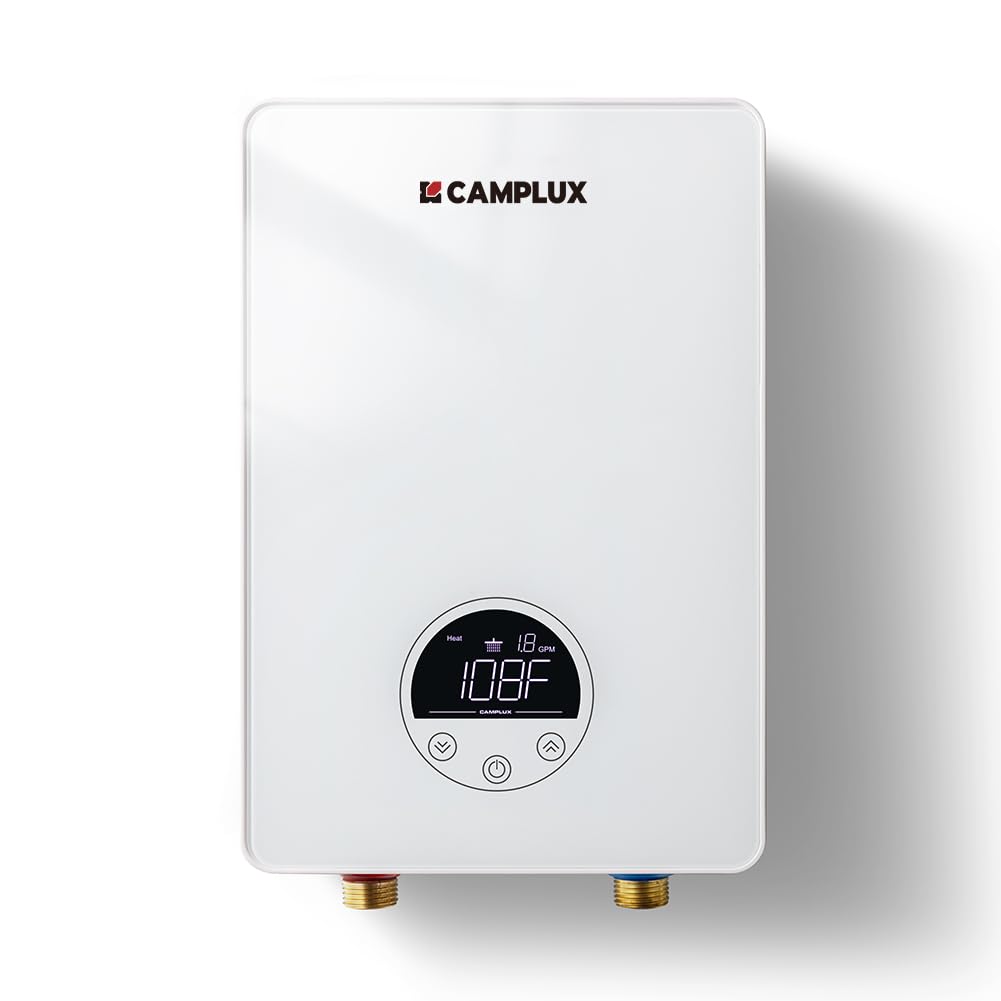
1. CAMPLUX Tankless Water Heater Electric 6kW
Hot water in three seconds, from a panel slimmer than a hardback book.
If you want the hot water to keep coming no matter how many pans you rinse, this is the one. The CAMPLUX runs a 6kW heating system — 6,000 watts of electric heating power — which lets it raise the temperature of 1.0 GPM of flowing water by 50°F and deliver water between 85°F and 131°F within 3 seconds of opening the tap. There is no tank to run dry, so the stream stays hot for as long as you keep the faucet open. It measures 10.95″ x 7.4″ x 2.52″, and that 2.52-inch depth is what makes it disappear behind the clutter under a small apartment sink.
The self-modulating design is the quiet hero here. Instead of firing at full power all the time, it reads your water flow and adjusts how much energy it spends heating, which the maker puts at up to 99.8% energy efficiency in consumption terms. It also keeps a real-time temperature display and an inlet flow readout on the touch panel, so you can see exactly what the unit is doing while you dial in a comfortable setting. The cast aluminum heating element is built to shrug off scale from hard water, and there is an auto-shutoff for overheat protection. CSA approval sits on the label as a safety certification.
Here is the catch, and it is a wiring catch rather than a performance one. This unit is 6kW at 240V and only works hardwired, so you need a 30A circuit breaker, 10AWG wire, and a 1/2″ NPT water connection before it will run at all. That is electrician territory for most people. It is also why the 3.9-pound weight is a bit misleading as a portability signal — the box is light, the install is not. The other thing to watch is how hard you push the tap: the 50°F temperature rise is measured at 1.0 GPM, so a wide-open faucet on very cold incoming water will feel cooler than a gentle draw. Backed by a 2-year limited warranty and 24/7 support.
Where it wins
- Endless hot water at 6kW — no tank to exhaust mid-wash
- 85°F to 131°F range reached in about 3 seconds
- Only 2.52 inches deep, so it tucks under a tight cabinet
- Self-modulating power use plus a live temperature and flow display
- Cast aluminum element resists hard-water scale
What it asks of you
- 240V hardwired only — 30A breaker and 10AWG wire required
- Opening the tap wide lowers the delivered temperature
- No stored reserve, so it is not a fit for an RV with no reliable 240V supply
Made for: a kitchen or utility sink with 240V service and a household that never wants to wait between loads.
Think twice if: your panel is full or you rent — the hardwired 240V requirement is a real hurdle, not a footnote.
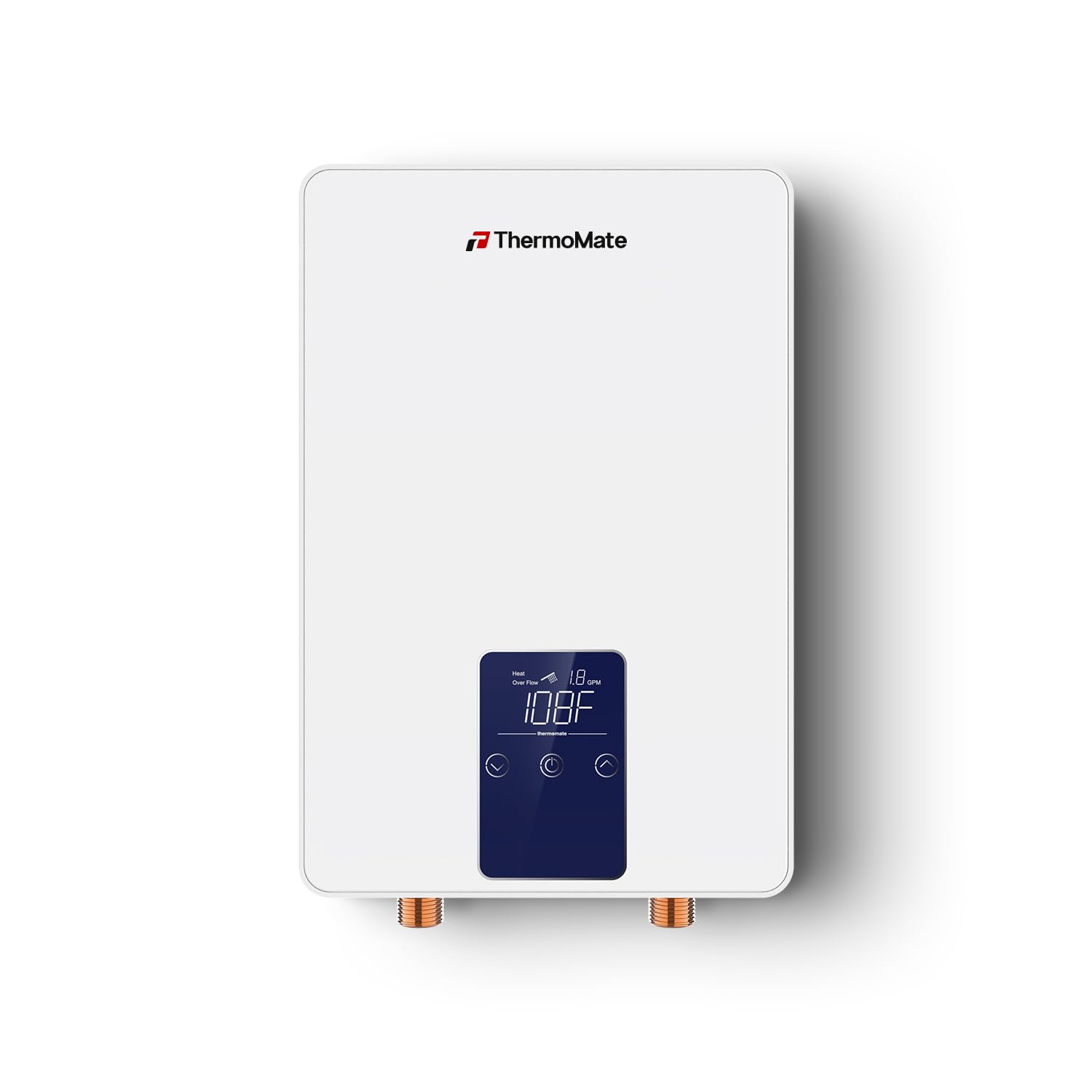
2. ThermoMate 6kW Tankless Water Heater
For the cabinet that has room for a serving plate and nothing else.
Where the CAMPLUX above brings more sheer heat to the sink, this ThermoMate matches it on paper in a package that slips into the same narrow slot. Both are 6kW tankless units at roughly 2.52 inches deep, and both are hardwired 240V designs. The difference shows up in the details. ThermoMate rates the heating element at 6000 watts, lists a 1.07 gpm flow at a 35°F temperature rise, and covers 85°F to 131°F, with a 24-hour standby mode and a 25-amp draw at 240V.
The engineering choice worth talking about is the heating element. The cast aluminum element sits separated from the water line, which the maker says cuts scale, corrosion, and mineral buildup, and it runs through a SUS 304 stainless steel water tube. If your tap water is hard, that separation between metal and water is the kind of design detail that protects the part that costs the most to replace. The touch panel lets you adjust in 1° increments and shows the temperature on a digital display, and the housing is rated IP25 for water resistance, so splashes from a nearby faucet are not an emergency. It arrives with mounting kits in the box and uses a standard 1/2″ NPT fitting with a pre-wired pigtail for the electrical hookup.
What holds this at 4.5+ stars rather than higher is the same obstacle every 6kW unit shares: it is 240V hardwired, needs a 30A circuit breaker with a minimum 10AWG wire, and will not run on a standard outlet. The listed dimensions of 10.96″ x 7.4″ x 2.52″ mean it fits under cabinets and sinks, at hair salons, behind bar counters, and in hotel reception areas — anywhere the space is the constraint. Reviews center on performance and build, with the unit described as working reliably and feeling well made. If you have the circuit and the cabinet is cramped, this is the size that wins.
Space first, heat second: a 2.52-inch depth panel that still delivers 6000 watts and a 1.07 gpm flow — ideal where a bulky tank simply will not go.
The honest trade: the 35°F rise rating is generous enough for hand washing and light dish duty, but expect to moderate the faucet on very cold supply water.
Reach for this if: your cabinet is measured in inches and you already have 240V service run to the sink.
Look elsewhere if: the panel work is out of reach — a 120V plug-in mini tank is the simpler route.
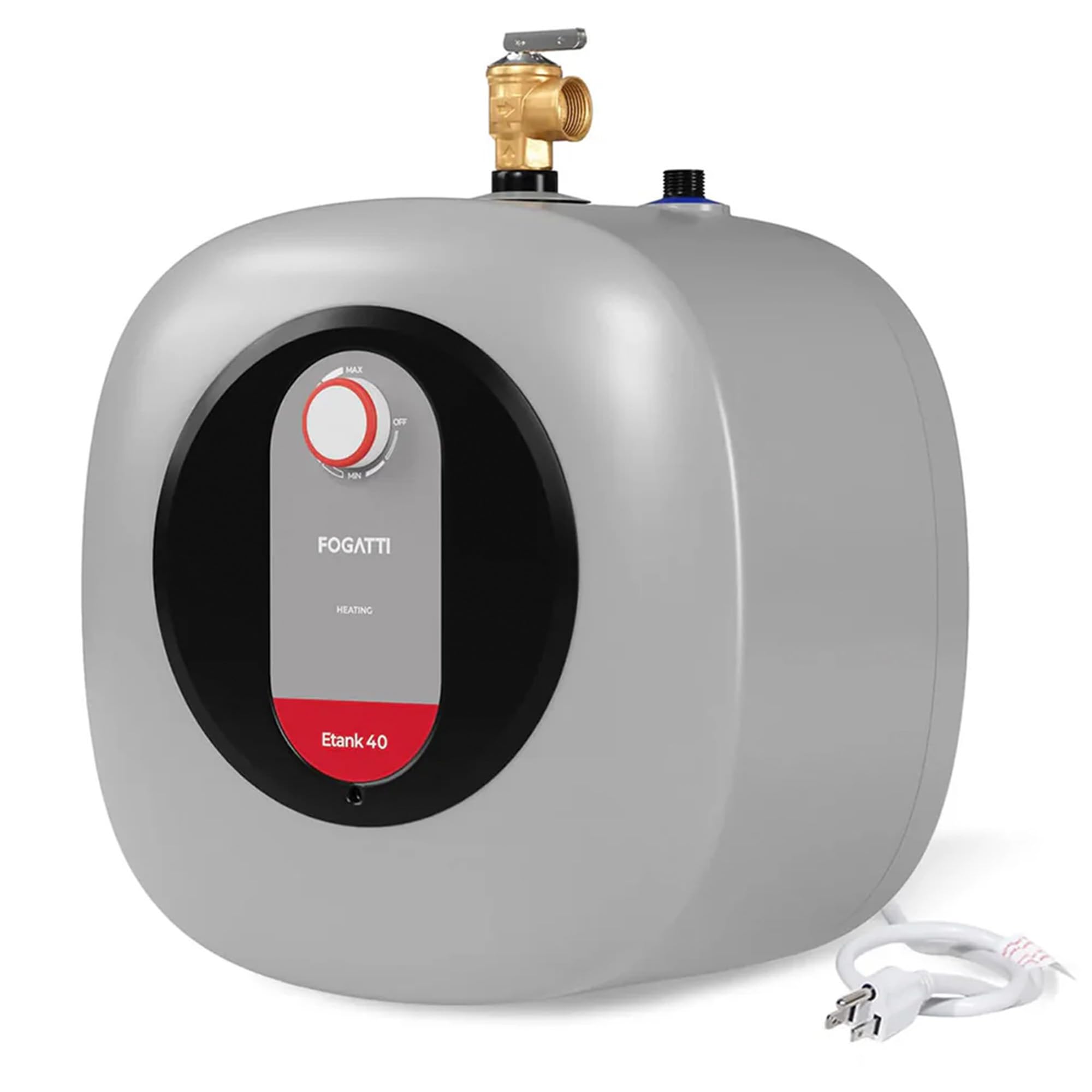
3. FOGATTI Electric Mini Tank Water Heater, 4.0 Gallon
Four gallons of stored hot water that plugs into a normal wall outlet.
The big advantage of this FOGATTI is right in the electrical spec: it runs on 120 volts with 1440W and comes with a plug and cord, so you do not need an electrician for the wiring. For food truck owners, camper owners, and anybody working out of a rented space, that single fact turns a weekend project into an afternoon one. The 4-gallon tank gives you a genuine reserve, which is the difference between washing dishes in shifts and running out halfway through the stack. Its 4 gpm flow rating is the highest in this group, so the supply pours out fast while it lasts.
Longevity is where the design money went. The tank surface carries a uniform 0.8mm thick German-made enamel layer over the steel, with an L-shaped 310S stainless steel heating rod designed to boost heat exchange with the water. There is an integrated magnesium rod inside to protect the tank from corrosion, and the maker backs the tank with a 6-year limited warranty and components with a 1-year warranty. Safety hardware includes CSA certification, a high-temperature limit device that cuts the heat at 167°F, and a T&P valve for high-pressure relief, with an adjustable range from 55°F to 145°F.
The physical footprint is the trade-off. Reviews consistently celebrate the reliability of the stored supply, with the unit described as heating quickly and delivering hot water within 30 minutes of a cold start. Durability is the one mixed signal, and a fair read is this: some units deliver years of steady service, an occasional one does not, and the tank warranty is your protection if yours is the unlucky one. Recommended circuit breaker is 15 amps, water connections are 1/2″ NPT, and maximum pressure is 150 PSI.
Why people stick with it
- 120V plug-in install — no 240V circuit or hardwiring needed
- 4-gallon reserve at a 4 gpm flow rate
- Enamel-lined tank with a magnesium protection rod
- 6-year limited tank warranty and a 167°F limit shutoff
Before you buy
- 20 pounds and a 12.80-inch depth take genuine shelf space
- You wait for the tank to recover once the reserve is spent
- Durability reports vary, so the warranty matters more here than on a tankless unit
Best fit for: RVs, food trucks, and any sink where a normal outlet is available but a 240V run is not.
Only caveat: reserve the cabinet depth first — 12.80 inches is a real commitment under a small sink.
4. Ecosmart ECO MINI 2.5 Electric Mini Tank Water Heater

Four seconds to hot water, with a cord that goes into any standard outlet.
This is the pick for the person replacing a tired unit under a kitchen sink on a Saturday afternoon. The ECO MINI 2.5 holds 2.5 gallons, runs at 1440W on 120V, and ships with its line cord and plug included. No venting, no hardwiring, no panel work — it can be installed directly at the point of use. That combination is why it keeps showing up in kitchens specifically, where the job is dishes and hand washing rather than a long shower.
The heating speed is the number that sells it. Owners consistently describe near-instant hot water at the sink, with the tap turning warm in about 4 seconds rather than the long wait of a distant central heater. The digital output temperature display lets you see what you are set to without guesswork, and the 98% thermal efficiency figure in the spec means most of the electricity goes into the water rather than the surrounding air. At 15.8 pounds and 10.94″W x 17″H, it is manageable for one person to lift into place, and the design keeps a low profile under a counter.
What keeps this honest is durability and the occasional leak. The mixed reports here follow a familiar pattern with mini tanks: plenty of units run happily past five years, and some give up far sooner than the owner expects. That is the nature of a stored-water appliance, and the 6-year limited warranty against leaks plus 2-year parts cover is what protects you. If your incoming water pressure runs high, check it before install — a pressure relief setup is your friend on any tank unit. Otherwise this is the least fuss, lowest wiring-risk way to get hot water at a sink.
Install-day winner: 120V, cord and plug included, no venting — a genuine drop-in replacement rather than a wiring project.
Fair caveat: it is a 2.5-gallon tank at 1440W, so a long dish session will outrun the reserve and you will wait for recovery.
Choose this if: you want the simplest possible install under a kitchen sink and hot water in about 4 seconds.
Pass if: you need back-to-back gallons for a shower — a bigger tank or a tankless model serves that better.
5. ThermoMate 2.5 Gallons Under Sink Water Heater Electric

The tank that can stand alone or give your big heater a head start.
Most of the picks on this list do one job. This ThermoMate does two, and that flexibility is its whole reason to exist. It works as a single-point heater for a bathroom or kitchen sink, or it can be plumbed in-line as a booster to a larger hot water system, so the water arriving at your tap has already been pre-warmed. The temperature knob adjusts between 68°F and 140°F, and the 2.5-gallon tank runs on 1440W at 120V with a standard corded plug. The 24-hour standby and foam insulation mean the stored water stays warm between uses.
The tank construction is where the money goes. It carries a gold porcelain glass lining, which the maker says improves insulation and resists leaking, and it uses fused ceramic as its material. The temperature and pressure relief valve is a CSA component made in the USA, and the whole unit is UL certified — a safety listing that matters when you are putting a pressure vessel inside a wooden cabinet. Installation is straightforward in practice: a 1/2″ NPT connector, a standard outlet, and a choice of shelf, wall, or floor mounting. Measured at 11.4″W x 11.4″D x 22.4″H including the valve, it fits inside a cabinet if the cabinet is deep enough.
The size number to watch is that 22.4-inch height including the valve — it is taller than a tankless panel and taller than some under-sink clearances. The other honest note is temperature consistency. Owners find the tank holds warmth well but note the water does not always stay evenly hot across the full 2.5 gallons, so the last of the draw can run cooler than the first. That is normal behavior for a small tank with a single heating element, and it is why the booster role suits it so well: you are only topping up a temperature, not carrying the whole load. Maximum pressure is 150 psi.
Pick it for: sinks far from the central heater where you want warm water immediately, or a fixture that needs a temperature lift.
Measure first: 22.4 inches of height including the valve clears some cabinets and not others.
6. Ariston Andris Mini Tank Electric Water Heater, 4 Gallon

A four-gallon tank built for the utility sink nobody wants to walk away from.
Utility sinks are the worst case for hot water. They sit at the far end of the house, in a cold garage, or in a workshop, and the run from the main heater wastes both time and water. This Ariston Andris exists to fix exactly that: it hangs on the wall near the sink, holds 4 gallons at 1440W on 120V, and can run as a stand-alone unit or as a booster to an existing system. The titanium glass-lined tank is the durability story, built for heat retention and resistance to the corrosion that comes with sitting full of water.
Owners describe it as reliable and easy to install, and they specifically like where it can go — shops, garages, and utility sinks are the scenarios that come up again and again, along with small spaces where a full-size heater has no chance. The plug-in design keeps the install simple. It measures 14.25″W x 14.25″H, mounts on the wall, and takes a 1/2″ NPT connection. The smart boost function is useful if you ever wire it as a supplement to a larger tank, since it can lift the incoming temperature rather than starting cold.
The two things to go in with your eyes open are durability variance and leaks. Plenty of these tanks run for around five years without drama, and some buyers report a failure inside the first few months — a range wide enough that the install quality and your water conditions likely play a part. Leak reports cluster around the fittings and connections, which is true of nearly every tank on this list and worth heading off with fresh thread sealant and a careful torque. If you want a small wall-mounted tank for a garage sink, this does the job with a well-known name behind it.
Best use case: a garage, shop, or utility sink where you are tired of waiting on the far end of the house for warm water.
Set expectations: 4 gallons at 1440W is a reserve for hand washing and light cleanup, not a household shower supply.
Good match for: wall mounting near a cold, distant sink with a normal 120V outlet close by.
Worth noting: check your fittings twice on install — connection leaks are the most common complaint on any tank heater.
7. Rheem RTEX-06T 6.5kw Point of Use Thermostatic Tankless

Holds your set temperature within one degree, load after load.
Most tankless units in this category give you roughly the right temperature. The Rheem RTEX-06T is built to give you the exact one. It continuously monitors water temperature and controls flow rate so the delivered water stays within 1 degree of the setting you chose, which is the sort of consistency you notice when you are washing something delicate or running a fixture that hates temperature swings. It is a thermostatic design, meaning it actively manages both heat and flow rather than just firing the element and hoping.
The form factor makes it easy to place. Rheem states that its Professional POU T tankless electric heaters are 90% smaller than traditional tank heaters, and at 4 pounds with a 3-inch depth spec, this one hangs on a wall with almost no intrusion. The flow rate is 1.5 gpm, so it covers a sink comfortably, and the endless on-demand design means no reservoir and no recovery wait. It also only heats water when in use, which keeps the idle energy cost close to nothing compared to a tank sitting hot all day.
The honest limitation is flow. Thermostatic control is impressive at the rate the unit is rated for, but push the faucet beyond what a point-of-use heater can handle and the temperature will fall, because there is only so much heating power available to spread across more water. That is the trade for the tiny footprint. Installation is described as manageable, and the unit is rated for a maximum pressure of 150 psi with a 105°F heat output spec. If temperature precision matters more to you than the endless draw of a bigger system, this is the most controlled pick here.
What earns its spot
- Holds within 1 degree of your set temperature
- 4 pounds and 3 inches deep — almost no cabinet intrusion
- Only heats while water is flowing
- Tankless design means no recovery wait
What to plan around
- 1.5 gpm ceiling limits how far you can open the tap
- Requires the proper circuit and plumbing for a hardwired point-of-use unit
Designed for: anyone who wants steady, repeatable temperature at one sink rather than maximum gallon output.
Skip if: you expect to run a wide-open tap — 1.5 gpm is the working limit.
8. Stiebel Eltron SHC 2.5 Mini-Tank Water Heater

The one that has people timing their kitchen tap with a stopwatch.
If you want the fastest-recovering 2.5-gallon tank in this lineup, this is it. The SHC 2.5 holds 2.5 gallons, heats at 1300W on a standard 120V outlet, and comes with a wall-mount bracket and a T&P valve in the box. The heating speed is what owners fixate on: hot water arrives in less than 5 seconds, versus the long wait at the end of a run from a distant main heater. That is the whole point of a point-of-use tank, and this one hits under 5 seconds.
The construction is why it earns the top-rated nod across the group. It is a glass-lined tank with a 6-year warranty on the tank itself, built for fast recovery so you spend less time between uses waiting for the next gallon to heat. Owners describe the build quality as excellent, and the unit gets singled out for outdoor off-grid setups where someone is running a sink off a small power source. It fits under kitchen sinks and in tight spaces, and the configuration draws praise for island installations where there is no other sensible place to mount a heater. Flow rate is 2.5 gpm and it weighs 15.9 pounds with a 10-5/8-inch depth.
At 2.5 gallons, the reserve is finite — this is a hand-washing and dish-rinsing tank, not a shower supply, and that is true of every tank in its size class. The distinction that matters is how quickly it recovers between draws, and this one recovers fast. If your sink sees steady use all day, the recovery rate is doing the work, not the tank volume. The 1300W element is slightly lower wattage than the 1440W units here, so recovery takes marginally longer per gallon, but the build quality offsets that for most buyers. It comes with everything needed for a basic wall install.
What wins people over: hot water in under 5 seconds and a glass-lined tank backed by a 6-year warranty — a combination that reads as built to last.
One thing to know: at 2.5 gallons and 1300W, this serves a sink, not a family shower schedule.
Ideal for: a kitchen or island sink where you want fast hot water and long-term tank durability in one small package.
Not intended for: high-volume back-to-back draws — 2.5 gallons goes fast when the whole family uses the same tap.
9. BOSCH Tronic 3000 T 2.5-Gallon Water Heater

A 2.5-gallon tank rated to keep up with two sinks at once.
Most 2.5-gallon tanks are single-sink devices. Bosch rates this one for supplying up to 2 sinks at a time, which changes the calculus the moment you have a kitchen and a bathroom sharing a wall. It holds 2.5 gallons, delivers 1440W at 120V, and quotes thermal efficiency at 98% — meaning almost all the electricity you pay for ends up in the water. The 36-37″ cord plugs into a standard 120V outlet, and you can also plumb it in-line with a larger hot water source if you want it to serve as a top-up rather than a stand-alone.
The install story is unusually friendly. Owners describe getting it running in about 10 minutes once the plumbing is tapped, and the unit can sit on a shelf, hang on a wall with the included bracket, or rest on the floor — so cabinet layout stops being a barrier. It uses glass-lined construction for service life, runs at 12A on 120VAC, and carries a 6-year warranty on the unit with 2 years on parts. Dimensions are 13.75″W x 13.75″H x 10.75″D and it weighs 15.5 pounds.
Here is what you should know about the pressure relief valve. It is the component that comes up most often, and the pattern reads as a valve doing its job rather than a tank failing — when pressure builds, it releases, and that looks like a leak if you are not expecting it. Plan the discharge path before you install, and this ceases to be a story. The rest of the consensus is that the hot water assist works, the water arrives in seconds, and the device is priced well against what it replaces. If you want a 2.5-gallon tank rated for two sinks, this is the one.
Why it earns the spot
- Rated to supply up to 2 sinks at a time
- 98% thermal efficiency and a 36-37″ plug-in cord
- Shelf, wall, or floor mount — bracket included
- 6-year warranty on the unit
Set up for the reality
- The pressure relief valve releases water — plan where it goes
- At 2.5 gallons, two sinks drain the reserve quickly
Right answer for: a pair of nearby sinks that share a cabinet wall and a standard outlet.
Be ready for: a little water from the relief valve during pressure changes — that is the valve protecting the tank.
10. Stiebel Eltron SHC 4 Water Heater

The 4-gallon sibling that buys you more hot water per draw.
If the 2.5-gallon SHC above sounds right in every way except the reserve, this is the answer. The SHC 4 runs the same 1300W at 120V, plugs into a standard outlet, and carries the same German build pedigree, but it stores 4 gallons instead of 2.5. That extra gallon-and-a-half is the difference between one round of dishes and two. It measures 12.63″W x 19.75″H and weighs 19.8 pounds, with a flat back and bottom for easy installation and 1/2″ NPT brass plumbing connections.
Owners describe it as a very good point-of-use heater that delivers near-instant hot water and installs without drama. The heat output is consistent, and the fact that it plugs into 120V means no electrician and no panel work. It works as a stand-alone sink heater or as a supplement, and the copper material inside and the glass-lined construction are what the 6-year leak warranty and 2-year defect warranty are protecting. For hand washing and kitchen applications, the 4-gallon tank covers the real supply a small sink needs.
The trade-off is that the 19.8 pounds and 19.75 inches of height need a slightly more generous cabinet or wall space than a 2.5-gallon unit. That is the cost of the extra reserve. Durability feedback is mixed, and the honest read is that a small tank is a wear item — the element and the pressure vessel take abuse over time, and the warranty is what stands behind it. If you want the most hot water per draw in a 120V plug-in tank made in Germany, this is your pick, and the extra capacity is worth the extra inches.
The upgrade that matters: 4 gallons versus 2.5 means more hot water per session without changing the 120V plug-in simplicity.
Worth planning for: 19.75 inches tall and 19.8 pounds — this one wants a bit more room than the smaller tanks.
Best for: a sink that sees more than a quick hand wash and needs the reserve a 4-gallon tank provides.
Trade to accept: the larger size and weight demand a more spacious cabinet than the 2.5-gallon options here.
Know the Specs
Wattage and what it means for your breaker
Wattage is how much electrical power the heater draws, and it drives the biggest install decision you will make. A 1300W to 1440W mini tank plugs into a standard 120Voutlet and runs on an ordinary household circuit. A 6kW tankless unit needs 240V and hardwiring behind a dedicated breaker. Higher wattage means faster heating and more hot water per minute, but it also means a bigger electrical job. Match the wattage to the circuit you already have, not the one you wish you had.
Flow rate and tank capacity
Flow rate is measured in gallons per minute, or gpm — how much hot water the unit can push through in a minute. A tankless unit rated at 1.07 gpm delivers hot water at that draw, and opening the tap wider spreads the same heating power across more water, so the stream cools. A tank unit sidesteps that math because the water is already hot, but its stored supply eventually runs out. Tank capacity tells you how much reserve you have. Think of flow rate as the tap’s ceiling and capacity as the tank’s endurance.
The temperature rise figure
Temperature rise is how many degrees the unit can lift the incoming water at a given flow. A 35°F rise at 1.0 gpm means the heater can add 35 degrees to water moving at that rate. In a cold climate the incoming water is colder, so the same unit delivers a lower final temperature. In a warm climate it feels hotter. This is why the same heater earns different reviews from different regions — the number is fixed, the incoming water is not.
Tank construction and warranty
A water heater tank lives full of water and heat, which is a recipe for corrosion over time. Glass-lined and enamel-lined tanks use a coating to keep water off the steel, and some add a magnesium rod to sacrifice itself instead of the tank. The warranty tells you how much confidence the maker has: a 6-year tank warranty is common in this group, and it is the number to weigh when a unit costs more than its neighbor. Cheap construction shows up as leaks and element failures years down the road.
Mounting style and cabinet space
A tankless panel can be as thin as 2.52 inches, which is why it disappears into a cramped cabinet. A tank unit can run 10.75 to 12.80 inches deep and up to 22.4 inches tall including its valve, so it needs real shelf or wall space. Several tanks here mount on a shelf, wall, or floor, which gives you options when the cabinet is oddly shaped. Measure the depth, the height, and the clearance for the plumbing before you buy, and confirm whether the unit needs a wall bracket or sits on its own base.
Hardwired versus plug-in connections
A plug-in unit uses a standard 120V cord and outlet, which is the simplest path for a homeowner. A hardwired unit connects directly to the electrical panel through a breaker, which is the path for a 240V tankless model. The trade is straightforward: plug-in is easy but limited in power, hardwired is powerful but needs an electrician. Decide which camp you are in before you fall for a spec sheet, because no amount of clever design gets around the wiring requirement.
Common Questions
Can an under counter water heater run on a normal household outlet?
What is the difference between a mini tank and a tankless point-of-use heater?
How many gallons per minute do I need for a kitchen sink?
Will a 6kW tankless heater work on 120 volts?
How long does hot water last from a 2.5-gallon tank?
Do these units need a pressure relief valve?
Can a point-of-use heater work as a booster to my main water heater?
What size breaker does a mini tank water heater need?
Will an under counter heater fit inside a standard kitchen cabinet?
Are hard water conditions bad for these heaters?
The Bottom Line
For most buyers, the under counter water heater winner is the CAMPLUX 6kW Tankless because it delivers 85°F to 131°F hot water in about 3 seconds and never runs out — as long as you can supply the 240V hardwired circuit it requires. If you want the simplest install and a true plug-in, grab the Ecosmart ECO MINI 2.5 at 1440W on 120V. And for a garage or utility sink where you want a wall-mounted reserve without a panel job, the Ariston Andris 4-Gallon is the one to reach for.
One honest nudge: the answer really does come down to your breaker panel, so open it and look at what you have before you click buy. If you have 240V service at the sink, the CAMPLUX is a standout. If you do not, a 120V mini tank will serve you better and save you the electrician bill.
How we choose
We do not accept paid placement. Every pick is matched to a real buyer and a real use-case; we do not hands-on test units.
Sources
Specifications: manufacturer listings and product documentation. Review insights: verified customer reviews, as of November 2026. Pricing: not shown on this page (it changes often); check the current price via the retailer link.
As an Amazon Associate, Tactical Gear Guy earns from qualifying purchases. This does not affect which products we feature.