Specs are compiled from manufacturer listings and verified buyer reviews and can change over time — please confirm the key details on the product page before buying.
The battery that decides your day on the water is the one that still has charge when the wind picks up. A marine deep cycle 12 volt battery is built to run a trolling motor down slowly and recharge instead of delivering one big cranking burst. Most boaters get the chemistry wrong before they even check capacity. The guide below lines up eleven real options and tells you which one suits your hull, your motor thrust, and your back.
This guide is built by comparing the manufacturers’ published specifications and the patterns across verified customer reviews, so you get each pick’s real strengths and trade-offs instead of marketing spin.
The right marine deep cycle 12 volt battery keeps a trolling motor running all day and still takes a full recharge at the dock.
Top Picks

How To Choose The Best Marine Deep Cycle 12 Volt Battery
The single decision that changes everything is chemistry. A lithium iron phosphate battery (LiFePO4, a lithium type that does not use cobalt) lets you pull nearly all of its rated capacity without wrecking it. A sealed lead-acid AGM battery (absorbed glass mat, where acid is held in fiberglass mats) wants you to stop around half. That one difference decides how many fishing hours you actually get.
Chemistry first, then capacity
A 100 amp-hour AGM battery gives you roughly half that in usable draw before you start shortening its life. The same 100 amp-hour figure in LiFePO4 is closer to all of it. So a lithium pack rated at 100Ah can genuinely outlast a bigger lead-acid pack, and it does it at a fraction of the mass. Watch the amp-hour number on its own and you will misjudge the purchase.
Will it fit your battery box?
Group size is the physical footprint the marine industry settled on. Group 24, Group 27, and Group 31 are the three you will meet on boats, and the numbers rise with size. Check which box you have before ordering anything. Several lithium packs here are built to Group 31, while one is sized to Group 24 and will still drop into the larger boxes.
Weight is not a small detail
On a small hull, battery mass moves the whole boat. A 68-pound AGM in the stern of a jon boat is a different vessel from a 22-pound lithium pack in the same tray. You notice it at launch, on the trailer, and when you are carrying it down a dock ramp in one hand.
Cold weather and charging
Lithium does not like being charged below freezing. Look for a battery with a low-temperature cutoff, which pauses charging when the sensor reads cold and resumes once it warms. If you fish late into the season or store the boat outside, that protection belongs on your shortlist.
Side-by-Side Comparison
| Model | Best For | Chemistry | Rated Capacity | Weight | Amazon |
|---|---|---|---|---|---|
| Litime 12V 100Ah Trolling Motor LiFePO4★ Best Overall | Overall lithium pick | LiFePO4 | 100 amp_hours | 22.2 pounds | Amazon |
| Newport 12V 50Ah Deep Cycle AGMBest for Small Craft | Kayaks and small boats | Lead-Acid, AGM | 50 amp_hours | 32 pounds | Amazon |
| VEMDIA 12V 100Ah LiFePO4 Smart BMSBest Value Lithium | Budget lithium entry | Lithium Ion | 100 amp_hours | 24.5 pounds | Amazon |
| DC HOUSE 12V 100Ah Bluetooth LiFePO4 | Bluetooth monitoring | Lithium-Phosphate | 100 amp_hours | 10.8 kg | Amazon |
| VEVOR 12V 100Ah AGM Deep Cycle | No-maintenance lead-acid | Lead Acid, AGM | 100 amp_hours | 27.7 kg | Amazon |
| MARSENERGY 12V 100Ah Group 24 LiFePO4 | Tight battery boxes | Lithium-Phosphate | 100 amp_hours | 21 pounds | Amazon |
| Redodo 12V 100Ah LiFePO4 Group 31 | Proven long-runner | Lithium | 100 amp_hours | 22 pounds | Amazon |
| Power Queen 12V 100Ah Trolling Motor LiFePO4 | Big-thrust trolling motors | Lithium-Phosphate | 100 amp_hours | 22 pounds | Amazon |
| VMAX MR127 12V 100Ah AGM | Heavy-duty AGM | Lead-Acid, AGM | 100000 milliampere_hour | 68 pounds | Amazon |
| VMAX MR137-120 12V 120Ah AGM | Long runtimes on lead-acid | Lead-Acid, AGM | 120 amp_hours | 75 pounds | Amazon |
| VMAX MR127-100 Two-Battery Kit | 24V trolling motor setups | Lead-Acid, AGM | 100 amp_hours | 68 pounds | Amazon |
Detailed Reviews
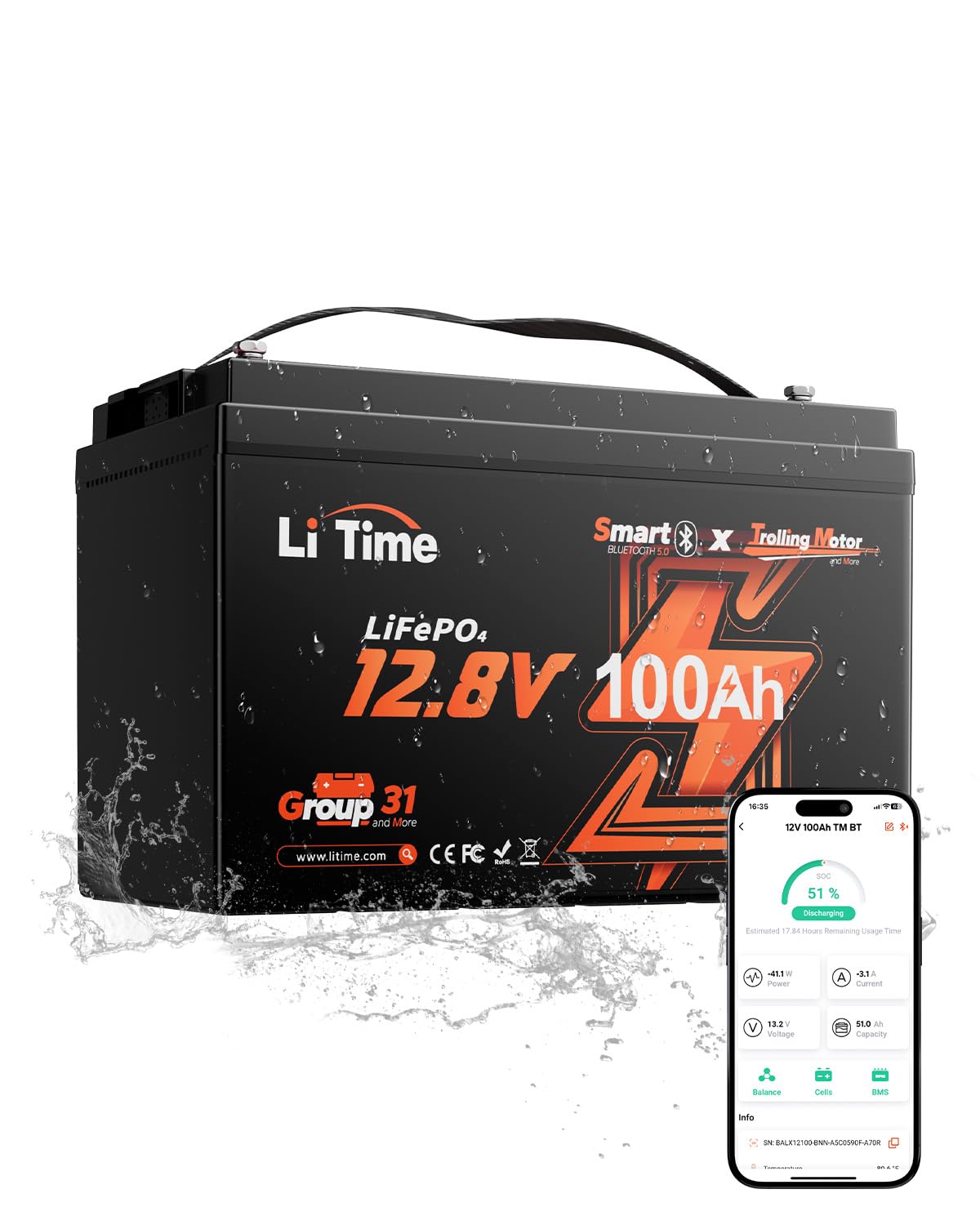
1. Litime 12V 100Ah LiFePO4 Battery
Our pick — 4.5+★ from 650+ verified ratings; the strongest balance of quality and price.
A 22.2-pound Group 31 lithium pack that shows state of charge on your phone and runs a full day of trolling.
Start with the mass, because that is where the Litime rewrites the day. It lands at 22.2 pounds in a standard Group 31 case, a 44 percent drop from the 32-pound Newport AGM above it in this list. On a small hull that is the difference between a boat that squats at the stern and one that planes clean. It also means you carry it to the dock with one arm while the cooler occupies the other.
The cells inside are LiFePO4, and Litime publishes cycle figures of 4000 deep cycles at 100 percent depth of discharge, 6000 at 80 percent, and 15000 at 60 percent. The 100 amp-hour rating pairs with a 1280Wh energy figure, which the spec sheet frames as twice the range of traditional lead-acid. What wins people over is the capacity and the reliability behind it — owners consistently describe a pack that runs all day and only ever needs a recharge, never a rescue. The Bluetooth link is the second thing they talk about. It auto-connects in seconds and shows state of charge, discharge control, and system checks right on your phone.
The catch sits in the fine print. This is an energy storage battery, not a starting battery, and it will not serve a golf cart or a jack. You also have to prime the Bluetooth by charging with a lithium-activation or MPPT charger on first use. Cold protection is there too — charging stops below 32°F and discharging stops below -4°F — with IP65 waterproofing and a salt-resistant shell for spray-heavy days.
Where it earns the crown
- 22.2 pounds in a Group 31 footprint
- 100 amp-hours with 1280Wh of usable energy
- Bluetooth app for state of charge and system checks
- IP65 waterproof and salt-resistant
What to plan around
- Not a starting battery, golf cart, or jack battery
- Bluetooth needs a lithium-activation charge on first use
Go here for: anyone moving a trolling motor rig from lead-acid to lithium who wants to see the charge level without lifting a seat cushion.
Look past it for: engine cranking duty, where the maker explicitly says no.
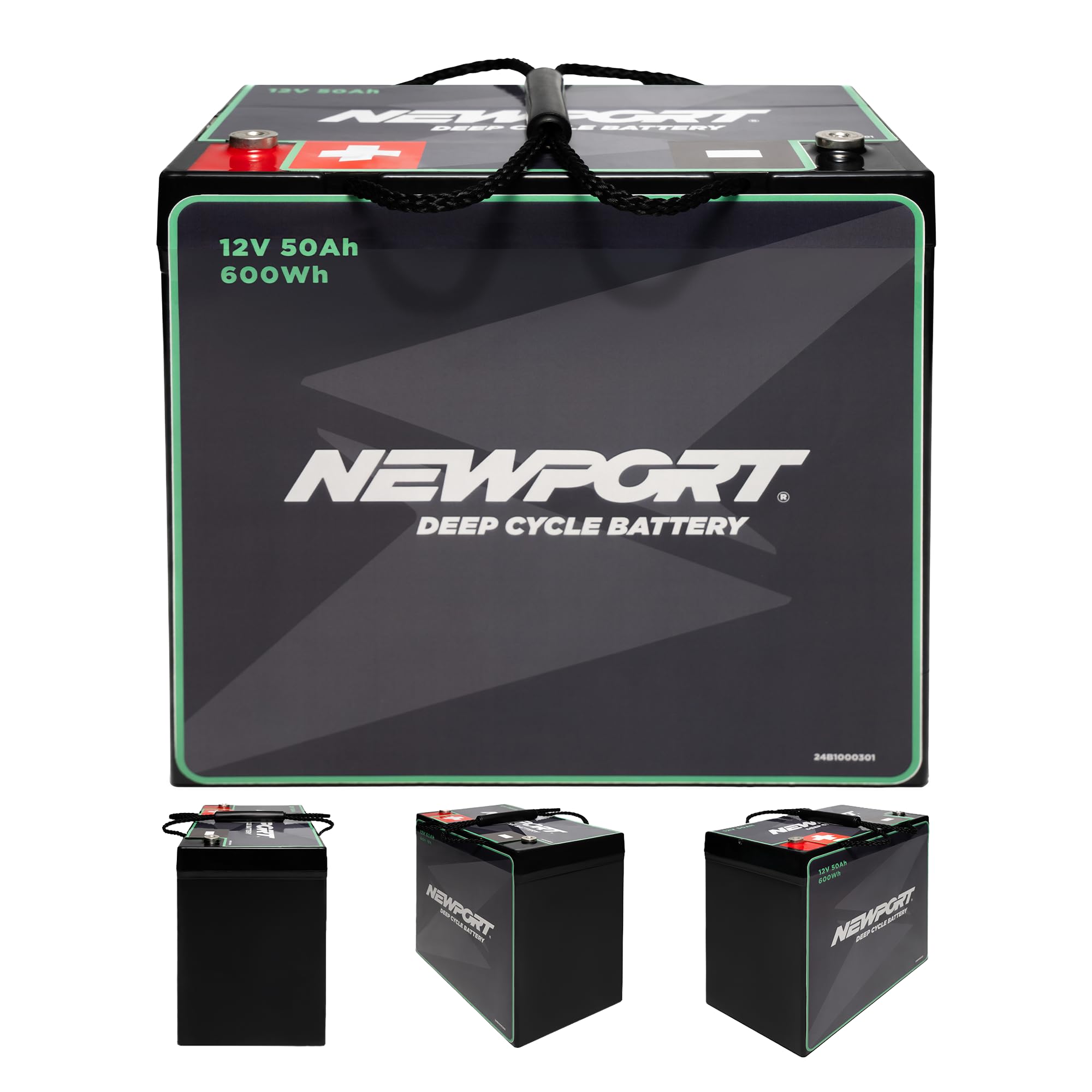
2. Newport 12V 50Ah Deep Cycle AGM Marine Battery
Half the capacity of the lithium big boys, and exactly the right amount for a kayak or a jon boat.
Fifty amp-hours sounds modest next to the 100Ah lithium packs here, and it is. The Litime carries 100 amp_hours against this Newport’s 50, a 2.0x gap in rated capacity. But that is the point of this battery. On a tiny craft you feel that, so check your weight budget before you assume more capacity is better.
The build is sealed lead-acid AGM, which means no water to top up and no acid to spill. Holding a charge and going the distance is what buyers describe most, and the reliability follows — the pack sets up easily and simply keeps working trip after trip. Newport also builds this specifically to suit its own trolling motors, so if you already run one of those, the pairing is straightforward.
Two things to know before you click buy. The terminals are a recurring sore spot — some units arrive without posts or bolts, so inspect the box the moment it lands and check the marine terminals. Value also splits opinion, with some finding it a fair deal and others feeling the outlay is high for the capacity you get. Newport is headquartered in California with an in-house support team and backs this with a one-year limited warranty.
Best-use picture: pair the 50Ah rating with a light hull and a modest motor and it holds up well for fishing and cruising. Bring it aboard a heavier boat and you will be reaching for a second battery.
Buying check: open the carton at the dock and confirm both marine terminal posts and bolts are present before your first run.
Fits like a glove: kayak and inflatable owners who want a compact AGM and will not miss the extra amp-hours.
Think twice if: you run a bigger motor or a heavier hull, where 50Ah runs thin.
3. VEMDIA 12V 100Ah LiFePO4 Battery, Group 31 Smart 100A BMS
A budget lithium pack with a big cycle promise, and a charging quirk you need to hear about first.
The headline numbers are loud. VEMDIA claims 8000 to 15000 deep cycles depending on depth of discharge, with 6000 cycles at 100 percent DOD, 8000 at 80 percent, and 15000 at 60 percent. The pack weighs 24.5 pounds in a Group 31 footprint, measures 12.87 by 6.69 by 8.58 inches, and fits a standard Group 31 box as a drop-in replacement for lead-acid. It also expands — up to 4S or 4P, reaching a claimed 20.48kWh bank.
Then there is the honest part. The BMS, which is the battery management system that watches overcharge, over-discharge, over-current, heat, and shorts, is where opinions divide. Some packs charge perfectly and run beautifully. Others cut charging off in the 13.75 volt range and never reach full. That is why the charging story is the one to test first — run a full charge cycle the day it arrives, watch where the voltage settles, and confirm it tops out properly before you depend on it for a long trip.
Where it shines is temperature range. The pack operates from -20°F to 140°F, with charging rated from 0 to 45°C and discharging from -20 to 60°C. That covers a hot July afternoon and a cold morning launch. It powers up to 1280Wh and charges from a 14.6V 20A lithium charger in about five hours, from a solar panel and controller, or from an alternator. The 100A BMS and stable LiFePO4 chemistry — resistant to thermal runaway up to 500°F — are the safety backbone, and a two-year warranty backs it.
Why it’s worth a hard look: the cycle count and the wide temperature band put lithium performance within reach at an entry-level outlay.
The honest wrinkle: the BMS charging cutoff is the shared frustration, so verify a full charge early rather than mid-season.
Worth a shot for: boaters who want lithium cyclability and a flexible, expandable bank without moving up a tier.
Hold off if: you want a pack you can trust blind on day one — test the charge behavior before you commit to a long run.
4. DC HOUSE 12V 100Ah Bluetooth LiFePO4 Trolling Motor Battery

Bluetooth 5.1 alerts to your phone, plus a low-temp sensor that cuts charging below 19.4°F.
Bluetooth 5.1 is the reason this one stands out. The DC HOUSE app reaches 5 to 10 meters and reports state of charge, voltage, and current down to specific cells. There is a dedicated fault page for troubleshooting, plus push notifications when the pack detects an anomaly. If you have ever wondered whether a battery was fading or just cold, that live readout answers it without a multimeter.
The low-temperature protection is upgraded and specific. The sensor cuts charging when it reads below 19.4°F, cuts discharge below -4°F, and recovers automatically once the pack warms to 32°F. That matters on late-season trips and for boats stored without heat. The cells are Class A LiFePO4 with UL and UN38.3 test certification, and the pack claims up to 15000 cycles and a 10-year service life. Lead-acid and AGM packs, by contrast, typically manage 200 to 500 cycles over about three years.
Look at the footprint before ordering. This is sized close to Group 24, about 0.32 inches taller than the standard Group 24 spec, and it weighs 10.8 kg. It suits RVs, boats, trolling motors, fish finders, ice fishing, camping, solar, and home alarm systems. You must charge it with a dedicated lithium charger. Expansion goes to 4 in series or 4 in parallel with a maximum of eight batteries total, and 4P4S is not allowed. It is not a starting or cranking battery, and DC HOUSE backs it for three years.
For the data-inclined: cell-level readouts and anomaly alerts turn battery care into something you can see on your phone.
One real constraint: the Group 24-adjacent size limits expansion beyond the eight-battery cap.
Reach for it if: you want visibility into every charge cycle and fish into the cold months.
Pass if: you plan to build a big bank — the no-4P4S rule blocks that layout.
5. VEVOR Deep Cycle Battery, 12V 100Ah AGM Marine

Sealed AGM construction with no water to top up, and an 800A burst for 5 seconds on heavy loads.
For buyers who want 100 amp-hours without touching electrolyte, VEVOR makes a clean case. It uses absorbent glass mat construction, so there is no liquid top-up and minimal electrolyte consumption compared with flooded lead-acid. The discharge spec is the standout: up to 800A within 5 seconds, delivering stable output for short bursts. It also claims high-temperature resistance and low self-discharge, which are the qualities that keep an AGM usable between trips.
The quality record here reads strong. Owners describe a well-made pack, and the performance and build quality both draw praise. It is the sort of battery that does the unglamorous RV, solar, and backup work without fuss. But read the discharge language carefully. VEVOR says it can not be used as a starting battery for car ignition. It is an energy storage battery, so cranking duty is out.
Battery life is where opinions divide. Some report it holds a charge very well and keeps going for weeks of use. Others say theirs would not hold a charge at all, which is the usual AGM deep-cycle risk if a unit is left flat or abused. Professional charging equipment is required during use, so plan for a proper charger. Treat it well and this is a dependable AGM at the entry tier of the lead-acid market.
Where it holds up: zero-maintenance AGM construction and an 800A 5-second burst suit lights, electronics, and backup loads.
Watch out: deep-cycle AGMs punish neglect, so keep it charged through the off-season.
Made for: the boater who wants lead-acid simplicity and never wants to check water level again.
Not the one for: engine starting, which VEVOR explicitly rules out.
6. MARSENERGY 12V 100Ah LiFePO4 Battery, BCI Group 24

Exact BCI Group 24 dimensions at 21 pounds, so it swaps into a Group 24 tray with no modification.
At 21 pounds, MARSENERGY makes the lightest 100 amp-hour pack on this list. It measures 10.16 by 8.46 by 6.54 inches, which meets the BCI Group 24 standard exactly. That is the useful part: if you have been running a Group 24 lead-acid battery, you can lift it out and drop this in. It still fits larger Group 27 and Group 31 boxes, so the sizing works in your favor either way.
Quality is the aspect that carries this battery, with owners treating the pack as excellent and meeting expectations. The BMS adds a safety layer — it watches for short circuit, over-voltage, and temperature faults, then cuts power and drops the battery into sleep mode. Nothing fires up until you reactivate it, which is a deliberate guard rather than a flaw. The pack is described as completely waterproof, with low-temp additives in the cells. The BMS still cuts discharge at -4°F and charging at 32°F for safety, even though the cells themselves technically allow operation at -40°F.
Cycle life is quoted as 4500 deep cycles at 100 percent DOD, 8000 at 80 percent, and 15000 at 60 percent. Marsenergy includes two M8 terminal bolts and a service card, and backs the pack for five years. Remember to reactivate it out of sleep mode when it has shut itself down — the manual spells out the procedure if you ever get stuck.
Why box-fit buyers love it
- Exact BCI Group 24 dimensions for a direct swap
- 21 pounds at 100 amp-hours
- 5-year after-sales coverage
- Waterproof case with low-temp cell additives
Before you order
- Sleep mode requires manual reactivation after a BMS trip
- Shipping weight and case size mean you should confirm tray clearance
Made for: anyone replacing a Group 24 lead-acid pack who wants lithium range without building a new tray.
Less suited to: buyers who want the biggest possible bank — this is a Group 24 footprint, not a 4S expansion rig.
7. Redodo 12V 100Ah LiFePO4 Battery, Group 31, for RV, Marine
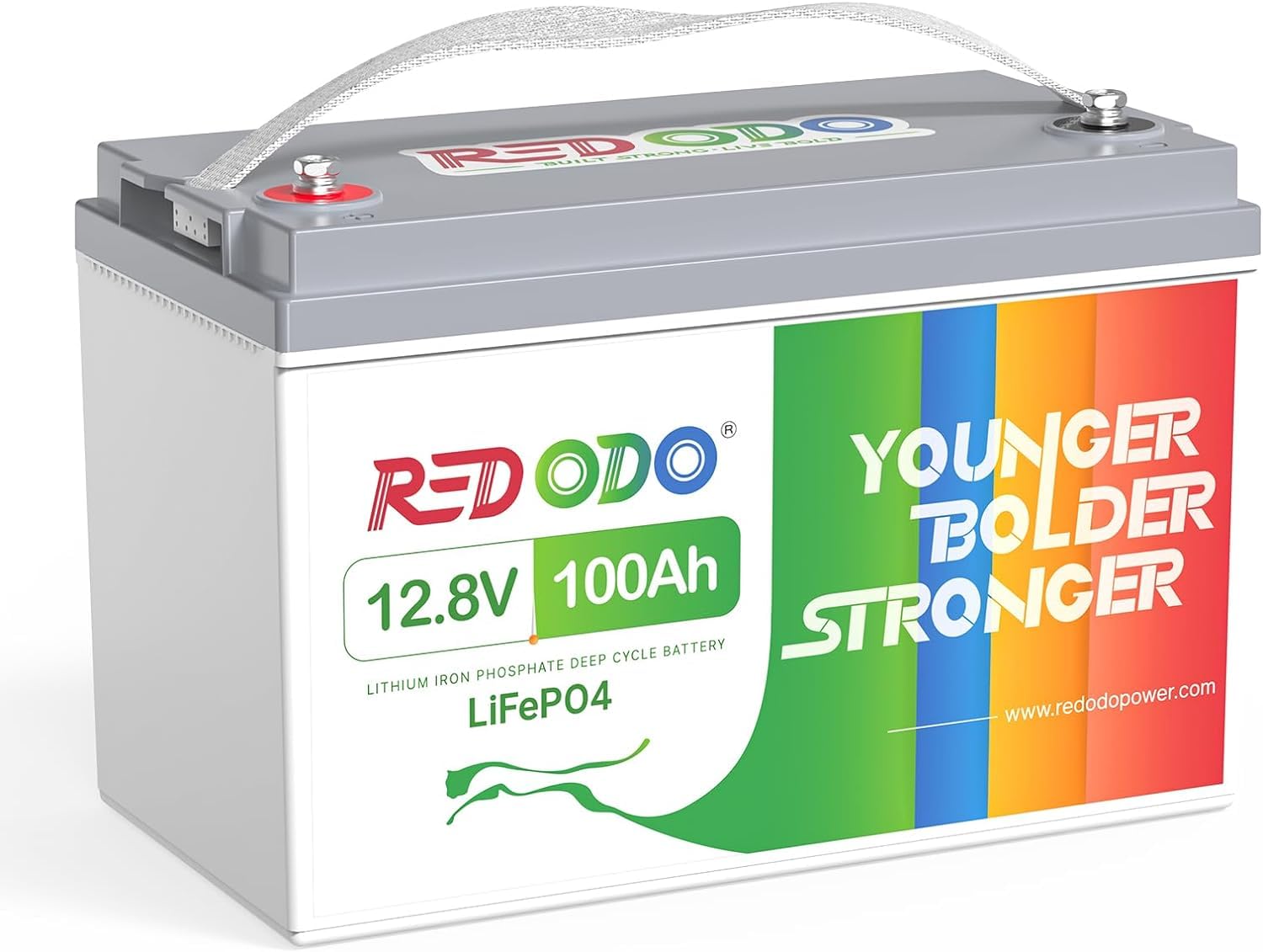
58Wh per pound of energy density, against roughly 20Wh per pound for lead-acid at the same capacity.
Redodo publishes a comparison worth knowing. This pack comes in at 58Wh per pound of energy density, against roughly 20Wh per pound for lead-acid at the same capacity. It weighs 22 pounds and measures 13 by 6.77 by 8.43 inches, which suits a Group 31 box. The maker describes it as 60 percent lighter and 5 percent smaller than a 100Ah lead-acid pack. That density gap is the whole argument for switching.
Performance is the second thing owners talk about, with the pack working as advertised and needing no intervention. Charging has its own story: buyers describe reaching full charge in about five hours of full sun and going up to three days between recharges. That tells you a solar setup pairs cleanly with this battery. You can charge it four ways — a lithium charger sold separately, a solar panel with controller, an alternator, or a generator.
The pack is built from automotive grade cells with a low 3 percent self-discharge rate and quoted cycle life of 4000 at 100 percent DOD, 6000 at 80 percent, and 15000 at 60 percent. The 100A BMS handles overcharge, over-discharge, over-current, short circuit, and high temperature. Expansion reaches 4S or 4P for 400Ah or 48V. Redodo suggests this for a 30 to 70 pound thrust trolling motor and rules it out for starter duty or golf carts. Battery life here draws mixed reports, so long-run ownership is worth planning around with proper charging habits.
Why the numbers matter: 58Wh/lb against 20Wh/lb means you get far more usable energy from a fraction of the mass.
The honest note: battery life draws a split response, so treat charging discipline as part of your purchase.
Lean this way if: you fish a 30 to 70 pound thrust motor and want a proven lithium pack backed by years of owner experience.
Steer clear for: engine starting or golf cart duty, both outside Redodo’s stated use.
8. Power Queen 12V 100Ah Trolling Motor LiFePO4 Battery
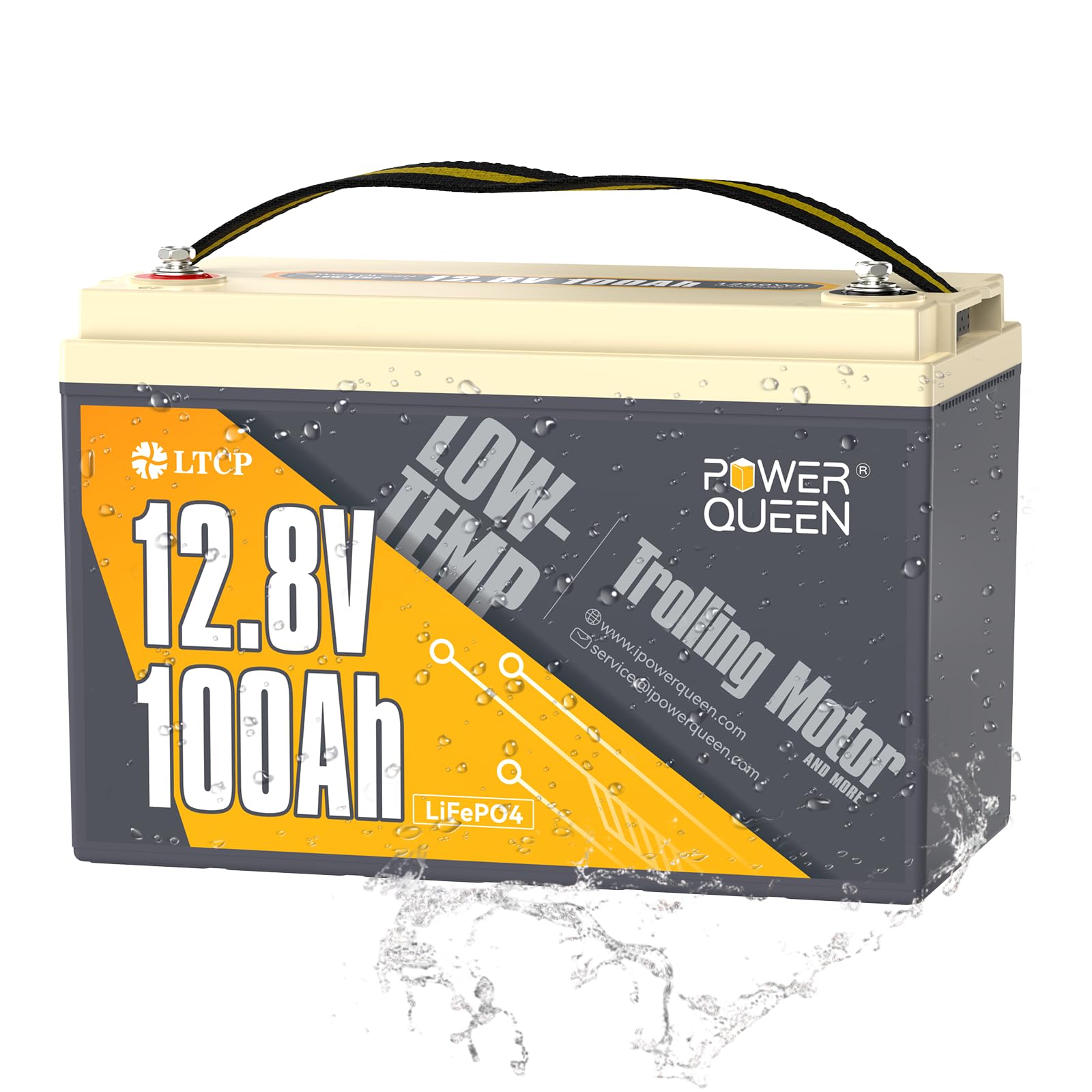
Built for trolling motors up to 120lb thrust, with a surge protector to keep voltage spikes off your electronics.
This is the one aimed squarely at the electric fishing crowd. Power Queen builds it for trolling motors up to 120lb thrust, with a built-in TVS surge protector that blocks voltage spikes across 12V to 36V systems. If you fish a heavier boat with a big motor, that surge guard is the detail worth paying for. It also carries ABYC E-13 compliance, a marine electrical standard, with a triple-protected BMS guarding against overcharge, heat, short circuits, and dust, water, and salt spray.
It is light enough to matter too. The pack weighs 22.16 pounds in a Group 31 case, which Power Queen measures at up to 64 percent lighter than a 12V 100Ah lead-acid. That reduces boat load for smoother handling and quicker response, and it makes installation less of a wrestling match. Expansion reaches 4P4S for 51.2V and 400Ah, and the cycle rating comes in at 4000 cycles at 100 percent depth of discharge.
Low-temperature protection is standard: charging stops below 32°F and discharging stops below -4°F. A five-year warranty covers the pack. The one honest caveat is runtime. Some users report power for days, others report a unit that gave up after a single four-hour run — that split says more about the motor-to-battery pairing than the spec sheet. Match your thrust rating before you buy.
What makes it a marine specialist
- Rated for trolling motors up to 120lb thrust
- TVS surge protection across 12V-36V systems
- ABYC E-13 compliant with triple-protected BMS
- 22.16 pounds and 5-year warranty
Plan for this
- Runtime reports range from days to a single trip
- Match your motor thrust to the rating before use
Pairs best with: a high-thrust trolling motor on a bass boat or pontoon that needs surge protection built in.
Worth hesitating on if: you run a low-thrust motor and want the simplest possible match — runtime reports vary.
9. VMAX MR127 12 Volt 100Ah AGM Deep Cycle Marine Battery

A 68-pound Group 27 AGM with heavy-duty lead tin alloy grids that survive repeated over-discharges.
VMAX does not try to be small. This is a 68-pound Group 27 AGM pack, and that mass is doing real work. Heavy-duty lead tin alloy grids give an extra margin of performance and service life, even after repeated over-discharges. The electrolyte suspension system uses high-porosity absorbed glass mat to soak up and hold the electrolyte, with no silica gels or contaminants added. If you have a history of killing batteries by running them flat, that durability claim is the pitch.
It delivers too. The thing buyers report most is that it holds a charge and lasts all day, and the power holds up — running a trolling motor through a full session with capacity to spare. This pack is designed for 40 to 100lb trolling motors and ships with carrying handles, which you will need.
Here is the honest trade. At 68 pounds, this is a two-hand lift and a strain on any small hull. Several owners find the weight a real burden, and some report the handles being the weak point under strain, so lift from the body, not the handles alone. Value gets a mixed read, with some finding it well worth the cost and others balking at the sticker. As an AGM, it also wants a proper deep-cycle charger, and the warranty runs one year.
What you’re really buying: thick lead tin grids and an electrolyte system engineered for the abuse that kills lighter AGM packs.
The cost of that build: 68 pounds across your stern and a footprint to match, so check your weight budget.
Built to outlast: buyers who have killed batteries before and want a heavy duty AGM that takes over-discharge punishment.
Not for: anyone who lifts the battery by hand up a dock ramp or runs a small hull where 68 pounds is a liability.
10. VMAX MR137-120 AGM Sealed Marine Battery 12V 120Ah

120 amp-hours in a Group 31 case, the largest lead-acid capacity here, at 75 pounds.
If you want the largest capacity here and are staying with lead-acid, this is it. VMAX rates it at 120 amp-hours against 100 for the MR127, which is the extra runtime a long fishing day or an overnighter may need. It is compatible with 50 to 110lb thrust Minn Kota, Newport Vessels, Cobra, Sevylor, and other trolling motors, and it fits the BCI Group 31 footprint. The build is the same VMAX platform — heavy duty lead tin alloy grids and a porous absorbed glass mat electrolyte system, with no contaminants.
It is a beast on the water. Buyers describe the pack as a beast that works reliably, with plenty of storage capacity and fast charging. The power the 120Ah shell holds is the reason. Maintenance is nonexistent for a reason — there is no provision to check specific gravity or add water during normal service life. You install it, charge it, and use it.
The trade-off is unmissable. At 75 pounds, this is the heaviest battery on the list, and owners describe it as super heavy without much apology. That is what 120Ah of lead costs you. Battery life also reports both a full day of running and failure within a year, so charging discipline matters. Value splits opinion, with some buyers appreciative and others finding the outlay high. The warranty is one year.
The capacity draw: 120 amp-hours gives you the longest run in the lead-acid group here, at a weight that keeps that range honest.
Who should look elsewhere: small hulls where 75 pounds in the stern would change how the boat handles.
Pick this one for: a heavier boat with a 50 to 110lb thrust motor where the extra 20Ah pays off in hours on the water.
Not the answer if: you lift it manually or fish a light craft — the 75 pounds is a one-way ticket to a strained back.
11. VMAX MR127-100 AGM Batteries

Two matched 100Ah Group 27 AGMs in one order, ready to wire into a 24-volt trolling motor.
If your trolling motor runs on 24 volts, buying two batteries separately is a hassle you can skip. This kit ships two Group 27 12-volt 100 amp-hour deep-cycle AGM packs, each 100 amp-hours and rated for 24-volt trolling motor setups when wired in series. They fit any Group 27 battery box and drop into the Minn Kota trolling motor power center, so the physical fit is sorted for you.
The construction is the VMAX platform. It uses an electrolyte suspension system built from high-porosity absorbed glass mat that fully absorbs and contains the electrolyte, with no silica gels or contaminants. Heavy duty lead tin alloy grids add an extra margin of service life in float and cyclic use, even after repeated over-discharges. Maintenance is a non-issue — there is no water to add and no specific gravity to check.
Holding a charge is the strength here, and owners mention the batteries remain strong after a year of use, which is exactly the note a 24V pairing needs. The rub is the load. Each battery is 68 pounds, so you are lifting 136 pounds of lead onto the boat in total. If your transom can carry it and your back can manage the trips, this kit is the simplest way into a 24V AGM setup.
The convenience factor: matched pairs and a known Group 27 footprint mean no hunting for a second battery that fits the same box.
The honest total: two 68-pound packs means a heavier boat and a heavier lift each launch.
Right for: 24V trolling motor owners who want a matched pair and the predictable box fit of Group 27 AGM.
Best avoided if: your hull is small or your back is not — the combined mass is the real cost of the kit.
Know the Specs
Amp-hours and usable capacity
Amp-hours is the amount of charge a battery can deliver over time. The catch is that lead-acid and AGM batteries lose life when drawn far below half, so a 100Ah AGM delivers roughly half that in real usable draw. LiFePO4 packs tolerate deep discharge, so their rated amp-hours are closer to what you actually get. That is why a 100Ah lithium battery can outlast a 100Ah AGM in both runtime and years of service.
Group size
Group size is the industry footprint for a battery case and terminal placement. Group 24 is the smallest common marine size, Group 27 sits in the middle, and Group 31 is the largest of the three. Buy the group size that matches your box. If you are upgrading from an AGM to a lithium pack, check whether the replacement is built to Group 24, 27, or 31 before you lift the lid.
BMS and low-temperature cutoff
The BMS, or battery management system, is the electronic brain inside a lithium battery. It prevents overcharge, over-discharge, over-current, overheating, and short circuits, and it can shut the pack down to protect it. Low-temperature protection is a sub-function: it stops charging below a set cold threshold, protects the cells, and resumes once the pack warms. Useful for cold-weather boats.
Cycle life and depth of discharge
Cycle life is how many charge-and-discharge rounds a battery survives before capacity drops. Depth of discharge(DoD) is how far you drain it each round — deeper drains cost more cycles. LiFePO4 packs here quote separate figures for 100 percent, 80 percent, and 60 percent DoD, so the shallower your draw, the longer the pack lasts overall.
Common Questions
Can I use a marine deep cycle battery to start my boat engine?
Is lithium better than AGM for a trolling motor setup?
How many amp-hours do I need for a full day of trolling?
Will a Group 24 lithium battery fit where my Group 31 AGM was?
What happens if I charge a lithium battery below freezing?
Do I need a special charger for a LiFePO4 marine battery?
Can I wire two 12 volt batteries into a 24 volt trolling motor system?
How long should a marine deep cycle battery last?
Is a deep cycle battery safe to keep on board a boat with saltwater spray?
Can I expand a lithium marine battery into a bigger bank later?
The Bottom Line
For most boaters, the marine deep cycle 12 volt battery that gets the nod is the Litime 12V 100Ah Trolling Motor LiFePO4 — 100 amp-hours of usable power at 22.2 pounds, with Bluetooth monitoring and IP65 waterproofing that hold up on the water. If lead-acid simplicity is what you want, the VEVOR 12V 100Ah AGM gives you a sealed, no-maintenance pack with an 800A burst. And for anyone wiring a 24-volt setup, the VMAX MR127-100 two-battery kit arrives matched and ready for the Minn Kota power center.
If you have a Group 24 tray and want no modification, the MARSENERGY is the natural fit. And if the budget stretches only to a compact hull, the Newport 50Ah is sized for a kayak and priced to match. Match the chemistry to how far you drain it, and the group size to the box you already own — that decision matters more than any single number on the label.
How we choose
We do not accept paid placement. Every pick is matched to a real buyer and a real use-case; we do not hands-on test units.
Sources
Specifications: manufacturer listings and product documentation. Review insights: verified customer reviews, as of November 2026. Pricing: not shown on this page (it changes often); check the current price via the retailer link.
As an Amazon Associate, Tactical Gear Guy earns from qualifying purchases. This does not affect which products we feature.