Specs are compiled from manufacturer listings and verified buyer reviews and can change over time — please confirm the key details on the product page before buying.
If you are shopping for a 4K camcorder, the answer that matters most is this: buy a camera whose sensor actually records 4K, not one that just upscales from a lower resolution. The Canon VIXIA HF G50 earns the top spot here because its genuine 4K sensor, 20x optical zoom lens, and 5-axis stabilization cover events, family milestones, and even webcam duty without a tripod. Everything below sticks to camcorders with true 4K capture, so you are not paying for a resolution label the hardware cannot deliver.
This guide is built by comparing the manufacturers’ published specifications and the patterns across verified customer reviews, so you get each pick’s real strengths and trade-offs instead of marketing spin.
The choices split cleanly between compact consumer bodies and pro-style rigs with XLR audio and dual card slots. Whether you shoot handheld family footage or paid event work decides which of these top rated 4k camcorders fits.
Top Picks


How To Choose The Best Top Rated 4K Camcorders
Because a camcorder lasts years, match the hardware to how you actually shoot. A handheld family camera and a two-person interview rig share the 4K badge but little else.
Start with the sensor, not the sticker
True 4K means the sensor records 3840 pixels across, which keeps detail sharp when you zoom into the frame later. If a listing only promises “4K” without a sensor resolution, treat that as a question to ask before you buy.
Optical zoom beats digital zoom every time
Optical zoom moves real glass to magnify your subject, so the image stays crisp at the long end. Digital zoom crops and enlarges the picture electronically, which softens detail the further you push it. Lean on the optical figure for your buying decision.
Audio separates consumer bodies from pro rigs
Camcorders aimed at events and journalism often add XLR inputs, the pro-style connectors that accept external microphones and give you clean sound. If you plan to record interviews or ceremonies, that audio path matters as much as the picture.
Side-by-Side Comparison
| Model | Best For | Optical Zoom | Effective Video Resolution | Recording Format | Amazon |
|---|---|---|---|---|---|
| Canon VIXIA HF G50★ Best Overall | All-around events and streaming | 20x | 3840 pixels | MPEG-4 | Amazon |
| Minolta MN4K100ZBudget Champion | Budget 4K with night vision | 10x | 3840 pixels | MOV | Amazon |
| Panasonic VX3Lightest Carry | Lightweight travel shooting | 24x | 3840 pixels | DCF/EXIF/JPEG | Amazon |
| Canon VIXIA HF G70 | Long shoot days and livestreaming | 20x | 2160 pixels | AVCHD, H.264, MP4 | Amazon |
| Panasonic HC-X1200 | Compact 4K travel and events | 10x digital | 3840 pixels | JPEG | Amazon |
| Panasonic HC-X2 | 4K 60p broadcast quality | 20x | 8.29 mp | MP4, MOV | Amazon |
| Sony PXW-Z90V | HDR broadcast and live production | 12x digital | 3840 pixels | XAVC | Amazon |
Detailed Reviews
1. Canon VIXIA HF G50 4K30P Camcorder, Black
Our pick — 4.5+★ from 350+ verified ratings; the strongest balance of quality and price.
A true 4K sensor and 20x glass lens that turns handheld event footage into something usable.
For the person filming a wedding, a school play, or a family reunion who wants one camera to handle all of it, the G50 is the smartest all-rounder here. Its sensor records at 3840 pixels wide — the full 4K width — so the footage stays sharp when you push into the frame later. The 20x optical zoom is glass, not software, so a subject at the back of the room stays crisp as you zoom in.
Shooting handheld is where this camera separates itself. The 5-axis image stabilization (a system that counteracts your hand movement on five planes) smooths out the walking, panning, and breathing that otherwise ruin long takes. Combine that with a 29.3mm wide angle of view and you can fit a whole reception hall in frame without stepping backward. Owners consistently point to image quality as the reason they bought it, and the 4K output is the star of that story.
There is a bonus use-case that keeps this camera earning its keep between events: clean HDMI output lets it double as a high-quality webcam through its HDMI port. The catch is that this is still a 4K30P camera, so if you need the smoother motion of 4K 60 frames per second for fast action, look at the higher-end picks below. The other honest note is that it records at 30p maximum, which is fine for events but not built for slow-motion work. It ships with the body, compact power adapter, battery pack BP-820, and lens hood with lens barrier.
What earns this the crown
- Genuine 4K recording at 3840 pixels wide, so detail holds when you crop in.
- 20x optical zoom with a 29.3mm wide angle that fits tight rooms and wide halls alike.
- 5-axis stabilization makes handheld walking shots look far steadier.
- Clean HDMI output turns the camera into a webcam for streaming and calls.
The honest trade-offs
- 30p maximum frame rate is not ideal for fast-motion or slow-motion shots.
- Some reviewers wanted more performance headroom for difficult lighting.
Reach for this if: you want one dependable 4K camera for events, family milestones, and the occasional livestream.
Look elsewhere if: you specifically need 4K 60 frames per second for high-speed footage.
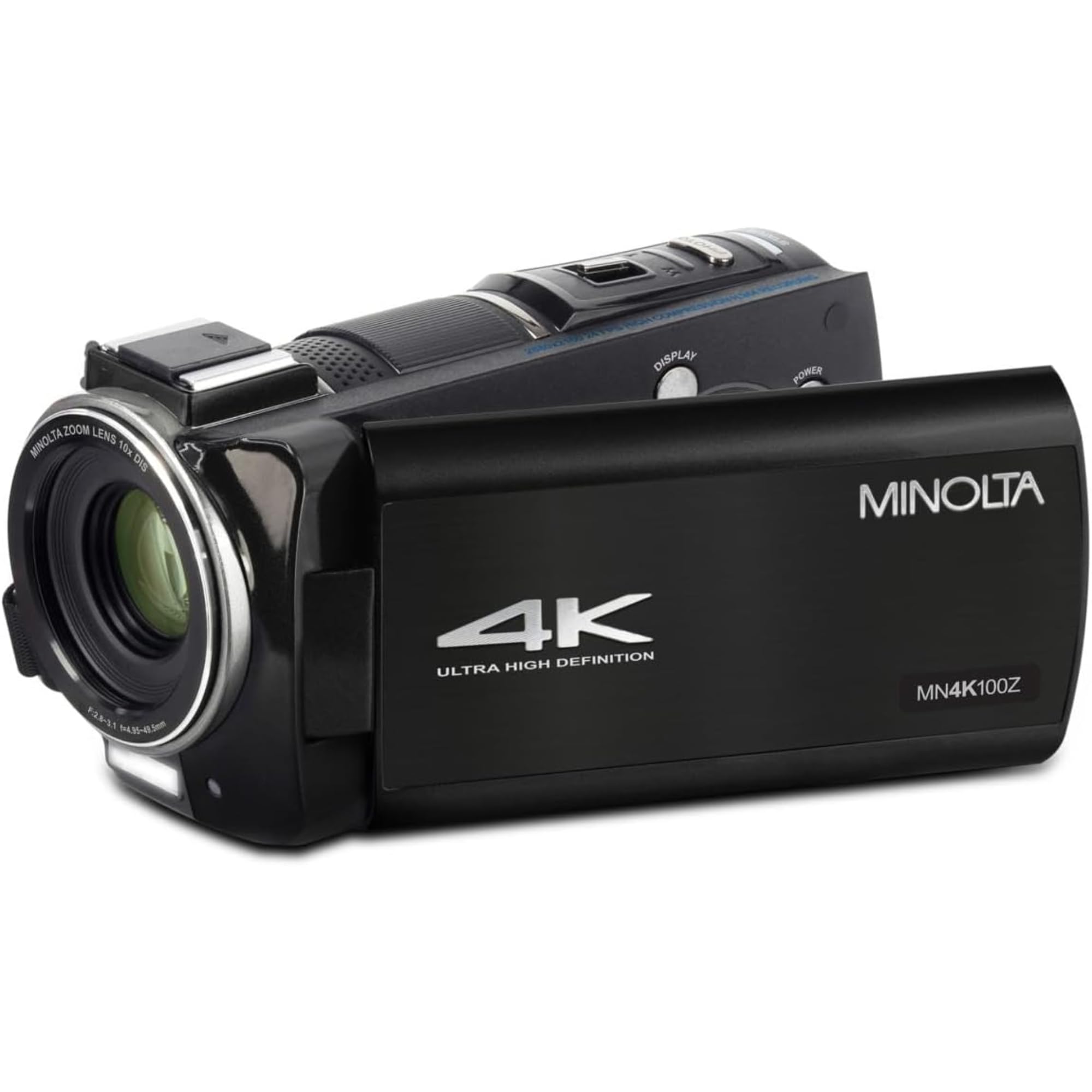
2. Minolta MN4K100Z Camcorder
The low-cost 4K body that also grabs 28MP stills and shoots after the lights go down.
If you want real 4K video without the professional-tier spend, the Minolta is the entry point. Its 28-megapixel effective still resolution is the highest in this roundup — the Canon VIXIA HF G70, by contrast, lists 8.29 megapixels — so you get bigger still photos alongside your video. It records at 4K UHD 24 frames per second, which gives footage a slightly cinematic cadence rather than a live-TV look.
Electronic stabilization is included, which reduces blur when you are moving, and the 3.5-inch IPS touchscreen (a panel wide enough to frame and review on the go) makes settings changes straightforward. The kit arrives practically ready to shoot: camcorder, pouch, USB and HDMI cables, AC adaptor, lens cap, lithium-ion battery, a 32GB memory card, and a remote control. It carries a 4.0+ rating across a small base of early reviews, so treat this as a good-value option rather than a proven workhorse.
Where it shines: the 10x optical zoom plus 36x digital zoom gives you reach, and the 32GB card in the box means you can record the day you unbox it.
Set expectations here: electronic stabilization reduces blur but does not match the multi-axis systems on the pricier Canon and Panasonic bodies, and the tiny review base means fewer owner experiences to draw on.
Best for: first-time 4K buyers, travelers, and anyone who wants video and high-resolution stills from one affordable body.
Think twice if: you need rock-steady handheld footage in motion or a large body of owner feedback.
3. Panasonic VX3 4K Camcorder, Lightweight Video Camera
A bright F1.8 lens and an ergonomic grip that makes long handheld shoots feel easy.
You can shoot a wide landscape and then a tight close-up without swapping lenses, thanks to the VX3’s 24x zoom and its 25mm wide-angle to 600mm telephoto range. The bright F1.8 lens (a wide aperture that lets in more light) is what makes that range usable in dim settings. The 1/2.5-inch sensor is built to keep low-light footage clear. And in-camera 4K editing lets you trim and stabilize clips without touching a computer. It suits travelers who film as they go.
What wins people over here is the stabilization and autofocus combination: 5-Axis HYBRID O.I.S+ and high-precision AF keep the frame steady and the subject sharp even while you move. The ergonomic grip fits snugly in the hand for extended shooting, and USB-C plus a remote control port and touchscreen round out the controls. Owners rate this body highly, and the lightness is a big part of that enthusiasm.
The one figure worth knowing before you commit is battery life: 55 minutes of average recording. The Canon VIXIA HF G70 runs 170 minutes by comparison, so plan on spare batteries for a full day of filming. Consider the digital zoom spec a secondary feature — the 24x optical is the number to trust.
Why travelers favor it
- Bright F1.8 lens keeps low-light video cleaner.
- 25mm wide to 600mm telephoto covers wide scenes and distant subjects.
- In-camera 4K editing means trimming and stabilization without a computer.
Plan around this
- 55-minute average battery life is short for a full day of shooting.
Pick this for: travel and family filming where a light body and a bright lens matter more than battery endurance.
Carry spares if: your shoot day runs long, since the battery averages 55 minutes.
4. Canon VIXIA HF G70 Camcorder 4K UHD CMOS, 20x Optical Zoom

Runs for 170 minutes and streams straight to a computer — built for event days that refuse to end.
The G70 is the endurance camera of this group. Its 170-minute average battery life is the standout figure, and it runs far longer than the Panasonic VX3 at 55 minutes. For anyone filming a ceremony, a conference, or a full school day, that margin alone can be the difference between one battery and three.
A 4K sensor and DIGIC DV6 image processor deliver crisp 4K UHD images, and the 8-blade aperture produces cinema-style out-of-focus highlights when you want a soft background. The 20x optical zoom works with advanced image stabilization, and the hybrid autofocus system with face detection keeps your subject sharp as they move. UVC livestreaming lets you send HD video directly from the camera to a PC or Mac over one cable.
For production work, the standout is on-screen time-stamp recording, which embeds date, time, timecode, and other data into your original files. Buyers rate build quality highest, with video quality close behind. The honest caveat: value and performance opinions are genuinely split — some call it a superb tool for the money, while others feel the price runs high for what they use it for. If you rely heavily on a long, deep zoom, note that zoom feedback is mixed too. Recording formats include AVCHD, H.264, and MP4.
The strongest asset: battery endurance and clean UVC streaming in one body, which suits event shooters who stream and record.
Weigh this carefully: performance and value opinions are mixed, so match it to your actual workload before committing.
Suited to: event and conference videographers who need long runtime and easy computer streaming.
Worth a pass if: you mainly shoot short casual clips where a lower-cost body would do the job.
5. Canon VIXIA HF G70 4K Camcorder Bundle with 20x Optical Zoom
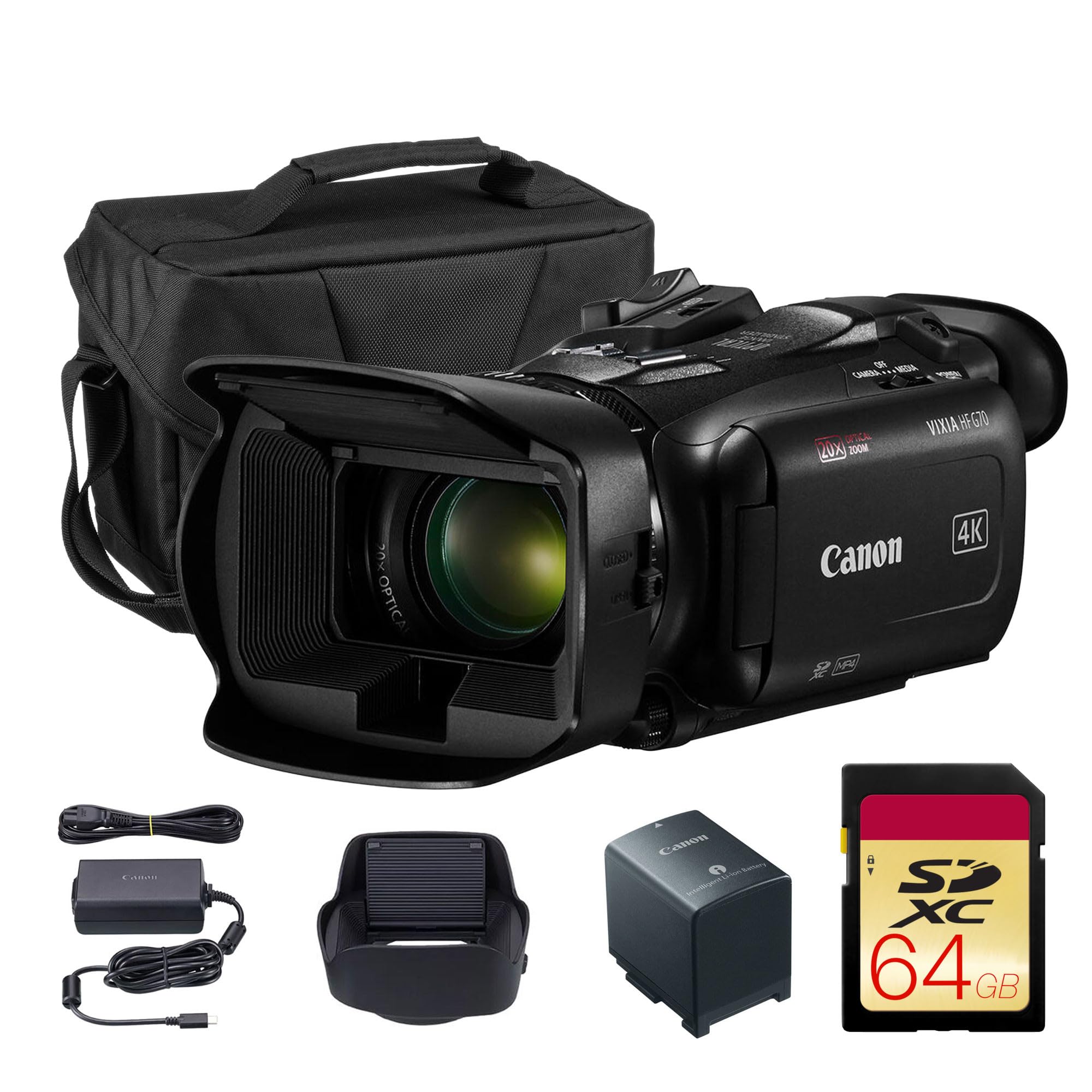
A handheld 4K body with an 8.29-megapixel MOS sensor and broad device compatibility.
Panasonic’s HC-X1200 lists an 8.29-megapixel effective still resolution and 3840-pixel effective video resolution, with an 8.29MP MOS sensor driving the picture. The digital zoom is listed at 10x, a modest figure compared with the Panasonic VX3’s 1500x digital zoom, so this body favors picture quality over long-range reach. It captures to internal flash memory with a UHS-I interface and C10 speed class.
Its versatility is in the connections: HDMI output and compatibility with personal computers, laptops, smartphones, and tablets make it adaptable across workflows. The listing is sparse on details — a marketing line and spec sheet — and there are no verified customer reviews to draw on yet. That means the 4.0+ rating rests on a small early group, so weigh it as a promising option rather than a fully proven one.
Choose it if you want a compact Panasonic 4K body with HDMI compatibility across computers, laptops, and tablets. If you need deep zoom reach or a large body of owner feedback, the established picks above are safer territory. The camera ships as body only.
Best fit: buyers who want a Panasonic 4K handheld and value multi-device HDMI compatibility over long zoom.
Skip if: you need extensive owner reviews or a generous digital zoom range.
6. Canon XA60 Professional UHD 4K Camcorder Bundle

A 1.0-type MOS sensor pushing 4K 60p with 13-stop V-Log for broadcast-grade color work.
For news, interviews, and event photography where smooth motion and color grading matter, the HC-X2 stands apart. Its effective 15-megapixel 1.0-type MOS sensor records 4K 60p/24p and FHD 60p in multiple formats with HEVC codec support, so fast action stays smooth rather than juddery. The 24.5mm wide-angle lens with 20x optical zoom (and i.ZOOM 32x in FHD or 24x in UHD) covers both tight rooms and distant subjects, while 4K high-precision autofocus with face detection keeps subjects sharp.
Professional streaming is built in: Wi-Fi, direct Ethernet connection, HLG Gamma Mode, and 13-stop V-Log let you produce 4K HDR content and stream live events without extra gear. Five-axis HYBRID O.I.S keeps handheld work steady, XLR input and a triple manual ring support serious field work, and a wired remote is available for multi-camera setups. Owners describe the quality as excellent.
The zoom is the one point where opinions split — some find it capable, others less so. That does not undermine the core strength, which is the image pipeline and live-streaming flexibility. If your work involves broadcast-style deliverables and you need 60p, this is the pick.
Built for broadcast work
- 4K 60p recording with HEVC codec for smooth motion.
- 13-stop V-Log and HLG Gamma Mode for HDR production.
- Wi-Fi plus Ethernet for reliable live streaming.
Worth knowing
- Zoom feedback is mixed — some find it capable, others less so.
Ideal for: broadcast, live-event, and documentary work needing 4K 60p and Ethernet streaming.
Overkill if: you only shoot home and holiday footage.
7. Sony PXW-Z90V 4K HD Compact NXCAM Camcorder

Instant HDR with HLG and 10-bit 4:2:2 XAVC slow motion in a compact broadcast body.
The PXW-Z90V is the production-grade pick for HDR workflows. Its instant HDR capability with HLG (Hybrid Log-Gamma, a broadcast HDR standard) lets you deliver high-dynamic-range footage without a separate grading pass. Fast hybrid autofocus and Super Slow/S&Q motion in Full HD XAVC 10-bit 4:2:2 give you flexible creative options, and it records 3840-pixel 4K with a 14.2-megapixel effective still resolution.
Networking is a strength: 2.4/5 GHz Wi-Fi with support for the XDCAM Air production system, plus a simple live solution when paired with an MCX500 Live Producer and RM30BP remote. A 62mm filter thread lets you add standard filters, and the compact body is made for run-and-gun broadcasting. What buyers report most is solid performance and camera quality.
This is the highest-positioned professional option in this roundup, aimed squarely at broadcasters and live-event crews. The digital zoom is a modest 12x, so this pick is about the HDR and 10-bit pipeline rather than extreme reach. It is the camera to choose when your deliverables are broadcast-standard HDR, not when you need the longest zoom.
The right tool for: broadcasters and live-production crews delivering HDR content.
Not the tool for: buyers who prioritize long zoom reach or casual family filming.
Know the Specs
Optical vs Digital Zoom
Optical zoom moves the lens glass to magnify, so the image stays sharp — a 20x optical lens holds detail at the long end. Digital zoom crops and enlarges the pixels electronically, which softens the picture the further you push. Always weigh the optical figure; digital numbers like 1500x are a software stretch, not real reach.
Sensor Size and Image Quality
A larger sensor gathers more light, so the 1-inch CMOS on the Canon XA70 handles low light better than the 1/2.3-inch sensors on the G70 and XA60. The MOS and CMOS labels describe the chip technology; what matters to you is how big the sensor is and how many effective pixels it records.
Battery Life and Shoot Days
Average battery life can range from 55 minutes on a lightweight body to 170 minutes on a long-shoot camera. If your day runs long, check this figure before buying and plan spare batteries accordingly.
Audio and Connections
XLR inputs accept pro microphones for clean interview sound, while a 3.5mm or built-in mic suits casual filming. Clean HDMI and USB Type-C output let you stream or feed a monitor, and dual SD slots allow redundant or relay recording on long shoots.
Common Questions
Is a 4K camcorder better than a 4K phone for recording?
What does true 4K mean for a camcorder?
Do I need XLR audio inputs on a camcorder?
How long does a 4K camcorder battery last?
Can a 4K camcorder be used as a webcam for streaming?
Is optical zoom better than digital zoom?
What are dual SD card slots for on a camcorder?
Does image stabilization matter when filming by hand?
What does HLG and V-Log mean on a professional camcorder?
Do I need a large sensor for low-light video?
The Bottom Line
For most buyers, the top rated 4k camcorders winner is the Canon VIXIA HF G50. It balances a genuine 4K sensor, a 20x optical zoom, and 5-axis stabilization in a body that also streams over clean HDMI. If long shoot days and easy computer streaming top your list, grab the Canon VIXIA HF G70 with its 170-minute battery. And for pro audio and a 1-inch sensor, the Canon XA70 is the one to reach for. Add spare batteries and a spare card, and the G50 covers nearly any event you point it at.
How we choose
We do not accept paid placement. Every pick is matched to a real buyer and a real use-case; we do not hands-on test units.
Sources
Specifications: manufacturer listings and product documentation. Review insights: verified customer reviews, as of November 2026. Pricing: not shown on this page (it changes often); check the current price via the retailer link.
As an Amazon Associate, Tactical Gear Guy earns from qualifying purchases. This does not affect which products we feature.