Specs are compiled from manufacturer listings and verified buyer reviews and can change over time — please confirm the key details on the product page before buying.
You want gear that survives a full season of recess, PE class, and Saturday practice — not something that cracks on the first kick. The quick answer: the Champion Sports Rhino Skin dodgeball set is the safest all-round buy here, because its 6-inch foam-core balls are built to be thrown hard without stinging anyone. Below you get nine picks sorted by what they actually do on the field, from agility ladders to rebounder nets.
This guide is built by comparing the manufacturers’ published specifications and the patterns across verified customer reviews, so you get each pick’s real strengths and trade-offs instead of marketing spin.
Coaches and parents both get burned by equipment that looks tough in the listing and falls apart in the gym bag. That is why each pick below is judged on the specs that decide whether it survives a season, from rung count to pole material to net stitching, so you can match the gear to your group before you spend anything on the best team sports equipment.
Top Picks


How To Choose The Best Team Sports Equipment
The gear on this list splits into three jobs: something to throw, something to run through, and something to practice against. Decide which job you are buying for first, because a dodgeball set will not fix your footwork and an agility ladder will not teach a serve.
Match the ball to the thrower
A dodgeball’s diameter decides who can grip it. The smaller 6-inch balls suit younger children because small hands wrap around them. A foam core keeps the bounce low, so the ball stays inside the play area instead of sailing over a fence. Coated surfaces matter too, because an uncoated foam ball tears the first time it hits gravel.
Count rungs before you count drills
An agility ladder is measured by its rungs — the crossbars you step between. A 12-rung ladder at 20 feet gives you enough room for a full footwork sequence. Fewer rungs means more resetting and less flow. Adjustable rungs let you widen or narrow the spacing for beginners versus advanced players.
Check pinnie sizing for the age group you coach
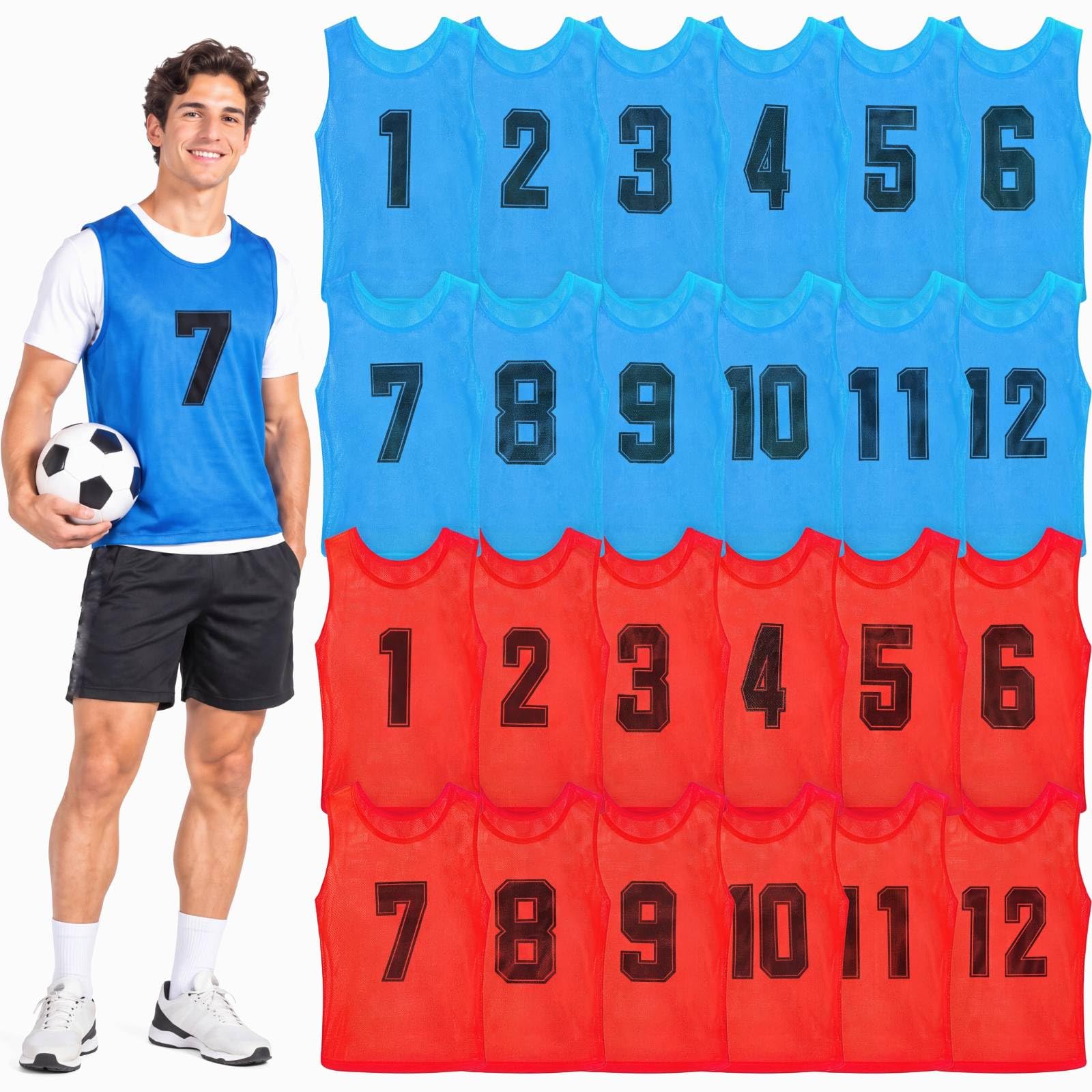
Practice vests are the piece coaches regret most often, because a pack that fits one age group will not fit another. Read the size notes carefully when you are outfitting adults, not just youth players. Breathable mesh keeps a vest comfortable through a hot practice, and numbered backs make substitutions faster.
Side-by-Side Comparison
| Model | Best For | Type | Size / Count | Material | Amazon |
|---|---|---|---|---|---|
| Champion Sports Rhino Skin Dodgeball Set★ Best Overall | Safe gym and playground play | Dodgeball set | 6 balls, 6″ diameter | Foam, polyurethane coating | Amazon |
| GHB Soccer Agility Training SetFull Drill Kit | Coaches running full drills | Agility kit | 20ft ladder, 6 poles | Plastic | Amazon |
| Vabean 24 Pack Numbered PinniesSquad Outfitter | Outfitting a full squad | Scrimmage vests | 24 vests | Nylon mesh | Amazon |
| MUROZA Agility Speed Training Set | Home footwork training | Agility kit | 20ft ladder, 12 rungs | Nylon, plastic, steel | Amazon |
| FITPARNER Backyard Soccer Goals | Young kids in the yard | Soccer goal set | 2 goals, 4×3 ft | Fiberglass, oxford cloth | Amazon |
| Apex Sports Volleyball Rebounder | Solo practice without a partner | Rebounder net | 7×4 ft | Knotless HDPE, alloy steel | Amazon |
| GoSports XL Tackle Dummy | Contact drills for youth teams | Tackle dummy | 4 ft tall, 1 ft wide | Composite leather, foam core | Amazon |
| MangoStar Volleyball Net System | Height-adjustable home net | Training net | 11×8 ft | Alloy steel, polyester | Amazon |
| Apex Sports Volleyball Training Net System | Structured team practice | Training net | 3 adjustable heights | Alloy steel | Amazon |
Detailed Reviews
1. Champion Sports Rhino Skin Dodgeball Set
Our pick — 4.5+★ from 900+ verified ratings; the strongest balance of quality and price.
Six foam-core balls that let kids throw full force without anyone yelping.
This is the pick that ends the argument about whether dodgeball hurts. Each ball measures 6 inches across, a diameter small enough for younger children to wrap their hands around, and the low-density foam core keeps bounces short so the ball stays in the gym instead of bouncing off the far wall. The whole set weighs 1.5 pounds — you can carry all six in one hand and the mesh storage bag comes with them.
What wins people over is the build quality, and durability runs a close second in owner feedback. The patented Rhino Skin coating sits over a multi-layered construction in foam and polyurethane, so the surface takes scrapes from asphalt and dirt infields without shredding. Coaching a wrestling warm-up or a K-6 PE class, the same set keeps coming back out of the bag. Parents describe them as soft but rugged — heavy enough to throw accurately, gentle enough that nobody flinches.
The honest catch is a size limit, not a defect. At 6 inches these suit elementary and middle-school players best; a high school or adult league will want a bigger ball for grip and throw weight. And if you need tournament-spec dodgeballs rather than recess and practice balls, look elsewhere.
What earns the top spot
- 6-inch foam-core balls sting far less than classic rubber
- Rhino Skin coated surface handles rough outdoor play
- Set of six plus a heavy-duty mesh carry bag
- Low bounce keeps play inside a driveway or small gym
Where it stops short
- 6-inch diameter is small for adult or high-school play
- Practice-grade, not a tournament-spec ball
Reach for this if: you coach youth players or run a PE class and want a ball nobody is afraid of catching.
Look elsewhere if: your squad is high school age or older and needs a larger ball in hand.
2. GHB Soccer Agility Training Equipment 6 Agility Poles
One bag that covers a whole practice session, poles and parachute included.
If you are a coach who sets up a circuit and moves a group through stations, this kit saves you hauling five separate boxes. You get 6 agility poles at 5.9 feet each, and each pole splits into 4 detachable sections measuring 15.75 inches, so the height adjusts to whatever drill you are running. Spring-loaded spikes 7.87 inches long anchor them into turf or grass.
The rest of the bag fills out the session: a 20-foot speed ladder with 12 rungs, 12 disc cones, a resistance parachute with a quick-release waist belt, a jump rope, 5 resistance bands, a cone holder, 4 metal pegs, and a printed drill guide. Everything packs into the included carry bag. A 2-year manufacturer warranty covers the set if a pole section gives out.
Where it earns its keep: the sectioned poles are the reason to pick this over a plain ladder set — you can run a slalom drill at one height and a limbo-style drill at another without buying a second product.
The trade-off: this is the newest listing in the group, so there is no long owner history to lean on, and the pole sections add assembly steps before each session.
The verdict: buy it when you want a single bag that covers sprint, footwork, and resistance work in one practice.
The honest limit: a plain ladder will suit a coach who only runs footwork drills.
3. Vabean 24 Pack Numbered Pinnies Vests for Youth Adult
Twenty-four numbered mesh vests — enough to split a full squad into two sides.
Scrimmage gear is the least glamorous thing on this list and the one you notice most when it is missing. Twenty-four vests means two full teams of twelve, and the numbering on the back lets you call out matchups without squinting across the field. Nylon mesh breathes through a hot practice, and the whole pack weighs 4.41 pounds, so it rides in a car boot without drama.
The quality of the vest itself is what draws the strongest feedback here, with the vest function close behind. Coaches describe them as doing exactly the job of separating teams at practice. That is the whole brief for a pinnie, and these hit it.
Read the sizing note first: this pack draws the most criticism on adult fit — the vests tend to run small for grown players. Measure or size up if you coach adults rather than youth, and expect the colors to vary from what the photo suggests.
Who it fits: youth programs and mixed-age practices where an oversized fit is not the concern.
Best for: youth coaches who need a big pack fast and want numbered backs for drill work.
Check before ordering: the adult sizing, which runs toward the small side.
4. MUROZA Agility Ladder Speed Training Equipment Set
A backyard obstacle course that folds into one bag when the session ends.
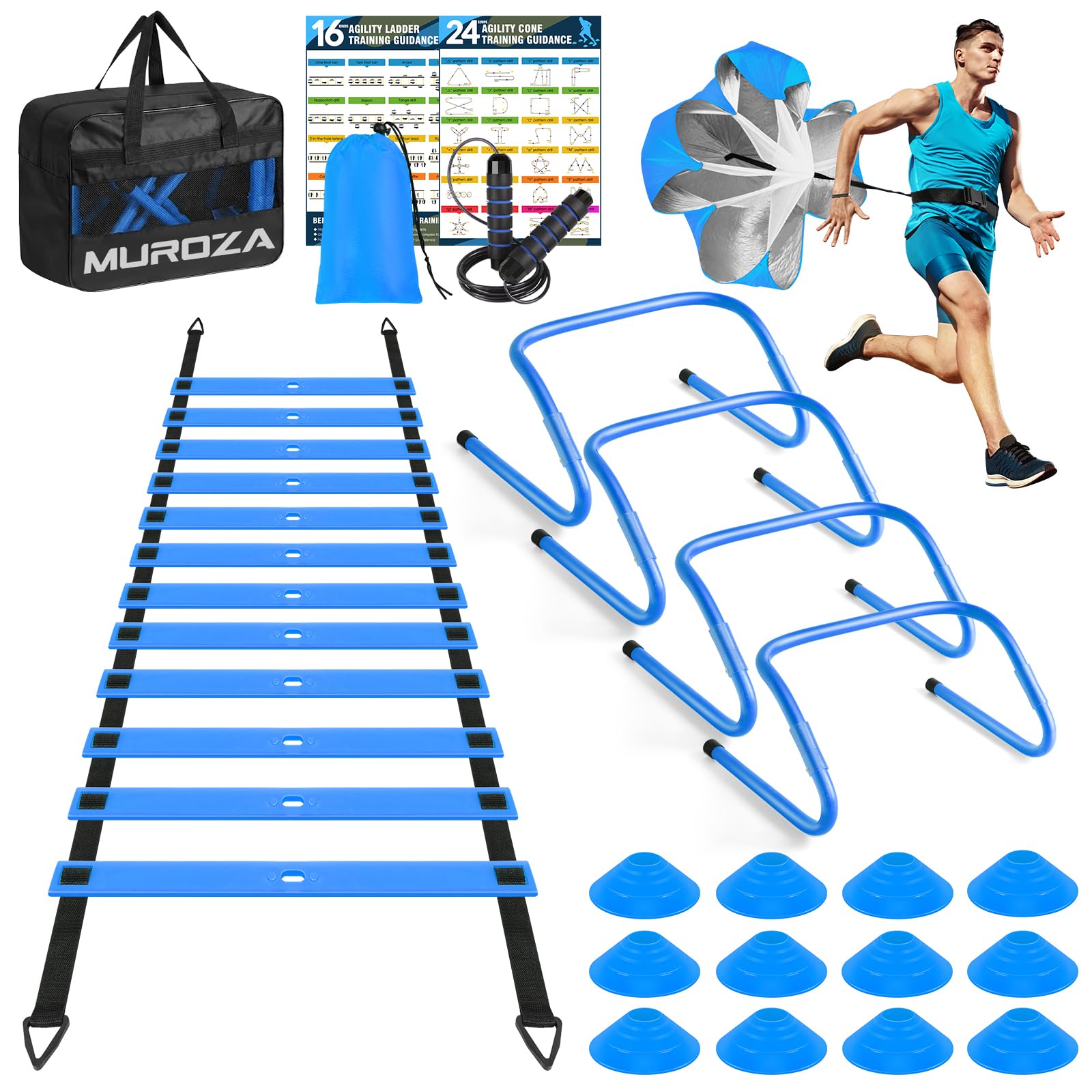
Here is the comparison that matters most in this group. This set places a 20-foot ladder with 12 rungs and 4 stakes beside 4 adjustable hurdles that rotate between 8.5 and 12 inches tall, so you can run a low-speed footwork drill and then raise the bars for a hop sequence. Twelve disc cones at 7.9 inches wide mark the lanes, and a running parachute 56.7 inches wide adds resistance work.
Setup is quick enough that you will actually use it. The fixed-width ladder resists tangling between drills, and the whole kit works on grass, turf, concrete, or a gym floor. At 6 pounds it carries easily, and a 19-inch by 13-inch bag holds everything including the footwork drill poster. Teen athletes training for speed find it well matched to their level.
Why owners keep it: quality is the strongest theme in feedback, with suitability for training right behind it — the hurdles and parachute make it a full session rather than a single drill.
The honest caveat: the cones are the weak link and have been known to crack, and the rungs suit steady footwork work rather than heavy cleat stomping.
Go for it: if you train one athlete at home or a small group in a yard and want variety in one bag.
Think twice: if you plan to run the same ladder every day on hard ground for a whole season.
5. FITPARNER Backyard Soccer Goals 2 Pack
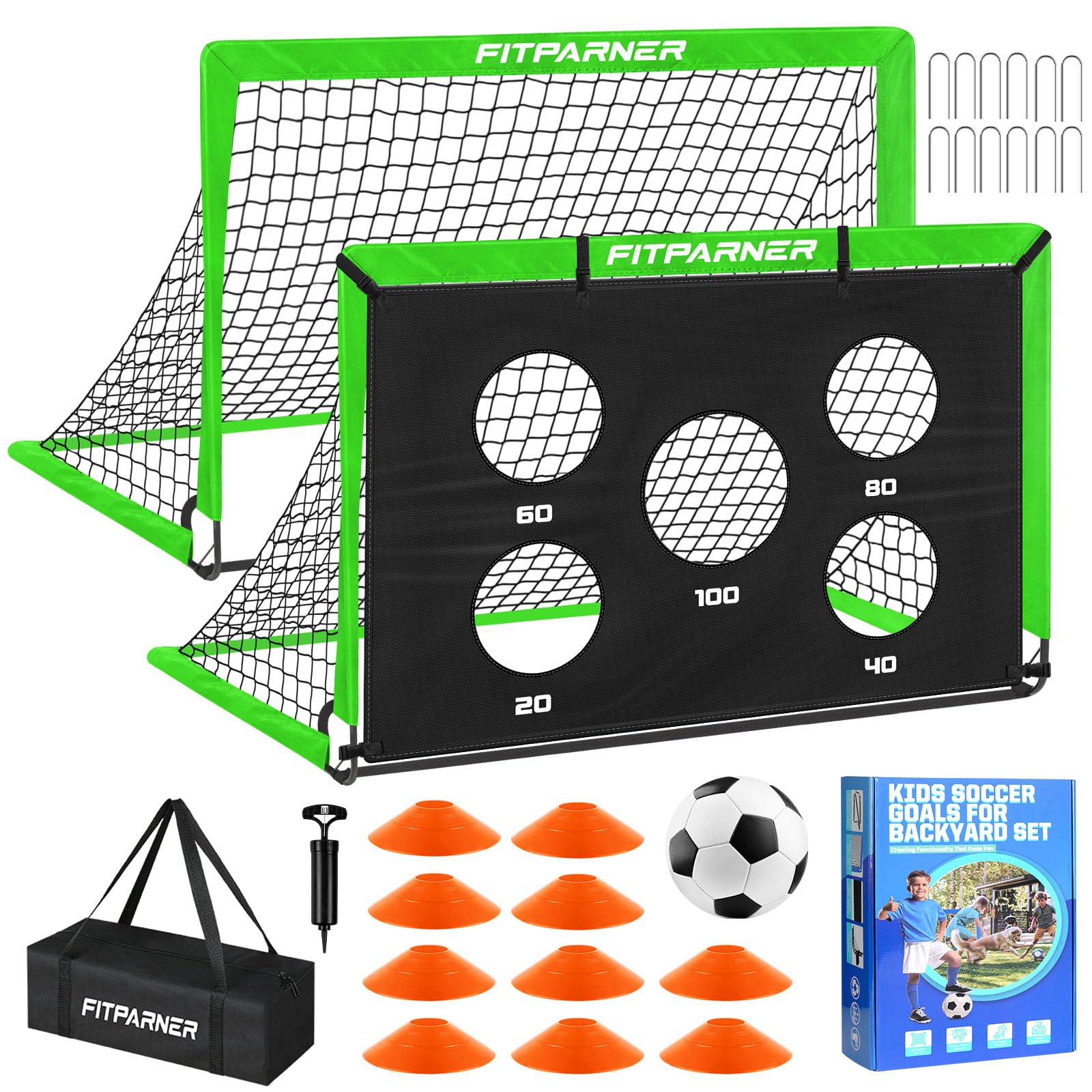
Two 4×3-foot goals, a target cloth, and a ball — the whole yard setup in one box.
The smart part of this set is the detachable target cloth with 5 scoring zones. A young player can practice shooting accuracy alone, without a goalkeeper or a parent standing in goal, which is exactly the gap most backyard gear leaves open. You also get a size 3 soccer ball, a needle-inflated pump, 10 training cones, and 8 U-shaped metal ground stakes to pin the goals down.
The frames use 450D thickened oxford cloth over high-elastic fiberglass poles, and the goals fold down for storage in the included bag. Setting one up takes a read through the manual rather than a tool kit. Grandparents buying for a 6 or 7 year old describe the size as right for that age band and the assembly as manageable. The form factor is 4 by 3 feet per goal.
The trade-off to know: the cloth and poles are built for kids kicking, not for teenagers blasting shots — some buyers report the mesh ripping after months of hard use. Keep it for the age range it is designed for and it holds up.
Solid pick for: families with kids in that youth range who want goals, a ball, and stakes without buying separately.
Not for: older players who will strike the ball at full power.
6. Apex Sports Volleyball Rebounder, 7×4 ft Bounce Back Net
You do not need a partner to practice a spike when the net throws the ball back.
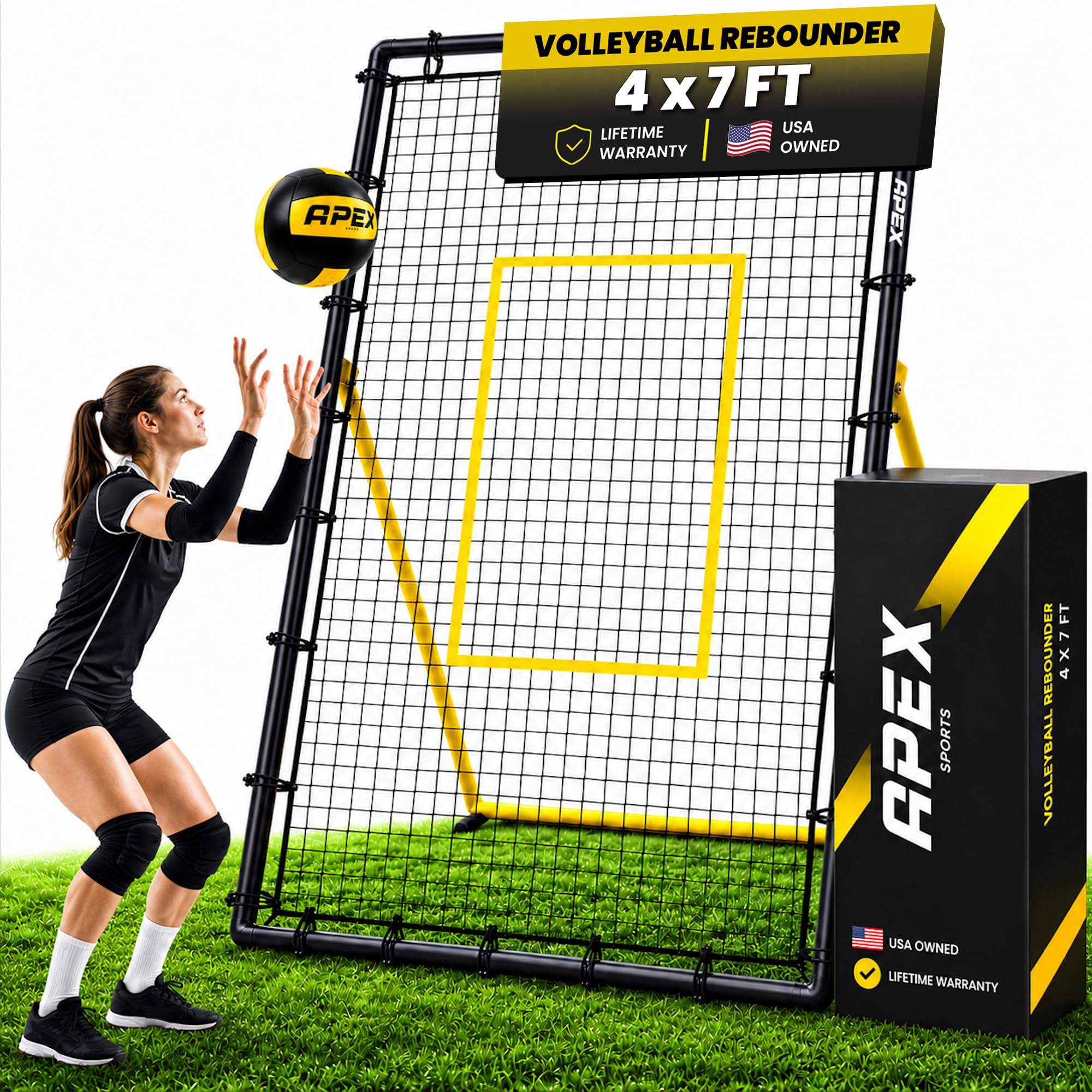
This is a solo training tool first and a net second. The rebounding surface spans 7 by 4 feet, which gives you a wide target for bumping, setting, and spiking without chasing the ball into the neighbour’s yard. The angle adjusts so you can mimic a real return from the block, and the netting is knotless HDPE with UV resistance, so sun exposure does not chew through it.
The steel frame is powder-coated, and Apex backs the rebounder with a lifetime warranty and sells replacement parts. Setup takes minutes rather than an afternoon, which is why owners describe it as genuinely usable at home. Coaching a club or a school program, one person can run a whole rebound drill while the rest of the squad works elsewhere.
The upside on paper: the 7×4-foot surface and adjustable angle pair well with a steel frame that stays put during a full-power spike.
The honest note: the elastics and ties wear first, and some owners brace the back legs against a wall for stability. the elastics and ties are the part that wears, with some owners bracing the back legs against a wall for stability. Plan to check the tension cords each season.
Worth it for: the player who practices alone in the yard and needs a partner substitute.
Skip if: you play doubles drills where a full net and court setup matter more than a bounce-back wall.
7. GoSports Heavy Duty Football Tackling Dummy

A 4-foot foam block with real handles, built to take a full-speed hit in practice.
This pad measures 48 inches tall and 12 inches wide, and it carries a dense foam core inside a tear-proof composite leather shell. That shell is sweatproof and waterproof, which matters when it sits on wet grass through a whole session. The surface has held up to being dragged across a lawn with kids hanging off it, with the stitching still in place.
Three reinforced handles give you control points for blocking and tackling work rather than one grip down the middle. It suits football, basketball, and martial arts drills, and youth, middle school, high school, and college athletes can all use the same pad. A third-grade football team can run blocking and tackling stations with it in a yard.
What stands out: the composite leather exterior is the reason it survives rough treatment — owners mention no rips or tears after heavy use.
The honest catch: weight is the most-debated point, and some owners find it lighter than they would like for larger players. For a middle-school or youth pad, that is actually an advantage, because smaller athletes can move it.
Suits: youth and middle-school coaches running contact stations, plus martial arts and multi-sport training.
Consider a heavier option: if your varsity players need a pad that resists much harder impacts.
8. MangoStar Volleyball Net System for Backyard
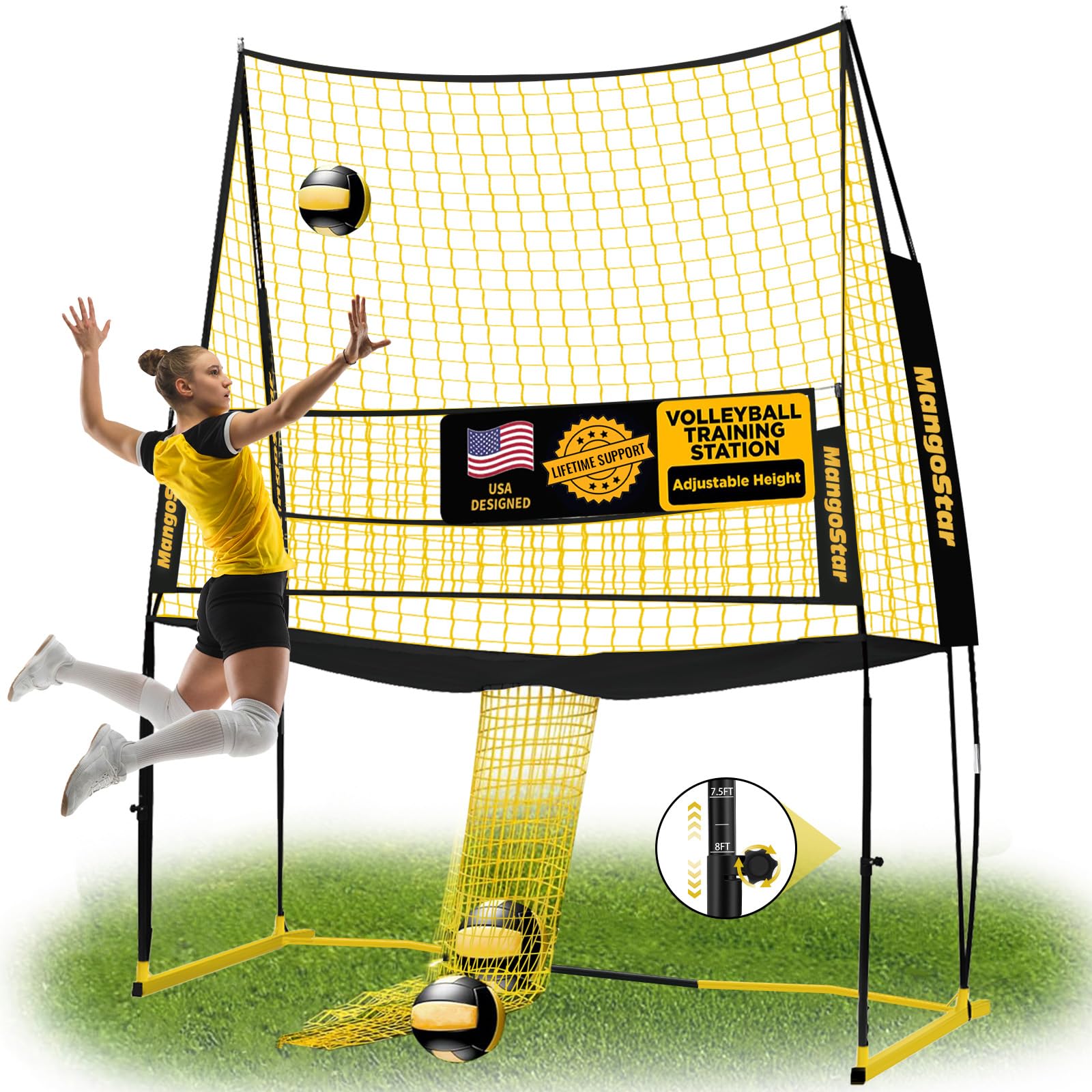
Height slides from 6.5 to 8 feet, so the same net grows with your player.
The height range is the whole argument. A quick-release lock lets the net move smoothly between 6.5 and 8 feet, with a clear height scale on the front so you can dial in the right setting for any age or skill level. That beats a fixed-height net, and the lock design avoids the hand-pinching that comes with older slide mechanisms.
The frame uses heavy-duty powder-coated materials, and the upgraded 16MM fiberglass poles are built to absorb impact without warping. Netting is 5-ply knotless with double-stitched seams, and four metal stakes add stability on grass. The 11 by 8 foot system assembles without tools and packs into a carry bag for the backyard, basement, gym, or beach. A girl practicing overhand serves can set it up on her own.
Where it shines: the adjustable height and tool-free setup make it a shared-family net — one setting for a younger player, a higher one for a teen.
The honest note: the fiberglass poles can shed small splinters at the surface, so a quick wipe before each use is sensible. Some owners also report the seam fabric at the pole wearing after repeated sessions.
The pick for: a family with players of different ages who share one net in the backyard.
Only if: you will mostly play on grass or turf where the stakes can bite.
9. Apex Sports Volleyball Training Net Equipment System

Three fixed heights, one solid alloy steel frame, built for a full squad’s practice.
Where the adjustable net above focuses on families, this one is aimed at coaches. It offers set heights of 8 feet, 7 feet 3 inches, and 6 feet 6 inches, matching the standards you would use for different age groups. The alloy steel frame holds tension against powerful hits and serves, giving you a designated target area for serving, spiking, setting, and blocking drills.
Customers note the frame feels solid and sturdy once assembled, and the second setup goes faster than the first. One parent of a high school player said the extra practice time through the season made the purchase worthwhile. The net packs into a compact footprint for storage between sessions, which suits a gym or a garage corner.
The real strength: quality and assembly are what owners bring up most, and the three set heights line up with actual age-group standards.
The honest catch: stitching and seam fabric are the wear points, with some owners seeing it fail after a couple of months of regular outdoor use. Store it dry and out of wind and it lasts considerably longer.
Made for: coaches and parents running structured hitting and serving practice for a high-school-age player.
Also know: the taller you set it, the more the frame relies on correct assembly and a flat surface.
Know the Specs
Ball diameter and core
A dodgeball’s diameter decides who can grip it and how it throws. A 6-inch ball suits smaller hands, while a larger ball offers more to grab for older players. A foam core — a low-density foam centre — keeps bounces short so the ball stays where you are playing. A coated skin over that foam protects it from dirt, asphalt, and repeated impact.
Ladder rungs and hurdle height
An agility ladder is counted in rungs, and 12 rungs across a 20-foot ladder gives you room for a full footwork sequence without stopping to reset. Adjustable hurdles that rotate between two heights — like 8.5 and 12 inches — let you change the difficulty of a drill without changing equipment. Both specs decide how quickly a coach can move players from one station to the next.
Pole material on nets
Fiberglass poles flex and absorb impact, which is why they appear on adjustable nets, while alloy steel frames hold firmer tension. Both need care: fiberglass can shed splinters at the surface, and steel parts benefit from being stored dry. A powder coating on either one protects it from weather and sweat.
Netting and stitching
Knotless netting — a mesh built without knots at the crossings — and double-stitched seams are the two build details that keep a net from giving way under a hard spike. Five-ply netting adds material at each strand. These are the parts that wear first on any training net, so check them before each season.
Common Questions
Will a 6-inch dodgeball work for high school players?
Do foam dodgeballs sting when you get hit?
How many rungs should an agility ladder have for team drills?
Can adults wear 24-pack numbered pinnies or are they youth-sized?
Is a rebounder net better than a partner for volleyball practice?
What height should a backyard volleyball net be set to?
How long does a training net last outdoors?
Do the fiberglass poles on volleyball nets need any care?
How heavy should a tackle dummy be for youth practice?
Can backyard soccer goals survive a season outdoors?
The Bottom Line
The best team sports equipment here is the Champion Sports Rhino Skin dodgeball set, because six foam-core balls with a coated skin cover the most common team-play need without stinging anyone. If your gap is footwork, the MUROZA agility set packs 12 rungs, 4 hurdles, and a parachute into one carry bag. And for solo volleyball practice, the Apex Sports rebounder lets a player drill spiking and bumping without hunting for a partner. Start with the pick that fills the biggest gap in your practice, then add the rest as the season demands.
How we choose
We do not accept paid placement. Every pick is matched to a real buyer and a real use-case; we do not hands-on test units.
Sources
Specifications: manufacturer listings and product documentation. Review insights: verified customer reviews, as of November 2026. Pricing: not shown on this page (it changes often); check the current price via the retailer link.
As an Amazon Associate, Tactical Gear Guy earns from qualifying purchases. This does not affect which products we feature.