Specs are compiled from manufacturer listings and verified buyer reviews and can change over time — please confirm the key details on the product page before buying.
You already know the feeling: you lean into a normal corner on a frosty morning and the bike slides out from under you. The fix is not riding more carefully — it is swapping to a studded or cold-weather tire. Winter bike tires use metal studs or a soft cold-weather compound so the tread actually bites into ice and packed snow instead of skating across it. The short answer on which to buy: the Schwalbe Marathon Winter Plus is the safest all-rounder for most commuters, the Schwalbe Winter 700Cx30C is the road-friendly value pick, and the wide fat-bike crowd should look at the CST Toboggan.
This guide is built by comparing the manufacturers’ published specifications and the patterns across verified customer reviews, so you get each pick’s real strengths and trade-offs instead of marketing spin.
Below you will find the sizes, stud setups, and pressures that decide whether a tire keeps you upright, plus the honest trade-offs nobody mentions. Read on for the full breakdown of winter bike tires.
Top Picks


How To Choose The Best Winter Bike Tires
The first thing to get right is fit — a winter tire you cannot mount on your rim is useless, no matter how many studs it carries. Start by reading the ETRTO number on your current tire’s sidewall (a pair like 42-622 or 50-559). That number tells you the exact width and rim diameter the tire is built for, so you match it rather than guessing from a rough inch label.
Studs versus compound: two different ways to grip ice
A studded tire has tiny metal spikes pressed into the tread that physically dig into ice — that is what stops the front wheel washing out on a frozen puddle. A winter-compound tire skips the metal and instead uses softer rubber with fine slits (called lamellar tread) that stay pliable in the cold. Studs win on glare ice; a soft compound tends to suit cold, wet pavement and light snow better.
Pressure changes everything
On studded tires, the manufacturer’s own guidance is that the spikes grip best at minimum pressure, because lower pressure lets the studs push into the surface. Pump the tire up toward maximum and the ride gets quieter on bare roads, but you trade away some of that bite. A pressure gauge and a few minutes of experimenting will tell you more than any sidewall label.
Match the tire to the bike and the terrain
A 4-inch fat-bike tire floats over snow and soft ground, while a 30 mm road tire cuts through slush and stays fast on cleared pavement. Be honest about where you actually ride: deep rutted snow favours volume, while a plowed city commute favours a narrower, studded tire with lower rolling drag.
Side-by-Side Comparison
| Model | Best For | Size / ETRTO | Studded? | Weight | Amazon |
|---|---|---|---|---|---|
| Schwalbe Marathon Winter Plus 42-622★ Best Overall | All-round winter commuting | 42-622 (28×1.60) | Yes | 2 pounds | Amazon |
| Schwalbe Winter 700Cx30CBest for Road Bikes | Road and hybrid bikes on ice | 700Cx30C | Yes | 16 ounces | Amazon |
| Schwalbe Ice Spiker Pro 65-584Top Performer | Trail and mountain riding on ice | 65-584 (27.5×2.6) | Yes | — | Amazon |
| Continental Contact Plus City | Cold, wet pavement without studs | 50-559 (26×1.90) | No | 16 ounces | Amazon |
| CST Toboggan 26 x 4.0 | Fat bikes in extreme snow | 26 x 4.0 | Yes (240-studded) | 3.6 pounds | Amazon |
| Schwalbe Ice Spiker Pro Hs379 | Road and BMX builds on ice | 70 cm diameter | Yes | 2.1 pounds | Amazon |
| GRELiving Fat Tires 26×4.0 | Budget fat-bike and e-bike winter tires | 26×4.0 (102-559) | Studdable (studs sold separately) | — | Amazon |
| Vee Tires Snowshoe XL 26 x 4.8 | Maximum float on snow and sand | 26 x 4.8 | Studded | 3.8 pounds | Amazon |
Detailed Reviews
1. Schwalbe Marathon Winter Plus 42-622 (28×1.60)
Our pick — 4.5+★ from 250+ verified ratings; the strongest balance of quality and price.
The commuter tire that keeps full control on icy roads without giving up flat protection.
The number that matters here is 42-622 — that is the ETRTO size, meaning a 42 mm wide tire built for a 622 mm rim (the standard 700C road and hybrid size). It fits the cyclocross and hybrid bikes most people actually commute on, so you are not hunting down a rare rim. And at 2 pounds it stays in a range you can spin all winter without feeling like you bolted on a wheelchair.
What sells this tire is the combination of studs and a SmartGuard layer. The studs give you grip on ice, and the SmartGuard belt underneath is a puncture-protection layer so a winter pothole or road debris does not end your ride in the cold. Schwalbe’s own guidance is that the spikes grip best at the minimum pressure, and at max pressure the noise drops right down on ice-free roads — so you can tune it toward bite on a snowy week and quiet on a dry one.
The one adjustment to plan for is noise. On bare, dry asphalt a studded tire like this hums and feels a little draggy — that is the price of metal spikes, not a defect. If your winter is mostly cleared roads with only occasional ice, the Continental Contact Plus below skips the studs and runs quieter. But for a real freeze-and-thaw commute, the front-wheel confidence this gives is the whole reason to buy it.
Why it earns the top spot
- Studs for ice plus a SmartGuard puncture layer in one tire.
- 42-622 size fits common hybrid and cyclocross bikes.
- 2 pounds keeps the ride manageable for daily commuting.
- Grip and noise can be tuned by adjusting pressure.
Where it asks something of you
- Audible hum and drag on dry, stud-free pavement.
- You need a pump with a gauge to set pressure properly.
Reach for this if: you commute through real ice and slush and want one tire that covers grip and flats together.
Look elsewhere if: your roads are mostly cleared and dry — the stud noise will wear on you.
2. Schwalbe Winter 700Cx30C Wire Kevlar Guard Reflex Studded
A slim, fast studded tire built to slice through slush on a road or hybrid bike.
At 700Cx30C this is a narrow tire — 30 mm wide where the fat-bike picks run 4 inches or more. That slenderness is the point: a thin profile cuts down through slush to the surface underneath instead of floating on top. It is designed for road bikes and the paved commute, not for rutted backcountry snow.
The specs to note are the Kevlar Guard belt (a protective layer under the tread that resists punctures) and a 50TPI casing, with a 50-95 PSI pressure window. That wide pressure range lets you drop toward 50 for more grab on ice and pump up toward 95 for a faster, quieter roll on cleared tarmac. Reflex sidewalls add a reflective stripe so you show up in headlights on dark winter evenings.
Two honest caveats surface again and again on this tire. Mounting it can fight you — wire-bead studded tires are stiff, and getting one over the rim takes patience and a good set of levers. And it is not fully planted in a hard lean; standard turns are fine, but pushing a fast corner on ice will find the limit. Ride it with a little restraint and it stays trustworthy.
The commuter case: narrow enough to stay quick, studded enough to cross a frozen patch, and reflective for dark rides — a sensible road-bike winter swap.
Plan for: a stubborn install and a modest top-end in aggressive cornering.
Fits best: road and hybrid riders who want winter grip without going wide.
Think twice: if you want a tire that pops on by hand — this one wants levers.
3. Schwalbe Ice Spiker Pro Performance DD 65-584 (27.5×2.6)
Built for frozen trails and rooty singletrack, with stud count up to 402 per tire.
For mountain riders who keep going when the trails freeze, the Ice Spiker Pro is the aggressive option. It comes in the 65-584 size (27.5×2.6) and carries up to 402 studs per tire in the 29×2.25 size, according to the maker — enough to grip on completely frozen surfaces. That stud density is the headline: where a commuter tire wants a few spikes for a puddle, this wants a carpet of them for a frozen descent.
The Double Defense Raceguard construction is a double layer of Nylon fabric under the tread, which is there to fend off punctures on rocky, rooted trails without turning the tire into a brick. It is also Tubeless Easy (TLE) — meaning it is designed to run without an inner tube when set up tubeless, which lets you drop pressure for more grip. Schwalbe backs it with a 3-year warranty from purchase or 5 years from production date, whichever comes first.
The catch is that all that studded armor makes it a trail tool, not a commuter. On hard pavement it will feel slow and loud, and the price sits in the premium tier. If your winter riding is a plowed bike path, the Marathon Winter Plus above is the calmer choice; if it is a frozen forest loop, this is what you want under you.
The trail verdict: stud count and Raceguard protection make this a serious frozen-trail tire, with a warranty to back it.
The honest limit: heavy and loud on cleared pavement, and priced at the top of the range.
Built for: mountain and trail riders who refuse to park the bike when the ground freezes.
Not the one: for a paved daily commute — you would be paying for grip you rarely use.
4. Continental Contact Plus City Bike Tire

No studs, just a cold-weather compound tuned for wet pavement and light snow.
This is the tire for the rider whose winter is wet and cold but rarely a solid sheet of ice. Continental built the Contact Plus City around a lamellar tread — fine slits in the rubber that open up to grip on slippery roads, borrowed from the company’s car and truck winter tires. It comes in the 50-559 size (26×1.90) with a 26-58 PSI range and a folding bead that works with an inner tube.
The protection story is a Vectran Breaker layer, described as more cut-resistant than aramid, sitting under the tread to resist punctures without adding rolling drag. It is E50 rated and ECE-R75 certified, meaning Continental recommends it for e-bikes up to 50 km/h, including S-Pedelecs. Reflex sidewalls help you get seen on dark evenings, and it is handmade in Germany.
Be clear-eyed about the limit: this tire grips well on wet tarmac and light snow, but it has no metal studs, and that shows up on real ice. On smooth, plowed-over icy snow it can slide, and in deep snow it gives up quickly. So treat it as a cold-and-wet pavement tire, not an ice tire. If your commute truly freezes over, the studded Schwalbe Marathon Winter Plus is the safer bet.
What it delivers
- Lamellar tread grips cold, wet roads well.
- Vectran Breaker puncture layer under the tread.
- E50 rated and ECE-R75 certified for e-bikes up to 50 km/h.
- Reflective sidewalls for dark-ride visibility.
Where it falls short
- No studs, so true ice and deep snow defeat it.
- Best kept to wet pavement and light snow duty.
The right match: city and e-bike riders facing wet, cold pavement rather than hard ice.
Wrong tool: if your route ices over reliably — go studded instead.
5. CST Toboggan 26 x 4.0 Wide 240-Studded Fat Tire

A wide 26 x 4.0 fat tire with 240 studs that punches far above its price.
For fat-bike riders, the CST Toboggan is the tire that makes studded winter riding affordable. It runs the 26 x 4.0 size with a wire bead, and it comes studded from the factory rather than asking you to fit spikes yourself. At 3.6 pounds it is a genuine fat-bike tire — that volume is what lets you run low pressure and float over soft snow instead of plowing through it.
Here is the comparison that matters: this Toboggan is wide, at 4 inches, where the Schwalbe Winter road tire is 1.2 inches — a 3.3x gap in width, and it relies on that width plus studs instead of a slim cut-through profile. Buyers report running it down to 10 PSI, where the 240 studs bite into ice instead of skating across it. What wins people over is on-snow performance, and it grips on pavement about as well as pricier fat tires while beating many of them on sand and gravel.
The trade-off is durability, and it is genuinely a split verdict — owners mention a tire lasting a full winter of commuting, while others find the softer rubber wears faster under road use. Set expectations accordingly: on snow and trail it holds up, on constant dry asphalt it gives ground sooner. Keep it for the winter season and it earns its keep.
The value read: factory-studded 26 x 4.0 grip at a fraction of premium fat-tire money.
The honest wrinkle: the soft compound can wear fast if you leave it on pavement year-round.
Made for: fat-bike riders who want studs without the premium sticker.
Skip if: you plan to leave it on dry roads through summer — wear will catch up.
6. Schwalbe Ice Spiker Pro Hs379 Evolution Line Folding

The folding-bead Ice Spiker Pro for road and BMX builds that still want real ice bite.
This is the folding-bead cousin of the Ice Spiker Pro above, from Schwalbe’s Evolution Line. The folding bead matters for two reasons: it is easier to fit on a ride, and it lets the tire roll up compact for storage or a spare in the kit. At 2.1 pounds it is lighter than the trail version’s heavy build, so it spins more freely.
The size puts it in a different lane. With a 70 cm diameter it lines up with road, BMX, and mixed bikes rather than fat-bike terrain. The trade against the wider pick is telling: this one is 28 mm wide where the Contact Plus City runs 11 centimeters — meaning this is a slim, sharp tire meant to cut and grip, not float. Cross that with the 62.2 cm diameter of the Schwalbe Winter 700Cx30C and you get a real spread of sizes to match to your frame.
The catch is simple: the premium Ice Spiker build costs more and is a specialist winter tire. It wants ice and cold trails, and it will feel overbuilt on a dry, clear commute. If your winters are mild, the value Schwalbe Winter is the smarter spend. If your winters are brutal and your bike is a road or mixed build, the folding studs here are worth it.
The specialist’s edge: folding bead, Evolution Line studs, and a lighter 2.1-pound build for road and mixed bikes.
The honest cost: premium price and a summer-road tire it is not.
Best for: road, BMX, and mixed builds facing hard winters and real ice.
Overkill if: you ride mostly dry, cleared pavement.
7. GRELiving Fat Tires 26×4.0 Studdable Snow Tire
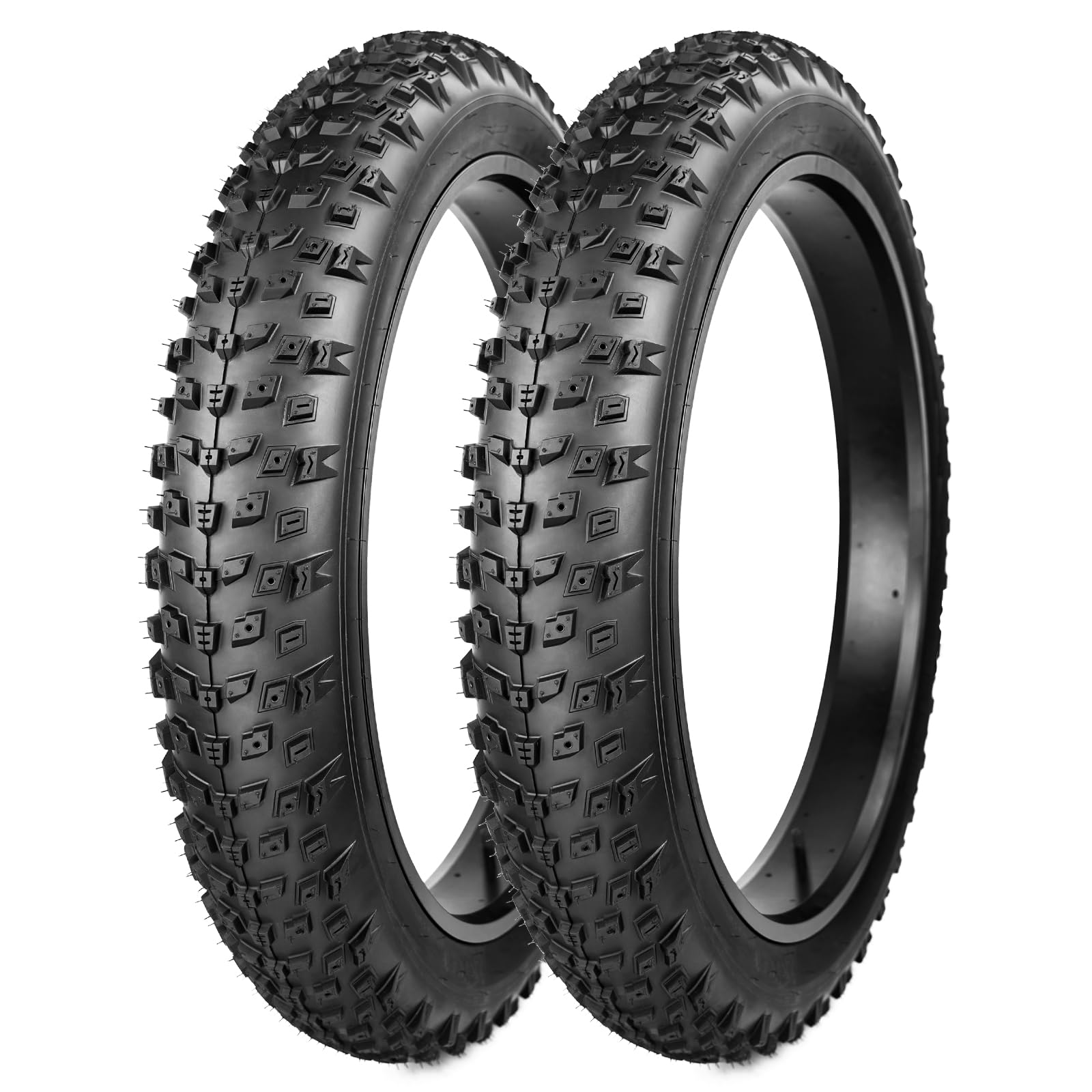
A dual-purpose fat tire you can stud yourself for winter, then ride all year bare.
The clever thing about the GRELiving fat tire is that it does double duty. Without studs it is a high-performance all-terrain tire for year-round riding; add metal studs (sold separately) and it becomes your winter ice tire. That flexibility is what puts it on this list as the budget-flexible option — you buy it once and adapt it to the season.
The specs that matter for snowy riding are the tread and the volume. A deep, open knobby pattern with large convex knobs digs into loose surfaces and clears mud, which helps on snow, dirt, and sand. The wide 4.0-inch volume gives flotation so you ride on top of soft ground rather than sinking in. A foldable Carbon Steel bead lets it pack down small for storage or transport, and it comes in 20×4.0 (102-406) and 26×4.0 (102-559) sizes with a max 30 PSI and a 30 TPI casing.
Two things to know before you buy. First, the studs are not included — the ice grip only happens once you fit them, so budget that step into the plan. Second, without studs it is a soft-terrain tire, not an ice tire; on a true frozen surface it will not grip like the pre-studded picks. For a rider who wants one tire that covers winter snow and summer trails, this is a smart flexible buy.
The flexible case
- Studdable design works year-round, studs optional.
- Deep knobby tread for snow, mud, dirt, and sand.
- Wide 4.0-inch volume for flotation on soft ground.
- Foldable steel bead packs away easily for storage.
The caveats
- Studs sold separately, so ice grip is an extra step.
- 30 PSI max and 30 TPI — a utility build, not a race tire.
Pick it if: you want one fat tire that handles snow now and trails later.
Not the one: if you want factory ice grip from the start — you will need to buy and fit studs.
8. Vee Tires Snowshoe XL Studded Fat Bike Tire 26 x 4.8
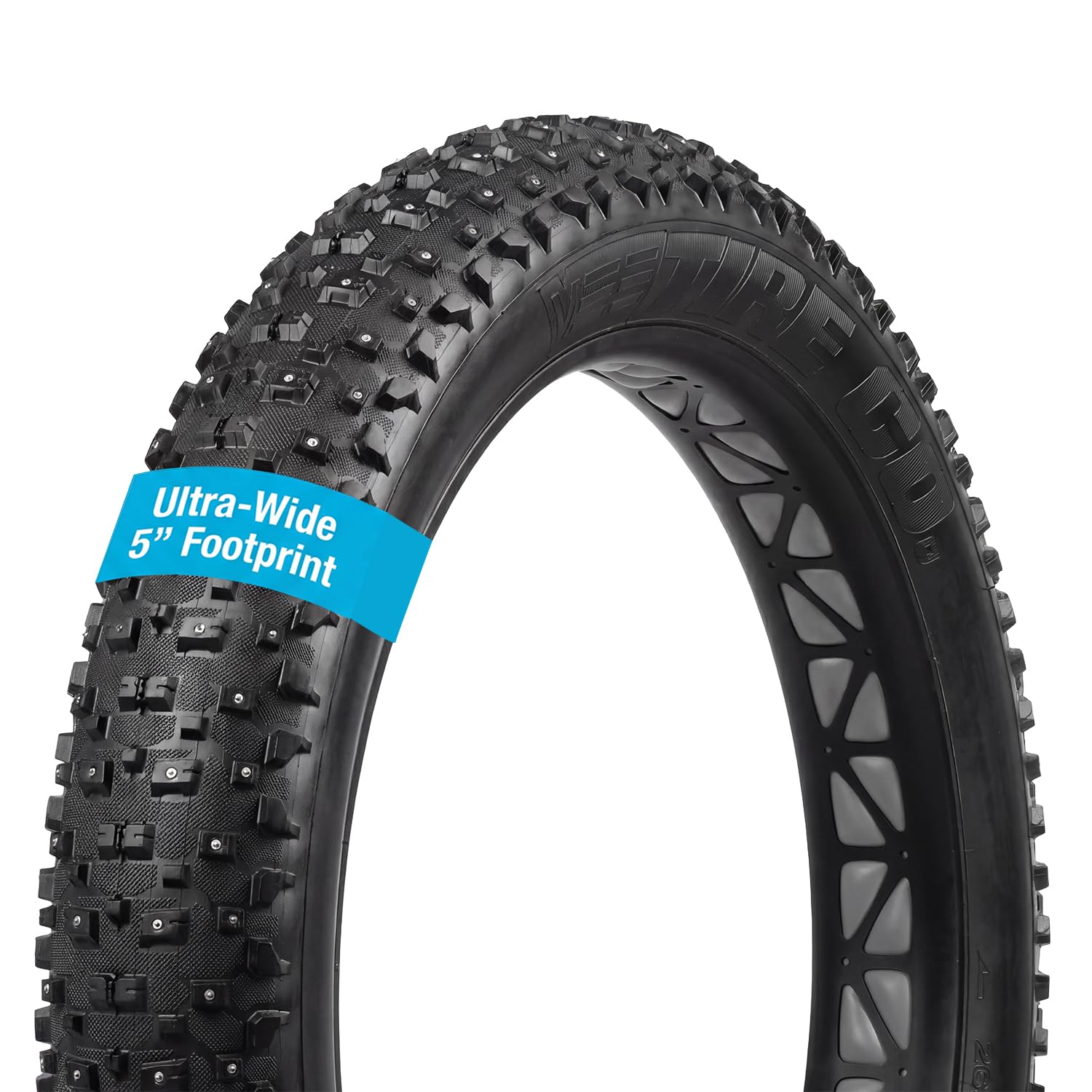
An ultra-wide 4.8-inch studded fat tire for snow and sand where float is everything.
When your winter riding is deep snow or soft sand, width is the whole game. The Snowshoe XL runs 26 x 4.8 — the widest tire here, beating the CST Toboggan’s 4 inches. That extra volume means more float, so the tire rides over soft ground and keeps you moving instead of bogging down. It uses a silica compound and a folding bead on a tubeless-ready carcass, which lets you run low pressure for maximum contact.
What lands with riders is the quality of the build and the grip on ice — it is studded from the factory and keeps you upright on frozen surfaces, and people keep coming back to it every winter. The block tread provides traction in every direction, and it holds its line better side-to-side than some rival studded fat tires.
The honest limit is cornering on ice. The studs sit on the tread blocks but not on the outermost shoulder knobs, so when you lean hard the tire can lose grip and wash out — a few riders find this a real frustration. If you ride straight-line snow and trail, it is fine; if you carve aggressive icy corners, know the edge. It is also the heaviest tire here, so expect some effort on climbs.
The float advantage: a 4.8-inch tubeless-ready studded tire that keeps you on top of deep snow and loose sand.
The trade-off: corner grip thins out under an aggressive lean, and it is the heaviest pick here.
Choose it for: deep-snow and sand riding where maximum flotation matters most.
Think again if: your route is mostly hard, icy corners — the shoulder grip has limits.
Know the Specs
The ETRTO size number
Look for a two-part number on the sidewall, like 42-622 or 50-559. The first figure is the tire’s width in millimeters and the second is the rim’s bead-seat diameter in millimeters. Match both to your existing tire and the new one fits the rim and frame. An inch label like 26 x 4.0 is a rough guide, but the ETRTO number is the exact one to buy against.
Studs and pressure
Studs are small metal spikes in the tread that bite into ice, and how well they work depends on how hard the tire is pumped. Lower pressure lets the studs press into the surface for more grip; higher pressure quiets the tire on bare roads. A pressure gauge lets you move between the two as conditions change.
TPI and puncture protection
TPI, or threads per inch, describes how fine the tire’s casing threads are — a lower number like 30 or 50 TPI tends to mean a tougher, heavier build, while higher counts are lighter and more supple. Puncture protection appears as a named belt under the tread, such as SmartGuard, Kevlar Guard, Vectran Breaker, or Raceguard.
Width and float
A wider tire holds more air at lower pressure, which spreads your weight over more surface so you float on snow and sand. A narrower tire at higher pressure cuts through slush and rolls faster on cleared pavement. Pick width for the surface you actually ride most, not the one you hope to ride.
Common Questions
Will a studded winter tire work on my regular commuter bike?
How do I tell if a tire is actually a winter tire and not a summer knobby?
Do I need to run studded tires at a specific pressure?
Are studded tires loud on dry pavement?
Can I put studs in a studdable tire myself?
What is the difference between a fat-bike winter tire and a narrow studded tire?
Will a 26 x 4.0 tire fit my fat bike?
How long do studded winter bike tires last?
Do winter bike tires work on e-bikes?
Should I run winter tires on the front, the rear, or both?
The Bottom Line
For most winter commuters, the pick that covers the most ground is the Schwalbe Marathon Winter Plus, because it pairs studded ice grip with a SmartGuard puncture layer in a size that fits everyday hybrid and cyclocross bikes. If your winters are mostly wet and cold rather than truly icy, the Continental Contact Plus City trades the studs for a cold-weather tread that runs quietly on pavement. And if you ride a fat bike through deep snow, the CST Toboggan delivers factory-studded 26 x 4.0 grip without the premium price. Match the tire to the surface you actually ride, set your pressure with a gauge, and swap back to summer rubber when the thaw comes.
How we choose
We do not accept paid placement. Every pick is matched to a real buyer and a real use-case; we do not hands-on test units.
Sources
Specifications: manufacturer listings and product documentation. Review insights: verified customer reviews, as of November 2026. Pricing: not shown on this page (it changes often); check the current price via the retailer link.
As an Amazon Associate, Tactical Gear Guy earns from qualifying purchases. This does not affect which products we feature.