Specs are compiled from manufacturer listings and verified buyer reviews and can change over time — please confirm the key details on the product page before buying.
If your steering wheel sits off-center or your front tires are feathering on the inside edge, you can fix it in your own driveway with the right clamp, plate, or gauge. The pick that suits most home mechanics is the AutoSolo 3D DSP Wheel Alignment Clamp, because it grips rims from 11 to 25 inches and gives a magnetic gauge a flat, steady face to read from. Below are nine alignment tools sorted by what they actually measure: toe plates, camber and caster gauges, turn plates, and one air bladder that pushes a strut into place.
This guide is built by comparing the manufacturers’ published specifications and the patterns across verified customer reviews, so you get each pick’s real strengths and trade-offs instead of marketing spin.
You will see which tools read from the tire and which read from the rim, what accuracy each one claims, and where the cheap shortcuts bite. Whether you are chasing toe only or a full camber, caster, and toe session, this breakdown of vehicle alignment tools matches each job to a tool that can measure it.
Top Picks

How To Choose The Best Vehicle Alignment Tools
Alignment work splits into three jobs, and no single tool does all three well. Toe is the angle the front of the tires points in or out relative to each other — that is a plate-and-tape job. Camber is how far the top of the wheel leans in or out — that needs a gauge. Caster is the steering axis tilt, and reading it means turning the wheel through a sweep, which is where turn plates earn their place. Buy for the angles you actually adjust, not for the biggest kit on the shelf.
Decide whether you read from the tire or the rim
Most toe plates press against the tire sidewall, which is fast but inherits any bulge or lettering in the rubber. Plates that reference the wheel rim itself skip that variable, and one pick here is built specifically around that idea. If your tires have a tall sidewall or a pronounced bulge, a rim-referenced plate gives you a cleaner repeatable number.
Check the rim and hub range against your own wheels
A clamp rated for 11 to 25 inch rims covers everything from a compact car wheel up to a truck wheel, but you still need to measure your own rim diameter before you buy. Hub-mount plates need clearance for your studs and lug nuts. Measure your rim diameter and stud spacing first — that one step saves most returns in this category.
Match the accuracy claim to the job
A gauge that reads camber to a quarter degree is plenty for a street car. A digital angle finder quoting 0.2° accuracy is a finer increment, and a tool claiming 0.1° camber accuracy goes finer still. A finer increment is not automatically better — it only helps if your setup and your patience can hold that repeatability.
Side-by-Side Comparison
| Model | Best For | Tool Type | Stated Accuracy | Vehicle / Rim Range | Amazon |
|---|---|---|---|---|---|
| AutoSolo 3D DSP Wheel Alignment Clamp★ Best Overall | Holding a magnetic gauge steady on the rim | Camber/caster gauge mount | — | 11–25 inch rims | Amazon |
| VEVOR Wheel Alignment Tool (2 PCS)Budget Champion | Budget toe and camber at home | Toe plates + digital angle gauge | 0.2° (angle gauge) | 20.1–24.0 in plates; cars, trucks, SUVs | Amazon |
| Longacre Racing 79501 Toe-in PlatesOne-Man Toe Check | Quick toe checks with one person | Magnetic toe plates | 1/32″ tape increments | Tire-sidewall contact | Amazon |
| 3-in-1 Toe Alignment Plates (ASTPSETX) | Toe, steer ahead, and thrust angle | 3-in-1 toe plate system | 1/16″ tape readings | Passenger car, truck, van | Amazon |
| Tenhulzen Toe Plates (Made in USA) | Rim-referenced toe readings | Toe plates with stand-offs | 1/32″ tape increments | Rim contact via stand-offs | Amazon |
| JohnDow TC-614 T.O.M.C.A.T. | Nudging camber on MacPherson struts | Air-assisted camber adapter | — | Car (universal fit) | Amazon |
| Longacre 52-78260 Caster/Camber Gauge | Precise camber and caster readings | Magnetic caster/camber gauge | 1/4° camber; 1/2° caster | Universal with magnetic adapter | Amazon |
| AutoSolo Wheel Alignment Turn Plates | Freeing the front wheels for caster sweeps | Turn plates (pair) | 1-degree dial intervals | 4-ton capacity per pair | Amazon |
| 2-Wheel Alignment Tool (Tenhulzen 3300) | One kit for camber, caster, and toe | All-in-one alignment tool | 0.1° camber | Universal fit | Amazon |
Detailed Reviews
1. AutoSolo 3D DSP Wheel Alignment Clamp for 11-25 inch Rims
Our pick — 4.5+★ from 300+ verified ratings; the strongest balance of quality and price.
A rigid steel clamp that turns any bare rim into a steady platform for a magnetic gauge.
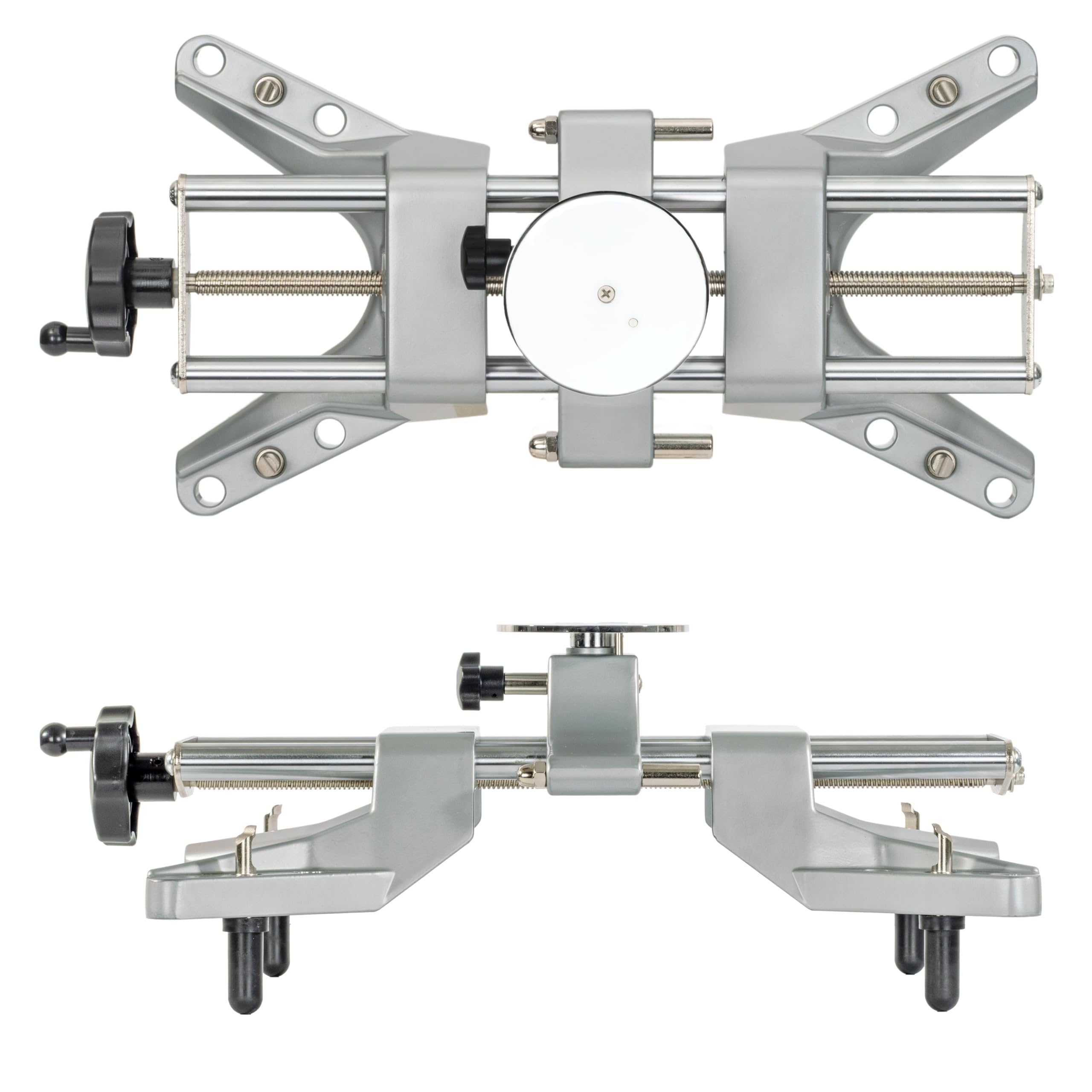
This is not a measuring instrument — it is the mount that makes your gauge trustworthy. One rotating knob opens and closes the clamp on the rim, so you mount it, check a corner, then move to the next wheel without hunting for a spanner. The slider rods span 11 to 25 inch rims, which covers a compact car wheel right up through truck and SUV wheels; measure your own rim diameter and confirm it lands inside that window before you order.
The chrome plated universal adapter gives the magnetic camber and caster gauge a flat face to sit on, and that face is the whole point. Once the clamp is set, you adjust, recheck, and read the same reference every time — after a tie rod turn or a shim change, you are comparing like with like. Reversible locator pins flip to suit different wheel profiles and hold the clamp in one spot while the wheel turns through a caster sweep. The frame is powder coated steel alloy with heavy duty slider rods, and at 8 pounds it is no lightweight throw-in-the-toolbox trinket — it is 38% heavier than the Longacre toe plates here, which is the trade you make for a mount that will not shift under a gauge.
Setup rewards patience. Rest a digital level on the outer rim edge or lay a straight rod across the wheel, compare that figure with the angle of the adapter plate, and adjust the clamp until the two agree — that is your zero. If you run 3D targets, the adapter socket holds a round target shaft from 14 to 15.97 mm, so measure the shaft with calipers first, and strap the clamp down when a heavy target could tug it off. The recurring caution from the review pages is to line the pins up before you clamp and to watch the hook steel on polished aluminum rims. One clamp and the magnetic adapter plate come in the box; gauges, turn plates, and targets shown in the photos are separate.
What holds up in the garage
- Adjustable rods grip 11 to 25 inch rims without a socket set in your hand.
- The magnetic chrome face keeps a camber and caster gauge from drifting mid-adjustment.
- Powder coated steel alloy frame and heavy duty slider rods shrug off repeated mounting.
- Reversible locator pins keep the clamp in one position through a full caster sweep.
Where it asks a little care
- You supply the gauge, turn plates, and any target — the box holds the clamp alone.
- Steel contact pins can nick polished aluminum wheels if you clamp carelessly.
Buy it if: you already own a magnetic camber and caster gauge and need a mount that reads true on rims from compact car to SUV size.
Think twice if: you wanted a one-box measuring kit — this is the clamp that supports a gauge, not the gauge itself.
2. VEVOR Wheel Alignment Tool
A toe and camber starter kit that hands you the plates, the angle gauge, and both tapes.
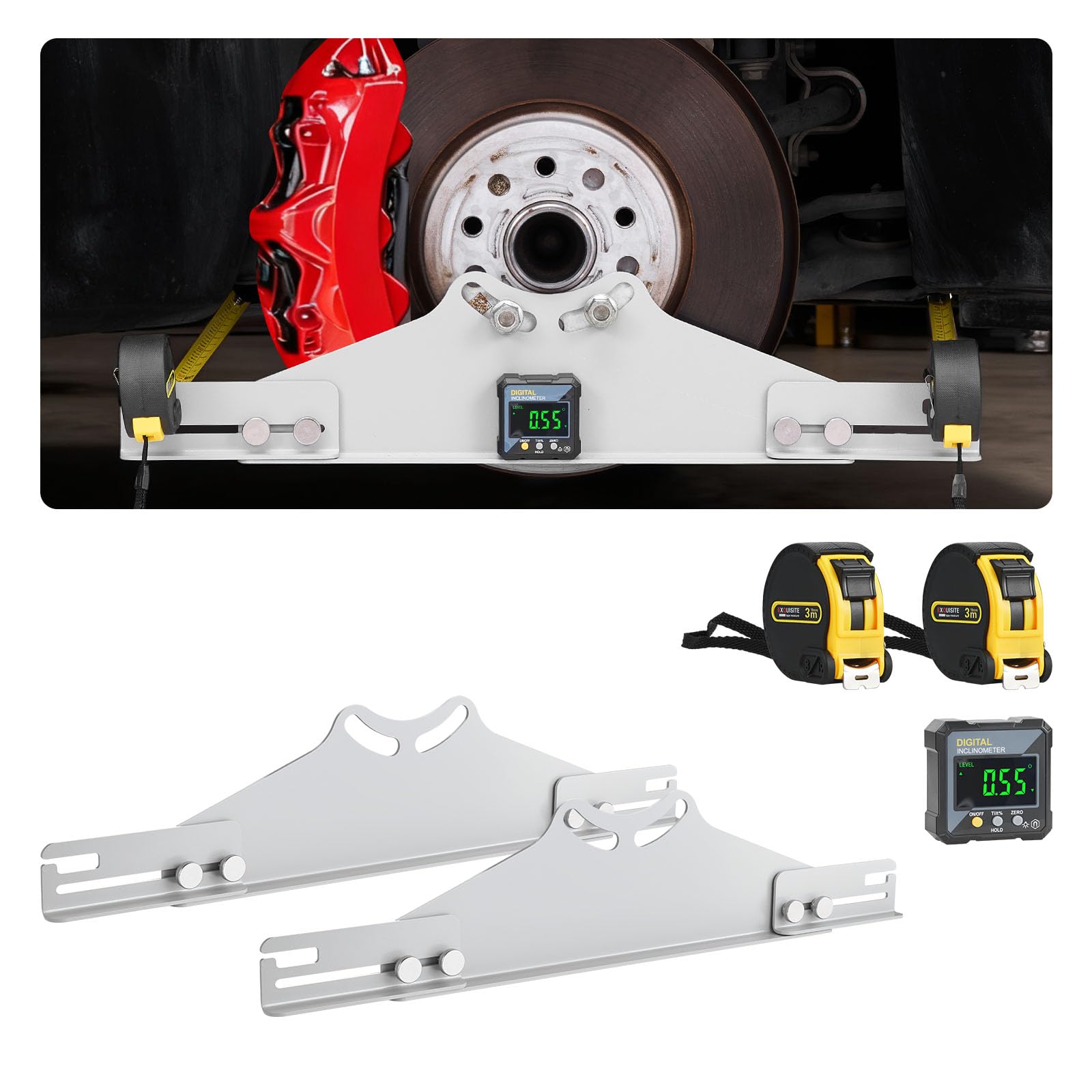
Most budget toe plates leave you sourcing tapes and a level separately. This pair bundles a magnetic digital angle gauge rated to 0.2° accuracy, plus two imperial tape measures at 16.4 ft with 1/16 inch accuracy. The plates bolt to the brake disc hub rather than the tire, so tire bulge and sidewall lettering cannot skew the reading. Adjustable length runs 20.1 to 24.0 inches, and universal bolt holes mean most sedans, trucks, and SUVs will take them.
The build is carbon steel with a baked enamel finish, which is what resists water and oil in a working garage. At 7.72 pounds the pair sits near the middle of this group — heavier than the Longacre plates, lighter than the AutoSolo clamp. Fitting matters more than any of that, though: compatibility is the thing owners talk about first and most, and the stories run from a 2019 Wrangler toe-in to an 85 K5 Blazer that came out spot on. The other repeat note is that the plates beat a homemade kit, which is the honest comparison for a first alignment tool.
Here is the catch worth knowing before the box arrives — the metal edges come sharp. Owners describe filing them down before first use, so budget five minutes and a file. Nothing structural, just a finish detail. Beyond that, this is the cheapest full toe-and-camber entry here by a wide margin, and the two included tapes alone save you a trip.
The kit math: plates, a 0.2° digital angle gauge, and two 1/16 inch accuracy tapes arrive together. For a first toe and camber session at home, that is the whole shopping list in one order.
Do the prep: run a file along the plate edges once, and the razor-sharp finish stops being a story you tell later.
Reach for this if: you want toe and camber covered in a single budget order and your vehicle is a normal sedan, truck, or SUV.
Look elsewhere if: you are set up for a race car needing finer repeatability than a 0.2° gauge gives.
3. Longacre Racing 79501 Aluminum Toe-in Plates with Magnets
Aluminum plates with magnets that hold the dumb end of the tape so you can work alone.
Toe alone, done fast. Rest one plate against each front tire, hook the tapes, read, subtract. The integrated magnets are the difference-maker here — they grab the tape end and hold it against the plate while you walk to the other side of the car. That is what makes this a one-person operation rather than a two-person juggling act, and it is the detail that keeps coming up as the reason owners like the setup.
The plates measure 23-1/2″ x 9″ and ship as a pair with two 3/4″ tapes in 1/32″ increments. The formed design is rigid so the plate sits square against the tire and stays there while the magnets do their work. At 5.81 pounds this is the lightest plate pair in this group — 38% lighter than the AutoSolo clamp — which makes it easy to hang on a peg between sessions. What owners talk about most is the quality: the plates feel solid and square, and the tool handles basic alignment and front-end work without complaint.
Two honest notes from the review pages. The tapes divide opinion — the plates are the good part, the tape measures less so, and the tape can sit awkwardly in its groove. And owners wish the box came with setup guidance for different alignment configurations. Buy it for the plates, plan to add better tapes if you want, and know that reading caster and camber is a separate job this tool does not do.
The reason one person can do this
- Magnets hold the tape end against each plate, so no second set of hands is needed.
- Rigid formed aluminum keeps the plate square to the tire while you measure.
- 1/32″ tape increments give a fine enough number for a street toe setting.
- At 5.81 pounds the pair is easy to store and carry.
What to plan around
- The included tapes are the weak link for some owners — the plates are the value.
- No setup instructions for different alignment configurations, so expect to research the process.
The fit: a garage that needs a fast, repeatable toe check on one car and wants to do it without a helper.
The limit: toe only — camber and caster need a gauge this kit does not carry.
4. 3-in-1 Toe Alignment Plates
The plate kit that reads toe, then keeps going into steer ahead and thrust angle.
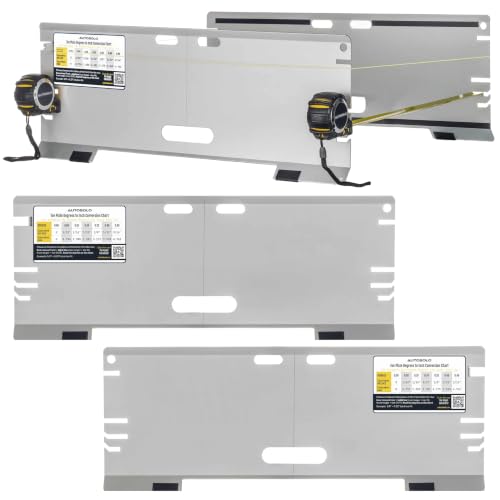
Most toe plates stop at toe. This set keeps measuring. Three numbers come out of one kit — toe in or out, steer ahead (whether your steering wheel is centered relative to where the car actually goes), and thrust angle (how far the rear axle sits off the centerline). If your car crabs down the road with the wheel straight, the thrust angle reading is the one that explains it.
You get two ways to mount it. The sidewall method keeps the vehicle on the ground, drops the kickout plate against the outer sidewall at three contact points, and hooks both tapes under spring tension. The hub-mount method pulls the wheel and drops machined 0.57″ / 1.45 cm slots over the lower two wheel studs, so you isolate toe from tire deformation. The plate seats flush against the hub face and finger-tightens with your existing lug nuts. Tapes read to 1/16″, a degree-to-inch chart is included, and the cut-out at the bottom clears AutoSolo turn plates so you can steer the wheels and check steer ahead while the plates stay put.
It is stainless steel, 23.50″ wide by 7.12″ tall, and built as one piece rather than welded sections — that solidity is the point owners make against “bendy” plates that will not stay in place. The one complaint that surfaces is tape readability at certain measurements; the plates themselves are the solid part. For a home mechanic who wants to center the wheel and sort a rear-axle misalignment without a shop rack, this covers more ground per dollar than a toe-only pair.
Why the extra angle matters: a centered steering wheel and a straight-traveling car are two different measurements. This kit reads both, plus the rear axle.
The honest limit: tapes can be fiddly to read at some distances, so budget a second pass on each measurement.
Worth it for: the DIYer chasing a crooked steering wheel or a rear end that will not track straight.
Not for: anyone who only ever needs a plain front toe reading — the extra angles go unused.
5. Tenhulzen Toe Plates Wheel Alignment Tool – Made in USA

Stand-offs reach past the tire bulge and take the measurement off the wheel rim itself.
The idea here is simple and it separates this plate from nearly everything else on the shelf: the readings come from the wheel rim, not the tire. Stand-offs bridge the gap to the rim, so a fat sidewall or a stiff tire bulge stops being a variable in your number. Two high resolution tape measures with 1/32 inch increments are included, and a degree-to-inch conversion chart is built into the plate so you can compare a tape reading against your factory spec.
The cut slots are shaped so the tape ends cannot fall out mid-measurement, and everything snaps together for storage without a case. Owners describe it as nicely engineered — one of the details that gets called out is the printed conversion table right on the plate, because it saves a lookup every single time. The tape reads cleanly and accurately, and one owner knocked out a full alignment in about 20 minutes on a 2007 Ford Focus, making a quarter-inch turn on each tie rod and re-measuring.
The real constraint is fitment on wide setups. Stand-offs need to reach the rim past the tire, and on a 7 inch rim with a 9.5 inch tire and a heavy sidewall bulge, the pins may not get there. There is also a durability note — the little stand-offs that rest against the wheel have been reported to break off after limited use. Treat them with care and this plate earns its keep; force them and you will be shopping again.
Where the engineering shows: rim-referenced stand-offs plus an on-plate conversion chart mean fewer variables and fewer lookups per session.
The quirk to respect: stand-offs are the vulnerable part, and wide tires with heavy bulge can keep them from reaching the rim at all.
Pick it when: your tire sidewalls are throwing off tape readings from tire-referenced plates.
skip it if: you run a wide tire on a narrow rim — the stand-offs may never touch the wheel.
6. JohnDow TC-614 Camber Tool

An air bladder that wedges into a strut and moves camber while you tighten the bolts.
Every other tool here measures an alignment. This one moves the suspension so you can set it. It is a 2-foot air hose and air bladder with an air control valve for inflating and controlled deflating — you slip it in at the strut, inflate to nudge the knuckle to the camber you want, then tighten the bolts and the adjustment is done. On a MacPherson strut with two lower bolts, that eliminates the pry-bar-and-hope routine entirely.
The body is aluminum at 2 pounds, so it is light enough to tuck above a strut in a tight bay — one owner describes it as handy for moving objects with little to no room. The valve gives you controlled deflate, which matters: you want to ease the bladder back down, not pop it. This is aimed at cars with MacPherson style struts, and the manufacturer lists universal fit for car applications. It also gets used on struts with the two lower bolts that only need a small nudge positive.
Durability is the standout story here — one owner is on a second unit after the first withstood 15 years of active use, and the tool is widely described as the best one-man camber tool going. For sport-compact work and custom alignments it takes a lot of the wrestling out of the job. If you are doing a strut-based camber adjustment alone, this is the piece that makes it a one-person task.
What it does that a gauge cannot
- Air bladder inflates and holds the strut where you need it while you tighten the bolts.
- 2-foot hose and control valve give you reach and controlled deflate.
- At 2 pounds and aluminum, it works in the tight space above a strut.
- Long service life is the recurring report — one unit lasted 15 years of active use.
Where it stops
- It moves camber — it does not measure it, so you still need a gauge to read the result.
- Built around MacPherson style struts, so it does not adapt to every suspension layout.
For the solo mechanic: MacPherson strut camber work where holding the knuckle and turning a bolt at the same time is the whole problem.
Not a measuring tool: pair it with a camber gauge or you will be guessing at the number you just set.
7. Longacre 52-78260 Caster/Camber Gauge with Magnetic Adapter

A bubble gauge built like an instrument — CNC-machined surfaces and vials checked one by one.
If your alignment work is about cornering setup rather than just straightening a steering wheel, this is the gauge the rest of the kit hangs off. Camber reads from +6° to -6° accurate to 1/4°, and caster reads from +12° to -4° in 1/2° increments. The magnetic adapter lets it stick to a clamp or plate, and a carrying case protects the vials between sessions.
Longacre checks each vial individually and assembles it on a precision fixture, and the critical surfaces are CNC machined. That is why owners describe the build as close to a piece of art — the vials are big enough to read without squinting, and the whole tool feels solid in the hand. One owner measured and set caster and camber on an old Ford in about an hour; another uses it on big truck alignments and limos that will not fit on a rack. If you want repeatability, this gauge reports within a quarter degree.
What you get for the precision is friction: it is a bubble gauge, not a digital readout, and you still need a clamp or plate to hold it against the wheel. The AutoSolo clamp at the top of this list is the natural partner, and it is no accident that these two arrive at the same measurement. Set camber first, caster second, and the case keeps the vials honest between jobs.
The precision case: +6° to -6° camber to 1/4° and caster to 1/2° increments is a real instrument’s spec, matched to CNC-machined surfaces and individually checked vials.
The pairing: it needs a magnetic mount — a clamp like the AutoSolo is what turns this gauge into a working setup.
Go here when: camber and caster are the numbers you care about and you want a gauge that repeats.
Know before you buy: there is no digital display and no mount in the box — this is the measuring head, not the whole rig.
8. AutoSolo Wheel Alignment Turn Plates
Two plates that let the front wheels pivot freely so caster can actually be measured.
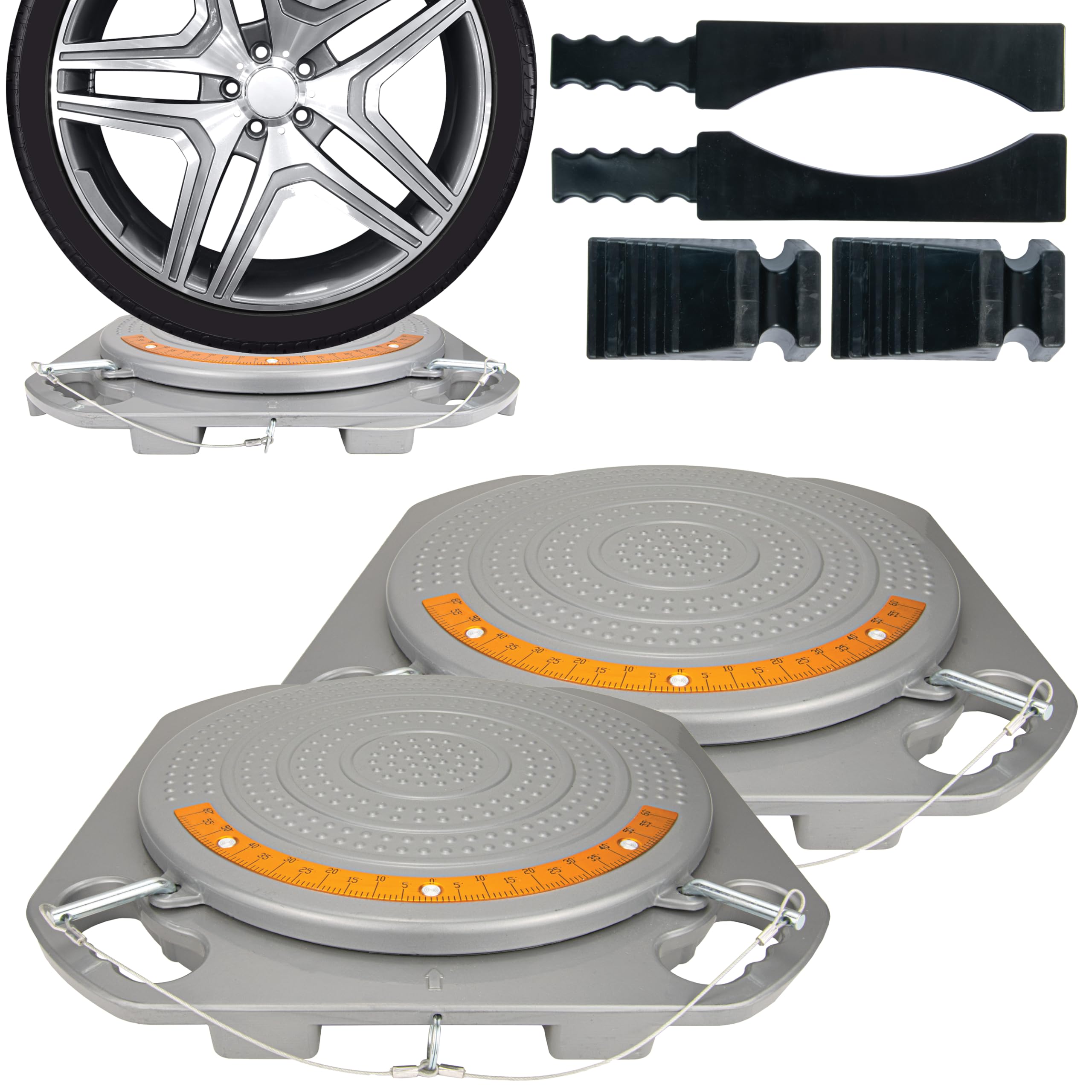
Reading caster means turning the steering wheel through a sweep, and on dry pavement the front tires fight you every inch. These turn plates sit under the front wheels and let them rotate without scrub, which is what makes a caster sweep possible. The brass dial reads in 1-degree intervals and allows up to 60 degrees of rotation left and right — enough swing to sweep the steering and read the angle change.
Each pair carries a 4-ton total capacity and is built from heavy-duty metal by die-cast injection with a powder coated finish. Handle slots let you position each plate under a wheel without crawling around, and heavy-duty locking pins hold them in place once set. A 1-inch offset from the centerline accommodates wheel movement as the tire turns. Two wheel chocks and two transition bridges come in the box, which saves you fabricating ramps. Owners put a 3/4 ton pickup with a Duramax diesel on them and report they hold fine with all the extra weight.
The built-in degree indicator is the feature that turns caster adjustment from a puzzle into a reading. The honest note is a learning curve if you have never used turn plates before — there is a feel to setting them and letting the wheel settle. It is not magic and it rewards knowing what you are doing. For a garage that already has a gauge and a clamp, these are the piece that completes the caster job.
Why the sweep works
- Up to 60 degrees of rotation each way lets you sweep the steering and read caster.
- The brass dial steps in 1-degree intervals, so the reading is right under the wheel.
- 4-ton capacity per pair handles a loaded 3/4 ton truck without complaint.
- Wheel chocks and transition bridges are included, so no ramp building.
The honest adjustment
- Turn plates have a learning curve if you have never worked with a free-floating wheel.
- They need space under the front wheels, so a tight or sloped parking spot is a poor fit.
Completes the kit: a garage that already has a camber and caster gauge and needs the wheels to turn freely for a caster sweep.
Not a starter tool: bought on its own it does nothing — it is the platform under a gauge-based alignment.
9. 2-Wheel Alignment Tool

One kit that measures camber, caster, and toe — and skips the turn plates on caster.
The pitch here is consolidation. This tool covers camber, caster, and toe in one setup, and its camber reading is accurate to within 0.1 degrees, which is finer than a bubble gauge can do. The stand-offs, described as patent pending, hold the tool against the wheel to reduce the slop that makes readings wander. Two details change the shopping math: it does not need turn plates for a caster measurement, and it runs on a 9V battery that is included.
Functionality is the thing to understand first: owners align front ends that range from a 1939 Plymouth to modern cars, and the tool does what it says. You can dial alignment values precisely to the specs in a factory manual once you have the process down. Sustained use on a drift car, where the setup changes constantly, is the case where an all-in-one kit saves the most repeated trips to a shop.
The honest trade is repeatability. It works, but disciplined setup matters — you have to take the same care every time to get the same number twice, and the posts that rest on the rim are less rigid than a solid gauge mount, which is the source of that wobble. Instructions are a discussion point too: plan on the step-by-step video and online references rather than a thick printed manual. At 0.1° camber accuracy, it pays for itself after a few shop alignments.
The consolidation win: camber, caster, and toe in one tool, at 0.1° camber accuracy, without needing turn plates for the caster read.
The discipline tax: repeatability depends on careful setup, and the rim posts are the weaker link — take your time on each measurement.
Best for: the owner who wants one tool covering all three angles and will invest the time to dial in a repeatable routine.
The trade-off: finish is a skill here — rush the setup and your second reading will not match your first.
Know the Specs
Toe Plates: Tire-Referenced vs Rim-Referenced
A toe plate gives you a flat reference the tape measure runs against. Sidewall plates press against the tire at contact points, which is fast but inherits any bulge or lettering in the rubber. Rim-referenced plates use stand-offs to reach past the tire and read the wheel itself, removing that variable. Both approaches read to a fine increment — 1/16″ or 1/32″ depending on the tapes — but if your tires bulge heavily, the rim-referenced design gives you a cleaner repeatable number.
Camber and Caster Accuracy
Camber is the lean of the wheel top in or out. Caster is the steering axis tilt, and reading it means turning the wheel through a sweep and comparing the angle change. Accuracy claims vary widely: a bubble gauge reading to 1/4° is solid for a street car, a digital angle finder quoting 0.2° is a finer increment, and a tool claiming 0.1° camber accuracy goes finer still. A finer increment does not mean better by itself — it only helps if your setup can hold that repeatability.
Turn Plates and Caster Sweeps
Caster cannot be measured with the wheels pinned to the ground. Turn plates let the front wheels rotate freely, so you can swing the steering and read the angle change. A brass dial reading in 1-degree intervals with up to 60 degrees of rotation each way is what lets you complete that sweep. The alternative is a tool that calculates caster without turn plates, which trades the platform for a different kind of setup discipline.
Rim and Hub Fitment
The two numbers that cause most returns are rim diameter and hub clearance. A clamp rated for 11 to 25 inch rims covers compact car wheels through truck and SUV wheels, but you still need to measure your own rim. Hub-mount plates need clearance for your studs and lug nuts — machined slots that drop over the lower two wheel studs are one solution, provided your stud spacing matches. Measure first; order second.
Common Questions
Can I do a wheel alignment at home with just toe plates?
What is the difference between reading toe from the tire and from the rim?
Do I need turn plates to measure caster?
How accurate does a camber gauge need to be for a street car?
Will a toe plate kit fit my truck or SUV?
What is thrust angle and why does it matter?
Can one person check toe without a helper?
Does a camber adjustment tool also measure camber?
How much space do turn plates need under the front wheels?
Are alignment tapes included or do I buy them separately?
The Bottom Line
For most home garages, the vehicle alignment tools winner is the AutoSolo 3D DSP Wheel Alignment Clamp because it is the rigid mount that makes every gauge reading trustworthy, gripping 11 to 25 inch rims with a magnetic chrome face. If you want toe and camber covered in one budget order with tapes and a digital angle gauge in the box, grab the VEVOR Wheel Alignment Tool. And for the number itself — camber to 1/4° and caster to 1/2° — the Longacre 52-78260 Caster/Camber Gauge is the one to reach for, with the AutoSolo Turn Plates underneath when you need a caster sweep. Match the kit to the angles you actually adjust, and the tools will outlast the car.
How we choose
We do not accept paid placement. Every pick is matched to a real buyer and a real use-case; we do not hands-on test units.
Sources
Specifications: manufacturer listings and product documentation. Review insights: verified customer reviews, as of November 2026. Pricing: not shown on this page (it changes often); check the current price via the retailer link.
As an Amazon Associate, Tactical Gear Guy earns from qualifying purchases. This does not affect which products we feature.