Specs are compiled from manufacturer listings and verified buyer reviews and can change over time — please confirm the key details on the product page before buying.
If your tarp, awning or camper canvas has a tear in it, the fix is not one product — it is one decision. Do you glue a patch on, or do you stick a strip of tape over it? The honest answer depends on what the surface is made of. Vinyl tarps and pool liners want a vinyl cement and a matching patch. Canvas awnings, tent walls and boat covers want a fiberglass-reinforced tape. Pick the wrong one and you get the moment that shows up again and again in the reviews below: the adhesive simply will not grab.
This guide is built by comparing the manufacturers’ published specifications and the patterns across verified customer reviews, so you get each pick’s real strengths and trade-offs instead of marketing spin.
The picks below cover cement kits, peel-and-stick rolls and canvas patch sets, with the surface type and tape width that decide whether your repair holds. Here is the shortlist of every tarp repair kit worth putting in your gear box.
Top Picks

How To Choose The Best Tarp Repair Kit
Start with the material under your finger, not the size of the hole. Run your thumb across the tear — if it feels slick and rubbery, you have vinyl and you need a cement kit. If it feels woven and slightly rough, you have canvas or woven fabric and a reinforced tape will bond to it. That thumb test rules out most wrong-material buys before you spend a cent.
Match the kit to the surface, or nothing sticks
Vinyl cement is a solvent-based glue that literally melts two vinyl surfaces into one. It works on pool liners, pontoon covers, vinyl tarps and inflatable backers. It does nothing for woven canvas. Tape runs the other way — a fiberglass-reinforced strip with a pressure-sensitive adhesive that grabs canvas, nylon, sailcloth and plastic sheeting, but slides off slick vinyl. Most of the mixed adhesion scores in this category trace back to someone applying cement to canvas or tape to slick vinyl.
Width and length decide how long the job takes
A wide roll means fewer passes down a long seam. A 3.15-inch roll is fine for small punctures and quick touch-ups. A 4.5-inch or 5-inch roll covers a full awning seam in one or two strips, which matters when you are up a ladder in the wind. Length matters too: a 10-foot roll runs out fast on a big canopy, while a 39-foot or 40-foot roll leaves you plenty of spare for next season’s tear.
Check the temperature range before you climb the ladder
Adhesive behaves differently in cold. One tape here is rated from -30°C to +70°C, and another sticks tighter as the weather heats up. In cold weather, most of these makers recommend warming the surface with a blow dryer first — the adhesive needs a little heat to flow and grab. Apply in the cold without that step and you are far more likely to see a strip lift in the first wind.
Read what the tape will not stick to
Nearly every roll in this category states a limit in the listing, and skipping that line is expensive. Tape does not work underwater. It does not work on most inflatable products. It does not bond to every vinyl. If your repair is on a paddle board, an air mattress or a submerged liner, tape is the wrong tool — a cement kit or a dedicated patch is the right one.
Side-by-Side Comparison
| Model | Best For | Repair Format | Roll / Patch Size | Material | Amazon |
|---|---|---|---|---|---|
| Mytee Products 18oz Vinyl Repair Kit HH66★ Best Overall | Vinyl tarps, pool liners and pontoon covers | Cement plus patch | 18″ x 60″ patch, 1 qt cement | 18 oz vinyl | Amazon |
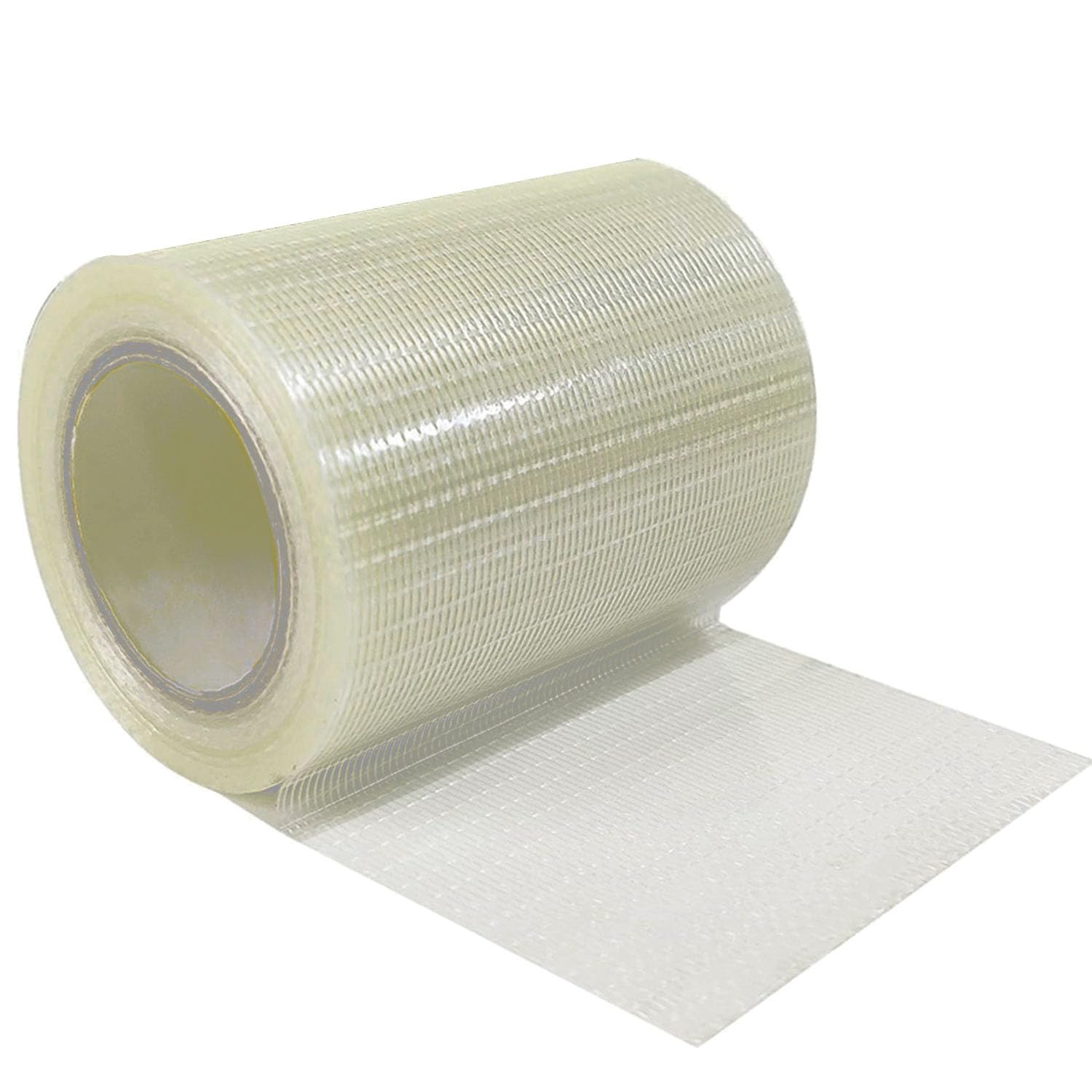
| YBhuoo 39FT RV Awning Repair TapeLongest Roll | Long awning seams and big canopies | Peel-and-stick tape | 3.15 in x 39 ft | Fiberglass with clear vinyl | Amazon |
| AIHSUMC 4.5Inch x 40FT Awning Repair Tape | Fast wide coverage on canvas awnings | Peel-and-stick tape with scissors | 4.5 in x 40 ft | Fiberglass-reinforced vinyl | Amazon |
| KAIHENG Waterproof Canvas Tarp Repair Tape | White canvas and bimini tops | Peel-and-stick tape | 4 in x 20 ft | Composite fabric with fiberglass | Amazon |
| Tikfoam Heavy Duty Repair Tape | RV roofs, underbellies and clear patches | Peel-and-stick clear tape | 5 in x 10 ft | PVC | Amazon |
| TrailMax Outdoor Canvas Patch Kit | Pop-up campers and canvas tents | Adhesive plus canvas patches | 5″ x 60″ strip, 10″ x 10″ patch, 6 oz glue | Sunforger canvas | Amazon |
| Mytee Products 8.8 oz Vinyl Tarp Repair Tape | Flatbed trailer tarps and woodpile covers | Peel-and-stick vinyl tape | 4 in x 25 ft | 8.8 oz PVC fabric | Amazon |
Detailed Reviews
1. Mytee Products HH66 Vinyl Repair Kit
Our pick — 4.5+★ from 900+ verified ratings; the strongest balance of quality and price.
A quart of real vinyl cement and seven and a half square feet of patch — this is the kit that rebuilds a tarp instead of taping over it.
If your tarp is vinyl, this is the pick that behaves like an actual repair rather than a band-aid. You get a 1/2 yard roll of 18 oz vinyl cut to 18″ x 60″, which works out to 7.5 square feet of patch material, plus a 1 quart brush-top can of HH-66 vinyl cement. The cement is a solvent glue: it softens both vinyl faces and fuses them into one skin, so the patch moves with the tarp instead of sitting on top of it. Everything is made in the USA.
The 18 mil thickness is the number that matters. That is heavier than a typical tarp skin, so a patch cut from it stiffens the repair instead of flapping. In practice, owners have used this exact kit to rebuild an in-ground pool liner, back a torn yard inflatable, and mend a pontoon covering they were quoted a replacement cost on — the leftover material became the reason they did not need to. What wins people over is the first-attempt result: the cement fuses on the first try, and the patch holds through a full winter.
Here is the catch, and it is a real one. HH-66 is a vinyl-to-vinyl cement, so it bonds vinyl beautifully — but it is not a universal leak sealer. Owners who tried it on a paddle board following the printed instructions found water still got through. If you are sealing a slick non-vinyl surface, do not buy this expecting a miracle. Size it against the other kits and the proposition is clear: this one patch covers the most ground of any pick here, while the tape rolls trade that coverage for peel-and-stick speed.
Where the kit earns its place
- 18 mil vinyl is heavier than a standard tarp skin — patches stay flat instead of curling
- 7.5 square feet of patch material handles several repairs from one roll
- Brush-top quart can of HH-66 means no mixing cups or applicators to buy
- Fuses vinyl to vinyl so the repair flexes with the tarp, not against it
Where it stops working
- PPC cement is vinyl-specific — it will not seal a paddle board or a non-vinyl surface
- Solvent glue needs a clean, dry, degreased surface or the bond fails
- No UV protection rated, so long sun exposure is on you to watch
Buy this when: your tear is in vinyl — pool liner, pontoon cover, heavy black tarp — and you want a patch that outlives the original seam.
Pass on it for: woven canvas or inflatables, where a fiberglass tape or a canvas patch kit below is the correct tool.
2. 39FT RV Awning Repair Tape
Thirty-nine feet of fiberglass-backed tape in a 3.15-inch width — enough to run an entire awning seam twice and still have spare.
This roll is built for the long, straight tear. The core is a high-density fiberglass weave, which is what gives it tear resistance beyond a plain adhesive strip, and the surface is a clear vinyl layer that sheds water. The 3.15-inch width is narrower than the wide rolls here, but the 39 feet of length is where it wins — you can run a continuous strip down a full awning seam instead of piecing short sections together, and the leftover stays on the shelf for the next hole.
Compare it head to head with the Tikfoam roll: the YBhuoo gives you 3.15 in x 39 ft against the Tikfoam’s 5 in x 10 ft, so if length is your constraint this is the roll that will not run out mid-repair. The maker also notes it doubles as packing tape, which is a fair description of how strong the fiberglass core makes it. It comes in at 9.8 ounces on the roll, light enough to tuck into a camping bag without noticing it.
The listing is refreshingly blunt about what it will not do, and that honesty is worth reading before you buy. It does not work underwater. It does not work on all inflatable products. The clear vinyl surface is water-resistant rather than a structural waterproof membrane, so treat the surface prep as the real job: clean and dry first, or the adhesive will not bite. Get that right on canvas, sailcloth or a boat cover and this roll does exactly what the listing promises.
What you are really buying: length and a fiberglass core. A 39-foot run covers a whole awning seam in one pass, which is the whole reason people reach for this size over a short roll.
Know before you apply: no underwater use and no guarantee on inflatables — if your repair is a pool toy or an air mattress, this is the wrong roll.
The right roll if: your tear runs long — an RV awning seam, a canopy edge, a boat cover — and you want one continuous strip.
Pick another width if: you want maximum coverage per pass, since the wide rolls below span more inches in one go.
3. 4.5Inch × 40FT RV Awning Repair Tape

A 4.5-inch wide, 40-foot roll that comes with its own scissors — the one you grab when the tear is long and the ladder is already up.
Wide plus long is the whole pitch here, and the math backs it. At 4.5 in x 40 ft you cover more surface per strip than the 3.15-inch YBhuoo roll, and you get 40 feet instead of 39 — a genuinely bigger roll in both directions. The fiberglass reinforcement gives it the tear and puncture resistance a canvas awning needs, and the vinyl surface is rated waterproof for outdoor and indoor use. It weighs 200 g on the roll, making it the lighter of the two tape picks compared with the KAIHENG at 251 g.
The temperature window is the standout spec: rated from -30°C to +70°C, which covers a cold winter morning as well as desert heat. The adhesive is made to grab canvas, fabric, nylon, leather, metal, wood, plastic, glass and vinyl. A pair of scissors in the box sounds trivial until you are holding a sticky roll one-handed on a roof — cut-to-size becomes quick and clean. Buyers report running it down the full length of an RV awning seam on both awnings, with the repair still holding past 1.5 years on one camper.
The honest trade-off is heat and wind. In full summer sun with a stiff breeze, one strip lifted — the adhesive is strong, but this is a peel-and-stick repair, not a chemical weld. Prep is your best defense: clean the torn canvas, warm it if it is cold, and press the strip flat with real pressure. The maker backs the roll with 24/7 support, and applying it to both sides of a canvas awning is the recommended way to make the repair last.
The case for this roll
- 4.5 in x 40 ft gives the most width-and-length combination in this lineup
- Rated -30°C to +70°C, so it holds in winter cold and desert heat
- Scissors included — cut to the exact length without hunting for a blade
- Fiberglass reinforcement resists tears and punctures on canvas and awning fabric
The part to plan around
- Summer heat plus wind can lift an edge — press hard and prep the surface first
- Sticks to a long list of materials, but it is still a surface strip, not a vinyl weld
Best matched to: RV owners and camper owners patching a long awning seam who want width, length and a built-in cutter.
Not the one for: a vinyl liner or an inflatable, where the surface will not accept this adhesive.
4. Waterproof Repair Tape for Awning

The white roll — sized for the canvas party tent, the bimini top and the boat cover you actually want the patch to blend into.
Color is not vanity on a repair. A white tape on a white canvas canopy disappears, and this roll is the one in the lineup built for that job. It is a 4-inch by 20-foot roll layered with fiberglass for tear and puncture resistance, faced with an aluminum film surface that the maker rates waterproof, anti-abrasion, corrosion-resistant, UVproof and heat-resistant. It will also work as insulation and sealing tape on buildings, air conditioners and appliances, which is a wider brief than most awning tapes claim.
The adhesive side is the flexible part — canvas, leather, vinyl, fabric, wood, glass, plastic, metal and nylon all take it, and the maker notes the bond strengthens with more applied area. Weight is 251 g on the roll, heavier than the AIHSUMC tape. The recurring set-up note from the maker is worth repeating: apply it to both sides of a canvas canopy for the best result, and warm the surface with a blow dryer in cold weather. Owners have sealed a party tent through heavy downpours and doubled it up on both sides of a screen panel where the fabric had split from the bottom.
Durability is the split verdict on this roll — some repairs hold through storms, others are still a question mark. That reflects the material honestly: this is a 20-foot roll, the shortest tape here, so a big canopy will eat it fast. The backing paper is on the thin side, and peeling it without tearing takes patience — one careful hand and a slow peel solves it. At 4.0+ stars from a deep pool of buyers, the general report is still firmly positive on quality and performance.
Why it stands out: the white face and the aluminum film layer — the first makes the repair invisible on light canvas, the second makes it water, heat and UV resistant.
The patience tax: thin backing paper makes a quick repair slower than it should be, and 20 feet runs out on a large canopy.
Reach for it when: the surface is white or light canvas and you want the patch to read as part of the fabric, not a strip stuck across it.
Look elsewhere if: you need long-run coverage — the 39-foot and 40-foot rolls above stretch much further.
5. Heavy Duty Repair Tape for Fabric

Five inches wide and clear — the widest strip in the lineup, and the one that hides itself on a window, a vent cover or a boat canvas.
The width is the headline. A 5-inch roll covers a tear in a single pass that a 3.15-inch roll would need two strips for, and the clear PVC face means the patch does not announce itself. From a distance it reads as the original surface. The maker rates it waterproof, wear-resistant and tear-resistant, and lists it for awning, RV roof, underbelly, tarp, tent, boat cover, seat, furniture, plastic curtain, rain barrel, plumbing patches and hoses — a broader job list than any other roll here.
The 10 feet of length is the ceiling on this one. Compare it with the YBhuoo’s 39 feet or the AIHSUMC’s 40 feet and the Tikfoam is clearly the short-run roll — perfect for a vent cover, a basement window or a pool liner patch, less so for a full awning seam. The PVC body is thick and strong, and it has sealed a boat canvas cover for months without issue. What wins people over is the clear finish: one owner patched a small hole in a camper vent cover and got a repair that looked clean from a distance.
The one limitation that keeps coming up is vinyl. This tape is a pressure-sensitive adhesive, and on a slick vinyl tarp it can refuse to grab — if the surface is not clean and dry, the bond will not form. The maker’s note that the tape sticks tighter as the weather heats up is real, and so is the advice to warm a cold surface with a blow dryer first. Apply it to canvas, plastic, metal, glass or wood with real pressure and it holds; apply it to a slick vinyl with no prep and it will not.
What this roll gets right
- 5 in x 10 ft — the widest single strip in the lineup, so one pass covers most tears
- Clear PVC face hides the repair on windows, vent covers and boat canvas
- Waterproof, wear-resistant and tear-resistant for indoor and outdoor patches
- Covers jobs beyond awnings: RV roofs, underbellies, rain barrels and hoses
What to watch
- 10 feet is the shortest run of any tape here — a full awning seam will use most of it
- Will not bond reliably to slick vinyl without a clean, dry, warmed surface
Good fit for: RV roofs, underbellies, vent covers and boat canvases where you want a wide, clear strip that blends in.
Think twice if: your tarp is slick vinyl or you need to cover a long seam — the vinyl cement kit and the long rolls serve those better.
6. Outdoor Canvas Patch Kit

Real canvas patches and fabric adhesive — the sewing-free repair for a pop-up camper bunk end that has to keep the rain out.
This kit is the only one here that repairs canvas with canvas. You get a 5″ x 60″ Sunforger canvas repair strip, a 10″ x 10″ patch of the same water-resistant canvas, and a 6 oz bottle of Tear Mender Fabric and Leather Adhesive — a flexible fabric glue that bonds without sewing, heat or special tools. That is 2.5 square feet of patch material in total. The material match is the point: a canvas patch on a canvas bunk end stretches with the fabric and looks like the original, where a plastic strip will crinkle and peel.
The uses are specific and that is a strength. Pop-up camper bunk ends, canvas tents, panniers, hunting camp walls, boat covers, tarps — anything you would sew if you had a machine and an hour. Owners have patched a quarter-sized hole in a pop-up camper canvas, fixed six separate problems from one small kit, and sealed the edges with the glue to the point where one repair would not pull off a season later. What wins people over is the coverage: one small box handles multiple canvas repairs.
The catch is the glue itself. Tear Mender is runny, so it will wick and drip if you are heavy-handed — one owner found it failed to hold new canvas to existing canvas after repeated attempts. The fix is technique, not product: cut the patch to size, spread a thin even coat on the patch face, and press it flat. Once the bond sets, it holds through rain and wind. The trade-off versus a tape is time — this is a glue job, not a peel-and-stick, so give it a proper work surface and let it cure.
The reason it earns a premium spot: Sunforger canvas plus fabric adhesive repairs canvas with canvas, so the patch moves with the fabric instead of sitting on top of it.
Technique matters more here than anywhere: the runny glue rewards a thin, even coat — spread it heavy and it drips and fails to grab.
Made for: pop-up camper owners, canvas tent campers and boat cover owners who want a patch that looks and behaves like the original fabric.
Not the fastest fix: if you need a two-minute peel-and-stick on the trail, take a tape roll instead.
7. Mytee Products 8.8 oz Vinyl Tarp Repair Tape
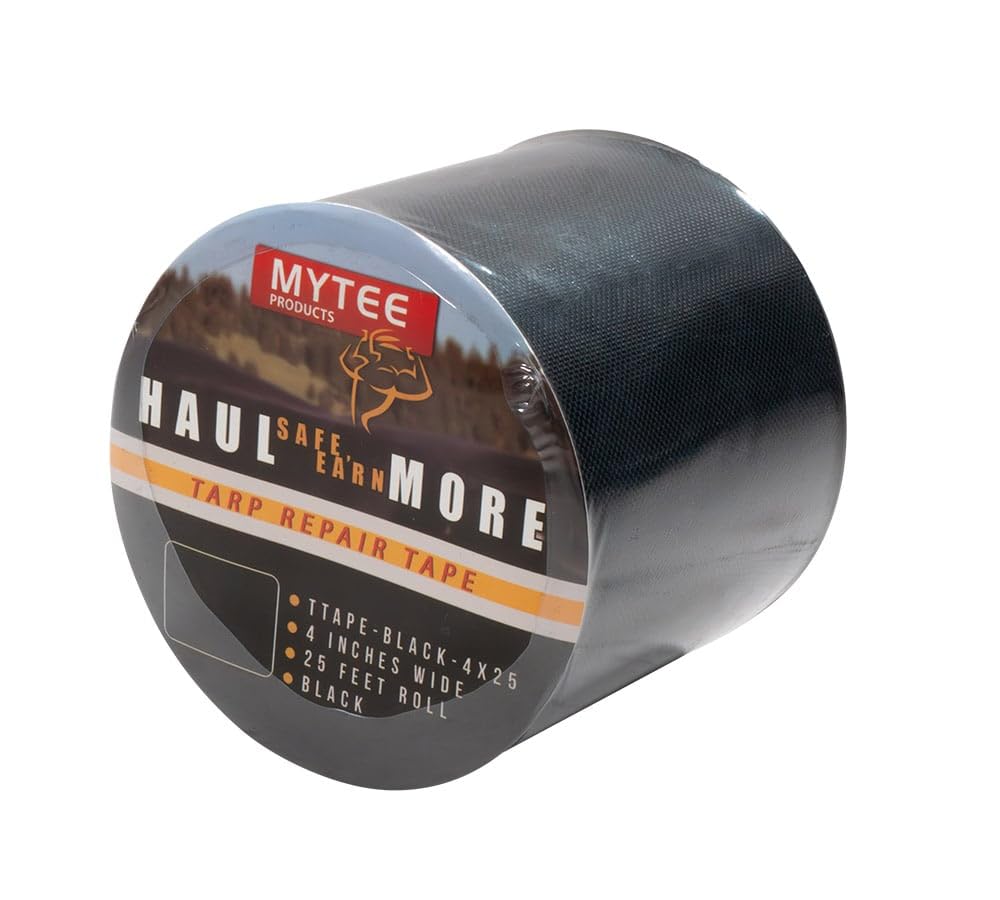
A black vinyl strip with a polyurethane coating — peel it, stick it to a flatbed tarp, and skip the cost of a new cover.
If you haul with a flatbed trailer, this is the roll shaped for the job. It is a 4-inch by 25-foot strip of 8.8 oz PVC fabric with a polyurethane coating, a single-sided heavy-duty adhesive backing, and a black face that matches a black tarp. It cuts easily to size with scissors, so a tear along a trailer tarp or a woodpile cover gets a strip sized to it rather than a strip that overhangs. The maker lists a temperature range of -20℃ to 70℃ and rates it waterproof and UV resistant.
The spec most buyers skim past is the lifespan: 5 years outdoors, with a 1.5-to-2-year shelf life before use. That is a long-service repair tape, and it explains the heavier build. Owners have used it to patch holes in a large tarp covering a wood store and to seal a tear in a camper awning, and the adhesive is the thing that gets noticed — it grabs and stays put.
The honest limit is volume: this listing has fewer buyers behind it than the tape rolls and the cement kit, so the track record is shorter. The upside of that is a roll that is built for a specific surface — black vinyl — and does it well. Check the surface is clean and dry before you peel, press it down hard, and this is a set-and-leave repair for a working trailer tarp.
The long-haul value: 8.8 oz PVC rated for 5 years in outdoor conditions — a strip that is meant to stay on a trailer tarp, not get replaced next season.
Where it is thin on proof: a smaller buyer base than the other rolls, so treat the track record as shorter, not worse.
For the working trailer: flatbed tarp owners and anyone covering a woodpile or equipment with black vinyl who wants a patch that lasts years.
Skip it for: canvas or white awnings, since the black PVC face will stand out against light fabric.
Know the Specs
Repair format: cement versus tape versus canvas patch
A vinyl cement kit fuses two vinyl faces into one skin — a patch you build, not stick. A peel-and-stick tape is a pressure-sensitive strip that grabs a surface and holds with adhesive. A canvas patch kit gives you fabric plus fabric glue. Each solves a different material. Cement is for vinyl; tape is for canvas, plastic and sailcloth; canvas patches are for canvas that has to look and behave like the original.
Roll width and length
Width decides how many passes a tear takes. A 3.15-inch roll handles punctures and short tears; a 4.5-inch or 5-inch roll covers a full awning seam in one or two strips. Length decides how far a roll goes before it runs out. A 10-foot roll is for spot repairs; a 39-foot or 40-foot roll runs a long seam and leaves spare.
Fiberglass reinforcement
A fiberglass core is a woven mesh inside the tape that resists tearing and puncture. It is what separates a repair tape from a heavy duct tape — the strip will not rip apart under wind load. Nearly every tape here carries fiberglass for exactly that reason.
Temperature range and UV resistance
Adhesive behaves differently in cold and heat. One tape is rated -30°C to +70°C; the vinyl cement kit has a listed range of -20℃ to 70℃. UV resistance keeps the strip from going brittle in the sun. In cold weather, warm the surface with a blow dryer so the adhesive can flow and grab.
Common Questions
Will a tarp repair tape work on a slick vinyl tarp?
Can I use these tapes to repair a paddle board or inflatable?
How long does a tape repair last on an RV awning?
What size roll do I need for a full awning seam?
Do I need to clean the fabric before applying tape?
Can these tapes be used underwater or in a pool?
Is a vinyl cement kit or a tape roll better for a pontoon cover?
Do I apply the tape to one side or both sides of a canvas?
Will these tapes stick in freezing weather?
Does the tape work on leather, metal and plastic too?
The Bottom Line
For most tarp owners, the winner of the tarp repair kit shortlist is the Mytee Products 18oz Vinyl Repair Kit — 18 mil vinyl, 7.5 square feet of patch and a quart of HH-66 cement is the only pick here that fuses vinyl into a real repair instead of taping over it. If you want the fastest wide strip for a long awning seam, grab the AIHSUMC 4.5Inch x 40FT Tape — 4.5 inches wide with scissors in the box. And if your repair is on a pop-up camper bunk end or a canvas tent, the TrailMax Outdoor Canvas Patch Kit is the one to reach for, because it repairs canvas with canvas. The Mytee kit has fewer buyers behind it than the tape rolls, but the ones who buy it come back to the 18 mil patch.
How we choose
We do not accept paid placement. Every pick is matched to a real buyer and a real use-case; we do not hands-on test units.
Sources
Specifications: manufacturer listings and product documentation. Review insights: verified customer reviews, as of November 2026. Pricing: not shown on this page (it changes often); check the current price via the retailer link.
As an Amazon Associate, Tactical Gear Guy earns from qualifying purchases. This does not affect which products we feature.