Specs are compiled from manufacturer listings and verified buyer reviews and can change over time — please confirm the key details on the product page before buying.
With a white batting helmet, fit decides everything: a shell that sits high or wobbles mid-swing leaves you flinching instead of tracking the pitch. A shell that sits high, wobbles mid-swing, or slides on a ponytail leaves you flinching instead of tracking the pitch. This guide picks nine white-shell helmets that stay put, meet the NOCSAE standard for play, and look clean under the lights. It walks you through fit, ventilation, face guards, and the one sizing mistake that sends more helmets back than anything else.
This guide is built by comparing the manufacturers’ published specifications and the patterns across verified customer reviews, so you get each pick’s real strengths and trade-offs instead of marketing spin.
Every pick below has a white shell, so the real decision depends on fit, airflow, and jaw coverage. Here are nine white-shell helmets that stay put, meet the NOCSAE standard, and hold up through a full season of swings.
Top Picks


How To Choose The Best White Batting Helmet
Measure your head before you pick a shade of white. A white shell only looks clean if it sits flush on your skull, and a helmet that rocks while you load your swing is a helmet that distracts you at the worst moment. Measure the circumference of your head just above your ears, then match that number to the maker’s hat-size chart.
Why fit beats extra padding
The most common batting helmet return starts with skipping the size chart and hoping thick padding will close the gap. Thick crown padding can make a helmet sit high, resting on top of the head instead of down around it. If you land between two sizes, measure first and look for a maker that publishes both a hat size and a head circumference, so you are not guessing.
Why the white shell is worth thinking about
A white helmet reflects light rather than soaking it up, and the matte finishes hide scuffs better than a glossy shell. Several picks here use a matte white that buyers report resists yellowing in sun. If your team colors are strict, confirm the white is the shell color and not a trim accent before you order.
Face guard, jaw guard, or neither
A face guard adds a metal mask across the field of vision, while a jaw guard covers one side of the jaw for the side you turn toward the pitcher. Fastpitch and youth leagues often require the extra coverage, while adult slowpitch may not. Check your league’s face and jaw guard rules before you buy on looks.
Side-by-Side Comparison
| Model | Best For | Certification | Face/Jaw Guard | Weight | Amazon |
|---|---|---|---|---|---|
| Easton Ghost Fastpitch★ Best Overall | Fastpitch players | NOCSAE approved | Face guard included | 2.1 lb | Amazon |
| Champro HX LegendBudget Champion | Budget league play | NOCSAE standard | None | 16 oz | Amazon |
| Champro HX Legend PlusBest Value | Value with jaw guard | NOCSAE standard | Jaw guard included | 16 oz | Amazon |
| Easton MOJO | Youth to teen look | NOCSAE approved | None | — | Amazon |
| Marucci DuraVent | Airflow seekers | NOCSAE verified | Reversible jaw guard | 0.82 kg | Amazon |
| EvoShield XVT 2.0 | All-around hitters | SEI certified to NOCSAE | None | 0.7 kg | Amazon |
| RIP-IT Vision Pro | Long hair and ponytails | SEI certified to NOCSAE | None | 1.1 lb | Amazon |
| EvoShield XVT 2.0 with Facemask | Younger players | SEI certified to NOCSAE | Facemask included | 0.94 kg | Amazon |
| Rawlings MACH Adjust | Switch hitters | Meets NOCSAE | Adjustable jaw guard | 1.6 lb | Amazon |
Detailed Reviews
1. Easton Ghost Batting Helmet with Face Guard
Our pick — 4.5+★ from 650+ verified ratings; the strongest balance of quality and price.
The fastpitch helmet that tucks a ponytail under a matte white shell without lifting off the skull.
For fastpitch players who want jaw coverage built in, this is the pick to beat. The Ghost comes with a face guard already attached, so you skip the dead end of hunting a bigger size at a local store that only stocks shell-only helmets. The protective shell is reinforced at crucial impact regions and shaped to fit different hairstyles, so a thick ponytail does not lever the helmet up off the crown.
What wins people over is the build quality, and it holds that reputation season after season. The white shell is reported to resist yellowing in sun rather than soaking up a dingy tint, and a matte finish keeps scuffs from showing like a gloss shell would. One owner logged three softball seasons on it with no paint chips and only a few scratches. The sweat control is real too: a DRI-LINER treatment on the forehead and cheek pads keeps the white padding from turning into a sweat trap through a doubleheader.
The catch is sizing — this shell runs tight against other brands in the same stated size. A petite 7-year-old slots into her size while an S/M that swallowed a larger kid was too big for her, so measure the head and lean on the size chart rather than age. The improved facemask sits lower and closer to the face for vision, and it is certified for balls no smaller than 11” in circumference. At 2.1 pounds it carries a little heft compared with the 0.7 kg EvoShield above, but the coverage earns that weight back.
What earns its keep
- Face guard comes attached — no separate purchase or size hunt
- DRI-LINER forehead and cheek pads fight sweat at the plate
- Matte white shell resists the sun yellowing that dulls cheaper shells
- Reinforced shell shaped to fit over braids and ponytails
Where it bites
- Runs tight against other brands in the same size label
- 2.1 lb is heavier than the lightest picks here
Made for: fastpitch players who want jaw protection without a separate shopping trip.
Measure first: this shell fits snug, so a head on the line between sizes needs the larger chart number.
2. Champro HX Legend Batting Helmet
The entry-level shell that gets a kid to the plate protected without stretching the league budget.
If you are outfitting a young team or just need a backup lid for practices, this is the sensible starting point. It uses a durable ABS shell (a hard plastic outer layer) that meets the NOCSAE standard for all levels of play, and the vent holes release heat so a hitter does not cook behind the mask. The DRI-GEAR liner wicks moisture, and a Bio-Fresh treatment helps the padding stay fresher between weekend tournaments.
Here is the honest part: fit is the mixed bag. The crown padding is thick enough that some kids feel the helmet sit on top of the head instead of down around it. One parent had to send a size back because the child found it too tight, while the next size up ran big. When the size lands right, though, it earns its place: a 12-year-old slotted in snug, and a whole-season user had no complaints. The shell comes in a Scarlet/White combo, so check that the white you get is the shell and not a stripe.
For a first helmet, that fit gamble is the trade you make at the entry tier. The payoff is a NOCSAE-certified shell that takes a hit without drama and a moisture liner that keeps the padding dry through July doubleheaders. It wears 16 ounces on the head. If your child has a head that always sits between two chart sizes, the Champro HX Legend Plus below gives the same family of fit with jaw coverage added.
What stands out: a NOCSAE-certified ABS shell with vent holes and a moisture-wicking liner, at the entry tier of the list.
Fair warning: thick crown padding can make it ride high, so trial the size before a season commitment.
Reach for it if: you need a certified, budget-friendly shell for practice reps or a growing player.
Try before you commit: a head between two sizes may need the next chart up.
3. Champro HX Legend Plus Batting Helmet
A jaw guard that flips to either side, so a lefty never has to buy a second helmet.
The Legend Plus takes the same Champro shell family and adds a jaw guard you can move from one side to the other. For a left-handed hitter that is a genuine win — one helmet covers you no matter which way the pitcher is throwing. It also fits the way most parents hope it will: one user’s 120-pound 13-year-old slotted in perfectly, and a 10-year-old was comfortable from the first at-bat.
Quality leads the story here, and it shows in the build. The ABS shell meets the NOCSAE standard, the liner is impact foam with jaw pads wrapped in soft moisture-wicking fabric, and a Bio-Fresh treatment keeps it from going stale. One helmet took a foul ball straight on and did its job; another has been through a whole season with a kid who does not exactly baby his gear. The aesthetic holds up too — a sleek white shell that a young player is genuinely proud to wear.
Where the Legend Plus asks for patience is size. Once the size is right, the jaw guard, the DRI-GEAR liner, and the easy on-and-off make it a daily driver. It runs 16 ounces, and the white-on-navy colorway puts a clean white shell up front.
Why it competes
- Jaw guard moves to either side for switch and lefty hitters
- DRI-GEAR moisture-wicking liner keeps the padding dry
- NOCSAE-certified ABS shell at a value tier
- Easy on and off, comfortable through a full season
Worth planning around
- Some head shapes fit neither the medium nor the large cleanly
- Hard shell plus jaw guard can feel bulky to some players
Best for: the hitter who wants jaw coverage on their strong side without paying a premium.
Check the chart: size is the one variable that catches buyers out on this one.
4. Easton MOJO Baseball Batting Helmet

The white shell with a side graphic that makes a kid easy to spot in the dugout.
Fit is the reason this one gets recommended so often. It runs true on the Easton sizing chart — Senior covers hat size 7 1/8″ to 7 1/2″ — and owners describe it as spot-on for teens and 9U players alike. The shell is high-impact resistant ABS thermoplastic, the liner is dual-density foam that absorbs shock, and a padded Bio-Dri layer fights sweat. It meets the NOCSAE standard for all levels of play.
The MOJO pattern is what makes it recognizable. A subtle side design in a contrasting color lets a player pick his helmet out of a rack of identical white shells, and the look reads as a pro on-field style rather than a youth gimmick. Kids reach for it, and the white MOJO colorway stays clean-looking through the season. Users call it lightweight and say the color is true to the product image, so what you see is what lands on the porch.
There is no face guard or jaw guard here, so if your league requires extra coverage this is not the right shell — the EvoShield XVT 2.0 with facemask further down fills that gap. What you trade in accessories you gain in a clean, comfortable, well-fitting helmet that a young player actually wants to wear. It comes in the Senior fit only on this listing, so check the size range against the player.
The fit story: Senior runs 7 1/8″ to 7 1/2″ on the hat chart, and owners describe it as true to size.
The look: a signature MOJO side pattern on a white shell gives a kid a helmet that stands apart from the team rack.
Pick it when: a youth or teen player wants a clean white shell with a little personality built in.
Look elsewhere if: your league mandates a face guard or jaw guard on the shell.
5. Marucci DuraVent Batting Helmet

Seventeen vents and a jaw guard that reverses to either side — airflow built for hot afternoons.
For a hitter who cooks behind the mask, the DuraVent is the pick. It carries 17 ventilation portals across the shell, which moves real air over the head during intense at-bats. The build is three layers of impact-grade ABS with high-density contour comfort foam, and the jaw guard is universal — it mounts to either side so a switch hitter is covered. The white shell is a clean, sharp look that stays simple rather than flashy.
Marucci builds this gear as a company founded and run by current and former Big Leaguers, and the field pedigree shows in how it takes a hit. The laminated moisture-wicking liner and fully wrapped ear pads keep the sweat managed, and the imported sizing splits Senior (7⅛ – 7½) from Junior (6½ – 7⅛). It will deflect a pitch that gets away from the pitcher, and the jaw flap has taken solid contact without giving way.
The one variable to watch is size. Height on the head is what people notice — a 14-year-old was happy, but a bigger player found even the largest size did not sit properly. It is a narrower-box helmet than the Easton Ghost up top, at 5 x 6 x 9 inches versus the Ghost’s 12.52 x 8.23 x 8.66 inches, so there is less shell material front to back. Measure against the chart, and if the head is near the top of the Senior range, look hard before you commit.
Airflow leader: 17 ventilation portals and a universal jaw guard that reverses for left or right.
The fit caution: a player near the top of a size range may find it does not sit down on the head the way a bigger shell would.
Go with it if: heat in the box is your enemy and you want a jaw guard that flips sides.
Bring your measurements: sizing is the one thing to get right on this shell.
6. EvoShield XVT 2.0 Batting Helmet

The all-around white shell that a 13-year-old and a 14U travel player both call a great fit.
Few helmets get this consistent a read on fit across ages. The S/M slotted a 13-year-old perfectly, while a 14U player called his great, which tells you the chart is honest. EvoShield sizes it off a fitted hat number: XS up to 6 ½”, S/M at 6 ½ – 7 1/8”, M/L at 6 7/8 – 7 1/2”, L/XL at 7 ¼ – 7 7/8”. It tells you to measure the circumference of the head just above the ears. Do that and the size tends to land.
Comfort and venting are the other half of the story. Dual-density padding is placed where it keeps the head comfortable through a long game, and a top plate venting system helps the heat escape. The matte Team White finish is the draw for team colors — one buyer’s son matched his uniform cleanly, and the shell does not carry the shine that shows scuffs. It is certified by SEI to meet NOCSAE standards, and it weighs in at 0.7 kg.
This is the version without a facemask — the XVT 2.0 with facemask is the same shell family a few spots down. What makes this the performance pick is the combination: true sizing, dual-density padding, venting, and a matte white shell that stays looking sharp. It fits a wide range of ages, which is rare.
Strong where it counts
- Consistent fit across teen and travel-ball players
- Dual-density padding placed for comfort over a long game
- Matte Team White finish stays clean-looking
- Top plate venting keeps the head from overheating
Note before you buy
- Listed size can run bigger than a hat size suggests
- No face guard or jaw guard in this listing
Best for: a wide range of players who want true sizing and a matte white shell that stays sharp.
Confirm the guard: this listing is shell only — add the facemask version if your league needs one.
7. RIP-IT Vision Pro Matte Softball Batting Helmet
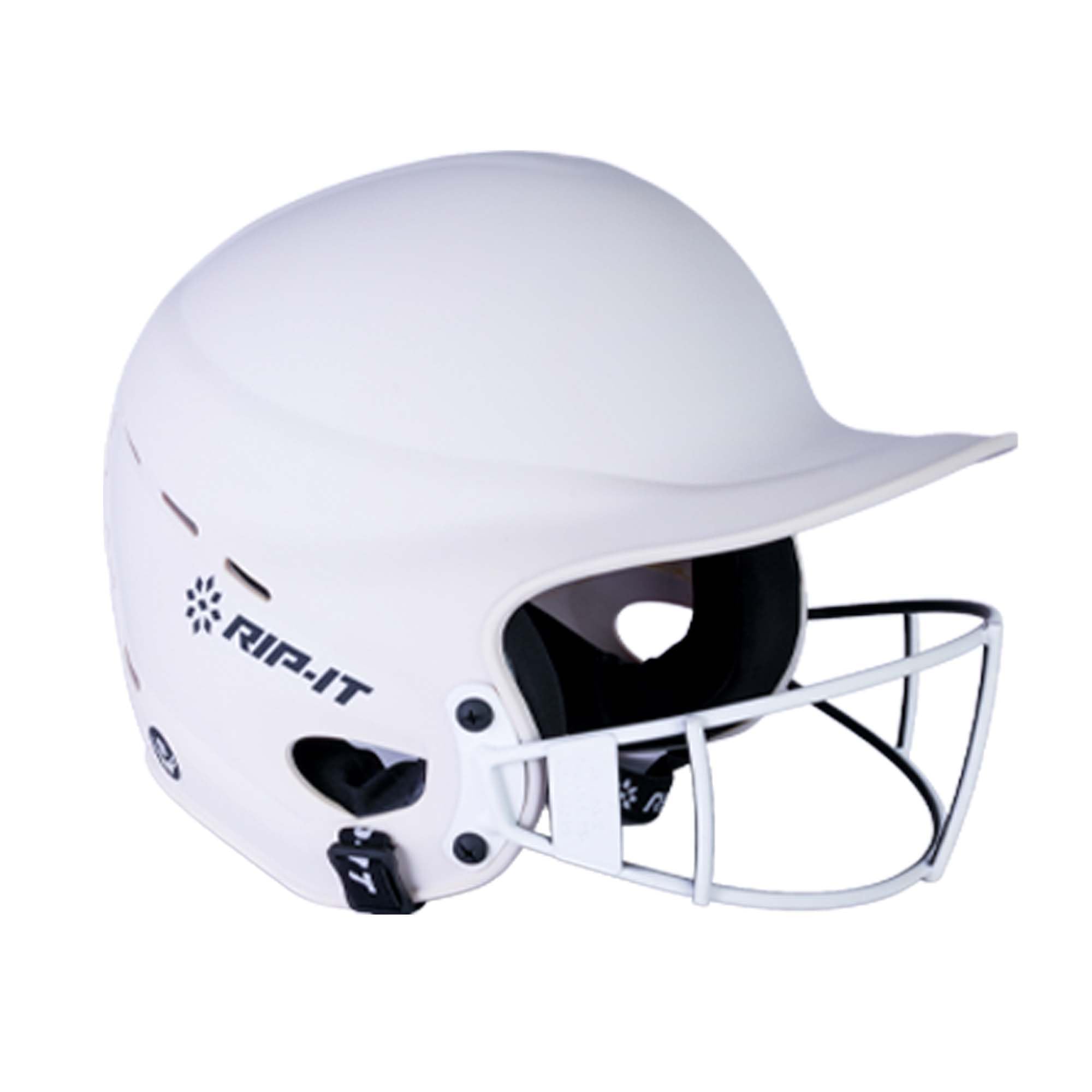
The fastpitch shell with a rear channel that cradles a ponytail instead of sitting on top of it.
This is the pick for players who have grown out of the helmet that wobbles on a bun. A standard shell sits high on hair and slides mid-swing; the Vision Pro builds in a rear ponytail channel that cradles thick hair, braids, and ponytails so the shell sits flush against the skull. For a fastpitch player with long hair, that single design choice changes the whole at-bat.
The field of view gets the most love here. Ultra-thin side bars and a light-absorbing interior coating knock down sun glare and blind spots, so tracking a fastball or a spin pitch is easier. The padding around the ears makes it easy to put on and take off without tugging, and the strap can be adjusted by unbuttoning it. A daughter who tried every helmet on the rack called this the best vision of any she tested. It weighs 1.1 pounds and carries 21 ventilation ports with moisture-wicking padding to keep heat moving.
The sizing is where you need to spend a minute. RIP-IT publishes a head circumference chart — X-Small at 18 3/4 to 20 1/4 in., Small/Medium at 19 5/8 to 21 5/8 in., Medium/Large at 20 1/2 to 23 1/4 in., X-Large at 22 3/4 in. and up — and tells you to order the larger size if you land between two. Measure half an inch above the brows and ears. The matte white gets compliments, and the shell holds up season after season.
The design win: a rear ponytail channel plus 21 vent ports and a light-absorbing interior for a clearer view of the pitch.
The sizing rule: the circumference chart is not optional here — order up if you land between two sizes.
Made for: fastpitch players with long hair, braids, or ponytails who are tired of a helmet that rides up.
Measure carefully: the circumference chart decides the fit, not the age or the label.
8. EvoShield XVT 2.0 Batting Helmet with Facemask

The same trusted XVT shell, now with a facemask for younger players and softball leagues that require one.
This is the helmet a parent reaches for when the league says the batter needs a facemask. It is the EvoShield XVT 2.0 shell with a facemask bolted on, so you get the dual-density padding, the top plate venting, and the matte Team White finish that holds up in team photos. It is certified by SEI to meet NOCSAE standards and sized the same way — by fitted hat size, from XS through L/XL.
Owners put it on their kids and leave it there. One family owns four of them; another daughter grew out of her first and went straight back for a second. That is the tell for a helmet that works: a player does not want to wear anything else. The facemask adds plenty of visibility and protection without blocking the view, and the lightweight build means a young player does not fight the weight of it. The white shell stays clean-looking with several color options if you ever branch out.
The thing to keep an eye on is liner durability. Some owners mention the padding pulling away from the shell within a couple of months of steady use. If you have a player who takes the helmet on and off constantly, check the padding now and then. When the liner holds, this is a top performer for youth and softball. It weighs 0.94 kg, so it sits heavier than the shell-only version, which is expected with the facemask added.
Why families keep buying
- Facemask built in for leagues that require it
- Lightweight enough for young players to wear all game
- Matte Team White shell with several color options
- Dual-density padding and top plate venting from the XVT line
Keep an eye on
- Some liners pull away from the shell with heavy use
- Heavier than the shell-only XVT 2.0 above
Choose it when: a young player’s league mandates a facemask and you want a trusted shell family.
Do the upkeep: give the padding a look every month or so to catch any liner separation early.
9. Rawlings MACH Adjust Baseball Batting Helmet with Jaw Guard

Nine adjustable jaw guard settings on a matte white shell, tuned for the view you want at the plate.
The MACH Adjust is for the hitter who wants the jaw guard exactly where it feels right. A two-piece adapter and flap combination gives right-handed batters coverage with a clearer view, and the guard offers 9 adjustable settings so you can dial in the blend of protection and sightline. For a switch hitter, moving the face guard from the left-handed side to the right side is a quick adjustment rather than a whole new helmet.
Comfort and protection carry the rest of the build. IMPAX foam is a high-performance material that absorbs and disperses force, and a moisture-wicking liner with wrapped jaw pads keeps a player cool in the box and on the basepaths. The shell is matte white and holds up to a lot of weekend tournaments — it does not scratch easily, and it keeps its color through the season. The padding is washable, which matters after a hot tournament weekend.
Sizing is a Junior range here, 6 3/8″ to 7 1/8″ hat size, so it is aimed at younger players rather than adults. This listing is built for right-handed batters, and it is the heaviest pick at 1.6 pounds, which is the trade for the adjustable jaw guard. It meets the NOCSAE standard, and the fit-to-size relationship is solid — a grandson slotted in perfectly on the chart. If your player is a left-handed hitter, confirm the hand orientation before ordering.
The adjustable advantage: 9 jaw guard settings and washable padding on a matte white shell that resists scratching.
Know the limits: it is built for right-handed batters and ships in a Junior size range, at 1.6 pounds.
Pick it when: you want fine control over jaw guard positioning and a shell that survives tournament weekends.
Check the hand: right-handed batters only on this listing, in Junior sizing.
Know the Specs
NOCSAE Certification
To be legal for play at most levels, a batting helmet has to meet NOCSAE, the safety standard for the sport. Look for “meets NOCSAE standard” or “SEI certified to meet NOCSAE standards” on the listing; SEI is the third party that tests it. A white shell without that label is a display piece, not game gear. Every helmet in this guide carries the certification, so check that first before anything else.
Face Guard vs Jaw Guard
A face guard is a metal mask across the whole field of view, usually required in fastpitch and youth leagues. A jaw guard covers one side of the jaw — the side you turn toward the pitcher — and can be fixed or adjustable. If your league mandates a full face guard, pick a shell that ships with one rather than trying to bolt one on later. If it only calls for jaw protection, a jaw guard shell keeps the weight and cost down.
Fit and Hat Size
Batting helmets are sized in hat size or by head circumference. Measure around the head just above the brows and ears, then match that to the maker’s chart. Many brands tell you to order the larger size if you land between two. A shell that fits correctly sits flush against the skull — if it rides high or rocks when you turn your head, the size or the crown padding is wrong. That is the single biggest reason helmets get returned.
Ventilation and Liner
Vent holes in the shell release heat so a hitter stays cool in the box. Liner material matters too: a moisture-wicking liner pulls sweat off the skin, and a treated liner like DRI-GEAR or a Bio-Fresh finish helps the padding stay fresher between games. More vents generally mean more airflow, but the liner is what keeps the padding dry against your skin. Together they decide how comfortable a helmet feels in a July doubleheader.
Common Questions
How do I measure my head for a white batting helmet?
What does NOCSAE certified actually mean on a batting helmet?
Should I get a face guard or just a jaw guard?
Why does my white batting helmet turn yellow over time?
Can a left-handed hitter use a right-handed jaw guard helmet?
How long should a batting helmet last?
Is a heavier helmet safer than a lighter one?
Will a batting helmet fit over a ponytail or braids?
Can you wash the padding inside a batting helmet?
Do I need a different helmet for softball versus baseball?
The Bottom Line
For most fastpitch players, the top pick in this white batting helmet roundup is the Easton Ghost, because it ships with a face guard already attached and a sweat-fighting liner that keeps the white padding fresh game after game. If you want a matte white shell with true sizing and dual-density comfort across a wide age range, grab the EvoShield XVT 2.0. And for a young player with a ponytail or braids, the rear channel of the RIP-IT Vision Pro is the one built for that exact head of hair.
How we choose
We do not accept paid placement. Every pick is matched to a real buyer and a real use-case; we do not hands-on test units.
Sources
Specifications: manufacturer listings and product documentation. Review insights: verified customer reviews, as of November 2026. Pricing: not shown on this page (it changes often); check the current price via the retailer link.
As an Amazon Associate, Tactical Gear Guy earns from qualifying purchases. This does not affect which products we feature.