Specs are compiled from manufacturer listings and verified buyer reviews and can change over time — please confirm the key details on the product page before buying.
You want a charger that refills AA and AAA cells overnight without cooking them. The Panasonic BQ-CC65AKBBA is the one to beat: it reads each battery on its own circuit, shows you voltage and capacity on an LCD (a small screen that displays numbers), and can recondition cells that have gone flat. If you only need four batteries charged for game controllers and remotes, the Energizer Recharge Pro does the job for a fraction of the money. Everything below is sorted so you can decide in a few minutes instead of an afternoon.
This guide is built by comparing the manufacturers’ published specifications and the patterns across verified customer reviews, so you get each pick’s real strengths and trade-offs instead of marketing spin.
Two specs separate a charger that preserves cells from one that cooks them: per-slot monitoring, where each bay reads its own battery, and a charge current matched to the cell. Here is how to pick the right one among the battery chargers on the shelf today.
Top Picks

How To Choose The Best Battery Chargers
Most people buy a charger by counting how many batteries it holds. That is the least useful number on the box. What separates a charger that keeps your cells alive for years from one that quietly kills them is how it treats each battery individually, and how much current it pushes through.
Independent slots versus shared pairs
A charger with independent circuits treats every slot as its own job, so you can drop in one battery, or a mix of half-full and empty ones, and each gets what it needs. Shared-pair chargers force you to fill slots in twos, and a mismatched pair can leave one cell undercharged and the other overcharged. If you own a dozen AA cells in various states of drain, independent slots are worth looking for.
Charge current and how fast is too fast
Current is measured in milliamps (mA), and higher current means a faster fill but more heat. A 500mA court is gentle and easy on cell life; 1A and above is quick but works the battery harder. A slow, monitored charge almost always outlasts a fast one, so a charger with a selectable low rate is the safer bet for expensive cells.
Cell chemistry: NiMH versus Li-ion
Rechargeable AAs and AAAs are usually NiMH (nickel-metal hydride), while flashlights and vape devices often run Li-ion cells like the 18650. These two families need different charging profiles, and a universal charger that claims both should be checked for exactly which sizes it accepts. The XTAR VC4, for instance, charges a long list of Li-ion sizes plus NiMH AA and AAA, but the maker states it cannot charge protected 20700 and 21700 cells.
Side-by-Side Comparison
| Model | Best For | Slots | Charge Time | Cell Types | Amazon |
|---|---|---|---|---|---|
| Panasonic BQ-CC65AKBBA eneloop pro★ Best Overall | Overall smart charging | 4 | 1.5 hours (2 cells) | AA / AAA NiMH | Amazon |
| Energizer Recharge ProBudget Champion | Budget four-bay with batteries | 4 | 3 hours (per maker) | AA / AAA NiMH | Amazon |
| Duracell Ion Speed 1000Best for Gaming | Game controllers and remotes | 4 | 6 hours | AA / AAA NiMH | Amazon |
| XTAR VC4 | Flashlight and 18650 cells | 4 | — | Li-ion + NiMH AA/AAA | Amazon |
| BEVIGOR 8-Bay Smart | Family households | 8 | — | AA / AAA NiMH/NiCd | Amazon |
| Tenergy TN162 | Trail cameras and bulk cells | 8 | 2.3 hours | AA / AAA NiMH/NiCd | Amazon |
| Nitecore UMS2 | Travel and EDC kits | 2 | — | Li-ion + NiMH/NiCd | Amazon |
| Panasonic BQ-CC63SBA eneloop | Eight independent AA/AAA bays | 8 | 5 hours AA / 3 hours AAA | AA / AAA NiMH | Amazon |
| Tenergy T9688 Smart | Mixed C, D and 9V batteries | 4 + 2 (9V) | — | AA/AAA/C/D/9V NiMH/NiCd | Amazon |
Detailed Reviews
1. Panasonic BQ-CC65AKBBA eneloop pro Charger
Our pick — 4.5+★ from 800+ verified ratings; the strongest balance of quality and price.
The charger that reads every cell on its own circuit and tells you exactly what it sees.
This is the pick for someone who owns serious rechargeable cells and wants to know their condition, not just guess at it. Each of the four slots charges independently, so a single drained AA gets topped up without a partner in the next bay. The LCD panel reports charge time, cell voltage and discharge capacity for every battery, which turns a blind chore into something you can actually read. All of that at 4.5+ stars across 800+ owners puts it at the front of this list.
Speed is where it separates from the crowd. Panasonic rates 2 AA or 2 AAA cells at 1.5 hours and a full set of four at up to 4 hours. That 1.5-hour figure is the same number the Energizer Recharge Pro lists as its two-cell time — except the Energizer carries a 5-hour spec field in its own technical data, so the Panasonic’s stated quick figure is the clearer promise of the two. The refresh setting is the feature worth the upgrade: it cycles a weak cell to bring back capacity, and it is the reason people keep this on a bench for years.
One extra: the USB port puts out 5V 1A so it can top up a phone or a light while the batteries charge. The catch is packaging and power. It is a corded unit that runs from a 5V input and ships without eneloop pro batteries, so budget for cells separately. Some owners also grumble about the corded design when they wanted a plug-in body, and the value-for-money aspect of its review split reflects that. If you want a self-contained wall plug and nothing more, the Tenergy T9688 or the Duracell below suit better.
What earns it the top spot
- Four independent slots with individual LCD readouts for voltage, capacity and charge time.
- 1.5-hour fill on a pair, up to 4 hours on a full set of four.
- Refresh mode reconditions weak cells instead of writing them off.
- A 5V 1A USB port doubles it as a phone or light top-up.
Where it asks more of you
- Batteries are not in the box.
- Corded body rather than a fold-out wall plug.
- The value question runs mixed among owners.
Made for: anyone with a stable of eneloop or NiMH cells who wants to see each one’s health and rescue the weak ones.
Think twice if: you want a wall plug built into the unit and cells in the box.
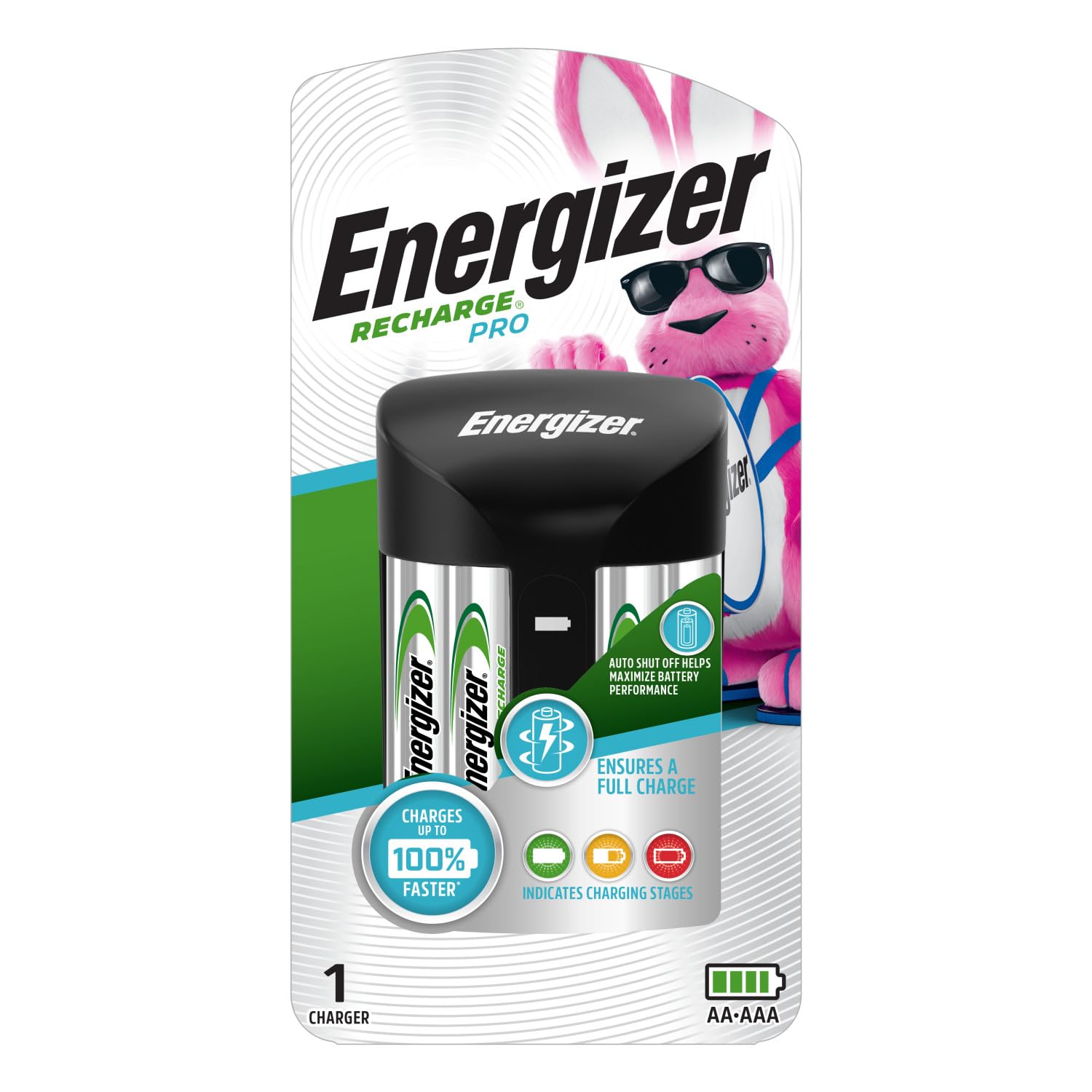
2. Energizer Recharge Pro Battery Charger
The four-bay starter pack that fills your controller batteries and beeps when it is done.
If your goal is simply to stop buying disposables for an Xbox pad, a remote and a few toys, this is the sensible entry point. It ships with four NiMH AA batteries, so you are charging the same day it lands. Its quality and functionality are the two aspects owners talk about far more than anything else, and the practical read is a charger that does what the box says for household devices. It also carries a bad-battery detector: a red X lights and the unit beeps to flag a cell that will not take a charge, which saves you wondering why one slot never finishes.
Expect the lights and beeps to do a lot of the work here. Red, yellow and green LEDs walk you through the charge, and audio alerts mark the start and end. Fast fill is the pitch, up to 100% quicker than the brand’s basic model, though the tech spec field lists a 5-hour charge time against the marketing 3-hour number — so do not bank on a stopwatch figure. Auto shutoff and overcharge protection guard the cells when you forget they are in there, which is most of us.
The limits surface with long-term use. Battery longevity is the mixed note: some owners get weeks out of a set in a controller, others find the cells fade early. AAA handling drew a specific gripe from a buyer who found only AAs seated reliably, so if you are mainly charging AAAs, look at the 8-bay BEVIGOR or the Tenergy TN162 instead.
Why it earns a place: four bays, four NiMH batteries in the box, a bad-cell detector and audible stage alerts — a complete starter kit for game controllers and remotes.
The catch to weigh: advertised 3-hour fills versus a 5-hour spec field, plus early cell fade for a minority. Treat the included batteries as a bonus, not a long-term plan.
The right buy for: a first charger for controller and remote batteries where the four included AAs close the deal.
Look elsewhere if: you mostly run AAA cells or want cells that hold up over several years of daily gaming.
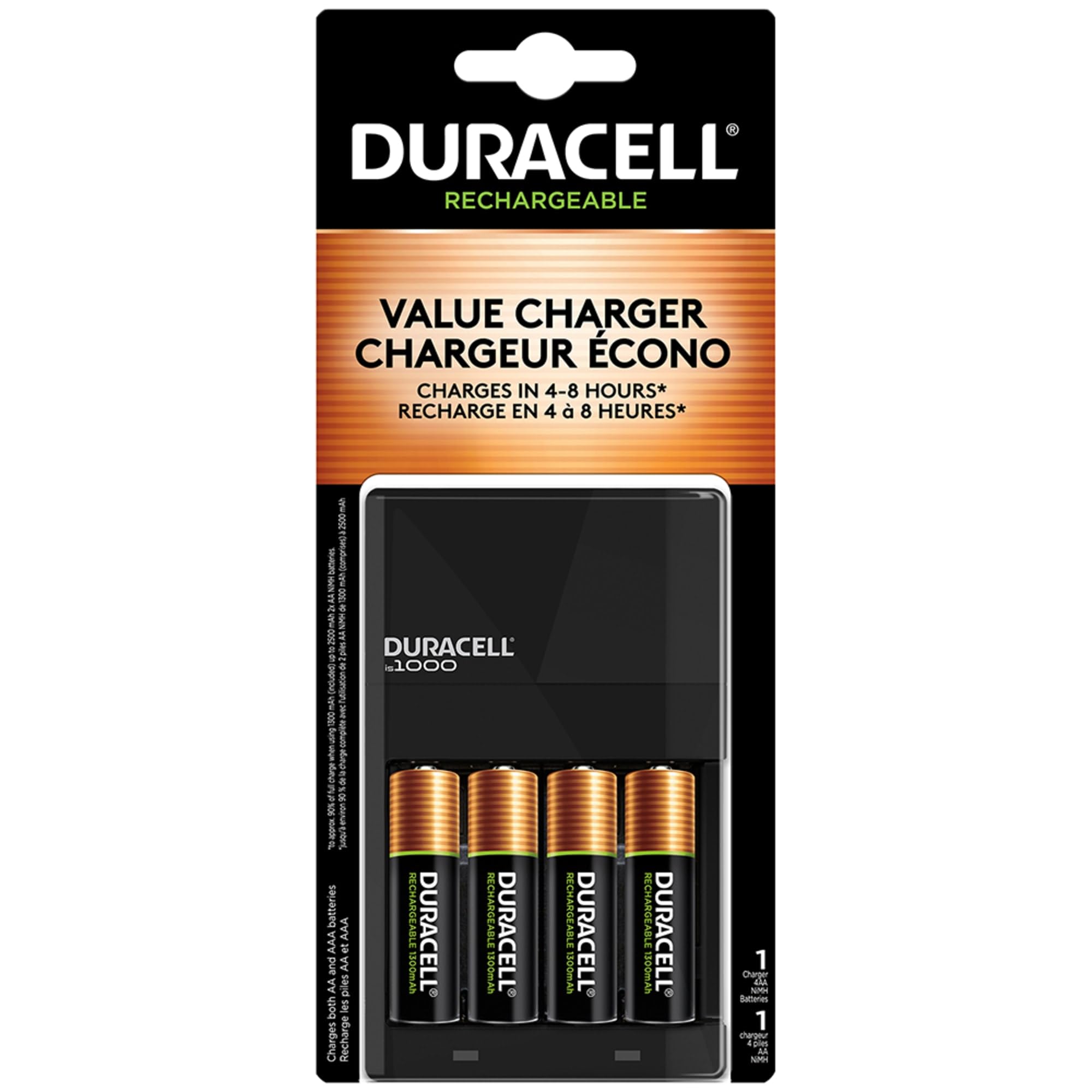
3. Duracell Ion Speed 1000 Battery Charger
Four bays, a fold-out wall plug and a charger that quietly lives beside the console.
For a house full of controllers, this is the no-fuss option. It charges four AA or AAA cells at once, takes other brands’ NiMH batteries as happily as its own, and folds its wall plug flat so it disappears into a drawer. Functionality and value are the two things it gets praised for most, and the pattern matches the design: simple, cheap to run, and one less reason to buy disposables. Owners routinely run it for years. One long-term report covers two years of Wii remote duty with no trouble.
The name “Ion Speed” oversells the pace a little. The unit’s rated charge time is 6 hours, which is a slow overnight job rather than a quick turnaround. That does not matter for a controller that sits idle most evenings, but it does matter if you are swapping cells mid-session. The included StayCharged AA cells carry a three-year storage guarantee, so a spare set can sit in a drawer and still work when you reach for it.
The battery-life aspect is the most-talked-about point overall and it splits both ways: some report a set lasting months of regular play, others see cells fade. That reads as an occasional dud among many satisfied long-term owners, not a pattern of failure. If you want eight cells charging at once, the Tenergy TN162 is the roomier step up.
Pick it when: game controllers and remotes need a steady, inexpensive top-up and the fold-away plug suits your shelf.
Choose another if: you need a fast turnaround for gear that cannot sit out a 6-hour cycle.
4. XTAR VC4 Battery Charger

For the flashlight-and-18650 crowd, a bench charger that shows every cell’s voltage live.
This is the pick if your rechargeable life is built around Li-ion cells rather than AAs. The VC4 takes four bays and a very long compatibility list, from 10440 up through 18650, 26650 and 32650, plus NiMH AA, AAA, C and D. Its LCD reports each cell’s voltage, type, charge current and how much capacity it has taken on, so you can spot a cell that is not holding up before it strands your light. Two current settings — 500mA slow and 1000mA fast — let you choose the gentle path when you have the time.
Speed is where the honesty lives. It tops out at 1A of current, and Nitecore’s dual-bay UMS2 pushes up to 4A with a suitable quick-charge USB source. The VC4 will get there, but on its own time: users note it can take over 12 hours to charge two 18650 batteries at the slow setting. That is fine for an overnight charge and frustrating if you expect a fast refill. A safer split is 500mA for routine charges and 1A only when you need a cell sooner.
One hard limit to note before buying: XTAR states this model cannot charge protected 20700 and 21700 batteries, so if those are in your kit, look at the XTAR X4 or VC8 instead. And it is a USB-powered charger with no wall adapter in the box, so plan for a 5V source. For slim pocket lights and 18650 handhelds, though, it remains a solid, well-priced workhorse that keeps cells topped up in the field.
The honest verdict: a slow, informative, generously compatible charger that is best treated as an overnight routine rather than a quick-fix tool.
On the wish list: the pace at 1A and the lack of a bundled wall adapter are the two compromises to accept up front.
Reach for this if: you run flashlights or vape cells and want a live readout of every battery’s health.
Pass on it if: you need protected 21700 support or a charger that fills in minutes rather than hours.
5. BEVIGOR 8-Bay Smart Charger
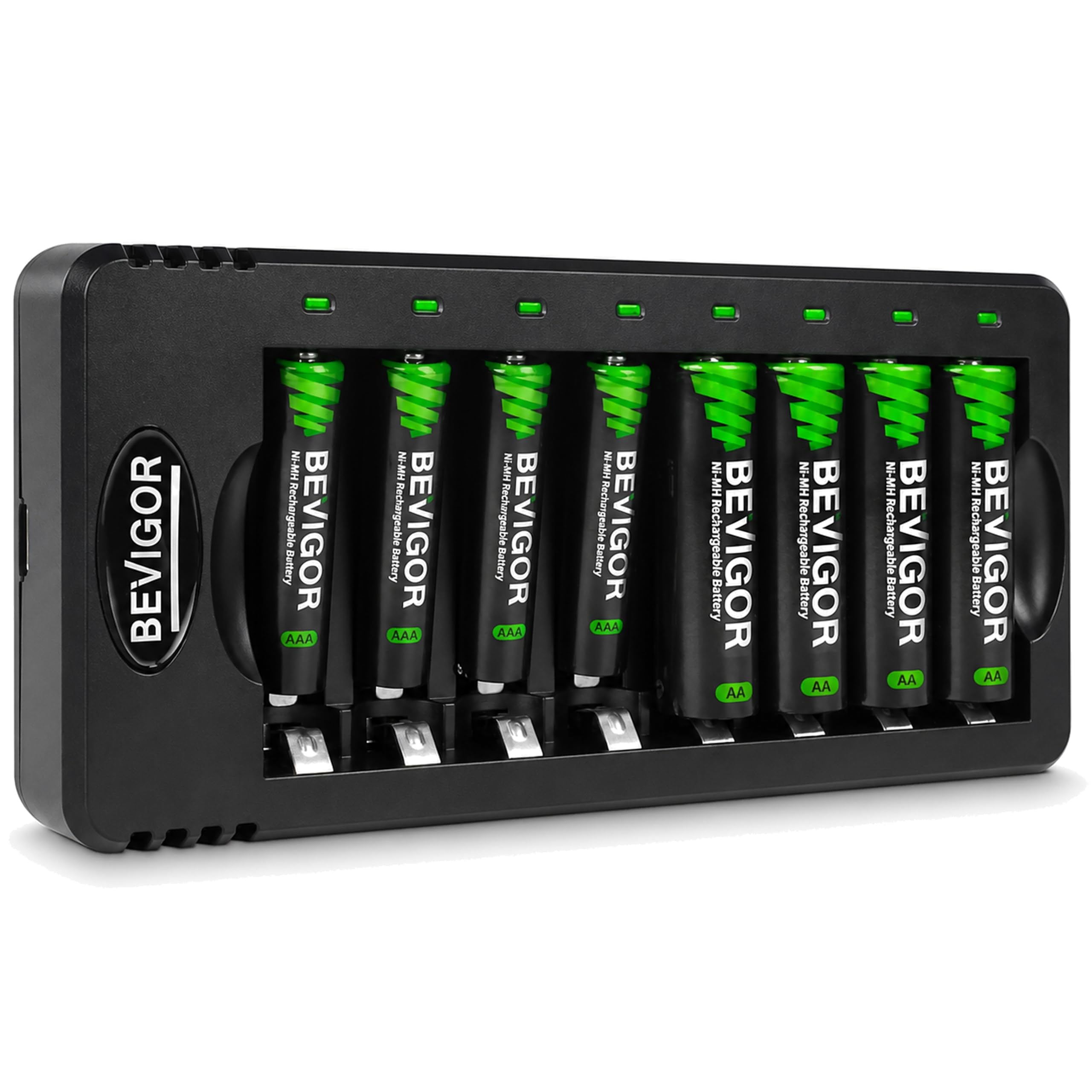
Eight bays, a Type-C cable and a set of cells — built for the household with kids and toys.
If your drawers are full of dead AAAs from toys and VR controllers, this starter set attacks the problem at the source. It ships with four AA 2800mAh cells and four AAA 1100mAh cells, and the eight bays run on isolated circuits so you can charge any mix of one to eight at once. Battery quality is what it gets praised for most, followed by functionality. Low self-discharge is the other practical point: the maker rates the cells to hold 80% of capacity after three years of storage and to take up to 1500 recharge cycles.
Small and portable is the theme. The compact body is easy to leave out on a counter, which is exactly where it should live if kids are grabbing batteries for controllers. The Type-C cable makes it easy to power from any adapter or power bank. A trickle charge mode keeps cells topped up after the main cycle finishes, and thermal cutoff with auto power-off guards against overheating. Red and green LEDs show each bay’s status.
Two things to know. The unit is small, and a few buyers found the AAA slots tight, so seat AAA cells carefully on first use. And low-discharge cells still drain over time, so a spare set charged and left in a drawer will be slowly fading by the time you want it. Compared to the Panasonic BQ-CC65, you get twice the bays and batteries in the box, but without the per-cell voltage LCD.
The natural fit: busy households that go through AA and AAA cells fast and want a charger and cells in one order.
Skip if: you need per-cell voltage readouts or only charge single cells at a time.
6. Tenergy TN162 8-Bay Smart Charger

Eight independent bays, a detailed status LCD and a 12V car adapter for trail-camera duty.
Trail cameras, game cameras and field gear burn through AA cells, and this charger is built for exactly that pace. It takes one to eight AA or AAA batteries at a time, each slot monitored on its own with a Delta-V cutoff, which ends the charge the moment that individual cell hits peak. The LCD shows a status icon per battery so you know which ones are still working. The 12V car port adapter bundled in the box makes it a genuine road-trip tool, not just a bench charger.
The rated charge time sits at 2.3 hours on a 500mA current, which is a sensible middle ground between the six-hour Duracell and the fast quad-bay Panasonic. Owners tend to call it solidly built, easy to use and good value, and the slow-but-gentle character is what people keep repeating — it does not run batteries hot. For trail-camera users who need to refresh eight cells every weekend, that combination is close to ideal. One owner specifically reaches for the discharge button before recharging to keep older cells healthy.
The trade-offs are heat and pace. Some owners find a full cycle takes several hours, which is a quiet price for the gentle current. The unit is large and boxy on a shelf. Reliability shows up in its reviews as mixed, which for a product this well-built usually means one unit out of many misbehaving rather than a design flaw. It is not as compact as the BEVIGOR, but it includes the car adapter that BEVIGOR leaves off.
Reasons it suits field gear
- Eight independently monitored bays with per-cell cutoffs.
- 2.3-hour rated charge at a gentle 500mA current.
- 12V car adapter included for charging away from a wall outlet.
Trade-offs to accept
- Boxy footprint that eats shelf space.
- A full cycle can run several hours.
Ideal for: trail-camera hunters and field users who want eight bays and a car adapter in one box.
Not the one if: counter space is tight or you want the quickest possible turnaround.
7. Nitecore UMS2 Battery Charger

A pocket two-slot charger that puts 18650 cells back to full in under an hour.
Two slots sounds like a step down until you see the current. Paired with a 9V quick-charge USB source, the UMS2 reaches a total of 4000mA across two slots or 3000mA into one — many times what the XTAR VC4 puts out at 1A. The result is an 18650 filled in under an hour, which is why it earns a spot in an EDC or travel kit rather than a workshop. Its compatibility list is long, from 10440 through 21700 and 26650 Li-ion sizes, plus NiMH and NiCd AA, AAA, C and D. A battery organizer comes in the bundle.
Intelligent charging is the other draw. The unit picks the right current and voltage for each cell on its own, which protects the battery and helps it last. The LCD reports battery health, charging status and the current charge mode, so you can watch a cell and see whether it is holding up. That is a useful check if you rotate a handful of 18650s through a flashlight.
Two catches. A few owners had hoped for a USB-C port and found the charger’s input is USB Micro, so bring the right cable. The other is longevity: a long-term user found the unit starting to fail on one side after about two years. That is one report against a large base of satisfied flashaholics. If you need lots of bays and a slow, gentle charge, the Panasonic BQ-CC63SBA is more the tool; if you need one hot cell in under an hour, this is the one.
Speed and portability: up to 4A across two slots, a live health readout and a bundled organizer make it a genuine travel charger.
Two small annoyances: USB Micro input rather than USB-C, and a long-term report of one slot failing after about two years.
Your pick if: you carry one or two 18650 lights and want the fastest refill in a small pocket-sized body.
Keep looking if: you need many bays or want USB-C input without a Micro cable in your bag.
8. Panasonic BQ-CC63SBA eneloop Charger
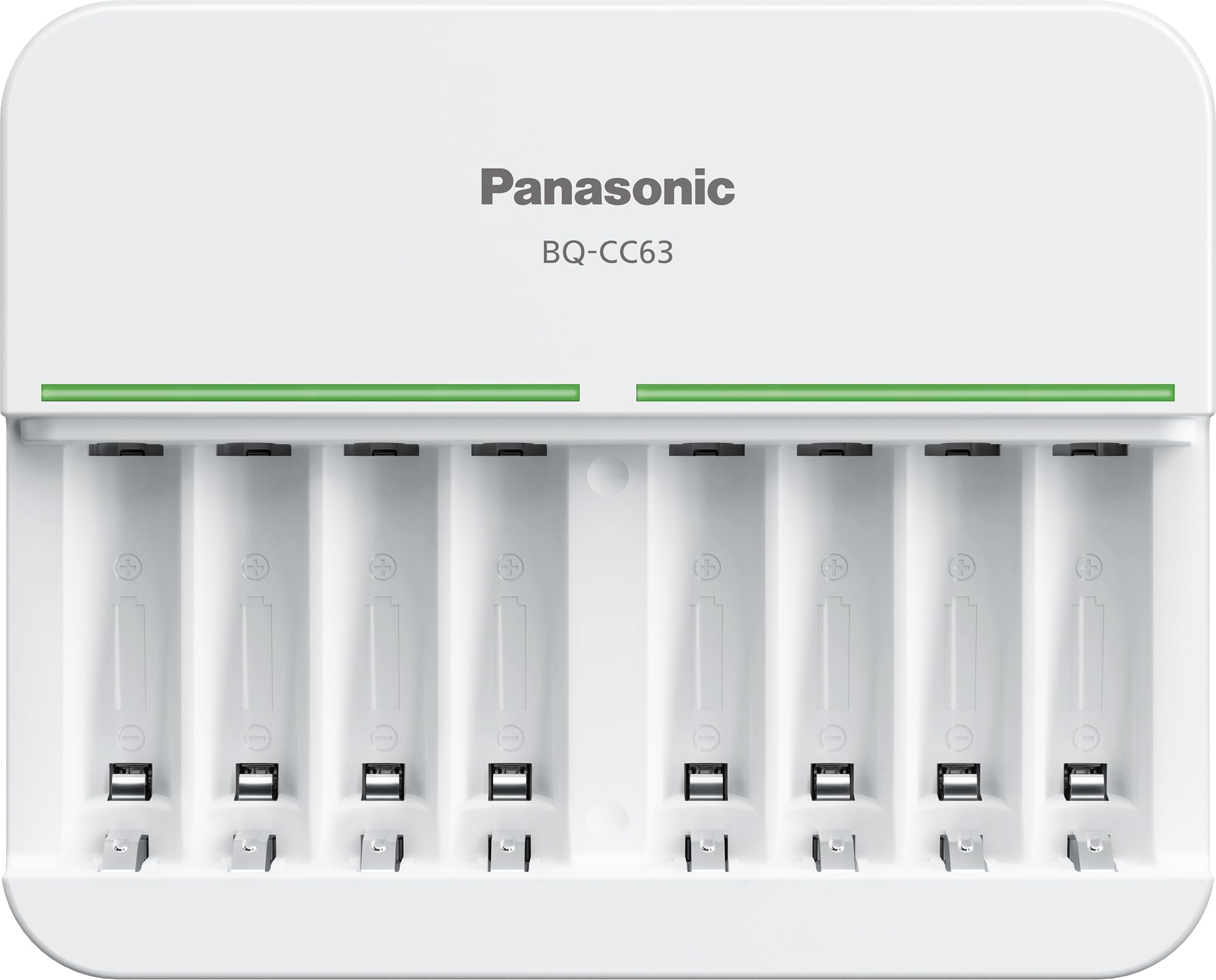
Eight AA or AAA cells charged on eight separate circuits, each with its own green light.
If what you want is simply to keep a large stock of eneloop cells ready, this is the cleanest answer. It handles any combination of up to eight AA or AAA batteries, charging a full set of AAs in as little as 5 hours or AAAs in 3 hours. Each bay runs on its own circuit and stops at peak voltage for that cell, which is the setting that protects battery life. Eight separate green LEDs — one per slot — tell you at a glance which cell is done and which is still working.
Panasonic built this to be lived with. Quality and functionality are what owners praise most, and the smart cutoff that stops each cell when it hits peak keeps you from accidentally cooking a full battery. The unit is compatible with eneloop and eneloop pro cells and with other NiMH rechargeables — Amazon Basics cells work fine in it too. A 6-foot power cord gives you enough slack to reach an outlet from a shelf, which is more useful than it sounds.
The two things to accept: it charges NiMH cells only, with no support for other types, and a couple of AA cells sit slightly proud of the recess when seated. Charge times land where the maker says — a few hours per set — with no sign of overheating, which is the whole point of buying a slow, careful charger. For a household charging eight AAs at a time, that slow, NiMH-only approach is the point.
Built for: homes with a big stock of AA and AAA NiMH cells that want to charge a whole set without watching it.
Not for: anyone who needs to charge Li-ion cells or other battery sizes alongside their AAs.
9. Tenergy T9688 Smart Universal Charger

The one-bay-fits-any-size charger for smoke alarms, lanterns and big D cells.
Most chargers stop at AA and AAA. This one keeps going: it takes AA, AAA, C and D cells across four bays, plus two individual channels for 9V batteries. That makes it the pick for the household with a smoke alarm, a lantern and an old flashlight all needing different cell sizes. The unit auto-selects the right current per battery size, and it includes an automatic charge and discharge function so you can condition older cells rather than bin them. Owners who revived errored-out batteries with the discharge cycle treat it as a minor miracle.
The backlit LCD shows individual battery icons for capacity, charging, discharge and full, so you can read the state of each cell without guessing at a single light. A built-in USB port (5V DC 500mA) on the back can power a small device while you charge. The unit’s rated current is 1300mA, giving it enough push to handle larger D cells that would take forever on a small four-bay AA charger.
The catch is the LCD: several owners find its lettering too small to read without leaning in. A handful of owners find the LCD lettering small and hard to read without close inspection, which undercuts the point of a status screen. Charging pace is also mixed — some find it quick, others note it can take a while. It also expects a cell to be substantially drained before a full charge begins, so a half-full battery may not top up as far as you expect. Budget for a learning curve on the first few uses.
What makes it useful: AA, AAA, C, D and 9V support in one body, auto current selection and a discharge mode that rescues weak cells.
What to plan for: small LCD lettering and a charge cycle that wants drained cells. Expect to read the manual this time.
Buy this when: your devices span C, D and 9V cells as well as AA and AAA, and you want one charger for all of them.
Choose simpler if: you only charge AAs and AAAs and want a screen you can read from across the room.
Know the Specs
Milliamps (mA) and Charge Current
Milliamps measure how much current the charger pushes into a battery each hour, and higher current means a faster fill at the cost of more heat. A 500mA charger treats cells gently and is the safer daily default; 1000mA and above fills quicker but runs the battery harder. Look for a charger that lets you pick the slow rate when you have time, because a slow, monitored charge is easier on cell life than a rushed one.
Independent Slots and Delta-V Cutoff
An independent slot means each bay monitors and stops its own battery, so one full cell does not keep charging while its partner still catches up. Delta-V detection is the trick most smart chargers use: it watches for a tiny voltage dip that signals a NiMH cell has reached peak, then stops the charge. Chargers without it tend to trickle-charge forever, which shortens battery life.
NiMH versus Li-ion Cells
AA and AAA rechargeables are usually NiMH and want a slow, gentle charge profile. Li-ion cells like the 18650 carry more energy for their size but need a constant-current, constant-voltage charge and are pickier about voltage. A universal charger must be built for both and should list exactly which sizes it handles — a few models accept 18650 and 21700 but refuse protected versions of those cells, so check the size list before buying.
mAh Capacity and Refresh Mode
mAh is the capacity rating on a battery — how much energy it holds. Higher mAh means longer runtime but usually a longer charge time. A refresh or discharge mode is the feature that cycles a weak cell down and back up to recondition it, and a good charger with one can bring a retired battery back into service. A refresh mode is a big part of why these chargers cost more than a basic four-bay wall unit.
Common Questions
Can I charge different battery sizes in the same charger?
Will a NiMH charger also charge 18650 flashlight batteries?
How long does a full charge take on a typical charger?
What does the Delta-V cutoff actually do?
Can I leave batteries in the charger after they finish?
Do I need a wall adapter for a USB-powered charger?
What is a refresh or discharge mode used for?
Are fast chargers bad for my rechargeable batteries?
Can a charger bring a dead battery back to life?
What is the difference between an eneloop charger and a generic one?
The Bottom Line
For most people, the battery chargers winner is the Panasonic BQ-CC65AKBBA because it combines per-cell LCD readouts, a 1.5-hour fill on a pair, and a refresh mode that rescues weak eneloop cells — a level of information the four-bay budget units here do not offer. The crowd favourite on sheer scale is the Energizer Recharge Pro at 4.5+ stars across 68,000+ owners, but that popularity is built on a starter kit with four cells in the box rather than fine control.
If you want a fast refill for one or two 18650 cells (rechargeable lithium-ion batteries), grab the Nitecore UMS2 — its 4A quick charge is the fastest single-cell option here. And for a house that runs through AAs and AAAs every week, the Panasonic BQ-CC63SBA with eight independent bays and eight LEDs is the one to reach for, while the Tenergy T9688 is your answer if C, D and 9V cells are in the mix.
How we choose
We do not accept paid placement. Every pick is matched to a real buyer and a real use-case; we do not hands-on test units.
Sources
Specifications: manufacturer listings and product documentation. Review insights: verified customer reviews, as of November 2026. Pricing: not shown on this page (it changes often); check the current price via the retailer link.
As an Amazon Associate, Tactical Gear Guy earns from qualifying purchases. This does not affect which products we feature.