Specs are compiled from manufacturer listings and verified buyer reviews and can change over time — please confirm the key details on the product page before buying.
You want to bolt panels on a van roof or a shed and start making your own power, without paying an installer to do it. The catch is that “400 watts” on a box means almost nothing until you check three things: the panel’s real voltage under load, whether your charge controller can swallow it, and whether the panels even fit your roof. Get those right and a weekend of drilling and wiring does the job. Get them wrong and you own expensive glass that trips a breaker or charges nothing.
This guide is built by comparing the manufacturers’ published specifications and the patterns across verified customer reviews, so you get each pick’s real strengths and trade-offs instead of marketing spin.
You can wire some kits yourself on day one; bare panels need extra parts first. This breakdown separates the two and flags the voltage traps before you drill a single hole, so you can sort every self install solar panels option with confidence.
Top Picks
How To Choose The Best Self Install Solar Panels
Self-installing means you become the electrician, so the spec sheet is your safety net. The ordering below is the order that keeps you from buying twice.
Match the panel voltage to your charge controller
Two panels put out 47.48V Vmp and 54.62V Voc when wired in series — that is the loaded and the open-circuit voltage, and the second one is higher. Many portable power stations list a maximum solar input voltage in the 60V class. Check that number on your unit before you buy a pair, because panels that exceed it can simply refuse to charge or trip the input protection.
Decide if you want a kit or bare panels
A kit arrives with the charge controller, cables, brackets and sometimes a battery, which suits you if you have never run DC wiring. Bare panels are cheaper per watt but assume you already own a controller, MC4 extension cables and mounting feet. Buy the kit if you want one box to open. Buy bare panels if you are upgrading a system that already works.
Look at cell type only as far as it changes behavior
N-type cells (a newer silicon recipe) tend to hold output better when it is hot, and the 16BB and 18BB labels describe the number of thin collector ribbons across each cell. More ribbons spread the current and lower the risk of hot spots and microcracks. In practice, a 16BB N-type panel is a reasonable minimum for a roof that stays up for years.
Measure your mounting space before wattage
A 200W panel measuring 51.3 × 30.3 inches takes real estate. Four smaller 100W panels at 31.1 × 22.7 inches each may fit a curved van roof where one large panel will not. Sketch the roof, then match wattage to the space that actually exists.
Side-by-Side Comparison
| Model | Best For | Rated Watts | Operating Current | Weight | Amazon |
|---|---|---|---|---|---|
| Callsun N-Type 16BB 400W Bifacial (2×200W)★ Best Overall | Best all-round DIY roof and van setup | 400 watts | 8.43 A | 23.8 lb per panel | Amazon |
| ECO-WORTHY 400W N-Type (4×100W)Best Value | Low-cost four-panel starter array | 100 watts per panel | 4.96 A | 23.8 pounds | Amazon |
| Callsun 400 Watt (4×100W)Compact Pick | Compact panels for tight roof space | 400 watts | — | 46.8 pounds | Amazon |
| JJN 400W Bifacial (2×200W) | Max watts per panel on a mobile mount | 400 watts | 9.12 A | 46.3 pounds | Amazon |
| ECO-WORTHY 200W Starter Kit | Total beginner wanting battery included | 600 watts peak inverter | 3.76 A | 11.5 pounds | Amazon |
| Renogy 400W Premium Kit | Turnkey kit with MPPT controller | 100 watts per panel | — | 56.4 pounds | Amazon |
| ECOBOSS 1200W (6×200W) | Large array build-out in one order | 200 watts per panel | 10.32 A | — | Amazon |
| Renogy 1280W N-Type 18BB | Whole-home and ranch scale | 320 watts per panel | 8.46 A | 144 pounds | Amazon |
| JJN UL61730 1180W (2×590W) | Maximum power from two big panels | 1180 watts | 14 A | 123.4 pounds | Amazon |
Detailed Reviews
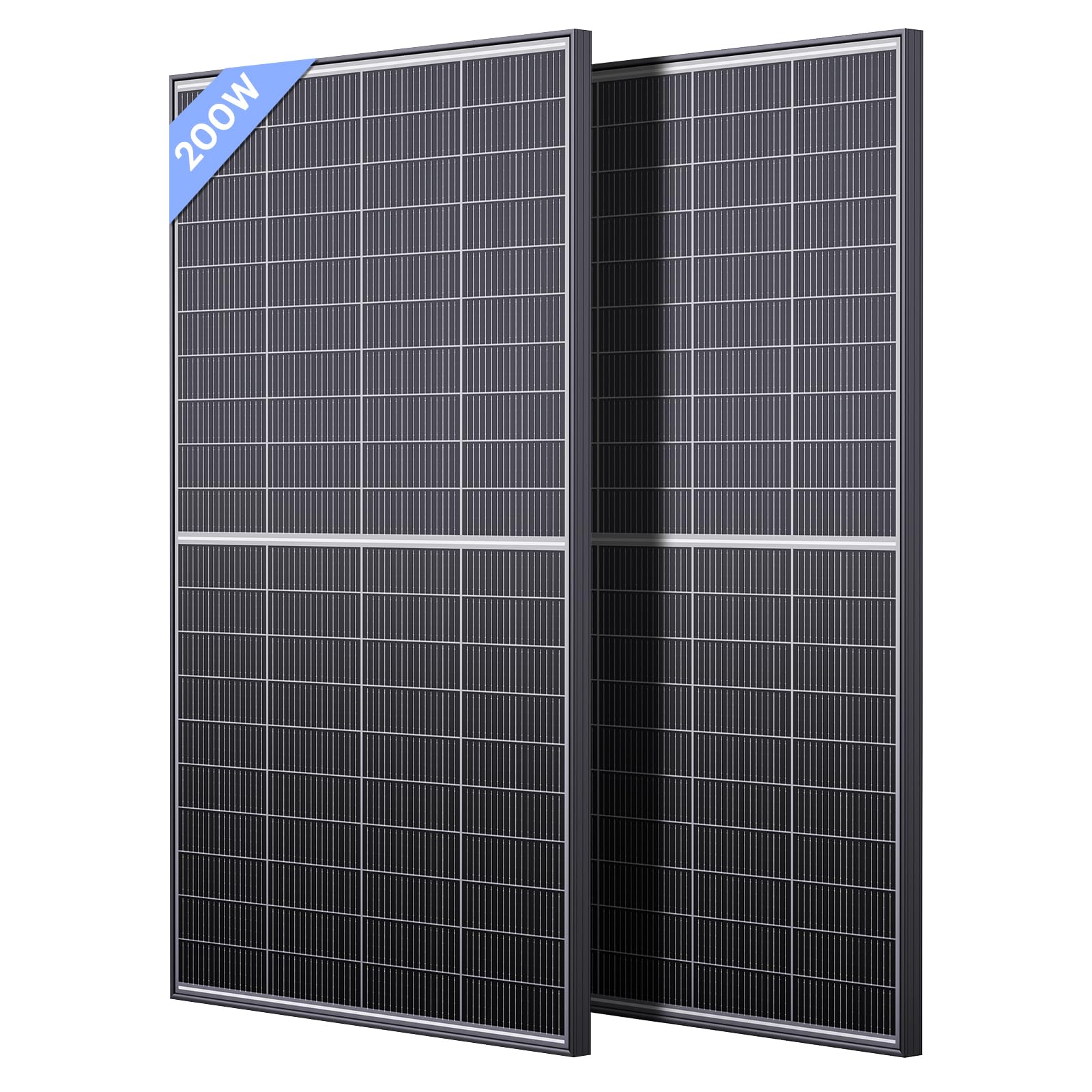
1. Callsun N-Type 16BB 400W Bifacial Solar Panel, 2×200W
Our pick — 4.5+★ from 500+ verified ratings; the strongest balance of quality and price.
The dual-module panel that keeps charging when half of it is in tree shade.
Two 200W panels get you 400 watts of rated power, and the number that decides your build is 25.6% — the cell conversion efficiency, the share of sunlight the panel turns into usable electricity. Higher efficiency means more watts from the same roof footprint, which matters when you are covering a van or a small cabin roof and have no room to spare.
The dual-module parallel layout is the real reason to pick this one. Each panel splits into two independent sections, so when a tree, vent or antenna shades one side, the other keeps producing. Owners back that up with fast morning pickup, with the review pages describing rising harvest within half an hour of sunrise. Connectors are standard solar type and the junction box carries an IP68 rating (fully sealed against dust and water immersion), so it survives roof spray.
Compare it with the ECO-WORTHY four-panel set, which is rated at 100 watts per panel — this Callsun lands 400 watts across two panels, and at 8.43A it carries 70% more amperage capacity than that set’s 4.96A. Wiring is the trade-off: series connection pushes Vmp to 47.48V and Voc to 54.62V, so confirm your power station accepts that input. Each panel measures 51.3 × 30.3 × 1.4 inches at 23.8 lbs, and the temperature coefficient of -0.30%/K keeps summer losses small.
What earns the top slot
- 25.6% conversion efficiency packs 400 watts into two panels, not four.
- TwinCell anti-shade design keeps one half producing when the other is shadowed.
- Bifacial backsheet harvests reflected light from a white or reflective roof surface.
- Pre-drilled mounting holes mean a bracket-and-drill install with no cutting.
Before you drill
- Series pair reaches 54.62V open circuit — check your charge box matches.
- Glass panels this size want a second pair of hands on the roof; one person solo is awkward.
- No brackets, cables or controller in the box, so budget for those separately.
Made for: Anyone mounting to a van, camper or cabin roof with shade from vents or branches and a 60V-class solar input on their power station.
Plan around: The 23.8 lb weight per panel and the series voltage limit — wire in parallel if your controller tops out lower.
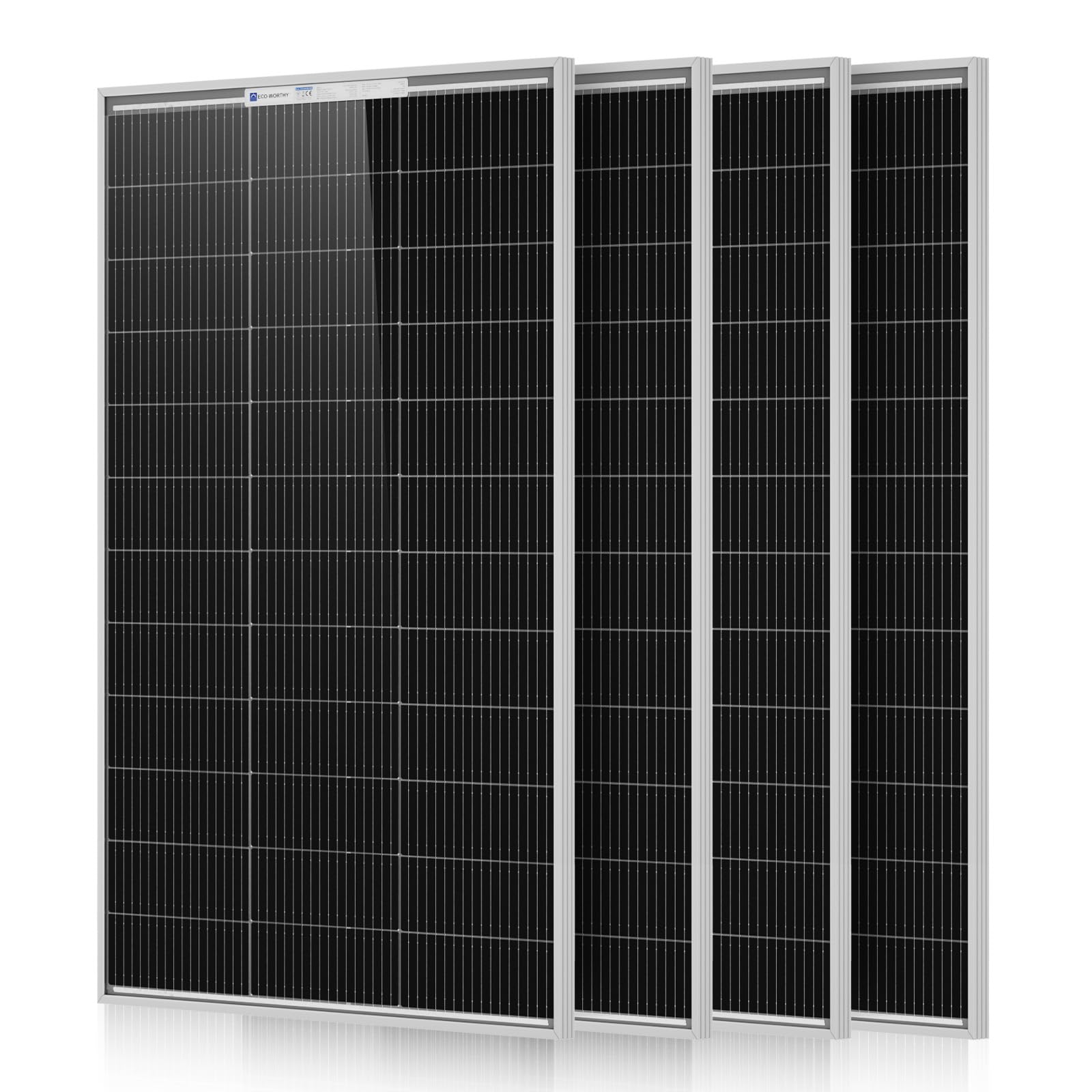
2. ECO-WORTHY 400W Solar Panels N-Type, 4×100W
Four small panels that let a first-timer fit a curvy roof without a custom bracket.
Here is the case for buying four 100W panels instead of one big one: each measures 35.63 × 23.03 × 1.18 inches, so you can spread them across a roof with vents, ribs and odd curves. Wiring is the plug-and-play MC4 kind (the snap-together solar connectors used on most off-grid gear), and a waterproof IP68 junction box with pre-installed bypass diodes limits how much a shadow drags the whole string down.
Each panel comes with 35-inch cables, which shortens the cable run you need to buy separately. Efficiency sits at up to 25% thanks to N-type cells and 16BB busbars. The 1.18-inch thickness is deeper than some rivals and gives heat room to escape, which helps output on a hot roof.
Where this one needs honesty is output consistency. While quality is the thing buyers praise most and the panels have earned a 4.5+ star average, output is the topic that draws mixed reports — some owners see the full advertised wattage, others get less on gloomy days. That is a fair fit-note: treat the label as a ceiling, not a guarantee, and you will not be disappointed. Order arrives as two separate boxes, so hold off on the install until both land.
Worth knowing: No mounting hardware ships with these, so add Z-brackets or your own rail system to the project list.
The honest read: Panel corners can arrive with small sharp edges that a file smooths off in seconds — cosmetic, not a defect you send back for.
Right for you if: You want the lowest entry into a 400-watt 12V or 24V array and can spread four modest panels over an irregular roof.
Look elsewhere when: You need guaranteed peak wattage in cloudy conditions — the bigger bifacial panels above hold output better.
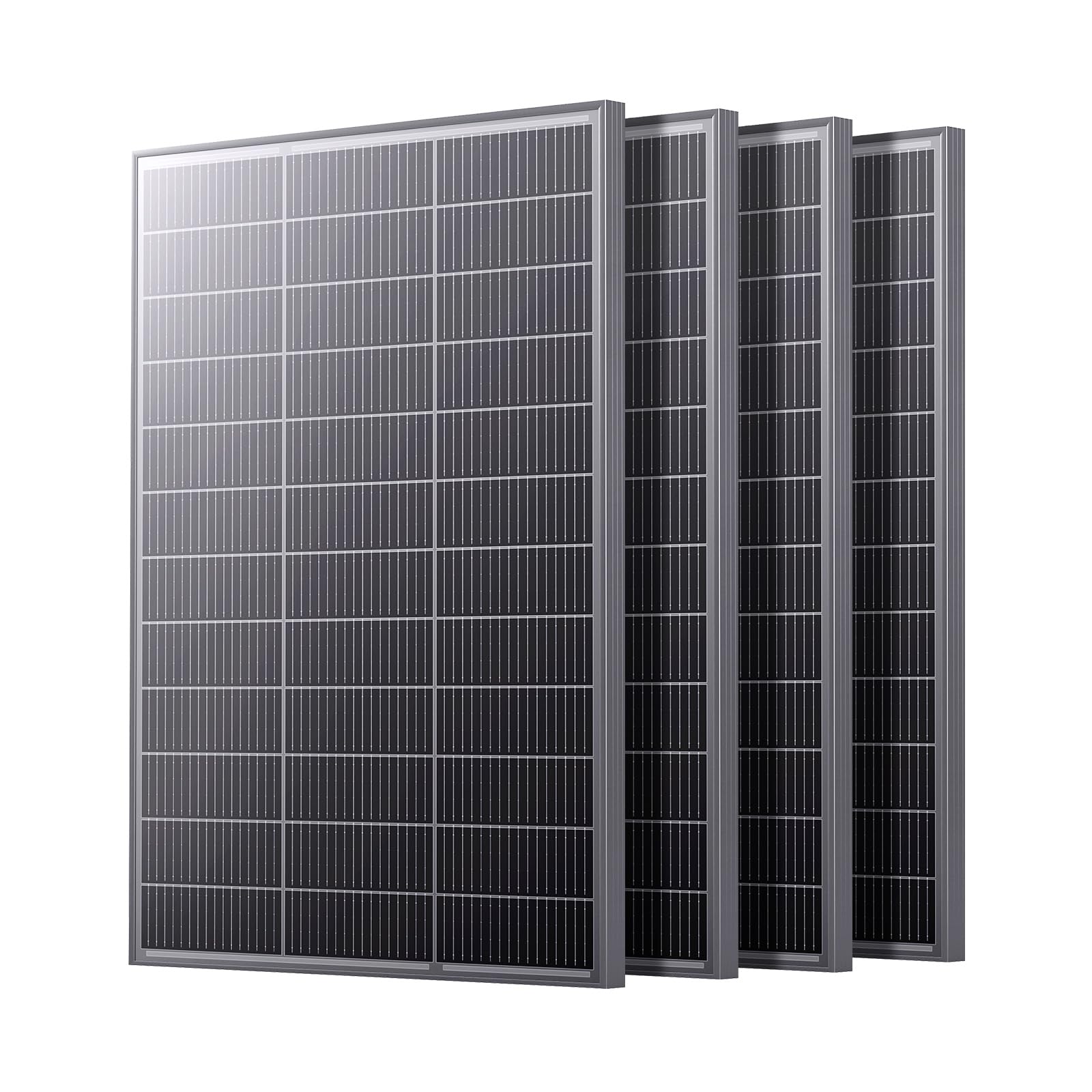
3. Callsun 400 Watt Solar Panel, 4×100W
Smaller than expected is exactly what makes these four panels fit.
A tight roof is where this panel wins: each one measures just 31.1 × 22.7 × 1.1 inches and weighs 11.4 lbs, and the spec sheet calls it 15% smaller than traditional panels. That is small enough that owners describe fitting six of them in a two-series, three-parallel layout onto a small travel trailer. If your roof is tight, that size advantage does more for you than any wattage badge.
You also get shade tolerance built into the cell design: 16 busbars against the 9BB or 10BB designs found on older panels spreads current more evenly and fights hot spots. The 1.1-inch depth is the thinnest of the four-100W group here, and 46.8 pounds total is a load you can lift panel by panel.
What you should not expect is the full rated watts on every panel, every hour — that is the recurring caveat with compact 100W panels, and buyers report real output landing below the 100W label at times. Snow load of 5400 Pa and wind of 2400 Pa give the frame real headroom for exposed roofs, and 3.2mm low-iron tempered glass with corner guards handles hail better than the size would suggest.
The standout spec: 15% smaller than traditional panels at the same 100W class — a genuine space win for a cargo van or camper shell.
The catch to size: The compact footprint means less cell area per panel compared to a full-size 200W unit, so count on wiring more panels for the same total harvest.
The fit: Small-roof builds, trailers and cargo vans where every inch of mounting length matters.
Think twice if: You have a large open roof — fewer, bigger panels save you connectors and cable runs.
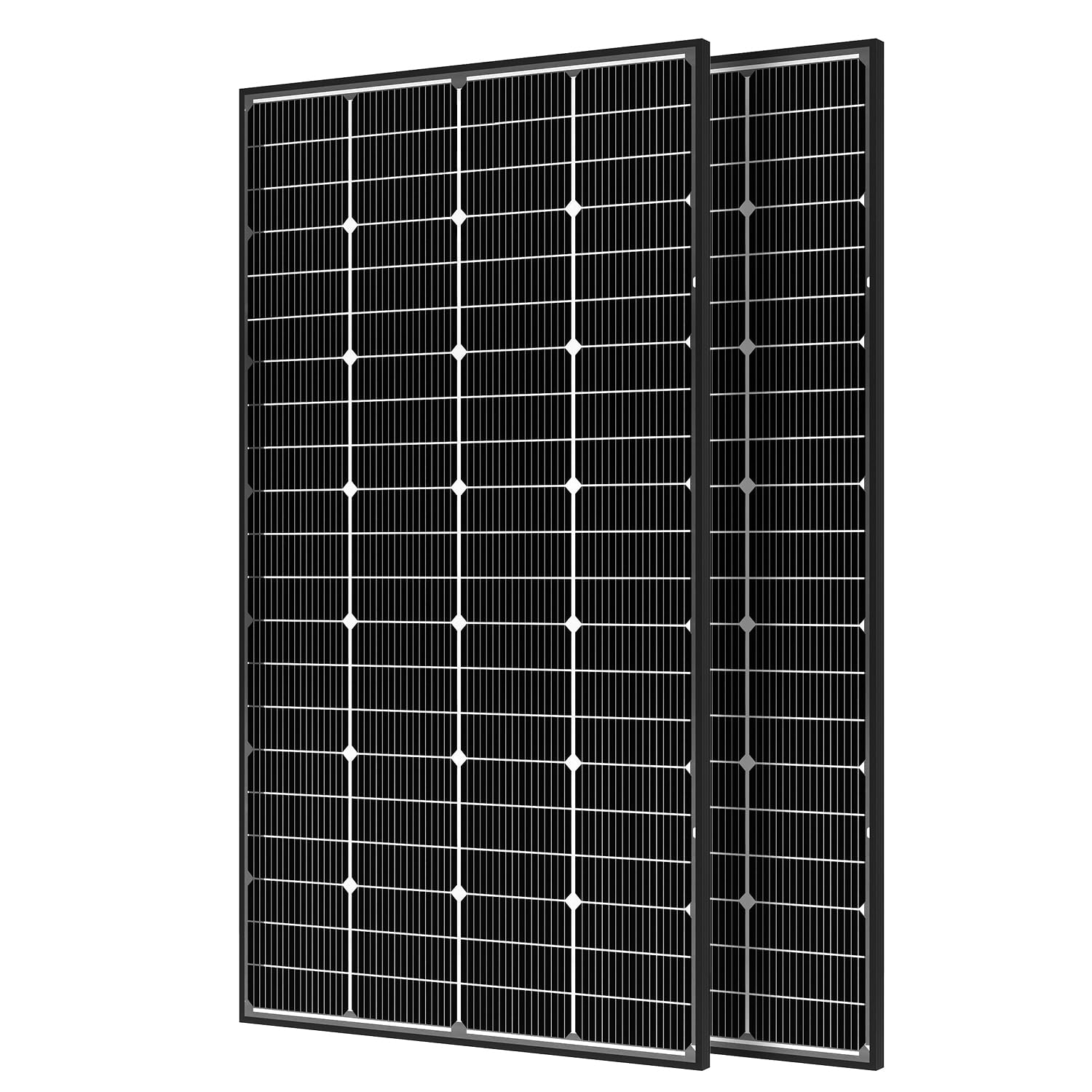
4. JJN 400W Bifacial Solar Panels, 2×200W
Two 200W panels that owners on mobile mounts describe hitting 90% of rated wattage.
The transparent backsheet is what separates this from the Callsun pair — it generates from the rear as well as the front, harvesting light bouncing off a white roof, gravel or water. In real rooftop use that shows up as output above the rating: owners mention pulling over 380 watts per panel on a mobile mount. That is about 90% of the 400-watt rating per panel, which tells you these panels reach their number in real sun.
They connect with MC4 connectors (the standard solar plug type) and use a black corrosion-resistant aluminum frame rated for 2400 Pa wind and 5400 Pa snow load. A 9.12A operating current gives a bit more headroom than the Callsun’s 8.43A, and the IP67 connectors plus IP65 junction box handle rain and low-pressure spray. Weighing 24.3 lbs each, they are light enough for one person to walk up a ladder with one.
The one wrinkle left in the data is a rare failure report of a single panel shorting, plus a note that the package ships panels only — you supply mounting and controller. Treat that as a warranty-and-test step: check each panel’s output before you bolt it down, and the 10-year workmanship and 30-year output warranty have you covered if a unit is bad.
Why it earns its place
- Bifacial rear-side harvesting pushes output toward the rated 400 watts in bright reflective settings.
- Grade A+ monocrystalline cells with 16BB busbars and a 182mm full-soldering process.
- 2400 Pa wind and 5400 Pa snow ratings cover destructive weather in exposed locations.
- Drain clip included for water runoff at the frame edge.
What to plan around
- Panels only — no controller, brackets or cable in the box.
- Bifacial gains need a reflective mounting surface to show up at all.
- Packaging suffers in transit occasionally, so inspect on arrival.
Who this fits: A builder mounting onto a white membrane roof or over gravel who wants back-side gain to count toward the total.
The limiting factor: Without a reflective surface behind the panel, that rear-side advantage largely vanishes.
5. ECO-WORTHY 200W 12V Complete Solar Panel Starter Kit
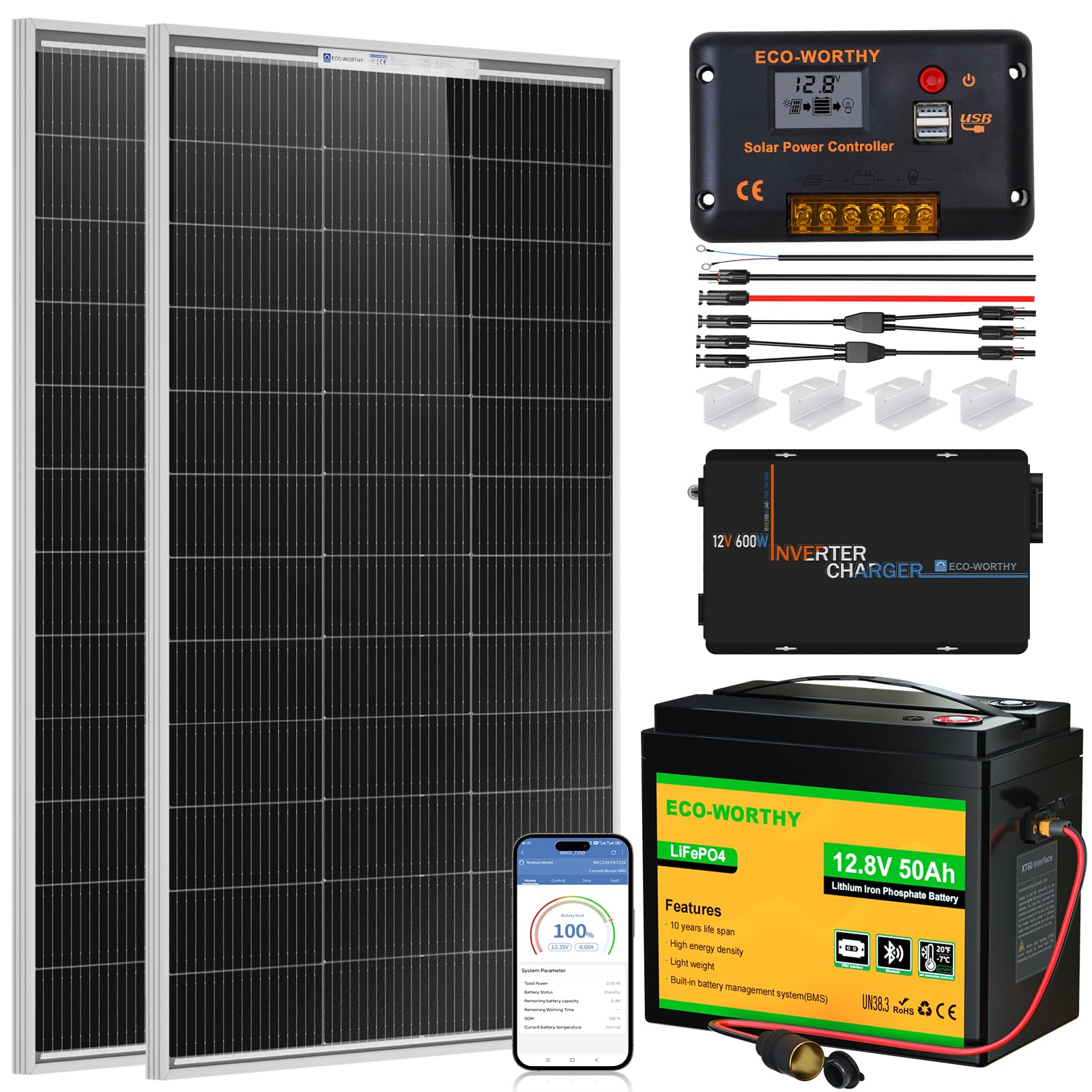
One box with panels, battery, charger and inverter — the shortest path to your first kilowatt-hour.
This is the only pick here that ships with the whole chain: two 100W N-type panels, a 12V 50Ah LiFePO4 battery, a 30A PWM charge controller, a 600W pure sine wave inverter and mounting brackets. If you have never touched DC wiring, that matters more than efficiency figures.
The 50Ah LiFePO4 battery is the standout: 4,000 to 15,000 recharge cycles versus the 300 to 400 a lead-acid manages. The inverter integrates UPS auto-switch at 20ms and accepts 5A-40A adjustable current from an app or the buttons. That makes this an honest beginner platform, and the starter-kit quality is what draws the strongest praise, with the panels and mounting hardware all present on arrival.
The honest caveat is the inverter (the box that turns panel power into household AC) — that is the one component flagged for early failure, and it carries the shortest warranty of the set (battery 3 years, the rest 1 year). If you plan to run a fridge and freezer, size up beyond this kit’s 200W of panels. It is expandable, though: owners describe bolting on more panels and more batteries as they learn.
The trade-off, sized: The controller is PWM rather than MPPT, so it is simpler and cheaper but squeezes less out of the same sun. A fair first-kit compromise, not a flaw.
Instruction quality: The manual leaves some owners doing internet searches for polarity, so plan a little research time on install day.
Best suited to: A first-time off-grid buyer who wants a working system with one order and one install weekend.
Not your fit if: You already own a charge controller and battery — this whole kit would be redundant.
6. Renogy 400W Solar Kit

Four panels plus the charge controller type that most solar installers reach for first.
The letter string to pay attention to here is MPPT — maximum power point tracking, a controller that constantly hunts for the best voltage to pull from the panels. That is meaningfully more efficient than a basic PWM controller, especially when the sun angle is low or the panels get hot. Combine the 40A MPPT Rover with four 100W monocrystalline panels and a Bluetooth module and you have a kit built to be upgraded rather than outgrown.
Panels are MC4-typed, dimensions are 41.8 × 20.9 × 1.38 inches each, and the full kit weighs 56.4 pounds across four panels. Z-brackets, adaptor kit, tray cable and a fuse are included — the “everything you need” packaging shows up repeatedly, and the controller’s Bluetooth module lets the app show you live production numbers without a separate meter.
The recurring gripe is the wiring run — the short 8-foot cable from controller to battery is not enough for many mounting layouts, so plan a cable extension. The app is functional but not polished, which is a small price for the production data it shows. And a mounted controller inside a van or cabin is a box the size of a small radio, so pick an interior wall that has room.
What the MPPT buys you: Better harvest on hazy mornings, low sun angles and hot days — the situations a PWM controller tends to waste power in.
Worth flagging: The controller’s Bluetooth range inside a metal-sided RV is limited; check the app screen before you mount it deep in a cabinet.
Lean toward this: A builder who plans to expand and wants MPPT efficiency, a proper controller and one box of matched accessories.
Skip if: You are chasing the absolute lowest cost per watt and already own an MPPT controller — you can assemble the parts yourself.
7. ECOBOSS 1200W Solar Panels, 6×200W N-Type
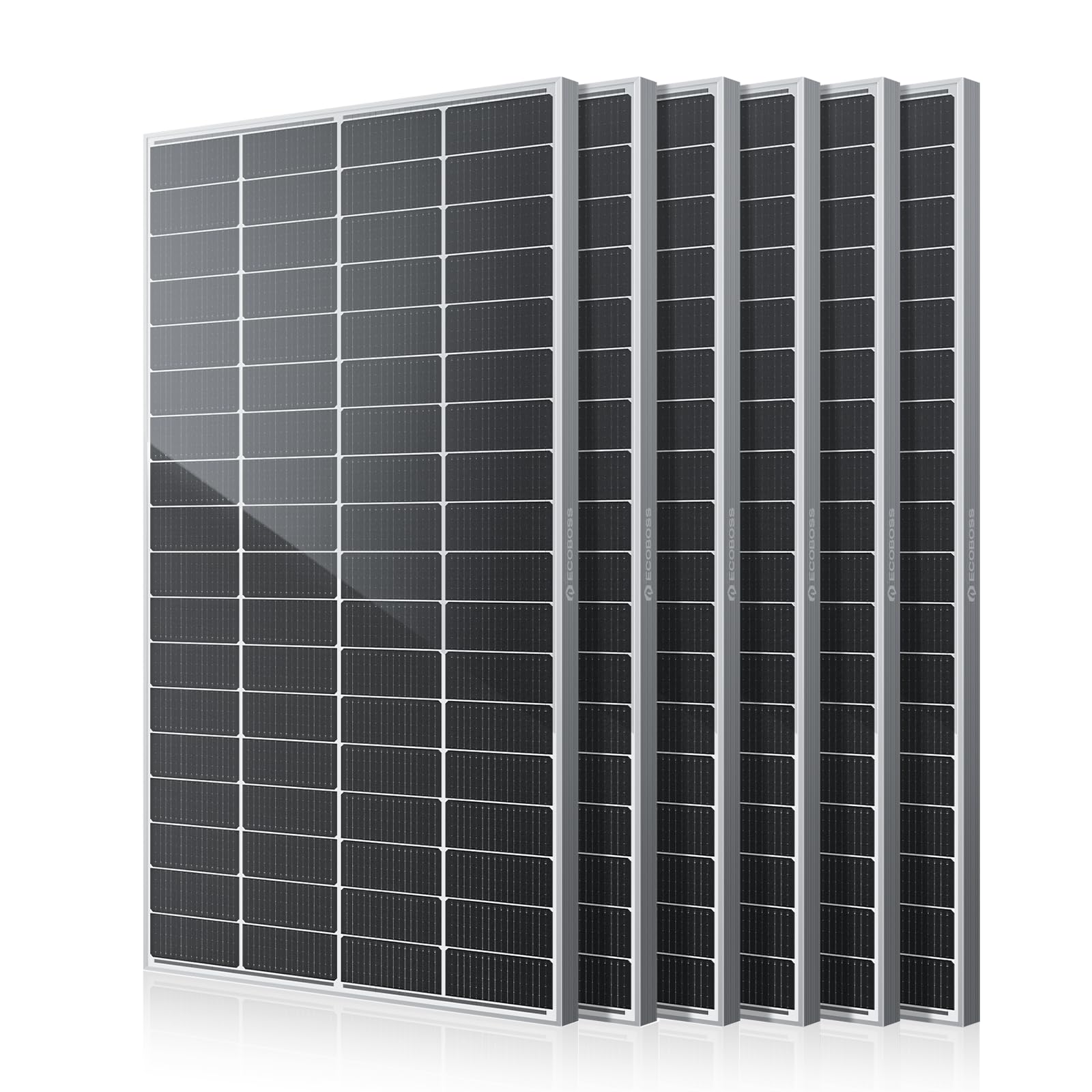
Six high-efficiency panels in one order — a full array build without hunting for a matching second batch.
The whole point here is the count: six 200W panels, 25.6% efficiency each, 16BB busbars and 182mm Grade A+ cells. Ordering six at once takes away the matching problem — every panel has the same cells and specs, so series and parallel mixes behave predictably. If you are scaling a shed roof or a ground-mount array to 24V or 48V, matching matters.
Specs to anchor on: 10.32A operating current, 23.06V maximum voltage, IP68 protection, 2400Pa wind and 5400Pa snow load. Bypass diodes are fitted for shade, and pre-drilled mounting holes and standard MC4 connectors mean no cutting. 3.2mm low-iron tempered glass is the top layer on every panel.
This is a new listing on the review front — the rating is high but the sample size is still small, so read the listing specs as the honest guide rather than owner history. Manufacturer support is stated as 10 years technical and up to 30 years of service life, but no long-term owner track record exists yet. Buy six because the spec sheet fits your system, not because aftermarket feedback confirms the lifespan.
Where it delivers
- Six matched 200W panels in a single order, all built to the same spec.
- 25.6% efficiency with Grade A+ N-type cells — an above-average figure for the size class.
- IP68, 2400Pa wind and 5400Pa snow all rated for exposed, off-grid installs.
- Pre-drilled holes and MC4 connectors make install quick without custom cuts.
Before you commit
- New listing — no long-term owner track record to lean on for lifespan.
- Ships as panels only; controller, brackets and cable are extra purchases.
- Six 200W panels take a lot of footprint — measure your roof before ordering.
Fits best: A builder scaling a shed, cabin or ground mount who wants a matched six-panel set in one delivery.
Wait if: You need proof of long-term field performance before committing — this is a recent listing.
8. Renogy Solar Panels 1280W N-Type 18BB

The industrial-grade four-pack for a whole rooftop or ranch build where you plan in kilowatts.
More ribbons across each cell means lower internal resistance and a gentler response to hot spots in harsh weather. Each panel is rated 320 watts, and pairs up to 640 watts total — Renogy rates the four-panel set at roughly 3200Wh of daily output, with each 320W panel giving a 20-watt edge over a standard 300W unit.
These go onto rooftops, cabins and yachts with pre-drilled holes, and compatibility is broad: Renogy’s ground mount, Z-bracket, corner bracket, pole mount and tilt mount all fit. IP68 rating and a 25% cell efficiency hold through hot and cold extremes. The listing also notes the federal solar tax credit, which is worth investigating if the install is on a home rather than a vehicle.
Two friction points to know: weight and shipping. Each panel is heavy enough that the full set runs 144 pounds, so you will want two people on a roof lift. And this is the pick most likely to arrive damaged — broken glass and bent frames show up in the review record, which is a shipping and packaging matter rather than a panel defect. Unbox and inspect on the pallet before signing for it.
what separates it: it holds up to hail better, thanks to 18 busbars (thin metal strips that carry current off each cell) and multi-layer sheet lamination that protect cells from physical distortion — a build detail you feel on a roof that sees hail.
The honest limit: Value lands mixed here — the cost per watt is premium, so only chase this if the mounting ecosystem and 18BB build matter for your roof.
For you: A permanent rooftop install on a home, cabin or outbuilding where you want the Renogy mounting ecosystem and one supplier.
Look past it: If you are mounting on a vehicle that moves — the weight and four-panel footprint suit a fixed structure.
9. JJN UL61730 1180W Solar Panel 48V, 2×590W
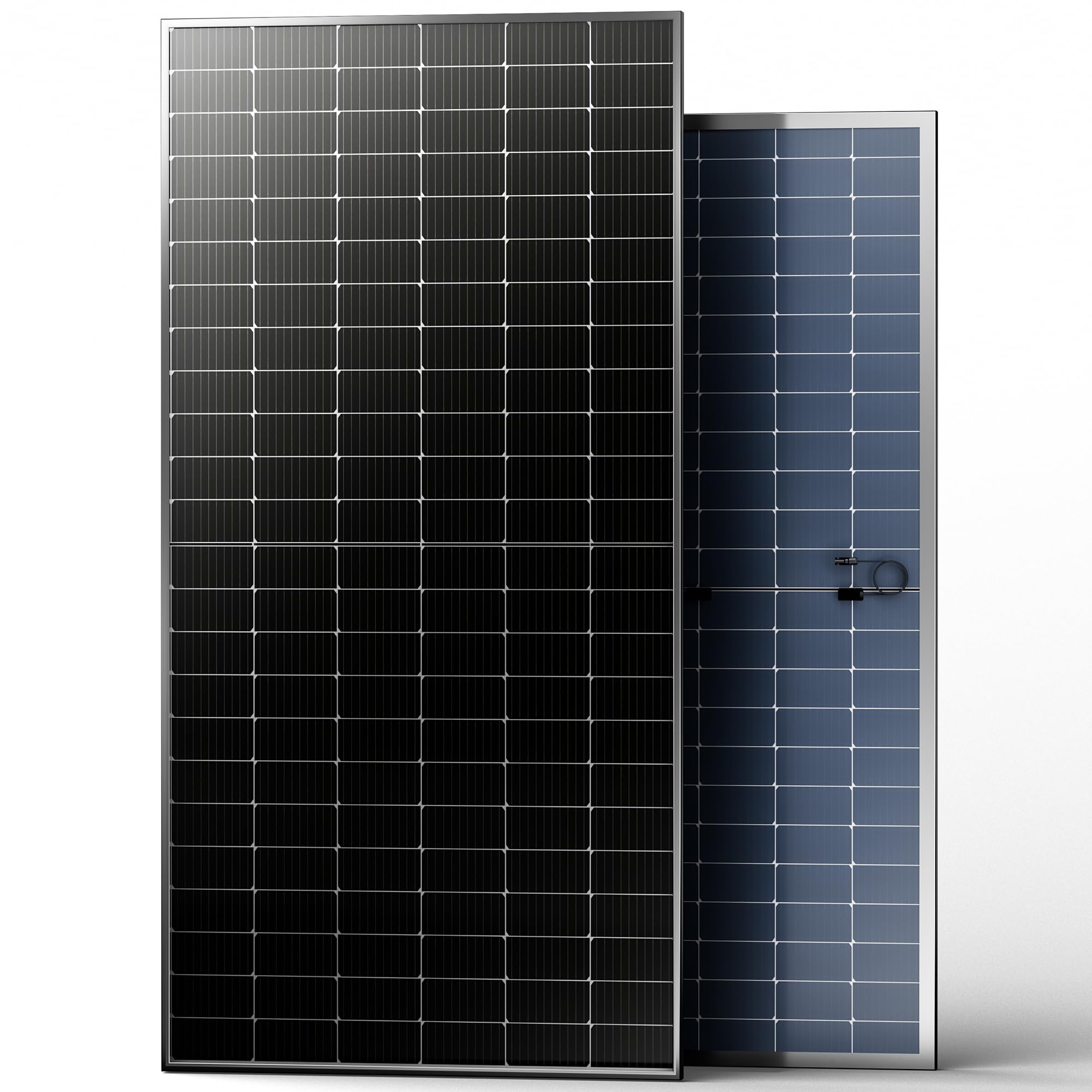
Two enormous panels that each cover more floor than a dining table and pump out 590 watts.
These are not van panels. Each measures 89.61 × 44.65 × 1.38 inches and weighs 123.4 pounds for the pair, which puts them squarely in ground-mount or large-roof territory. The upside is raw output: 1180 watts from two panels, 21.2W per square foot, UL 61730 certified for electrical safety and Class A fire-rated. That is the certification set many code jurisdictions look for on a permanent install.
The transparent backsheet captures reflected light, and JJN claims up to 35% more total energy in the right mount, with rear-side output reaching 206W. A low temperature coefficient of -0.29%/°C keeps the panels producing on hot days, and the 25-year performance target stays at 87.5% output. Four drainage clips come in the box with a user manual.
The trade-off to weigh is durability. Review reports split between panels holding up fine over time and some failing, so factor the 10-year manufacturer warranty into your risk and inspect the glass on arrival. The 2mm dual-layer glass resists hail better than thin panels but a big flat panel is a big flat target. At 14A current, standard MC4 connectors and pre-drilled holes still mean an easy install — it is the lifting that takes two people.
The case in one line
- 1180 watts from two panels — the most power per shipment on this list.
- UL 61730 and Class A fire rating help with code compliance on a permanent build.
- Bifacial rear-side output claimed up to 206W on reflective ground.
- -0.29%/°C temperature coefficient holds output better in summer heat.
Before you buy big
- 123.4 pounds for the pair — this is a two-person lift or a hoist job.
- 89.61 × 44.65 inches per panel needs serious real estate.
- Durability reports split — inspect glass and connectors before mounting.
Best for: A ground-mount or large flat-roof array where panel count matters less than total watts per panel.
Not for: Vehicle mounting or buildings that need a light, flexible footprint — these panels are large and heavy.
Know the Specs
Vmp and Voc
Vmp is the voltage a panel delivers when it is connected and working, and Voc is the higher voltage it shows with nothing attached. Your charge controller must withstand the Voc figure, not the Vmp figure, because a cold morning can spike the open-circuit voltage above the loaded number.
Bifacial Gain
A bifacial panel has a transparent backsheet that catches light bouncing off a bright surface underneath — white membrane, gravel, sand or water. Without a reflective surface behind it, the rear side adds nothing meaningful, so match this feature to your mount.
Busbar Count
The busbar is the thin metal ribbon that carries current across each cell. Panels with 16 or 18 busbars spread current more evenly and lower the risk of hot spots and microcracks, which is why the count has crept up from 9BB and 10BB designs.
MPPT vs PWM Controllers
MPPT (maximum power point tracking) controllers constantly adjust the voltage they draw to pull the most from the panels. PWM controllers are simpler and cheaper, but waste more power when the sun is weak or the panels are hot.
Temperature Coefficient
A figure like -0.30%/K means how much output you lose for each degree the panel heats above its test temperature. Lower numbers mean less summer loss. On a hot roof, a good coefficient can be the difference between a panel near its rating and one far below.
IP Ratings
IP65 and IP68 indicate dust and water protection for the junction box and connectors. The higher the second digit, the more water pressure the part tolerates. For a roof or vehicle mount, IP68 on the junction box is a sensible minimum.
Common Questions
Can I wire two 200W panels straight into my portable power station?
Will a solar panel still charge in partial shade?
What is the difference between moncrystalline and N-type cells?
How many panels do I need to match my battery capacity?
Do bifacial solar panels actually make more power?
Can I install solar panels on an RV or van without a professional?
What does the IP rating on a solar panel mean?
How long do solar panels last, and what warranty should I expect?
Do I need an MPPT controller for a 400W system?
What tools do I need to self install a solar setup?
The Bottom Line
For most builds, the self install solar panels pick is the Callsun 2×200W N-Type Bifacial: it packs 400 watts into two panels at 25.6% efficiency, with a twin-module anti-shade design that suits a van or cabin roof. If you want a matched whole-roof array and can handle the weight, the Renogy 1280W 18BB set gives you four panels with a 2400 Pa wind and 5400 Pa snow load. And if you have never wired DC (direct current) before, the ECO-WORTHY 200W starter kit puts the controller, battery and inverter in one box so you can build confidence before you expand. The Callsun pair holds 4.5+ stars across 500+ owners, a fair sign the anti-shade claim holds up on real rooftops.
How we choose
We do not accept paid placement. Every pick is matched to a real buyer and a real use-case; we do not hands-on test units.
Sources
Specifications: manufacturer listings and product documentation. Review insights: verified customer reviews, as of November 2026. Pricing: not shown on this page (it changes often); check the current price via the retailer link.
As an Amazon Associate, Tactical Gear Guy earns from qualifying purchases. This does not affect which products we feature.