Specs are compiled from manufacturer listings and verified buyer reviews and can change over time — please confirm the key details on the product page before buying.
If your crosscuts drift a degree off square and your picture frames never quite close at the corners, the weak link is usually the stamped gauge that came with your saw. A good miter sled or gauge locks your workpiece to the blade at a repeatable angle, so the cut you set is the cut you get — every single time. One note before you shop: this list uses flexible, human-like matching for designed-to-fit-a-miter-slot compatibility, so not every pick here is the exact model or size you typed into the search bar. The nearest same-type gauge that serves the same purpose is included instead, so you are never misled about what you are buying.
This guide is built by comparing the manufacturers’ published specifications and the patterns across verified customer reviews, so you get each pick’s real strengths and trade-offs instead of marketing spin.
You will see what separates a hobby-grade slider from a machined gauge, which fences extend far enough for wide panels, and how to match a bar to your own slot. Below is an honest shortlist of the table saw miter sled options worth your bench space.
Top Picks


How To Choose The Best Table Saw Miter Sled
Your first question is not which gauge is fanciest — it is which one physically slides into your saw. Get that wrong and the best-machined tool in the world just sits on a shelf. Everything else follows from there: how wide a board you need to crosscut, how precise your angles must be, and if you want a gauge that rides the slot or a full sled that carries the workpiece past the blade.
Match the bar to your miter slot first
Most cabinet and contractor saws use a standard 3/4-inch by 3/8-inch slot (the groove your gauge rides in), and several gauges here state that spec outright, including the WEN WA1401. The small GOINGMAKE 0122B ships with a 12-inch miter slide bar and adjustable rings to tighten the fit. A sled is a different animal entirely — the Original Dubby needs a slot that is 3/4-inch wide by 3/8-inch deep, at least 27 inches of table depth front to back, and a slot set 4 to 5-3/4 inches from the blade. Measure your saw before you order, because a jobsite-style saw often will not take a full sled.
Count the stops, then check their spacing
Positive stops are preset notches that click the gauge into a known angle so you are not squinting at a scale. The count varies a lot across this list: the small GOINGMAKE gauge has 11, the WEN and POWERTEC units carry 27, the O’SKOOL extension model has 27, and the INCRA Miter1000/HD has 180 with 1-degree spacing. More stops means faster setup at the angles you use most, but the real prize is a stop that locks without slop.
Decide how much fence you actually need
A fence gives the board a straight edge to register against, and its length sets your maximum crosscut width. Fixed small fences suit portable saws, while telescoping designs stretch to handle wider stock — the INCRA MITER1000SE runs 18 to 31 inches and the O’SKOOL PTA026 extends 22 to 36 inches. If you mostly trim narrow rail stock, a compact fence is easier to manage; if you build cabinets, reach for the longer extension.
Side-by-Side Comparison
| Model | Best For | Angle Stops | Fence Length | Weight | Amazon |
|---|---|---|---|---|---|
| INCRA MITER1000SE★ Best Overall | Precision crosscuts and repeat work | 41 V-stops | 18–31 in telescoping | 8.3 lb | Amazon |
| GOINGMAKE 0122BCompact Pick | Compact and portable saws | 11 | 12–21 in extendable | 2.66 lb | Amazon |
| WEN WA1401Best Value | Steel-and-brass value across tools | 27 | — | — | Amazon |
| POWERTEC 71391 | Complete 3-piece fence kit | 27 | 24 in (3 in wide) | 5.8 lb | Amazon |
| O’SKOOL PTA026 | Wide panel support | 27 | 22–36 in extension | 5.06 lb | Amazon |
| Dubby Jr. Sled | Compact crosscut sled | — | Adjustable fence | 4.01 kg | Amazon |
| Kreg KMS7102 | Professional shop gauge | — | 24 in | 6 lb | Amazon |
| INCRA Miter1000/HD | Fine micro-adjust angles | 180 (1° spacing) | 18–31 in telescoping | 7.7 lb | Amazon |
| Original Dubby Sled | Large panels and tiny pieces | Shape scale (4–16 sides) | Crosscuts to 24 x 52 in | 3.5 lb | Amazon |
Detailed Reviews
1. INCRA MITER1000SE Miter Gauge
Our pick — 4.5+★ from 800+ verified ratings; the strongest balance of quality and price.
A 41-stop machined gauge with a GlideLOCK bar that replaces your stock slider for dead-on crosscuts.
If you want one gauge that handles trim, frames, and repeat parts without you re-measuring every piece, this is the pick. It packs 41 laser-cut V-stops — the preset notches that click the gauge into common angles — for accuracy at all the popular settings. An engraved stainless steel primary scale gives you a readable reference point so you can dial an angle and trust it. The 18- to 31-inch telescoping incremental fence stretches to support wide stock, then slides back down for narrow work. It is the crowd favorite here too, holding 4.5+ stars across 800+ ratings — the highest of any pick on this list.
The signature part is the patented GlideLOCK miter bar with 6 expansion points. Those are adjustable pucks that push outward to fill the slack in your saw’s slot, so the bar runs tight and repeats the same angle cut after cut. It weighs 8.3 pounds, which is the sort of mass that keeps the gauge planted instead of chattering. The dual flip shop stop — an adjustable stop block that sets the exact cut length — means you can batch out identical pieces without touching a tape measure. As owners describe it, one disciplined setup session of 15 to 20 minutes is what buys you accurate cuts for a very long time.
Here is the comparison that puts it in perspective: against the small GOINGMAKE gauge, this INCRA carries 41 stops versus 11, weighs 8.3 pounds versus 2.66 pounds, and its fence spans 18 to 31 inches versus 12 to 21 inches. All three numbers point the same way — this is the far more capable, far more substantial tool. The honest catch is that it demands a real calibration session before its precision shows up. The adjustability that makes it so tunable is also the thing owners have to dial in carefully; it rewards patience and punishes a rushed install.
What earns it the top slot
- 41 V-stops give you accurate preset angles across the popular range.
- GlideLOCK bar with 6 expansion points removes slot play for repeatable cuts.
- 18- to 31-inch telescoping fence handles both narrow and wide stock.
- Solid 8.3-pound build stays stable through the cut.
Where it asks more of you
- Plenty of adjustment means a real setup session is required up front.
- It is the heaviest gauge in this group at 8.3 pounds, so it is a fixed-bench tool.
Built for: the woodworker who wants one gauge to set and trust for frames, trim, and batch crosscuts.
Think twice if: you want a plug-and-play slider you never have to calibrate — the tuning is part of the deal.
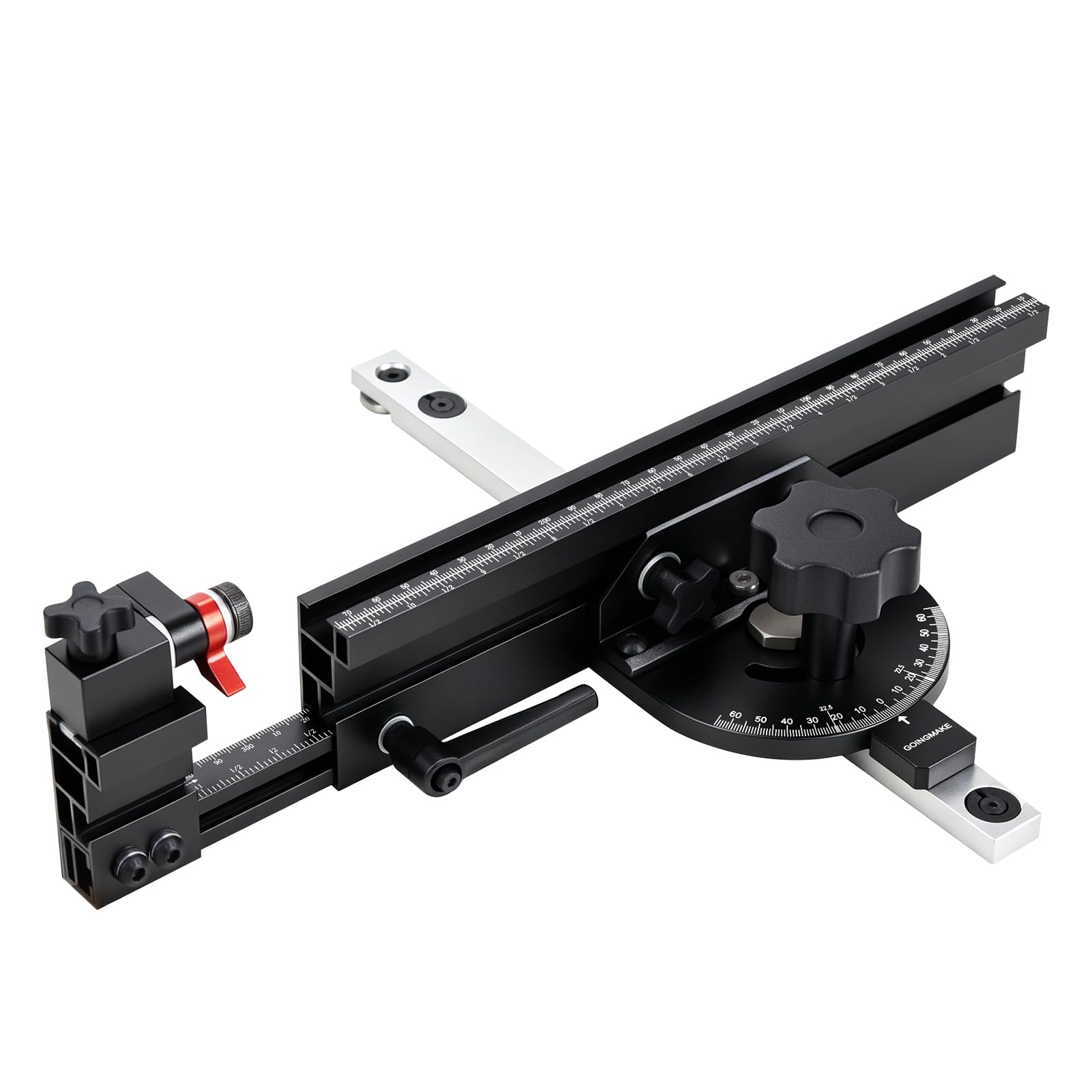
2. Small Table Saw Miter Gauge
A 2.66-pound slider with a 12-to-21-inch fence built for compact and jobsite saws.
Here is the number that decides it: 2.66 pounds. That is what the GOINGMAKE 0122B weighs, and it is the reason this gauge suits a compact jobsite or benchtop saw instead of a fixed shop bench. The 12-to-21-inch extendable fence gives you a range that grows with the board, and clear laser-engraved scales in both millimetre and inch let you read a setting without hunting for a ruler. You get 11 positive angle stops, with the presets covering 90°, 60°, 45°, 30°, 22.5°, and 15° so square and common miter cuts are a click away.
The compatibility side is spelled out plainly. It fits most saws with a standard 3/8-inch by 3/4-inch T-slot or U-slot, and it comes with a 12-inch long miter slide bar. Adjustable rings let you snug that bar to your specific slot so there is no play — the gauge glides smooth instead of wiggling. An engineering plastic locking handle pins the angle, and a multifunctional flip stop lets you set a repeat cut length right on the fence. That flip stop is also easy to zero-calibrate, so you can skip the tape measure on repeat work.
The trade-off to size up: this gauge is genuinely small by design, and the listing says so outright. Its 11 stops and 12-to-21-inch fence trail the 41 stops and 18-to-31-inch reach of the INCRA above. If you crosscut full cabinet panels every day, you will want the longer tool. If you break down trim and rail stock on a saw you move around, the light build is the whole point.
Reach for this if: your saw is a compact or portable model and you want a slider that answers to a standard 3/4-inch by 3/8-inch slot.
Look elsewhere if: your crosscuts run to wide cabinet panels that need a longer fence.
3. WEN WA1401 Miter Gauge
An alloy steel and brass gauge with 27 stops that fits any standard 3/4-inch by 3/8-inch slot.
Start with the surprise people keep flagging: the feel of the thing. The WA1401 is built from alloy steel and brass, and that combination reads as heavy and solid in the hand — the sort of mass that sits still in a router table or on a band saw the way a flimsy plastic stock gauge never will. It carries 27 positive stops (fixed angle settings that click into place) across a precision-cut miter plate, and it is universal enough to slide into any industry-standard 3/4-inch by 3/8-inch miter slot. That covers the brand’s own BA1411 band saw and the TT0811 and TT1015 table saws, plus the many other tools sharing that slot.
Where it earns its keep is the little hardware most gauges skip. Miter bar expansion discs tighten the fit and push out wobble, the lock knobs are industrial-grade brass, and the scale markings are laser-etched so they resist wear instead of rubbing away. A two-year warranty backs the whole thing. What wins people over above all is the build quality, and owners run this gauge across band saws and portable table saws alike without complaint about the cuts.
The one recurring fit note: there is a lip on the bottom of the plate that has caught on a table saw and kept the gauge from gliding freely into the slot. It is a setup detail, not a defect — check the underside against your slot before you lock down your expectations. 4.5+ stars across 200+ ratings backs the overall read.
Best fit for: the woodworker running the same gauge across a table saw, band saw, and router table on a sensible budget.
Check first if: your saw’s slot has an unusual lip or profile — inspect the plate underside before you count on a smooth glide.
4. POWERTEC 71391 Miter Gauge System
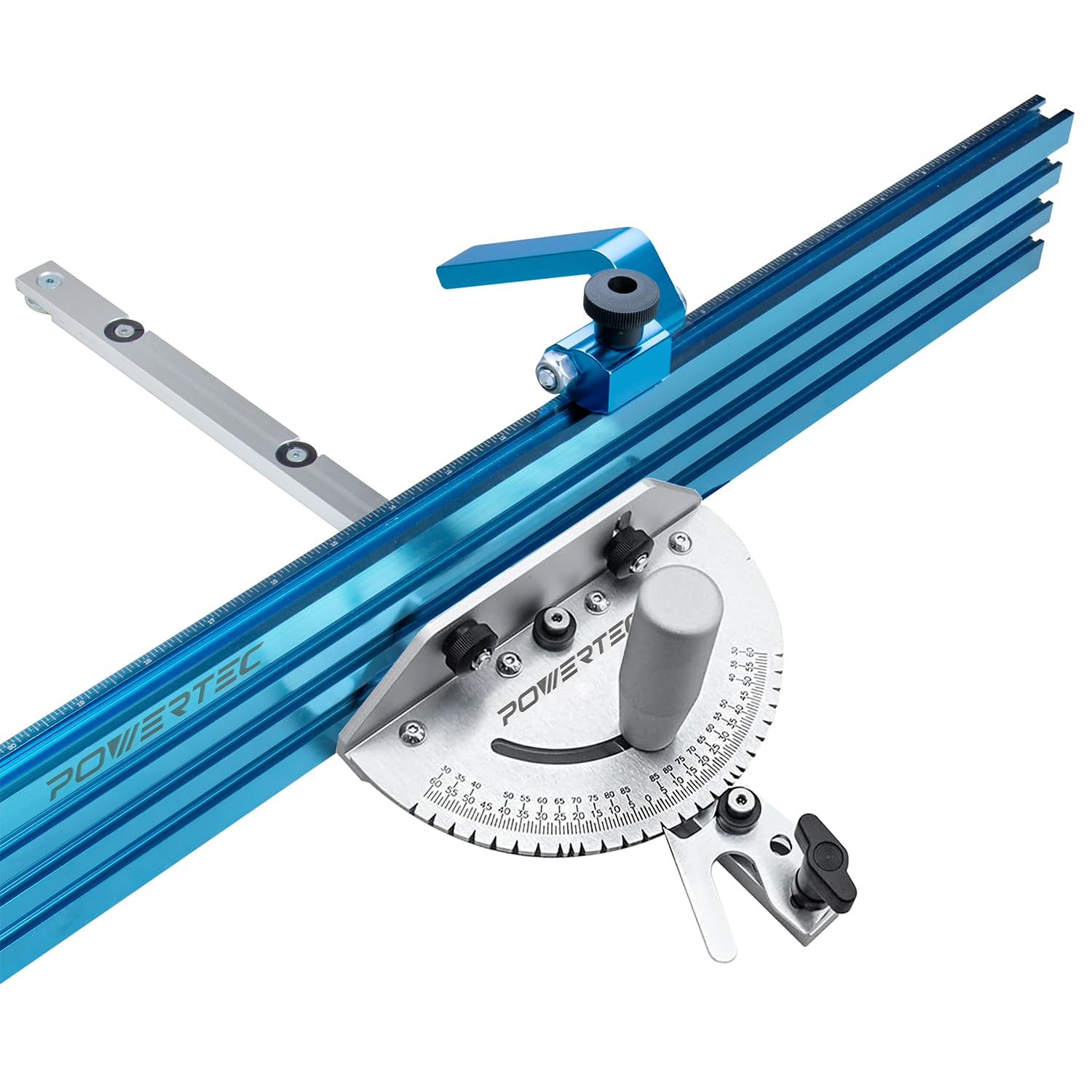
A three-piece kit: 27-stop gauge, 24-inch T-track fence, and flip stop in one order.
This one sells itself on scope. You get three pieces in the kit: the miter gauge, a 24-inch by 3-inch multi-track miter fence with a laser-engraved measuring scale, and a T-track flip stop. That is everything you need to set a length and repeat it, instead of buying a gauge and then chasing down a fence separately. The gauge itself has 27 angle indexing stops with 1-degree step spacing, plus positive stops at 0°, 10°, 22½°, 30°, and 45° and nine others on both the left and right side.
The extruded aluminium fence is the sleeper feature. It accepts 1/4-inch-20 hex bolts, 1/4-inch T-bolts, and 5/16-inch T-bolts along with T-track accessories, so you can bolt on stops and hold-downs as your work grows. The flip stop locks without tools and can swap to either side of the blade. It is a 5.8-pound system, which keeps it steady on the table. The overall build is solidly made and lands at a fair value, and the parts are easy to assemble and put to work.
Two honest caveats come straight from the spec sheet and the shop floor. It will not work with smaller saws or tools that have 5/8-inch miter slots — this is a strict 3/4-inch by 3/8-inch tool. And the rail guide and positive stops can show some play, so plan on spending real time calibrating before the accuracy shows up; the adjustability is genuinely mixed in how easily it settles. Do that calibration and it cuts true.
Why the kit makes sense
- Three pieces in one purchase: gauge, 24-inch fence, and flip stop.
- 27 stops with 1-degree spacing and presets both left and right.
- Aluminium fence takes standard T-bolts and T-track accessories.
- Tool-free flip stop swaps sides of the blade for repeat lengths.
The setup reality
- Will not fit 5/8-inch miter slots or smaller saws.
- Rail guide and stops can have some play that needs dialing out.
The smart buy for: anyone who wants the gauge and fence sorted in one order on a 3/4-inch by 3/8-inch slot.
Skip the guesswork: allow an evening of calibration so the stops lock where you set them.
5. Miter Gauge for Table Saw with 22-36 in Extension Fence
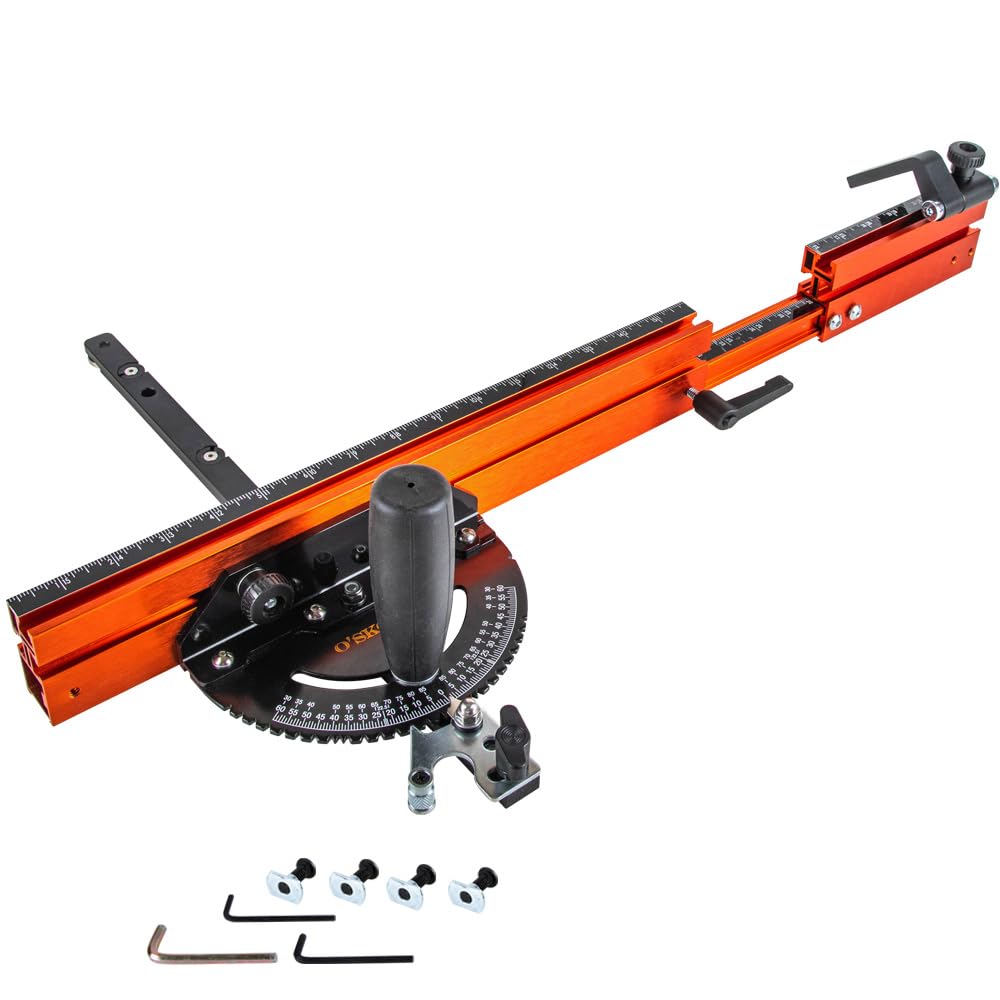
A 22-to-36-inch extension fence that keeps wide panels registered to the blade.
For crosscutting wider stock, fence reach is the whole game, and the O’SKOOL PTA026 goes furthest of the gauge options here — 22 to 36 inches of aluminium extension. More fence under the board means more of the workpiece stays straight against the blade as it moves through, so the cut stays square on panels that would drift on a short fence. It carries 27 positive angle stops set in 5-degree increments from 0° to 60°, plus 22.5°, and the reading index still handles the odd non-preset angle when your project calls for one.
The tuning side is built for precision. Four expansion washers tighten to reduce side clearance (the wiggle between bar and slot) in a compatible 3/4-inch by 3/8-inch miter slot — a direct answer to the loose fit of most stock gauges — and three underside gliding pads help the fence skate across the table. The fence reverses to either side of the blade, and the flip stop can mount left or right too, so it matches whatever layout your bench uses. Assembly comes together easily and the finished fence is well made for the money. What wins people over most is the build, with functionality a close second.
Two things are worth knowing before you buy. The front T-track takes a user-supplied 3/4-inch plywood faceplate for extra registration, and you provide that faceplate material yourself. And durability is the softer spot — the spacers do not hold up to abuse forever, and the fence can knock out of square if it takes a drop or a hard bump. Treat it as a bench tool that earns care, not a jobsite beater.
Opens up for: cabinet and frame work where the widest board needs a long fence to stay true.
Handle with care on: drops and knocks — the spacers and squareness reward gentle handling.
6. Dubby Jr. Table Saw Sled Left Side

A compact sled with an aluminium fence and stop block for repeatable cuts on benchtop saws.
A sled does a different job than a gauge. Instead of a bar in the slot with a fence hanging off it, a sled is a platform that carries the whole workpiece past the blade — and this Dubby Jr. version folds that into a compact kit built for jobsite, contractor, and benchtop saws without eating your bench space. The aluminium fence and stop block give you repeatable cuts for production-style batch work, and a hold-down toggle keeps thinner material pressed flat.
The angle side is where it saves time. A clearly marked scale with pre-labeled shapes lets you dial an angle without running test cuts first, so you skip the scrap-and-check ritual. The patent-pending miter bar rides the slot as the platform moves, and included slick strips keep the run smooth. For small picture frames and trim, the platform registering the material against the fence cuts down on the shimmy that makes tight corners fight you.
Measure before you commit: this sled is not universal. It does not fit Ryobi table saws, and one owner had to drill fresh track holes to line it up with a Metabo portable saw, while another needed modifications for a Kobalt 10-inch saw. It is well made and genuinely functional, but it wants a saw it agrees with from the start.
Right for: a compact or benchtop saw owner who wants sled-style control for small panels and frames.
Not for: Ryobi saws, or anyone who wants a zero-fuss install — verify your model first.
7. Kreg KMS7102 Miter Gauge System
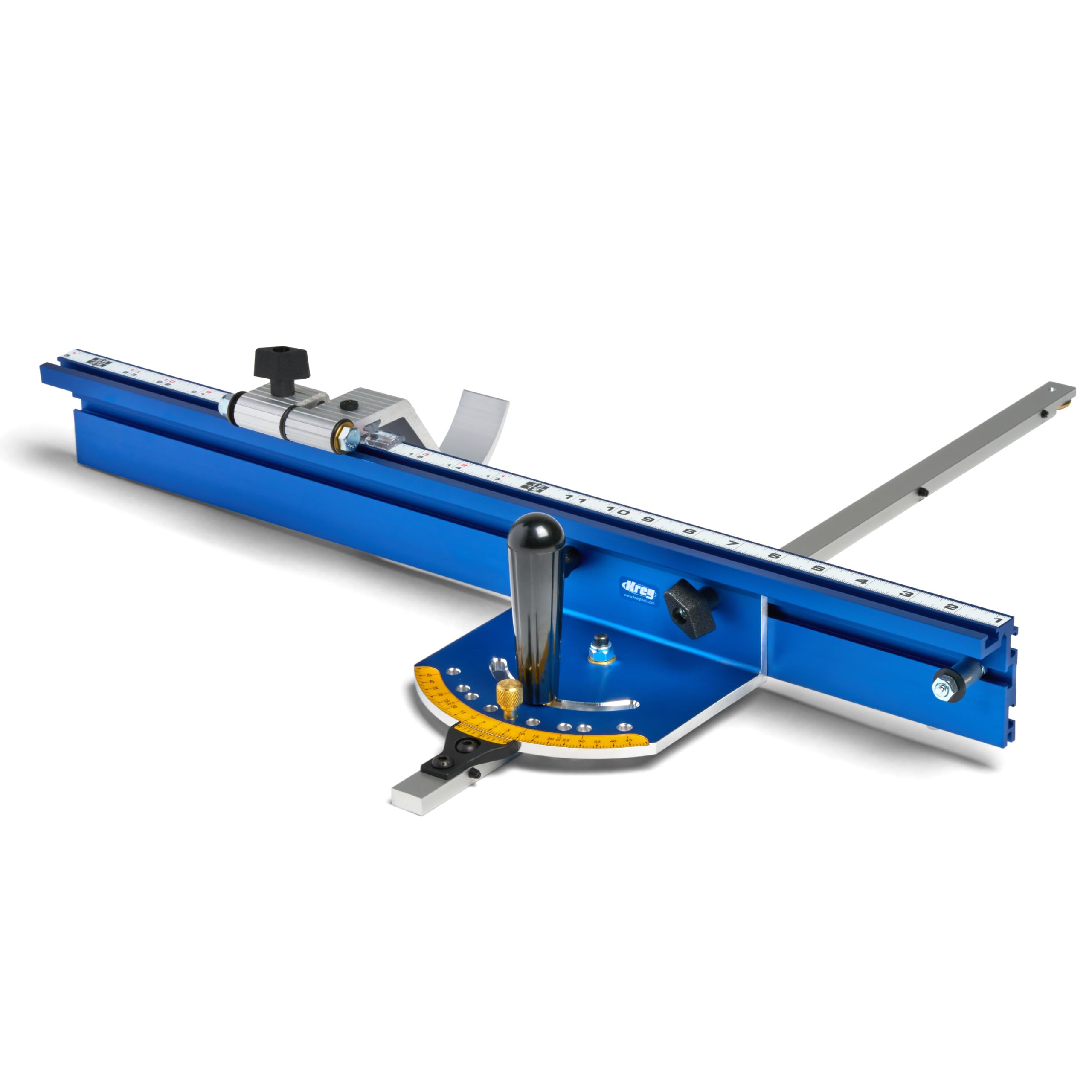
A 24-inch-fence gauge with adjustable angle control for repeatable miter and straight cuts.
Kreg built its name on repeatable jigs, and the KMS7102 leans into that. It runs a 24-inch fence and a 45-degree cutting angle spec, with an adjustable fence engineered for cuts you can set once and hit again. It is a 6-pound unit — lighter than the 8.3-pound INCRA MITER1000SE — yet still planted enough for steady work. Owners run it across both straight and miter cuts, and the machined construction reads as professional-grade, with setup coming together easily.
What makes it worth considering at this level is the sheer volume of people who trust it on their saws. Quality is the thing it is known for, accuracy close behind, and it does the thing every shop wants: it lets you throw the plastic stock gauge away and start cutting miters that actually fit. A DeWalt 744 owner called the result “a miter on steroid,” and a beginner credited it with miters that close up cleanly. For repeat parts, its adjustable fence and easy setup make short work of a batch.
The honest downsides are real but manageable. Getting the nylon set screws dialed in can be fussy, and one unit arrived with shipping damage — an occasional delivery miss, not a design flaw. More to the point, the unit can sit a touch lifted in the slot and wobble on some saws, so check that the bar seats flat before you trust the cut. Value is where opinion splits: some feel it is well worth the money for accurate woodwork, others less so. That is a preference call, and the tool’s performance does the arguing.
The case for the Kreg
- 24-inch adjustable fence sets repeatable cut lengths.
- Professional-grade machined construction with easy assembly.
- Handles straight and miter cuts with accuracy owners trust.
- 6-pound build balances stability against bulk.
Where to watch it
- Nylon set screws take patience to dial in precisely.
- Some saws let the unit ride slightly lifted and wobble.
A fit for: the woodworker who wants a proven, adjustable gauge for everyday miter and straight work.
Worth a check: seat the bar flat in your slot first, and allow time to tune the set screws.
8. INCRA Miter1000/HD Miter Gauge
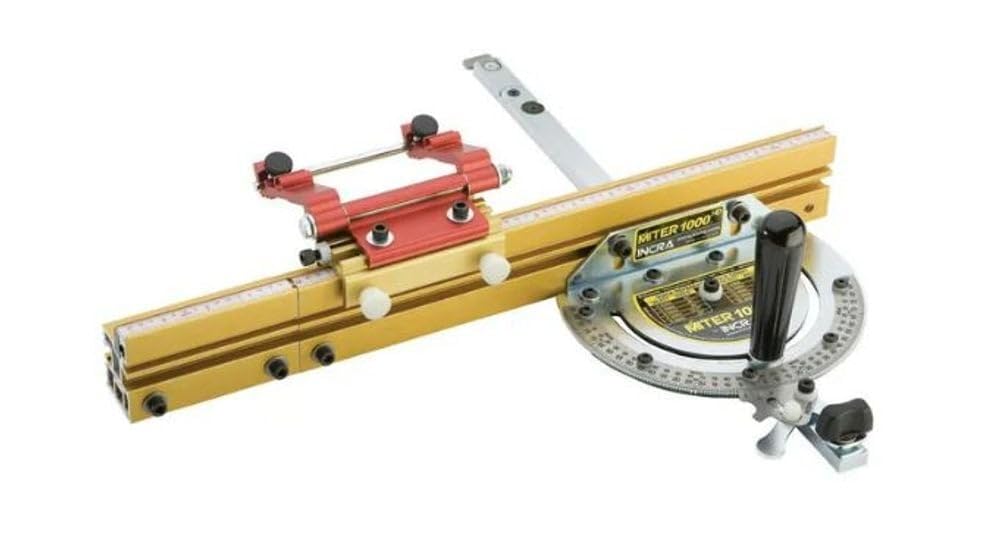
A 180-stop gauge with a 1/10th-degree vernier cursor for exact fractional angles.
If “close enough” never quite satisfies you, start with the reading device. This gauge has a 1/10th-degree vernier cursor — a fine scale that lets you split a degree into ten parts — so oddball angles are a calculated setting rather than a guess. Behind it sit 180 angle LOCK indexing stops with 1-degree step spacing and special stops at ±22-1/2-degree. Those are not just common angles; they cover the whole sweep, so almost any setting you need is a click away, then locked down hard.
The rest of the tool is built to match that intent. It uses the same patented Glide LOCK miter bar expansion disks as the Special Edition above, so it fits a slot tight with no side play. Heavy-duty machined and laser-cut components hold up under frequent use, and a patented incremental Flip Shop Stop sets cut length for repeat parts. The telescoping fence expands from 18-inch to 31-inch overall length, and a removable retaining clip lets you use T-slot miter channels. At 7.7 pounds, it is a settled bench tool. What it is known for is the sheer quality of the manufacturing, with accuracy right behind it.
Setup is friendlier than you might expect from something this precise. Owners slide it into the slot and find it square to the blade without fussing, then dial exact half-degree adjustments when a project needs them. One put it to work on an old Delta Unisaw from 1939 and reported it dead-on once set. That is the whole value here: set it once and it repeats. The one thing to accept is that all those stops and scales cost more machining time than a simple 27-stop gauge — you are paying for the last tenth of a degree.
Choose this when: your work calls for exact fractional degrees and you want a gauge you will never need to replace.
Reasonable to pass if: you only ever cut 0°, 45°, and 90° — a simpler 27-stop gauge covers that for far less fuss.
9. The Original Dubby Cut-Off Sled for Table Saws (Left Side)

The sled that swallows a 24-by-52-inch panel and keeps your fingers clear of the blade.
For sheer capacity, nothing else on this list comes close. The Original Dubby crosscuts panels up to 24 inches wide by 52 inches long, and because the platform carries the panel instead of letting it rest on the saw top, “walking” of the material is all but eliminated. That means square cuts on furniture and cabinet panels without wrestling the board into place. The angle scale is built to skip the math — it has preset lines for any shape from 4 to 16 sides, so a hexagon or octagon frame needs no test cuts.
For small parts, the included hold-down clamp is the standout. It applies 35 pounds of hold-down pressure to pin little pieces in place while your hands stay back, then pivots out of the way when you do not need it. That safety margin is why owners reach for it on tiny cuts, and the build is solid enough to earn trust. For frames and trim, the calibrated scale and careful setup give dead-on miters once the sled is dialed in.
The catch is fit, and it is a firm one. Your saw needs a 3/4-inch wide by 3/8-inch deep miter slot, at least 27 inches of depth front to back, and a slot sitting 4 to 5-3/4 inches from the blade. The listing is clear that it will not work on most jobsite-style saws. Measure your saw before ordering, because a sled that will not seat is a sled that will not cut — and this one is worth the measuring tape ritual.
Where it shines and where it strains: the panel capacity and 35-pound hold-down make it the tool for big panels and tiny parts alike. The trade-off is that it demands those exact slot and depth dimensions, so a jobsite saw will usually rule it out before the first cut.
Made for: the cabinet-and-frame builder with a full-size saw that meets the slot, depth, and blade-distance specs.
Off the table for: jobsite-style saws and any table that falls short of a 27-inch depth.
Know the Specs
Miter Slot Dimensions
The slot is the channel your bar or sled runs in, and its width and depth decide what fits. Most cabinet and contractor saws use a 3/4-inch by 3/8-inch slot, which the WEN, POWERTEC, and INCRA gauges are built around. A sled like the Original Dubby needs the same 3/4-inch by 3/8-inch slot plus at least 27 inches of table depth and a slot 4 to 5-3/4 inches from the blade. Measure before you buy: a gauge built for a 5/8-inch slot or a smaller saw can leave you with a tool that simply will not seat.
Positive Angle Stops
Positive stops are preset notches that click a gauge into a known angle so you are not measuring each time. The count and the spacing both matter. The GOINGMAKE 0122B has 11, the WEN and POWERTEC and O’SKOOL units carry 27, the INCRA MITER1000SE has 41 V-stops, and the INCRA Miter1000/HD runs 180 with 1-degree spacing. More stops and tighter spacing mean faster setup for the angles you cut most, but only if the stop locks without play — a wobbly stop cancels out the count.
Fence Length and Extension
The fence is the straight edge your board registers against, and its length limits how wide a piece you can crosscut. Fixed small fences suit portable saws, while telescoping and extension designs stretch for wider stock — the INCRA MITER1000SE runs 18 to 31 inches and the O’SKOOL PTA026 runs 22 to 36 inches. Longer fences keep more of a wide panel registered to the blade, so the cut stays square as the board moves through.
Expansion Disks and Zero Play
Expansion disks, washers, and adjustable rings are the small fittings that tighten a bar against the sides of the slot to remove side-to-side wobble. The INCRA GlideLOCK bar uses 6 expansion points, the O’SKOOL PTA026 uses four expansion washers, and the WEN WA1401 uses expansion discs. A snug bar glides smooth and repeats an angle, while a loose one drifts. That is why a few minutes spent tuning the fit is often the difference between a cut that is close and a cut that is right.
Common Questions
Will a 3/4-inch by 3/8-inch gauge fit my table saw?
What is the difference between a miter gauge and a crosscut sled?
How many angle stops do I actually need?
Will the Original Dubby sled fit my jobsite table saw?
Why does my miter gauge wobble in the slot?
Can I use a miter gauge on a router table or band saw?
How long does it take to set up a precision miter gauge?
Do I need to supply my own faceplate for the O’SKOOL PTA026?
Is a telescoping fence better than a fixed one?
The Bottom Line
The safest bet for most shops is the INCRA MITER1000SE — 41 V-stops (notched angle stops), a GlideLOCK bar with 6 expansion points, and an 18- to 31-inch telescoping fence put it at the top of the pile, and its 4.5+ star rating is the highest here. If you want a complete gauge-and-fence kit on a tighter budget, grab the WEN WA1401 with its steel-and-brass build and 27 stops. And for cutting wide panels or tiny pieces with a sled, the Original Dubby is the one to reach for — just measure your saw against its slot and depth specs first, because fit is everything here.
How we choose
We do not accept paid placement. Every pick is matched to a real buyer and a real use-case; we do not hands-on test units.
Sources
Specifications: manufacturer listings and product documentation. Review insights: verified customer reviews, as of November 2026. Pricing: not shown on this page (it changes often); check the current price via the retailer link.
As an Amazon Associate, Tactical Gear Guy earns from qualifying purchases. This does not affect which products we feature.