Specs are compiled from manufacturer listings and verified buyer reviews and can change over time — please confirm the key details on the product page before buying.
You want a camera that hands you a real photo, not another file buried in your phone. The trick is matching the film format to the prints you want, so you don’t pay for cartridges your camera can’t use. Every pick below spits out a physical print, and the top one is the Fujifilm Instax Mini EVO, which lets you shoot all day, review the shots, and only print the keepers — the crowd favorite at 4.5+ stars across 600+ ratings.
This guide is built by comparing the manufacturers’ published specifications and the patterns across verified customer reviews, so you get each pick’s real strengths and trade-offs instead of marketing spin.
Some cameras here print pocket-sized prints; one shoots full squares at 1.5x the size of a mini. Others pair a digital screen with a built-in printer so you never waste a frame. Below you’ll find the honest trade-offs on each, laid out so you can pick the old camera that prints pictures that fits how you actually shoot.
Top Picks


How To Choose The Best Old Camera That Prints Pictures
The camera body is the cheap part. The film is where your money keeps going, and the film format decides everything else — print size, cost per shot, and whether the camera you bought can even take the cartridge you grabbed.
Film format comes first, before anything else
Each camera locks you into one film family. Fujifilm’s Instax Mini cameras print the credit-card 2″ x 3″ size, and the Instax Square bodies take square film that comes out 1.5x the size of a mini print. Polaroid’s i-Type and 600 cameras take Polaroid film, while the tiny Polaroid Go takes only Go film — i-Type and 600 will not fit it. Buy the format that matches the prints you actually want to hand out.
The hybrid question: print every shot or only the keepers?
A classic analog instant camera prints the moment you press the shutter, so a bad frame is a wasted frame. A hybrid like the Instax Mini EVO puts a screen on the back, lets you shoot and review, then prints only what you chose — plus it can print photos already sitting on your phone. If you tend to shoot fast and delete later, the hybrid saves real film.
Auto exposure and a selfie mirror do the heavy lifting
Almost every camera here runs automatic exposure, which means the camera reads the light and sets the shot for you — no dials to learn. A front-facing selfie mirror lets you frame your own face instead of guessing. Both matter far more on instant film than any megapixel number, because you cannot fix a dark, blurry print after the fact.
Side-by-Side Comparison
| Model | Best For | Film Format | Print Size | Weight | Amazon |
|---|---|---|---|---|---|
| Fujifilm Instax Mini EVO★ Best Overall | Printing only the keepers | Instax Mini | 2″ x 3″ | 9.92 oz | Amazon |
| Polaroid Now+ 3rd Gen BundleMost Versatile | App control and manual shooting | i-Type & 600 | Full-size Polaroid | 15.9 oz | Amazon |
| Fujifilm Instax Square SQ1Bigger Prints | Bigger square prints | Instax Square | 1.5x a mini print | 390 g | Amazon |
| KODAK Mini Shot 2 Retro | Phone printing on the go | Kodak Instant 2.1 x 3.4 | 2×3″ | — | Amazon |
| Impossible Polaroid 600 Square | Classic one-step feel | Polaroid 600 | Square (600 film) | 1.5 lb | Amazon |
| Polaroid Now (Renewed Premium) | Budget entry to Polaroid film | i-Type & 600 | Full-size Polaroid | 596 g | Amazon |
Detailed Reviews
1. Fujifilm Instax Mini EVO Instant Camera – Brown
Our pick — 4.5+★ from 600+ verified ratings; the strongest balance of quality and price.
The hybrid that lets you shoot all day and print only the shots worth keeping
This is the pick for anyone who has ever burned a whole pack of film on blurry frames. The Mini EVO is a hybrid — a digital camera with a screen on the back and a built-in printer — so you press the shutter as often as you like, look at what you got, then print the winners. It spits out 2″ x 3″ Instax Mini prints, the credit-card size that slides into a wallet or a phone case. The film itself is sold separately, but that control over what you print is the whole reason this sits at the top.
What wins people over is the printability: saving printed images to your phone through the free INSTAX MINI EVO app, then sending pictures from your phone to the camera over Bluetooth and printing them. That flips the usual flow — the camera becomes a printer for the photos already on your phone. Digital image stabilization helps steady handheld shots, and the built-in selfie mirror plus dual shutter buttons (one for portrait, one for landscape) mean you can frame yourself without guessing. There are 10 lens effects and 10 film effects to combine for 100 ways of expression, and a microSD card slot (card not included) lets you store far more shots than the internal memory.
Now the catch, and it’s worth hearing. The recurring gripe is reliability — a rough first pack of film that comes out exposed, a camera that stops turning on. Film cost is the other honest pinch: refills add up, and wasted boxes sting. Image quality and Bluetooth both split opinion too, so expect a few frames that miss. If you want a screen to review shots before they print, this hybrid delivers that control. If you want zero electronics and zero app, a plain analog body suits you better.
Why the control wins
- Shoot freely, then print only the frames you chose — the strongest cure for wasted film
- Prints straight from your phone over Bluetooth through the free Instax Mini Evo app
- 100 lens and film effect combinations for varied looks on one camera
- Weighs 9.92 ounces and measures 3.4 x 4.8 x 1.4 inches, easy to carry all day
What to watch for
- Film is sold separately and refills are pricey
- Electronics bring a reliability risk — some units fail to power on
- You need the microSD card (not included) to store many shots
Reach for this if: you want the freedom of digital shooting with real printed output, and you like the idea of printing phone photos too.
Look elsewhere if: you want a purely mechanical analog camera with no app or screen in the mix.
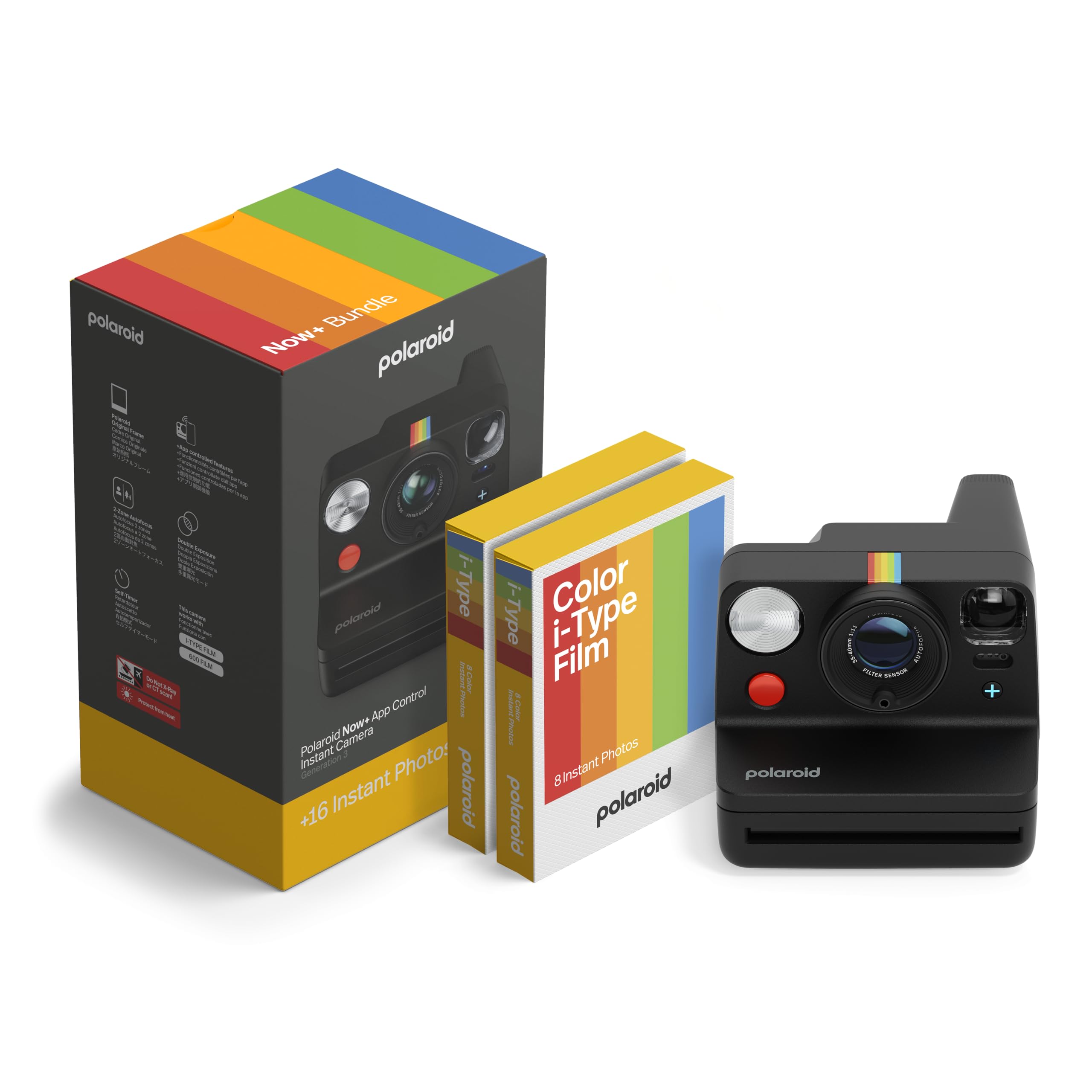
2. Polaroid Now+ 3rd Generation
The app-controlled analog camera that hands you manual mode and a full-size Polaroid
If you want the classic big Polaroid print but you also want to actually control the shot, this is your body. It shoots both i-Type and 600 film, and the output is the full-size Polaroid frame — the large nostalgic look, not a pocket mini. The magic happens when you pair it with the Polaroid app over Bluetooth: manual mode, aperture priority, and remote controls open up features that could not fit on the camera itself. It also does double exposure and self-timer, so you can layer two moments into one frame or get yourself into the picture.
Battery is a real upgrade over disposable cells. The built-in USB-C rechargeable battery is rated to last for over 15 film packs, so you can keep shooting without hunting for batteries. An ISO range of 100-800 covers bright outdoor light down to dim indoor scenes, and a tripod mount plus upgraded autofocus and photo filter compatibility make it the most tweakable camera on this list. The bundle includes the camera plus 16 color photos, so you can start shooting right away.
Here is the honest trade-off. This camera prints every frame the moment you take it — no screen, no veto — so bad shots cost film. It also leans on the app for the advanced modes, which means a phone in the loop. Buyers who want to just point-and-shoot may find a simpler analog body less fuss. For someone who wants to learn instant shooting and play with settings, the Now+ earns its spot as the most versatile pick.
what separates it: app-linked manual mode, aperture priority, and remote control on a camera that still prints full-size Polaroid film — plus a USB-C battery rated for over 15 film packs, so no throwaway batteries.
The honest limit: it prints every single frame with no preview-and-delete safety net, and the advanced controls live behind the Polaroid app.
Pick this one if you want an analog Polaroid that you can actually steer with manual and aperture settings.
Think twice if you want a press-and-print camera with no phone or app involved.
3. Fujifilm Instax Square SQ1
The one that prints bigger squares instead of pocket-size frames
Print size is the whole story here. The SQ1 shoots square format and prints images at 1.5x the size of a mini print, so more of the moment fits in the frame. That larger square is what makes it the pick for someone who wants prints worth framing or pinning up rather than tucking into a wallet.
The grip is a thoughtful touch — a rounded and textured body with a separate thumb grip attachment included — so it’s comfortable to hold steady for that bigger frame, and the camera weighs 390 g. Auto exposure reads the light for bright images, and a selfie mirror plus one-touch selfie mode covers the front-facing shot. It runs on 2 CR2 batteries and takes Instax Square film.
Reliability is the honest caution with this body: some units arrive damaged or stop feeding prints after a few snaps, with the photo getting stuck. Picture quality draws mixed notes too — instant film is not the medium for razor-crisp results. But the thing everyone raves about is the build and finish, and the terracotta orange color is a draw on its own for a lot of buyers. If you want the larger square look and a camera that feels good in the hand, this delivers. Just test it the day it arrives.
Why the size matters most: a square print at 1.5x a mini catches more of the scene, and the textured grip with a thumb attachment keeps the bigger frame steady in your hand.
The real risk: print feeding can stall on a bad unit, so check it works the moment it lands.
The right buy for someone chasing the big square Polaroid look with a grip that feels solid.
Second-guess it if you need rock-solid feed reliability and cannot deal with a return.
4. Fujifilm Instax Mini 12 Instant Camera Lilac Purple Bundle

A camera and a phone printer in one body, with laminated 2×3 prints
Two devices in one: shoot a 2×3 print straight from the camera, or connect your phone over Bluetooth and print the photos you already took. It uses genuine 4PASS dye-sublimation printing — each photo is built in three color layers, then finished with a clear protective lamination — so in about 55 seconds you get a smooth print designed to resist fingerprints, water, and fading. The bundle comes with 38 sheets, photo paper and ink cartridge included, so it prints on day one.
The camera side matters too: 10 MP effective still resolution, a 3:2 aspect ratio, automatic exposure, and a retake-before-printing feature so you can fix a shot on the screen before it commits to paper. That built-in review is the whole appeal of a 2-in-1, and it makes this the pick for someone who keeps an eye on film waste. It fits in a hand, bag, or pocket, so it travels easily for parties, trips, and scrapbook projects.
Two honest limits. The Bluetooth link drops sometimes and the app needs a lot of color adjustment to get a print you’re happy with — the picture quality is not high-end, so do not expect phone-screen crispness. The other is battery: it dies fairly quickly, so bring a battery pack for a long day. Sized against that, the dye-sublimation laminated prints set it apart from ordinary instant film — they hold up better to fingers and water.
The standout spec: 4PASS dye-sublimation printing finishes each 2×3 photo with a clear laminated layer built to resist fingerprints, water, and fading — in about 55 seconds per print.
The honest catch: the Bluetooth connection is fussy and the battery drains quickly, so plan on a power pack and a little patience with the app.
Worth it for people who want to print phone photos and laminated 2×3 keepsakes on the move.
Pass on it if you want true instant film and cannot be bothered with an app and cable.
5. Polaroid 600 Square

The refurbished vintage one-step that brings back the original 600-film experience
This is for the buyer who wants the old-school feel, not a new plastic gadget. It’s a carefully refurbished Polaroid 600 one-step camera, fitted with a new Impossible frog tongue — the part that shields photos as they exit the camera — so prints come out clean. It takes 600-type film, runs automatic exposure, and has a built-in electronic flash for indoor shots. Light sensitivity sits at 640 ISO, and it carries a one-year warranty.
For genuine analog character, this one is the purest choice on the list. It’s also the biggest and heaviest of the group at 7 x 7 x 6 inches and 1.5 pounds — that is 2.1x the size footprint of the pocketable Instax Mini EVO, which measures 3.4 x 4.8 x 1.4 inches. So it’s a shelf piece as much as a carry piece. The trade-off is clear: you get the classic look and a new frog tongue for clean photos, and you accept the bulk and the need to source 600 film.
No screen, no app, no review — every shot is committed the moment you press. That is exactly what some buyers want: a 600-film one-step with no screen, app, or review step. If you want the classic 600-film one-step look and can live with a 1.5-pound body, this is the authentic article.
Go with this if you want a refurbished, warranty-backed Polaroid 600 with the real vintage body and flavor.
Consider a smaller body if pocketability or modern features matter more than the classic one-step feel.
6. Fujifilm Instax Mini 41
The factory-refurbished Polaroid that gets you into full-size instant film for less
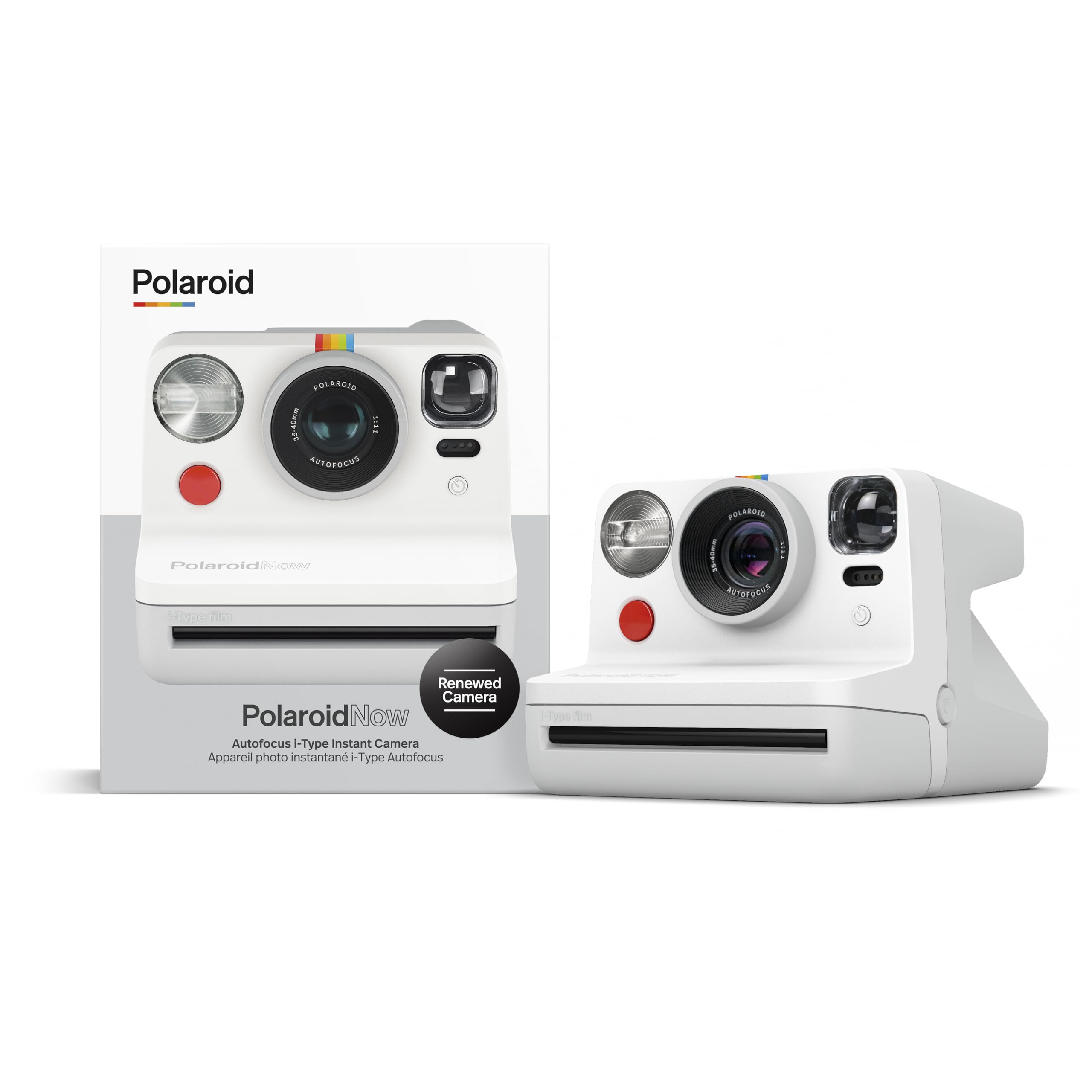
Here’s a way into big Polaroid prints on a budget: a factory-refurbished Now body, which is the cheapest point of entry to the full-size i-Type and 600 film formats on this list. The Now has autofocus, automatic exposure, double exposure, a self-timer, and an accurate flash — so you can layer two frames into one or get yourself into the shot. It is a point-and-shoot analog camera that commits every frame to film the moment you press.
What tends to surprise people is how new a refurbished unit can feel — the recurring sentiment is that you’d assume it was new if not for the small “refurbished” sticker on the box. That’s the appeal of Renewed Premium here: a fully functional Polaroid at the lowest film-format entry point, weighing 596 g and measuring 4.4 x 3.7 x 5.9 inches. It takes both i-Type and 600 film, so your cartridge options are wider than the Go.
The honest cautions: some refurbished units ship that don’t behave like new — the recurring gripe is soft, light, blurry prints — and with no screen you won’t know until the film is spent. Film is expensive here, the same cost pinch that hits every Polaroid body. Buy it as a value route into analog Polaroid printing and size expectations accordingly.
Best entry point for anyone who wants full-size Polaroid prints and double exposure on a budget.
Think hard if you want a guaranteed-new camera or sharp, reliable output on the first try.
Know the Specs
Film format: the one spec you cannot get wrong
Film format is the cartridge family the camera accepts — and it’s fixed. Instax Mini cameras take Mini film and print the 2″ x 3″ card size. Instax Square cameras take square film, which prints at 1.5x the size of a mini. Polaroid’s larger cameras take i-Type and 600 film, while the tiny Go is Go-film only. Buying the wrong cartridge means a camera you cannot feed, so match the format to the prints you actually want.
Print size: what you hand out
Print size determines the sense of the memory. Credit-card 2″ x 3″ mini prints are wallet-size and portable. Full-size Polaroid and the 1.5x-larger square prints give more room to frame a scene, but they cost more film and take a bigger bag. Decide whether the print is going in a wallet or on a wall, then pick the format that matches.
Auto exposure and flash: no dials to learn
Auto exposure means the camera reads the light and sets the shot for you — a huge convenience on instant film because you cannot fix a dark print afterward. A built-in flash covers indoor and low-light shots where the sensor would otherwise underexpose. Both are standard across these cameras; the difference is how well the flash handles a dim room versus a bright day.
Hybrid vs analog: control versus simplicity
Analog bodies print the second you press — no screen, no veto, which is honest and simple but lets bad frames cost film. Hybrids like the Instax Mini EVO and the KODAK Mini Shot 2 Retro add a screen so you shoot, review, and print only the keepers, and they can print phone photos too. Choose analog for the ritual, hybrid for the savings.
Common Questions
Can the Polaroid Go take the same film as a Polaroid Now?
How big are the prints from an Instax Mini versus an Instax Square?
Is a hybrid instant camera worth it over a plain analog one?
How does a dye-sublimation camera like the KODAK Mini Shot 2 print differently?
What does a renewed or refurbished instant camera mean?
Do these instant cameras need batteries, and which kind?
Can I put an Instax Mini film cartridge in a Polaroid camera?
Why do instant prints look soft or grainy?
Which instant camera prints from my phone?
Is a Polaroid Now+ manual mode hard to use for a beginner?
The Bottom Line
Most people buying a camera that prints pictures want the freedom to shoot first and print only the keepers — that is why the Fujifilm Instax Mini EVO takes the top spot. It pairs a screen-and-printer hybrid with 100 lens-and-film effects, prints 2″ x 3″ mini photos, and can print straight from your phone over Bluetooth, so wasted film stops being a worry. If you want full-size Polaroid output and app-linked manual control, the Polaroid Now+ 3rd Gen is the versatile analog pick. And for a gift that arrives ready to shoot with 60 sheets of film, a case, and an album, the Instax Mini 12 bundle is the one to hand over.
Whichever you choose, buy the film format that matches the print size you want, and expect soft, nostalgic output rather than phone-screen sharpness.
How we choose
We do not accept paid placement. Every pick is matched to a real buyer and a real use-case; we do not hands-on test units.
Sources
Specifications: manufacturer listings and product documentation. Review insights: verified customer reviews, as of November 2026. Pricing: not shown on this page (it changes often); check the current price via the retailer link.
As an Amazon Associate, Tactical Gear Guy earns from qualifying purchases. This does not affect which products we feature.