Specs are compiled from manufacturer listings and verified buyer reviews and can change over time — please confirm the key details on the product page before buying.
Your back and your row spacing decide which small tiller you buy, not raw digging power. You need a machine that slips between two rows of tomatoes, lifts without straining you, and still breaks up packed dirt into plantable soil. Nine compact battery-powered tillers are lined up here on the things that actually settle it: tilling width (how wide a strip it churns in one pass), tilling depth (how far down the tines dig), battery capacity, weight, and the problems owners hit after a season or two. Want the short answer? Jump to the top pick. Then work down through the budget and premium tiers to see where extra money changes the job.
This guide is built by comparing the manufacturers’ published specifications and the patterns across verified customer reviews, so you get each pick’s real strengths and trade-offs instead of marketing spin.
Most buyers get this wrong by chasing raw power and ending up with a machine too wide for their beds. Below you’ll find the smallest garden tiller options ranked by how they handle tight space, packed clay, and a battery that has to outlast your patience.
Top Picks
How To Choose The Best Smallest Garden Tiller
Your garden layout is the real opponent here. A tiller that is too wide won’t fit between two rows of tomatoes, and one that is too heavy ends up parked in the shed by July. Match three things to your patch and the rest is comfort: the tilling width (how wide a strip it churns in one pass), the tilling depth (how far down the tines dig), and the battery setup (how long you can keep going without a wall socket).
Tilling width and depth — the numbers that decide if it fits
Width is what makes a tiller “small” in practice. A 9-inch working width slips between established plants and down a raised bed; a 4-inch width is basically a handheld weeding tool that fits in a pot. Depth is a separate promise — most of these cut 6 to 7 inches down, and that is enough to turn a bed for planting without going full rototiller. A higher RPM motor helps break packed ground, but the tines and the width are what you actually feel.
Battery capacity versus runtime — read the Ah, not the marketing
The battery spec you want is the amp-hour rating, written as Ah — it’s the size of the fuel tank in electric terms. Two 4.0Ah packs give you a real working session; a single 1.5Ah or 2.0Ah pack runs dry much faster and leaves you waiting on the charger. Many tillers here ship with two batteries and a charger, which lets you swap mid-job and keep the tines moving. One model is sold as tool only, meaning you supply the battery from a power-tool kit you already own.
Weight, handles, and the back-saving details
Weight runs from a genuinely one-hand-carry frame to a 10-plus-pound machine, and that gap matters when you are lugging it out of a shed or lifting it over a bed edge. Look for an adjustable telescopic handle so you are not stooping, an auxiliary front handle for control, and a safety switch that forces two hands to start the motor. On hard or rocky dirt, expect some bucking — a lighter unit is easier to hold steady than a heavy one.
Side-by-Side Comparison
| Model | Best For | Tilling Width | Tilling Depth | Battery | Amazon |
|---|---|---|---|---|---|
| Endutools Plus 21V Cordless Tiller★ Best Overall | All-round raised-bed work | 9 in | 7 in | 2 × 4.0Ah | Amazon |
| SEYVUM 20V Cordless TillerBest for Hard Soil | Hard clay and compacted beds | 9 in | 7 in | 2 × 4.0Ah | Amazon |
| OGORI Mini CultivatorBest for Tight Beds | Narrow flower beds and edges | 9 in | 6.3 in | 2 × 4.0Ah | Amazon |
| Quini 24V 2-in-1 Tiller | Pots, grow bags and tight corners | 4 in | 4 in | 2 × 1.5Ah | Amazon |
| TaskStar Cordless Tiller | Bigger plots on a mid budget | 9 in | 7 in | 2 × 4.0Ah | Amazon |
| ADOTOCAM Dewalt-Compatible Tiller | Owners already on Dewalt 20V | 9 in | 6.5 in | Tool only | Amazon |
| SOARFLY Cordless Tiller | Long multi-bed sessions | 9 in | 6.6 in | 2 × 4.0Ah | Amazon |
| Scotts TC70020S | Weed patrol and soil additives | 7.5 in | 6 in | 20V 2.0Ah | Amazon |
| Earthwise TC70020IT | Budget entry to cordless tilling | 7.5 in | 6 in | 20V 2.0Ah | Amazon |
Detailed Reviews
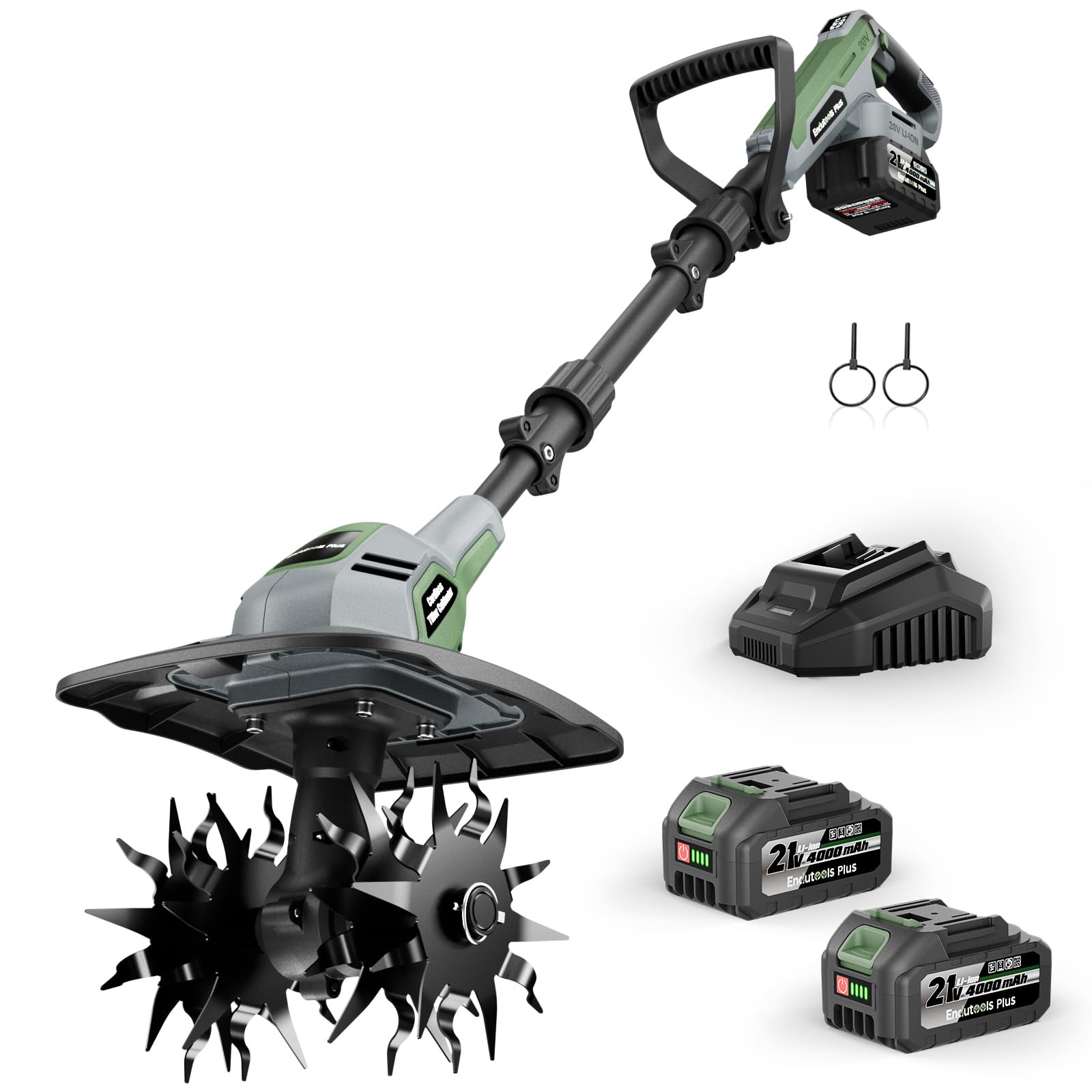
1. Endutools Plus 21V Cordless Garden Tiller Cultivator
Our pick — 4.5+★ from 900+ verified ratings; the strongest balance of quality and price.
The all-rounder that covers a raised bed edge-to-edge without asking you to be a weightlifter.
You get a working strip 9 inches wide and up to 7 inches deep, cut by four sets of steel tines spinning at up to 360RPM (revolutions per minute — how fast the tines turn). That is enough to break packed soil, chop clumps, and pull weeds in a bed you’ve let go. This width and depth pairing is the balance for a small tiller: wide enough to make real progress, narrow enough to squeeze between rows. The frame weighs 10.58 lbs, which is light for a machine cutting 7 inches down, so lifting it out of the shed is a one-hand job. The telescopic handle adjusts to your height, so you aren’t bent double all afternoon.
Runtime is where this one pulls ahead of the budget tier. Two 21V 4.0Ah lithium batteries, each rated for up to 60 minutes of continuous work, and a 1–2 hour fast charger to refill them. A battery level indicator sits on the handle so you can see what’s left before the motor dies mid-row — a small thing that saves a lot of swearing. Owners lean on the long utility time and the “light weight, small, but can get the job done” feel, which is exactly what a compact tiller should deliver.
The honest trade-off is simplicity, not power. There’s no brushless motor claim here and no fancy control, just a proven 360RPM setup with a safety lock to stop accidental starts and a detachable structure so it packs down for storage. It is also the strongest overall value in this lineup — 4.5+ stars across 900+ ratings, the highest crowd score of the nine. If you want a 9-inch, 7-inch-deep tiller that breaks a bed on the first pass, start here.
What earns it the top slot
- 9-inch width by 7-inch depth clears a raised bed in fewer passes
- Two 4.0Ah batteries at up to 60 minutes each keep you working
- 10.58 lbs with an adjustable telescopic handle eases arm fatigue
- Battery level indicator on the handle prevents surprise power-offs
Where it asks for patience
- The 1–2 hour charge means keeping one pack on the charger while you work
- No brushless motor spec, so it’s a standard tine-and-motor build
Go for this if: you want one tiller that handles raised beds, spring turning, and weed clearing with a second battery in reserve.
The catch: plan your session around the charger, not the other way round.
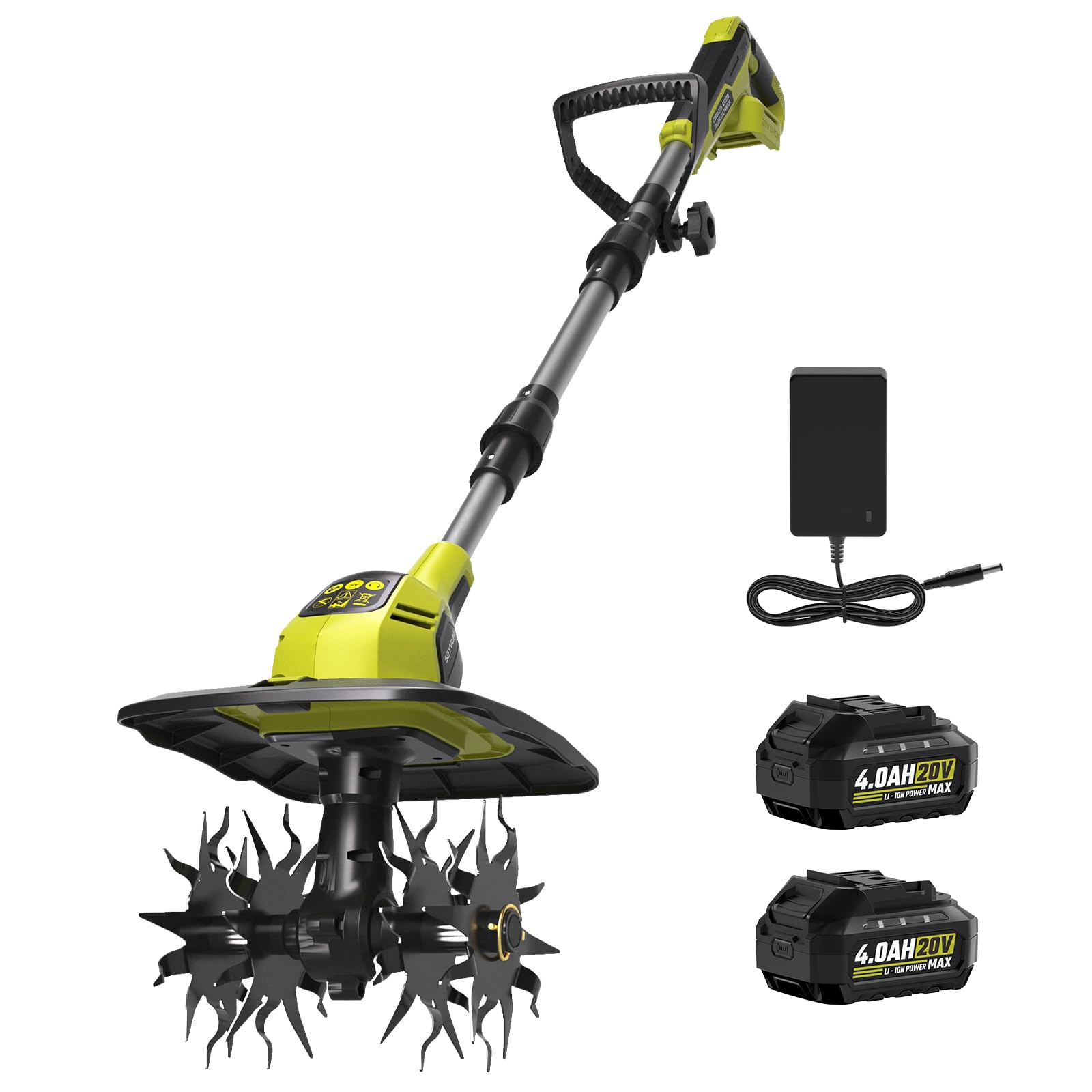
2. SEYVUM 20V Cordless Tiller for Gardening
Built for the gardener staring down a bed of hard, compacted clay that has beaten every hand tool.
The headline here is a brushless motor rated at 20,000 RPM — brushless means fewer wearing parts and less noise than a brushed motor, so it holds power through tough ground instead of bogging down. Paired with a 9-inch width and 7-inch depth, it cuts the same size strip as the top pick. The difference is in the soil it can take on. What wins people over is raw performance, and the recurring scene in the reviews is a tiller chewing through hard clay to open up a brand-new garden bed.
Two 4.0Ah lithium batteries give it up to 50 minutes of continuous running, and the dual-battery setup is the reason you can push through a larger patch without a mid-job recharge. Four sets of 12-tooth steel blades break clods and level ground as they go. Weight stays manageable too — someone in their eighties expecting it to be too heavy found it “perfect,” which tells you the balance is right for a machine this capable.
Set against the Endutools Plus above, the SEYVUM trades 60 minutes of per-battery runtime for that 20,000 RPM brushless motor, so it’s the better match when your ground fights back. It comes with an 18-month warranty, which is longer coverage than most here. If you are breaking ground that has never been worked, its 20,000 RPM brushless motor saves your shoulders.
The power case: A brushless motor at 20,000 RPM, a 9 × 7 inch cut, and two 4.0Ah packs make this the hard-ground specialist of the group.
Weigh the runtime: At up to 50 minutes per pack it runs shorter stretches than the 60-minute top pick, so plan bigger jobs around swapping batteries.
Reach for it if: your beds are packed, clay-heavy, or never broken before and you need torque over a long battery count.
Look elsewhere if: you mostly fluff already-tilled soil and would rather have the extra runtime.
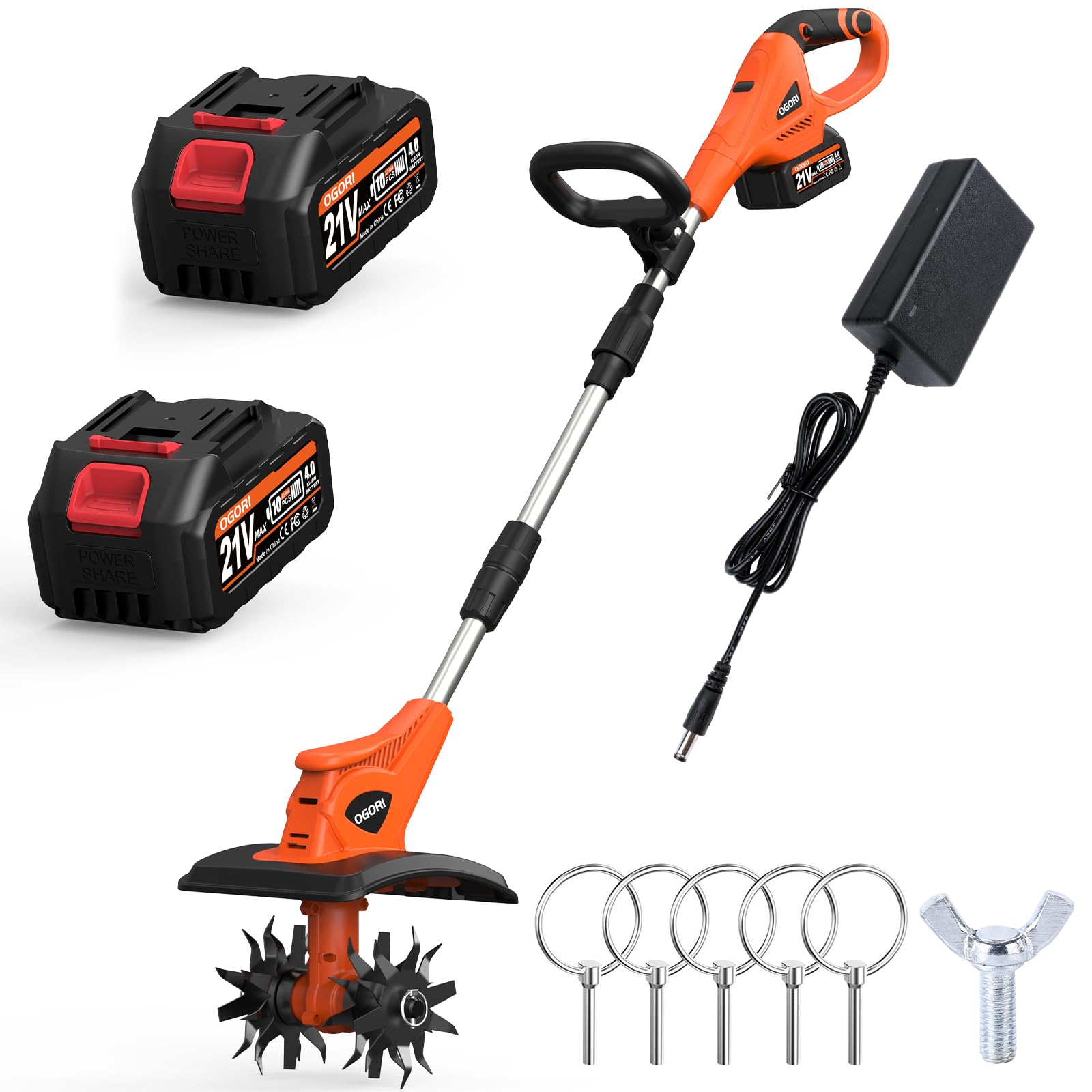
3. OGORI Cordless Electric Garden Tiller Mini Cultivator
The narrow-frame option for flower beds and home veggie plots where a wide machine simply won’t fit.
OGORI’s frame runs 23″D x 5″W x 7″H, so it’s a slim unit built to slide between plants rather than bulldoze a whole plot. You get a 9-inch tilling width and a 6.3-inch depth from four steel tines with 12 blades each, turning at 360RPM to rip through hard-packed soil and roots. The 8.0Ah combined battery total — two 4.0Ah packs — is the biggest capacity figure in this lineup, which means long, uninterrupted sessions for a machine this size.
Two things make it a natural fit for smaller gardeners. First, the small portable frame is aimed at women and seniors managing flower beds and home vegetable plots, so the handle and weight are set up for control rather than brute hauling. Second, the zero oil-change, no-gas design means it lives quietly in a shed without the maintenance ritual of a gas tiller. It runs on cordless electric power with no cord to drag across the lawn.
Compared with the SEYVUM above, the OGORI gives up a little depth — 6.3 inches against 7 — in exchange for that slimmer 5-inch-wide footprint and the larger battery total. Reach for it when your beds are narrow, your ground is workable, and you’d rather have capacity in reserve than the deepest possible cut.
Pick this one if: your gardening happens in tight flower beds and small plots where a 5-inch-wide frame is the whole point.
One thing to accept: a 6.3-inch depth is a planting cut, not a deep renovation of hard ground.
4. Quini 24V 2-in-1 Cordless Tiller Cultivator
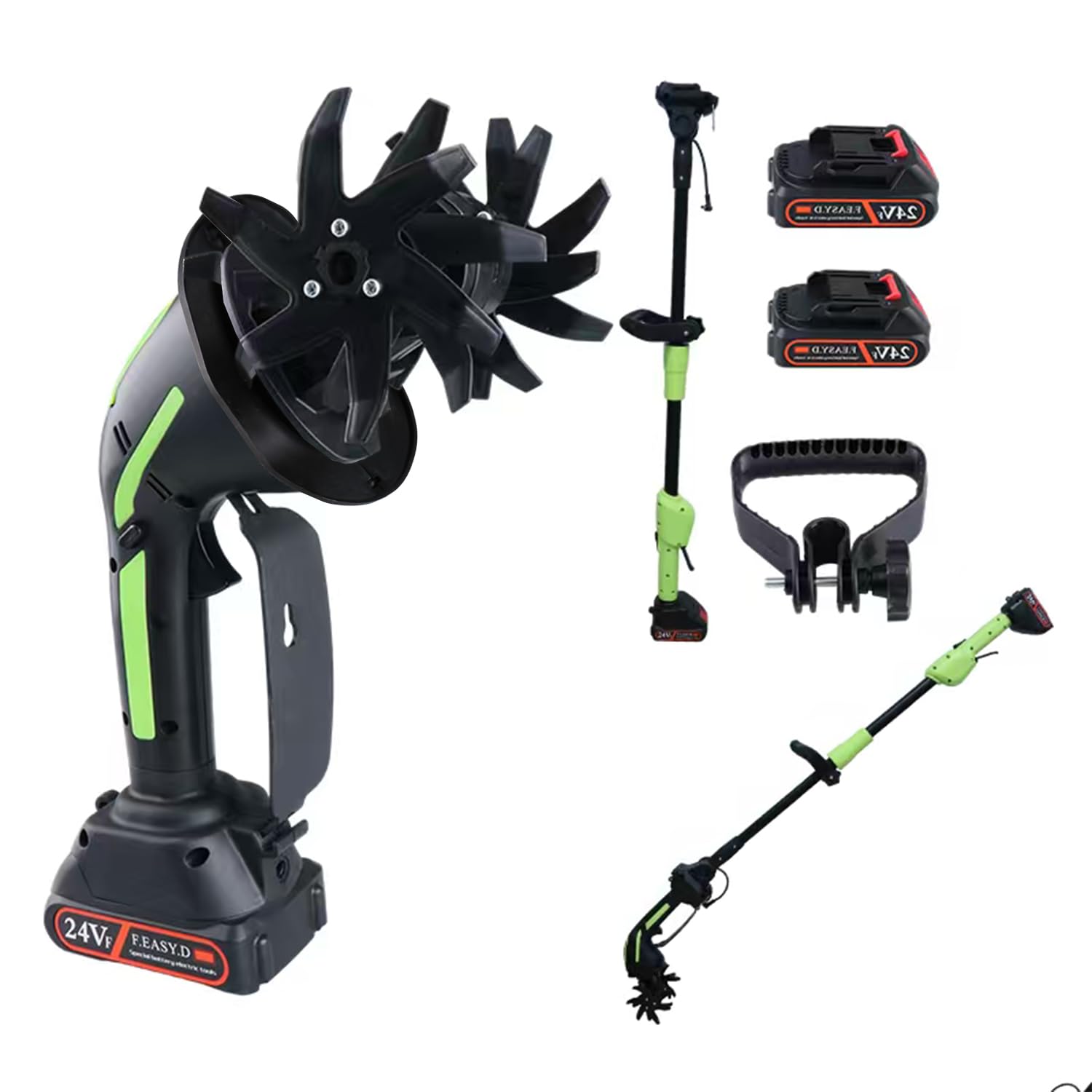
The handheld one that fits in a grow bag and lifts with two fingers.
At 2.65 lbs, this is the featherweight of the group — and the number to weigh against the 10.58 lb Endutools Plus, which makes this Quini roughly a fifth as heavy. That lightness is deliberate: the wireless body with a detachable extension rod lets you work standing or drop the handle for close-up pot work. The tilling width and depth both come in at 4 inches, which is small on purpose. This is the tool for pots, grow bags, and the corners of a bed where bigger tines can’t reach.
It runs two 1500mAh lithium batteries, each giving up to 1 hour of runtime, and they’re interchangeable with quick-charge tech so you swap rather than wait. The 65Mn hardened steel blades are made for loosening compacted soil and clearing weeds in small flower beds and medium vegetable gardens. A safety switch that needs a simultaneous press-and-trigger keeps accidental starts off the table. Owners say it does the job on a slow, steady pass over a raised bed or a dozen grow bags.
Be clear-eyed on the limits. A handful of buyers hit clogging on tougher, rooty ground, and some found assembly instructions thin — so treat it as a light-duty cultivator for small spaces, not a sod-buster. Compared with the OGORI above, it cuts a much narrower 4 inches, not 9, but it goes where that machine can’t. For balcony and container gardeners, that trade is the whole reason to buy it.
Where it shines: 2.65 lbs, a 4 × 4 inch cut, and two 1.5Ah batteries that each run up to an hour make it the easiest tiller here to pick up and use on a whim.
Keep it light-duty: buyers report clogging on rooty or stony ground and vague assembly instructions, so it rewards slow passes on small targets.
Best for: container gardeners, grow-bag growers, and anyone who needs to reach into a pot without hauling a heavy frame.
Not for: breaking new ground, where its light build and 4-inch tines will bog down.
5. TaskStar Cordless Tiller Cultivator for Gardening
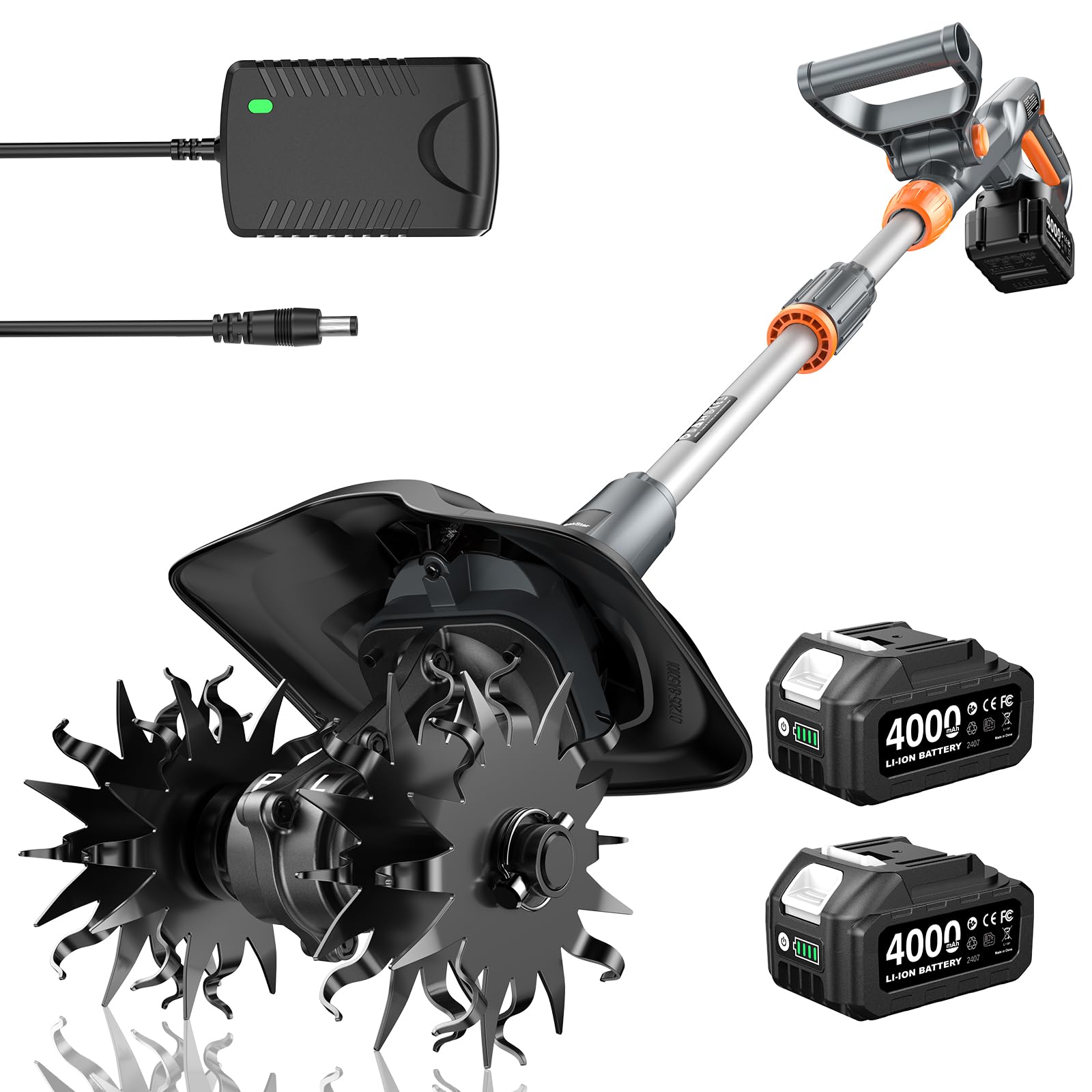
The proven crowd-favorite that punches through dirt without weighing you down.
TaskStar brings a 360RPM high-torque motor and a 9-inch tilling width by 7-inch depth, plus 48 heavy-duty rust-resistant steel tines that dig deep to loosen compacted soil and improve aeration. Weighing 10.6 lbs, it’s built to be carried, pushed, and maneuvered through raised beds and uneven ground. The adjustable main handle and front auxiliary handle give you stability when the tines hit a root and the machine wants to kick.
Runtime comes from two 20V 4.0Ah lithium batteries, and the cordless design means no gas, no fumes, and no engine maintenance. The detachable tine system makes clearing stuck soil quick. This is the most-reviewed pick in the lineup — 4.5+ stars across 500+ ratings — and the consistency shows: what people talk about most is how it performs and how little effort it takes. A seventy-year-old gardener calling it the first tiller she could actually handle sums up the appeal better than any spec sheet.
Against the Endutools Plus at the top, it matches the 9 × 7 inch cut and the weight class but runs a slightly different battery setup — two 4.0Ah packs versus two 4.0Ah packs at a different voltage. If you want a mid-priced 9-inch tiller with 48 tines and 500+ ratings behind it, this is the safe pick.
Why it’s a crowd favorite
- 48 rust-resistant steel tines over a 9 × 7 inch cut
- 10.6 lbs with adjustable and auxiliary handles for control
- Two 20V 4.0Ah batteries and a detachable tine system for easy cleaning
The realistic gripe
- Some find the batteries run shorter than the biggest capacity packs here
My take: the most-vetted tiller of the bunch, with the tine count and width to handle a real garden and the lightness to keep at it.
Consider the trade: if runtime tops your list, the larger-capacity packs elsewhere edge it out.
6. ADOTOCAM Electric Tiller Compatible with Dewalt 20V Battery
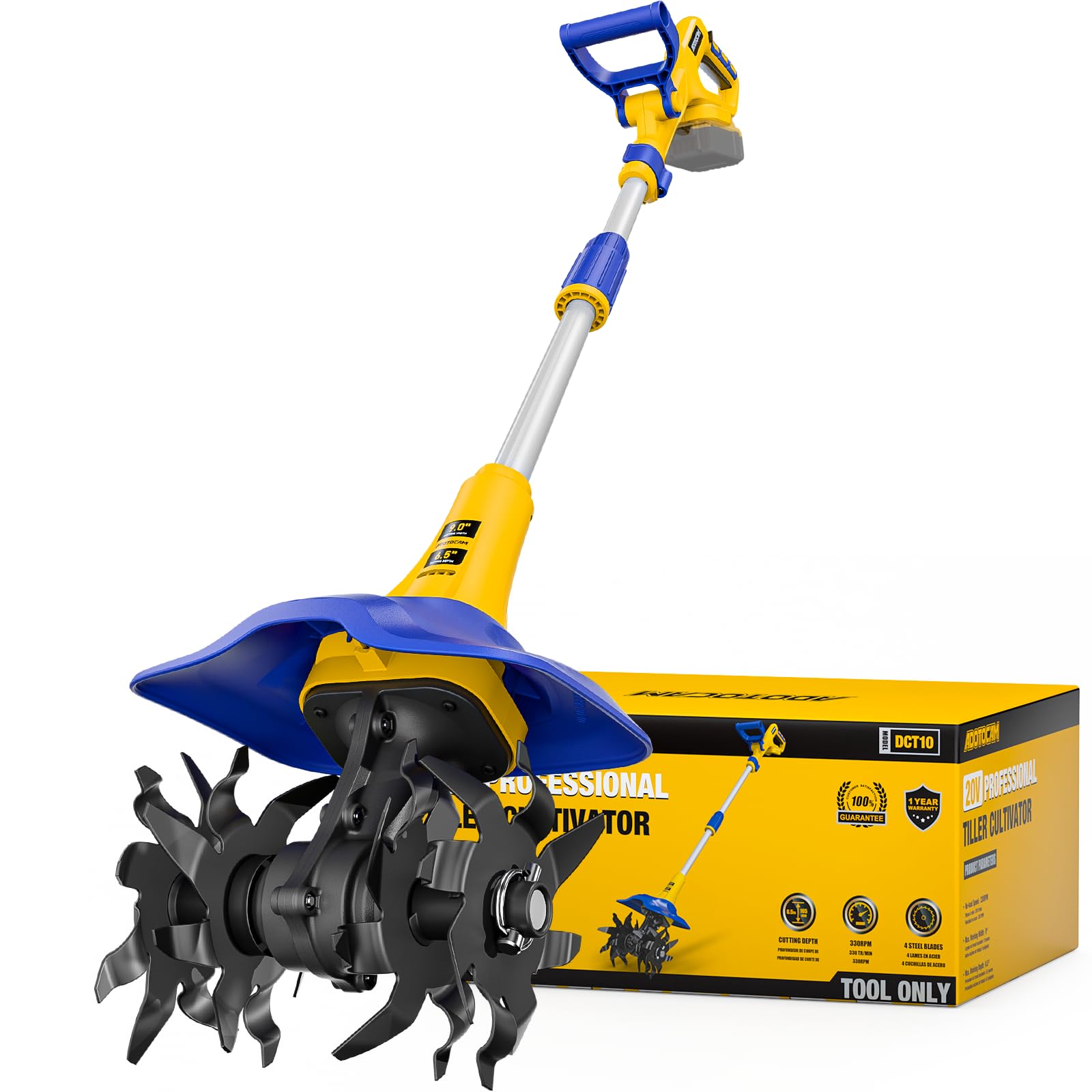
For the workshop already stacked with Dewalt batteries, this tool-only tiller slots right in.
You skip buying another battery and charger, because this one is sold as tool only — no battery in the box. It runs on the Dewalt 20V Max packs you already own, including DCB206, DCB205, DCB204, DCB181, DCB182, and more. If you’re a Dewalt household, that is a genuine saving. Sharp steel tines rotate at up to 330 RPM and cover a 9-inch width by 6.5-inch depth, which suits small to medium gardens and tight corners.
The telescopic shaft extends from 51.5 to 59.5 inches, which lets a range of body heights work without stooping — the tiring bend of long gardening sessions is exactly what that adjustment kills. Owners praise the battery compatibility and versatility most: one put it to work on a 30-foot flower bed in about 10 minutes, and another used it to install a retaining wall over a weekend. The safety button must be pressed alongside the trigger before the motor starts, so no accidental fire-up.
The catch is obvious but easy to plan around: no battery means you must supply one, and runtime depends entirely on which pack you slot in. Against the two-battery tillers above, you’re trading a bundled battery for the flexibility of using what you already charge in the shop. Detachable gears make clearing stuck weeds and roots simple between passes.
The clever bit: Dewalt 20V Max compatibility and a 51.5-to-59.5-inch telescopic shaft mean less to buy and less to bend for.
Read the fine print: it ships tool only, so factor in that you provide the battery and it runs as long as your pack allows.
Ideal for: the Dewalt 20V owner who wants a tiller without paying for another battery system.
Not for: anyone starting from scratch with no Dewalt packs on the shelf.
7. SOARFLY Cordless Tiller Cultivator
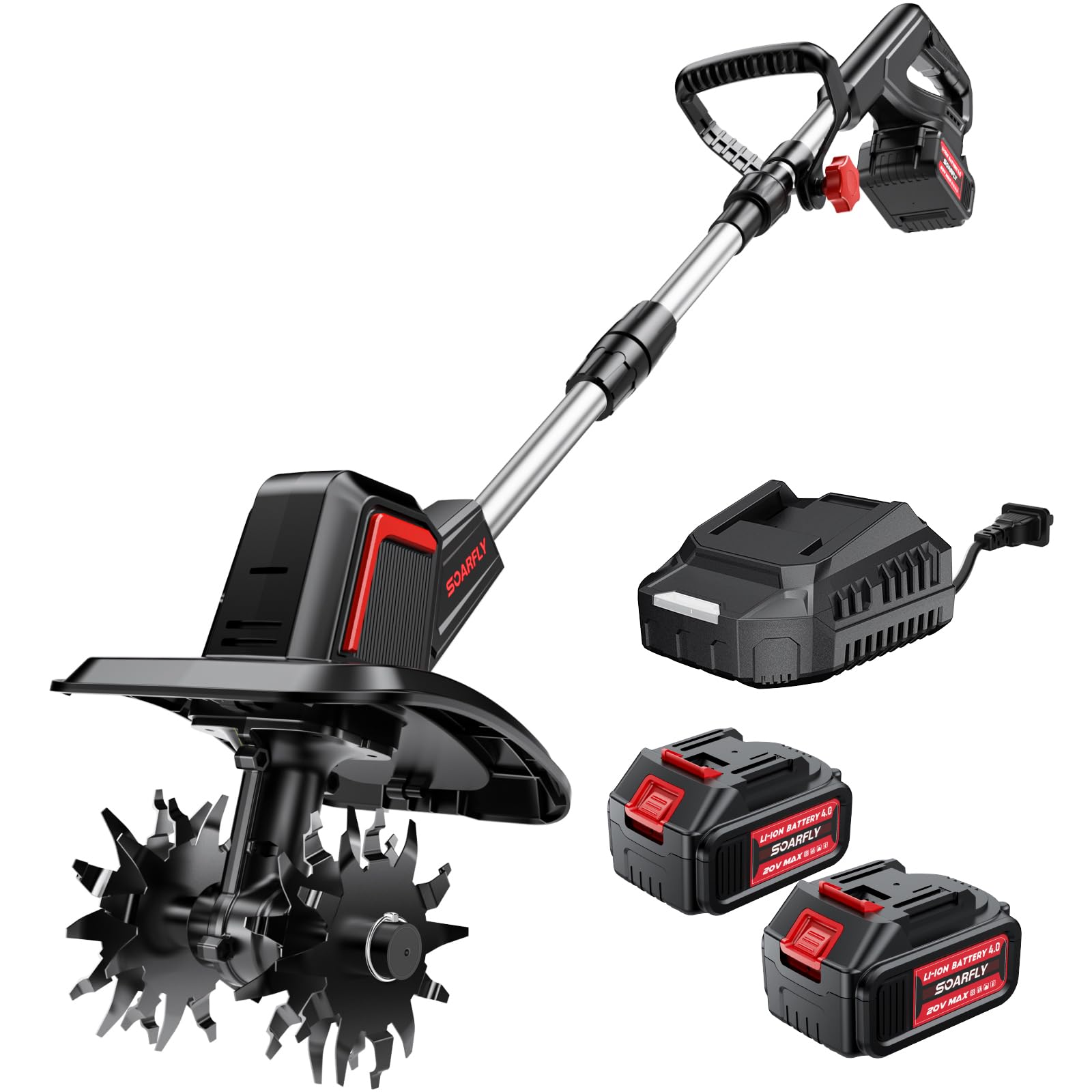
The stay-out-there option: dual batteries rated for up to two hours of continuous work.
You can finish a chain of raised beds and flower plots without hunting for an outlet, thanks to two upgraded 4.0Ah Li-ion batteries (lithium-ion — a rechargeable pack type). Each holds double the capacity of a typical 2.0Ah model, for up to 120 minutes of combined continuous operation. That is the longest stated runtime in this lineup. The upgraded motor holds a steady 360 RPM, so the tines keep turning at the same speed even as you work through compacted ground.
You get a 9-inch width and 6.6-inch depth from 48 steel tines, which puts it right alongside the top pick’s cutting footprint. The height-adjustment system and ergonomic auxiliary handle give you a personalized stance — the company calls out that many competing models can’t adjust height, and it reduces fatigue on long sessions. On clay and normal garden soil, the guidance is to start shallow and increase depth in passes. Owners rave about the performance — one cleared an area around 6′ x 6′ and added compost, another finished a full garden on a single charge.
Weigh it honestly: the stated weight comes in around the middle of the range, so it’s a two-hand machine rather than a pocket tool. Against the Endutools Plus above, the SOARFLY’s advantage is that longer stated runtime, and both cover a 9-inch strip. If you want to till every bed in one session without a battery swap, this is the one.
Choose it when: you’ve got multiple beds and want the stated runtime to carry you through without swapping mid-job.
Think twice if: you only have one small bed and would rather not handle a heavier frame.
8. Scotts Outdoor Power Tools TC70020S Garden Tiller

The name-brand weeder for pre-season prep and mixing compost into flower beds.
Raised beds and flower-bed edges get a tidier fit here, because the cut narrows to a 7.5-inch tilling width and 6-inch depth from four durable steel tines — a touch narrower than the 9-inch machines. It ships with a 20V 2.0Ah lithium battery and fast charger, and that Scotts battery works across all other Scotts 20-Volt products, so it slots into a brand ecosystem if you already own one. At 5.4 pounds it is easy to carry, and the auxiliary handle keeps it balanced.
Where this tiller is genuinely at home is mixing soil additives — compost, fertilizer, organic matter — and as a weed-control tool along the edges of beds, pulling stray grass up by the roots. Owners find it effective at tilling topsoil and light enough for small plots. One worked a raised garden with a third of the battery, saving the back-breaking spadework. On soft, prepped ground it mixes compost and lifts shallow weeds without stalling.
The trade-off is that this is a light-duty tiller with a smaller 2.0Ah pack. On tougher ground it takes some muscle — you pull back to keep it digging in, and it can buck against you. Treat it as a weeding and soil-mixing companion for gentle ground, not a renovator.
What it does well: 7.5 × 6 inch cut, 5.4 lbs, and a Scotts 20V battery that shares across the brand’s tools make it a handy edge-and-additive tool.
Where it strains: a 2.0Ah pack and light build mean hard, rooty ground needs muscle and patience.
Go with it for: seasonal weed patrol, compost mixing, and edge cleanup in a small plot.
Skip it for: breaking fresh, hard ground — this one likes soil that’s already workable.
9. Earthwise TC70020IT 20V Cordless Electric Garden Tiller

Earthwise keeps it simple: a light cordless machine backed by a two-year warranty, so a breakdown doesn’t leave you paying for repairs.
The Earthwise cuts a 7.5-inch width by 6-inch depth from four durable steel tines, running on a 20V 2.0Ah lithium battery with a fast charger included. At 12 pounds it’s on the heavier side of the compact class, but owners love how easy it is to control — far less work than a hoe or shovel. It’s built for turning over beds, mixing in soil additives, clearing old depleted soil, and pulling weeds up by the roots along garden edges. The 2-year warranty is a nice cushion at the budget end.
What people consistently rate highest is performance and ease of use — it’s the kind of tiller you grab for a small landscaping project and finish without fuss. One buyer picked it to break up the dirt in a chicken run and then used it in flower beds; another sized it perfectly for a raised-bed garden. Its 2.0Ah pack covers a single raised bed or small plot before you need to recharge.
Be realistic on two fronts: a 2.0Ah pack is not the biggest here, so expect to recharge for larger areas, and on sod or clumpy grass the tines can leave chunky turf rather than a fine seed bed. Compared with the TaskStar above, the Earthwise cuts 7.5 inches versus 9 — a smaller bite that suits tight beds, and its simpler battery fits that smaller mission.
Where the value sits
- 7.5 × 6 inch cut in a light, control-friendly frame
- 20V 2.0Ah battery and fast charger included
- Rated 4.0+ stars across a large pool of owners, with a 2-year warranty
The honest limits
- A 2.0Ah pack means recharge breaks on bigger plots
- Leaves clumps on tough sod rather than a fine bed
Best suited to: a first-time cordless buyer who wants a light, well-loved entry tiller with warranty cover.
Know before buying: it’s a gentle-soil tool — clumpy sod and deep hardpan will test its smaller battery and tines.
Know the Specs
Tilling Width and Depth
Tilling width is the width of the soil strip the tines turn in a single pass — 9 inches covers ground fast, while 4 inches is for pots and tight corners. Tilling depth is how far the tines dig, and most here cut 6 to 7 inches, enough to prepare a planting bed. A tiller that’s too wide won’t fit between rows, so match the width to your bed layout before chasing a bigger motor.
Battery Capacity (Ah) and Runtime
Ah stands for amp-hours, the size of the battery’s fuel tank. A 4.0Ah pack holds roughly double a 2.0Ah, and the tillers here that ship two 4.0Ah batteries give you a real working session plus a swap. A single 1.5Ah or 2.0Ah pack runs dry sooner and leaves you waiting on the charger. Some models are tool only, meaning you supply the battery from your own power-tool kit.
Motor RPM and Tine Count
RPM is how fast the tines spin, and the machines here range from 235 to 360 RPM. A brushless motor (one without carbon brushes rubbing inside, so it runs cooler and lasts longer) rated at 20,000 RPM, as one model is, holds power through tough ground better than a brushed one. More tines mean more bites per turn, which helps break clods and level soil. High RPM helps with compacted dirt, but tilling width and depth still decide whether the tool fits your beds.
Weight, Handles, and Safety Switches
Weight decides whether you carry it or leave it in the shed. These run from a 2.65 lb handheld to a 12 lb frame, and lighter is easier to hold on hard ground that makes the tool kick. An adjustable telescopic handle and an auxiliary front handle reduce fatigue and improve control, and a safety switch that needs two actions to start keeps the motor from firing accidentally.
Common Questions
How wide a strip can a small garden tiller turn in one pass?
How deep will these tillers dig into the soil?
Is a 4.0Ah battery really better than a 2.0Ah one for tilling?
What does tool only mean when buying a cordless tiller?
Will a small tiller handle hard clay or compacted ground?
How long does one battery charge actually last?
Are these tillers light enough for a senior to use?
Do I need to change oil or do engine maintenance on a cordless tiller?
Can I use a tiller’s battery in other tools?
Why does my tiller clog or bog down on roots and stones?
The Bottom Line
Most gardeners should buy the Endutools Plus 21V Cordless Garden Tiller. It cuts a 9 × 7 inch strip, runs two 4.0Ah batteries at up to 60 minutes each, and its 10.58 lb frame is light enough to actually lift — all backed by the best crowd score in the lineup. If your ground is hard clay that fights back, the SEYVUM 20V Cordless Tiller leads on raw power. For container work or tight pots, the Quini 24V 2-in-1 Tiller at 2.65 lbs reaches where the wide machines can’t. It wins on both rating and category fit, so it’s the one to buy if you want to stop reading and start planting.
How we choose
We do not accept paid placement. Every pick is matched to a real buyer and a real use-case; we do not hands-on test units.
Sources
Specifications: manufacturer listings and product documentation. Review insights: verified customer reviews, as of November 2026. Pricing: not shown on this page (it changes often); check the current price via the retailer link.
As an Amazon Associate, Tactical Gear Guy earns from qualifying purchases. This does not affect which products we feature.