Specs are compiled from manufacturer listings and verified buyer reviews and can change over time — please confirm the key details on the product page before buying.
If your tomato seedlings stretch out thin and pale on a windowsill, the fix is a light that pushes enough intensity plus the red wavelengths that trigger flowering and fruit set — not just a bright white tube. This guide covers the lights that actually carry tomatoes from seed to ripe fruit indoors, sorted by what each one does best.
This guide is built by comparing the manufacturers’ published specifications and the patterns across verified customer reviews, so you get each pick’s real strengths and trade-offs instead of marketing spin.
The gap between a seedling light and a fruiting light is measured in spectrum and wattage, and the picks below cover both ends without wasting your season. Here is what separates a real tomato light from a shelf ornament, starting with the tomato growing light spec sheet.
Top Picks

How To Choose The Best Tomato Growing Light
A tomato plant has two very different jobs indoors. Early on it needs steady blue-heavy light to build short, stocky stems instead of leggy ones. Once flowers show up, it wants red and deep red to push pollination and fruit. A light that only does one of those jobs leaves you with a healthy-looking plant and no tomatoes.
Spectrum: look for 660nm red, not just “full spectrum”
Manufacturers slap “full spectrum” on almost everything now. The useful question is whether the listing names 660nm red diodes, which sit in the red band that plants use heavily during bloom. A mix like 3000K warm white plus 5000K cool white plus 660nm gives you both vegetative and flowering coverage from one fixture. Deep IR (often listed around 730nm) is largely invisible to your eye, so do not assume a dim-looking fixture is weak.
Wattage and the real coverage it buys
Wall draw is the honest number — the watts the light actually pulls, not the “equivalent” figure on the box. A 72W bar light and a 100W panel are not the same tool. The higher draw generally buys you more punch over a larger canopy, which is what a fruiting tomato needs. Match the fixture’s stated coverage to your tent or shelf footprint rather than guessing.
Height and heat in a small space
Light strength falls off fast with distance. That is why adjustable hanging height matters: you can drop the fixture close during early growth and raise it as the plant stretches. Heat is the other variable. Fanless aluminum heatsink designs run quieter, but in a sealed tent that warmth has nowhere to go, so plan your airflow before you buy.
Side-by-Side Comparison
| Model | Best For | Wattage | Light Output | Footprint | Amazon |
|---|---|---|---|---|---|
| Spider Farmer SF1000★ Best Overall | Best all-round tent panel | 100 W | 10000 lumens | 2×2 / 3×3 ft | Amazon |
| FREELICHT 2-Pack 4FTBest Value | Budget shelf coverage | 40 W | 168 LEDs | 4 ft bars | Amazon |
| Barrina TX72Most Focused Beam | High-PPFD single bar | 72 W | 8100 lm | 4 ft bar | Amazon |
| Spider Farmer SF600 | Slim 2×4 coverage | 72 W | 11000 lumens | 2×4 ft | Amazon |
| MARS HYDRO TS600 | Compact 2×2 value | 100 W | 10000 lumens | 2×2 ft | Amazon |
| GLOWRIUM 48W with Stand | Potted plants on a stand | 48 W | — | Adjustable to 79 in | Amazon |
| VIVOSUN AeroLight A100 | Light plus airflow | 100 W | PAR output | 13 x 13 in | Amazon |
| Barrina T10 Pro Vertical | Tall plants, freestanding | 42 W | 169 LEDs | Reaches 4–5.6 ft | Amazon |
| VIVOSUN AeroLight 240W | Large tent, sealed bars | 200 W | IP65 bars | 26 x 13 in | Amazon |
Detailed Reviews
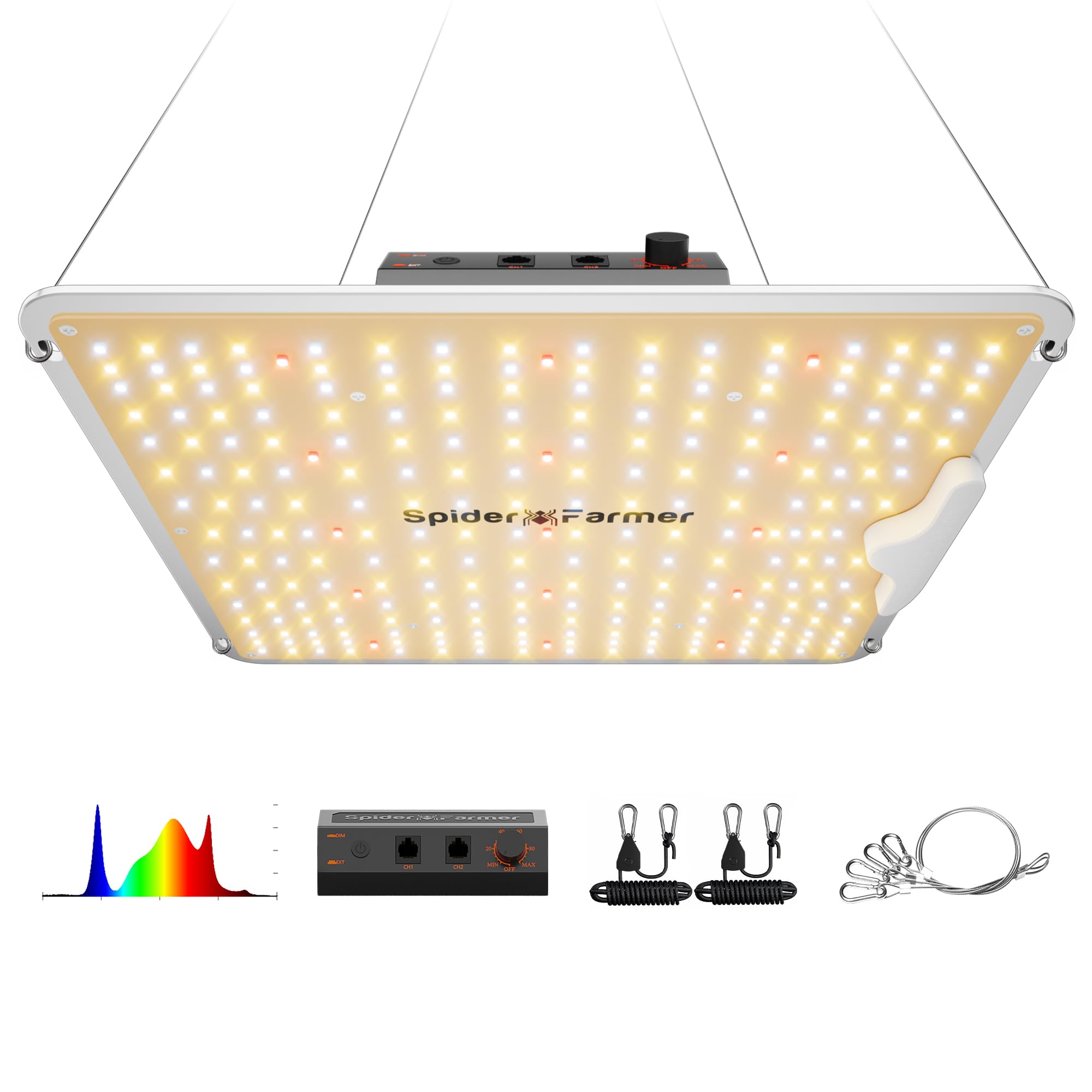
1. Spider Farmer SF1000 LED Grow Light
Our pick — 4.5+★ from 12,000+ verified ratings; the strongest balance of quality and price.
A 100 W, 10000-lumen panel that carries tomatoes from seedling to ripe fruit in a 2×2 or 3×3 tent.
This is the fixture most indoor tomato growers end up with, and the numbers explain why. It draws 100 W and puts out 10000 lumens — 72 W of it is the Barrina TX72’s territory, so the SF1000 runs 28 W hotter on draw. That extra headroom is what lets it hold a 3×3 ft tent instead of a single shelf.
The spectrum covers what a tomato needs across its whole life: 3000K warm white, 5000K cool white, 660nm red and IR at 760nm. The 660nm red is the piece that matters once flowers appear. A dimming knob lets you dial intensity down for young seedlings and back up for heavy flowering. Better still, the diodes now sit gathered at the edge of the board, which spreads the light more evenly across the canopy instead of hot-spotting the middle.
What wins people over is raw brightness — the overwhelming majority of the feedback centers on how much light this throws for the wattage. Expectations hold up over multiple grow seasons, and the value angle comes up constantly. The recurring gripe is heat: it runs warm, and a board that overheats is the failure mode to watch. A few owners also wish a built-in timer were included.
Where it earns its keep
- 100 W draw with 10000 lumens covers a 3×3 ft footprint
- Full spectrum to 660nm red and 760nm IR for flowering
- Dimming knob plus GGS controller compatibility and multi-light linking
- Fanless aluminum heatsink keeps it silent
What to plan around
- Runs warm — good tent airflow matters
- No built-in timer, so add your own schedule control
Reach for this if: you want one panel that carries seedlings through ripe fruit in a 2×2 or 3×3 tent without swapping lights.
Look elsewhere if: you need the fixture to stay cool in an enclosed space with no fan running.
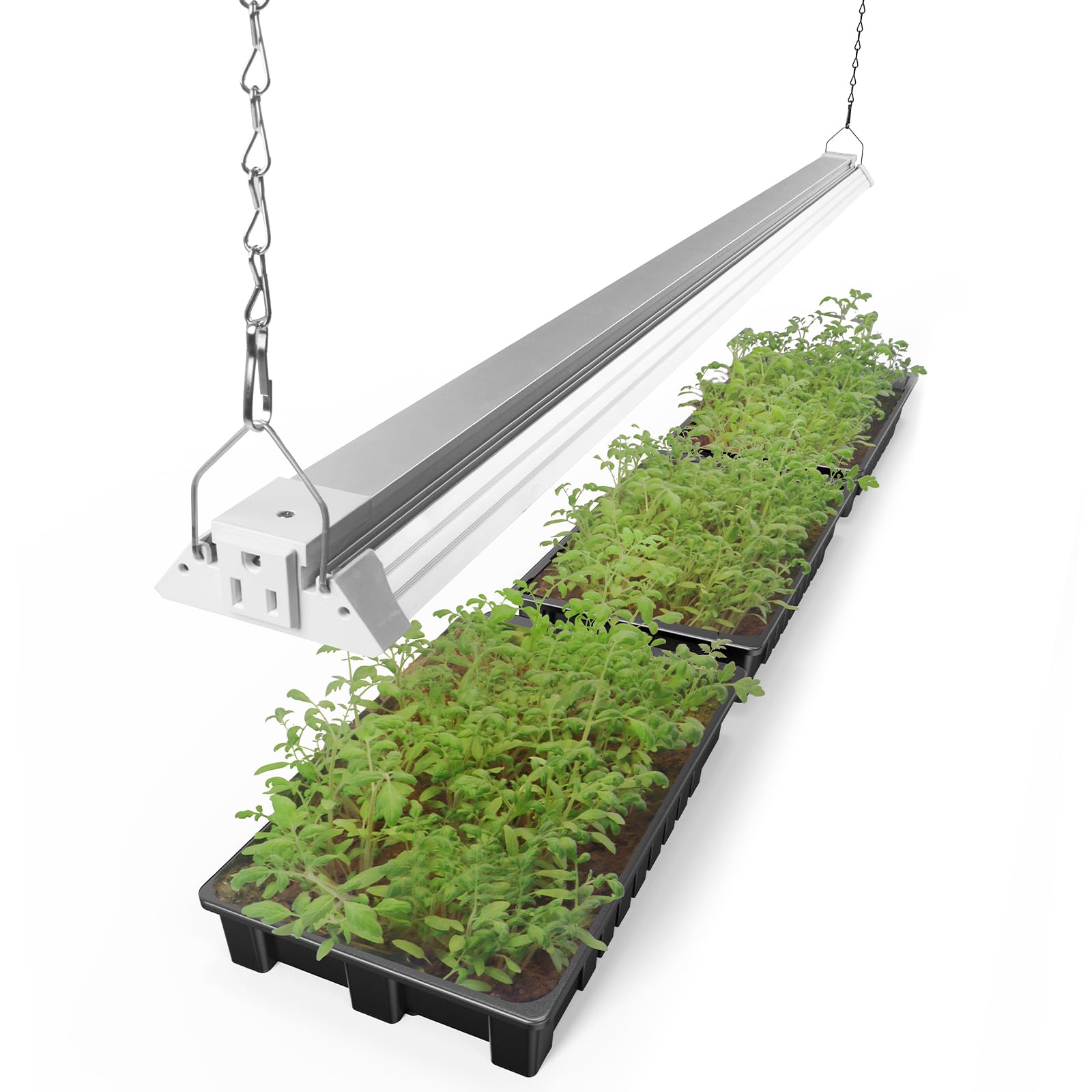
2. FREELICHT 2Pack 4FT Grow Light
Two 4 ft bars at 40 W each, linkable to four, that cover a whole shelf.
If your tomatoes live on a multi-shelf rack, this pair makes more sense than any single panel. Two bars at 40 W each with 168 LEDs between them, and each one weighs 2.2 pounds — the Spider Farmer SF1000 above is 5.8 pounds, so these are far easier to hang on command hooks and cheap brackets.
The setup is genuinely flexible. You can hang them or surface-mount them, and the included wire rope hooks, clips, connectors and screws mean no extra hardware trip. Daisy-chain up to four lights with the 59 inch power cords if you extend the run later. The 3500K color temperature leans warm, which suits flowering plants and reads as a pleasant light in a room.
What buyers praise most is straightforward quality — the top-cited theme by a wide margin — with function and plant growth close behind. The flexibility is a real advantage: easy to hang, low heat, and bright across the full spectrum. The one catch worth knowing is the clips. They don’t grip tightly, so a bump during watering can drop a bar.
The shelf math: 40 W per bar keeps electricity use modest while still throwing a bright, sunlike spread over a rack of seedlings and young plants. Linkability to four bars means you can grow the setup as your crop counts grow.
Clip caution: the mounting clips are the weak point — reinforce them or hang from the rope hooks instead if the light sits over anything fragile.
Suits shelf and rack growers: anyone covering a wide, shallow footprint like a plant stand or a metal rack of tomato starts.
Think twice for: a tall single plant that needs punch from above — this is spread, not a spotlight.
3. Barrina TX72 4FT LED Grow Light
A single 4 ft bar built to pour light straight down onto fruiting plants.
Here is the number that earns this bar its spot: 525.69 μmol/m²/s PPFD — that’s the light energy actually landing on a leaf — measured at just 3.94 inches from the lamp. That short throw is the whole personality of this fixture. Bring it close and it is a very potent bar. The 312 LEDs include 660nm red chips, so it carries a tomato from germination through leafy growth and into blooming and fruiting.
Where it differs from the Spider Farmer SF1000 is dialing. The SF1000 gives you a dimming knob and the TX72 does not — no dimming, no spectrum adjustment. That is a genuine trade-off. In exchange you get 8100 lumens at a CRI of 89+, which means colors read true, so a yellowing leaf actually looks yellow under the light instead of being washed out.
What wins people over is lighting quality, the most-praised theme here, with function right behind it. It earns its reputation as a winter keeper on metal shelf racks and for starting seeds early. The aluminum housing spreads heat well. If your plants are full-sun types that want enormous intensity, set your expectations: this is a strong bar, not a sun replacement.
Why it stands out
- 525.69 μmol/m²/s PPFD at 3.94 inches from the leaf
- Full spectrum to 660nm red for blooming and fruiting
- 8100 lumens, CRI 89+ for accurate color reads
- Daisy chains up to 4 with individual on/off switches
Where it asks you to adjust
- No dimming or spectrum adjustment — you move the light instead
- Best punch comes at a very short distance from the canopy
The right call for: a shelf or single row of plants where you can control the 3.94 inch gap and want maximum intensity per bar.
Not your fit if: you depend on dimming to gently ease seedlings along — this light stays at full output.
4. Spider Farmer SF600 LED Grow Light

A 39-inch bar that throws 11000 lumens on 72 W, built to run down a 2×4 ft shelf.
Line the SF600 up against the Spider Farmer SF1000 and the split is obvious. It pulls 72 W against the SF1000’s 100 W, yet throws 11000 lumens against the SF1000’s 10000. That is a genuinely brighter beam from a lighter draw, which is why it holds the output crown in this lineup. Its shape explains it — 39.3 inches long and 5.9 inches wide, built to run down a 2×4 ft shelf instead of flooding a square.
The beam angle is a wide 120 degrees, and the spectrum runs a broad 660-665nm red, 730-740nm IR, 2800K-3000K warm white and 4800-5000K blue. That covers germination, flowering and fruiting. Installation is truly plug-and-play into standard sockets, no ballast work. The slim body and cool running suit closets, shelves and countertops where a bulky panel will not fit.
The most-discussed theme is lighting quality, and reliability follows close behind — this light does its job and keeps doing it. It barely heats up even after 12+ hours, and owners running 2×4 shelf areas report the coverage is exactly right. Two things to weigh: the hanging hardware is the sub-optimal part, and value gets debated. There is also no dimmer, so a seedling and a flowering plant get the same intensity.
Footprint advantage: 11000 lumens stretched across a 2×4 ft span lights a full shelf of tomato starts edge to edge — more than the SF1000 manages in raw output at a lower wall draw.
No dimming dial: you set intensity by raising and lowering the fixture, not by turning a knob, and the included hangers are the part worth upgrading.
Buy it for: narrow grow shelves, closet builds and 2×4 tents where a rectangular beam beats a square one.
Pass if: you want adjustable intensity from a dimmer dial on the fixture itself.
5. MARS HYDRO TS600 100W LED Grow Light
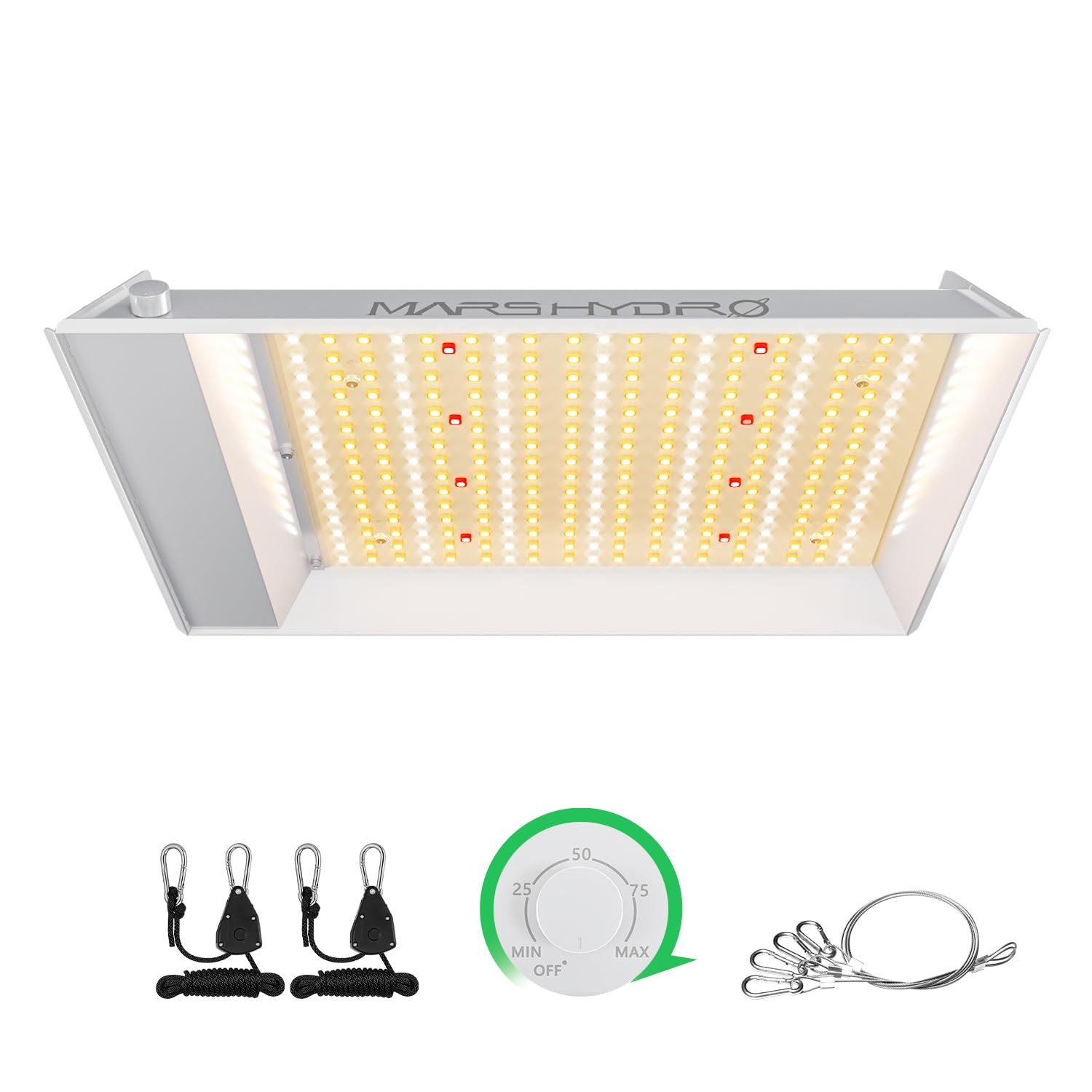
A 2 lb, 12.2 x 14 inch panel that puts 10000 lumens into a 2×2 tent.
At 2 pounds and 12.2 x 14 inches, this is the easiest huge-output light in the lineup to hang and reposition. It still delivers 10000 lumens from a 100 W draw, and the patented 120-degree white reflector is the reason — it gathers scattered light and pushes it down into the canopy instead of letting it spill sideways. Its spectrum blends 3000K, 5000K, 660nm deep red and 730nm IR.
The dimming side is unusual. There is no knob on the housing; instead an RJ12 control port handles 0-100% stepless dimming once you pair a separately sold iControl or iHub. That controller also brings WiFi access, timers and sunrise-sunset simulation. For multi-light runs, it daisy-chains up to 40 units through 3-way connectors — enough for a serious multi-tent setup.
Brightness is what wins people over here by a huge margin, and value follows. The fanless aluminum heatsink keeps it quiet, and an anti-sulfur coated circuit board handles humid grow rooms. The trade-off is heat, which the feedback splits on: fine in an open area, hotter in a tight closed tent. Lifespan also shows up as a mixed theme, so keep it in open airflow where heat can escape.
The case for it
- 10000 lumens, 100 W, in a 2 lb housing
- 120° reflector pushes light deep into the canopy
- Daisy-chain up to 40 units for large runs
- Stepless 0-100% dimming through a smart controller port
The honest catches
- Dimming needs a separately sold controller
- Runs hot in a sealed space; open airflow helps
The natural match: a compact 2×2 tent or cabinet where light weight and a small body matter most.
Keep looking if: you expect on-board dimming without buying any add-on controller.
6. GLOWRIUM 48W Grow Light with Stand
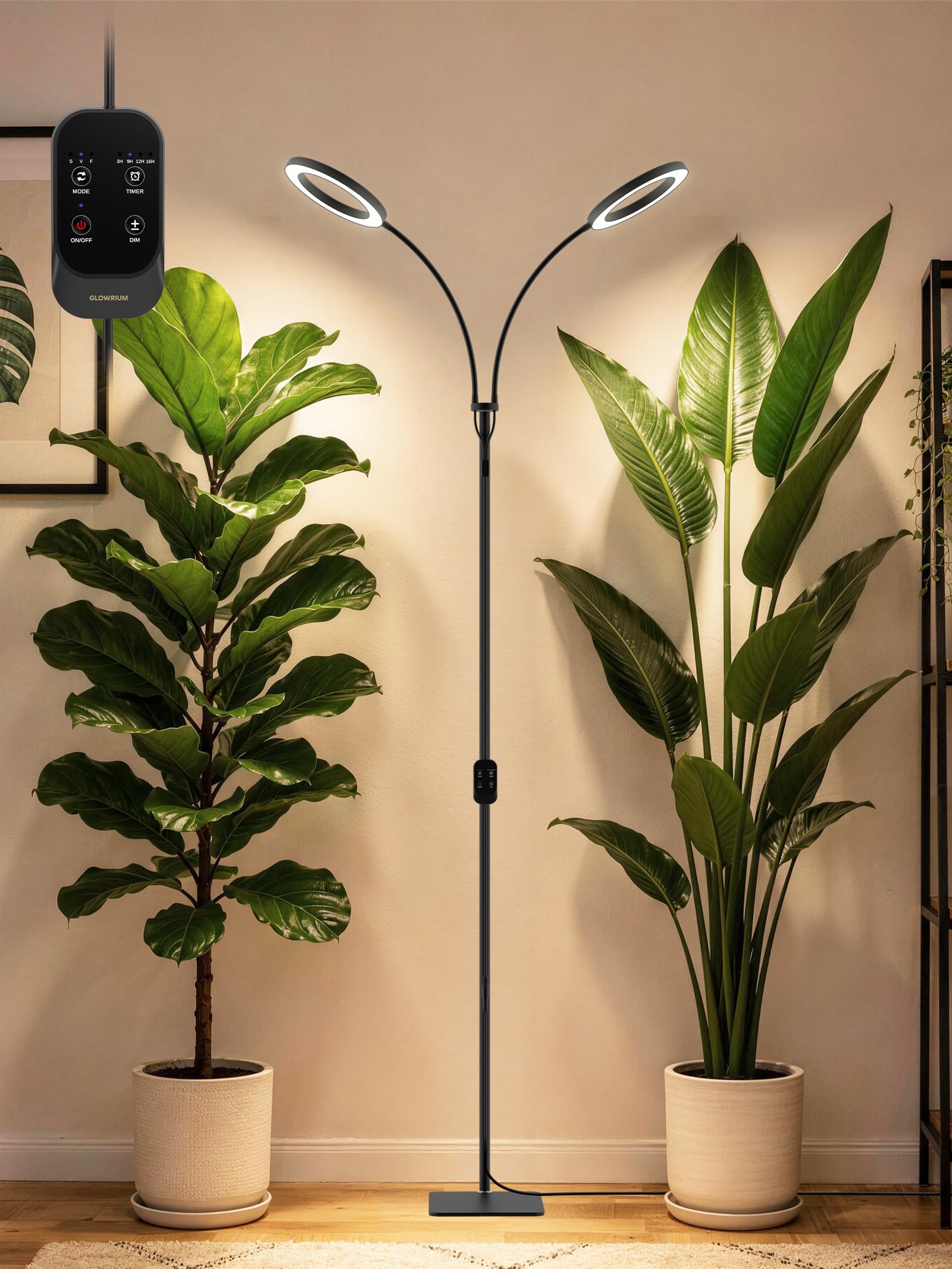
A 79-inch stand lamp with a gooseneck head for a single potted tomato in a living room.
Not every tomato plant lives in a tent. If your plant sits on a floor stand by a window, a bare panel is the wrong tool — you want a lamp you can point. This one has a 4-section pole that extends up to 79 inches, plus a 360-degree flexible gooseneck on the lamp head and a 10.83 inch disc base in aluminum. It stands on its own and aims where you want it.
The controls are where it earns the indoor-plant price. Three modes and stepless dimming let you soften the light for seedlings and push it for flowering. A built-in timer runs 3, 9, 12 or 16 hour cycles automatically, so your schedule holds even when you’re away. The 24V low-voltage system keeps it modest on power. It is not waterproof, so keep water away from the head.
What buyers praise most is how it looks — decor appeal leads every other theme by a clear margin. Function and adjustability follow, and the height flexibility suits tall plants and wintering-over pots. There are also care extras built in: light measurement, watering and fertilizer reminders, growth records. The honest limit is coverage. At 48 W it lights a table or a cluster of pots, not a full tent canopy.
The room-friendly angle: a stand-plus-gooseneck form factor that reaches 79 inches and aims by hand, with frosted diffuser light soft enough to sit in a living space.
Coverage reality: 48 W is enough to keep a couple of tomato plants happy, but it is not a canopy-filling grow light.
Ideal for: one or two potted tomato plants in a sunny room or on a plant stand where looks matter as much as growth.
Choose something else if: you’re lighting a full tent or a deep shelf of many plants.
7. VIVOSUN AeroLight A100 100W LED Grow Light
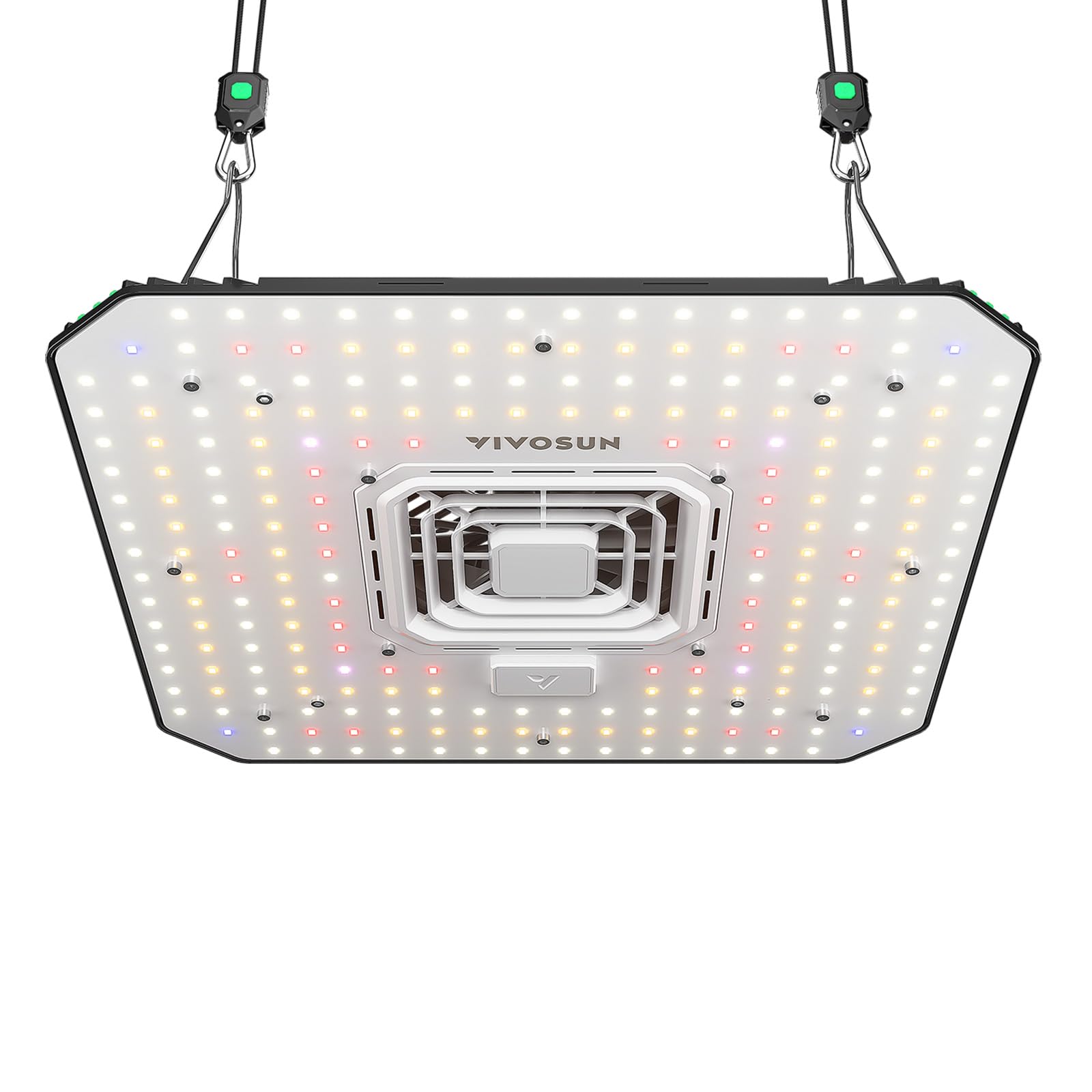
A 13 x 13 inch panel with a center-mounted fan pushing air down into the canopy.
The A100 solves a problem panels ignore. A centrally mounted circulation fan sits in a hollow cutout in the light, pushing air down into the canopy where a normal tent fan can’t reach. That means better airflow and humidity balance right at the leaves, on top of the full-spectrum 390nm-730nm light at 3000K and 5000K. It’s a 13 x 13 inch square at 1.77 inches thick.
There is a catch with the smart side. The fan’s extra features, plus the spectrum and day/night scheduling, run through the Vivosun GrowHub Controller — and this package does not include it. You buy that separately. Plan for that before you commit, because the light’s fan and dimming are limited without it. The 3-year after-sales service and 100 W draw are solid.
What wins people over is quality, the top-praised theme, with function close behind. The fan and light working together is the standout, and the compact size suits smaller spaces well. Noise and the missing controller are the two things to weigh — the fan runs audibly, so it’s not a library-quiet fixture.
Why it earns a spot
- Integrated center fan pushes air into the canopy
- Full-spectrum 390-730nm light for all stages
- 3-year after-sales service
- Compact 13 x 13 inch footprint fits small spaces
What to budget for
- GrowHub Controller sold separately for smart features
- The fan runs audibly, not silent
Best suited to: a small basement or greenhouse space where you want light and airflow from one unit.
Not for you if: you need silent operation or want full smart control without extra purchases.
8. Barrina T10 Pro Vertical Grow Light

A 42 W vertical tower that lights a tall tomato from the side, with a pole that adjusts from 4 to 5.6 ft.
Indeterminate tomatoes get tall, and overhead panels stop reaching the lower leaves once the vine climbs. This vertical design solves that by lighting from the side along the height of the plant. The pole adjusts from 4 ft to 5.6 ft, so as the stem grows you raise it. It stands on a disc base in aluminum and polycarbonate, and it assembles without tools.
The output is honest: 42 W, up to 169 LEDs including 660nm red chips for the fruiting stages. A CRI of 88 means colors you see roughly as they are, which helps you spot a sick leaf. T10 side-lighting spreads the beam wide, and the warm yellow spectrum the listing notes keeps it from glaring. A mechanical timer on the fixture handles the on/off cycle for you.
What wins people over is quality, with brightness right behind it, and the height adjustment is the feature owners lean on for tall plants. The wide, non-glaring coverage makes it easy to live with on open shelving. Where it falls short: the timer is a mixed theme, and this is not a heavy-intensity rig — for full-sun plants and heavy flowering, you’ll want more punch from above.
Side-light logic: 42 W spread vertically down the plant reaches lower leaves that an overhead panel misses, and the 4ft-5.6ft pole grows with your tomato.
Intensity limit: bright enough to keep a tall plant healthy, not intense enough on its own for a heavy fruiting crop that wants full sun.
Great fit for: a tall Monstera-style plant or a leggy tomato that needs light down its whole height.
skip it if: you need maximum flowering intensity in a concentrated canopy.
9. VIVOSUN AeroLight 240W LED Grow Light
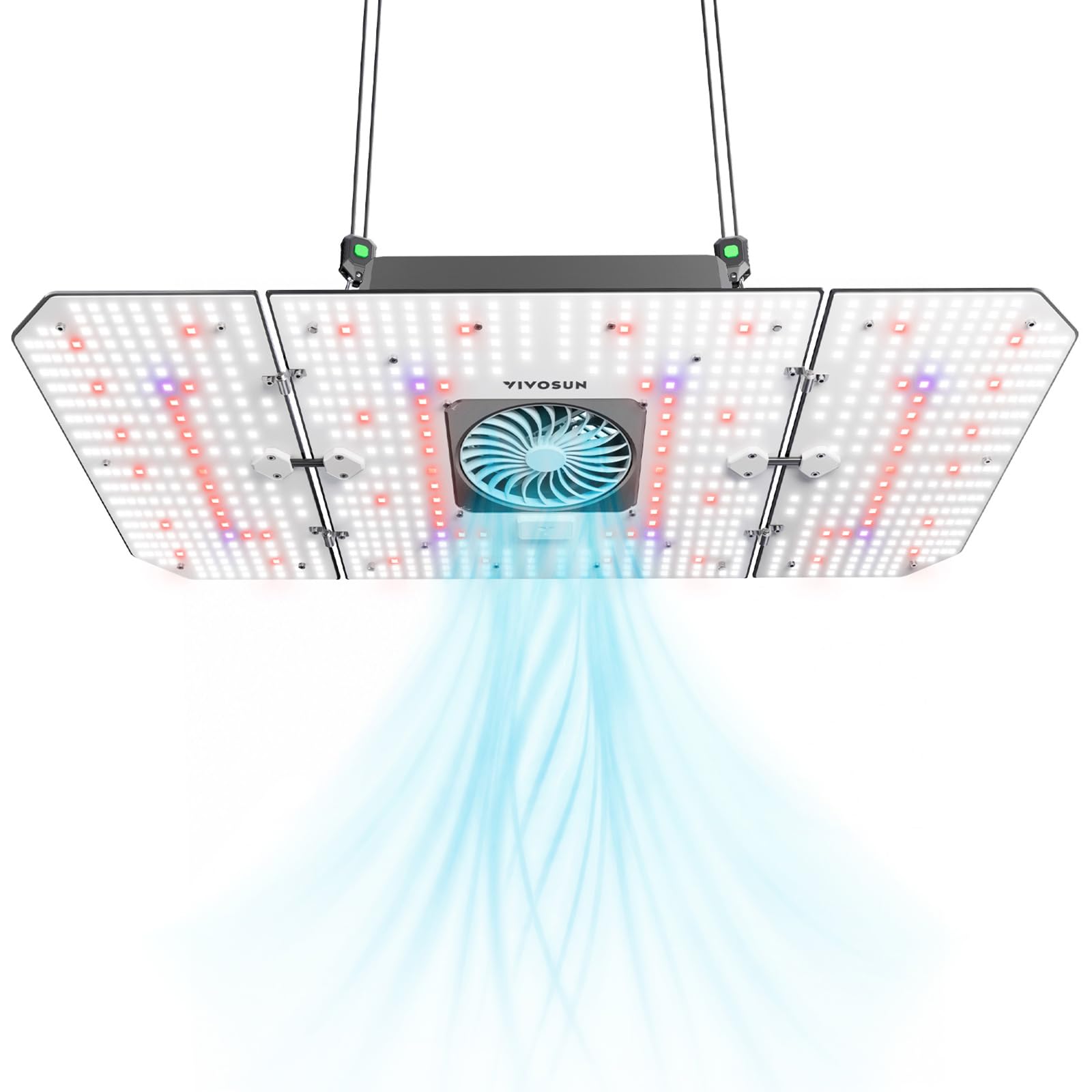
A 200 W bar fixture with IP65 sealed bars, a 2600 RPM turbo fan and a tunable spectrum.
The draw on this one is on a different level from the rest of the list. It’s rated at 200 W, and the turbo fan system pushes up to 2600 RPM for faster air circulation than the A100 above. That fan matters in a big 4×4 tent where stagnant pockets form between plants. The sealed bars carry an IP65 rating — protected against dust and water spray — so you can wipe them down without worrying about the LEDs.
The spectrum is tunable, meaning you steer the wavelengths toward whatever the plant needs now: root establishment, leafy growth, or flowering. Constant-power output holds the intensity steady as you shift the spectrum. The diode layout keeps coverage even — up to 0.91 uniformity, so the plants at the tent edges get nearly the same light as the center. It daisy-chains and pairs with the separately sold GrowHub for app control and schedules.
What wins people over is lighting quality, the top-praised theme, with value and plant performance behind it. The integrated fan getting called out for evenness, the easy phone-app control, and the ratcheting clip mounts all come up. The honest note is reliability as a mixed theme, and the smart side needs the GrowHub you buy separately.
What the big tents get
- 200 W rated with up to 2600 RPM turbo fan
- IP65 sealed bars resist dust and spray
- Tunable spectrum with constant-power output and 0.91 uniformity
- Up to 50,000 hours (Q90) rated use
Points to weigh
- App and scheduling need the GrowHub sold separately
- Reliability is a mixed theme in owner feedback
The large-tent answer: a 4×4 grower who wants sealed, washable bars and airflow built into the fixture.
Weigh it against: your budget and your tolerance for buying the GrowHub separately to get the smart functions.
Know the Specs
PPFD (the light that actually hits the leaf)
PPFD measures how much usable light energy lands on a given area each second, written in μmol/m²/s. It is not the same as lumens, which describe brightness to your eye. A light can look dim to you yet deliver strong PPFD at a short distance — the Barrina TX72 hits 525.69 μmol/m²/s only 3.94 inches away. Because PPFD drops fast with distance, adjustable height is the tool that keeps useful light on your canopy as plants grow.
Wattage versus “equivalent” watts
Draw watts are what the fixture actually pulls from the wall and what you pay for. The “equivalent” figure on the box is a rough comparison to older bulbs, not a power number. A 100 W panel like the Spider Farmer SF1000 draws 100 watts; the FREELICHT bars draw 40 W each. Higher draw generally means more intensity over a larger area, which is what a fruiting tomato crop wants.
Spectrum and 660nm red
A full-spectrum light blends many wavelengths so plants get a balanced diet. The critical detail for tomatoes is 660nm red, a wavelength plants use heavily during flowering and fruiting. Fixtures that list it — the SF1000, the TX72, the T10 Pro — can carry a plant into bloom, not just leafy growth. Deep IR near 730nm also appears on several pick lists; it is largely invisible to your eye, so a dim IR channel is normal.
Daisy chaining and smart control
Linkable lights let you run many fixtures from one power source, which simplifies a multi-shelf or multi-tent setup. The FREELICHT bars chain up to four, the TX72 up to four, and the MARS HYDRO TS600 chains up to 40 through 3-way connectors. Smart control ports add dimming, timers and app scheduling — but check what is in the box. The A100 and the 240W VIVOSUN need the GrowHub controller, sold separately, for their full smart features.
Common Questions
What spectrum do tomatoes need to actually set fruit?
How close should a tomato growing light hang above the canopy?
Is 100W enough for a 3×3 tomato grow tent?
Do I need a dimmer for growing tomato seedlings?
Will a grow light make my tomato tent too hot?
Can I daisy chain multiple grow lights on one outlet?
What is the difference between a bar light and a panel light for tomatoes?
Does a tomato light need a built-in timer?
Can I use a tomato growing light for other vegetables too?
Do I need a separate controller for smart grow lights?
The Bottom Line
For most indoor tomato growers, the best tomato growing light is the Spider Farmer SF1000 — 100 W, 10000 lumens, full spectrum through 660nm red and 760nm IR, and a dimming knob that carries seedlings to ripe fruit in a 2×2 or 3×3 tent. It is the crowd favorite here, and the consistency across grow cycles is why. If you want a brighter beam on a narrow 2×4 footprint, the Spider Farmer SF600 throws 11000 lumens on just 72 W. And for a tall plant stretching past its shelf, the freestanding Barrina T10 Pro lights down the whole vine and grows with it.
How we choose
We do not accept paid placement. Every pick is matched to a real buyer and a real use-case; we do not hands-on test units.
Sources
Specifications: manufacturer listings and product documentation. Review insights: verified customer reviews, as of November 2026. Pricing: not shown on this page (it changes often); check the current price via the retailer link.
As an Amazon Associate, Tactical Gear Guy earns from qualifying purchases. This does not affect which products we feature.