Specs are compiled from manufacturer listings and verified buyer reviews and can change over time — please confirm the key details on the product page before buying.
Here is the thing nobody tells you before you buy one: almost none of these handhelds come with games. They are empty shells waiting for you to supply your own ROM files. So the real question is not which one has the biggest game library — it is which screen, chip, and battery combo you can live with while you load up your own collection. This guide breaks down nine portable console emulators by what actually matters once the box is open.
This guide is built by comparing the manufacturers’ published specifications and the patterns across verified customer reviews, so you get each pick’s real strengths and trade-offs instead of marketing spin.
You will see the difference between a chip that just about handles retro titles and one that eats GameCube for breakfast. The right pick depends on how much setup you will tolerate and what screen size you can comfortably hold.
Top Picks

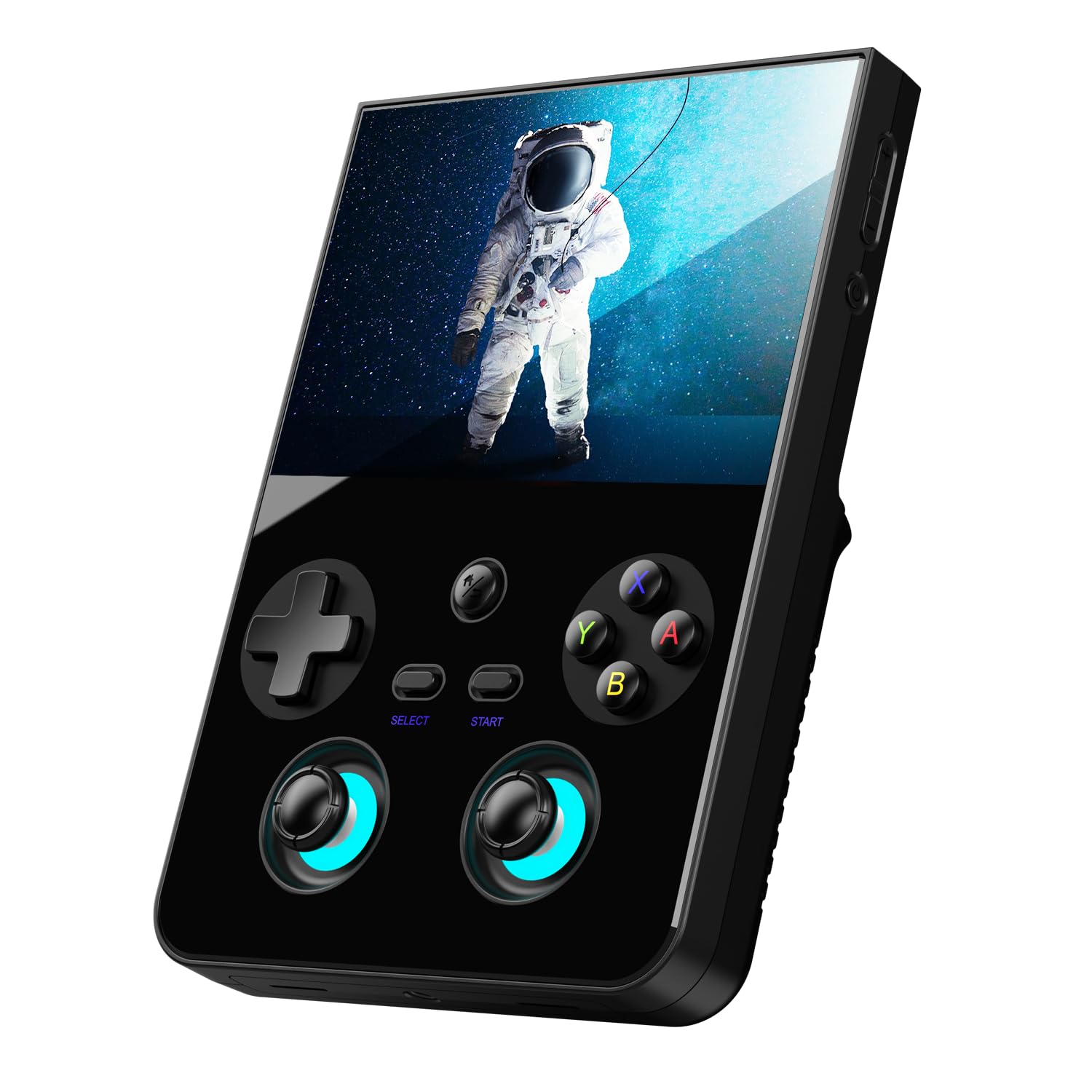

How To Choose The Best Portable Console Emulator
Choosing one of these is less about brand loyalty and more about matching the hardware to the games you actually want to play. A device that runs Game Boy Advance perfectly might choke on a GameCube title. Decide your target consoles first, then pick the chipset that keeps up.
Screen resolution and panel type
A higher resolution gives you sharper visuals, especially on games from the PlayStation era and beyond. Look for an IPS panel (a type of screen with wide viewing angles and better colour) with OCA lamination — that means the glass is bonded directly to the display, which cuts glare and makes colours pop. A 640×480 screen is fine for older 8-bit and 16-bit titles, but a 720×720 or 1080p panel handles 3D games with far more clarity.
Chipset and RAM
The processor (CPU) and graphics chip (GPU) determine which consoles you can emulate without stutter. A quad-core ARM chip with 1GB of RAM handles up to PlayStation 1 comfortably. Step up to a Snapdragon or Dimensity chip with 8GB of RAM and you can push into GameCube, Wii, and even some PS2 territory. More RAM also keeps the system menu snappy when you are switching between emulators.
Linux versus Android
If you want to start playing with minimal fiddling, a Linux-based handheld often boots straight into a game front-end. Android handhelds give you app stores, streaming services, and cloud gaming, but they usually need more setup before you play. Neither is better — it depends on if you want plug-and-play or flexibility.
Battery capacity and portability
The battery figure in mAh (milliamp-hours — the stored charge) tells you roughly how long you can play before hunting for a charger. A 3000mAh cell might get you around six hours on a low-power chip, while a 5000mAh battery paired with a hungrier processor can still stretch into a long session. Also check the weight and dimensions, because a device you cannot comfortably hold for an hour is a device you will leave at home.
Side-by-Side Comparison
| Model | Best For | Screen | Battery | Storage | Amazon |
|---|---|---|---|---|---|
| Retroid Pocket 5★ Best Overall | All-round Android performance | 5.5-inch 1080p touchscreen | 5000 mAh | 128 GB | Amazon |
| RG477VPremium Pick | Premium high-end emulation | 4.7-inch 1280×960 OCA touch | 5500 mAh | 128 GB | Amazon |
| Retroid Pocket 4 ProTop Performer | Powerful mid-tier Android gaming | 4.7-inch touchscreen | 5000 mAh | 128 GB | Amazon |
| Anbernic RG DS | Dual-screen DS and 3DS emulation | Dual 4-inch IPS touch | 4000 mAh | 32 GB | Amazon |
| Anbernic RG40XX H | Budget-friendly Linux gaming | 4.0-inch 640×480 IPS | 3200 mAh | 64 GB | Amazon |
| Miyoo Mini Plus | Pocketable retro emulation | 3.5-inch 640×480 IPS | 3000 mAh | 64 GB | Amazon |
| RG35XXSP Flip | Clamshell portability and GBA nostalgia | 3.5-inch 640×480 IPS | 3300 mAh | 64 GB | Amazon |
| X36 Ultra | Android apps and retro on a budget | 4.2-inch 720×720 IPS | 3500 mAh | 8 GB internal + TF expansion | Amazon |
| RG40TV | Kids and family co-op fun | 4.0-inch 720×720 IPS | 4000 mAh | 128 GB | Amazon |
Detailed Reviews
1. Retroid Pocket 5 Retro Handheld Game Console
Our pick — 4.5+★ from 500+ verified ratings; the strongest balance of quality and price.
The large-screen Android handheld that makes GameCube and Wii look easy instead of hopeful.
Picture a phone-sized slate with real shoulder buttons, a proper gamepad layout, and a 5.5-inch 1080p touchscreen. That screen is the biggest on this list — 57% more screen area than the 3.5-inch RG35XXSP — so text, map edges, and distant enemies stay legible. The Snapdragon 865 processor and Adreno 650 GPU are the engine behind that: older 8-bit and 16-bit games run without breaking a sweat, and indie titles from the app store land smoothly too.
Inside you get 128GB of storage — double the 64GB on the RG35XXSP — plus a microSD slot for expansion. The 5000mAh battery carries 52% more capacity than the RG35XXSP’s 3300mAh cell, so a long train ride or cross-country flight barely registers. Wi-Fi 6 and Bluetooth 5.1 handle cloud gaming and wireless controllers, and Android 13 means you can pull emulators from the Play Store instead of hunting for sideloaded files.
One catch you need to know before ordering: there are no games preloaded. You supply your own emulators and ROMs, which is exactly how a device like this stays flexible — but it is not a turn-it-on-and-play toy. A fresh unit also may ship in battery protection mode, which means you have to plug it in for at least 8 hours before the screen will wake. The trade-off is fair for anyone who already knows their way around a ROM folder.
Where it pulls ahead
- 5.5-inch 1080p touchscreen is the sharpest and largest display here.
- Snapdragon 865 with Adreno 650 GPU handles Android emulators and cloud services with room to spare.
- 128GB built-in storage doubles the RG35XXSP and still takes a microSD card.
Where to set expectations
- No games are preloaded — you must supply your own emulators and ROM files.
- A brand-new unit may need an 8-hour charge before it powers on.
Best for: players who want one Android handheld to cover retro consoles, indie titles, and cloud gaming without carrying two devices.
Skip if: you want to open the box and immediately play a preloaded game library.
2. RG477V Dimensity 8300 Android 14 Handheld
The hardware heavyweight that eats PS2 and GameCube upscaled, provided you bring the games yourself.
The Dimensity 8300 chip inside this thing is a 5G SoC (a system-on-chip — the processor and modem built into one piece of silicon) fabricated on a 4nm process. In plain terms: it runs cool and fast at the same time. Add 8GB of LPDDR5X RAM and a Mali-G615 MC6 GPU, and buyers report it handles PlayStation 2 and GameCube games at upscaled resolutions with ease. The 4.7-inch OCA screen runs at 1280×960, and the full lamination cuts glare so the picture stays crisp in bright rooms.
The 5500mAh battery is the largest on this list, and the manufacturer rates it for seven hours of continuous play — enough for a transatlantic flight. Two Hall effect joysticks (magnetic sensors that resist the drift and wear of traditional sticks) give you more precision and a longer lifespan than standard controls. There is also a six-axis gyroscope, a vibration motor, and a high-speed fan with a heat pipe to stop thermal throttling during long sessions. The RGB lighting on the joysticks is customizable if that matters to you.
Here is the honest catch: this ships with nothing on the storage card. No game card, no preloaded ROMs — you download everything yourself. A few gripes cluster around the speaker quality and the fan noise turning noticeable under load. Mostly, though, this is the handheld that makes you feel like you are holding a dedicated gaming rig rather than a novelty.
Power ceiling: PS2 and GameCube titles upscaled to 2-3x resolution without breaking stride — a straight jump in capability over the lower-end Linux picks.
Weight and heat: The active cooling works, but the fan whine is audible and the speaker is thin compared to the rest of the hardware.
The power play: pick this if you want to run the newer, heavier consoles and you are comfortable sourcing your own ROM library.
Look elsewhere if: you need a game library on day one or you are sensitive to fan noise during long play sessions.
3. Retroid Pocket 4/4Pro Retro Handheld Console
A 4.7-inch pocket powerhouse that runs GameCube and PS2 titles for people who do not mind a little setup work.
The Mediatek Dimensity 1100 octa-core CPU (four A78 cores at 2.6GHz) paired with a G77 MC9 GPU and 8GB of LPDDR4X RAM is the spec sheet of a mid-range phone, not a toy. That translates into smooth GameCube and PS2 emulation, and it even handles native Android games and PC streaming via Moonlight. The 4.7-inch touchscreen sits in that comfortable middle ground — noticeably larger than the 3.5-inch RG35XXSP and Miyoo Mini Plus, but still small enough to slip into a bag without thinking about it.
You get 128GB of UFS 3.1 internal storage — a faster storage standard than the standard flash memory in most budget handhelds, which means games load more quickly — plus a microSD slot for expansion. The 5000mAh battery matches the Retroid Pocket 5’s capacity, and active cooling with a fan keeps the chip happy during long PS2 sessions. WiFi 6 and Bluetooth 5.2 round out the connectivity. At 251g it is heavier than the Linux handhelds, but still light enough for a long commute.
The setup is where this one asks for patience. Installing emulators and games has a learning curve, and while excellent video tutorials exist, it is not instant. Once that work is done, though, the payoff is real — the device runs GameCube, Wii, PS2, and PS1 titles with headroom. If tinkering sounds like a chore, this is not the pick for you; if it sounds like part of the fun, the wait is short.
Why gamers gravitate here
- Dimensity 1100 and 8GB RAM run GameCube, Wii, and PS2 titles smoothly.
- 128GB UFS 3.1 storage and microSD expansion cover a large library.
- 5000mAh battery supports long sessions, with active cooling to prevent throttling.
The fair warning
- Setting up emulators and games takes some technical expertise.
- It runs warmer than the Linux handhelds under extended load.
Reach for this if: you want serious GameCube and PS2 performance in a body that still fits a bag, and you are happy to configure it yourself.
Think twice if: you want zero setup friction from the start.
4. Anbernic RG DS Handheld Game Console
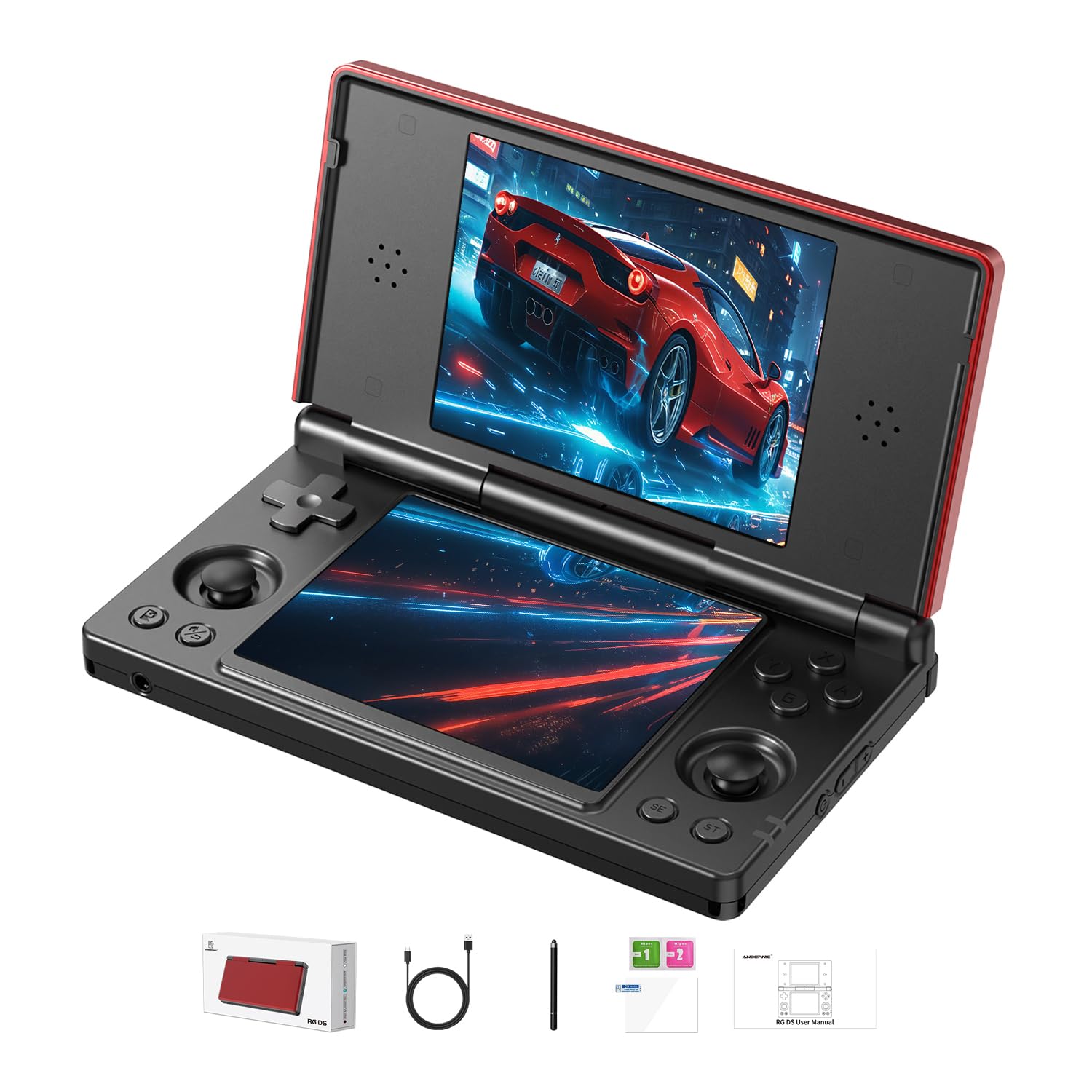
The only pick here with two screens, and the one that actually makes DS and 3DS games feel native.
Most handhelds force a single screen onto a two-screen game. The RG DS does not. It carries two 4-inch IPS OCA-laminated displays, both with capacitive touch and stylus support, so DS and 3DS titles look and play the way they were designed. The quad-core RK3568 CPU at 2.0GHz and Mali-G52 GPU are modest, but they run over 20 emulators without straining. It also handles Android titles and PC game streaming via Moonlight.
That second screen is a genuine multitasking tool. You can play on one panel while a walkthrough, map, or guide sits on the other. The hinge — one of the few aspects with any real complaint attached — holds up well for most owners, though a small number report early failures. Storage is 32GB from the start with a TF card slot that expands up to 2TB, so a full DS library fits with room for video and audio files. The 4000mAh battery covers a solid session, though charging is slower than you would hope.
The honest limitation is power. The RK3568 is not a PS2 or GameCube chip, and the manufacturer positions this device for DS-class emulation rather than the heavier 3D consoles. If your library lives in the DS and Game Boy era, this is the closest thing to a purpose-built clone on the market. If you need PS2 emulation, look at the Retroid Pocket 5 or RG477V instead.
Dual-screen magic: the two touch panels open up maps, guides, and translation side by side with gameplay — a feature no single-screen emulator here can replicate.
Slow to top up: the 4000mAh battery needs a long charging session, and the RK3568 chip caps out below PS2-class emulation.
Made for DS nostalgia: pick this if you want to revisit the dual-screen library with a proper stylus and two real panels.
Pass if: PS2, GameCube, or Wii emulation is the main draw.
5. Anbernic RG40XX H Retro Handheld Game Console

A weighty-feeling 4-inch Linux handheld that comes loaded with over 5,000 games and boots in seconds.
The moment you pick this up, the first thing you notice is that it feels denser and better put together than its price point suggests. The 4-inch IPS panel at 640×480 with OCA full lamination is bright and readable, and the 16-million-colour RGB joystick light can be set to stay on, breathe, or chase. Under the hood is a quad-core ARM Cortex-A53 CPU and PowerVR SGX544MP GPU with 1GB RAM — modest numbers, but enough to keep emulators running smoothly up to the PlayStation 1 era.
You can start playing minutes after opening the box because the 64GB TF card (a small memory card) comes preloaded with a large collection of classic games. The 3200mAh polymer battery is rated for up to 8 hours of continuous play, a 33% longer manufacturer estimate than the RG40TV’s 6-8 hour range. Wi-Fi plus Bluetooth let you pair a wireless controller or stream to a TV through the HD output. At roughly 200g it barely registers in a jacket pocket.
The catch is content. A subset of owners find that the preloaded library skips a lot of the famous titles they were hoping for — no recognizable Pokémon or 90s classics in some units. If your nostalgia hinges on a specific franchise, plan to add your own ROMs to the card. The emulator software and controls are friendly enough that adding games is not a technical hurdle, just an extra step.
The case for it
- 4-inch IPS screen with OCA lamination looks better than the price suggests.
- 64GB card arrives preloaded, so you play right away.
- 3200mAh battery and lightweight body suit commutes and travel.
What to watch for
- A portion of the preloaded library misses key nostalgic franchises.
- The Linux chipset struggles with anything above PS1-class emulation.
A smart first pick: the right fit if you want a bright 4-inch screen and a loaded game card without spending much.
Better elsewhere: if your must-have title is a specific 90s franchise that may not be preloaded.
6. Miyoo Mini Plus Retro Emulator Handheld

A tiny, focused Linux emulator that boots into your games and gets out of the way.
The 3.5-inch IPS screen at 640×480 is small but sharp for 8-bit and 16-bit titles, and the Linux system is tune to run game emulation stably without frame drops. An ARM Cortex-A7 CPU handles the older systems comfortably, and the 3000mAh battery gives you up to six hours of play on a full charge. You also get stereo sound effects, which makes a bigger difference on a small handheld than you might expect.
Two features stand out for a device this size. The RTC (real-time clock — a chip that keeps track of time even when the console is off) means games with day-night cycles or time-based events behave correctly. The upgraded Wi-Fi supports online multiplayer, so you can play with far-away friends. There is also a save and load function plus a favourites folder, so you can drop a game mid-level and pick it up later without losing progress.
The Miyoo supports dozens of emulators from the start and lets you download additional games in relevant formats, though it does not arrive with a full commercial library. It is the most pocketable pick here, and for many people that makes it the one they actually carry. If you want PS2 or GameCube power, it is not the answer — but for pure handheld nostalgia it delivers a lot in a small package.
The pocket factor: at just under seven ounces, it sits in a jeans pocket and disappears — a quality none of the larger Android picks can claim.
The RTC edge: the real-time clock keeps time-based games accurate, and the Wi-Fi opens online co-op, but the chipset tops out well below GameCube territory.
The one to carry daily: ideal if you mainly play 8-bit and 16-bit games on the go and want the smallest console here.
Not for you if: you want to run GameCube, PS2, or Wii titles.
7. RG35XXSP Flip Portable Retro Handheld Game Console
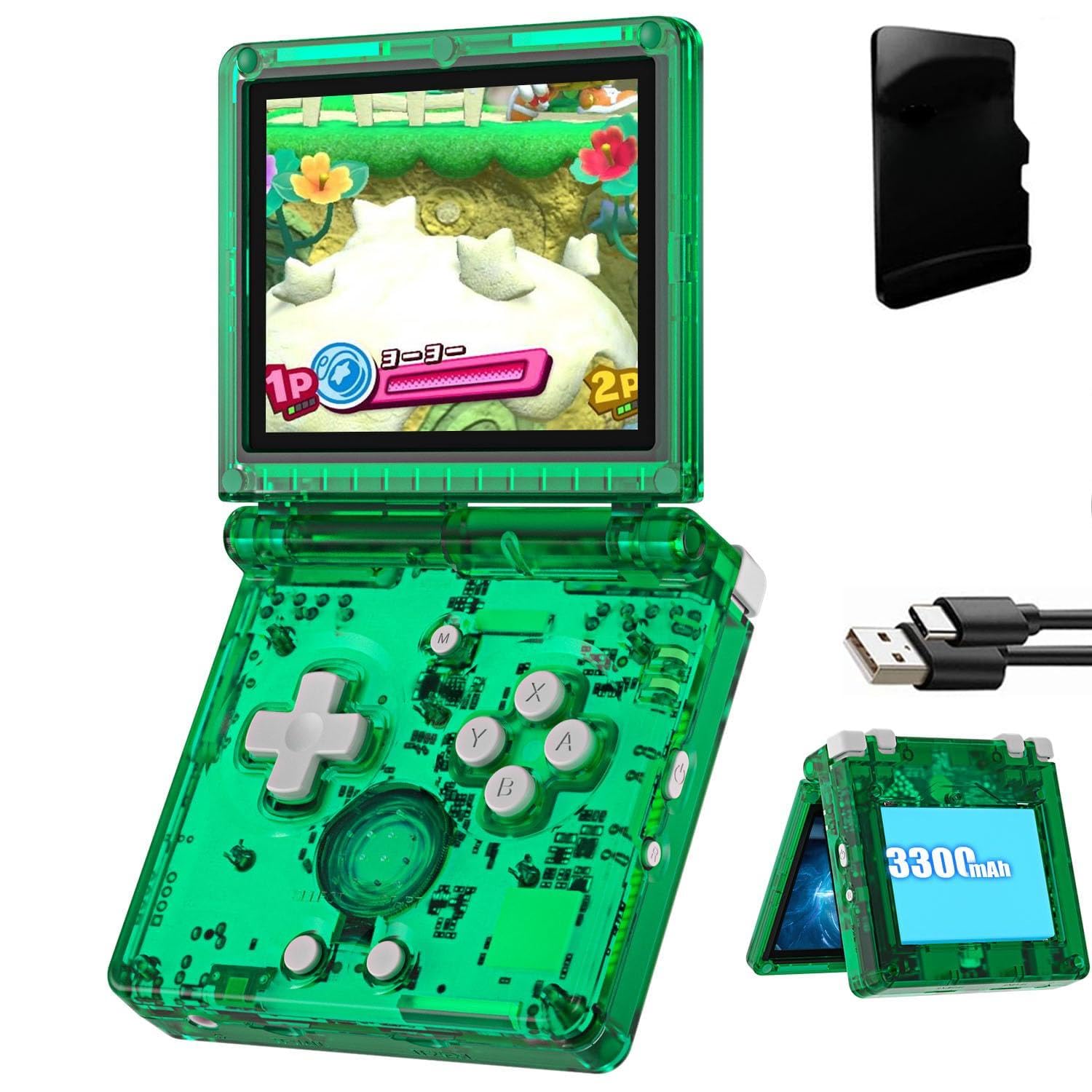
The flip-cover handheld that protects its own screen and gives you Atari-through-PS1 coverage from the start.
The fold-away shell is what makes this one different. Two magnets hold the lid shut, and an alloy hinge lets it hover at 190 degrees or 155 degrees with auto-lock. A Hall sensor chip (a magnetic sensor that detects the lid) wakes the screen when you open it and dims the display when you close it. It is the closest thing to a Game Boy Advance SP on this list. At 3.5 inches and 640×480, the OCA IPS screen (a laminated display that reduces glare) is sharp with saturated colour.
The 64GB card arrives preloaded with 5,532 games across 30-plus supported formats, and you can add more by dropping files onto the dual cards. The 3300mAh battery is a step down from the 5000mAh cells in the Retroid picks, but it still supports USB Type-C fast charging, and it delivers about 7-8 hours of play. Wi-Fi 5G and Bluetooth cover online multiplayer, wireless controllers, and TV output through HDMI.
Two things to know before you commit. First, the buttons can be loud — not a dealbreaker for solo play, but audible in a quiet room. Second, some owners find the battery drains faster under custom firmware, and a few question long-term component longevity. Overall, the flip form factor and preloaded card make it an entry point that rewards people who already understand how ROMs work.
What stands out
- Flip-cover design with magnetic lid and Hall sensor powers the screen on and off automatically.
- 5532 games preloaded across 30-plus formats, ready to play from the start.
- Runs Atari 2600 up through PlayStation 1, with Dreamcast handled well in many titles.
What to know first
- Buttons click loudly enough to notice in a quiet room.
- Custom firmware can pull the battery down faster than the stated runtime.
Nostalgia with a hinge: the pick for GBA SP fans and anyone who wants a preloaded no-fuss library in a pocketable flip body.
Only if noise is not an issue: the buttons are clicky, and custom firmware shortens the battery life.
8. X36 Ultra Retro Handheld Game Console
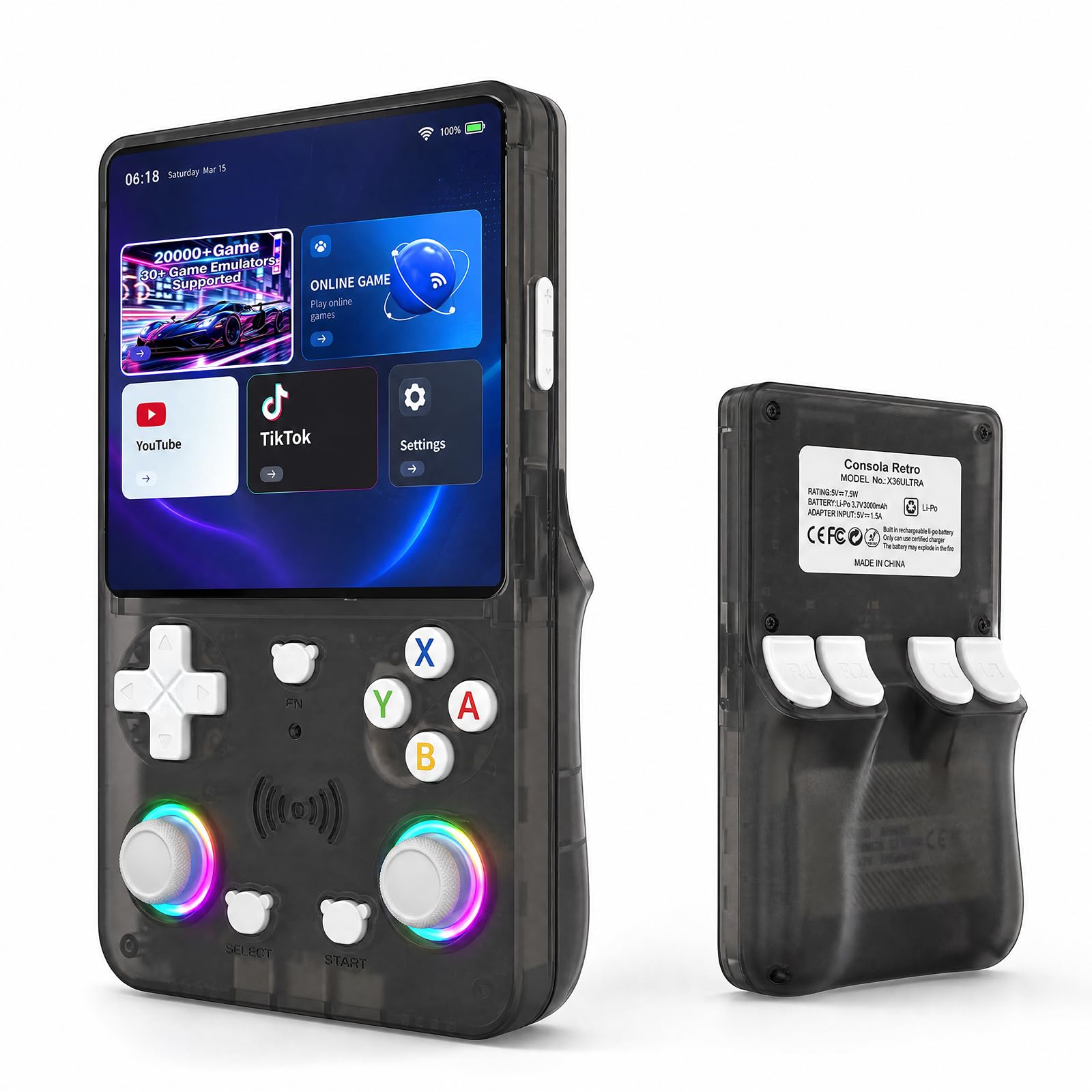
Retro games plus YouTube and TikTok in a lightweight Android body — the odd one out on this list, and proud of it.
Strictly speaking, this is a portable console emulator and a mini Android tablet in one case. The Qualcomm Gen1 quad-core CPU and Mali 450 GPU run Android 10, so you can browse YouTube or scroll TikTok between sessions. The 4.2-inch OCA full-laminated IPS display at 720×720 is the same resolution as the RG40TV’s screen, and the lamination cuts reflection for outdoor use. RGB joysticks and a claimed eye-care panel round out the front.
You get 1GB of RAM and 8GB of eMMC internal storage, with a TF card slot that expands up to 256GB — plenty for a retro library and a few saved videos. The 3500mAh battery offers up to 8 hours of continuous use, and charging over USB Type-C takes about two hours. At 210g it is noticeably lighter than the Retroid Pocket 4 Pro, which matters if you plan to carry it all day. It also supports local room multiplayer and comes preloaded with 20,000-plus classic games.
The honest limitation is that 1GB of RAM and Android 10 hold this back from heavier emulation. It is a fun pick for casual play and video, not a serious GameCube machine. Still, the dual-purpose trick — a retro console that also streams YouTube — gives it a niche no other pick here fills.
Double duty: a retro handheld and a pocket video device in one, at 210g, with TF expansion up to 256GB.
Know the ceiling: 1GB RAM caps the heavier consoles, so treat the emulation side as retro-first and casual.
Best for mixed use: the pick if you want retro games and streaming video in one pocketable device.
Avoid if: GameCube, PS2, or Wii emulation is on your list.
9. RG40TV Retro Handheld Game Console
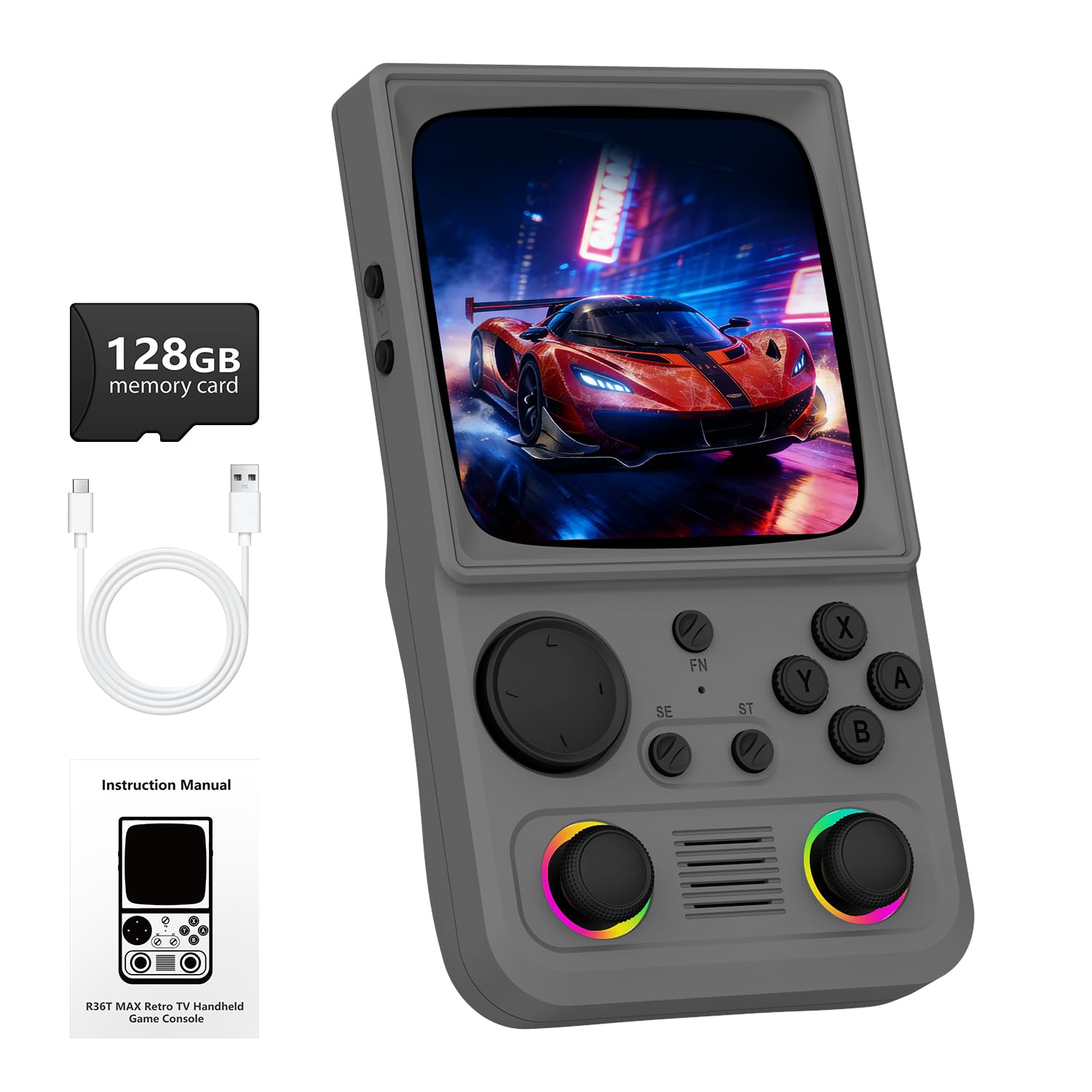
A pick built for family co-op, with a 128GB card loaded with over 22,000 games and a bright CRT-style screen.
The first thing you notice on this one is the screen. The 4.0-inch IPS display at 720×720 uses OCA full lamination and a curved glass frame styled after an old CRT television, and it looks brighter and sharper than its price suggests. The upgraded high-precision joystick with 16 million-colour RGB lighting and 16 adjustable effects is a nice bonus. The EmuELEC Linux system supports 30-plus emulators, and the 128GB TF card loads up with over 22,000 classic games — exactly double the 64GB card on the RG35XXSP.
What makes this one a practical family device is the 5G WiFi and 2.4G OTG wireless controller support. You can pair an extra controller and play head-to-head or co-op, and the setup suits kids learning the controls. A 4000mAh battery delivers a stated 6-8 hours of play, and the included custom carrying case keeps it safe in a bag. You can also hook it up to a TV for living-room play.
The trade-off is power. The EmuELEC chipset targets the classic 8-bit and 16-bit systems, and it handles those older titles well — but it does not punch into GameCube or PS2 territory. A few owners also find the battery drains quicker than the estimate under heavy use. For a kid’s first retro handheld or a family co-op unit, it is a friendly starting point.
Why families like it
- 128GB card arrives with 22,000-plus games and 30-plus emulators ready to play.
- 5G WiFi and 2.4G OTG support make head-to-head co-op easy to set up.
- 4000mAh battery and included carrying case suit travel and living-room sessions.
Where it tops out
- Emulation ceiling sits below GameCube and PS2 class.
- Battery drains faster than the estimate under heavy play.
For the family room: a great fit for kids and co-op play, with a loaded card and a case ready from day one.
Not a power pick: skip this one if you need modern consoles emulated.
Know the Specs
Chipset and GPU
The processor (CPU) and graphics processor (GPU) work together to run emulators without stutter. An ARM Cortex-A53 or A7 chip with a modest GPU handles 8-bit to PlayStation 1 emulation. A Dimensity or Snapdragon chip with 8GB of RAM pushes into GameCube, Wii, and some PS2 titles. Check the chipset before you buy if PS2 or GameCube emulation is your goal.
Screen resolution and panel
Resolution determines how sharp the picture looks. A 640×480 screen is fine for 16-bit systems. A 720×720 or 1080p panel gives you clearer 3D games. IPS panels offer wide viewing angles, and OCA lamination means the glass is bonded directly to the display, which reduces glare and improves colour. Touchscreen support adds on-screen menus and stylus input.
Battery capacity in mAh
The mAh rating is the stored charge. A 3000mAh cell might last six hours on a low-power chip, while a 5000mAh battery can stretch longer even with a hungrier processor. Runtime also depends on the screen brightness and how demanding the emulated console is. Consider the charging method too — USB Type-C fast charging means less waiting between sessions.
Storage and expansion
Internal storage measured in GB holds the operating system and a portion of your games. A microSD or TF card slot lets you add more. Look at the maximum card size the device supports — some go up to 512GB, others up to 2TB. Bigger cards are useful for large game libraries, but most retro titles are small, so moderate storage often goes a long way.
Common Questions
Do these handhelds come with games preloaded?
Can a portable console emulator run PS2 and GameCube games?
Is a Linux or Android handheld easier to set up?
How long does the battery actually last on a full charge?
Will a microSD or TF card work in these devices?
Can I connect a portable console emulator to a TV?
Do these consoles support wireless controllers or multiplayer?
7V support Bluetooth controllers and online multiplayer. Verify the specific pairing method for your chosen model.
Which of these is the best handheld for a child?
Do these emulators require an internet connection?
Will a brand-new handheld power on right from the start?
The Bottom Line
For most people, the portable console emulator winner is the Retroid Pocket 5 because its 5.5-inch 1080p screen, Snapdragon 865, and 5000mAh battery give you the widest range of emulation in a comfortable Android package. If raw PS2 and GameCube power is the priority, the RG477V delivers with its Dimensity 8300 and larger battery. And for a family-friendly unit that plays right from the start, the RG40TV is the one to reach for — just plan for its older-chip emulation ceiling. Match the pick to the consoles you actually want to play.
How we choose
We do not accept paid placement. Every pick is matched to a real buyer and a real use-case; we do not hands-on test units.
Sources
Specifications: manufacturer listings and product documentation. Review insights: verified customer reviews, as of November 2026. Pricing: not shown on this page (it changes often); check the current price via the retailer link.
As an Amazon Associate, Tactical Gear Guy earns from qualifying purchases. This does not affect which products we feature.