Specs are compiled from manufacturer listings and verified buyer reviews and can change over time — please confirm the key details on the product page before buying.
You want to wire a factory car stereo to an aftermarket amp, or fit new speakers to a receiver that only has RCA jacks — and the job stalls on one small part. An RCA to speaker wire converter is the little adapter that joins a round RCA plug to bare copper speaker wire, so the music actually reaches your speakers. Wrong gauge or a bad ground shows up as hiss, hum, or a sub that barely moves.
This guide is built by comparing the manufacturers’ published specifications and the patterns across verified customer reviews, so you get each pick’s real strengths and trade-offs instead of marketing spin.
The picks below split into two jobs — speaker-to-RCA line converters for adding an amp to a stock radio, and bare-wire-to-RCA cables for repairing or extending a run. Both live here, sorted by what they actually do. This breakdown of the rca to speaker wire converter covers wire gauge, connector build, and noise handling so you can wire once and forget it.
Top Picks

How To Choose The Best RCA to Speaker Wire Converter
The first thing to settle is which direction your signal is travelling. A line-output converter takes the high-voltage speaker signal coming out of a factory radio and steps it down to a low-voltage RCA signal an amplifier can accept. A bare-wire-to-RCA cable does the opposite job in a simpler way — it just carries the signal from a plug to raw copper so you can screw it into a terminal. Wrong part in the wrong slot is the number one reason these projects stall.
Match the gauge to the power you are pushing
Wire gauge, written in AWG, is a thickness score where a lower number means thicker copper. Thicker wire carries more current with less resistance, which matters most when a big amp is driving power-hungry speakers. The 20 AWG adapter here suits low-power repairs and line-level work. The 14 AWG options are built for real amp loads. For a subwoofer or a hefty amplifier, 20 AWG adds resistance that chokes bass and volume.
Decide your length before you buy
Length is the spec that quietly wrecks installs. A 16.4 foot run reaches from a trunk-mounted amp up to the dash in a sedan. A 6 foot pair is better for a tidy short hop behind a receiver or in a small cabinet. Buy long and coil the excess; a splice you have to hide is the worse outcome.
Understand noise before you blame the cable
Hum and whine usually come from a ground loop or an unshielded run, not from the copper itself. Gold-plated plugs resist corrosion and keep contact firm over years of plugging and unplugging. A shielded, twisted pair routed away from power wires kills most alternator whine. If a converter has no shield at all, expect to fight noise on sensitive gear like a phono stage.
Side-by-Side Comparison
| Model | Best For | Type | Gauge / Length | Connector | Amazon |
|---|---|---|---|---|---|
| Kicker 46KISLOC K-Series★ Best Overall | Factory radio to aftermarket amp | Speaker-to-RCA line converter | — | Male-to-Female RCA | Amazon |
| RULGOI Bare Wire to RCALong-Reach Fix | Long repair run to a receiver | Bare wire to RCA repair cable | 20 AWG / 16.4 ft | Male-to-Male RCA | Amazon |
| Pixelman 14AWG 6Ft | Driving bigger amps | Bare wire to RCA repair cable | 14 AWG / 6 ft | Male-to-Male RCA | Amazon |
| MOTONG Line Output Converter | Music spectrum displays | Speaker to female RCA converter | — | Speaker to Female RCA | Amazon |
| Yuchenfeng Gold-Plated | Subwoofer and home theater runs | Bare wire to RCA audio cable | 14 AWG | Male-to-Male RCA | Amazon |
| MOBOREST RCA Solder Adapter | DIY soldered connections | Solder-on RCA connector set | — | Male-to-Female RCA | Amazon |
Detailed Reviews
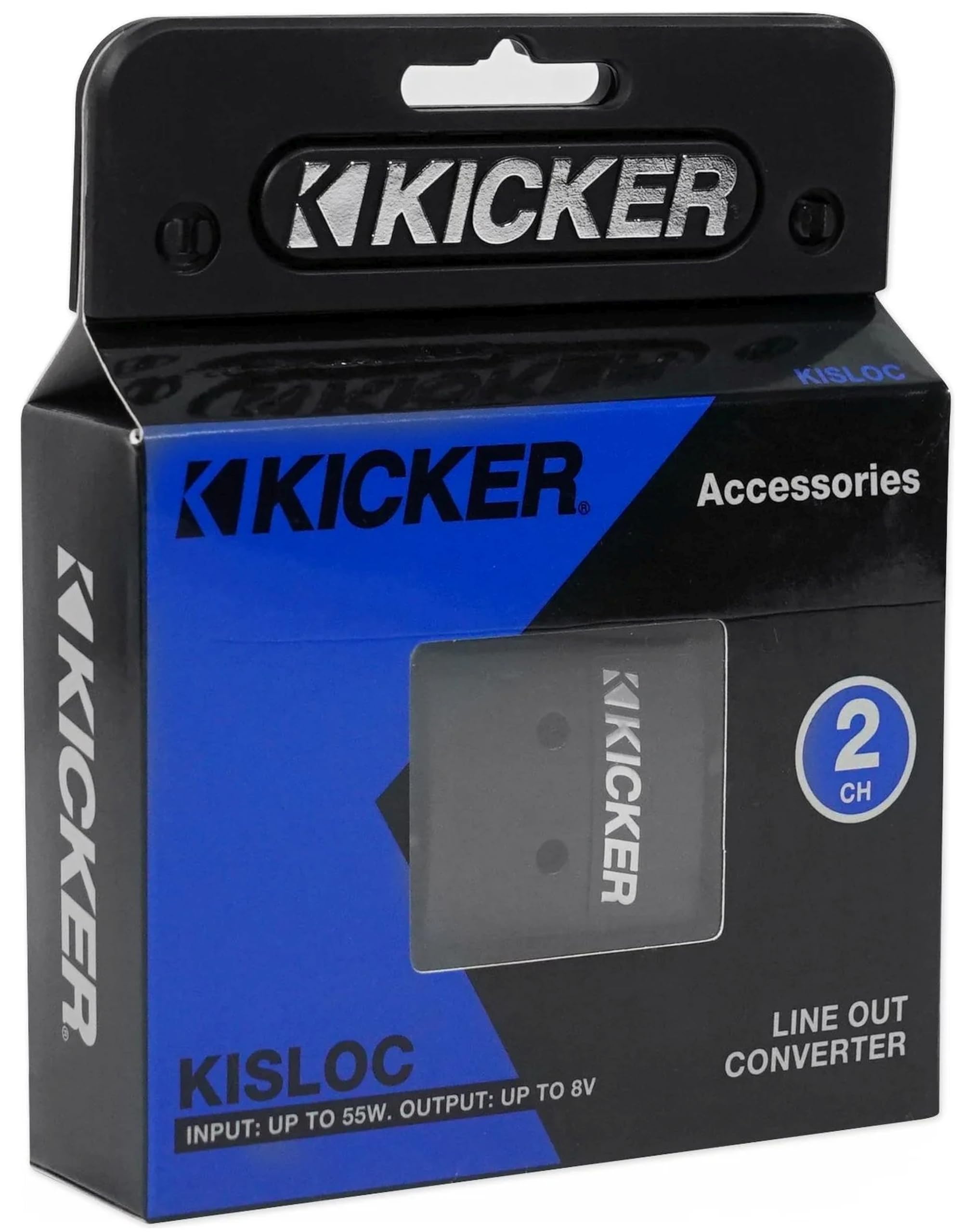
1. Kicker 46KISLOC K-Series Interconnect
Our pick — 4.5+★ from 7,000+ verified ratings; the strongest balance of quality and price.
The two-channel converter that lets a factory radio feed a real amplifier.
If your stock head unit has no RCA outputs and you still want to add a sub or an amp, this is the part that bridges the two worlds. The Kicker 46KISLOC is a two-channel speaker-to-RCA line-output converter. It accepts up to 55 watts of input from your radio’s speaker wires and turns that into as much as 8 volts of output for your amp. That 8-volt figure is the headline: a strong output signal gives an amp a clean, healthy feed to work with instead of a weak one it has to strain to amplify.
The build stays out of the way. It measures small enough to tuck behind interior body panels or a glovebox, and at 3.04 ounces you barely notice it once it is in. Kicker rates it compatible with OEM radios that carry short-circuit protection, and the design is meant to be sonically neutral, so it colors the sound as little as possible. The crowd favorite of this group, it holds 4.5+ stars across 7,000+ ratings — and owners keep coming back to how simple the install is.
Noise is the honest caveat. Most buyers report a clean, quiet signal, but a handful hit hum and have to chase down their ground. That is usually a grounding issue in the car rather than the converter itself, though it is worth knowing you may need to sort your ground before the sound is silent. What wins people over is the sheer quality and reliability of the connection — it does its one job and does it well.
Why This Earns Top Spot
- Accepts up to 55W input and delivers up to 8V output for a strong amp feed
- Small footprint hides behind a glovebox or body panel
- Sonically neutral design keeps your factory sound intact
- Two channels cover a sub or a pair of speakers in one unit
The Realistic Downside
- A minority chase down hum that traces to grounding, not the part
- It is a converter only, so mounting hardware is on you
Best fit: Anyone keeping a factory radio but adding an amp or sub — this is the one to buy first.
Know going in: Budget a little time for grounding; a clean ground is what keeps this silent.
2. RCA to Speaker Wire Adapter 16.4FT
A 16.4-foot reach for when your receiver and your speakers sit far apart.
Where the Kicker is a converter, this RULGOI part is a straight repair cable: an RCA male plug on one end and bare copper on the other. It is the piece you reach for when an existing RCA cable has worn out or when you need to extend a run to a speaker, a receiver, a subwoofer, or a turntable. The headline here is length — 16.4 feet is more than two and a half times the 6-foot pair below, which is the difference between a clean one-cable run and a splice you have to hide. That 2.7x gap matters when your amp lives in a trunk or your bookshelf speakers flank a whole living room.
The conductor is 20 AWG high-purity oxygen-free copper, chosen to keep signal loss low across that longer run. That is thinner than the 14 AWG options, and it fits low-power jobs and line-level work better than a big subwoofer amp. The alloy RCA plug and the red/black leads are marked so you can wire positive and negative without guessing — red to the speaker’s positive, black to its negative. You get two cables in the pack, ready to run a stereo pair.
Quality is clearly the part’s strong suit — buyers single it out most — and the price-to-length ratio is hard to argue with. The trade-off is honest: on sensitive gear some find it noisy, and it needs a source with RCA outputs to be of any use. If you are feeding a phono stage or a delicate line-level signal, keep the run away from power cables. For a straightforward repair or extension, it does exactly what the label says.
What you are buying: Two 16.4-foot, 20 AWG bare-wire-to-RCA cables — enough length for a full-room or trunk-to-cabin run.
The honest limit: Thinner 20 AWG copper and a mixed noise report make it a poor pick for high-power amp loads; choose the 14 AWG pair below if you are pushing real wattage.
Grab this when: Your gear is far apart and you need a long, tidy repair or extension cable.
Pass on it if: You are wiring a big amp — this gauge is built for lighter duty.
3. 14AWG 6Ft RCA to Speaker Wire Adapter 2-Pack

Thick 14 AWG copper for the buyer who is pushing a real amplifier.
This Pixelman pair is the muscle pick of the bare-wire group. Where the RULGOI above runs 20 AWG, this one jumps to 14 AWG pure copper — and the maker rates its cross-section at 4-5 times that of an ordinary adapter. Lower resistance means a steadier signal, which is what you want in front of a power-hungry amp. For a serious amplifier, 14 AWG copper keeps resistance low so the run stays steady under load.
The connectors are metal with high-purity copper conductors, built to survive repeated plugging without the rough, easily deformed feel of cheaper plugs. A spring tail screw guards the bare-wire joint from wear, and the two plugs come in red and black for quick signal identification. You get two cables in the pack, each 6 feet long, with an RCA male on one end and pure copper galvanized bare wire on the other. Six feet is the right length for a tight cabinet or a short hop behind a receiver, and it trades that compactness against the long run the RULGOI covers.
Build quality is where this one earns its keep — sturdy heavy-duty wiring is the recurring theme, and a buyer who tested it at both line level and speaker level found it held up. There are two small catches to plan around. The negative feedback centers on noise in shielded-sensitive setups, since there is no shield wire, so keep it clear of power cables. And the red/black color convention runs opposite to some gear, so verify polarity before you button the panel back up.
What Makes It Sturdy
- 14 AWG pure copper rated at 4-5 times ordinary adapter cross-section
- Metal RCA plugs built for repeated plugging
- Spring tail screw protects the bare-wire joint
- Two cables per pack in red and black for a stereo pair
Plan Around This
- No shield wire, so keep the run away from power cables
- Verify polarity — the red/black convention can read backward vs some gear
Reach for this if: You want heavier-gauge wire in front of a bigger amplifier without a long run.
Look elsewhere if: Your amp and speakers sit far apart — the 6-foot length will not bridge the gap.
4. Speaker to Female RCA Line Output Converter

A tiny two-channel converter aimed at music spectrum displays and RCA-to-amp wiring.
The MOTONG takes a high-voltage speaker signal and steps it down to a low-voltage RCA feed through a two-channel, two-pin design. Its design brief leans toward a specific niche: powering a music spectrum display off a car or home audio system, while also letting you run an RCA cable to an amplifier from a radio that only has speaker-wire outputs. It pairs female RCA out with raw speaker leads in, which is the mirror image of the male-plug cables above.
At 5.67 grams and molded in plastic, it is about as small and light as a converter gets — the kind of part you can mount on a cable and forget is there. The functionality does work: it converts the signal and sends a clean feed through the main speaker leads, with a small black remote wire alongside them.
This is the pick to consider carefully rather than the one to grab blind. Wiring markings are not clear — the positive and negative leads are unlabelled, and the included instructions are not in English — so you will likely need to trace the wiring yourself or open the shell to confirm it. Volume also drops noticeably on some amp setups, so it suits a spectrum display or a light-duty feed far better than it does a high-power sub build. Honest read: buy it for its actual niche, and expect to do some wiring detective work.
Where it shines: Ultra-small, near-weightless, and genuinely functional as a high-to-low converter for a spectrum display or a light amp feed.
The homework it demands: Unmarked positive/negative leads and non-English instructions mean you will trace the wiring before it is right — and output drops on demanding amp loads.
Good match for: Music spectrum display owners and light car/home audio wiring where you are comfortable tracing leads.
Think twice if: You need clear markings or are feeding a high-power subwoofer amp.
5. Yuchenfeng RCA to Bare Wire Speaker Cable

Gold-plated plugs and 200-strand copper aimed straight at subwoofer duty.
The Yuchenfeng leads with its connectors: 24K gold-plated RCA plugs over pure copper shells, built to resist rust and signal loss. Then comes the copper — a 14 AWG oxygen-free core rated at 200 strands, wrapped in double-layer PVC armor meant to fight tangles, cracks, and interference. The gold plating is the detail that pays off over years, since gold does not corrode the way bare metal can, keeping contact firm every time you plug in. A stronger, cleaner contact is exactly what a subwoofer feed wants.
It comes as a stereo pair (L+R), so you can hook up two subs or balance a surround setup in one shot. The bare end is simple by design: strip, twist, and screw into the speaker terminals, with a red stripe and a marked RCA tip for getting right and left right the first time. The flexible jacket survives tight bends behind a rack, and the maker backs it with a 1-year warranty. Quality is what owners mention most — sturdy, well-made, and up to running a demanding sub-and-speaker chain.
The one spec quirk worth flagging is length. Some buyers find the cable runs a few inches short of the stated figure, so measure your run with a little slack rather than cutting it close. A minority also see noise on very sensitive gear. For the everyday job — subwoofer, vintage receiver, home theater — those are small caveats on an otherwise solid piece of cable.
Built For Sub Duty
- 24K gold-plated RCA plugs resist rust and keep contact firm
- 14 AWG oxygen-free copper rated at 200 strands
- Double-layer PVC armor fights cracks and interference
- Stereo pair with a red stripe and marked tip for easy L/R setup
Measure Before You Cut
- Some report the cable running a few inches short of the stated length
- A minority hear noise on very sensitive gear
Ideal for: Subwoofer installs and home theater runs where you want gold-plated, heavy-gauge cable.
Watch for: Leave yourself a few inches of slack — this cable can measure a touch short.
6. MOBOREST RCA Male to Female Adapter

Bare connector shells for the buyer who would rather build the cable than buy it.
This is a different animal from the cables above — it is a set of solder-on connectors, not a finished wire. You get two RCA male plugs and two RCA female to AV terminal connectors, so you can build exactly the cable length your install needs and terminate the wire into an amp or a speaker run yourself. The 24K gold-plated plugs help signal travel cleanly, and the shell is high-strength alloy die-casting under a black baking varnish, built to feel solid and last.
It suits the terminal type found on some amplifiers and pro-audio gear, where you want a proper soldered joint instead of a screw terminal. If a pre-made cable never seems to be the right length or the right plug, a set like this is how you solve that permanently. The maker backs it with a 12-month warranty.
Be clear about what you are buying: this is DIY, and it assumes you own a soldering iron and know how to use it. There is no pre-attached wire, so it does nothing on its own until you do the work. Plan for that skill requirement, and this set becomes a flexible building block rather than a plug-and-play fix.
The build: High-strength alloy shell and 24K gold-plated plugs — four connectors (two male, two female) for a custom joint.
What it asks of you: A soldering iron and some skill; there is no wire included, so it is a parts kit, not a drop-in converter.
For the DIY builder: Perfect if you solder and want custom-length, gold-plated RCA terminations.
Not for: Anyone wanting a plug-and-play cable — this set needs a soldering iron to be of any use.
Know the Specs
Wire Gauge (AWG)
AWG is a thickness score where a lower number means thicker copper. Thicker wire carries more current with less resistance, so it stays steady under the load of a big amplifier. Thin 20 AWG suits low-power repairs and line-level runs. 14 AWG handles real amp and subwoofer loads. Match the gauge to the load you are driving, not to the lowest price.
Input Watts and Output Volts
A line-output converter’s two key numbers are how much it accepts and how much it puts out. The Kicker takes up to 55W of speaker-level input and turns out up to 8V of low-level signal. A higher output voltage gives the amp a stronger input signal, so it amplifies a cleaner feed.
Connector Gender and Type
Male plugs have the center pin; female jacks accept it. A cable’s two ends can be male-to-male, male-to-female, or a bare-wire termination. Get this wrong and the part simply will not join your gear. Check what your amp or radio port is before you order.
Shielding and Noise
A shield is a conductive wrap that blocks interference from power wires and other electronics. Gold plating resists corrosion and keeps contacts firm. On sensitive gear like a phono stage, an unshielded run is where hum creeps in, so route cables away from power lines and confirm a solid ground.
Common Questions
What is the difference between a line-output converter and a bare-wire RCA cable?
Will a converter let me add an amp to a factory car radio with no RCA outputs?
What gauge wire do I need to drive a subwoofer?
Why do I hear hum or alternator whine after installing an adapter?
Can I use an RCA to speaker wire adapter for home audio instead of car audio?
Do the colors on the speaker leads matter?
Do I need a soldering iron for these adapters?
How long should the cable run be for my setup?
Will a male-to-male adapter fit my amp and speaker ports?
What does the 24K gold plating actually do on these plugs?
The Bottom Line
For most people wiring a factory radio to an aftermarket amp, the Kicker 46KISLOC is the answer: 55W input, 8V output, and a tiny body that hides behind a panel — with a firm 4.5+ stars across 7,000+ ratings behind it. If you need a long, tidy repair cable instead, the RULGOI 16.4FT reaches where short cables cannot. And for driving a real amplifier or subwoofer with heavier copper, reach for the Pixelman 14AWG pair or the Yuchenfeng gold-plated cable. Every pick here moves signal from an RCA plug to bare copper or the reverse — match the type, gauge, and length to your job.
How we choose
We do not accept paid placement. Every pick is matched to a real buyer and a real use-case; we do not hands-on test units.
Sources
Specifications: manufacturer listings and product documentation. Review insights: verified customer reviews, as of November 2026. Pricing: not shown on this page (it changes often); check the current price via the retailer link.
As an Amazon Associate, Tactical Gear Guy earns from qualifying purchases. This does not affect which products we feature.