Specs are compiled from manufacturer listings and verified buyer reviews and can change over time — please confirm the key details on the product page before buying.
If you want vocals to sit in their own lane instead of smearing into the bass, a three-way bookshelf speaker is the shortcut. A three-way design splits the job across three dedicated drivers — a woofer for low notes, a midrange for voices and instruments, and a tweeter for the high sparkle — so each one handles less work. This guide covers eight real pairs that actually use that layout, from compact desk speakers to premium passive models that need an amp.
This guide is built by comparing the manufacturers’ published specifications and the patterns across verified customer reviews, so you get each pick’s real strengths and trade-offs instead of marketing spin.
The selection rule here is strict: every pair below uses a genuine three-way driver setup rather than a two-way with a marketing badge. Read on for the full breakdown of the three way bookshelf speakers worth your shelf space.
Top Picks


How To Choose The Best Three Way Bookshelf Speakers
Most buyers start by chasing a big woofer number, then discover the real difference is whether the mids get their own driver. Here is what actually moves the needle when you are buying a pair.
Count the drivers before you read the badge
A true three-way pair carries three separate drivers per cabinet — woofer, midrange, and tweeter. On the ELAC Uni-Fi 2.0 UB52, that midrange is a 4-inch aluminum cone paired with a 1-inch wide-roll surround tweeter, and the bass comes from a separate 5-1/4-inch aluminum cone driver. If the listing only names two drivers, it is a two-way, whatever the headline says. This matters because a dedicated midrange keeps vocals and instruments out of the woofer’s job, so they stay distinct instead of muddying when the bass hits.
Powered or passive: decide who supplies the amplification
A powered pair has its own amplifiers built in, so you plug in a source and go — the ULTIMEA BS-3 runs 70W RMS of built-in amplification, for example. A passive pair like the KEF Q Concerto Meta needs a separate amplifier and speaker wire. Powered boxes suit desk and TV setups where you want fewer cables; passive boxes suit buyers who already own good amplification and want to choose their own.
Match the woofer size to the room you actually have
Woofer size in inches is the clearest signal of how much low-end air the speaker can move. The Edifier R2750DB MKII uses a 7-inch woofer, while the Edifier R2850DB steps up to an 8-inch unit. Bigger woofers tend to fill larger spaces, but they also take up more shelf real estate — and the R2850DB’s own reviewers describe that cabinet as strikingly large. Small room, smaller box; open-plan room, think bigger.
Check the inputs against your actual sources
A TV wants HDMI ARC; a turntable wants RCA or line-in; a phone wants Bluetooth. The ULTIMEA BS-3 covers HDMI ARC, Optical, RCA, USB, and Bluetooth, and the Edifier R2750DB MKII adds HDMI eARC, Optical, Coaxial, and Line-In. Buy for the cables you already own, not the ones you might buy later.
Side-by-Side Comparison
| Model | Best For | Woofer Size | Amplification | Key Connectivity | Amazon |
|---|---|---|---|---|---|
| ELAC Uni-Fi 2.0 UB52★ Best Overall | Critical listening on a stereo amp | 5.25 inches | Passive (6-Ohm nominal) | Wired, 5-way binding posts | Amazon |
| Sony SS-CS5M2Compact Pick | Compact hi-res stereo and surround | 5.12 inches | Passive | Wired | Amazon |
| ULTIMEA BS-3Most Versatile | TV and streaming without a receiver | 5.25 inches | Powered, 70W RMS | HDMI ARC, Optical, RCA, USB, Bluetooth | Amazon |
| Sony SSCS5 Bundle | First hi-res setup on a tight budget | 5 inches | Passive | Wired | Amazon |
| Edifier MR5 | Desk monitoring and home DJ rigs | 5 inches | Powered, 110W RMS | Bluetooth, XLR, TRS, RCA, AUX | Amazon |
| Edifier R2750DB MKII | Living-room music and TV in one box | 7 inches | Powered, 144W RMS | HDMI eARC, Optical, Coaxial, Line-In, Bluetooth 6.0 | Amazon |
| KEF Q Concerto Meta | Building a serious passive hi-fi system | 6.5 inches | Passive — amplifier required | Speaker wire | Amazon |
Detailed Reviews
1. ELAC Uni-Fi 2.0 UB52 Bookshelf Speakers (Pair), Black
Our pick — 4.5+★ from 400+ verified ratings; the strongest balance of quality and price.
A passive concentric-driver pair that images so precisely the stage seems to extend past the cabinets.
The ELAC Uni-Fi 2.0 UB52 is the pick if you already own a decent stereo amplifier and want the cleanest midrange on this list. Its centrepiece is a concentric driver — the 1-inch tweeter sits inside the 4-inch aluminum midrange cone — so high and mid notes leave the cabinet from one point rather than two. That single-point origin is why owners describe a sound stage that seems to reach beyond where the boxes actually sit. The bass comes from its own 5-1/4-inch single-piece aluminum cone driver, which is what makes this a real three-way.
Placement is friendlier than most speakers at this level because the bass ports fire from the front. That means you can push the cabinets closer to a wall or the back of a shelf without the low end turning boomy — a genuine help in a bedroom or small study. A 6-Ohm nominal impedance keeps them compatible with virtually any receiver or amplifier, so you are not hunting for a special amp. The 5-way binding posts accept bare wire, banana plugs, or spades, so whatever cable you have will fit.
The honest catch: these want a break-in period and a decent amp behind them. Early listening can feel flat until the drivers loosen, and the low end will not satisfy someone chasing subwoofer-style thump. If you want plug-and-play bass with no amplifier at all, the powered ULTIMEA below is the better fit. Still, this is the strongest overall pick in this group — a crowd favourite at 4.5+ stars across 400+ owners, and the sonic accuracy is the trait that wins those owners over.
Why it earns top spot
- Concentric 1-inch tweeter and 4-inch aluminum midrange share one acoustic point
- Front-firing ports allow flexible placement near a wall
- 6-Ohm nominal impedance works with virtually all receivers and amplifiers
- 5-way binding posts take banana plugs, spades, or bare wire
Where it asks more of you
- Passive design — you must supply a separate amplifier
- Needs a break-in period before it sounds its best
- Modest bass on its own; no built-in subwoofer output
Worth owning if: you have a stereo amp and care most about vocal clarity and imaging.
Think twice if: you want built-in amplification and app control straight from the start.
2. Sony SS-CS5M2 Bookshelf Speakers
A 5.12-inch three-way cabinet whose super tweeter reaches 50,000 Hz from a shelf-sized box.
Sony’s SS-CS5M2 is the smallest footprint in this list that still delivers a true three-way layout, and it is the pair to grab when shelf depth is the limiting factor. The 5.12-inch woofer handles the low end, a high-precision tweeter covers the top, and a wide-dispersion super tweeter pushes the upper frequencies out into the room. That super tweeter is the reason the claimed frequency response reaches 53-50,000 Hz — well past what most ears catch, which is the point of Hi-Res Audio labelling. The bass reflex enclosure vents low notes cleanly rather than letting them distort.
Where you feel the compact build is at the desk or in a surround setup. Owners who swapped out larger speakers report a clear big sound from a small cabinet, and home-theatre buyers report these hold together at high volume without distortion. That matches the speaker’s own spec sheet: a reinforced cellular cone is built to keep audio undistorted. If you own a Sony AV receiver, the pairing is straightforward since Sony designs these to match.
One practical warning sits in the wiring. These are passive speakers, so a basic TV alone will not drive them — you need an amplifier or receiver in the chain, and owners note that teaming them with a cheap TV takes some connecting effort. On paper they edge out the SSCS5 bundle below on score — 4.8 versus 4.5 — and the sound quality is clearly the trait buying decisions turn on. For a compact, distortion-free pair that still hits deep enough for music and film, this is the budget-adjacent pick that punches above its box size.
Small box, wide stage: the 53-50,000 Hz Hi-Res response and wide-dispersion super tweeter mean more of the room hears the detail, not just whoever sits dead centre.
Plan for an amp: these need external amplification to run, so budget for a receiver if you do not already own one.
Reach for this if: space is tight and you want hi-res detail from a pair that disappears onto a shelf.
Look elsewhere if: you have no amplifier and want to plug straight into a TV.
3. ULTIMEA BS-3 Bookshelf Speakers
A powered 70W RMS pair with HDMI ARC that replaces a receiver for TV sound.
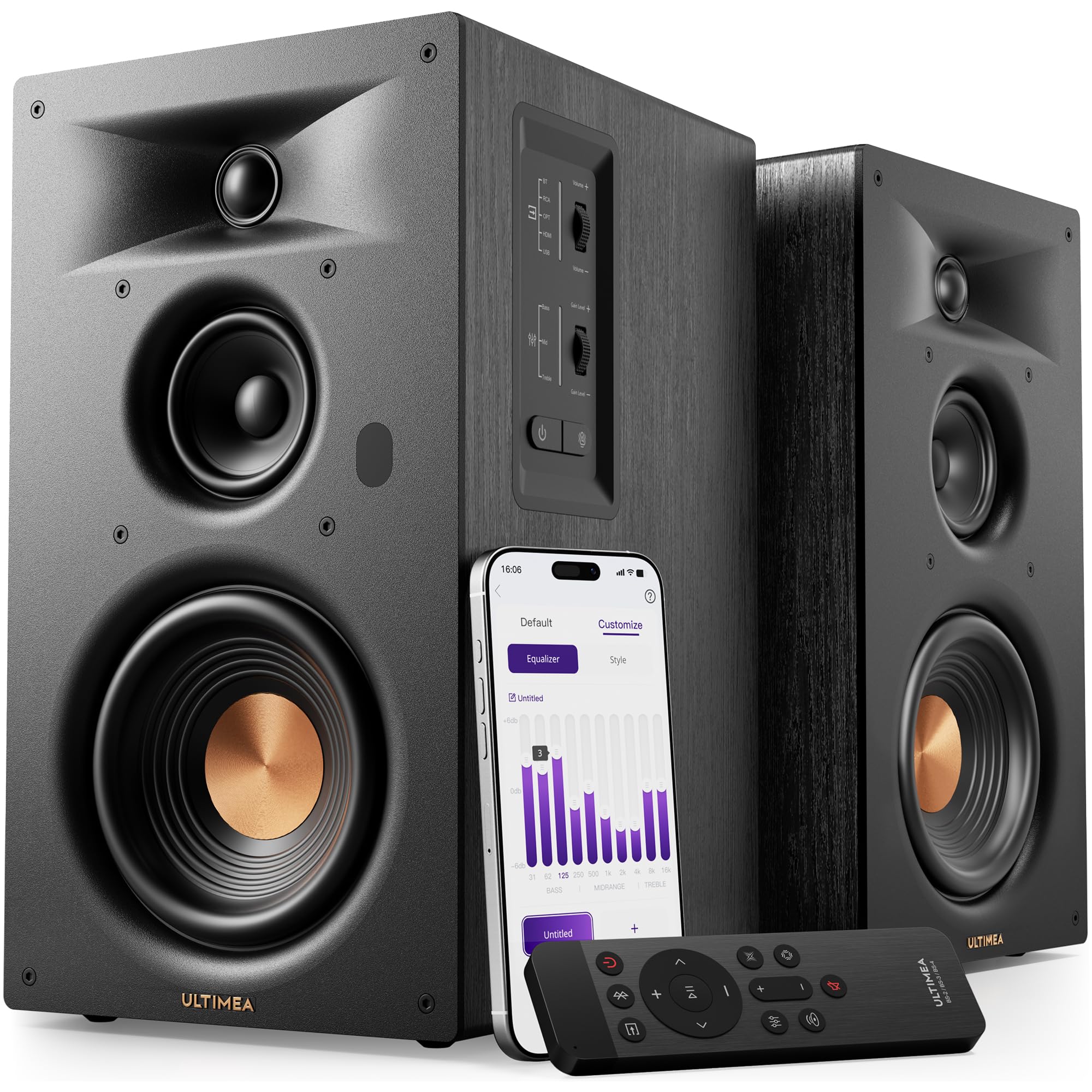
The ULTIMEA BS-3 is built for the buyer who wants better TV and music sound without buying a separate amplifier. Everything is onboard: a 5.25-inch woofer, a dedicated midrange driver, and a tweeter, all driven by 70W RMS of built-in amplification. That 70W figure trails the Edifier MR5’s 110W RMS, so if raw continuous power is your priority the Edifier leads there — but the ULTIMEA answers back with connectivity the desk monitors cannot match.
That connectivity is the selling point. HDMI ARC lets one cable carry TV audio and volume control, and the dedicated SUB OUT port means you can add an external subwoofer later for deeper low end. Alongside those sit Optical, RCA, USB, and Bluetooth, plus Auracast support for syncing multiple devices. Edge horn technology angles the treble toward your seat instead of scattering it, which keeps dialogue focused. BassMX tuning and a 15mm long-excursion woofer push the low end down toward 50Hz without smearing the mids.
The Ultimea App handles EQ, and the custom tuning is genuinely useful for matching a room — though the adjustability is the one area reviewers split on, and the EQ bands require creating an account and signing in before you can touch them. So the app is a helper, not a hands-off luxury. For a TV-first setup where you want ARC simplicity plus optional bass expansion, this is the most flexible powered option on the page.
Everything already onboard
- HDMI ARC, Optical, RCA, USB, and Bluetooth inputs in one pair
- SUB OUT port lets you add an external subwoofer later
- Built-in 70W RMS amplification — no receiver needed
- Ultimea App EQ for tuning to your room
Worth knowing before you buy
- App EQ requires creating and signing into an account
- 70W RMS continuous power sits below the more powerful Edifier options
- Adjustability is the feature that draws the most divided feedback
Built for: a TV or record player setup that needs ARC and Bluetooth without extra boxes.
Skip for: app-free purists who want to tweak EQ from a knob, not a login screen.
4. Sony SSCS5 Bookshelf Speaker System

A budget passive pair that ships with two studio isolation pads for desk or shelf.
For a first leap into a real three-way setup, the Sony SSCS5 bundle is the low-risk entry. You get two speakers plus two studio monitor isolation pads in the box, which saves you from decoupling them from a desk or shelf yourself. The 5-inch woofer handles bass, with Sony’s fine timing alignment across the frequency range giving the low notes a solid foundation rather than a one-note thump. These put out room-filling sound by reproducing instruments with a sense of position and depth.
The 5-inch woofer is very close in size to the SS-CS5M2’s 5.12-inch unit just above — the same class of cabinet, aimed at a different buyer. Where the CS5M2 scores higher, the SSCS5 bundle focuses on value: it is a budget-tier hi-res pair for turntables, desktops, and small living rooms. Turntable owners in particular report clear sound with real bass from records, which is a lot to ask of a budget pair. The isolation pads also count, since they tame the resonance a hard shelf can add.
Be realistic about what a budget passive pair will do. You still need amplification, and the low end, while present, will not match the powered Edifier R2750DB MKII with its 7-inch woofer. If your goal is a first hi-res system on a shoestring, this bundle is honest about its price tier. But if deep bass from the start matters more than saving money, consider stepping up. For everyone starting out, the sound coming off records and phones lands right where a budget buyer hopes.
What the bundle adds: the included isolation pads are the detail most entry pairs skip, and they keep the cabinets from colouring the bass on a hard shelf.
Keep expectations in tier: this is a genuine budget passive pair — it is clear and musical but will not reach down like the bigger powered Edifiers here.
Ideal starter: a turntable or desktop setup where value and a bundled pair matter.
Better elsewhere if: you need real low-end weight or built-in amplifiers.
5. Edifier MR5 Bookshelf Speakers

A 110W RMS active monitor with XLR and TRS inputs built for desk and DJ work.
If your speakers live on a desk beside a PC or a DJ controller, the Edifier MR5 is the one shaped for that job. It runs a true three-way active crossover: a 5-inch long-throw woofer, a 3.75-inch mid driver, and a 1-inch silk dome tweeter, spanning 46Hz to 40kHz. The 110W RMS Class D amplifier pushes 101dB peak SPL — more continuous power than the ULTIMEA’s 70W RMS, and the spec that earns it a spot on a busy desk.
The connectivity is built for studio gear. XLR, TRS, RCA, and AUX inputs let you run turntables, instruments, and mixers alongside Bluetooth 6.0 with multi-point pairing, and a front-panel 3.5mm headphone output means you can switch to headphones without crawling behind the desk. Room tuning happens two ways: rear knobs for high and low frequency, or the EDIFIER ConneX app for low cut-off, desktop control, and acoustic space presets. MDF cabinets keep resonance low, and a dimpled tweeter waveguide spreads the high end across a wider listening area.
Where the MR5 gives ground is low end and sheer output per cubic inch — owners note the bass is tight but the cabinet is not as loud as its size suggests, and the equalisation controls read as barely adequate in the app. That is a fair trade for near-field accuracy. Set them as monitors for production or DJ work and the clarity and multi-source switching hold up. For the most detailed, source-flexible desk pair here, the MR5 is the sharpened-tool choice.
What makes it a desk workhorse
- 3-way active crossover with 5-inch, 3.75-inch, and 1-inch silk dome drivers
- 110W RMS Class D power and 101dB peak SPL
- XLR, TRS, RCA, AUX inputs plus Bluetooth 6.0 multipoint
- Front 3.5mm headphone out and rear room-tuning knobs
Honest limits
- Bass is tight but not deep — a subwoofer would fill the gap
- Not as loud as the cabinet size implies, per owner feedback
- App equalisation described as adequate rather than generous
Made for: producers, DJs, and desktop listeners who need clean near-field sound and many inputs.
Not the pick for: a living-room TV rig where deep bass and ARC matter more than accurate monitors.
6. Edifier R2750DB MKII Bookshelf Speakers
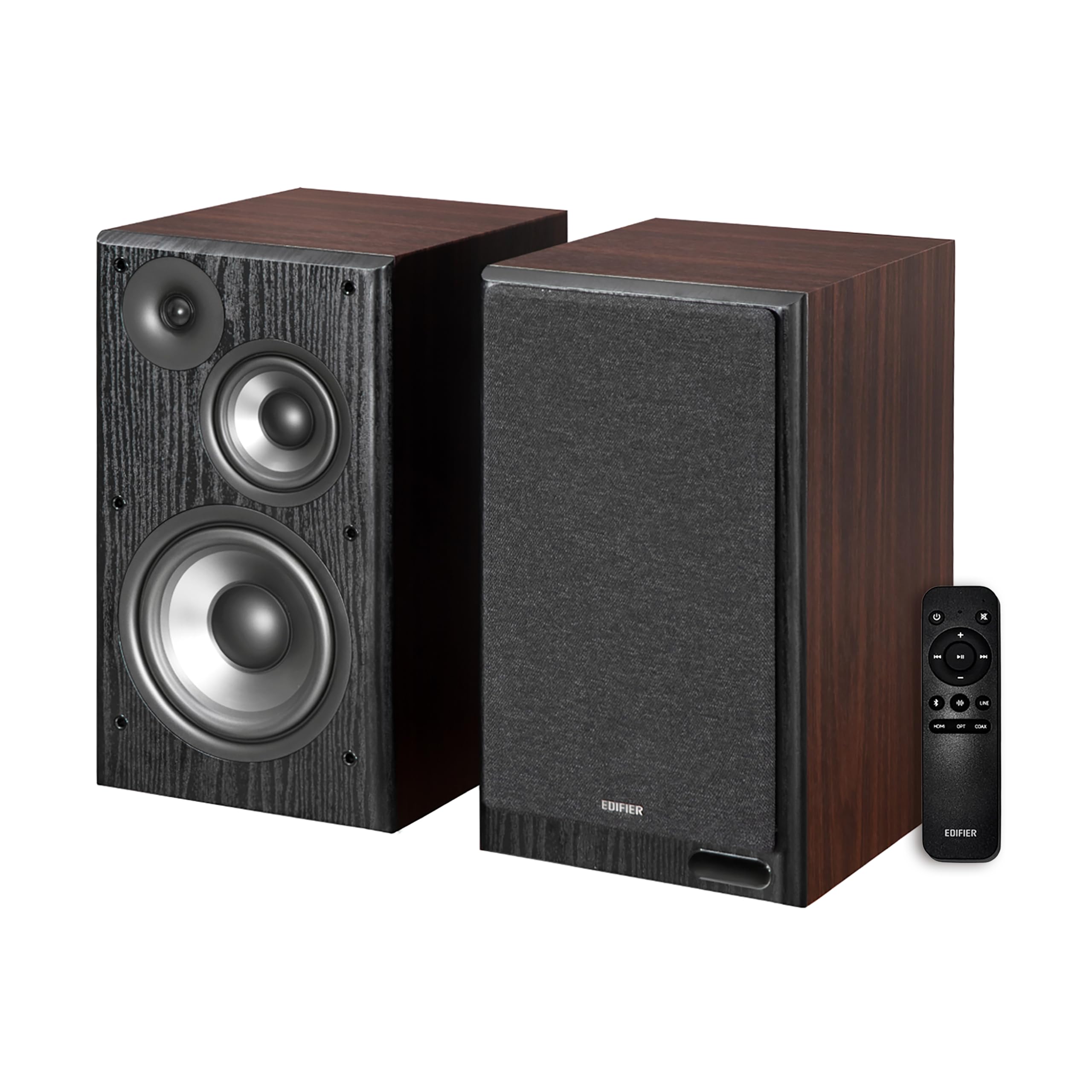
A quad-amped 144W RMS three-way with a 7-inch woofer and HDMI eARC for music and TV.
The R2750DB MKII is where Edifier bolts real power onto a three-way layout. A 7-inch woofer, a 4.5-inch midrange, and a 1-inch silk-dome tweeter are each driven by their own Class-D amplifier — quad-amping, in the maker’s language — across 144W RMS. That separates it from the ULTIMEA’s single 70W RMS amp and puts genuine low-end push behind it. Owners mention substantial bass without a subwoofer and a wide soundstage, which is exactly what a large woofer buys you in a living room.
The connections suit a shared space. HDMI eARC carries TV audio with one cable and volume control, while Optical, Coaxial, and Line-In feed a CD deck, turntable, or console. Bluetooth 6.0 with multipoint keeps phones and laptops attached. There is also a SUB OUT port if the 7-inch driver ever falls short. On tuning, you choose from 4 presets — Classic, Monitor, Dynamic, and Vocal — or build your own with a 9-band EQ in the EDIFIER ConneX app, and a physical remote handles playback and source switching without reaching for your phone. Hi-Res Audio and Hi-Res Audio Wireless certification round out the spec sheet.
Two honest notes. Bass is strong but stops short of subwoofer depth, so movie rumble fans may still want the SUB OUT filled. And the app’s tuning depth is deeper than the on-box controls, so app-averse buyers should plan on the remote instead. Walnut finish and sturdy cabinets draw compliments in owner notes, and the remote gets used daily. For a TV-and-music pair with real amplifier headroom, this is the balanced middle of the premium tier.
Amped three ways: quad Class-D amps plus a 7-inch woofer mean louder, fuller sound than any single-amped pair here — with bass you can feel, not just hear.
The physical catch: it is a large cabinet; leave real clearance on the shelf, not a few centimetres.
Buy it for: a mixed living-room diet of movies, streaming, and vinyl that wants one powered pair to cover it.
Hold off if: your shelf is shallow or you already own a big amplifier and prefer passive speakers.
7. KEF Q Concerto Meta Bookshelf Speakers

A passive Uni-Q pair with MAT tweeter absorption for a system you plan to keep and upgrade.
KEF’s Q Concerto Meta is a passive pair for listeners ready to invest in amplification and want the cabinet to grow with the system. Its centrepiece is the 12th Generation Uni-Q — the tweeter is mounted at the acoustic centre of the midrange driver so high and mid notes radiate from a single point. A 6.5-inch hybrid aluminium bass driver handles the low end. The result is a three-way pair aimed at greater clarity and a more convincing soundstage than typical budget boxes — the kind of detail the ELAC delivers with its concentric layout, raised here with KEF’s own engineering.
KEF’s damping trick is the differentiator. Metamaterial Absorption Technology, or MAT, absorbs 99% of unwanted sound from behind the tweeter, the maker claims, which is a genuine attempt to reduce distortion before it reaches your ears. Even dispersion means more of the room hears the same sound rather than just one sweet-spot seat. Because it is passive, you supply the amplifier and speaker wire, and that is the point: you can upgrade the amp or add matching speakers for home theatre later without replacing the pair.
This is the largest responsibility of any pick here — KEF states a 5-year spare part availability on the pair, a real signal of longevity. But the price tier sits at the top, and the crowd evidence is thinner than the ELAC’s deeper review base, so the KEF trades volume of feedback for the sophistication of its design. If your plan is a long-lived hi-fi system and clarity is the goal, the Q Concerto Meta is the target. If you want instant sound without amplification, look to the powered Edifiers instead.
Engineered for detail: Uni-Q single-point sourcing plus MAT rear-tweeter absorption is the most tech-forward three-way design on the page.
Amplifier required: the pair is passive, so pair it with an amp and plan the rest of the system around it.
For the long-haul builder: someone assembling a stereo setup they intend to keep and upgrade around.
Not the easy option: no amplification and no app — this pair relies on your existing gear to even power on.
Know the Specs
Driver Configuration (3-Way)
A three-way speaker splits the audio signal across three dedicated drivers: a woofer for low frequencies, a midrange for voices and instruments, and a tweeter for the high end. Each driver handles a narrower band, so it can do its job with less distortion. That is why a true 3-way pair keeps vocal detail intact when the bass is working hard — a cheaper two-way must shuffle lows and mids through one cone, and detail can blur under load.
Woofer Size and Bass
Woofer size, measured across the cone in inches, tells you how much low-end air the cabinet can push. The Edifier R2850DB’s 8-inch unit sits at the top of this group; the compact Sony pairs use 5-inch-class woofers. Bigger woofers usually mean deeper, louder bass, but they also demand a bigger cabinet and more shelf space, so match the woofer to your room rather than chasing the number.
Amplification: RMS and Powered/Passive
RMS watts describe continuous, clean power rather than peak bursts. A powered pair has its own amplifiers built in; a passive pair needs your receiver or amp to drive it. The Edifier R2750DB MKII delivers 144W RMS through quad Class-D amps, while a paired passive speaker like the KEF leans on whatever amplifier you own. Match this spec to the gear you already have on the shelf.
Inputs, Impedance and Hi-Res
Impedance, measured in Ohms, describes the electrical load the speaker presents to an amplifier — a 6-Ohm nominal rating like the ELAC’s means it works with virtually all receivers and amps. Inputs like HDMI ARC, Optical, Coaxial, and RCA decide which sources connect directly. Hi-Res Audio labelling refers to higher sample-rate audio support, often paired with Bluetooth codecs like LDAC for wireless playback close to wired quality.
Common Questions
What actually makes a speaker three-way?
Do these speakers need an amplifier?
Will a pair fit neatly on a bookshelf?
How do I connect a TV to powered bookshelf speakers?
Can I add a subwoofer to a three-way pair?
What is 6-Ohm nominal impedance and does it matter?
Is a bigger woofer always better for bass?
What does Hi-Res Audio mean on these speakers?
Will Bluetooth audio sound as good as a wired connection?
Do these speakers need break-in before they sound right?
The Bottom Line
For most listeners building a serious stereo system, the winner is the ELAC Uni-Fi 2.0 UB52 — its concentric driver and front-firing ports deliver imaging and clarity that outclass its cabinet size, and it is the pair owners are most loyal to. If you want an all-in-one powered setup with HDMI ARC and Bluetooth, the ULTIMEA BS-3 is the flexible, no-amp choice. And for a big room that needs weight, the Edifier R2850DB with its 8-inch woofer is the one to reach for.
One nudge before you decide: the ELAC’s 4.5+ star standing is the strongest sentiment behind any powered or passive pick here, and it earns that on sound accuracy rather than extras — so if detail is your goal, that is the pair to start with.
How we choose
We do not accept paid placement. Every pick is matched to a real buyer and a real use-case; we do not hands-on test units.
Sources
Specifications: manufacturer listings and product documentation. Review insights: verified customer reviews, as of November 2026. Pricing: not shown on this page (it changes often); check the current price via the retailer link.
As an Amazon Associate, Tactical Gear Guy earns from qualifying purchases. This does not affect which products we feature.