Specs are compiled from manufacturer listings and verified buyer reviews and can change over time — please confirm the key details on the product page before buying.
You want real photos, not phone shots that fall apart the moment you zoom. A value-priced compact or a renewed DSLR can still give you genuine optical zoom, a proper sensor, and full manual control. The trick is knowing which specs — optical zoom, sensor size, aperture — actually change your pictures.
This guide is built by comparing the manufacturers’ published specifications and the patterns across verified customer reviews, so you get each pick’s real strengths and trade-offs instead of marketing spin.
Below you’ll find nine cameras sorted by what they genuinely do well, from pocket vloggers to long-zoom bridge bodies. Every pick here is a top budget camera in the sense that matters — it earns its place on performance, not on a spec sheet.
Top Picks


How To Choose A Budget Camera
Start with the lens, not the megapixel count. A 64MP sensor crammed into a tiny body with digital-only zoom gives you big files and soft pictures. A 16MP body with real optical glass gives you a sharp print. Chasing the biggest megapixel number usually disappoints; checking optical zoom and sensor size usually pays off.
Optical Zoom Versus Digital Zoom
Optical zoom moves glass to magnify the scene — the picture keeps its detail. Digital zoom simply crops the sensor and stretches the result, so a 16x digital zoom can look mushy next to a 5x optical lens. If you shoot birds, sports, or anything far away, count the optical number first and treat the digital number as a bonus.
Sensor Size And Low-Light Performance
A 1-inch sensor gathers more light than a 1/2.3-inch sensor, which is why premium compacts hold up in dim rooms and the small-sensor crowd gets grainy. Pair that with a fast aperture — a lower f-number like f/2.0 lets in more light than f/3.6 — and you can shoot indoors without a flash. For daylight travel shots, the smaller sensor is fine.
Batteries, Cards, And What’s In The Box
Check what actually ships. A second rechargeable battery and a bundled memory card save you a separate purchase and a dead-camera afternoon. Watch the card type too: some bodies take microSD and some take full-size SD, and a Class 10 card is what most 1080p video needs. A kit that arrives without the advertised card is a hassle, so open the box and check before your first trip.
Side-by-Side Comparison
| Model | Best For | Optical Zoom | Sensor | Video | Amazon |
|---|---|---|---|---|---|
| G-Anica 5K 64MP Dual-Lens WiFi★ Best Overall | Beginners and vloggers | 16x digital | 64MP | 5K | Amazon |
| KODAK PIXPRO FZ55 BundleCrowd Favorite | Everyday pocket shooting | 5x optical | 16MP | 1080p | Amazon |
| KODAK PIXPRO AZ528Best Reach | Wildlife and distant subjects | 52x optical | 16MP BSI CMOS | 1080p | Amazon |
| Canon PowerShot V10 | Vlogging and travel video | Fixed 19mm wide | 15.2MP 1-inch CMOS | 4K at 30fps | Amazon |
| Nikon D3300 (Renewed) | Learning on a DSLR | 18-55mm Nikkor lens | 24.2MP CMOS | Full HD | Amazon |
| Canon EOS Rebel T7 (Renewed) | Starter DSLR with room to grow | 18-55mm lens | 24.1MP CMOS | Full HD | Amazon |
| Canon PowerShot IXY 650 Bundle | All-in-one travel bundle | 12x optical | 20.2MP CMOS | 1080p at 30fps | Amazon |
| Panasonic 4K Point and Shoot | Long-zoom 4K travel shooting | 60x optical | — | 4K | Amazon |
Detailed Reviews
1. G-Anica 5K 64MP Dual-Lens WiFi Camera Bundle
Two lenses, two batteries, and a tripod, so your first upload never waits on gear.
If you are starting a channel from scratch, this kit answers the annoying beginner question of what else to buy. You get the camera body plus a wide-angle lens for scenery and a macro lens for tight close-ups, and the wide-and-macro pairing means you can frame a landscape shot and a jewelry shot on the same walk. The 16x digital zoom is a crop-and-stretch affair rather than true glass, so treat it as a framing helper instead of a way to shoot distant birds.
The 180-degree flip screen is the practical highlight — you can frame yourself during a live stream or video call and confirm you are actually in shot. Built-in WiFi pushes clips straight to your phone for an immediate share. Two 1500mAh lithium-ion packs plus a 32GB card ship in the box, so a long afternoon of shooting is covered.
The rotary mode dial moves you between portrait, timelapse, filter effects, scene mode, video, burst, and auto without a menu hunt, and face tracking plus grid lines help you keep a subject placed properly. The bundle rounds out with an external microphone, a fill light, a three-piece filter set, and a tripod stand — real additions, not filler. The catch worth naming: this is a connected, app-sharing camera for near subjects, so if your heart is set on a long telephoto reach, the PIXPRO AZ528 below will serve you better.
What Sells It
- Wide plus macro lens covers scenery and close-ups
- Two 1500mAh batteries and a 32GB card included
- 180-degree flip screen makes self-framing simple
- Rotary dial with portrait, timelapse, and filter modes
Where It Tapers Off
- 16x zoom is digital, so far subjects lose detail
- No flash on the body
- Built for app-sharing and short-range shooting
Reach for this if: you are filming yourself, shooting close products, or want one box that covers the whole first month.
Pass it over if: distant wildlife or stadium sport is your main target — you want optical zoom instead.
2. KODAK PIXPRO FZ55 Compact Zoom Bundle
A pocket camera that quietly out-reviews most of this list.
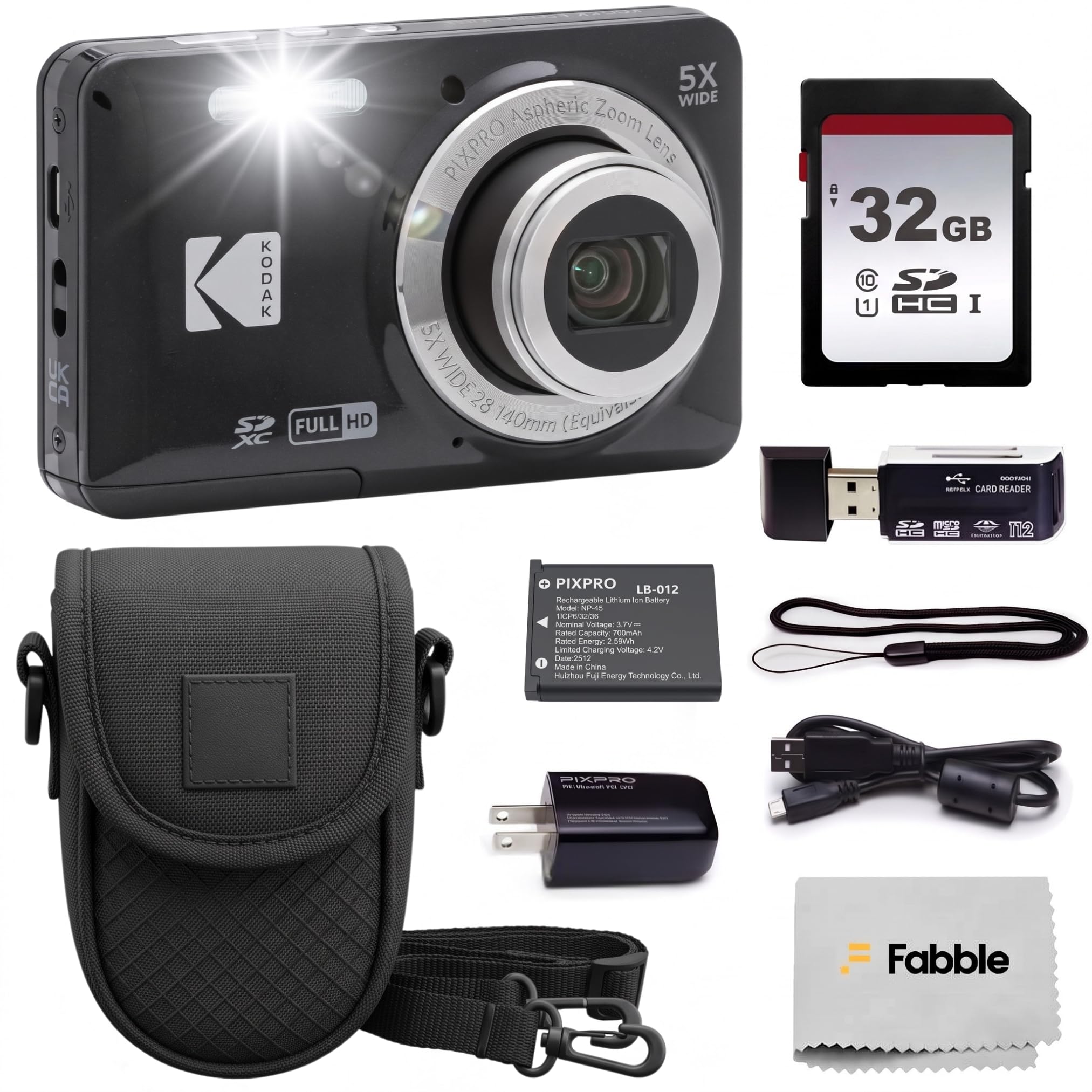
This is the crowd favorite on the whole page — 4.5+ stars across 300+ ratings, and the thing that wins people over is build-and-image quality above everything else. A 16MP sensor sits behind a 28mm wide-angle lens with 5x optical zoom and both digital and optical image stabilization, which is the combination that keeps a handheld shot steady in real light. It records 1080p Full HD video and frames everything on a 2.7-inch LCD.
Two specs deserve attention because they beat bigger-looking rivals. The autofocus system carries 179 focus points — that is 179 versus 25 on the KODAK AZ528 further down, so the FZ55 locks onto subjects across far more of the frame. Bit depth comes in at 12 Bit versus 8 Bit on the AZ528, which means finer color gradation in each file. Neither number appears on the box in big letters, and both change how the photos actually look.
Portability is the other half of the story. It’s small enough to carry everywhere and light enough that kids and teens pick it up without a lesson, and the nostalgic look of the body earns its own fans. The bundle includes the camera, a 32GB SD card, a case, a card reader, and a cleaning cloth. One real snag: a few bundles have arrived without the advertised SD card, so open the box and confirm before your first outing.
The pocket-camera value play: real 5x optical zoom, stabilization, and a 16MP sensor in a body small enough to live in a jacket pocket — with the card and case already in the box.
Give it a gentle hand: the build is compact rather than armored, and one functionality gripe centers on a missing bundle card, so verify contents on arrival.
Best for: travelers, teens, and anyone who wants genuine zoom without a camera bag.
Look elsewhere if: you need 52x reach or a large sensor for dim rooms.
3. KODAK PIXPRO AZ528 16MP Bridge Camera
Fifty-two times closer, and still sharp enough to count craters.
The defining number is 52x optical zoom, and it is real glass rather than a digital crop. A 24mm wide-angle lens spans landscapes all the way to a tight telephoto of birds, wildlife, or athletes, and built-in optical image stabilization counters hand movement even at full reach. That stabilization is what lets you shoot handheld at extreme zoom instead of dragging a tripod everywhere. A 16MP back-side-illuminated CMOS sensor adds better low-light behavior than a plain small sensor.
Speed matters for moving subjects, and 6fps burst mode fires rapid sequences so you can keep the sharpest frame after the fact. Built-in WiFi transfers photos to your phone or tablet from the field, and you can use the phone as a live remote viewfinder. It records 1080p Full HD video and accepts Class 10 SD, SDHC, or SDXC cards up to 1.5TB, which is enough for thousands of photos and hours of video on a single card.
Now the reframe. This is not a pocket camera and not the sharpest low-light body; what it is, is the most reach per dollar on this list. The autofocus system carries 25 points — a meaningful step down from the 179 on the FZ55 above — and focus hunting at full zoom is the recurring complaint. The moon-crater story is the fun one: with 52x optical, distant detail genuinely lands in frame. Expect a learning curve and brace for the occasional soft shot when the subject is far and moving fast.
What it does better than anything here: 52x optical zoom with stabilization, WiFi sharing, and 6fps burst in one body.
What you trade: 25 autofocus points mean more focus hunting, and the wide zoom range expects a steady hand at full extension.
Worth grabbing for: backyard birdwatching, stadium seats, and any shot that starts from far away.
Think twice if: you shoot mostly indoors in low light or want a camera that vanishes into a pocket.
4. Canon PowerShot V10 Compact Vlogging Camera

A one-inch sensor in a body that fits a fanny pack.
The sensor is where the money goes: a 15.2-megapixel 1-inch back-illuminated CMOS chip is large for a compact, and it is the reason low-light clips look clean instead of noisy. Video shoots 4K at up to 30 frames per second and Full HD at up to 60, with 14 movie color filters on hand for mood. Two stereo microphones sit up front, and a third microphone in the middle works to cut unwanted background noise.
The lens is fixed at 19mm (35mm equivalent) — a wide field of view that fits your face and the room behind you, but cannot zoom in. That is the point: you hold it at arm’s length or prop it on the fold-out stand. The stand folds front or back for hands-free angles, and the retractable front-facing screen lets you see yourself while recording. Three image stabilization modes (off, on, and enhanced) arrived in a firmware update, so check the body is on version 1.2.0 or later.
Battery life is the recurring gripe here — Canon rates it at 2 hours, and for all-day shooting you will want a spare or a USB-C top-up. A fixed wide lens also means you frame with your feet. If you vlog on the move and can live with those, it’s worth the buy; if you need reach or a full day on one charge, the AZ528 or a DSLR is the better fit.
The vlogger’s build: 1-inch sensor, 4K at 30fps, stereo mics plus a noise-cutting third mic, and a fold-out stand for hands-free setups.
The honest catch: a 2-hour battery rating and a fixed 19mm lens mean charging breaks and foot-powered framing.
Right choice for: talking-head creators, travel vloggers, and anyone who shoots video more than stills.
Not your pick if: you need zoom or a long day of shooting on one battery.
5. Nikon D3300 24.2MP CMOS DSLR (Renewed)

An interchangeable-lens DSLR for the price of a mid-range compact.
A 24.2MP CMOS sensor behind an 18-55mm Nikkor lens buys you something no point-and-shoot on this page can: a real optical viewfinder and the ability to swap glass later. The Nikon F mount opens up a huge used lens market. Its manual controls and optical viewfinder make it a hands-on way to learn aperture and shutter speed.
This is a Certified Refurbished unit, which means the body was tested, cleaned, inspected, and repackaged. It ships with all relevant accessories and a minimum 90-day warranty, and it may arrive in a generic box rather than Nikon packaging. That’s normal for renewed gear — the box is not the product. Buyers moving up from a phone tend to notice the picture clarity first; the sensor and lens simply resolve more detail than a small compact can.
The fit question is honest: this is a DSLR, so it is bigger and heavier than a pocket camera, and it is best for someone willing to learn the controls rather than point and shoot. The lens supplied is a standard 18-55mm zoom, so if you need long reach you will buy a second lens. For a first DSLR that teaches manual controls and accepts new lenses as you grow, it’s the smart entry.
Why It Earns a Spot
- 24.2MP sensor with an 18-55mm Nikkor lens included
- 50 autofocus points for confident subject tracking
- Nikon F mount lets you add lenses over time
- Certified refurbished with a minimum 90-day warranty
What to Know Before Buying
- Larger and heavier than a compact
- May arrive in a generic box, not Nikon packaging
- Standard 18-55mm lens — no long telephoto included
Pick it if: you want a proper DSLR to learn on and don’t mind buying lenses as you grow.
Skip if: you want something pocketable that works on full auto with no learning curve.
6. Canon EOS Rebel T7 DSLR with 18-55mm Lens (Renewed)

The beginner DSLR with the easiest on-ramp to real photography.
A 24.1MP CMOS sensor is the foundation, and it holds detail well even in tough light. The ISO range runs 100 to 6400 and expands to 12800, which is the dial you raise when the room is dim and you cannot use a flash. Autofocus is a 9-point system with AI Servo AF that tracks a moving subject, and Scene Intelligent Auto handles settings for you while you learn. The 3.0-inch LCD plus built-in Wi-Fi and NFC make sharing straightforward.
Here’s the number that separates it from the Nikon above: 9 autofocus points versus 50. The Nikon wins on focus coverage with 50 points versus 9, but the T7’s wider EF and EF-S lens mount is the bigger long-term advantage. It takes Canon EF and EF-S lenses and Canon EX Speedlite flashes, which is the widest support network in the beginner DSLR world.
The clearest honest note is on low light — the camera is a great all-rounder rather than a night specialist, and reviewers who push it in dim conditions hit that wall. It is also not a pro body; the fit is someone learning rather than someone shooting paid work. It’s the pick that grows with you, thanks to the EF and EF-S lens mount.
Why new shooters pick it: 24.1MP sensor, a friendlier 9-point AF with AI Servo tracking, Scene Intelligent Auto, plus Wi-Fi and NFC for easy sharing.
The fair caveat: low-light performance is modest and it’s built for beginners rather than pro workloads.
Made for: first-time DSLR owners who want lens choices and simple sharing on day one.
Not meant for: night photography or paid professional shoots.
7. Canon PowerShot IXY 650 (ELPH 360) Value Bundle (Renewed)
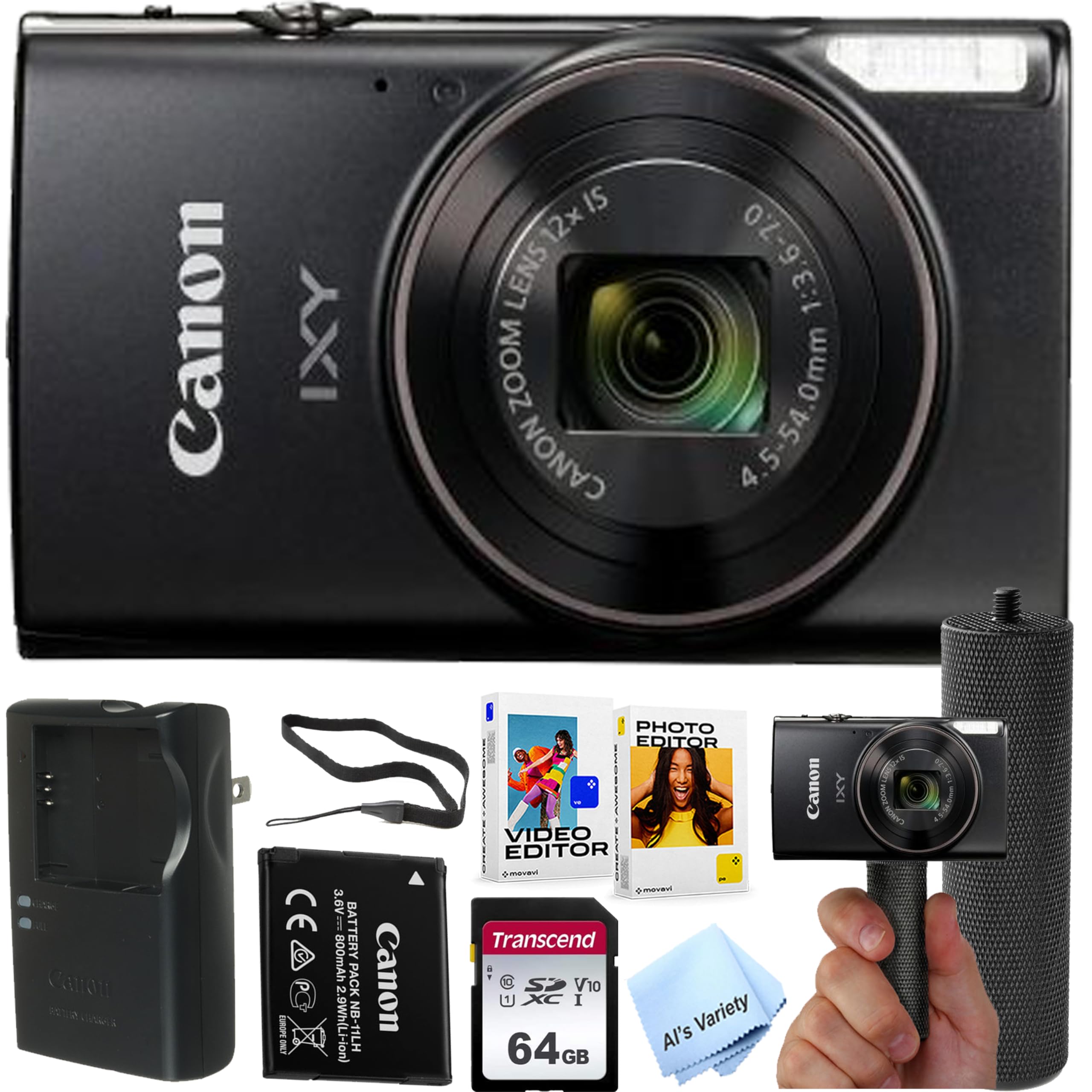
Twelve times the zoom, a 64GB card, and editing software in one box.
A 20.2MP 1/2.3-inch high-sensitivity CMOS sensor pairs with the DIGIC 4+ image processor, which together make up Canon’s HS System for keeping noise down. The lens is the real draw: a 12x optical zoom covering a 25-300mm equivalent range, so a wide street scene and a tight portrait both come from the same body. Intelligent IS stabilization works to calm handshake in both stills and video, and the sensor reaches ISO 3200.
Speed and video are both covered. It shoots continuous stills up to 7.2 frames per second and records Full HD 1080p at 30 frames per second. Built-in Wi-Fi with NFC lets you push photos to a phone or tablet, and a dedicated Wi-Fi button on the body shortcuts the connection process. The bundle is generous: a 64GB memory card, a stabilizing grip, and a Movavi photo and video editing software kit for Windows and Mac are all included.
Compare the reach with the FZ55 above and the gap is plain — 12x optical versus 5x, and a 25-300mm range versus a 28mm wide lens. The trade is sensor size: both use a small 1/2.3-inch class chip, so neither is a low-light champion. This one is for the traveler who wants one compact that covers wide and telephoto, plus the editing tools to finish the job.
The travel-ready bundle: 12x optical zoom across a 25-300mm range, 7.2fps bursts, 1080p video, and a 64GB card with editing software packed in.
The small trade: a 1/2.3-inch sensor keeps it compact but limits low-light shooting.
Fits best: travelers who want wide-to-telephoto reach from one pocket body with the extras already included.
Look elsewhere for: dim indoor venues where a bigger sensor is needed.
8. Panasonic Point and Shoot 4K Vlogging Camera

A 60x zoom and a viewfinder that stays readable in full sun.
The glass is the headline: a 3.58-215mm lens covering a 20-1200mm equivalent range delivers 60x optical zoom, and the 20mm wide end is genuinely useful for big scenes. A 2,360K-dot LVF electronic viewfinder at 0.74x gives you a clear look even in bright sunlight, so you frame without squinting at the rear screen. POWER O.I.S. optical stabilization works to suppress handshake at the telephoto end, which is the difference between a usable and unusable long shot.
Video is the second engine. 4K mode records at up to 4x the resolution of Full HD, and the 4K Photo feature lets you pull an 8-megapixel still out of a 4K clip after the fact. Post Focus flips the usual order — you touch the area you want sharp after the photo is taken. Autofocus carries 39 points, and the body sits on a Micro Four Thirds mount. Do bring a tripod for the highest optical zoom; that is where the reach pushes hardest, and the honest trade here is that clarity tapers and low-light noise appears when you push to the limit.
The practical read is that this is a long-zoom traveler’s camera for well-lit conditions — distant wildlife in good daylight is squarely its strength. It’s compact and light for the reach it holds, and it earns a spot for anyone who wants a viewfinder and 4K in a point-and-shoot body.
Standout Strengths
- 60x optical zoom with POWER O.I.S. stabilization
- 2,360K-dot LVF viewfinder for sunny days
- 4K video plus 4K Photo 8MP frame extraction
- Post Focus lets you pick sharpness after the shot
Where It Demands More
- Highest optical zoom needs a tripod for sharp results
- Low-light image quality is a compromise
- Menus take effort to learn
Choose it: for daylight wildlife, travel scenery, and anyone who wants 60x reach with 4K in a compact body.
Look past it: if you mostly shoot indoors in low light or want zero menu learning.
Know the Specs
Optical Versus Digital Zoom
Optical zoom moves physical glass to magnify — detail stays intact. Digital zoom crops the sensor and enlarges the result, so a 16x digital number can look softer than a 5x optical lens. The FZ55’s 5x optical lens and the Panasonic’s 60x optical lens both magnify with glass, which is why they hold detail a digital crop cannot.
Sensor Size And ISO
A larger sensor gathers more light. A 1-inch chip (the V10’s 15.2MP sensor) does better in dim rooms than a 1/2.3-inch chip (the IXY 650’s 20.2MP sensor), which is why premium compacts cost more. The T7 reaches ISO 12800 when expanded, which is the setting you lean on when light is scarce and you can’t use a flash.
Autofocus Points
More focus points mean the camera can lock onto a subject across more of the frame. The FZ55 carries 179, the Nikon D3300 has 50, the AZ528 has 25, and the Canon T7 has 9. For moving subjects in tight framing, the higher count helps — for posed shots, the difference fades.
Waterproof And Rugged Ratings
A depth rating like the PIXPRO P1’s 16ft tells you how far underwater the body is sealed, and a shockproof rating like 3ft tells you how far it can drop and still work. Waterproof cameras seal the lens for that reason, which is why fixed lenses like the P1’s are common — the reliability trade-off is real.
Common Questions
Is optical zoom really better than digital zoom on a cheap camera?
Do I need a memory card, and what type does each camera take?
What does renewed or certified refurbished mean for a DSLR?
Can a budget camera take good photos in low light?
How long does the battery last when shooting video?
Is a DSLR better than a point-and-shoot for a beginner?
What does the 4K Photo feature on the Panasonic actually do?
Will a waterproof camera work for snorkeling and pool days?
Do these cameras connect to my phone for sharing?
How much zoom do I need for birds and wildlife?
The Bottom Line
For most people, the top budget camera winner is the G-Anica 5K 64MP Bundle because it hands you the lenses, two batteries, a card, and a microphone in one box — the whole first month of shooting covered. If you want genuine optical reach for birds and travel, grab the KODAK PIXPRO AZ528 and its 52x optical zoom. And for shooting yourself on the move in 4K, the Canon PowerShot V10 is the one to reach for, as long as you pack a spare battery for its 2-hour rating.
How we choose
We do not accept paid placement. Every pick is matched to a real buyer and a real use-case; we do not hands-on test units.
Sources
Specifications: manufacturer listings and product documentation. Review insights: verified customer reviews, as of November 2026. Pricing: not shown on this page (it changes often); check the current price via the retailer link.
As an Amazon Associate, Tactical Gear Guy earns from qualifying purchases. This does not affect which products we feature.