Specs are compiled from manufacturer listings and verified buyer reviews and can change over time — please confirm the key details on the product page before buying.
You want a stick welder that strikes an arc on the first tap, holds it steady through a full rod, and doesn’t leave you chipping slag off a cold, failed bead. That’s the whole job. Everything else — the digital display, the app, the dual voltage — only matters if the arc stays lit while you drag it across steel. Below you’ll find eleven machines that actually do this, sorted by what each one is genuinely good at, from a 90-amp 120-volt box that runs off a household outlet to a 225-amp inverter that burns 5/16-inch steel in a single pass.
This guide is built by comparing the manufacturers’ published specifications and the patterns across verified customer reviews, so you get each pick’s real strengths and trade-offs instead of marketing spin.
Stick welding is unforgiving: the rod either lights or it doesn’t, and no feature list hides a weak arc. This breakdown covers amperage, duty cycle, rod compatibility and voltage so you can match a machine to your actual steel and your actual outlet.
Every machine below was checked for one non-negotiable: real SMAW stick capability, so you are reading about stick welding equipment that will actually burn a rod.
Top Picks


How To Choose The Best Stick Welding Equipment
Before you look at a single spec sheet, answer two questions about your own work: how thick is the steel you’ll weld most often, and what outlet will you be standing next to? Those two answers eliminate most of the field instantly. A 90-amp machine on 120 volts handles light frame and gate work beautifully and struggles on anything structural. A 200-amp inverter on 220 volts will burn heavier steel but needs the circuit to feed it.
Amperage and what it really buys you
Amperage (the raw heat going into the rod) sets your ceiling for steel thickness more than any other number on the box. The Forney Easy Weld 100ST tops out at 90 amps, which suits thin-gauge repair and small fabrication. The YESWELDER 205Amp runs up to 205 amps and will lay a bead on substantially heavier stock — that’s a 2.3x gap in output current between the two, and it shows up directly in what each machine can penetrate. Match the amperage range to the thickest steel you plan to weld, not the thinnest.
Duty cycle: the number buyers ignore and later regret
Duty cycle is the share of a ten-minute working window a welder can run at a given amperage before it needs to cool. A machine rated 30% duty cycle at its top amperage means six minutes of welding followed by four minutes of waiting. That’s fine for repairs; it’s painful on a long fabrication session. Higher-efficiency inverter designs tend to hold a longer duty cycle at a given amperage than older transformer-style boxes, which is one reason the inverter machines in this list punch above their size.
Voltage: 120V convenience versus 220V headroom
A 120-volt machine plugs into a standard household outlet and follows you around a barn or garage without an electrician’s visit. A dual-voltage or 220/240-volt machine reaches higher amperage but asks more of the circuit feeding it. Several machines here accept both — the VEVOR, YESWELDER, ARCCAPTAIN and TOOLIOM units all run on 110V/220V or 120V/240V input. If you have a 240-volt outlet available, it is almost always worth using for any work on heavier steel.
Rod compatibility and the 6010 question
Not every inverter loves every electrode. The 6010 rod is the fussiest common stick electrode because it needs a specific arc characteristic to run properly, and plenty of budget inverters claim compatibility without delivering it. The VEVOR machine names E6010 and E6011 explicitly, and the ESAB MINIARC Rogue models both include a dedicated stick 6010 mode. If 6010 is your everyday rod, that dedicated mode is worth more than any display feature.
Side-by-Side Comparison
| Model | Best For | Max Output | Input Voltage | Item Weight | Amazon |
|---|---|---|---|---|---|
| Forney Easy Weld 100ST★ Best Overall | Household-outlet repair work | 90 A | 120 V | 13.7 lb | Amazon |
| Winbegin ARC165Most Forgiving Power | Beginners on unstable power | 165 A | 100–240 V | 12.76 lb | Amazon |
| VEVOR 200Amp 3-in-1Budget Best | Budget workshop all-rounder | 120 A (110V) / 200 A (220V) | 110/220 V | 12.7 lb | Amazon |
| YESWELDER ARC-205DS PRO | Most people, most jobs | 205 A | 110/220 V | 8.8 lb | Amazon |
| ARCCAPTAIN ARC200 with TIG Torch | Two processes in one bag | 200 A | 110/220 V | 15.86 lb | Amazon |
| TOOLIOM TL-195S/LT Pro | Starter kit out of one box | 195 A | 110/220 V | 17.67 lb | Amazon |
| ARCCAPTAIN ARC205 Pro | App monitoring and heat control | 205 A (240 V) / 150 A (120 V) | 120/240 V | 14.52 lb | Amazon |
| ESAB HandyArc 1/8″ | Light, simple, established name | — | — | 6.3 lb | Amazon |
| Lincoln Electric Weld-Pak 225i | Heavy single-pass steel | 225 A | 120/230 V | 25 lb | Amazon |
| ESAB MINIARC Rogue ES 180i | All-day rod-after-rod work | 180 A | Dual voltage | 18 lb | Amazon |
Detailed Reviews
1. Forney 298 Easy Weld 100ST Welder
Our pick — 4.5+★ from 600+ verified ratings; the strongest balance of quality and price.
The all-metal box that runs off any household outlet and still lays a clean bead on 3/8-inch steel.
What makes this the pick for most people isn’t a headline number — it’s that a 90-amp, 120-volt machine covers the work most buyers actually do. It plugs into a normal wall socket, which means no electrician, no 240-volt run, no extension-cord math. Owners put it to work on frame repair, gates, grills, trailer brackets and lawn equipment, and the arcs come out strong enough that the steel holds.
The thing everyone raves about is build consistency. The all-metal case takes the knocks of a working shop, and the machine arrives with an 8-foot electrode holder and an 8-foot ground clamp already in the box. Nothing else is needed to start burning rod except a power source. That consistency, not amperage, is why it holds the top spot.
Now the honest part. A 90-amp ceiling is a real ceiling. Owners who tried it on stock beyond its comfort zone found it wanted more heat, and a handful ran into a unit that quit for no clear reason. That’s a fit question, not a defect story — if you weld 1/2-inch plate all day, you want a 200-amp inverter. If you weld repair work, this is the machine that follows you anywhere.
Where This Forney Delivers
- Runs on a standard 120-volt outlet — no special circuit required
- All-metal case built to take shop abuse
- 8-foot electrode holder and 8-foot ground clamp included
- Stick and TIG capable from one box
- 13.7 pounds, easy to carry around a barn
What To Know Before You Buy
- 90 amps caps how thick a plate it will handle comfortably
- Not the machine for heavy structural fabrication
- TIG function is capable, not a dedicated TIG rig
Go with this one if: your welding lives in the repair-and-small-fabrication lane and you want a machine that works off any household outlet.
Look elsewhere if: your steel runs heavy and continuous — a 200-amp inverter is the correct tool.
2. Winbegin ARC165 110V/220V Stick Welder with Digital Display
Built for the job site where the voltage sags and the rod still has to light.
Here’s the problem this machine solves: dirty power. The ARC165 accepts 100V to 240V input and keeps a stable welding output across that whole span, so a generator or a plugin at the far end of a long run won’t shut you down. It also ships with over-current and over-load protection, which is the kind of thing you only appreciate the day it saves the machine.
On paper, the 165-amp ceiling and 5/32-inch maximum rod size put it squarely in the capable middle. Its 80% duty cycle rating (the share of a ten-minute window it can run at rated load) is the detail that separates it from most of the budget field — that’s a machine that can be run hard for most of a ten-minute working window rather than a few minutes at a time. The aluminium handle and 9.3-pound listed weight make it easy to move between jobs.
What it lacks is a deep pile of owner reports to lean on. With relatively few ratings accumulated so far, you’re buying on the spec sheet and the closed-loop feedback design (circuitry that holds the output steady as input power shifts) rather than a long track record. If you want a machine plenty of people have already road-tested, look further up this list — but if your work happens where the power is unreliable, the wide input range is a real advantage most of these machines don’t match.
The voltage case: 100V–240V input with over current and over load protection means the machine adapts to a weak grid instead of failing on it.
The honest gap: fewer verified owner experiences to study than the established names here, so you’re trusting the design more than the reputation.
Made for: field work, generator power and anyone whose outlet voltage wanders.
Hold off if: you want a long, well-documented history of owner feedback before you commit.
3. VEVOR 200Amp Stick Welder
Two hundred amps on 220 volts, hot start built in, and a price that makes first-time welders smile.
The headline here is what the money buys: 120 amps on 110-volt input stepping up to 200 amps on 220 volts, with automatic dual-voltage conversion doing the switching for you. That’s real welding headroom on a machine that doesn’t require a separate high-voltage model. It runs E6010, E6011, E6013, E7014 and E7018 — including the fussy 6010 rod that trips up a lot of budget inverters.
What wins people over is how much capability lands in one box for the money. Hot start kicks the arc off quickly on a cold rod, arc force pushes heat into the puddle for deeper penetration, and anti-stick releases a rod that tries to freeze to the workpiece. The digital display and intelligent control hold a continuous arc during longer passes. For a first trailer project or a gate build, there’s genuinely enough machine here to finish the job.
The trade to understand is size and weight. This is a 12.7-pound, 16.1-by-10.4-by-13.2-inch box — noticeably bulkier than the compact inverters further up this list and not the one you’d tuck in a backpack. The other thing: E6010 support (a fast-freeze rod often used on dirty or rusty steel) is named in the listing, but on a machine this affordable you should set your expectations at “works well for small home jobs” rather than “replaces a shop rig.” It’s a genuine bargain in its lane, not a professional fabrication unit.
Reasons It Earns Shelf Space
- 120A on 110V step up to 200A on 220V with automatic conversion
- Runs 6010, 6011, 6013, 7014 and 7018 electrodes
- Hot start, arc force and anti-stick all built in
- Over-heating, over-current and over-loading protection
The Trade You Make
- Bulkier footprint than compact inverters at the same amperage
- Built for home and light shop work, not production fabrication
The match: a first inverter welder for home, trailer and gate projects where 220 volts is available.
Not the match: tight storage, frequent transport, or a daily production schedule.
4. YESWELDER 205Amp Stick Welder

Two hundred and five amps, an LED readout you can adjust with your helmet down, and barely any weight to carry.
Compare this to the Forney pick and the gap is stark: 205 amps versus 90. That’s a 2.3x difference in output current, and it changes what the machine can do — heavier steel, thicker rod, deeper penetration on a single pass. IGBT inverter technology (a switching design that runs cooler and more efficiently than older transformer circuits) is the reason this much output fits in an 8.8-pound housing that’s dramatically lighter than the 13.7-pound Forney.
The interface does more work than you’d expect. The LED display shows current, function mode and welding mode, and the precision knob lets you adjust without lifting your helmet or pulling a glove. Hot start and arc force each adjust across 1–10 levels, so you can dial the arc to the rod rather than fighting it. Automatic voltage fluctuation compensation and a stack of protections — overcurrent, overload, temperature control, thermal overload — keep it alive on messy power.
Where it draws honest criticism: the voltage readout isn’t perfectly accurate, so expect a little trial and error before the machine settles into its happy setting for a given rod. The printed literature is thin, too — the manual won’t teach you to weld. Neither complaint undercuts the arc itself, which is the thing you bought it for.
Power-to-weight: 205 amps in 8.8 pounds is the best ratio in this group, and dual 110V/220V input means it travels.
Set expectations: the voltage display wants a little calibration-by-feel, and the manual is not a teacher.
Choose it for: a do-everything garage machine that handles light and mid-heavy steel without a weight penalty.
Pass on it if: you need a thick printed operating guide to get started.
5. ARCCAPTAIN 200A Stick/Lift TIG Welder with Torch, 110V/220V
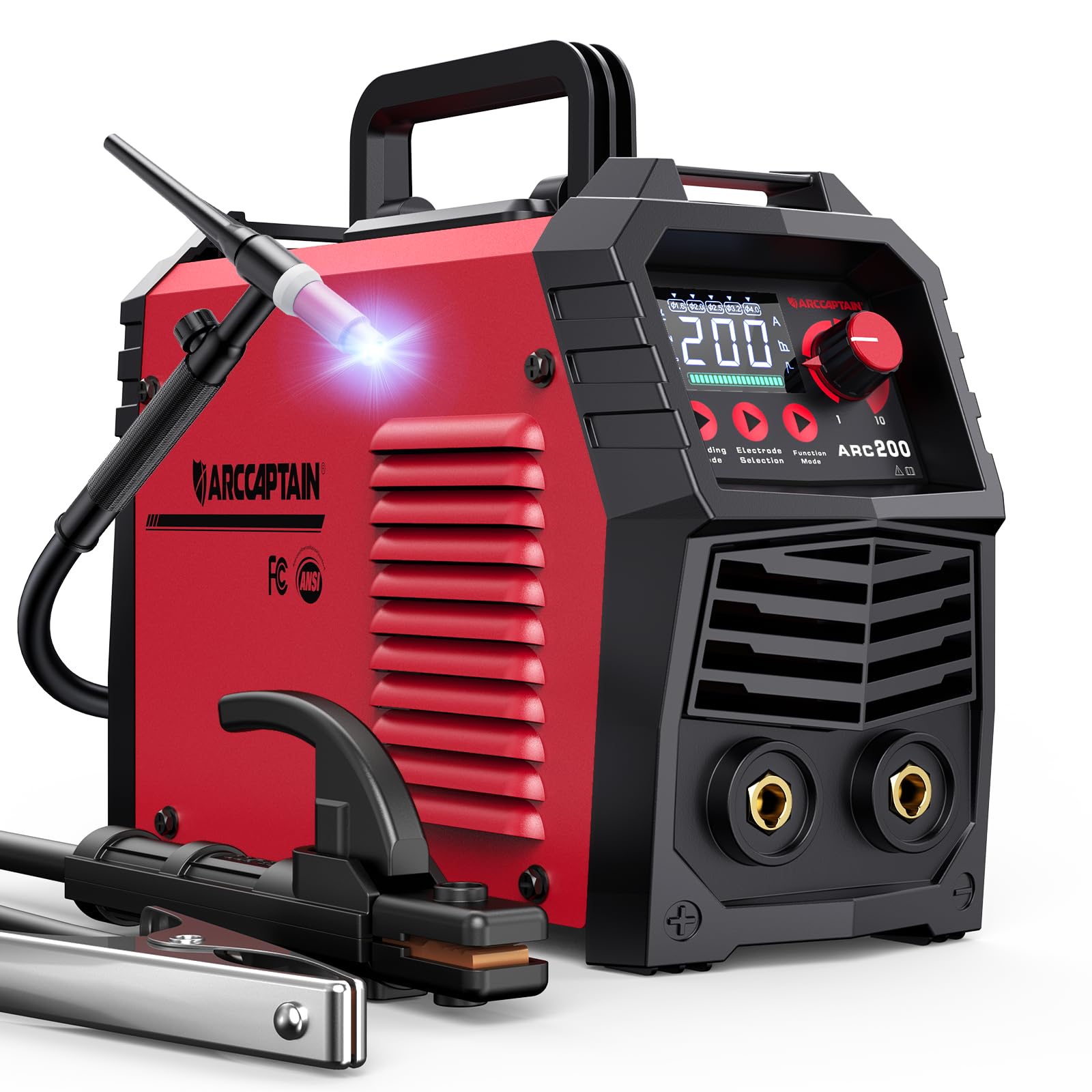
A stick welder with a proper lift TIG torch in the box, so you get two processes without buying twice.
The upgraded lift TIG torch (a torch for TIG welding, where you touch the electrode down to start the arc and lift off) is the reason to look here. Most stick machines list TIG capability and then tell you the torch is sold separately; this one ships with it, and the synergic control design (the machine sets current and voltage for you) lets a beginner select the electrode diameter and let the machine match current and voltage automatically. Run 6010, 6011, 6013 or 7018 rods for stick, or switch to TIG for lighter work on stainless and mild steel.
At 7.2 pounds it’s among the lightest here, and the package includes a shoulder strap so it can ride along to a job rather than sit in a corner of the garage. An onboard MCU control system with IGBT inverter technology manages the arc digitally, and adjustable hot start and arc force handle strike and puddle behavior. Every unit is tested against FCC and ANSI standards before it leaves the factory. Note the weight difference across the listing fields — 7.2 pounds body versus 15.86 pounds shipping weight — because the box is heavy while the machine is not.
Two operational catches matter. The machine wants you to wait until the display turns off and the cooling fan fully stops before switching input voltage or restarting — ignore that and you’re asking for trouble. And the two-process promise is only as good as the TIG side, which is lift-start rather than high-frequency, so it’s a capable second process rather than a dedicated TIG rig.
Package value: a lift TIG torch is included, which most stick machines in this range do not do.
Procedure to respect: the display and fan must fully shut down before a voltage switch or restart.
Right buyer: someone who wants stick for the heavy work and light TIG for the fiddly bits, all from one bag.
Wrong buyer: anyone chasing a dedicated TIG machine for thin precision work.
6. TOOLIOM 195A Stick Welder
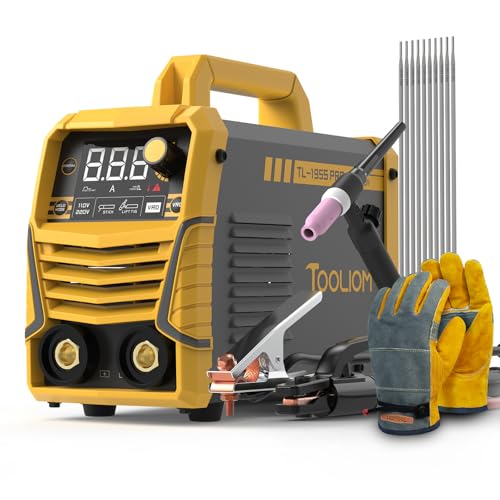
One box, one purchase: lift TIG torch, welding gloves and E6013 rods all arrive together.
If you are starting from zero, this is the shortest path to an arc. TOOLIOM packs the lift TIG torch, a pair of welding gloves and a handful of E6013 rods in the carton — the accessories you would otherwise buy one at a time. The 195-amp, 110/220V machine runs a 2-in-1 stick or lift TIG setup, with an LCD panel clear enough to read at a glance and simple enough for someone who has never struck an arc.
The VRD switch is a feature worth understanding. Voltage reduction device “ON” cuts the open-circuit voltage for shock protection; “OFF” restores full voltage so the arc strikes more easily with a better welding effect. That’s a real choice you make per job — safety first for a repair in a wet yard, arc quality first for bench work. Adjustable hot start and arc force round out the controls, and automatic anti-stick releases a frozen electrode from the puddle.
Be clear-headed about the TIG side of this machine. Stick welding is where it performs; the TIG function is more limited, and the functionality and value ratings are mixed across buyers rather than uniformly rosy. As a stick machine for home and light work it earns its place. As a TIG solution it’s the weakest argument on the list, so buy it for the stick capability and treat TIG as a bonus.
What You Actually Get
- Lift TIG torch, welding gloves and E6013 rods in the box
- Switchable VRD for shock protection or easier strikes
- Adjustable hot start and arc force with auto anti-stick
- Clear LCD display that’s beginner-friendly
Where It Falls Short
- TIG performance is limited compared with its stick welding
- Heaviest body of the budget group at 17.67 pounds
Buy it when: you want a complete first stick setup with nothing else to order before you can practice.
Skip it when: TIG is the reason you’re shopping — this one is a stick welder first.
7. ARCCAPTAIN 205A Stick Welder

Adjust the machine from inside the helmet from up to ten metres away with your phone.
The APP connection is what sets this one apart from its siblings. The ARC205 pairs to your phone, letting you adjust parameters from up to 10m, monitor machine status in real time, pick welding modes, and pull up FAQ answers. For a novice that’s a quiet advantage — the answer to “why is my arc doing that” sits in your pocket instead of a forum thread.
Amperage is split by voltage and worth reading carefully: 120V gives you 20A–150A of range, while 240V reaches 20A–205A. That’s a meaningful incentive to run it on 240 volts whenever you can, and it’s why this machine handles heavier steel better than its 120-volt range alone suggests. The MCU and digital control deliver a stable, consistent arc, and the LED interface with imperial units and fewer buttons means fewer menu dives to get to the setting you want. Hot start and arc force are both adjustable, and a matching dust cover is included.
One practical note from owners that applies to every 120-volt welder, this one included: check your breaker. Normal operating current sits right at 10 amps, and a typical 120-volt household circuit is 15 amps — workable, but tight with anything else drawing on the same leg. Also respect the voltage-switching rule: never flip between 120V and 240V while the screen is still lit. Its 3-year warranty is the longest in this group.
The connectivity angle: 10-metre APP control and live status monitoring cut the guesswork out of setting up a new rod.
Breaker reality: normal current runs near 10 amps on 120 volts, so don’t share the circuit with a compressor.
Built for: the welder who wants digital feedback and app support while learning on a 240-volt outlet.
Not ideal for: anyone who wants a no-phone, twist-a-knob simplicity machine.
8. ESAB HandyArc 1/8″ Stick Welder
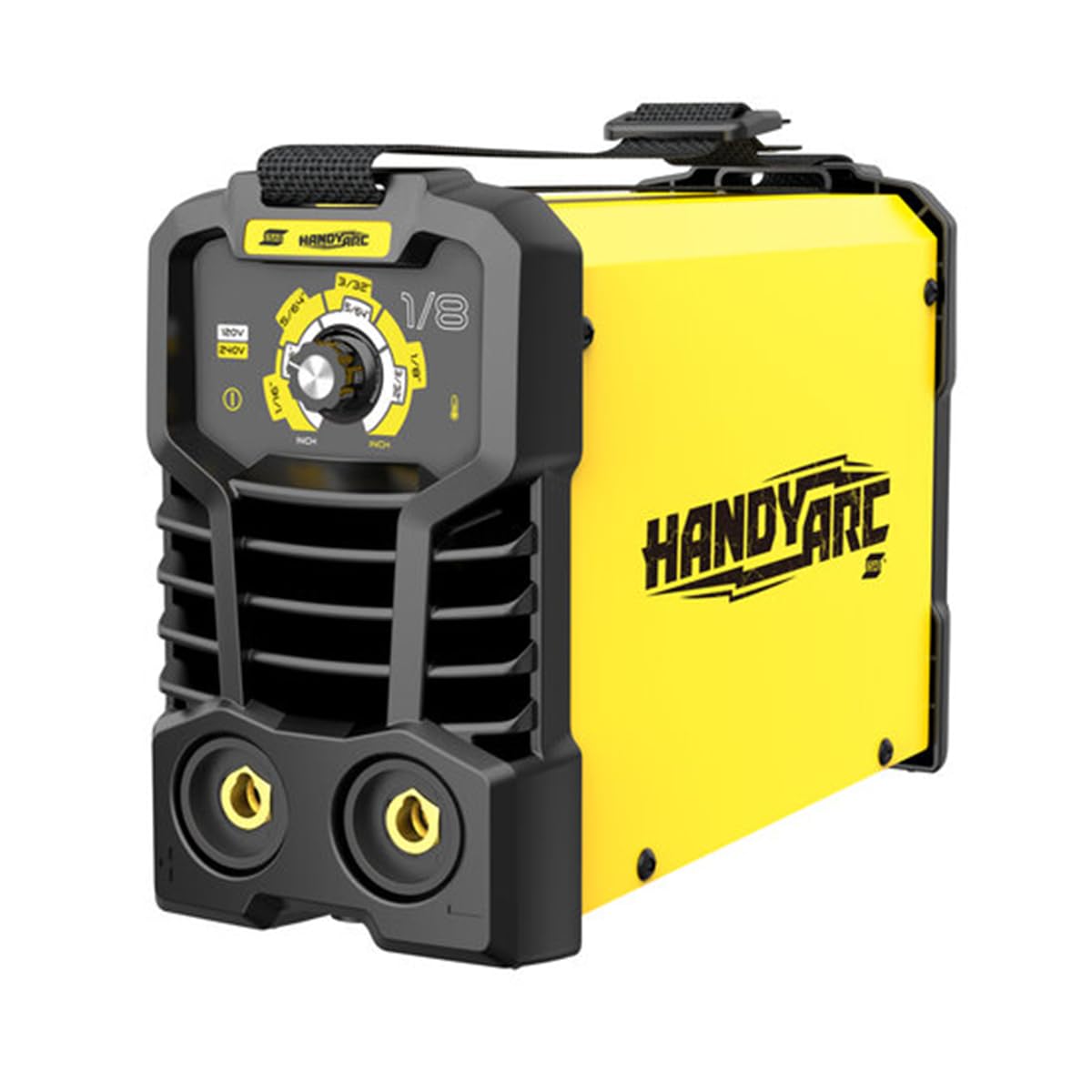
Six point three pounds of established-brand inverter that goes wherever the repair is.
At 6.3 pounds, this is the lightest machine on the list by a comfortable margin — lighter even than the 7.2-pound ARCCAPTAIN with its torch. It’s a compact little box with a 10.3-by-7.1-by-4.5-inch footprint, sized to sit on a shelf or under a workbench and come out when a repair needs one. The high-efficiency inverter design draws less energy than an older transformer machine, which matters if you’re running it off a limited supply.
Function is deliberately simple. It starts arcs cleanly, welds 6013 electrode, and ships with quality accessories so you’re not hunting for a holder or clamp. For a maintenance welder who wants a dependable name and doesn’t want to fiddle with a dozen settings, this is the tidy answer.
It’s also a simple machine — no hot-start dial, no digital readout — so if you want per-level arc tuning, the YESWELDER or ARCCAPTAIN picks give you that. Think of this as the one you grab for a fast repair, not the one you learn on.
For the grab-and-go welder: a 6.3-pound ESAB that handles 6013 repairs without a manual.
Not for the tinkerer: if adjustable hot start and arc force matter to you, look at the digital machines.
9. Lincoln Electric Weld-Pak 225i Stick Welder, Dual Voltage
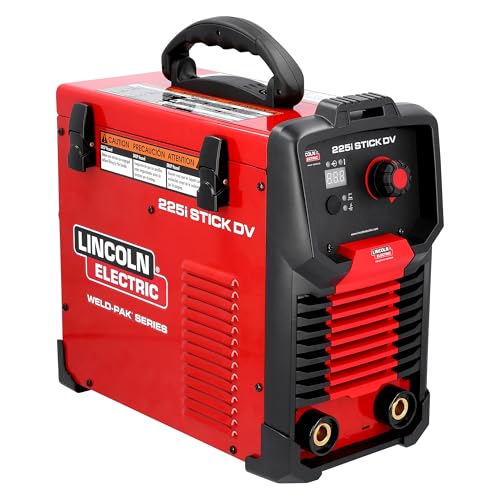
Twelve-gauge sheet all the way to five-sixteenths steel in a single pass, twenty-five pounds of it.
This is where the list turns serious. A 10–225 amp output range on 120V/230V input, a 30% duty cycle at 225 amps on 230 volts, and single-pass capability on 12-gauge sheet metal up through 5/16-inch steel. That’s the thickest single-pass range on the list, and it’s the reason a fabrication shop would tolerate the 25 pounds. Touch Start TIG is supported with additional accessories if you want a second process.
The kit is complete in a way most machines here aren’t: a shoulder strap, a 13-foot work cable and clamp, a 13-foot electrode cable and holder, a 6-foot input cable with a 6-50P plug and a 5-15P adapter. There’s even a built-in tool-box top for stashing cables and consumables. That 13-foot reach on both cables is a practical luxury — you spend less time dragging the machine around to get to the joint. The LCD-free, no-nonsense design keeps the controls minimal.
The honest trade is weight and footprint: 25 pounds and an 18-by-10-by-15.5-inch body is not a grab-and-run machine. The 30% duty cycle at the top amperage also means you’ll get several minutes of hard welding followed by a cooldown — normal for the class, but worth knowing if you plan continuous passes. If your work is heavy steel on a bench, the weight and cooldown are a fair exchange for 5/16-inch single-pass capability.
Raw capability: a 225-amp ceiling with single-pass welding up to 5/16-inch steel.
What you carry: 25 pounds and an 18-inch-long body — this stays in the shop.
Reach for it if: thick steel and long cable runs are routine and the machine can live in one place.
Leave it if: you need something you can carry in one hand between jobs.
10. ESAB 0700500070 MINIARC Rogue ES 180i Stick Welding System
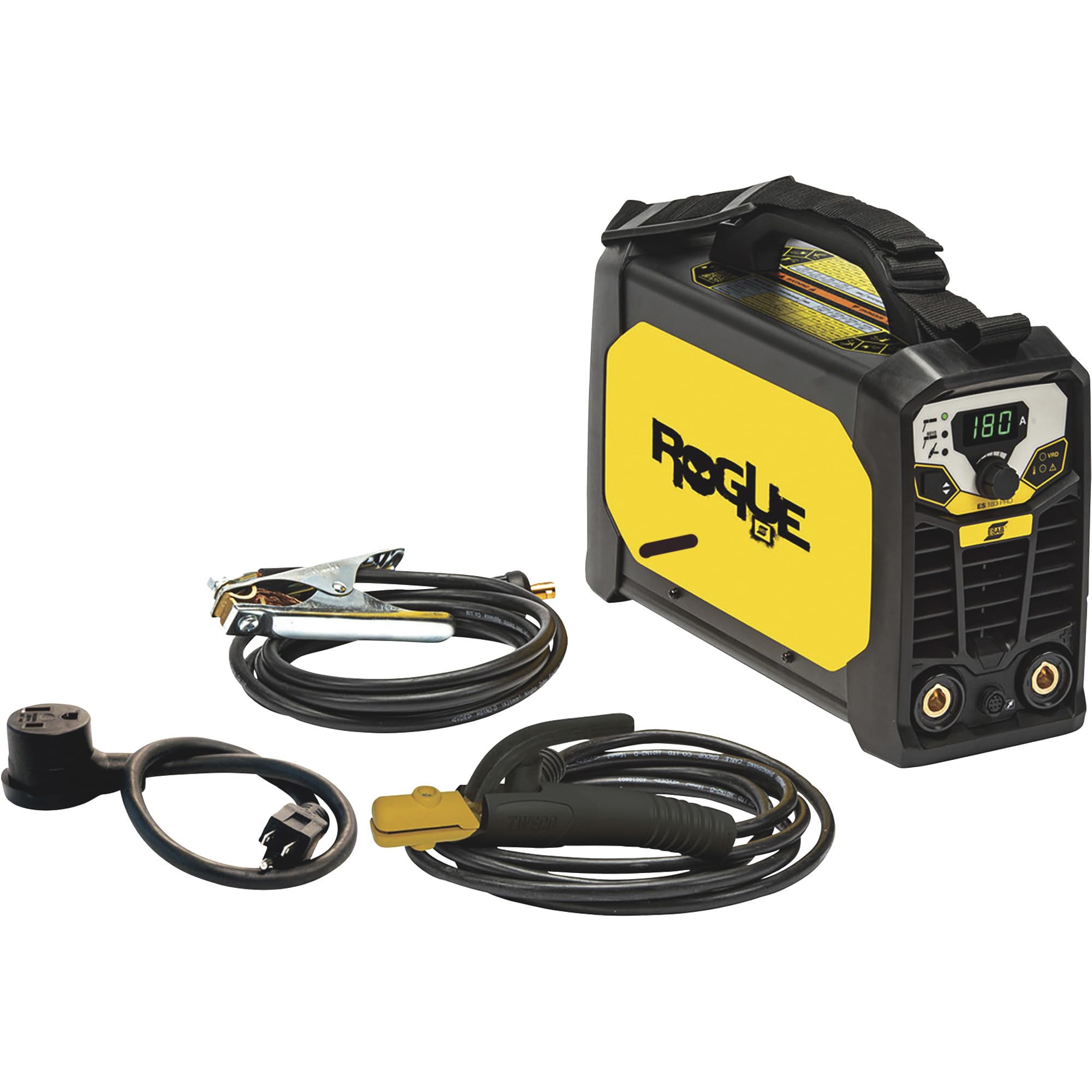
Built for the rod-after-rod, all-day grind, and the general consensus is that it takes it.
The 180-amp output and a dedicated stick 6010 mode are the core of this machine, and the arc quality is where it shines. Same superior arc characteristics as its 130i sibling — smooth and stable, including the special 6010 mode — plus the same dual voltage input for flexibility on single-phase plugs. The practical design and carry handle make it easy to move from bench to site.
The build quality here is what earns the loyalty. Owners run it hard, day in and day out, and it asks nothing more than a current setting and a rod. Generator compliant at 7kW recommended, it’s the ESAB of choice when continuous work is the job rather than the occasional repair.
Worth knowing: at 18 pounds and an ESAB price point, this is a professional tool aimed at people who weld a lot, not a hobbyist’s first inverter. The 5/32-inch electrode ceiling is generous but not unlimited, and you’ll want a reason to spend this much before choosing it over the capable mid-range machines. For a shop that burns rod all day, that durability is the whole point.
All-day durability: a 180-amp ESAB with dedicated 6010 mode that handles continuous rod work without fuss.
The careful buyer’s note: 18 pounds and a professional price mean it’s built for people who weld constantly, not now and then.
Pick it for: a fabrication bench that runs rods continuously and needs a machine to keep up.
Think twice if: you weld occasionally and want the budget to go further.
Know the Specs
Amperage and Output Current
Amperage is the heat the machine can push through the rod, and it sets your thickness ceiling. A 90-amp unit like the Forney handles light repair; a 205-amp or 225-amp machine handles heavier structural work. More amps generally means more penetration and thicker rods, but only on an appropriate voltage input. On 120 volts you’re limited by what a household circuit can deliver — several dual-voltage machines here reach full amperage only on 220/240 volts.
Duty Cycle Explained
Duty cycle is a percentage of a ten-minute period a machine can run flat-out before it needs to cool. A 30% duty cycle at top amperage means about three minutes of welding, seven cooling. A 80% duty cycle keeps you welding most of the window. The higher the duty cycle at high amperage, the more continuous work you can do without downtime. For most home and repair buyers, a moderate duty cycle is plenty; for production work, it’s the deciding spec.
Hot Start vs. Arc Force vs. Anti-Stick
Hot start briefly boosts current when you strike to light the rod faster. Arc force adds current as you push the rod into the puddle, deepening penetration and preventing the arc from snuffing out. Anti-stick cuts current if the electrode freezes to the workpiece, so you can break it loose without wrecking the rod. Together they turn a fussy beginner’s session into a workable one; on some machines here each is adjustable independently.
Input Voltage and Dual-Voltage Machines
Input voltage is what the machine accepts from the outlet. A 120-volt-only machine runs anywhere in a home but tops out lower. A dual-voltage machine accepts both 110/120 and 220/240, giving you convenience on household power and more amperage on a heavier circuit. Several picks here are dual voltage, and they typically split their amperage rating between the two — more output on the higher voltage. Always confirm the physical outlet and breaker before relying on the high-voltage numbers.
Common Questions
Will a 120-volt stick welder run on a normal household outlet?
Yes — the Forney Easy Weld 100ST, for example, is built for a standard 120-volt household outlet. The catch is that you share the circuit with whatever else is drawing from it. The ARCCAPTAIN ARC205 draws right around 10 amps during normal operation, and a typical 120-volt household circuit is 15 amps, so anything else running on the same leg eats into your headroom. Keep the welder on a dedicated circuit if you can.
What does 6010 mode actually mean on a stick welder?
The 6010 electrode is the fussiest common stick rod because it needs a specific arc characteristic to run well instead of sputtering out. A machine with a dedicated 6010 mode adjusts its arc profile for that, so the rod burns smooth. Both ESAB MINIARC Rogue models here include that dedicated stick 6010 mode, and the VEVOR machine names E6010 as a supported electrode alongside E6011, E6013, E7014 and E7018.
How thick a steel plate can these welders handle?
It depends almost entirely on amperage. The Forney, at 90 amps, is aimed at lighter repair work — its buyers report success up to somewhere around 3/8-inch stock on good passes. The Lincoln Electric Weld-Pak 225i goes further: it’s rated for 12-gauge sheet all the way to 5/16-inch steel in a single pass. Match the amperage to the thickest material you expect to weld regularly, then add margin.
Do I need a 240-volt outlet to get the most amps?
On dual-voltage machines, yes. The VEVOR outputs 120 amps on 110-volt input but 200 amps on 220 volts. The ARCCAPTAIN ARC205 runs 20A–150A on 120 volts and 20A–205A on 240. The YESWELDER reaches its 205-amp ceiling with 110V/220V capability. So the higher voltage isn’t just convenience — it’s how several of these machines reach their full output rating. Check your outlet type and breaker size before you shop.
What size extension cord can I run a stick welder on?
Long, thin runs kill amperage. The ESAB MINIARC Rogue ES 130i is built specifically for this: its power factor control lets it weld on extension cables up to 300 feet at 12 AWG size. That’s the machine to pick if the outlet and the weld are far apart. On smaller machines, shorter and heavier-gauge is safer.
Can I use these machines with a generator?
Some of them, yes. The Winbegin ARC165 is listed as generator friendly, the ESAB MINIARC Rogue models are generator compliant with 7kW recommended, and the ESAB 180i shares that rating. Confirm the generator’s output matches the rated draw of whichever machine you choose — the docs on each listing specify what the maker recommends.
Is a stick welder with a lift TIG torch worth it?
It’s worth it if you want a second process without buying a separate machine, but be honest about the difference. The ARCCAPTAIN ARC200 and TOOLIOM TL-195S/LT Pro both include a lift TIG torch, which is a capable second process — not a substitute for a dedicated high-frequency TIG rig. The TOOLIOM’s TIG side is the weaker of its two functions; its stick welding is the reason to buy it.
What does the VRD switch do on a stick welder?
VRD stands for voltage reduction device. Set to “ON,” it drops the open-circuit voltage at the electrode to reduce shock risk; set to “OFF,” it restores full voltage so the arc strikes more easily. The TOOLIOM machine has this swappable setting, and the ESAB 180i includes VRD function as part of its safety package. Choose based on where and how you’re welding.
Do I have to wait before switching voltage on a dual-voltage machine?
Yes. Both ARCCAPTAIN models and similar dual-voltage machines warn you not to switch between 120V and 240V while the screen is still on. On the ARC200, wait until the display turns off and the cooling fan has fully stopped before switching input voltage or restarting. Ignoring that instruction is the kind of thing that kills a machine.
Which is better for a beginner, a simple machine or one with an app?
A simple machine teaches you the arc with no layer between you and the puddle — the Forney Easy Weld 100ST is a tidy choice for that. An app machine like the ARCCAPTAIN ARC205 gives you real-time status and parameter control from your phone, plus FAQ answers that shorten the learning curve. The TOOLIOM is the easiest to start with from a pure kit perspective: torch, gloves and E6013 rods all arrive in the box.
The Bottom Line
For most people, the stick welding equipment that earns the top spot is the Forney Easy Weld 100ST because it runs on a plain household outlet, comes with the electrode holder and ground clamp already included, and puts down solid welds on the repair and light-fabrication work most buyers actually do. It’s the machine that follows you to the job without an electrician’s visit. If your steel runs heavier, the YESWELDER 205Amp takes the win — 205 amps in 8.8 pounds and a helmet-down LED knob make it the best all-rounder for a garage that tackles both thin and mid-heavy stock. And if the outlet is 300 feet from the weld, the ESAB MINIARC Rogue ES 130i is the one built for that exact problem.
The Forney backs that up with 4.5+ stars across hundreds of owner reviews — the strongest single reputation here, at less than half the price of the professional machines. For a first machine you won’t outgrow on repair work, it’s the safe buy. If you already know you’ll be burning rod all day, skip straight to the ESAB 180i and let the durability story carry you.
Common Questions
Will a 120-volt stick welder run on a normal household outlet?
What does 6010 mode actually mean on a stick welder?
How thick a steel plate can these welders handle?
Do I need a 240-volt outlet to get the most amps?
What size extension cord can I run a stick welder on?
Can I use these machines with a generator?
Is a stick welder with a lift TIG torch worth it?
What does the VRD switch do on a stick welder?
Do I have to wait before switching voltage on a dual-voltage machine?
Which is better for a beginner, a simple machine or one with an app?
The Bottom Line
For most people, the stick welding equipment that earns the top spot is the Forney Easy Weld 100ST because it runs on a plain household outlet, comes with the electrode holder and ground clamp already included, and puts down solid welds on the repair and light-fabrication work most buyers actually do. It’s the machine that follows you to the job without an electrician’s visit. If your steel runs heavier, the YESWELDER 205Amp takes the win — 205 amps in 8.8 pounds and a helmet-down LED knob make it the best all-rounder for a garage that tackles both thin and mid-heavy stock. And if the outlet is 300 feet from the weld, the ESAB MINIARC Rogue ES 130i is the one built for that exact problem.
The Forney backs that up with 4.5+ stars across hundreds of owner reviews — the strongest single reputation here, at less than half the price of the professional machines. For a first machine you won’t outgrow on repair work, it’s the safe buy. If you already know you’ll be burning rod all day, skip straight to the ESAB 180i and let the durability story carry you.
How we choose
We do not accept paid placement. Every pick is matched to a real buyer and a real use-case; we do not hands-on test units.
Sources
Specifications: manufacturer listings and product documentation. Review insights: verified customer reviews, as of November 2026. Pricing: not shown on this page (it changes often); check the current price via the retailer link.
As an Amazon Associate, Tactical Gear Guy earns from qualifying purchases. This does not affect which products we feature.