Specs are compiled from manufacturer listings and verified buyer reviews and can change over time — please confirm the key details on the product page before buying.
You want the whole conversation saved, not the first ten minutes of it. Three things decide whether a small voice recorder works for you: it has to keep running through a two-hour meeting, the playback has to be audible, and you need to get the file onto your laptop without hunting for a cable. Below are nine pocket-sized recorders, sorted by what each one does well. They range from a 30-gram magnetic clip-on that transcribes in 112 languages to a classic Sony that simply records everything you point it at.
This guide is built by comparing the manufacturers’ published specifications and the patterns across verified customer reviews, so you get each pick’s real strengths and trade-offs instead of marketing spin.
Some of these devices lean on an app and a subscription; others are pure offline hardware with a screen and a play button. The difference decides which one you should carry. Below you’ll find the picks ranked by fit, with the honest limits spelled out, so you can choose the right small device to record voice without paying for features you will never touch.
Top Picks
How To Choose The Best Small Device to Record Voice
Start with the number that actually limits you: how long one continuous session has to run before the recorder stops. A device that records 33 hours is not the same as one that gives you 35 hours on a charge while holding 110 hours of files. Match the runtime to your longest meeting first, then worry about everything else.
Runtime and standby are not the same thing
Battery life is how long the device keeps recording. Standby is how long it survives in your bag between uses. These are two separate figures on most spec sheets, and a recorder with a modest recording time can still sit for weeks without needing a charge.
Storage fills faster than you think
Storage capacity is quoted at the lowest bit rate (the amount of data saved per second of audio), so a large number like 110 hours assumes lean audio settings. Push the bit rate up for clearer recordings and that number shrinks. Decide if you want a big archive or the cleanest audio per minute.
The microphone tells you where it belongs
A single built-in microphone is fine on a desk across from a speaker. A multi-microphone array with noise reduction handles a room with several talking people. If you record phone calls, look for a device that explicitly supports call capture, because not every model can.
Side-by-Side Comparison
| Model | Best For | Recording Runtime | Storage | File Format | Amazon |
|---|---|---|---|---|---|
| Prouder Mage AI Voice Recorder★ Best Overall | Meetings and lectures with auto transcription | 35 hours | 64 GB | MP3 Audio, WAV | Amazon |
| Liebssen 8GB Digital Voice RecorderSimplest Controls | One-slide recording with a real screen | 110 hours | 8 GB | MP3 Audio, WMA | Amazon |
| EVISTR L359Biggest Archive | Long archives with AI summaries | 33 hours | 128 GB | MP3 Audio, WAV | Amazon |
| Yegolito 72GB USB-C Recorder | Cable-free file transfers | 35 hours | 72 GB | WAV | Amazon |
| Sony ICD-PX370 | Straightforward reliability | 57 hours | 4 GB | MP3 Audio | Amazon |
| OM SYSTEM WS-882 | Pickup of hushed speakers | 1040 hours | 4 GB | MP3 Audio | Amazon |
| Comulytic Note Pro | Subscription-free AI note-taking | 45 hours | 16 GB | MP3 Audio, WAV | Amazon |
| Plaud Note | Phone calls and field work | 30 hours | 64 GB | WAV | Amazon |
| OM SYSTEM LS-P5 | High-resolution music and detail | 24 hours | 16 GB | MP3 Audio | Amazon |
Detailed Reviews
1. Prouder Mage AI Voice Recorder (Slate Purple)
Our pick — 4.5+★ from 250+ verified ratings; the strongest balance of quality and price.
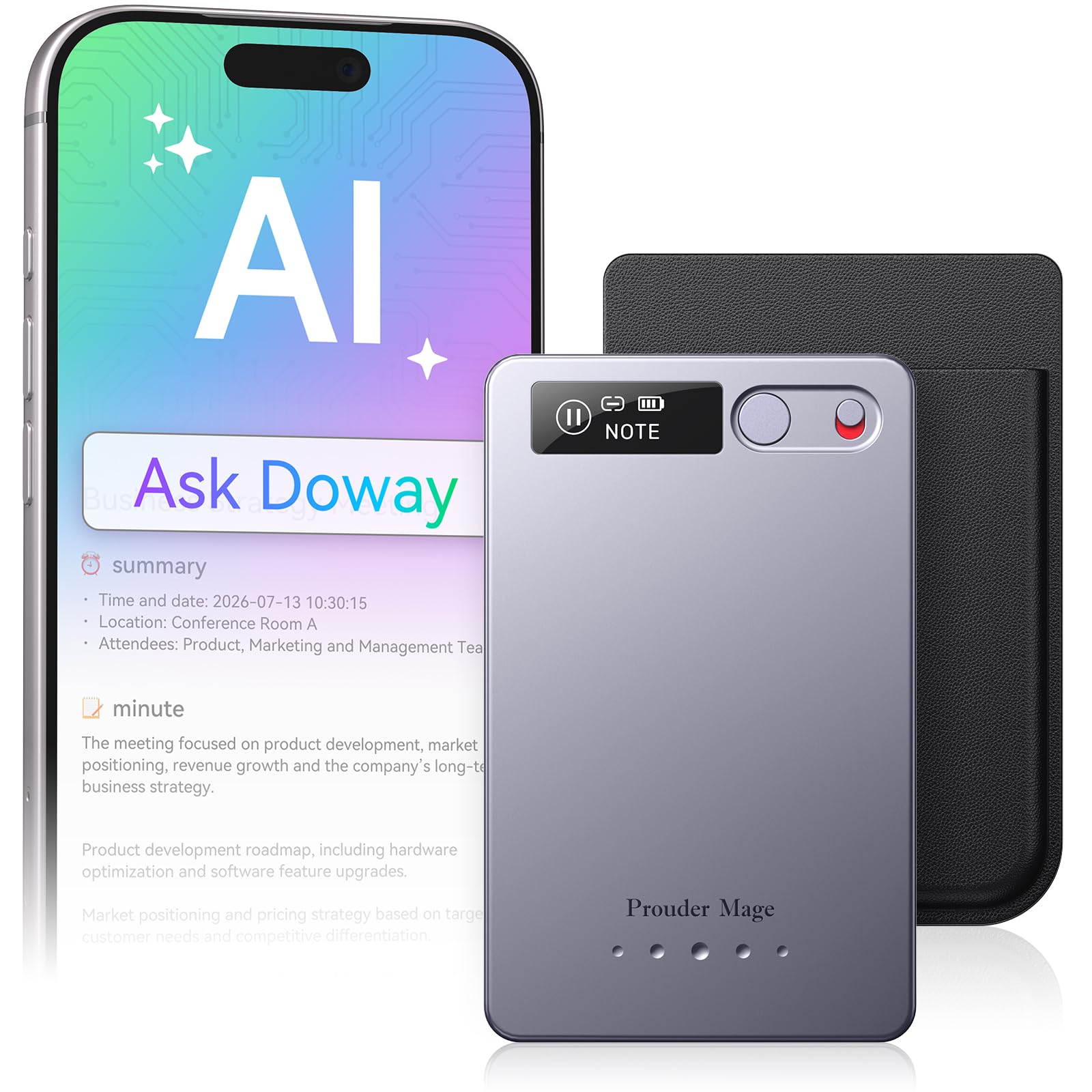
The 30-gram slip of aluminum that records your meeting and writes the summary for you.
Most of this list records audio and stops there. The Prouder Mage goes the next step, transcribing 118 languages at up to 98% claimed accuracy through GPT-4o algorithms and turning the result into summaries and mind maps. That is the whole pitch in one line: you leave the room with notes, not a file you have to listen through.
It disappears into a shirt pocket. At 30 grams it is lighter than the Sony ICD-PX370’s 136 g, and it is about as small as this category gets. The dual-mode design is the clever part — a condenser microphone (a mic that picks up room sound) handles lectures and meetings across a 1–7 meter range. Talk Mode lets you snap the unit magnetically to the back of a compatible phone for call recording. Built-in noise cancellation and automatic 3-hour file segmentation (splitting one long session into separate files) keep long sessions tidy rather than one sprawling track.
The parts you will actually live with are solid: a 400mAh battery good for 35 hours of continuous recording and 166 days of standby, 64GB of internal storage, USB 2.0 transfers, and Bluetooth 5.3. Recording stays locally encrypted until you choose to sync, and the maker states it is GDPR compliant. The honest catch is the transcription plan — you get 600 free minutes per month on the Starter Plan, and the unlimited tier is a separate paid upgrade. Heavy users will need to watch that meter.
What pushes it to the top
- 35 hours of recording plus 166 days of standby on a single charge
- 118-language transcription with 98% claimed accuracy and 9 professional templates
- Magnetic mounting for phone-call capture without headphones
- Aluminum alloy body at just 30 g
Where it asks more of you
- Unlimited transcription sits behind a paid plan
- No headphone jack, so playback is speaker-only or through the app
Buy it if: you want to walk out of a lecture or client call with organized notes already drafted.
Think twice if: you never plan to use transcription — the plain recorders further down do the same job for less.
2. Liebssen 8GB Digital Voice Recorder
A physical switch and a color screen — no app, no account, no learning curve.
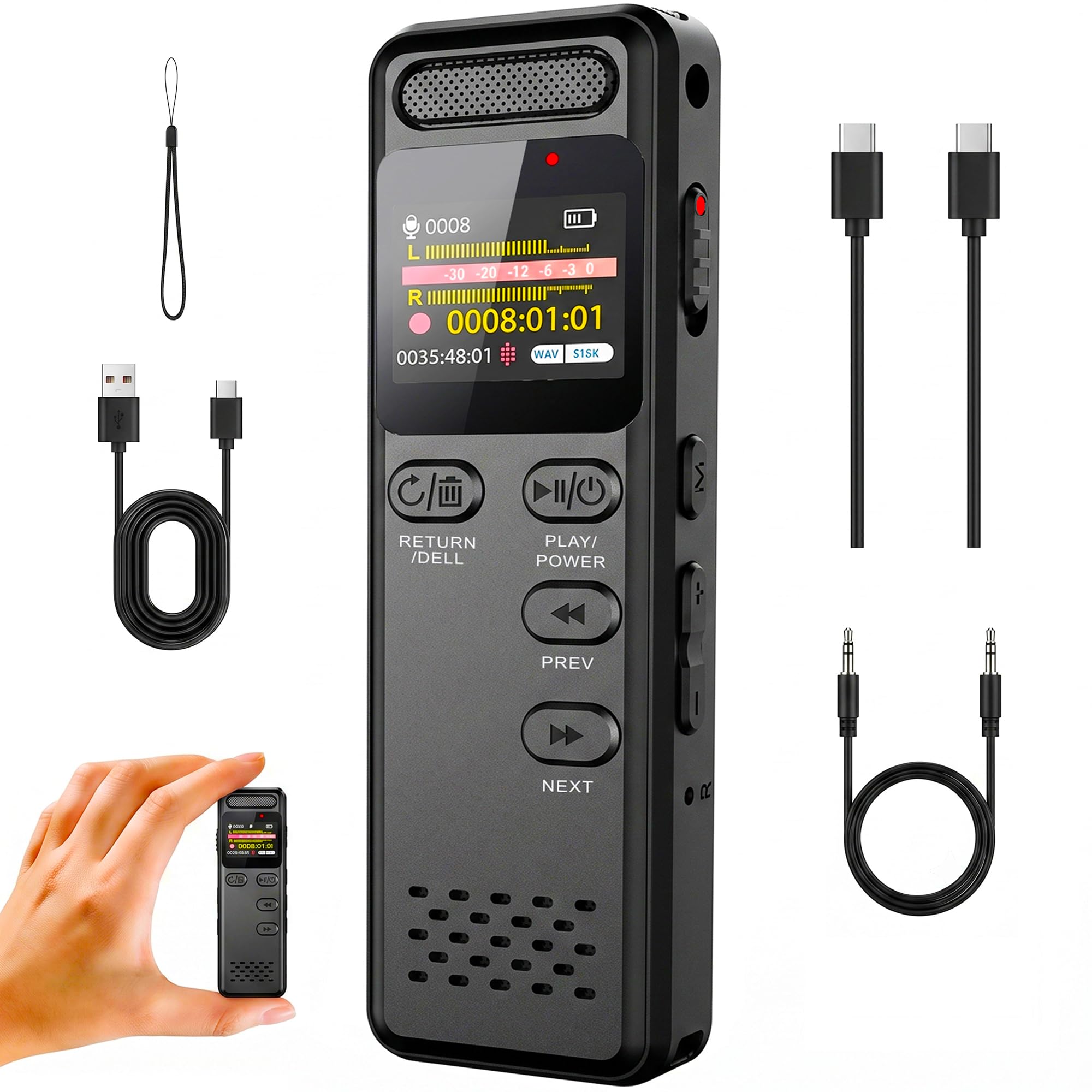
Here is the trade that defines this recorder: it holds 8GB, which is the smallest capacity on this list and roughly a sixteenth of the EVISTR’s 128GB. What you get in return is the longest raw recording window of any pick here — 110 hours of continuous capture on a full charge against the EVISTR’s 33 hours. For a single long deposition or a day of campus lectures, that matters more than archive depth.
Audio runs at 3072 Kbps with dynamic noise reduction, which is the setting that keeps voices crisp without the file sizes ballooning out of control. 8GB holds around 6 hours at that bit rate, so plan on offloading if you record at high quality. The all-metal body has a color display and the switch slides to “REC” or “SAVE” even with the device powered down, so a surprise conversation takes one motion. A lock function stops pocket bumps from cutting the file short.
Two details save you later: low-battery auto-save files everything before shutdown, and Micro SD expansion lets you grow the 8GB without replacing the unit. It also plays MP3 and WMA and can take an external microphone through the 3.5 mm jack. At 78 g it is heavier than the Prouder Mage’s 30 g, noticeable only if you are used to a near-weightless clip-on. The color screen and physical buttons mean everything works in the dark, in a basement, on a plane — no signal required.
Built for the hallway: the powered-off one-touch recording and lock switch are what you want when the interesting part of a conversation starts without warning.
The honest limit: 8GB is a small tank, and at 3072 Kbps you are looking at roughly six hours before you have to move files off.
Reach for this if: you want the longest single-session runtime and refuse to manage an app.
Look elsewhere if: you need a months-long archive sitting on the device itself.
3. EVISTR Digital Voice Recorder L359
128GB of archive space inside a body you will forget is in your bag.
The storage figure is the headline and it is not close. 128GB carries up to 9,216 hours of audio at 32kbps, sixteen times what the Liebssen’s 8GB holds. If you record every class, every interview, and every client call and you hate deleting anything, this is the one that never forces the decision.
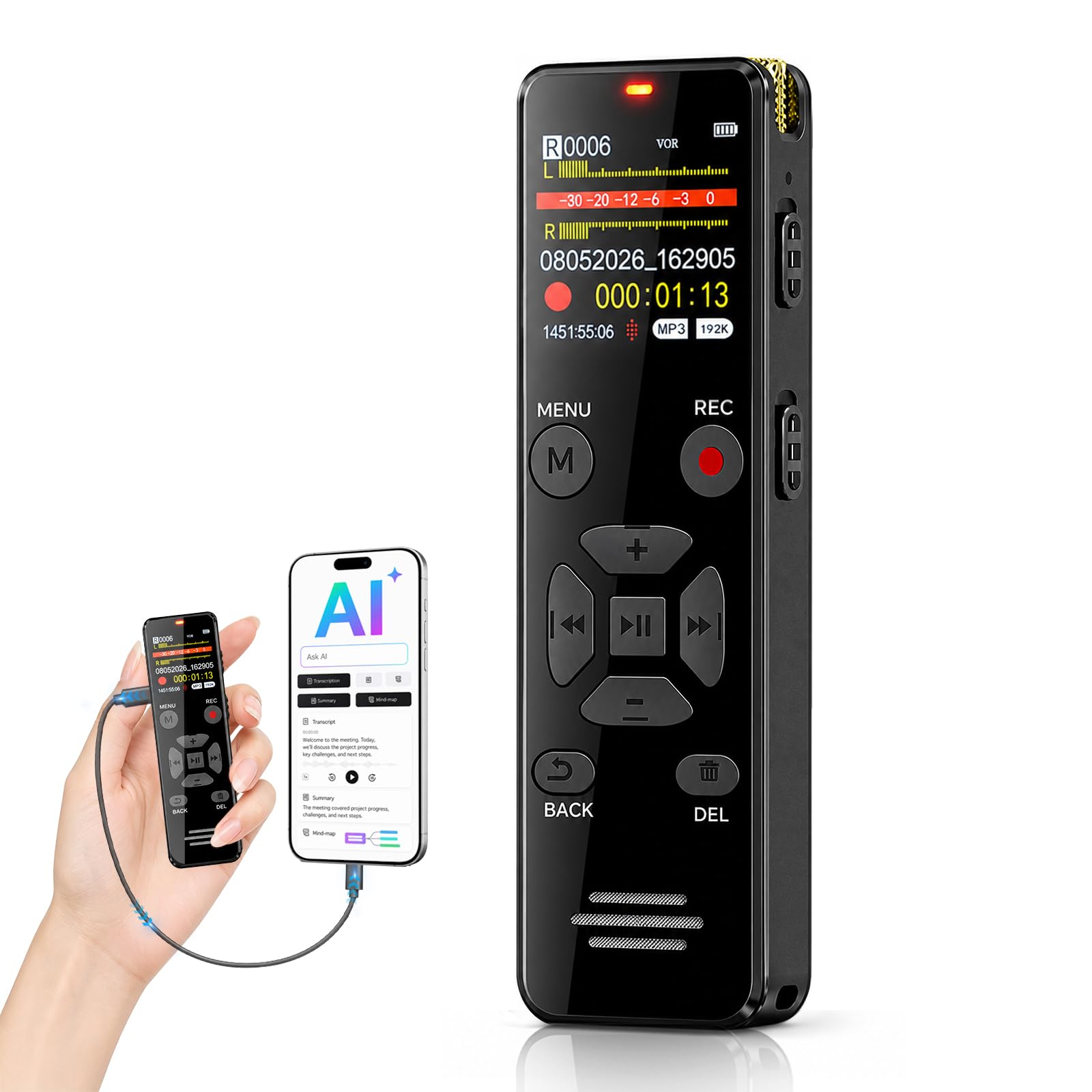
The AI layer runs through the AI DVR Link app, with transcription in 113 languages plus speaker identification, mind maps, and an Ask AI feature. Audio caps at 3072Kbps with intelligent noise reduction, and VOR voice-activated recording skips long silences so your files are not padded with room tone. There is a password lock for confidential material and a dedicated HOLD switch that kills every button while the unit sits in your pocket.
It runs 33 hours per charge — roughly the same ballpark as the Prouder Mage’s 35 hours, well short of the Liebssen’s 110 — and it weighs 65 grams. Transfer happens over the included OTG cable straight to your phone, which is a wired connection rather than Bluetooth. The recurring friction point is the interface: some people find the button logic confusing before they learn it, and a few have run into a unit that stopped recording after a minute or two. Test yours thoroughly in the first week.
Why the archive matters: with transcriptions running in 113 languages and every file kept locally on your phone, one device replaces a folder of notebooks.
Worth knowing: battery life is the real constraint here, not storage — 33 hours per charge is generous for a week of interviews but not for back-to-back multi-day events.
Best match for: students and researchers who hoard recordings and want them transcribed in one app.
Not the pick if: you want buttons so obvious you never open a manual.
4. Yegolito 72GB Digital Voice Recorder
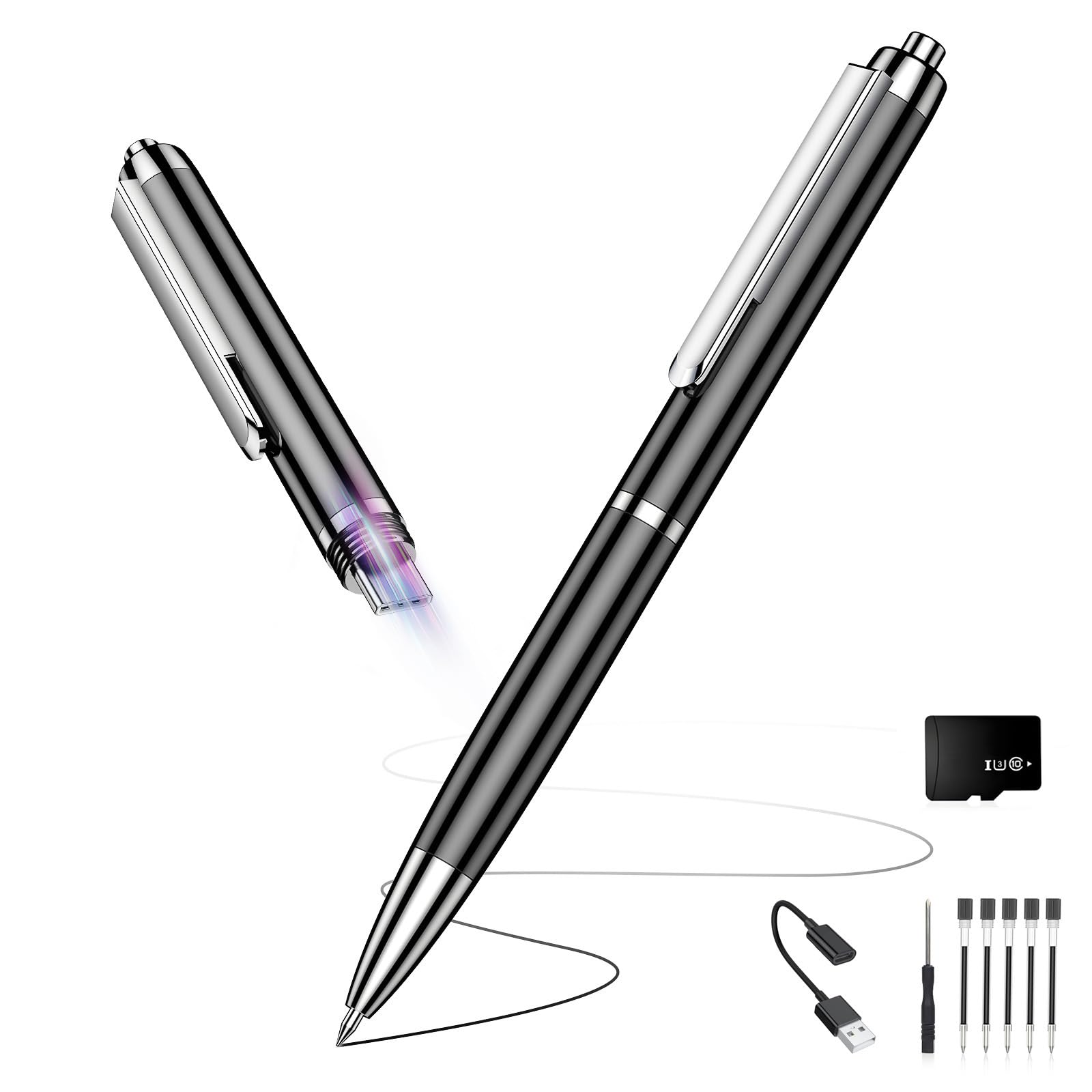
The recorder that plugs straight into your laptop like a thumb drive.
Most recorders need a cable, and cables disappear. This one carries a built-in USB-C connector, so offloading a file is a matter of pushing the body into a port on your computer, phone, or tablet. During that connection it also works as a temporary external drive, which is a neat second life for a device that otherwise sits in a drawer.
You get room for a huge archive: 72GB holds up to 7,600 hours of audio at low bit rates. The high-capacity rechargeable battery gives 35 hours of continuous recording — right alongside the Prouder Mage’s 35 hours and the EVISTR’s 33 hours. A low-battery auto-save protects the current file before the device powers down. That is the single most valuable feature on any recorder, and worth checking on every model you consider.
The 360° omnidirectional microphone captures voices from several directions, so a round-table meeting does not require you to aim the unit. DSP noise reduction then lifts the voices above background hum. Files are named by their start time so you can find a session later without opening each one, and segment saving is adjustable from 10 to 240 minutes. The box even ships with 3.5mm headphones, a USB-C to 3.5mm headphone cable, five replacement refills, and a screwdriver.
Arguments for this one
- Built-in USB-C means no misplaced cable before a transfer
- 72GB holds up to 7,600 hours of audio
- Timestamped filenames and 10 to 240 minute segment saving
- Headphones included for private playback
Where it gives ground
- Records in WAV only, so files are larger than a compressed format
- Mono microphone mode rather than stereo
Pick this one when: you move recordings to a computer constantly and want zero accessories in the loop.
Pass when: you need stereo audio or a compressed format for smaller files.
5. Sony ICD-PX370 Mono Digital Voice Recorder

The workhorse that has been recording meetings since long before AI entered the room.
Five thousand four hundred plus owners have rated this one 4.5+ stars, and that volume tells you something the spec sheet cannot: it keeps working. Battery life runs 57 hours at MP3 128Kbps stereo, longer than the Prouder Mage’s 35 hours, and it takes two AAA alkaline batteries rather than needing a recharge. Slip a spare pair in a bag and you never think about power again.
The USB connector slides out of the body for direct transfer to a PC — the same no-cable idea as the Yegolito, delivered with a mechanical slider. Recording is mono MP3, which keeps files small enough to email after a quick compressed export. The interface will look dated next to the AI models, and the screen is dim enough that you will want decent light, but the buttons are legible and the logic is documented in plain instructions.
The speaker is the weak link. Playback sounds thin, so most owners plug in headphones through the 3.5 mm jack and hear everything cleanly. It weighs 136 g and stores 4GB — the least capacity here — so it suits people who offload recordings regularly rather than keep a permanent library. Auto power-off protects the batteries between sessions.
The long-run argument: 57 hours on AAA batteries means a recorder that never asks you to hunt for a charger the morning of a big meeting.
The compromise: 4GB of internal memory is the smallest on this list, so plan to move files to a computer often.
The safe choice for: anyone who wants a recorder that just records, with replaceable batteries and no software account.
Skip if: you want transcription, a bright screen, or stereo capture.
6. OM SYSTEM Olympus WS-882 Digital Voice Recorder

Built to pick up the soft-spoken voice across a seminar table.
The quality of the pickup is what owners talk about with this recorder — the ability to catch quiet sounds that other devices miss. That is the reason it earns a place here: a lecture hall, a quiet interview, a musical performance all need a microphone that hears the detail, and this one does.
It records longer than anything else here: the 1040-hour maximum recording time is the biggest raw number in this guide, though it assumes the internal 4GB memory at a lean setting. You get Linear PCM (uncompressed audio) and MP3 formats, so you can pick between maximum fidelity and maximum runtime on the same device. Two AAA batteries run it 68 hours, longer than any rechargeable here except the Liebssen’s 110-hour mark. The direct USB connection slides out for transfer, and file indexing lets you flag a recording made on another device.
The recurring caution is the USB connector itself. A folding plug is convenient until it wears, and long-term users have had one fail internally. Treat that joint gently and it holds; treat it like a keychain and it eventually complains. It weighs 77 grams and records in mono, so this is a note-taking tool rather than a music machine.
What it does best: hearing a quiet speaker in a still room — the kind of recording where a lesser microphone captures a murmur.
The one watch-out: the folding USB plug is the part most likely to wear out over years of use.
Made for: class notes, interviews, and any setting where the speaker is soft or far away.
Better to avoid if: you need Bluetooth or app-based transcription.
7. Comulytic Note Pro AI Voice Recorder
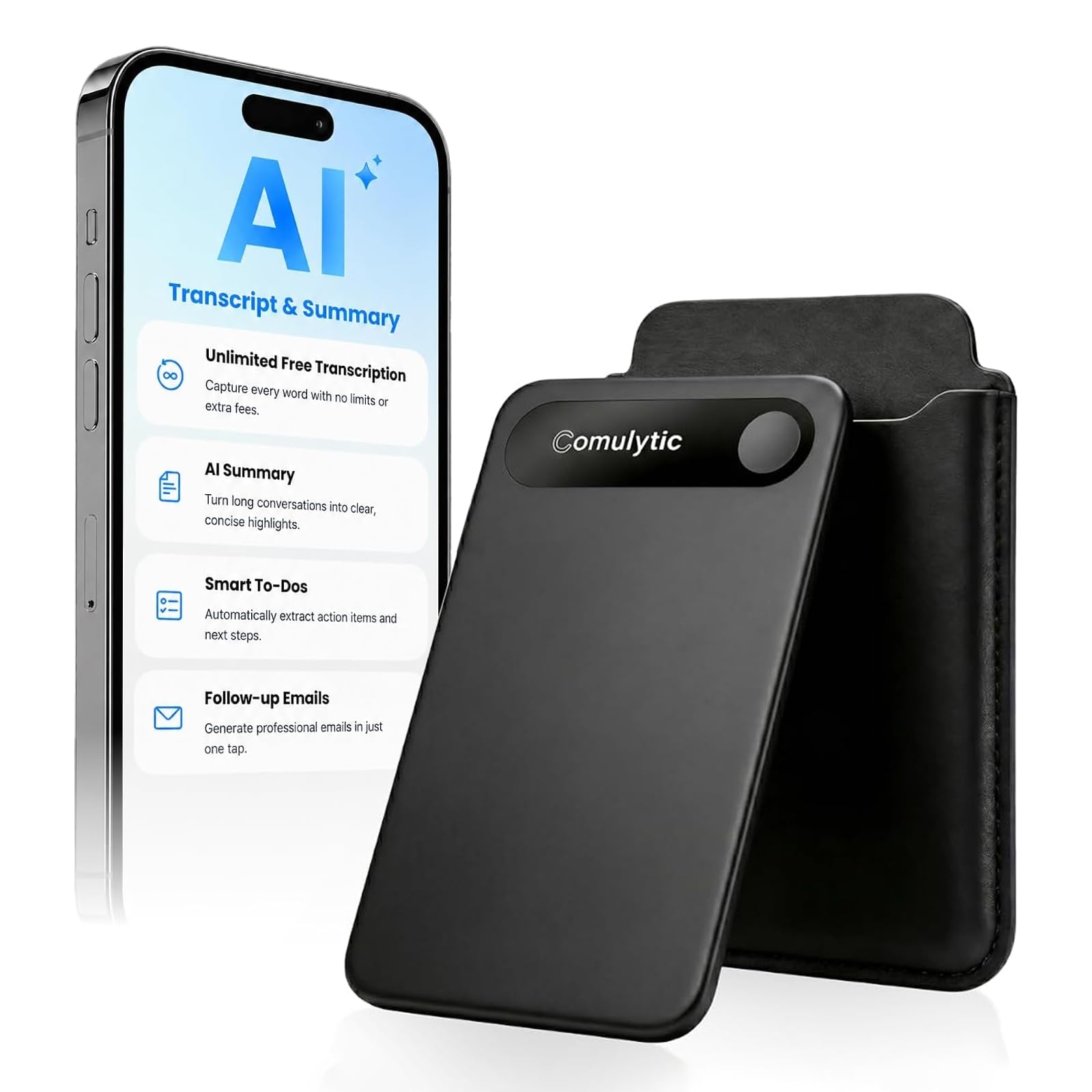
A 3 mm aluminum card that detects when a meeting starts and takes notes on its own.
This is the pick for people who live in back-to-back calls. The 70-hour battery figure is the standout, though the spec sheet also lists 45 hours of continuous recording and 107 days of standby — reserve the bigger number for mixed use, and treat 45 hours as your session ceiling. Either way, it outlasts the Prouder Mage’s 35 hours comfortably.
Transcription and basic summaries are free on the Starter Plan with no monthly bill, which separates it from most AI recorders that meter you from day one. The app delivers transcripts, action items, and to-do lists, and a vertical knowledge base tuned for insurance, real estate, auto sales, financial advising, law, recruiting, and consulting catches industry terms properly. A real-time translator mode makes it useful for bilingual meetings. Accuracy is claimed at 98% across 113 languages.
The hardware is what sells the daily habit. Three magnetic accessories snap it to a phone, a laptop, or a notebook. A triple-mic array with AI noise reduction captures speech within 5 meters, and Wi-Fi sync is claimed at up to 10× Bluetooth speed. Files are AES-encrypted and the maker states CCPA compliance.
Why it earns the office slot
- Unlimited free transcription and basic summaries on the Starter Plan
- 45 hours of continuous recording with 107 days of standby
- Triple-mic array with 5-meter pickup range
- 70-hour battery rating and a full charge in 90 minutes
What you give up
- 16GB local storage trails the larger AI recorders
- Advanced summary tools sit behind the Premium plan
Fits like a glove for: consultants and salespeople who need structured notes from every call without paying for transcription.
Not ideal if: you want every feature open up without ever upgrading.
8. Plaud Note AI Voice Recorder

The thin card that sits on the back of your phone and records the call itself.
Phone calls are the hardest thing in this category to capture, because the sound comes out of a speaker pressed against your ear. The Plaud Note solves it with a Vibration Conduction Sensor that picks up the internal phone audio directly, so your side of the conversation lands cleanly. It also switches to an in-person mode for ambient meetings and presentations.
At 30 grams and 0.12 inches thin, it is effectively invisible clipped to a phone case — which is the point for field work, client calls, and interviews where a visible recorder changes the mood. It records 30 hours continuously, holds 30 hours of standby at 60 days, and stores up to 64GB locally so you can capture without an internet connection. That 64GB matches the Prouder Mage and is four times the Comulytic’s 16GB.
Transcription covers 112 languages and the app runs on leading models to produce summaries, mind maps, and to-do lists from more than 10,000 professional templates. Multimodal input lets you type notes, add images, and tap the button to mark key moments mid-conversation. Privacy is the enterprise argument: SOC 2, HIPAA, GDPR, and EN18031 compliance, local encryption, and no processing without your authorization. The trade-off is the free 300 transcription minutes per month and the optional Pro and Unlimited plans above it, and the magnetic ring can slip off a smooth case. It is also the most expensive pick on this list.
The call-capture advantage: dual-mode recording with a vibration sensor means phone audio is captured internally, not through the air.
Budget before you buy: 300 free minutes per month covers light use, but anyone recording daily will be looking at a plan upgrade.
Made for: professionals who record client calls and need a device that looks like nothing at all.
Weigh the cost if: you only record in-person meetings — the Comulytic covers those for less commitment.
9. OM SYSTEM Olympus LS-P5 PCM Recorder

Studio-grade sound in a body the size of a box of matches.
This recorder is built for the person who cares what the file sounds like, not just that it exists. Recording runs at 96 kHz/24 bit with three directional microphones, in PCM, FLAC, or MP3. That is a different league from the mono MP3 capture on most of this list, and it makes the LS-P5 the right tool for music, ambient field recording, and any session you might want to restore later.
Customization is the other reason people gravitate toward it. You get noise cancelling mode, automatic and manual level settings, and a low-cut filter for trimming rumble. Bluetooth is built in, plus a 3.5 mm headphone jack, 16GB of internal memory, and 24 hours of recording time — the shortest runtime here, well under the Liebssen’s 110 hours. Owners praise the sound and the control it offers, while some find the menu logic takes practice and a few report playback volume that is too low for comfortable listening without headphones.
It is the premium pick, and you feel that in the hardware and the flexibility rather than in battery bragging rights. At 2.72 ounces it slips into a shirt pocket. If your recordings need to hold up under scrutiny — a court reporter’s archive, a musician’s reference track — this is the one where the audio quality is the whole reason to pay more.
The case in one spec: 96 kHz/24-bit stereo capture with three directional microphones is the highest fidelity on this list by a clear margin.
What it is not: a marathon runtime device — 24 hours per charge is the shortest here, so keep a spare battery for multi-day events.
For you if: sound quality is the deciding factor and you want control over levels, filters, and format.
Look elsewhere if: you want the simplest, cheapest way to capture a meeting.
Know the Specs
Recording time versus battery life
These are two separate numbers and they measure different things. Recording time is how much audio fits in memory at a given bit rate — the Liebssen’s 110 hours assumes lean settings. Battery life is how long the device keeps running on a charge. A device can hold hundreds of hours of files but run out of power long before it fills them. Match the battery figure to your longest session and the storage figure to how often you offload.
Bit rate and file format
Bit rate is how many kilobits of data the recorder saves each second; 3072 Kbps captures more detail than 128 Kbps but eats memory several times faster. Format matters too. MP3 and WMA keep files small and play anywhere. WAV is uncompressed and larger but easier to edit. Linear PCM and FLAC on the LS-P5 and WS-882 sit at the quality end. Higher numbers mean better audio and fewer hours per gigabyte.
Microphone type and pickup range
A single built-in microphone works across a desk. An omnidirectional microphone like the Yegolito’s 360° design hears voices from several directions. A triple-mic array with noise reduction, as on the Comulytic, targets speech within a stated range. A bone-conduction or vibration sensor, as on the Prouder Mage and Plaud Note, captures phone audio that travels through the handset rather than the air.
AI transcription and free-minute limits
AI recorders send audio to an app, which transcribes it and generates a summary. The cost is usually measured in free minutes per month. The Prouder Mage includes 600 free transcription minutes monthly on its Starter Plan, the Plaud Note 300, and the Comulytic offers unlimited transcription on its free Starter Plan. Check that limit before you assume transcription is free forever.
Common Questions
Will a small voice recorder pick up a quiet person across a meeting table?
Can any of these record a phone call?
How many hours of audio will 8GB actually hold?
Do I need a subscription to use AI transcription?
Is a rechargeable battery better than AAA batteries?
Will these recorders still work without an internet connection?
What is the difference between the Sony ICD-PX370 and the Olympus WS-882?
How small do these devices actually get?
Can I transfer recordings to my phone instead of a computer?
Does a higher bit rate always sound better?
The Bottom Line
For the small device to record voice job, the strongest all-rounder is the Prouder Mage AI Voice Recorder. It pairs 35 hours of recording and 166 days of standby with 118-language transcription, and its magnetic mounting covers phone calls that most recorders cannot touch. It carries the highest rating on this list at 4.5+ stars, though the Plaud Note has far more owners behind its score.
If you want zero subscription and a longer session, the Comulytic Note Pro runs 45 hours with unlimited free transcription on its Starter Plan. For pure offline reliability with replaceable batteries, the Sony ICD-PX370 at 57 hours is the one you grab without thinking.
How we choose
We do not accept paid placement. Every pick is matched to a real buyer and a real use-case; we do not hands-on test units.
Sources
Specifications: manufacturer listings and product documentation. Review insights: verified customer reviews, as of November 2026. Pricing: not shown on this page (it changes often); check the current price via the retailer link.
As an Amazon Associate, Tactical Gear Guy earns from qualifying purchases. This does not affect which products we feature.