Specs are compiled from manufacturer listings and verified buyer reviews and can change over time — please confirm the key details on the product page before buying.
If your phone’s built-in macro mode leaves you with soft, fuzzy close-ups, an add-on lens can fix that — but only if you pick the right one. The catch is that most clip-on kits look identical in the listing photos and behave nothing alike in your hand. This guide sorts the strongest options by what they actually do well: true macro reach, wide-angle scenery coverage, and telephoto distance work, so you can match one to the photos you genuinely take.
This guide is built by comparing the manufacturers’ published specifications and the patterns across verified customer reviews, so you get each pick’s real strengths and trade-offs instead of marketing spin.
One honest note before you scroll: this list uses flexible, human-like matching for add-on lenses that clip or mount onto a phone camera. Not every pick is the exact model you typed into the search bar — the nearest same-type lens serves the same purpose. Keep that in mind as you read the best Phone Camera Lenses.
Top Picks


How To Choose The Best Phone Camera Lenses
Start with the photo you keep missing. A macro lens fixes close-up detail. A wide-angle lens fixes group shots and landscapes. A telephoto lens fixes subjects you cannot walk up to. Buying a kit that does all three badly is worse than buying one lens that does your main job well. Decide your primary shot first, then read the specs against it.
Magnification tells you how close, not how good
A 15x macro lens pulls tiny details up close — insect wings, coin edges, jewelry settings. But magnification only describes how much the lens enlarges. Sharpness comes from the glass inside: HD optical glass with multiple elements and protective coatings reduces glare and ghosting, which is what keeps fine detail readable. A high magnification number on cheap resin glass gives you a big blurry image instead of a big sharp one.
Shooting distance decides what you can actually photograph
Every macro lens has a working range — the gap it needs between the front glass and your subject. A short range of 2 to 4 cm forces you uncomfortably close, which scares off insects and shadows the subject with your own hand. A longer range of 40 to 85mm lets you stay back and still fill the frame. If you shoot living subjects, weight the longer working distance heavily.
Clip-on versus thread mount is a fit decision
Clip-on lenses attach over your phone’s main camera with a spring clamp. They fit many phones but depend on camera layout, camera bump size, and case thickness — a thick case can push the lens off-center. A 17mm thread mount screws into a compatible phone case or cage, which holds alignment better but requires that specific case. Check what your phone and case combination supports before you buy.
Side-by-Side Comparison
| Model | Best For | Lens Type | Magnification / Reach | Shooting Distance | Amazon |
|---|---|---|---|---|---|
| NEEWER Basics LS-69★ Best Overall | Close-up macro on a budget | Macro | 15x | 2 to 4 cm (0.8″–1.6″) | Amazon |
| NEEWER Basics LS-67Best Two-in-One | Two lenses in one pouch | Wide angle + macro | 0.45x wide / 15x macro | 2 to 4 cm | Amazon |
| Apexel 2 in 1 Clip-OnSimplest Clip-On | Older phones with basic cameras | Wide angle + macro | 0.45x wide / 12.5x macro | 2 to 4 cm (0.8″–1.6″) | Amazon |
| Sevenka 11 in 1 Kit | Creative filter effects | Mixed kit | 0.63x wide / 15x macro | — | Amazon |
| Xenvo Pro Lens Kit | All-round macro plus fill light | Wide angle + macro | 0.45x wide / 15x macro | ~1/2 inch for macro | Amazon |
| ULANZI CL-003 | Video close-ups and TikTok filming | Macro | 10x optical | 45 to 90mm | Amazon |
| Kase HD Master Macro | Skittish insects at working distance | Macro | Macro (5 elements / 4 groups) | 40 to 85mm (4–8.5cm) | Amazon |
| TELESIN 2X Telephoto Master | Portraits and distant subjects | Telephoto | 200mm optical / 400mm digital | — | Amazon |
| APEXEL 5-10X Telephoto Zoom | Zoo, stage, and sideline reach | Telephoto zoom | 5x to 10x zoom | 2 to 30 m (6.6–98 ft) | Amazon |
Detailed Reviews
1. NEEWER Basics LS-69 Macro Phone Lens Kit
Our pick — 4.0+★ from 100+ verified ratings; the strongest balance of quality and price.
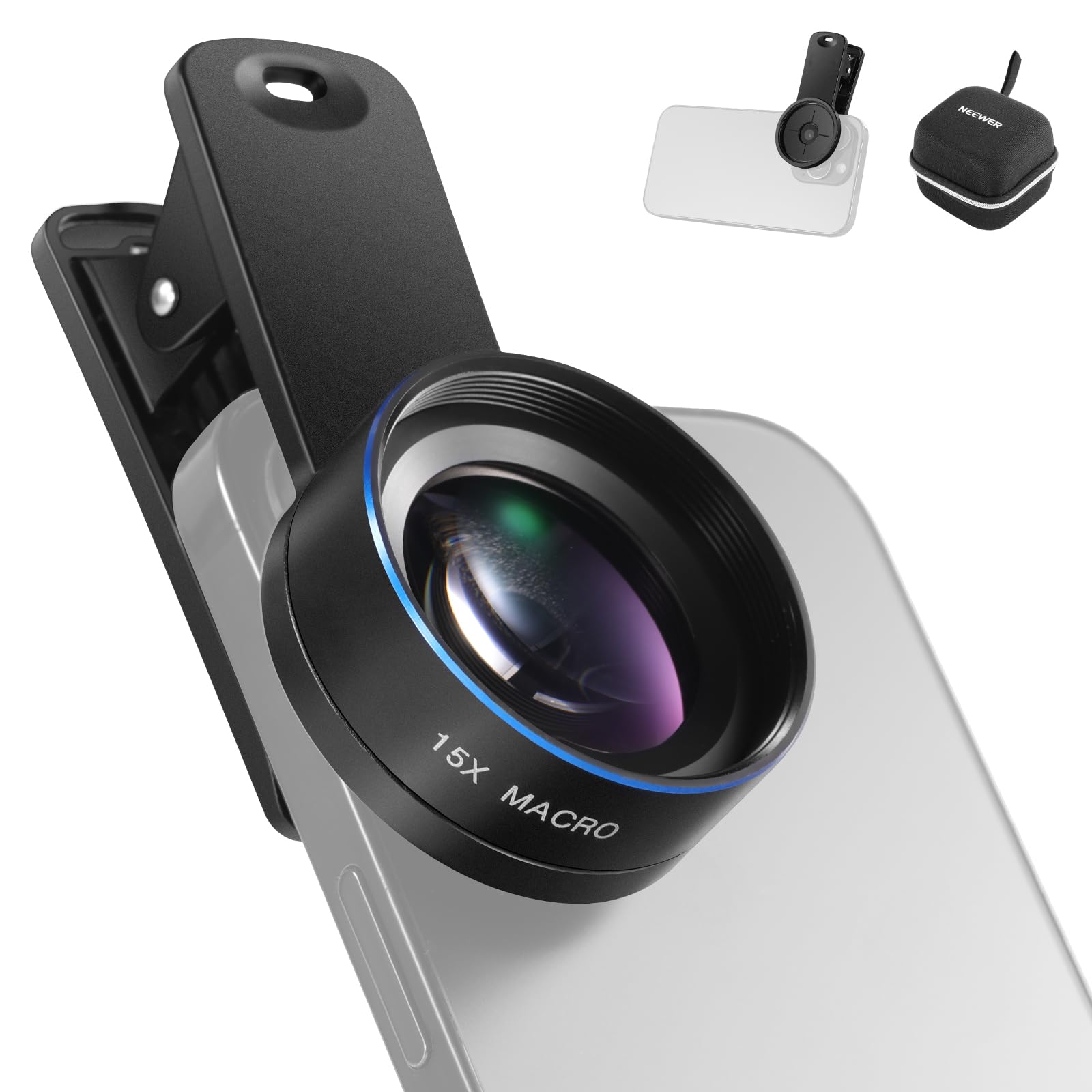
A 15x macro lens that threads onto a 37mm clamp instead of squeezing onto your phone.
If your goal is filling the frame with a coin’s ridges, a jewelry clasp, or an insect’s wing, this is the pick. The NEEWER LS-69 puts 15x magnification in front of your phone, with an optimal shooting distance of 0.8 to 1.6 inches (2 to 4 cm) — so you get right on top of the subject and the fine detail fills the screen. The barrel is a rugged aluminum alloy shell, which matters because a macro lens gets bumped against tables all day.
The glass is the part worth paying attention to. It uses HD optical glass rather than resin, built as 2 elements in 2 groups to cut glare, reflections, and ghosting — the hazy wash that ruins close-ups under kitchen lighting. Protective coatings resist water, fingerprints, and scratches, and a cleaning cloth comes in the box. Nothing is more frustrating than a fingerprint you cannot wipe off a tiny front element.
The 37mm clamp is the practical bit. The lens threads through the clamp, so it holds its position over your main camera instead of drifting, and the clamp is listed as compatible with iPhone 18 Pro Max through 15, plus Samsung Galaxy S26 and S25 Ultra and other smartphones. Read a 37 millimeters fixed focal length as the thread size, not a zoom range — this is a single-purpose macro. One genuine catch: vignetting (darkened corners) varies by phone model. If you see it, take the lens off, tighten the clamp, disable macro mode, and set camera zoom to 1.1X or higher. Clean the phone lens first — a smudge shows up fast at this magnification. For buyers who want one tool for extreme close-ups and nothing else crowding the drawer, this is the cleanest value in the group.
Where it earns its keep
- 15x magnification with a tight 2 to 4 cm working distance for true detail shots
- HD optical glass with 2 elements in 2 groups minimizes glare and ghosting
- Aluminum alloy shell shrugs off outdoor handling
- 37mm clamp holds alignment better than a plain spring clip
Where it asks patience
- Fixed focus — you move the phone to find sharpness, not a focus ring
- No image stabilization, so rest your hand on something solid
- Vignetting can appear depending on phone model until you adjust zoom
Reach for this if: close-up detail is your main shot and you want one small aluminum lens that does it without a bag of extras.
Look elsewhere if: you need wide scenery or distant subjects — a single macro element cannot do either job.
2. NEEWER Basics LS-67 Phone Camera Lens Kit
Two screw-together lenses that swap from wide scenery to tight macro in a twist.
The design here is clever and worth understanding before you buy. The wide-angle and macro lenses arrive screwed together. Attach both for the wide shot: 0.45x magnification, an 18 mm equivalent focal length, and a 100° field of view (how much of the scene fills the frame). Unscrew the wide-angle piece and you are left with a 15x macro with a 2 to 4 cm shooting distance for bokeh-heavy close-ups of insects, jewelry, plants, and coins. Both use HD optical glass with multiple protective coatings against water, fingerprints, and scratches, plus 2 elements in 2 groups.
The 18 millimeters focal length description refers to that wide lens’s equivalent view; stacking the two together is what expands the field to 140° for broad city and landscape frames. The kit ships with the clamp, front and back caps, a cleaning cloth, and a storage bag.
Be clear-eyed about what this is. It has manual focus and no autofocus and no image stabilization, so sharpness is your hand’s job. Feedback on this kit runs mixed — some owners find the wide angle perfectly usable while others find the macro adds little over a newer iPhone’s built-in macro mode. The honest read: if your phone is a recent flagship with a strong native close-up mode, the macro half will feel redundant, and one buyer’s experience with a 16 Pro Max was that the lens “didn’t work so great.” Buy this when you want wide and macro coverage from one compact pouch and your phone’s own camera leaves both jobs undone.
What the twist buys you: one clip, two focal lengths, and a 140° ceiling when you stack the elements — that is real versatility from a small bag.
Frame it honestly: treat it as an add-on for phones whose built-in cameras are basic, and expect to learn where the edges go soft.
Suits you when: you want wide-angle group shots and macro detail from a single kit that lives in a pocket.
Think twice when: your phone already shoots excellent macro natively — the second lens will sit unused.
3. Apexel Phone Camera Lens, 2 in 1 Cell Phone Clip-on Lens Kit
A no-app clip-on where the wide lens and the macro come attached at the factory.
Apexel’s approach keeps setup dead simple: no app, no special case, just clip the aluminum barrel over your main camera and align it. The 0.45X wide angle widens your field for group shots and landscapes, and unscrewing the front element exposes a 12.5X macro with an optimum distance of 0.8 to 1.6 inches (2 to 4 cm) for insects, jewelry, coins, and plants. HD coating on the glass is aimed at reducing glare, reflection, and ghosting.
The magnification gap between this and the NEEWER LS-69 is worth a direct mention: 15X on the NEEWER against 12.5X here, so the NEEWER pulls you slightly closer. That said, the 1 millimeters focal length figure in the spec sheet is a listing placeholder, not a real optical value — judge this lens on the 12.5X macro and 0.45X wide specification instead.
Where this kit splits opinion is fit on newer flagships. The listing itself warns results may vary on multi-camera phones with advanced built-in lenses, because the clip has to land over the correct lens without catching the camera bump. Buyers report both outcomes — some love the difference in photo and video quality, others found it bulky and returned it. The practical rule: it is designed for everyday smartphones with basic camera systems, so check your camera layout and case thickness before ordering. On a modern phone with a raised multi-lens island, spend the extra thought on a thread-mount lens instead.
The honest trade-off: a one-piece clip design that is fast to attach, paired with glass that gives its best on simpler phone cameras.
Skip past it if: you shoot on a recent multi-lens flagship — alignment becomes a fight and the built-in cameras may already win.
Best matched to: older or budget phones with a single rear camera that needs a wider view and closer focus.
Know before you click: the clip must sit flush over your main lens, and a thick case can throw that alignment off.
4. 11 in 1 Cellphone Lens Kit

Eleven pieces of glass in one pouch, from fisheye to star filters.
This kit is for the person who wants to experiment rather than specialize. Inside the carry pouch you get a 0.63X wide angle, a 15X macro, a 198° fisheye, a telephoto lens, plus CPL, flow, radial, star, and soft filter lenses and two kaleidoscope pieces. The fisheye creates a round fish-bowl effect, the CPL (circular polarizer) cuts reflected light for richer color, and the wide angle opens up selfies and group frames. For anyone learning what different focal lengths actually do, eleven lenses in one box teach that faster than reading about it.
The practical wrinkle is assembly. The macro and wide-angle lenses arrive screwed together — the macro works alone, but the wide angle needs the macro behind it. Owners note the threads can be fiddly: reports of a macro lens sticking in the holder and a wide-angle element rotating as if it lost its thread point to a kit that asks for gentle handling. Functionality feedback splits too, with some confirming it slips over an iPhone 12 case and others finding certain lenses do not play well with their phone.
Set expectations by what this is: a creative sampler, not a precision optic. The kit packs real value for the range of looks it delivers, and for kids, hobbyists, or anyone chasing novelty shots it is genuinely fun. But if you need one razor-sharp macro lens for serious work, spend your attention on a single-element macro instead of spreading it across eleven.
What the box delivers
- Eleven lens and filter options cover wide, macro, fisheye, telephoto, and creative effects
- CPL and star filters add in-camera looks without editing apps
- Arrives in an insulated carry case that keeps the pieces together
What to expect
- Screw-together threads need careful handling to avoid sticking
- Quality varies lens to lens inside the same kit
- Some phone and case combinations require removing the case
Worth it for: beginners and hobbyists who want to try fisheye, filters, and macro without buying five separate kits.
Not the pick for: anyone who needs one dependable macro optic for paid or detailed work.
5. Xenvo Pro Lens Kit

The kit that brings its own light, its own clip, and a case that fits in a jacket pocket.
Xenvo built this around two lenses and a light. The TruView 0.45x wide angle promises 45% more picture per shot with no dark corners (vignetting) like cheaper lenses, and the Clarus 15x macro handles close-ups — position it roughly 1/2 inch from the subject for the sharpest result. Glass is multi-element and coated to minimize ghosting, reflections, and lens flare, and the bodies are aircraft-grade aluminum. The TruGrip clip is built for grip, which is the piece that decides whether your lens stays aligned mid-shoot.
The GlowClip Mini LED is the piece most kits leave out. It clips anywhere on the phone and throws warm, continuous light with three brightness settings — low, medium, and high — for darker venues where a phone flash turns skin ghost-white. A quick-release lanyard lets you wear the lens instead of digging for it, and the DuraCase keeps everything together.
Quality is what the owner base keeps coming back to, and it shows in what people shoot: aquarium fish, jumping spiders on an iPhone 13 through an OtterBox case, vacation shots in Chicago that come out clear without the “rounded” distortion cheap wide lenses produce. The recurring nitpick is a small one — the macro lens has no dedicated protective cover, so store it in the case. And as with any coated glass this thin, expect a faint color cast in some lighting; one long-term user found a blue hue creeping into shots. Neutralize it in your phone’s white balance and you are fine. For a first lens kit that covers macro, wide, and dim-light shooting in one purchase, this is the safest bet in the group.
Why it leads the all-rounders: two solid lenses, a rechargeable three-setting fill light, and a travel case — no other pick here covers low light at all.
The small print: no dedicated cap for the macro front element, and coated glass can pick up a slight color tint that white balance fixes.
Pick this one if: you shoot close-ups and wide shots indoors or in dim venues and want the fill light built into the kit.
Consider another if: you only ever shoot one type of photo and would rather pay for a single sharper optic.
6. ULANZI CL-003 Phone Macro Lens

A screw-on macro built like a small camera lens, with a focus ring instead of guesswork.
Most clip-on macros make you slide the phone to find focus. The ULANZI CL-003 gives you a tele-focusing ring with a 45 to 90mm focusing range, so you set the distance and turn the ring — closer to how a DSLR macro behaves. Magnification is 10x optical, and the upgraded lens combination is designed for more light throughput and less distortion than a simple single-element design. The body uses aluminum alloy with a non-slip texture, styled after a real camera lens.
Mounting is the key difference. This is not a spring clip alone — it has a universal 17mm adapter that pairs with the included cold shoe lens clip, or screws directly into a 17mm port phone case or rabbit cage for quick, aligned installation. That threaded mount is what makes it a strong pick for anyone shooting video on a rig, because alignment stays put between takes. The 10x magnification puts millimeter details from plants, insects, jewelry, and handicrafts right in the frame with natural bokeh.
Where the CL-003 shines is moving footage. People film TikTok close-ups with it and call it the better of the lenses they have tried, and the crispness holds up on video as well as stills. The one honest caveat is the learning curve — you have to find the right distance before it snaps into focus, and a unit that arrives misaligned or blurry at the focus plane is a return. Once you dial in the 45 to 90mm range, though, it delivers some of the cleanest macro detail in this list.
The focus ring is the feature: 45 to 90mm of working range you set by hand instead of hunting with your arm, which is what makes close-up video repeatable.
The catch: the 17mm thread wants a compatible case or cage — with the bundled clip it works on most phones, but the screwed-in path is the one that stays aligned.
Ideal for: video creators and rig users who want repeatable macro focus via a 17mm thread mount.
Pass on it if: you want point-and-shoot simplicity — the manual focus ring rewards practice.
7. Kase HD Master Macro Lens

Macro with breathing room — 40 to 85mm of space so insects do not fly off.
Here is the number that matters most for insect and flower shooters: a shooting distance of 40 to 85mm (4 to 8.5cm). Compare that to the 2 to 4 cm working distance on the NEEWER LS-69 and Apexel kits — the Kase lets you stay back far enough that your hand and phone do not spook the subject or shadow the light. That longer distance also raises your hit rate on skittish bugs, which is exactly the problem most short-range macros create.
The optics back it up. Five elements in four groups is a more complex design than the 2-element layouts elsewhere in this list, and the low-dispersion glass carries anti-reflective multi-layer coating to cut reflection, glare, and ghosting while improving saturation. The aluminum body uses a frosted metal finish that resists scratches and wear, and the 17mm thread (M17 mount) lets you screw it into a compatible phone case or cage, with an included clip for near-universal phone coverage.
Build quality is what owners praise most, and it reads as a lens you keep rather than replace. The honest limit is focus: at 40 to 85mm you must land inside that band or the image will not resolve, and at least one iPhone SE user found the stated focusing distance did not behave as expected. Kase says it plainly — keep the lens 4 to 8.5cm from the subject or it will not focus. Master that and you get clear detail with soft background bokeh; miss it and you get mush. For patient macro work on living subjects, the extra distance is worth the discipline.
The distance advantage: 40 to 85mm of working room lets you photograph insects and flowers without crowding them, which short-range macros cannot offer.
The discipline required: manual focus inside a fixed band — drift outside 4 to 8.5cm and nothing comes into focus.
Go for it if: you chase insects, flowers, and jewelry and need standoff distance more than you need a clip-and-go setup.
Look at a shorter macro if: you shoot coins, documents, or flat objects where a 2 to 4 cm distance is no problem.
8. TELESIN 2X Telephoto Master Lens
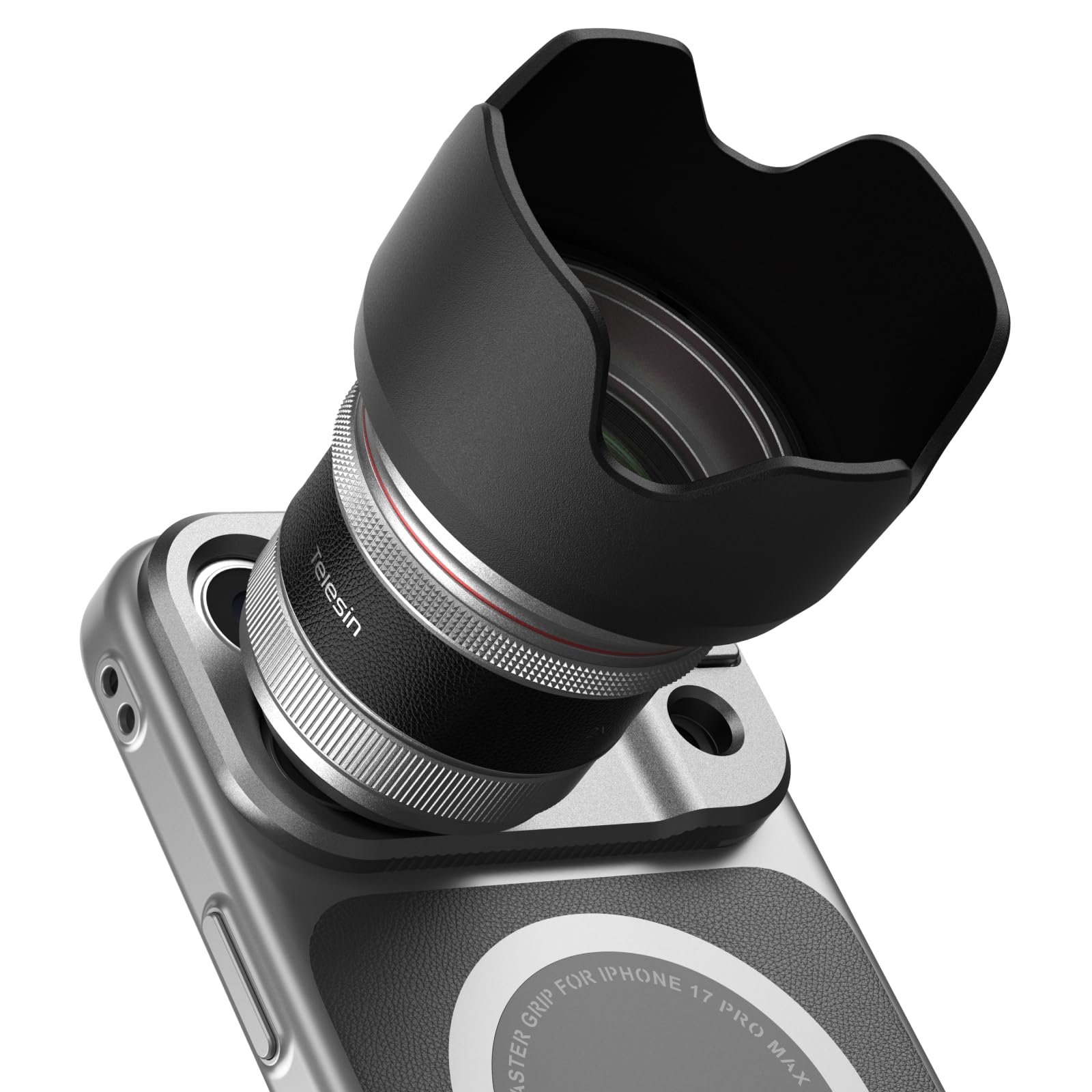
A true 200mm reach for distant subjects, made to pair with one specific phone.
This lens answers a different question: how do I get closer without walking closer? The TELESIN offers 200mm equivalent optical telephoto reach (described as 4x on iPhone 17 Pro Max) and 400mm digital zoom (8x) for distant subjects — wildlife, sports, concerts. Dial your phone to 2.2x and it renders the classic 105mm portrait perspective the maker calls the “golden-standard” look. Add the included lens hood to shade the front element in bright sun.
Stabilization is handled in software. The dedicated Reef Color App reads the phone’s gyroscope data and corrects for shake with only a roughly 10% crop factor. The lens mounts through a dedicated adapter plate onto the included iPhone 17 Pro Max case — tool-free, with alignment designed to avoid vignetting. Package contents run thorough: the lens, the case, a lens case, the adapter plate, hood, cap, and cleaning cloth.
Be sure this fits your phone before ordering, because it is a purpose-built mount for the iPhone 17 Pro Max, not a universal clip. And understand what the feedback describes: the review stream for this listing is dominated by impressions of a magnetic camera grip and its button, Bluetooth, and durability behavior, which tells you this is an accessory ecosystem with moving parts rather than a sealed lens. If you shoot distant subjects on that specific phone and want optical reach beyond the built-in zoom, this delivers it; if you are on any other handset, it will not mount.
What it solves: genuine 200mm optical reach plus a 105mm portrait setting, with app-driven stabilization and a hood for harsh light.
The fit gate: it is built for the iPhone 17 Pro Max case and adapter plate — other phones are out of scope.
Made for: iPhone 17 Pro Max owners who shoot wildlife, sports, or stage performances and want real optical telephoto reach.
Do not order if: you are on a different handset — the mounting system is phone-specific.
9. APEXEL 5-10X Telephoto Zoom Lens
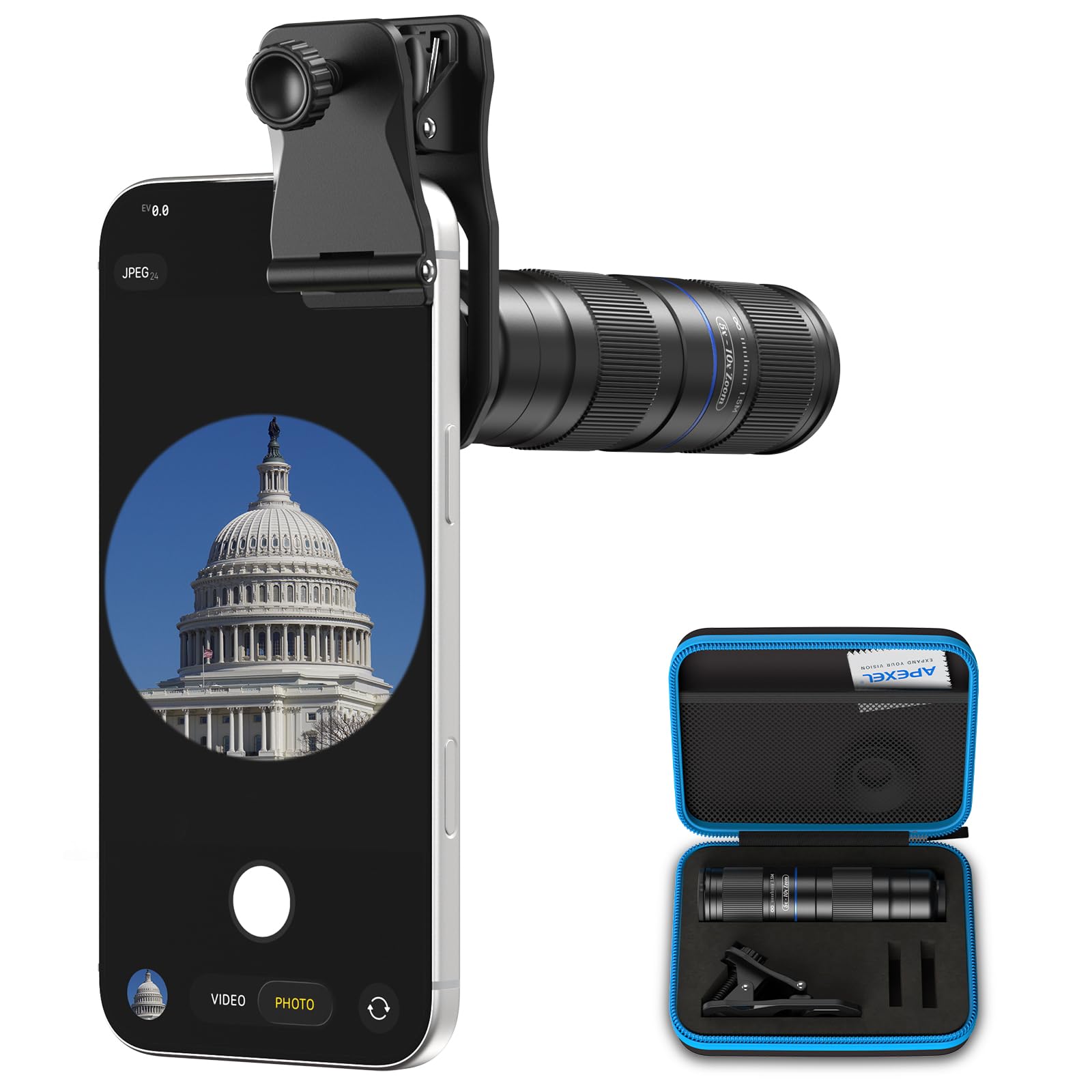
A zoom ring from 5X to 10X that works across a 6.6 to 98 ft subject range.
Where the TELESIN locks you to one phone, the APEXEL 5-10X aims wider. It adjusts from 5X to 10X with a zoom ring, then fine-tunes with a separate manual focus ring, designed for subjects roughly 6.6 to 98 ft (2 to 30 m) away. A 10-element, 6-group optical system with multi-coated glass reduces reflections across that whole range, and the aluminum body measures 4.96 in (126 mm) long at just 6.03 oz (171 g) so it packs into its case easily. Add the included eyecup and it doubles as a monocular for watching rather than shooting.
Where it fits your life is distances you cannot cross: performers on a lit outdoor stage, players near the sidelines, museum exhibits beyond the crowd, animals in a zoo habitat. It is best for stationary or slower-moving subjects in daylight or well-lit settings, and phone digital zoom of about 2 to 2.5X may be needed to clear circular borders depending on your setup — which crops the frame and narrows the view.
Compatibility is the thing to verify. The padded clip fits many phones, but it depends on camera layout, bump, and case thickness, and owners have hit real fit walls — an iPhone 12 Pro Max user saw a circle-within-the-picture look, and a heavier phone can tug the clip out of alignment. Keep the clip centered and flush, disable automatic macro switching, and a compatible threaded case (sold separately for select models) gives a firmer hold. For zoo days, concerts, and safaris where the subject stays put, the reach and light weight are hard to argue with.
Why the reach stands out: a 5X to 10X zoom across 2 to 30 meters, in a 171 g aluminum barrel that also works as a monocular.
Do a fit check first: clip seating depends on your camera bump and case, and off-center seating is where the circular-border look comes from.
Best for: travel, zoo, and outdoor event shooting where your subject is 2 to 30 meters out and you want zoom range in one light lens.
Think carefully if: your phone’s camera island is large and raised — alignment and clip grip are the risk, not the glass.
Know the Specs
Magnification and focal length
Magnification like 15x or 12.5x tells you how much the lens enlarges your subject — bigger numbers pull you closer. Focal length in millimeters describes the view angle: a low number like 18mm is wide, while a longer equivalent like 200mm is telephoto. Do not confuse a 37mm thread size with focal length — that number is the screw diameter the lens mounts through, not a zoom range.
Working distance
Every macro lens needs a set gap between its front glass and your subject to focus. A 2 to 4 cm range means pressing in close, fine for coins and documents but hard on living subjects. A 40 to 85mm range gives you room to stay back, which is the difference between a sharp insect shot and an empty frame. Longer distance usually means a manual focus band you must stay inside.
Glass elements and coatings
A lens is built from several pieces of glass grouped together — 2 elements in 2 groups is simple, 5 in 4 or 10 in 6 is more complex and generally handles distortion and light better. HD optical glass beats resin for clarity, and multi-layer coatings cut glare, ghosting, and flare while resisting fingerprints and scratches. More coated glass usually means cleaner detail under tricky light.
Mount type and vignetting
A clip-on mount springs over your camera; a 17mm thread mount screws into a compatible case or cage. Threads hold alignment better across a shoot, while clips fit more phones but depend on camera bump and case thickness. Vignetting — darkened corners — usually appears when the lens sits slightly off-center, so tighten the mount and nudge your camera zoom up if it shows.
Common Questions
Will a clip-on phone lens fit my phone case?
What is the difference between a 15x and a 10x macro lens?
Why do I get dark corners (vignetting) with an add-on lens?
Can I use a phone macro lens on insects and flowers?
Do these lenses work with both the front and rear phone camera?
What is the difference between a 17mm thread mount and a clamp?
Why does my phone’s own macro mode beat the add-on lens sometimes?
Do any of these lenses need an app to work?
Can a telephoto phone lens replace my phone’s built-in zoom?
The Bottom Line
For most people shopping the phone camera lenses, the NEEWER Basics LS-69 earns the top spot because its 15x macro and 37mm clamp deliver true close-up detail from aluminum and HD optical glass with a firm, aligned mount. If you shoot both close-ups and wide frames — and often in dim light — the Xenvo Pro Lens Kit brings a rechargeable LED fill light that no other pick here includes. For patient insect and flower work, the Kase HD Master Macro gives you 40 to 85mm of standoff so your subject does not bolt. And if distant subjects are your aim, the APEXEL 5-10X Zoom covers 2 to 30 meters in a light aluminum body that doubles as a monocular. One nudge worth taking: the Xenvo kit is the most-reviewed lens in this group by a wide margin — a strong hint that its 0.45x wide plus 15x macro formula holds up for a lot of real buyers.
How we choose
We do not accept paid placement. Every pick is matched to a real buyer and a real use-case; we do not hands-on test units.
Sources
Specifications: manufacturer listings and product documentation. Review insights: verified customer reviews, as of November 2026. Pricing: not shown on this page (it changes often); check the current price via the retailer link.
As an Amazon Associate, Tactical Gear Guy earns from qualifying purchases. This does not affect which products we feature.