Specs are compiled from manufacturer listings and verified buyer reviews and can change over time — please confirm the key details on the product page before buying.
If your bench is short and your trim work is real, the saw you want is a compact miter saw that cuts straight, stores against a wall, and doesn’t demand a two-person lift. This list covers eleven of them, from cordless 7-1/4-inch units you can carry in one hand to 10-inch slider-style saws with genuine capacity. One honest note before we start: these picks use flexible, human-style matching for compact form factor (roughly 7-1/4 to 10 inch blades, with full-size 12-inch saws excluded), so a pick may be the nearest same-type size rather than the exact model you searched for — the job it does is the same.
This guide is built by comparing the manufacturers’ published specifications and the patterns across verified customer reviews, so you get each pick’s real strengths and trade-offs instead of marketing spin.
Every pick below is judged on the two things that actually matter at the bench: how little room it eats and how cleanly it lands the cut. That is the whole test behind this shortlist of small miter saws.
Top Picks
How To Choose The Best Small Miter Saws
The mistake most first-time buyers make is shopping by blade size on the box and ignoring the footprint on the bench. A saw that won’t sit flush against a wall in a one-car garage is a saw you’ll fight every time you pull it out. Decide where it lives first, then work backward to the specs.
Decide corded or cordless before anything else
Corded saws pull full power from the wall and never need a battery swap — a 15-amp motor on a 10-inch blade is the classic trim setup. Cordless saws trade that for freedom from an outlet, which matters when you’re cutting baseboard in a finished room with no live circuit. The trade-off is that cordless models often arrive as bare tools, so check whether the battery and charger are included or sold separately.
Match the cutting capacity to your actual material
Cross cut capacity is how wide a board the saw swallows in one pass. A compact 7-1/4-inch saw typically handles a 2×4 and standard baseboard, while a 10-inch saw clears wider stock and nested crown. If your work is trim, casing, and shelving, a compact saw covers it; if you’re regularly cutting 2×10 or thick crown, step up to the larger blade.
Look hard at the miter and bevel ranges
Miter is the swing left and right for angle cuts across a board; bevel is the tilt of the head for cutting on the angle. Single-bevel saws tilt one direction only, usually left, while dual-bevel saws go both ways without flipping the workpiece. For most trim carpenters a single bevel with a wide miter range (52° left and right is common on this list) handles the job, but dual-bevel saves flipping on crown work.
Mind the footprint and the weight
A fixed rail system minimizes the benchtop-to-wall depth so the saw can sit flush against a wall. An articulated hinge arm does the same by shrinking the front-to-back travel of the head. Weight matters too — a 20-pound saw moves in one hand, while a 37-pound or 64-pound unit wants a stand or a second set of arms.
Side-by-Side Comparison
| Model | Best For | Blade Size | Weight | Power Source | Amazon |
|---|---|---|---|---|---|
| DEWALT 20V MAX 7-1/4-Inch Miter Saw (DCS361M1)★ Best Overall | Cordless trim work anywhere | 7.25 in | 16 oz (item weight) | 20V MAX battery | Amazon |
| Metabo HPT 10-Inch Compound Miter Saw C10FCG2Best Value | Value-first 10-inch cutting | 10 in | 24.2 lbs | 15 Amp corded | Amazon |
| MarvTool 10-inch Compound Miter Saw JS-1017C3Lightest Bench | Lightweight bench saw | 10 in | 20.5 lbs | 15 Amp corded | Amazon |
| Delta S26-262L 10″ Shop Master Miter Saw | Laser-guided shop work | 10 in | 25 lbs | 15 Amp corded | Amazon |
| Genesis GMS1015LC 10-Inch Compound Miter Saw | Versatile bevel and laser cuts | 10 in | 16 oz (item weight) | 15 Amp corded | Amazon |
| SKIL MS6306-00 7-1/4″ Single Bevel Miter Saw | Wall-flush tight-space cutting | 7-1/4 in | 31 lbs | 10 Amp corded | Amazon |
| RYOBI ONE+ 18V Cordless 7-1/4 in. Sliding Miter Saw | One-battery ecosystem cordless | 7.25 in | 30.2 lbs | 18V ONE+ battery | Amazon |
| CRAFTSMAN V20 7-1/4 inch Sliding Miter Saw | Cordless with battery included | 7-1/4 in | 21.8 lbs | V20 20V MAX battery | Amazon |
| Makita LS1040 10″ Compound Miter Saw | Dual-post precision cutting | 10 in | — | 15 Amp corded | Amazon |
| BOSCH CM8S 8-1/2 Inch Sliding Compound Miter Saw | One-handed jobsite portability | 8-1/2 in | 37 lbs | Corded | Amazon |
| BOSCH CM10GD 10 In. Dual-Bevel Glide Miter Saw | Shop-grade glide precision | 10 in | 64 lbs | 15 Amp corded | Amazon |
Detailed Reviews
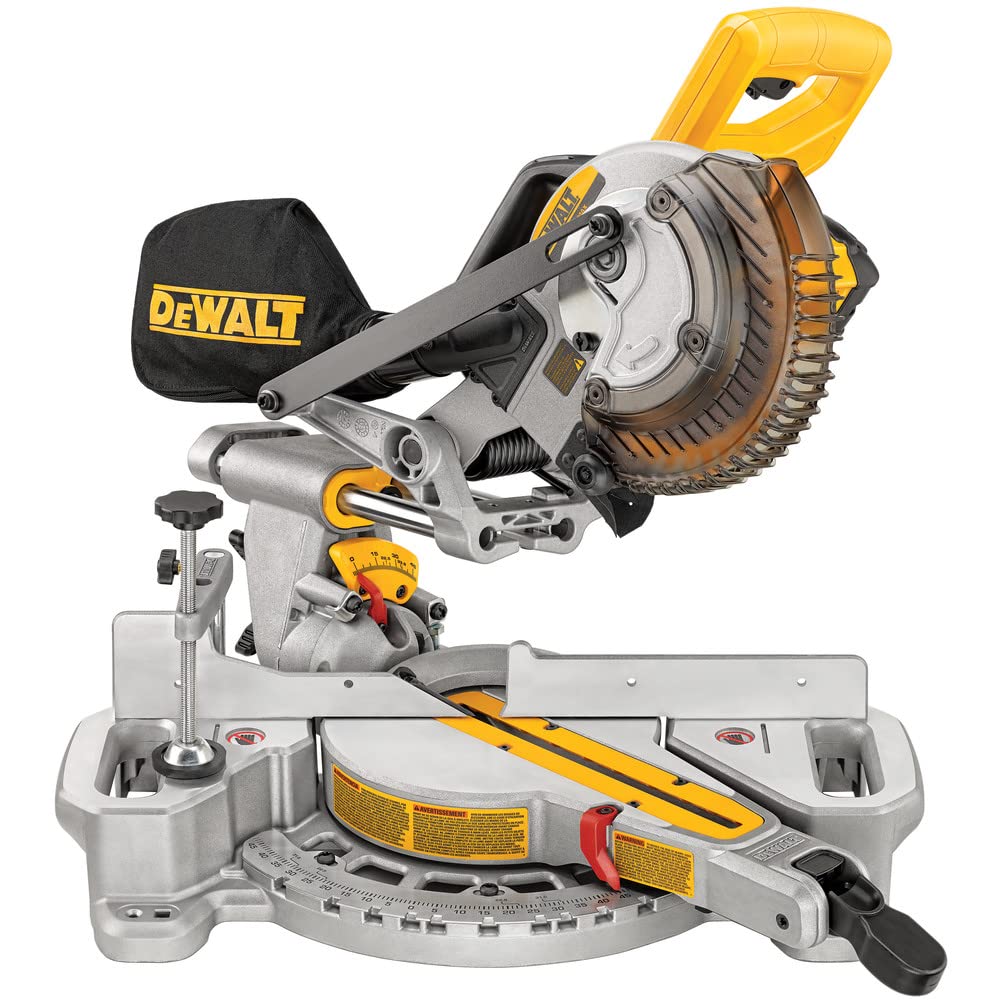
1. DEWALT 20V MAX 7-1/4-Inch Cordless Miter Saw (DCS361M1)
Our pick — 4.5+★ from 800+ verified ratings; the strongest balance of quality and price.
A 20V cordless 7-1/4-inch saw that makes 183 cuts of 2×4 pine per battery charge.
This is the saw for trim work in a finished room with no live outlet — the trim that has to happen after the drywall goes up. The 20V MAX battery pack (DEWALT’s rechargeable slide-in pack) delivers on average 183 cuts of 2×4 pine or 275 cuts of 3-1/4 pine baseboard, which is a full day of baseboard work on a single pack. Owners put it plainly: “Utilizes 20V Max* battery pack (DCB204) which provides on average 183 cuts of 2×4 Pine or 275 cuts of 3-1/4 pine baseboard.”
The cut line cross-cut positioning system (a built-in indicator that shows where the blade lands) needs no adjustment, so the first cut after you set it down is as clean as the last. The 7.25-inch high-speed steel blade handles 2x4s and 1×8 boards laid flat, and it cups 3-5/8″ nested crown plus 3-1/2 base vertically. The adjustable stainless detent plate gives you 11 positive stops, and the cam lock miter handle snaps to angle quickly.
What buyers love about this one is the size — it dominates the conversation far more than any other trait. It’s the kind of small that lets you set it on a kitchen counter and get the casing done. The 48-degree cutting angle and oversized bevel scale keep the mild bevel work honest.
Where it shines: The battery runtime is the defining feature here — hundreds of cuts between charges on a pack you likely already own for the drill. For a remodeler working trim across multiple rooms, that freedom is the difference between one trip and four.
The catch: The item weight of 16 ounces on the spec sheet is best read as the bare-tool listing figure rather than the whole saw; the saw is a portable 7-1/4-inch class, so plan on a two-hand lift onto a bench and a stand for high-volume days.
Best for: The remodeler or trim carpenter who wants cordless freedom and has DEWALT 20V batteries already on the shelf.
Look at a corded model instead if: You cut all day at one bench and don’t want to manage charge cycles — a 15-amp corded saw delivers endless runtime.
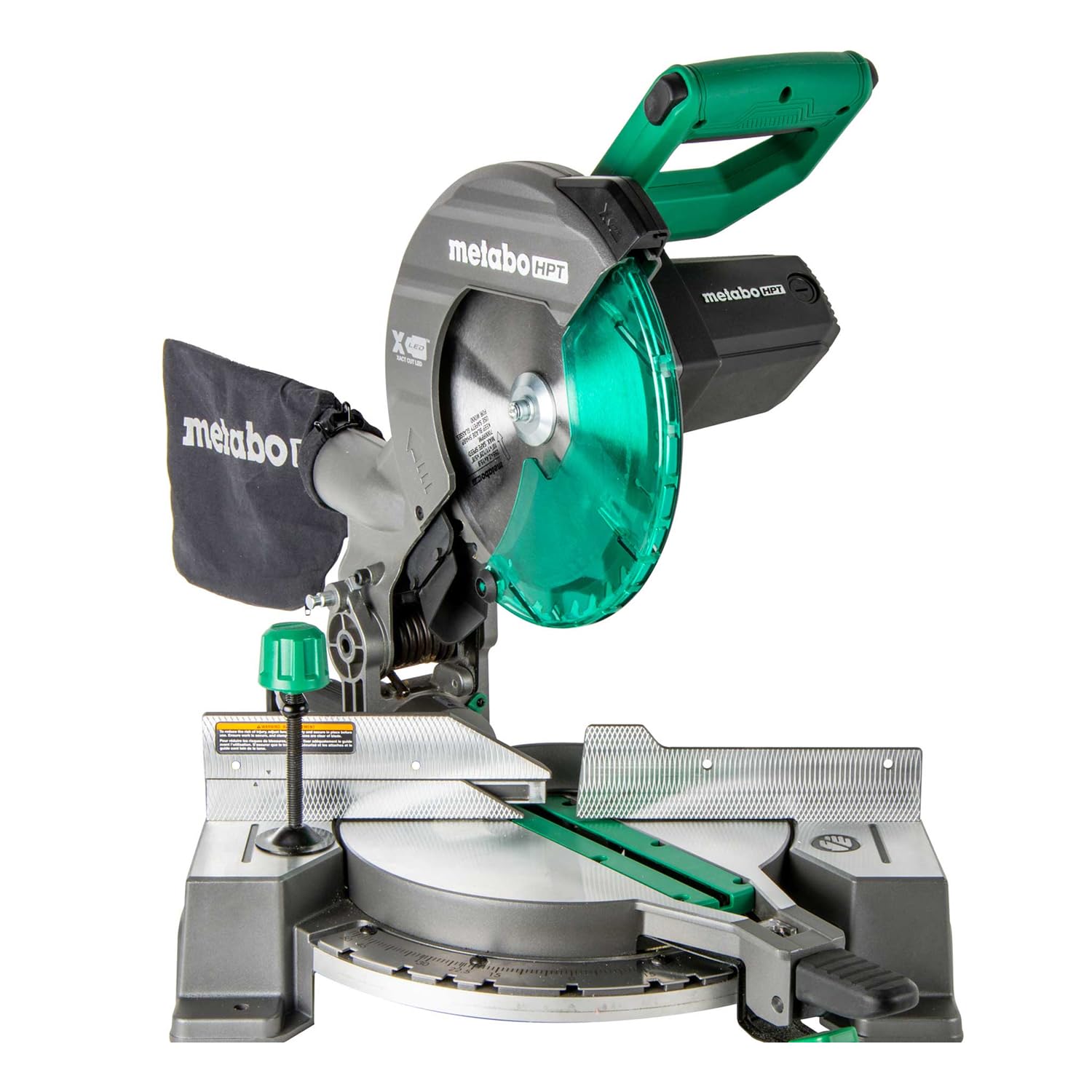
2. Metabo HPT 10-Inch Compound Miter Saw C10FCG2
A 15-amp, 10-inch corded saw with a 5-year warranty at an entry-tier price.
Quality is what wins here — it’s the attribute owners carry on about, well ahead of any other single trait. The 15-amp motor spins a 10-inch tungsten carbide blade up to 5,000 RPM, and the saw cuts through 6″ x 5/4″ composite boards and 2″ x 6″ lumber like butter. It handles a 0-52° miter range left and right and an adjustable 0-45° bevel left, which covers crown and casing. Shipping weight lands around 24.2 pounds, light enough to move from bench to truck without a helper.
The large table (the wide bed the material sits on) supports long stock better than smaller benchtop saws, and the vice clamping system holds the workpiece tight for each cut. The improved miter scale is easy to read and quick to set. Metabo HPT backs it with a 5-year warranty, which is rare at this price tier.
The case for the C10FCG2
- 15-amp motor with 5,000 RPM no-load speed handles composite and thick lumber
- 0-52° miter range and 0-45° left bevel cover nearly all trim work
- 5-year warranty from Metabo HPT
- Large table for better material support
Worth knowing first
- Single-bevel only on the left — no right tilt without flipping the workpiece
- 24.2 pounds is portable, not featherweight, so a stand helps for long sessions
- Corded, so you need a live outlet near the bench
Reach for it if: You want full 10-inch capacity and a long warranty without stepping into the premium tier — this is the strongest value pick on the list.
Pass if: You need dual-bevel tilt for crown work, where the left-only bevel forces you to flip boards.
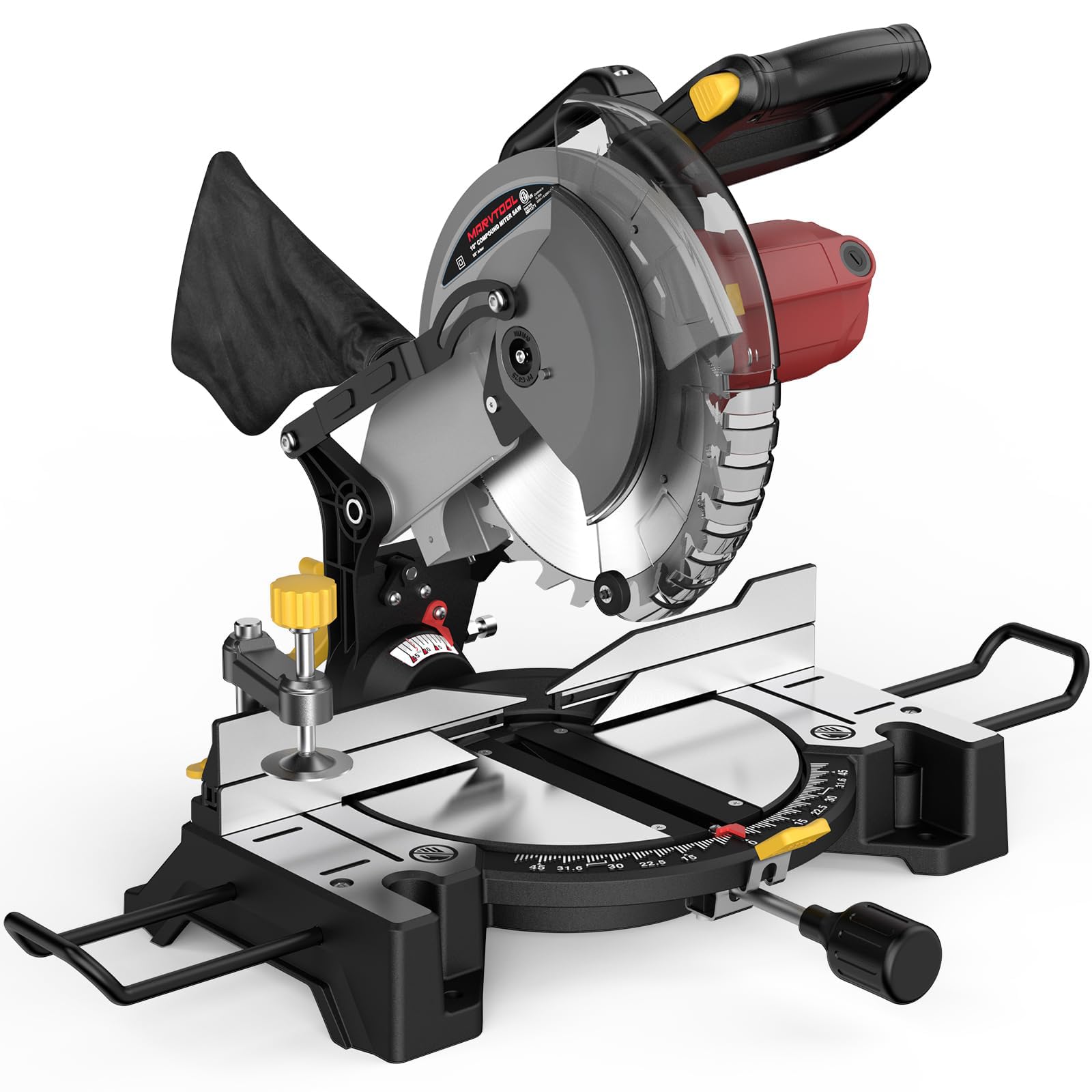
3. MarvTool 10-inch Compound Miter Saw JS-1017C3
A 15-amp, 10-inch compound saw at 20.5 pounds, the lightest 10-inch model here.
At 20.5 pounds this is the lightest 10-inch saw on the list — lighter than the Delta at 25 pounds and the Metabo HPT at 24.2 pounds. That matters if you carry the saw up stairs or set it up solo. The 15-amp motor delivers up to 5,000 RPM no-load, so you’re not trading power for the lower weight. The 0-45° miter range and 0-45° bevel on both sides cover compound angle cuts.
The head locks securely into the base using a release knob, which shrinks the saw down for storage. A 36-tooth carbide-tipped blade comes installed, and you also get two extension tables plus an Allen key in the box. A transparent blade guard keeps the cut line visible while the vise clamp holds the stock. The dust collection bag catches the chips before they cover the bench. MarvTool backs it with a 2-year warranty and 24/7 support.
What stands out: The weight-to-capacity ratio is the story. A 10-inch compound saw at 20.5 pounds is a saw you can genuinely set up alone, and the included extension tables mean you don’t need a separate stand for long baseboard runs.
Real limitation: This is the newest player on the list, so the long-term durability record is thinner than the established brands — but the 2-year warranty and full accessory kit soften that.
Suits you if: Portability is the top priority and you want 10-inch capacity with a full accessory kit in the box.
Look elsewhere if: You want a proven brand track record before you commit to a full shop setup.
4. Delta S26-262L 10″ Shop Master Miter Saw with Laser

A 15-amp, 5,500 RPM shop saw that cuts 4×4 and 2×6 in a single pass at 90°.
Delta’s Shop Master runs a 15-amp, 120V motor at 5,500 RPM — the fastest spindle speed on this list. It cuts a nominal 4×4 and 2×6 at 90° and a 2×6 in one pass, and it’s compatible with virtually all miter saw stands. The 10-inch blade and 5/8-inch arbor are standard sizes, so blades are easy to find. The spindle lock holds the shaft while you loosen the blade nut, making blade changes a one-wrench job.
Quality is what Delta loyalists point to, and it’s the saw’s strongest praise by a wide margin. The laser line is the practical daily win — it marks the cut ahead of time, so casing and shelving land on the pencil line without a practice cut. The trade-off is that reliability reads mixed across the review pages: the laser alignment can drift, and a few major miter angles don’t lock as solidly as the small stops do.
Strong suits
- 5,500 RPM no-load speed — highest on this list
- Cuts 4×4 and 2×6 in one pass at 90°
- Spindle lock for quick blade swaps
- Works with virtually all miter saw stands
Honest trade-offs
- Laser alignment can drift over time
- Some major miter angles don’t lock as firmly
- At 25 pounds it’s a two-hand lift onto a high bench
The right call for: Shop work where the laser speeds layout and the 5,500 RPM speed matters on dense stock.
Think twice if: You need dead-on detents at every major angle — expect to check the laser zero before critical cuts.
5. Genesis GMS1015LC 15-Amp 10-Inch Compound Miter Saw

Nine positive miter detents and a laser guide for crown, shadow boxes, and picture frames.
Genesis packs 9 positive detent miter stops into this 10-inch saw, so the common angles lock firmly without dialing them in each time. The die-cast aluminum base keeps the saw accurate while staying portable, and the 15-amp motor handles the cut. It bevels up to 45° left and handles compound cuts for crown molding, shadow boxes, and picture frames. Maximum cutting capacity at 45° x 45° is H 1-3/8″ x W 3-5/16″.
The 60-tooth carbide blade comes installed, and the box includes a hold-down clamp, a dust bag, two extension wings, a blade wrench, and two AAA batteries for the laser. The electric brake stops the blade in seconds, and the arbor lock makes blade changes a quick job. Owners treat this like a workhorse — it earns praise for how it functions day in and day out, and it’s forgiving on the setup.
Where the reviews split is on durability and adjustability, both of which read mixed. Treat this as a saw for occasiional heavy trim work rather than a daily production tool, and the value equation holds up well.
Why it earns its place: A full 60-tooth carbide blade plus nine stops plus extension wings in the box at the entry tier is a lot of saw for the money. For crown molding and picture-frame work, the compound capability is the whole reason to buy it.
Fair caveat: Durability and adjustability are the weaker spots — expect to recheck the detents and the laser after heavy use.
Good fit for: The hobbyist or weekend trim carpenter who wants compound capability and a full accessory kit from day one.
Better skip if: The saw will run daily in a production shop — the mixed durability record points to a beefier machine.
6. SKIL MS6306-00 10 Amp 7-1/4″ Single Bevel Miter Saw

A fixed compact rail system that keeps the saw flush against a wall in a tight corner.
Small-shop and closet work lives and dies by the footprint. SKIL’s fixed compact rail system minimizes the benchtop-to-wall depth, so the saw sits flush against a wall in a tight corner. The LED shadow line (a light that casts the blade’s shadow onto the board, showing exactly where the cut lands) is sharper than a laser for baseboards, casing, and crown. The 10-amp motor spins up to 4,800 RPM for detailed cuts.
Capacity is generous for a 7-1/4-inch saw: up to 2×10 crosscut at 0°, up to 3-1/2-inch crown moulding nested, and up to 2×6 at 45° left or right. The miter range runs 0 to 47° left and 0 to 50° right, with detents at 0, 15, 22.5, 31.6, and 45 degrees on both sides. The quick work clamp secures material, and the quick miter lock makes angle changes fast. Single bevel cuts from 0 to 45° left.
Quality and value are what owners talk about most — this saw is well regarded for the price. The shadow line earns its own praise as the standout feature. Accuracy is the mixed note: some users get dead-on cuts from the start while others find they need to dial in the detents. The overall package still reads as great value for tight-space work.
What sells it
- Fixed compact rail system for flush-to-wall work
- LED shadow line is sharper than a laser for trim
- 2×10 crosscut capacity at 0° — big for a 7-1/4-inch saw
- Quick work clamp and quick miter lock
Read before buying
- Accuracy is mixed — expect to verify the detents on setup
- Single bevel, left only
- The stand (SRS0001) is sold separately
Built for: The tight-space carpenter cutting trim in a corner, closet, or against a wall where no other saw fits.
Not the pick if: You need dual-bevel capability or dead-on detents without any setup check.
7. RYOBI ONE+ 18V Cordless 7-1/4 in. Sliding Miter Saw

An 18V ONE+ cordless slider rated for up to 800 cuts per charge and a 2×10 crosscut.
If you already run RYOBI ONE+ tools, this saw slots into the same battery family — over 260 ONE+ tools all work with any RYOBI ONE+ 18V battery. The headline figure is up to 800 cuts per charge, which is more cuts than most trim jobs need. It also carries a 2×10 crosscut capacity, the widest at this blade size. The 7.25-inch high-speed steel blade handles the trim and framing work at hand.
Owners describe this as great for 90% of mitering tasks — the convenience of cordless without giving up real capacity. It handles 2x4s easily, and the value is strong for anyone who already owns the batteries. The 30-day limited warranty and the bare-tool listing are the two things to note: confirm you have a battery and charger, since they’re sold separately.
The practical read: Functionality leads the praise here, and the 800-cuts-per-charge figure is what most buyers want to see. This is the saw for someone who measures value by the batteries already in the garage.
The honest limits: It’s a bare tool, and the 30-day warranty is the shortest on the list — plan on protecting the investment yourself.
Yes if: You’re already in the RYOBI ONE+ ecosystem and want a slider that runs on batteries you own.
No if: You’re starting fresh — the bare-tool listing means battery and charger are extra, and the warranty is short.
8. CRAFTSMAN V20 Cordless Sliding Miter Saw, 7-1/4 inch

A 20V cordless slider kit with 4.0AH battery, fast charger, carbide blade, and clamp included.
This is the cordless pick that doesn’t make you shop for extras. The kit includes a V20 20V MAX 4.0AH lithium-ion battery, a fast charger, a carbide-tipped blade, a blade wrench, a material clamp, and a dust bag. The 3,800 RPM motor cuts 2x dimensional lumber, hardwoods, baseboard, and trim, and it makes up to 585 cuts in 3-1/4-inch MDF baseboard on a single charge. The slide gives you 8-inch cross cut at 90° and 5-1/2-inch cross cut at 45°, plus 3-5/8-inch nested crowns and 3-1/2-inch baseboards cut vertically.
Performance is what buyers highlight most, and it shows: the saw cuts through 2x4s with ease and holds precision at both 0° and 45°. The LED cut line positioning system marks the cut, and 9 casted miter detent stops make angle changes quick. At 21.8 pounds with side carry handles, it moves easily between rooms or the truck. A 3-year limited warranty rounds out the kit.
Compact size and battery life land on the plus side too — one reviewer’s read was that it cuts all day on a full charge. For a handyman or contractor moving between jobs, that’s the whole package.
The whole-kit advantage: Every other cordless saw here asks you to supply or confirm your own battery. This one ships ready to cut, which makes the entry point simpler for anyone new to cordless tools.
Check before you commit: The listed blade length of 4 inches on the spec sheet reads as a data error — the saw is a 7-1/4-inch slider per its own name and included carbide blade, so measure the arbor before buying a replacement.
Matches your needs if: You want a cordless slider with everything in the box and a 3-year warranty behind it.
Think twice if: You cut wide 2×10 stock all day — 8-inch cross cut at 90° is the ceiling here.
9. Makita LS1040 10″ Compound Miter Saw

A dual-post pivot arm and machined aluminum base give this Makita its trim-carver’s accuracy.
The 15-amp direct-drive motor runs at 4,600 RPM, and the dual-post compound pivoting arm keeps the head square through the cut. Miter range runs 0°-45° left and 0°-52° right, with positive miter stops at 9 settings including 15°, 22.5°, 30°, and 45° on both sides. Bevel cuts to 45° left. The machined aluminum base, dual base, and dual slide rails support the head with less flex than a single-post design.
Owners describe a saw that handles pressure-treated lumber and PVC without complaint, and the lightweight build makes it easy to move. In the box you get a 40-tooth micro-polished blade, a bag, a socket wrench, a triangular rule, and a vertical vise. A 1-year warranty covers it. This is a saw that earns trust through precision rather than raw capacity, and for casing, shelving, and furniture-grade cuts, that’s the right trade.
What makes it precise: The dual-post pivoting arm is the reason the 9 positive stops hold cleanly. For a bench saw, that’s the difference between a joint that closes and one that doesn’t.
The honest note: The 1-year warranty is on the shorter side for a saw at this tier, so plan on caring for the base and the slide rails to keep the precision long term.
Right for: Fine trim, shelving, and furniture cuts where a clean joint matters more than cross cut width.
Not for: Wide-stock framing where you need more than a 10-inch blade’s single-pass reach.
10. BOSCH CM8S Miter Saw
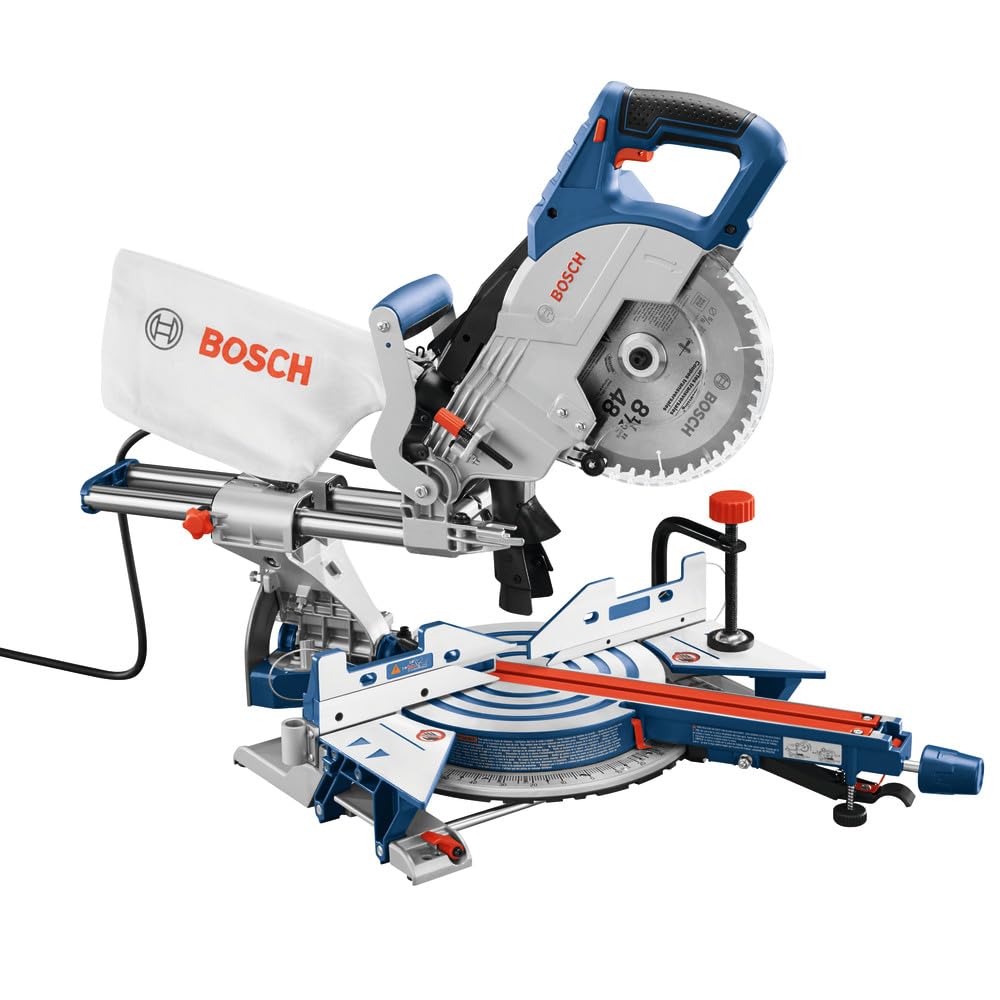
A well-balanced 37-pound slider with a top carry handle built for one-handed moves.
Bosch designed this saw around moving it. The top carry handle and well-balanced body deliver one-handed portability on and off the job — at 37 pounds, that handle is doing real work. The sliding arm gives a cross cut of 12-1/4 inches at 0°, 8 inches at 45°, 2-3/4 inches upright, and 3-1/2 inches for crown. The integrated expanding base extensions stretch up to 29 inches left to right for extra work-piece support on long boards.
The bevel lock lever and bevel turret stops sit on the side of the tool for quick adjustments. The miter and bevel scales read from 52° left to 60° right, with 10 adjustable miter detents at the most common cuts. The adjustable front stabilizing foot keeps the saw steady through slide cuts, and the clear lower guard gives an unobstructed view of the blade. An ambidextrous trigger handle fits either hand for all-day use.
Performance and weight both earn praise, and the saw cuts accurately. The honest note is that build quality, durability, and portability all read mixed — some owners find it well-built and easy to carry, while others find it awkward to handle and question how it holds up under hard use. For low-volume trim work, the portability wins.
The draw
- Top carry handle for one-handed moves
- 12-1/4-inch cross cut at 0° — wide for an 8-1/2-inch blade
- Expanding base extensions to 29 inches for long stock
- 10 adjustable miter detents and clear lower guard
Keep in mind
- Durability and build quality read mixed across reviews
- Single bevel — no right-side tilt
- At 37 pounds, some find the balance awkward when carrying
Choose it when: The saw lives in the truck and moves between jobs, and the carry handle plus 12-1/4-inch cross cut matter more than heavy-duty build.
Skip it when: You want a saw that lives bolted to one bench for a decade of rough framing.
11. BOSCH CM10GD 10 In. Dual-Bevel Glide Miter Saw
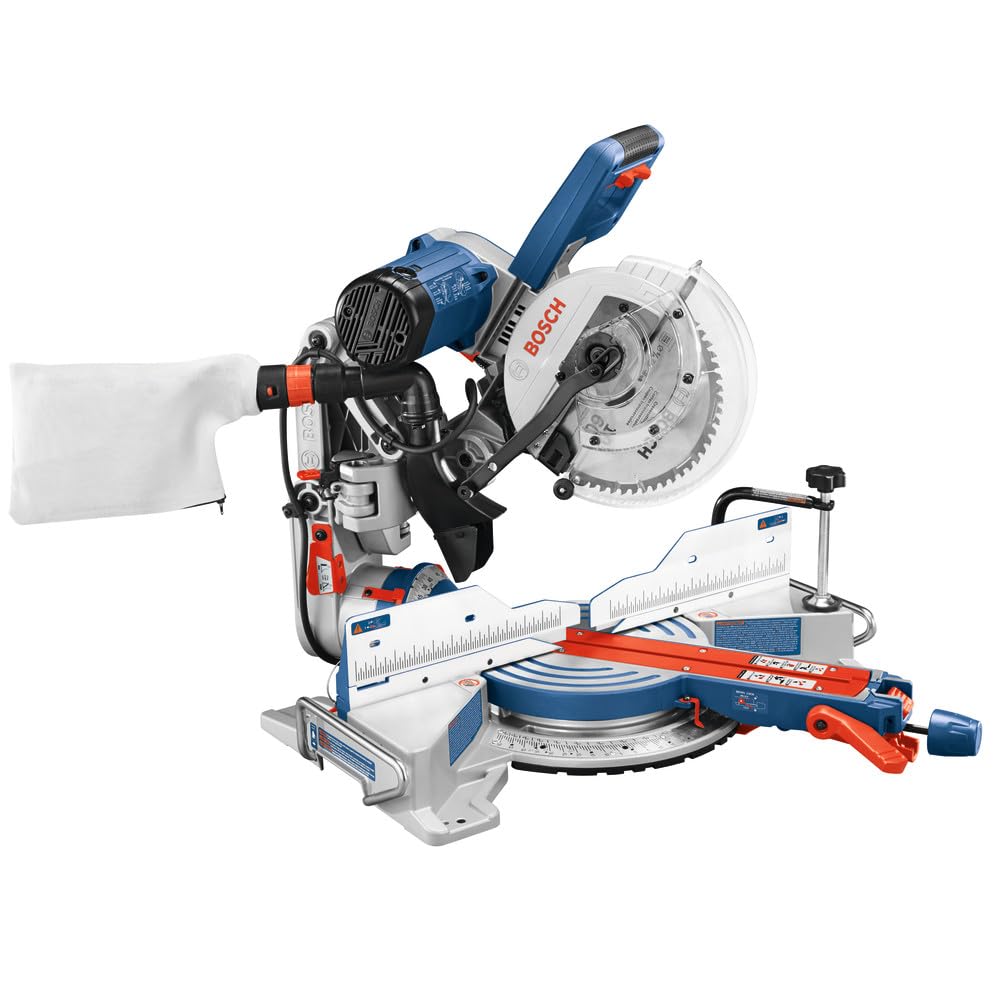
Articulated hinge arms cut the front-to-back footprint by up to 10 inches versus a slide saw.
This is the saw you put on a permanent bench. The articulated hinge arms reduce the front-to-back footprint by up to 10 inches compared to slide saws with similar capacities — that’s the difference between a saw that fits against a wall in a small shop and one that doesn’t. The Axial-Glide system trades the side rails of a traditional slider for a hinge that Bosch says offers more durable precision. A 15-amp motor delivers 4,800 no-load RPM.
Capacity is wide: 12-inch horizontal cut, 5-1/2-inch vertical baseboard cut against the fence, and 6-inch crown cut capacity nested against the fence at 45° spring. The 4-1/4-inch sliding fences support bevel setups and increased crown and base molding capacity. The bevel lock lever and range selector sit up front, so you don’t reach around back. Bevel range is 47° left and 47° right with detents at 0, 33.9, and 45 on both sides, plus miter detents at 0, 15, 22.5, 31.6, 45, and 60. A push-button miter detent override gives thumb-actuated fine adjustment.
Quality and accuracy are the two things owners praise most — this saw cuts clean and the controls are well-placed. The mixed notes center on value for money, angle adjustment, and ease of use: some angles arrive dead-on, while others need dialing in, and the setup takes patience. At 64 pounds it is a bench fixture, not a carry-along tool.
The shop-floor case: The Axial-Glide hinge and the up-front bevel controls make this the most refined saw here for daily bench work. The 12-inch horizontal capacity and 6-inch crown capacity cover full trim runs without flipping stock on the width cut.
Room to know: 64 pounds plus a 26.5-inch width footprint means it needs a dedicated bench and a clear space plan. The angle-adjustment learning curve is real, so budget a setup afternoon.
Made for: The dedicated woodworking shop that wants dual-bevel capability and glide precision sitting in one permanent spot.
Better to pass if: You need to carry the saw to job sites or you want a compact footprint on a small bench — the weight and width are the trade-off for the glide.
Know the Specs
Blade Diameter and Cross Cut Capacity
Blade diameter (the size of the circular blade) sets the maximum depth and width of a single cut. A 7-1/4-inch saw typically handles a 2×4 and standard baseboard, while a 10-inch saw clears wider stock and nested crown. Cross cut capacity is how wide a board the saw swallows in one pass — look for it stated at both 0° and 45°, because the 45° figure drops meaningfully on every saw. Match the cross cut to your actual material rather than shopping by blade size alone.
Motor Amps, RPM, and Cordless Voltage
Amps measure the electrical current a corded motor draws; RPM is how fast the blade spins with no load. A 15-amp motor is the standard for trim-class saws on this list, and 5,000 RPM and above is a common speed for clean cuts. Cordless saws list voltageinstead — 18V and 20V MAX packs are the two families here, and cuts-per-charge is the figure that matters. A higher amp-hour battery means more cuts before a swap; a bare-tool listing means battery and charger are extra, so check the box contents before you buy.
Common Questions
Will a 7-1/4-inch miter saw cut through a 2×4?
What is the difference between miter and bevel on a miter saw?
Is a 10-inch miter saw too big for a small shop?
Do cordless miter saws have enough power for baseboard?
Does the CRAFTSMAN V20 cordless saw come with a battery and charger?
Is a laser guide or an LED shadow line better for trim cuts?
What cross cut capacity do I need for crown molding?
Can a small miter saw cut metal and plastic as well as wood?
Do I need a stand for a compact miter saw?
What bevel range do I need for baseboard and casing?
The Bottom Line
For most people shopping for small miter saws, the pick that balances real capacity with cordless freedom is the DEWALT 20V MAX 7-1/4-Inch Miter Saw — 183 cuts of 2×4 pine on a single pack, an adjustment-free cut line system, and a compact size that wins over more owners than any other trait. If value and a longer warranty matter more than cordless, the Metabo HPT C10FCG2 delivers 10-inch capacity, a 15-amp motor, and a 5-year warranty for a fraction of the premium tier. And if your shop has one permanent spot for a saw, the BOSCH CM10GD with its Axial-Glide hinge and dual-bevel range is the bench fixture to build around. Any of the three will cut trim that fits — the range check is simply how much room you have and how often the saw has to travel.
How we choose
We do not accept paid placement. Every pick is matched to a real buyer and a real use-case; we do not hands-on test units.
Sources
Specifications: manufacturer listings and product documentation. Review insights: verified customer reviews, as of November 2026. Pricing: not shown on this page (it changes often); check the current price via the retailer link.
As an Amazon Associate, Tactical Gear Guy earns from qualifying purchases. This does not affect which products we feature.