Specs are compiled from manufacturer listings and verified buyer reviews and can change over time — please confirm the key details on the product page before buying.
If your garden lights fade out by midnight, the battery is almost always the culprit — not the panel and not the light itself. The fix is cheap and simple: a proper solar rechargeable AA with enough capacity to hold a charge from dusk until dawn. This guide covers the four packs worth shortlisting, what their capacities really mean for a night of light, and where each one honestly falls short.
This guide is built by comparing the manufacturers’ published specifications and the patterns across verified customer reviews, so you get each pick’s real strengths and trade-offs instead of marketing spin.
The picks below cover the full spread of solar rechargeable batteries.
Top Picks

How To Choose The Best Solar Rechargeable Batteries
A solar garden light is a tiny off-grid system: the panel collects sun, the cell stores it, and the LED spends it after dark. The cell is the weakest link in most setups, so it deserves the most attention. Get the capacity and chemistry right and your lights simply work; get them wrong and you’re out there with a screwdriver every few weeks.
Capacity in mAh decides how long the light stays on
Capacity is measured in mAh (milliamp-hours — think of it as the size of the fuel tank). A 1000mAh cell holds a moderate charge; a 2800mAh cell holds far more. Most garden lights ship with a weak 600mAh or 800mAh cell, so anything at 1000mAh or above is already an upgrade. Bigger capacity means the light can run longer after a cloudy day, but it also takes more sun to fill.
NiMH versus NiCd chemistry
NiMH (nickel-metal hydride) is the modern chemistry — it avoids the toxic heavy metals found in NiCd (nickel-cadmium) cells. NiCd is the older formula but still common in solar lights because it tolerates being drained flat night after night. If your fixture is sealed and runs the cell to empty daily, NiCd is a safe, proven fit. For everything else, NiMH is the better default.
Cycle life and low self-discharge
Cycle count is how many charge-and-drain rounds a cell survives before it weakens. A cell rated for 1,500 to 2,000 cycles is a long-term purchase for a nightly light. Low self-discharge matters too: a good cell keeps most of its charge in storage, so a spare pack doesn’t arrive flat next season.
Side-by-Side Comparison
| Model | Best For | Capacity | Chemistry | Pack Size | Amazon |
|---|---|---|---|---|---|
| Tenergy Solla 1000mAh AA (24 Pack)★ Best Overall | Year-round garden light replacement | 1000 mAh | NiMH | 24 AA | Amazon |
| Granicell 2800mAh AA (24 Pack) | Long runtime and high-drain devices | 2800 mAh | NiMH | 24 AA | Amazon |
| Tenergy NiCd 1000mAh AA (48 Pack) | Big installs of older solar fixtures | 1000 mAh | NiCd | 48 AA | Amazon |
| Kruta 2000mAh AA (20 Pack) | Mixed solar lights and everyday gadgets | 2000 mAh | NiMH | 20 AA | Amazon |
Detailed Reviews
1. Tenergy Solla Rechargeable NiMH AA Battery, 1000mAh, 24 Pack
Our pick — 4.0+★ from 13,000+ verified ratings; the strongest balance of quality and price.
The pack built specifically for the two things that kill garden-light batteries: overcharging sun and over-draining rain.
Here’s the spec that matters if you own a dozen path lights: a 1000mAh NiMH cell, sold 24 to a pack, shipped pre-charged so you can drop them straight into the fixtures. Tenergy engineered this one around the real failure modes of a solar light — the long summer day that keeps pumping current into a full cell, and the grey week that drains it flat. The anti-leak formula is there to survive both.
What wins people over is that they simply work in walkway and fence lights, which is exactly what this pack was aimed at. Tenergy rates the cell for 2,000 charging cycles and up to 5 years in a solar light, against the season or two a cheap cell typically lasts. It’s also free of the toxic heavy metals found in NiCd cells, and it carries UL certification, meaning an independent safety lab has signed off on the construction.
Be realistic about capacity. At 1000mAh this is a moderate tank, not a huge one — the Granicell pack below holds 2800 mAh in the same AA body. Buyers report honest splits: many get full charges and long nightly runs, while others find a cell lasts a single night or never tops off completely. That pattern usually points at the panel or the fixture as much as the battery, and it’s the reason to buy a 24-pack rather than four singles. Keeping two spares ready costs you nothing and saves a whole evening of troubleshooting.
What Holds Up Night After Night
- 1000mAh capacity with a 2,000-cycle rating and a maker claim of up to 5 years in a solar light
- Anti-leak engineering aimed at overcharge from long sunny days
- Pre-charged and ready to install the moment the box opens
- 24 cells per pack — enough to refresh a full run of path lights with spares
Where It Tapers Off
- Moderate 1000mAh tank next to the 2800 mAh Granicell, so runtime after a cloudy day is shorter
- Not a replacement for LiFePO4 cells — check your fixture’s spec sheet first
- Mixed reports on full charging, so a panel check is worth doing before blaming the cell
Solid fit for: anyone replacing the weak stock cells in walkway, fence or garden lights across a whole yard.
Look elsewhere for: high-drain gadgets or lights that need maximum reserve after a stretch of grey weather.
2. Granicell 24-Pack NiMH Rechargeable AA Batteries, 2800mAh
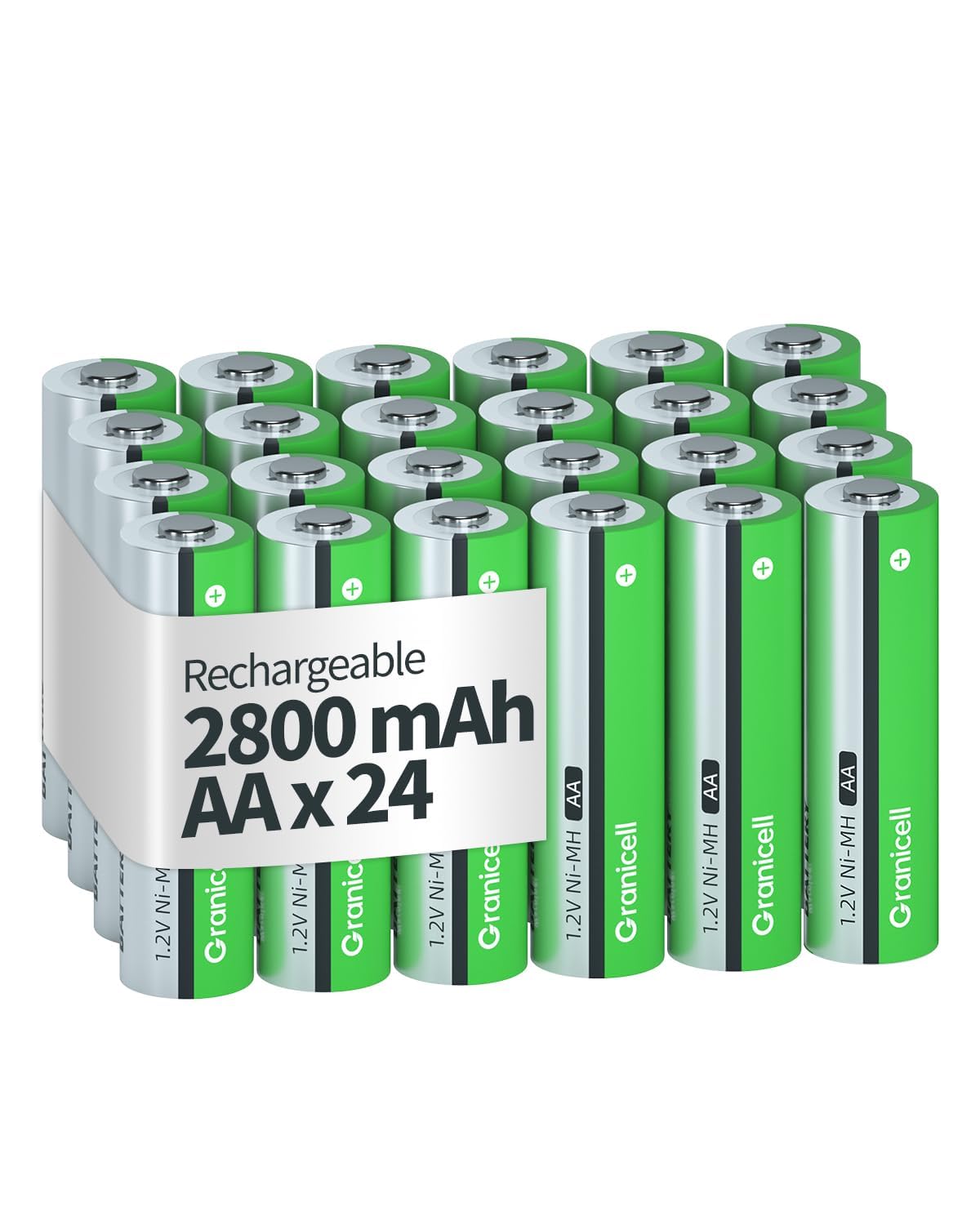
The biggest fuel tank on this list, and the one to pick when your lights need to run deep into the night.
Capacity is the whole story here: 2800mAh in a standard AA body, against the 1000mAh of the Tenergy Solla and the NiCd pack. That’s a big reserve for a light that has to stretch through a dark evening after a less-than-sunny day. If your current cells die around midnight and you want them burning until sunrise, this pack is the direct answer.
The supporting numbers are respectable too. Granicell rates the cell for up to 1,500 recharges, and its low self-discharge formula holds 80% of capacity after 3 years unused, so a partly stored 24-pack stays ready. The cells arrive pre-charged from the factory and, per the maker, pass six professional safety tests. Families with a mix of remote controls, toys and controllers will find plenty of non-solar uses for the spares.
The catch is honest and worth hearing: high-capacity NiMH cells need real sun to fill that 2800mAh tank. In a shaded planter or a north-facing bed, a smaller cell can actually out-perform it because it tops off more easily. Runtime also splits in reports — plenty of lights stay on from dusk to dawn, while some cells fade fast. If your panel gets limited light, drop to the Kruta pack below; if it bakes all afternoon, this is the one to grab.
The capacity math: 2800mAh versus 1000mAh on the Tenergy Solla is a 2.8x gap, which is exactly why this pack suits long-run lights and high-drain gadgets rather than quick top-ups.
Where it asks more of you: cell weight comes out heavier on paper and full charging demands good sun, so a shaded fixture is the wrong home for it.
Worth it when: your lights sit in full sun and you want the longest possible nightly burn.
Think twice if: your fixtures live in shade — a lower-capacity cell will charge more reliably there.
3. Tenergy Rechargeable NiCd 1000mAh AA Battery Pack 48 Count

Forty-eight older-chemistry cells for anyone maintaining a long run of solar fixtures on a budget.
Twenty-four cells covers a typical yard; forty-eight covers a landscaping job. This Tenergy pack is the bulk option, and the count is the headline — nearly double the Granicell and Tenergy Solla packs, in the same AA size. Each cell is 1000mAh at 1.2V in NiCd chemistry, the older nickel-cadmium formula that has powered solar lights for decades because it shrugs off being drained flat every single night.
Quality is clearly the thing buyers appreciate most about this pack, and it’s easy to see why the value lands: these are drop-in replacements for the stock cells in common solar garden and landscape lights, and they slot into a standard wall charger when the sun isn’t cooperating. Tenergy notes a 1000mAh rating is higher than the 600mAh or 800mAh cells many fixtures ship with, so a single charge should carry further. The cells measure 14.2 mm across and 50 mm long, standard AA dimensions, so fit isn’t a worry.
NiCd is the trade-off to weigh. It contains the heavy metals that NiMH avoids, so check whether your local rules care about disposal, and it can develop a “memory” if it’s repeatedly part-charged. Bright, long-lasting light is what this pack delivers in garden fixtures, though functionality and battery life draw a genuinely mixed response — some lights run all night and into morning, others quit after a day or two. Given how many of these cells are in circulation, the honest read is that most work well and a few disappoint. Buy the bulk pack and you have enough spares to shrug off a dud.
Why the count wins: 48 AA batteries versus 20 in the Kruta pack is a 2.4x gap — the practical choice when you’re refreshing dozens of fixtures in one order.
The chemistry caveat: at 19 g per cell it sits heavier than the 16 g Kruta cells, and NiCd brings heavy-metal disposal considerations that NiMH sidesteps.
Reach for this if: you’re re-celling a large landscaped yard or a rental property and want maximum count per order.
Pass if: you’d rather avoid NiCd chemistry and its disposal rules — a NiMH pack is the cleaner route.
4. Kruta NiMH Rechargeable AA Batteries, 2000mAh 1.2V, 20 Pack

A middleweight cell that moonlights in remotes and controllers once the garden lights are sorted.
Two-thousand milliamp-hours splits the difference neatly — double the Tenergy Solla’s 1000mAh tank, comfortably short of Granicell’s 2800mAh. For a yard of lights that gets decent sun, that’s a sensible middle ground. The cells are rated for up to 1,200 recharges and hold more than 80% of capacity for 3 years without leaking, so stored spares from a 20-pack stay alive.
The temperature range is where this pack quietly shines. Kruta rates it for -4°F to 140°F, covering a hard winter and a hot patio summer in one cell. It charges either from the sun or from a standard AA charger, and the maker suggests topping up on the charger when sunlight is patchy. That two-way flexibility is why it works beyond the garden: remotes, mice, keyboards, toys and game controllers all take a standard AA, so the spares earn their keep indoors too.
Value and battery quality are what buyers talk about most, and the verdict is largely warm — they work, they fit, and they’re priced as a practical multi-pack. The fair warning is life span: some find these outlast regular cells noticeably, others hit cells that stop holding a charge. At 16 g per cell they’re the lightest here, slightly under the 19 g Tenergy NiCd, which is a small plus if you’re handling a lot of them at once.
The flexibility play: solar or wall-charger charging plus a -4°F to 140°F range makes this the least fussy pack in the lineup.
Pick this one if: you want one pack that serves the solar lights and the drawer of household gadgets alike.
Skip the upgrade if: your fixtures bake in all-day sun and you’d rather have the full 2800mAh of the Granicell cells.
Know the Specs
mAh (Milliamp-Hours)
Capacity is the size of a cell’s fuel tank. A 1000mAh AA holds a modest charge for a night of garden light; a 2800mAh cell holds far more, so it can run longer after a dim day. The flip side is that a bigger tank takes more sunlight to fill, which is why a shaded fixture can do better with a smaller cell than a huge one.
Chemistry: NiMH and NiCd
NiMH (nickel-metal hydride) is the cleaner modern option and skips the heavy metals used in NiCd (nickel-cadmium). NiCd is the older formula, still common in solar lights because it tolerates being run to empty every night. Match the chemistry to your fixture’s manual and to how you’ll dispose of old cells.
Cycle Count
A cycle is one full charge and discharge. The packs here range from 1,200 to 2,000 cycles. A light that drains and refills daily will burn through a cycle every day, so a higher count means more seasons before you’re shopping again. Treat it as the durability rating of the cell.
Low Self-Discharge
This describes how slowly a cell loses charge while sitting unused. Packs that hold 80% of capacity after 3 years in storage are the ones you can buy in bulk, tuck in a drawer, and trust to still be alive next spring. Without it, spare cells quietly go flat on the shelf.
Common Questions
Will these AA batteries fit my solar garden lights?
Is 1000mAh enough for a solar light to stay on all night?
Should I choose NiMH or NiCd for solar lights?
Can I charge these batteries in a regular wall charger?
How many charge cycles should I expect before replacing them?
Why do some solar light batteries die after one night?
Do these batteries leak in hot or freezing weather?
Can I use these AA cells in remotes, toys and game controllers?
How should I store spare solar batteries between seasons?
Will a 2800mAh cell really last longer than a 1000mAh cell?
The Bottom Line
For most yards, the solar rechargeable batteries winner is the Tenergy Solla 24-Pack because its 1000mAh anti-leak formula was built for both the overcharge and over-drain that garden lights actually face. If raw capacity is what you’re after, take the Granicell 24-Pack with its 2800mAh cells. And if you’re re-celling a large landscaped property on one order, the Tenergy 48-Pack is the one to reach for — forty-eight NiCd cells in a single box. Whichever you pick, buy a few more than you need: one spare cell turns a dead light from a chore into a two-minute swap.
How we choose
We do not accept paid placement. Every pick is matched to a real buyer and a real use-case; we do not hands-on test units.
Sources
Specifications: manufacturer listings and product documentation. Review insights: verified customer reviews, as of November 2026. Pricing: not shown on this page (it changes often); check the current price via the retailer link.
As an Amazon Associate, Tactical Gear Guy earns from qualifying purchases. This does not affect which products we feature.