Specs are compiled from manufacturer listings and verified buyer reviews and can change over time — please confirm the key details on the product page before buying.
If you are buying a radio for a parent or grandparent, the deciding factor is not speaker wattage or Bluetooth — it is whether they can turn it on, find their station, and adjust the volume without help. A radio can sound lovely and still be useless if the tuning knob is a hair-thin wheel or the display is too dim to read across a dim bedroom. So this list ranks eight radios by how genuinely easy they are to live with day to day, from big analog dials with fluorescent pointers to a dementia-focused model with separate on and off buttons.
This guide is built by comparing the manufacturers’ published specifications and the patterns across verified customer reviews, so you get each pick’s real strengths and trade-offs instead of marketing spin.
You will see which sets run on plain AA or D cells, which ones plug into the wall, and which keep their tuning simple enough for shaky hands. The picks below cover every budget and every level of tech comfort, and each one earns its place for a different reason, which is exactly what makes choosing the right radio for seniors a matter of matching the controls to the person.
Top Picks


How To Choose The Best Radio for Seniors
Start with the hands and the eyes, not the speaker. A radio is only senior-friendly if the person using it can find the power button, see the frequency, and turn the volume up without hunting. Everything else — Bluetooth, presets, retro wood grain — is a bonus you add after that core job is solved.
Controls that work with shaky hands and dim eyes
Look for a large tuning knob rather than a tiny thumbwheel, and a dial with a bright pointer so the station number reads in low light. Separate, clearly labeled on and off buttons are easier than one button that toggles, because there is no guessing which state the radio is in. A volume dial that cannot drop all the way to silent is a small design choice that helps someone with memory loss know the set is still running.
Analog dial versus digital tuner
An analog dial is a physical wheel you turn until the station sounds right, which many older listeners find familiar from decades of use. A digital tuner with Auto Frequency Control locks onto the station for you, so it stays put instead of drifting. Neither is better in the abstract — the analog dial suits someone who wants simplicity, and the digital tuner suits someone who hates fine-tuning by ear.
Power: batteries, wall plug, or both
Dual power is the safest choice. A radio that runs on AA batteries and also accepts an AC adapter keeps working through a power outage and does not force a trip to the store when the cells run down. Pay attention to the cell size too: four AA batteries are light and cheap to replace, while four D batteries last far longer but make the set heavier and cost more to refill.
Side-by-Side Comparison
| Model | Best For | Power Source | Tuning Style | Senior-Friendly Control | Amazon |
|---|---|---|---|---|---|
| Panasonic RF-2400-K★ Best Overall | Everyday all-rounder | AC adapter or 4 AA batteries | Digital tuner with AFC | Large dial with fluorescent pointer | Amazon |
| Audiocrazy Bluetooth AM/FMBest for Streaming | Streaming plus radio | Power cord or 4 AA batteries | Analog dial | Large dial, LCD display | Amazon |
| PRUNUS J03CBest for Travel | Travel and carry-along | Rechargeable battery or AA backup | Smooth tuning knobs | Large easy-to-read frequency scale | Amazon |
| DreamSky AM/FM Portable | Bedside and kitchen | AC adapter or 4 AA batteries | Analog dial | Smooth large analog dial | Amazon |
| PRUNUS J08 | Outdoor and emergencies | Rechargeable, USB, solar | Oversized tuning knob | Large clear frequency scale | Amazon |
| Audiocrazy Vintage Wood | Looks and preset memory | Plug in wall | Digital with 40 presets | Large intuitive buttons, clear LED display | Amazon |
| C. Crane CCRadio EP PRO | Long-range AM talk radio | 4 D batteries or 6V AC adapter | Lighted analog dial | Large 5-inch speaker, simple controls | Amazon |
| Relish Simple Radio | Dementia and low vision | Mains or battery | Preset cards, hidden programming | Separate on/off buttons, non-zero volume dial | Amazon |
Detailed Reviews
1. Panasonic Portable AM/FM Radio RF-2400-K
Our pick — 4.5+★ from 33,500+ verified ratings; the strongest balance of quality and price.
A large dial with a fluorescent pointer that glows in a dark bedroom.
The thing buyers respond to most on this Panasonic is the sound — a full, warm tone that punches above what a small black plastic box suggests. The tuning is where it earns its place here, though. The large dial carries a fluorescent pointer, so the station marker glows faintly and stays visible in a dark bedroom without you switching on a lamp.
Underneath that dial sits a digital tuner with AFC — automatic frequency control, which is a circuit that locks the station in place so it does not drift while you listen. That combination is ideal for an older listener: the physical comfort of a real dial, plus the stability that stops a station sliding off frequency. The radio pulls in both AM and FM through its antenna, and you can use it on the AC adapter that comes in the box or on four AA batteries when the power goes out.
I compared it directly with the PRUNUS J03C, and the size gap is real: at 14″L x 6.25″W x 10.5″H versus 5.3″L x 1.4″W x 8.8″H, this Panasonic takes up far more shelf. What you get for that bulk is heft and stability on a nightstand. At 690 g it stays put when a hand brushes the dial rather than skidding across the table.
Where the Panasonic wins
- Glowing fluorescent pointer makes the station readable in the dark
- AFC keeps the tuned station from drifting
- Runs on the included AC adapter or 4 AA batteries
- Headphone jack for private listening at 3.5 mm
What to weigh first
- It is noticeably bigger than most sets on this list
- No Bluetooth, so it is radio only
Worth buying if: you want a dependable nightstand radio with a dial that reads in the dark and a station that stays put.
Think again if: the shelf is tight — this is the largest body in the group.
2. Audiocrazy Portable AM/FM Radio with Bluetooth
An AM/FM dial plus Bluetooth 5.0, so one 3-watt speaker plays both.
If the person you are buying for already has a tablet or phone full of podcasts and music, this Audiocrazy solves two problems at once. Bluetooth 5.0 lets a family member pair a device wirelessly and play through the same 3-watt speaker that handles the AM and FM bands. The frequency range is wide — FM 87-108MHz and AM 520-1710KHz — so the usual local stations come through alongside the streamed audio.
Weight is 1.37 lbs and the body measures 8.66 x 2.95 x 5.04 inches, which keeps it light enough to move from kitchen to bedside. It runs from a power cord or four AA batteries, so a dead outlet is not a dead radio. The interface is deliberately plain, and the cream retro finish reads more like a piece of furniture than a gadget.
The honest catch is reception. FM tuning gets split opinions — some sets pull stations cleanly, while others struggle, and a handful have stopped working shortly after setup. Read that as a fit note: if you live in a strong-signal area near the transmitters, this radio is a good pairing of old and new. If your favorite AM station already comes in weakly on other radios, this is not the one to bet on.
Why it earns a slot: the Bluetooth pairing turns a simple radio into something a grandchild can load with music from across the room, and the dual power keeps it usable without an outlet nearby.
The trade-off to know: the AM/FM side is the weaker half — reception reports vary from set to set, and a few units failed early.
Reach for this if: you want one speaker that plays both the local station and a streamed playlist.
Look elsewhere if: clear AM reception is the whole point of the purchase.
3. PRUNUS J03C AM FM Portable Radio
A 9-hour rechargeable that hands off to AA cells without a gap.
Most radios this simple make you choose: batteries or a cord. The J03C gives you a rechargeable battery that runs for up to 9 hours on a full charge, with AA cells sitting behind it as a backup. When both are in place the radio drains the rechargeable first, then hands off to the AAs without a gap — so a forgotten charge never turns into a silent set.
The body is a genuinely portable 8.2 x 5.2 x 2.4 inches at 1.1 lb, with a foldable handle that a hand can grip on the way to the garden. Tuning is a smooth knob across a large, easy-to-read frequency scale, and one button switches between AM and FM. A 19.5-inch telescopic antenna plus a DSP chip — a digital signal processor that filters noise — covers FM 87-108 MHz and AM 520-1710 KHz.
What owners value most is the overall build quality, and the battery life runs a close second in their estimation. The trade-off is that this is a radio, not a smart speaker: it has no Bluetooth and no station presets, so every listen starts with a turn of the knob. For someone who likes that ritual, that is a feature rather than a flaw.
The practical upside: the automatic switch from rechargeable to AA power means a power outage or a missed charge does not silence the radio mid-program.
Keep in mind: no preset memory and no Bluetooth — this is a turn-the-dial radio all the way.
Best match for: a household that wants one lightweight radio to carry room to room and out to the garden.
Not the one for: anyone who wants one-touch station buttons.
4. DreamSky AM FM Portable Radio

An 8.2-inch upright body with a big speaker and a smooth analog dial.
Compact size is what wins people over with the DreamSky — it tucks into the narrow strip of space beside a lamp or on a kitchen sill. The body runs 8.2″L x 2.2″W x 4.6″H, so it stands upright rather than sprawling. A big speaker inside that small frame throws clear sound across a room, and the analog tuning dial is smooth and large enough to grip.
Reception is the second thing that keeps this radio in daily use. It pulls both AM and FM, and the set is built to hold a station even in a spot with weak signal. Power works either way: the included adapter for indoor use, or four AA alkaline batteries (not supplied) when you want to take it to the yard. A 3.5 mm earphone jack lets the listener keep the volume to themselves at night.
The tuning is analog all the way, which means the listener turns the wheel until the station sounds clean rather than pressing a preset. For many older users that is exactly the point — it matches the radios they grew up with. The one adjustment for a new owner is learning how fine the dial needs to be turned on a crowded FM band.
What it does well: a small footprint paired with a loud speaker and a dial that is easy to grip and turn.
One thing to plan for: the AA batteries are not included, so buy a pack alongside it if portability matters.
Pick this one if: space is short and you want a loud, simple radio for the bedside or kitchen counter.
Pass if: you would rather press a saved preset than turn a dial to find the station.
5. PRUNUS J08 Portable Radio with Solar Charging
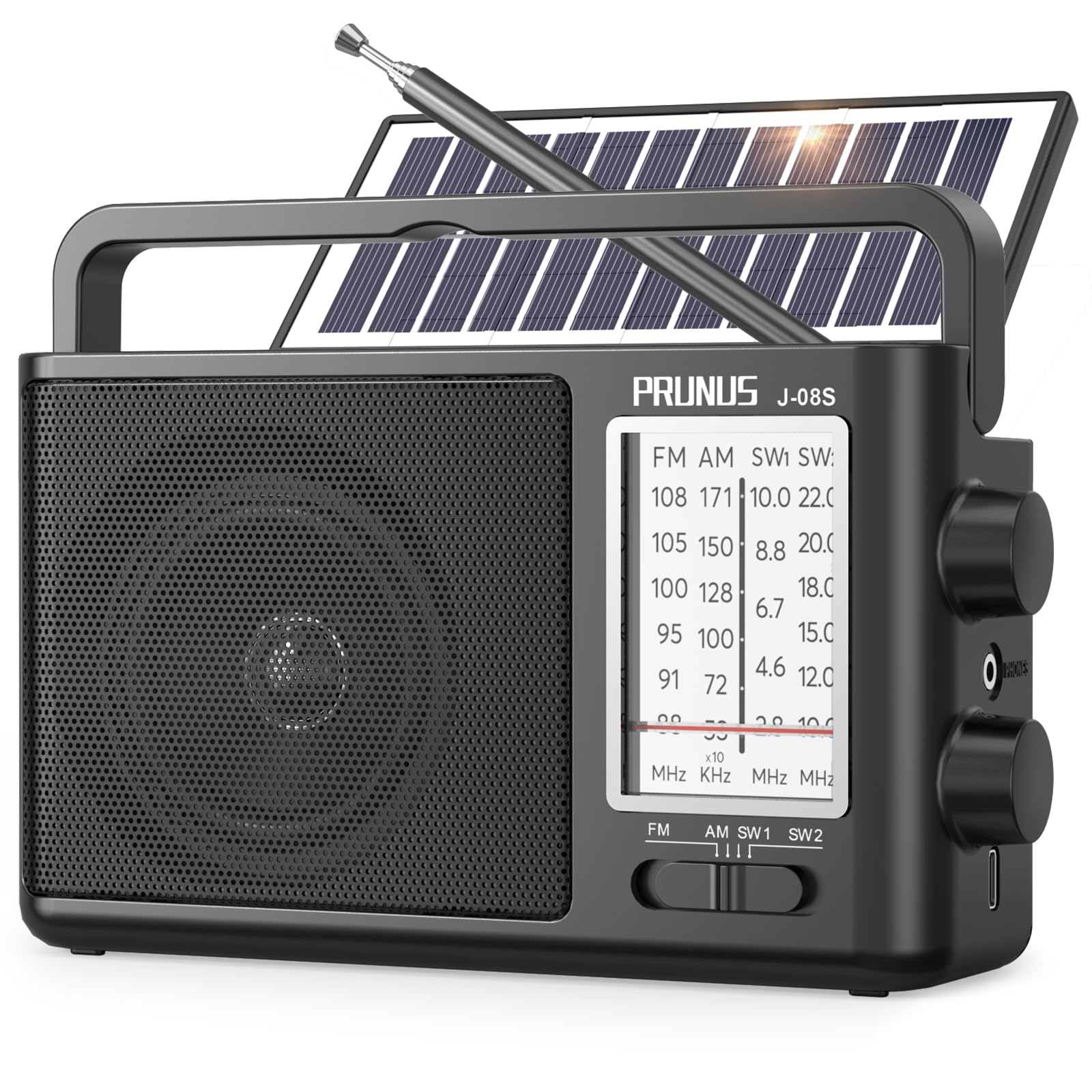
Rechargeable, USB, and a solar panel for outages, with an oversized tuning knob.
This is the radio to reach for when the lights might go out. It takes a rechargeable battery that runs up to 9 hours per charge, a USB charging cable, and a built-in solar panel that can top it up during an outage. For an older household in storm country, that third source is the difference between a working radio and a paperweight.
The tuning side stays simple: a large clear frequency scale and an oversized tuning knob that is easy to turn without a steady hand. Inside, an 18.5-inch 360° rotatable telescopic antenna works with a DSP chip to sharpen the signal across FM 88-108 MHz and AM 530-1710 KHz. Sound comes from a 3-inch 5W speaker, and a 3.5 mm headphone jack handles quiet listening.
At 7.5×4.2×2.8 inches and 1.2 pounds with a foldable handle, it fits in one hand — light enough for a walk but big enough that the speaker is not tiny. The recurring note in owner feedback is that the sound is the star, with solid performance a close second. Just know that the solar panel is a slow trickle, best treated as an emergency bridge rather than a daily charging habit.
Strong points
- Three power paths: rechargeable, USB, and solar
- Oversized tuning knob and large frequency scale
- 5W speaker with an 18.5-inch rotatable antenna
- Foldable handle keeps it one-handed portable
Points to consider
- Solar charging is slow and best for emergencies
- No preset memory, so tuning is manual every time
Ideal for: a home that wants a radio ready for power cuts, hiking trips, and everything between.
Keep looking if: you want push-button presets instead of a tuning knob.
6. Audiocrazy Vintage Wood AM/FM Bluetooth Radio

A wood-grain cabinet with 40 presets and a clear LED display.
For the person who keeps the radio on a shelf where guests can see it, this light-walnut Audiocrazy blends in better than any black plastic box. The wood enclosure and retro face make it look like part of the room. More practically, the digital tuner saves 40 preset slots between AM and FM, so a favorite station comes up with a press instead of a search.
A clear LED display shows the time, the frequency, and station info in any light. Large, intuitive buttons handle power, band switching, volume, and preset access, which is the part meant to suit older users. There is also a sleep timer with an auto-shutdown, handy for a bedroom. Note that there is deliberately no alarm function — this radio wakes nobody.
The mixed side of the picture is the learning curve. The FM tuner itself works well and setup is straightforward, but some owners find the overall operation less intuitive than a plain analog dial. The safest read: excellent for someone comfortable with a few buttons and a display, less so for a listener who wants only one knob. Setting up the presets once, in advance, gets around most of that.
Strong suit: 40 saved presets and a bright LED display remove most of the station-hunting, and the wood finish looks far nicer than the price tier suggests.
Before you commit: this is a button-and-display radio, not a single-knob one, and there is no alarm.
Right choice when: looks matter as much as function and someone can pre-program the presets once.
Different pick if: the user has never taken to button-and-menu interfaces.
7. C. Crane CCRadio EP PRO AM/FM Portable Radio

A Twin Coil Ferrite AM antenna and roughly 300 hours on four D cells.
This is the pick for talk radio and NPR in a rural spot where other radios go quiet. C. Crane fits a patented Twin Coil Ferrite AM antenna — a design aimed at pulling weak AM signals — and that is where the EP PRO separates itself. The sound that comes out of the 5-inch speaker is large, and the separate bass and treble controls let a listener shape voice and music differently.
Runtime is the headline number: roughly 300 hours on a fresh set of alkaline batteries at moderate volume with the display light off. The set takes four D cells (not included) or a 6V AC adapter (included). At 11.4″ W x 7.3″ H x 2.75″ D, with a flip-up carry handle, it is a sit-down radio rather than a pocket one, and the lighted analog tuning dial is easy to read in dim light.
What owners say most is simply that it is a quality piece of kit that feels solid in the hand, and that weak-signal stations come in that other sets miss. The narrow enhancement dial sharpens AM clarity further. The trade-off is the price and a few owners finding the value and tuning convenience less than they hoped — this is a specialized tool, not a general-purpose bargain.
The case for the C. Crane
- Roughly 300 hours per set of D batteries
- Patented Twin Coil Ferrite AM antenna for weak signals
- 5-inch speaker with separate bass and treble
- Flip-up handle and lighted analog dial
The honest caveat
- Four D cells add weight and refill cost
- Premium tier — the priciest full-radio option here
Made for: the far-from-town listener whose main stations are AM talk and NPR.
Overkill if: signal is strong at home and the radio just needs to play background music.
8. Relish Simple Radio & Music Player
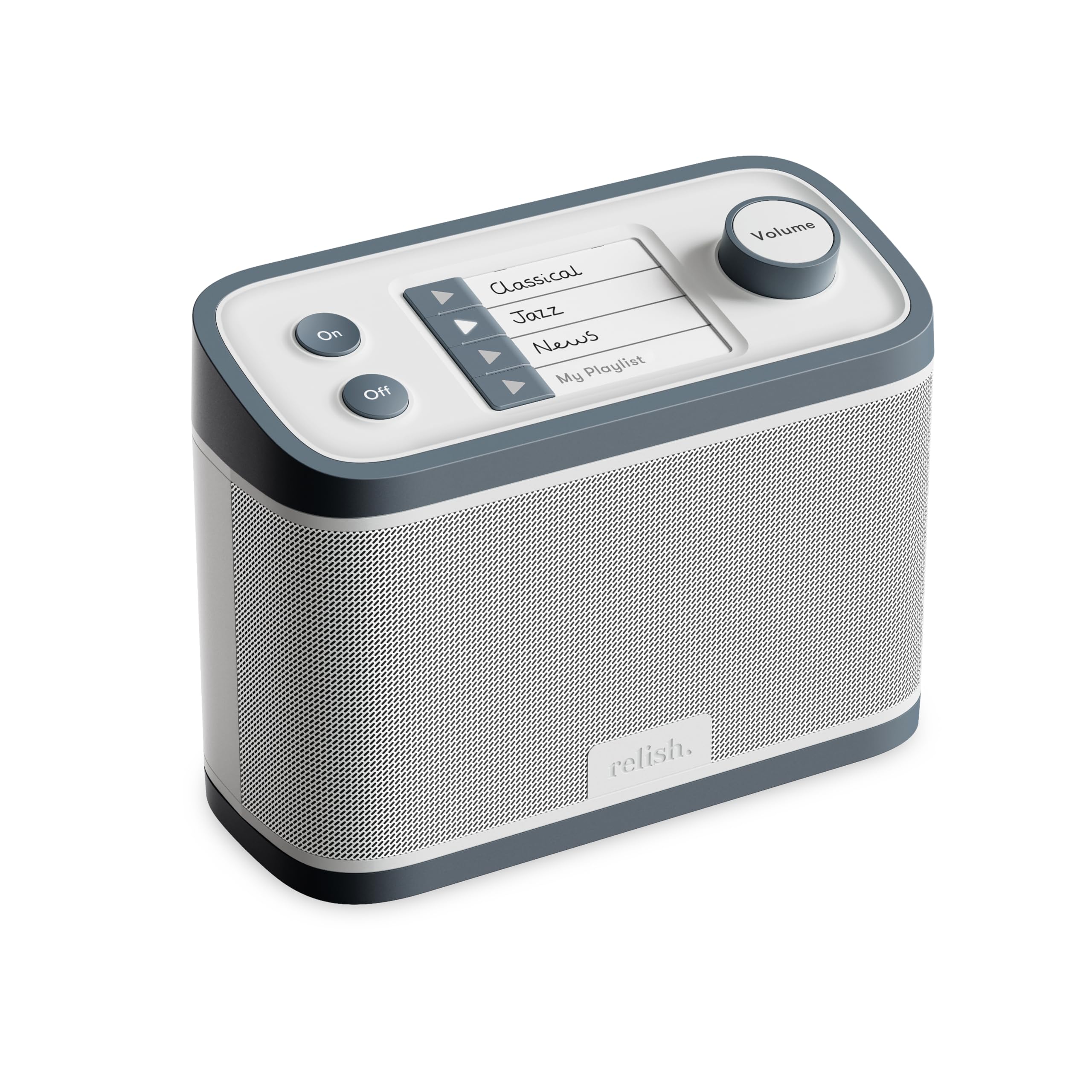
Handwritten station cards and separate on/off buttons for memory loss.
Relish built this one around a specific problem: a person with memory loss who cannot hold station names in mind. Instead of a dial with frequencies, the listener sees a card panel where you write the station names yourself — “Jazz,” “News,” “Relaxing” — so picking a channel means matching a familiar word. The panel is programmed once behind a back cover and then left alone.
Every physical choice leans toward accessibility. Large, clear, separate on and off buttons mean there is no toggle to misinterpret. High color contrast helps low vision, and the volume dial is designed so it cannot turn all the way down to zero — the set is always audibly on, which removes the “is it broken?” confusion. There is a headphone socket, and contact with FM and digital modes plus a USB port for a personal MP3 playlist (a USB stick is included). There is no AM.
Sound comes from a 3-watt speaker, and the body measures 9.84 x 4.33 x 7.09 inches. One thing to weigh: this is the priciest set in the group, and some families find the volume control hard to dial down to a whisper — the dial’s floor is deliberate, so quieter late-night listening is limited. For someone who needs a radio at normal room volume, that design is exactly why it works.
Its real strength: handwritten station names plus separate on/off buttons make choosing music possible even with significant memory loss.
Where it falls short: the volume floor that keeps the radio audible also stops it from reaching whisper level, and it costs more than a conventional set.
Specifically designed for: a listener with dementia, Alzheimer’s, or low vision who needs a station to be findable by name.
Not needed for: a senior with sharp memory and vision who just wants a plain, cheaper dial radio.
Know the Specs
Tuning: analog dial versus digital tuner
An analog dial is a wheel you turn by feel until the station is clear — familiar and reassuring to someone who has used radios for decades. A digital tuner uses circuits, sometimes with AFC, to lock a station in place so it does not drift. For a senior buyer, the question is which one feels less fussy: a smooth wheel, or a button that finds and holds the station for them.
Power and battery life
Most radios here run on AA cells, which are light and cheap to replace. The C. Crane takes four D cells, which last far longer but add weight and cost more per set. Dual-power sets that also take an AC adapter keep the radio usable through an outage. Rechargeable sets cut battery waste but need the discipline to plug in. Solar charging is a backup bridge, not a daily habit.
Reception: AM versus FM
FM tends to sound cleaner indoors, while AM carries long-distance talk radio but is more prone to static. Antenna design matters: a longer telescopic antenna and a DSP filter help pull weak stations, and C. Crane’s Twin Coil Ferrite AM antenna targets exactly that weak-signal case. If the listener’s favorite stations are AM talk, spend more on reception than on looks.
Accessibility features that matter
Look for large buttons, a bright dial or LED display, high color contrast, and separate on and off buttons rather than one toggle. Headphone jacks allow private listening at night. A volume dial that cannot reach zero keeps the radio reliably audible for someone with memory loss. These details decide whether a radio ends up used daily or left in a drawer.
Common Questions
Will a senior need help setting up the radio at all?
Is AM or FM better for an older listener?
How long do the batteries last in these radios?
What is the difference between an analog dial and a digital tuner?
Can a radio still work during a power outage?
Will these radios pick up weak stations in rural areas?
Do these radios have a headphone jack for private listening?
Is a dementia-friendly radio really different from a regular one?
What size radio is best for a small apartment or nightstand?
Do these radios have Bluetooth or a USB port?
The Bottom Line
For most households, the radio for seniors that gets used every night is the Panasonic RF-2400-K, because its fluorescent pointer and AFC tuner solve the two things that make a dial radio frustrating — reading the station and keeping it put. If the listener already streams music, grab the Audiocrazy Bluetooth radio so one speaker covers both. And for a parent living with dementia or low vision, the Relish Simple Radio is the one built to be findable by name.
How we choose
We do not accept paid placement. Every pick is matched to a real buyer and a real use-case; we do not hands-on test units.
Sources
Specifications: manufacturer listings and product documentation. Review insights: verified customer reviews, as of November 2026. Pricing: not shown on this page (it changes often); check the current price via the retailer link.
As an Amazon Associate, Tactical Gear Guy earns from qualifying purchases. This does not affect which products we feature.