Specs are compiled from manufacturer listings and verified buyer reviews and can change over time — please confirm the key details on the product page before buying.
If you are tired of hunting for a wall charger every time a battery goes flat, this is the fix: a USB-C rechargeable battery has a charging port built straight into the cell, so you plug a cable into the battery itself. That single change removes the dedicated charger from your life — no plastic dock on the counter, no proprietary cradle to lose, no charger to hunt for after a move. Below are nine USB-C rechargeable batteries that actually work this way, each one verified to charge through its own built-in USB-C port rather than needing a separate dock.
This guide is built by comparing the manufacturers’ published specifications and the patterns across verified customer reviews, so you get each pick’s real strengths and trade-offs instead of marketing spin.
What actually separates these cells is capacity in mWh, the chemistry behind the steady 1.5V output, and the rated charge-cycle count. Everything below is filtered through those three numbers, so you can tell an AA that powers a Blink camera for a season from one that barely makes it through a gaming session. This is the shortlist of the best USB-C Rechargeable Batteries for real devices, sorted by what each one is genuinely good at.
Top Picks
How To Choose The Best USB-C Rechargeable Batteries
The buying decision here is narrower than it looks. You are not really choosing between brands — you are choosing between chemistries, capacities, and pack sizes that either match your devices or do not.
Start with chemistry, not brand
A lithium-ion cell holds a flat 1.5V from full charge down to nearly empty, which is what an alkaline battery does. Older nickel-metal hydride (NiMH) rechargeables sit around 1.2V, and some voltage-sensitive gear — digital scales, thermometers, smart locks — reads that lower voltage as “battery almost dead” and misbehaves. Every battery on this list is lithium-based with a stated 1.5V output, so that mismatch is not a worry here. It does mean you should check your device’s voltage before you buy anything, because a 3V device is a different animal entirely.
Match mWh to your device’s appetite
Capacity is written in mWh (milliwatt-hours — a measure of total energy stored, so you can compare cells fairly across voltage ratings). A 4200mWh AA runs a high-drain device noticeably longer than a 1700mAh cell of the same size. For a TV remote or a wall clock, almost any capacity works. For a Blink camera, an Xbox controller, or a trail camera, the bigger number is the one that keeps you from swapping cells mid-week.
Count your pack size against your device count
A 4-pack is fine for one controller. An 8-pack covers a controller plus a couple of remotes with spares, and the USB-C 4-in-1 cables most of these ship with charge four cells at once. A 12-pack is genuinely useful if you run several cameras or sensors that all drain together.
Check the charge cycle count
Cycles are the number of full charge-and-drain rounds the cell is rated for before capacity drops. Anything around 500 cycles is serviceable; 1000 to 2500 cycles is the range where you stop thinking about batteries as a recurring purchase. Higher cycle counts usually mean the manufacturer expects you to keep the cells for years.
Side-by-Side Comparison
| Model | Best For | Capacity | Charge Cycles | Battery Type | Amazon |
|---|---|---|---|---|---|
| ENEGON 8-Pack AAA Lithium★ Best Overall | Small devices and voltage-sensitive gear | 1100 mWh | 500+ | AAA Lithium Ion | Amazon |
| imuto 4200mWh AA 8-PackLongest Runtime | High-drain devices and gaming gear | 4200 mWh | 2500+ | AA Lithium Ion | Amazon |
| HW Double A 3600mWh 8-PackFast Charger | Fast charging across many devices | 3600 mWh | 1000+ | AA Lithium Polymer | Amazon |
| CARDIENS 2800mWh AA 8-Pack | Budget household replacement | 2800 mWh | 1000+ | AA Lithium Ion | Amazon |
| ENEGON 4070mWh AA 8-Pack | Long runtime in high-drain gear | 4070 mWh | 500+ | AA Lithium Ion | Amazon |
| Coast ZITHION-X AA 4-Pack | Flicker-free low-draw performance | 2400 mAh | — | AA Lithium Ion | Amazon |
| PHILIPS 3600mWh AA 8-Pack | Charger-case storage and long cycle life | 3600 mWh | 1200 | AA Lithium Ion | Amazon |
| volkate 3960mWh AA 12-Pack | Running multiple cameras at once | 3960 mWh | 1200 | AA Lithium Ion | Amazon |
| Pale Blue AA 1700mAh 4-Pack | Fastest single-hour recharge | 1700 mAh | 1000+ | AA Lithium Ion | Amazon |
Detailed Reviews
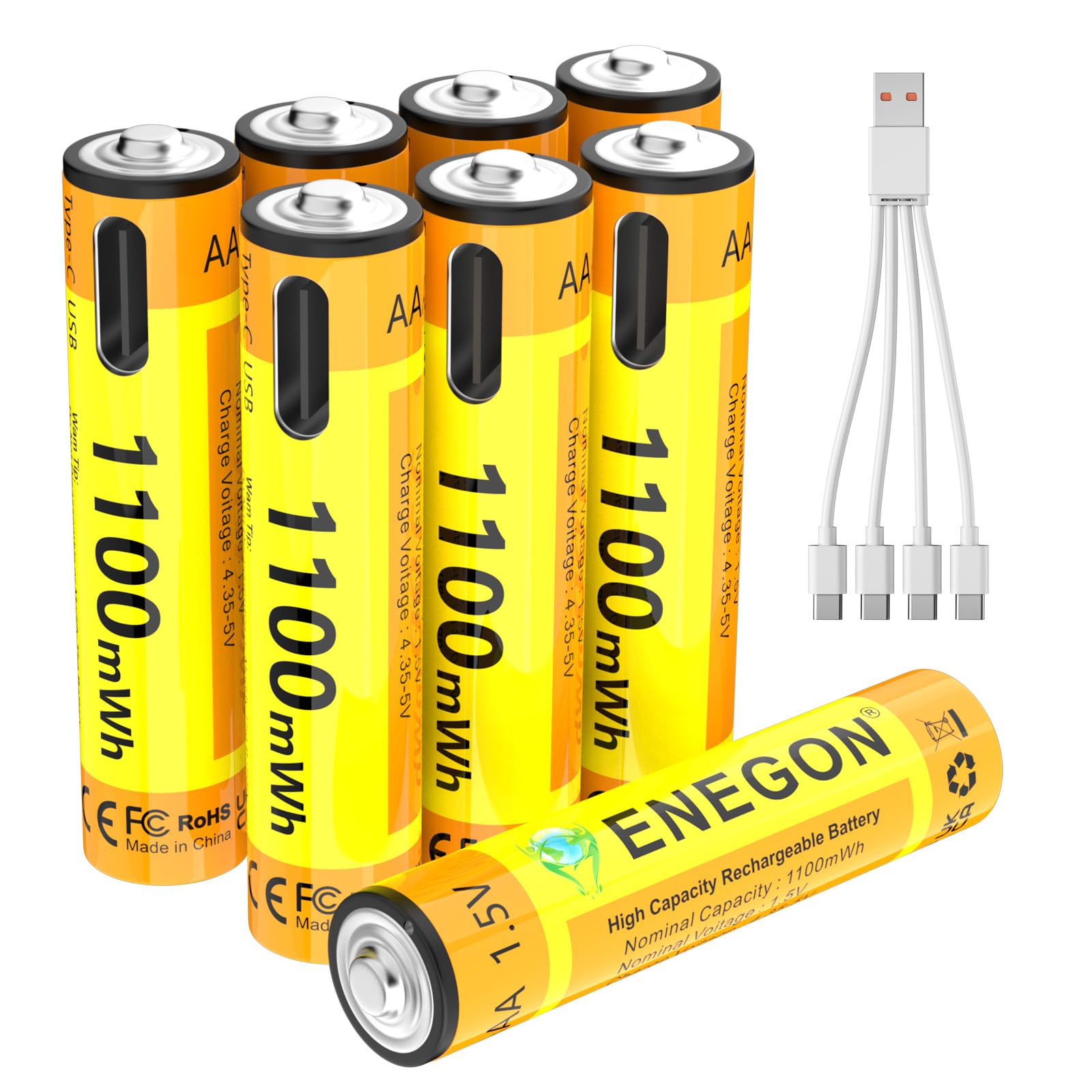
1. ENEGON 8-Pack Rechargeable AAA Lithium Batteries
Our pick — 4.5+★ from 450+ verified ratings; the strongest balance of quality and price.
AAA cells that top up from any USB-C port in about an hour — and skip the charger entirely.
The 1100 mWh rating here makes these a small-device specialist, and that is exactly where they belong. Each cell carries a built-in USB-C port and comes with a 4-in-1 cable that tops up four AAA batteries at once, so you plug into a laptop, power bank, or car adapter and walk away. Under standard 5V USB-C power, a full charge takes roughly 1 hour — the manufacturer positions that as up to 60% faster than traditional nickel-metal hydride cells, which it puts at around 2.5 hours.
What makes these worth their spot is the electronics rather than the watt-hours. Each cell holds a steady 1.5V until roughly 15% charge is left, then triggers a low-battery warning. Devices that misread voltage — a digital kitchen scale, an ear thermometer, a pH pen — keep behaving normally instead of dimming out or throwing false alarms. The same constant-voltage trait is why these suit door and window sensors and smart lock remotes, where a wobbly supply causes dropouts.
Owners consistently report the convenience of charging without a dock, and the maker’s numbers back it up: 500+ charge-discharge cycles per cell, and about 94% of charge retained after 28 days at room temperature versus 75% for ordinary NiMH. If you are shopping the best USB-C Rechargeable Batteries for a drawer full of small devices, this is the pack that covers the most of them.
The Real Advantages
- Built-in USB-C port on every cell — the 4-in-1 cable charges four at once, no charger needed
- Steady 1.5V output holds until about 15% charge remains, so voltage-sensitive gear behaves
- Holds roughly 94% of charge after 28 days at room temperature — a recharge every six months during storage
- 500+ charge-discharge cycles and six layers of protection against overcharge, overcurrent, and overheating
Where You Feel The Limit
- 1100 mWh is the smallest capacity on this list — AAA-powered flashlights drain fast
- If every device you own runs AA, this pack solves nothing
Pick this if: your gear runs on AAA and you want to keep a 4-in-1 cable in a bag rather than a charger on a counter.
Wrong pick if: you need AA cells or you are powering a high-drain flashlight on AAA — the 1100 mWh rating will run dry quickly.
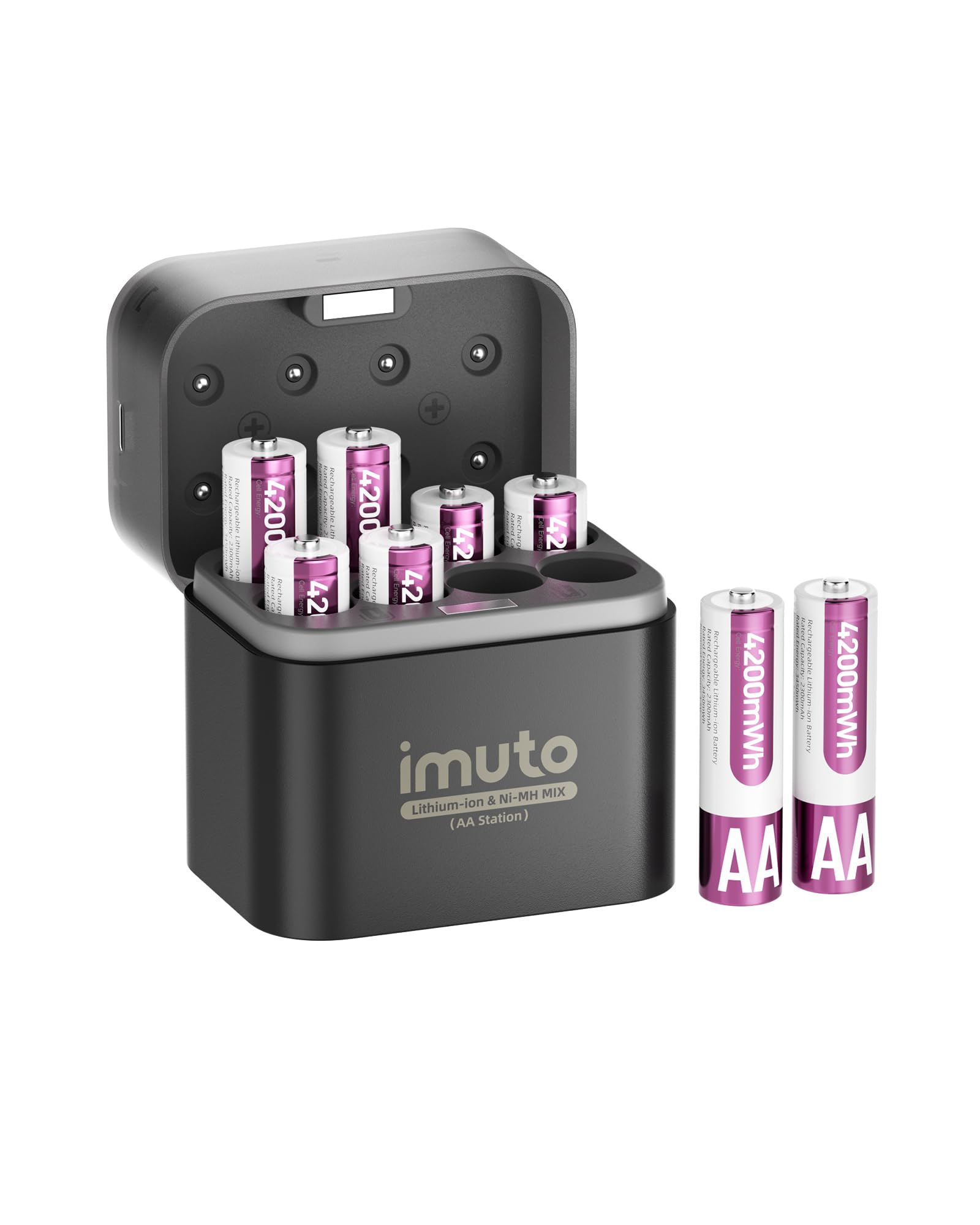
2. imuto AA Lithium Batteries 8-Pack
The capacity king of this list — 4200mWh per cell, backed by a charging case that doubles as storage.
No battery here holds more energy in AA form. At 4200 mWh per cell (the maker notes that is roughly 2800mAh), the imuto carries 3.8 times the capacity of the ENEGON AAA pack above. That gap is the whole story for anyone running Blink cameras, Xbox controllers, or trail cameras — the bigger number is the difference between a camera that lasts a season and one that needs a ladder every few weeks.
The charger is the part you will actually use every day. It is an 8-slot case that automatically detects whether a cell is lithium-ion or NiMH and charges either chemistry, with independent channels and LED indicators per slot. A full top-up of one to eight 4200mWh cells takes about 3 hours, which the manufacturer frames as 40% more efficient than NiMH. A magnetic closure lets the case double as a storage organizer, and it is rated to protect against moisture, dust, pressure, and splashes — so it travels in a pack without your cells rattling loose.
The cycle count is where this quietly wins: 2500+ recharges while holding above 70% capacity, against 500 cycles for the ENEGON 4070mWh pack. That is the number to care about if you are replacing disposables permanently rather than for a season. One honest limit — the fast-charge spec expects a 5V/3A adapter, and a weak USB port will stretch that 3-hour window considerably.
Why it earns second spot: 4200mWh cells, an 8-bay case that handles both lithium and NiMH, and 2500+ cycles — the pack that stops battery buying altogether.
The fine print worth knowing: the charger wants a 5V/3A power source for its stated times, and 8 cells of this capacity make a bulkier travel companion than a cable-only pack.
Lean this way if: your devices are hungry — cameras, controllers, gamepads — and you want the longest stretch between charges plus a case that keeps 8 cells organized.
Keep shopping if: you only need to top up a couple of remotes and prefer a bare cable over an 8-slot case.
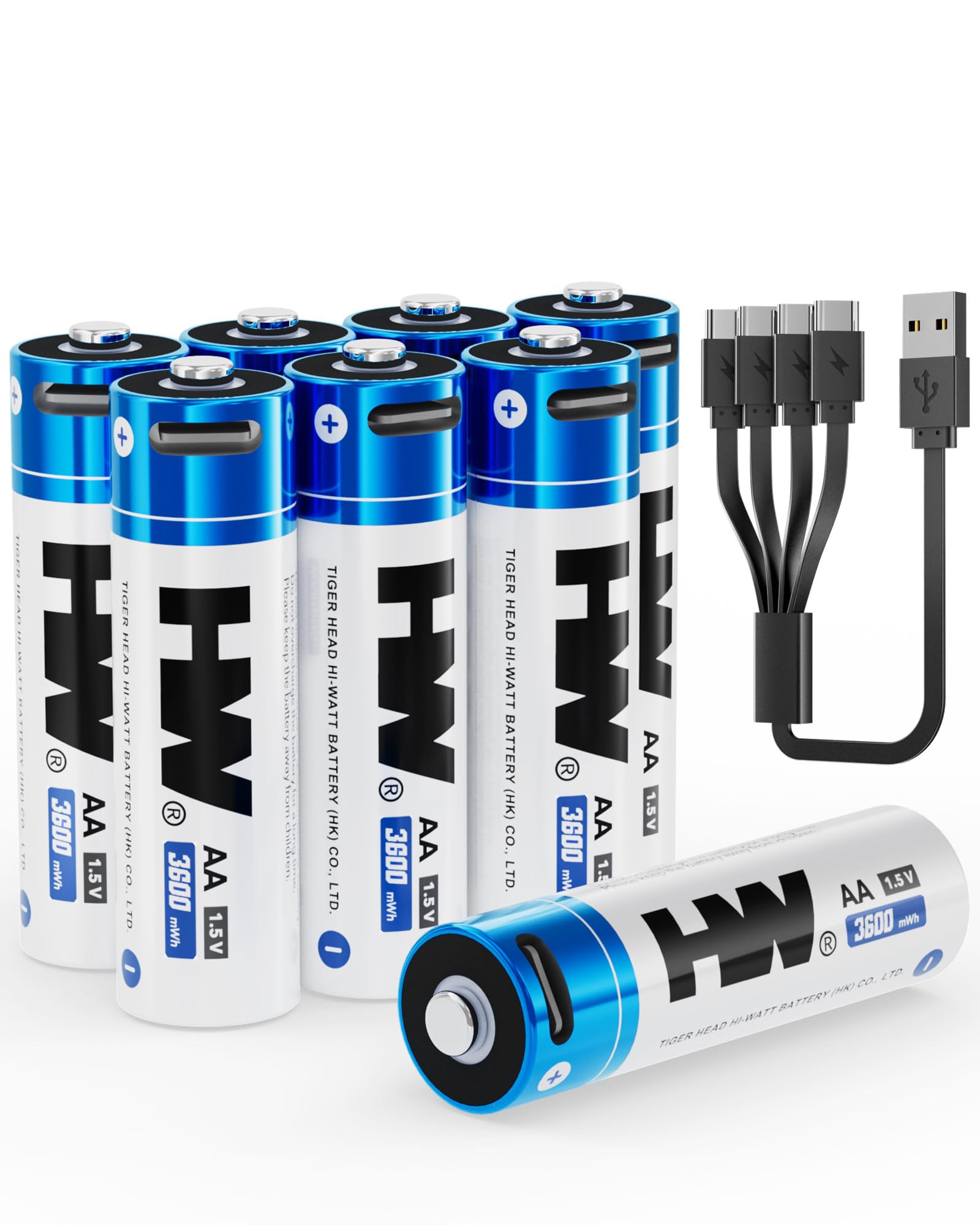
3. HW Double A Lithium Batteries 8-Pack
Four cells refilled in two hours from any USB port — laptop, power bank, or car adapter.
Charge speed is the headline: four AA cells in roughly 2 hours straight from any USB outlet, no wall charger required. That is a touch quicker than the imuto’s 3-hour window for its 8-cell case, and the difference matters when you are packing for a trip rather than setting up a home charging station. The included 4-in-1 USB to USB-C cable and pair of battery boxes complete a kit you can throw in a backpack without hunting for anything else.
Each cell carries 3600 mWh, and the manufacturer’s spec describes a gradual voltage decline from 1.5V rather than a hard cliff. In practice that means longer, steadier runtime than both alkaline and NiMH cells in the same device, which buyers confirm in the field — these are described as reliable in a range of gear, with the USB-C charging capability being the thing people call out. The listed device coverage is broad: Xbox and VR controllers, handheld gaming devices, remotes, toys, keyboards, mice, microphones, doorbells, and smart clocks.
1000+ recharge cycles put this comfortably ahead of disposable spending, and the built-in protection covers overcharge, over-discharge, over-voltage, over-current, short circuit, and overheating. The one gap to weigh: the manufacturer’s care service runs 6 months, which is shorter than what most rivals on this list offer, so factor that into how hard you plan to run them.
The two-hour advantage: 8 cells at 3600 mWh each, a 4-in-1 cable, and two battery boxes — a travel-ready set that matches the imuto on pack size with a quicker stated charge time.
What to weigh: the 6-month product care window is the shortest commitment here, so treat these as a workhorse set rather than a lifetime buy.
Reach for this if: you want eight AA cells that refill in about two hours from whatever USB port is nearest, with boxes to keep them paired.
Look elsewhere if: you want the longest possible charge-cycle headroom or a longer warranty commitment.
4. CARDIENS Rechargeable AA Batteries USB 2800mWh 8-Pack

A quick 1.5-hour recharge and blinking-then-solid LED indicators for the household drawer.
These are the everyday-replacement cells. At 2800 mWh they sit below the imuto and HW packs, but the charge time is right up there — a 1.5-hour refill, quicker than the imuto’s 3-hour case cycle and level with the fastest here. The indicator lights blink while charging and go solid when done, which is the kind of small thing you stop noticing until you own a set without it.
Buyers report these perform about as well as standard AAs and charge in roughly 2 hours in real use. The built-in charging port is the draw — one owner’s experience is that any USB-C cable will do the job, so you are never tethered to a proprietary plug. For a TV remote, a mouse, a keyboard, or a flashlight, the capacity is more than enough.
The manufacturer rates these for at least 1000 recharges and describes an explosion-proof, leak-proof build that has been through safety testing. The maker claims 1.4x the runtime of other AA rechargeables — treat that as a manufacturer figure and set your expectation by the 2800 mWh rating instead. The warranty window is 90 days, which is on the short side for a battery you intend to run for years.
Straight talk on value: a 1.5-hour charge, blinking LED status, and 1000+ cycles for the household devices that burn through disposables.
The trade-off in the paperwork: 2800 mWh trails the high-capacity packs, and a 90-day warranty means the long-term bet rests on the cycle rating, not the guarantee.
Buy these if: you want an eight-pack to refill remotes, mice, and flashlights quickly without paying for capacity you will never use.
Pass if: your devices are cameras or gaming controllers that need the biggest mWh figure you can get.
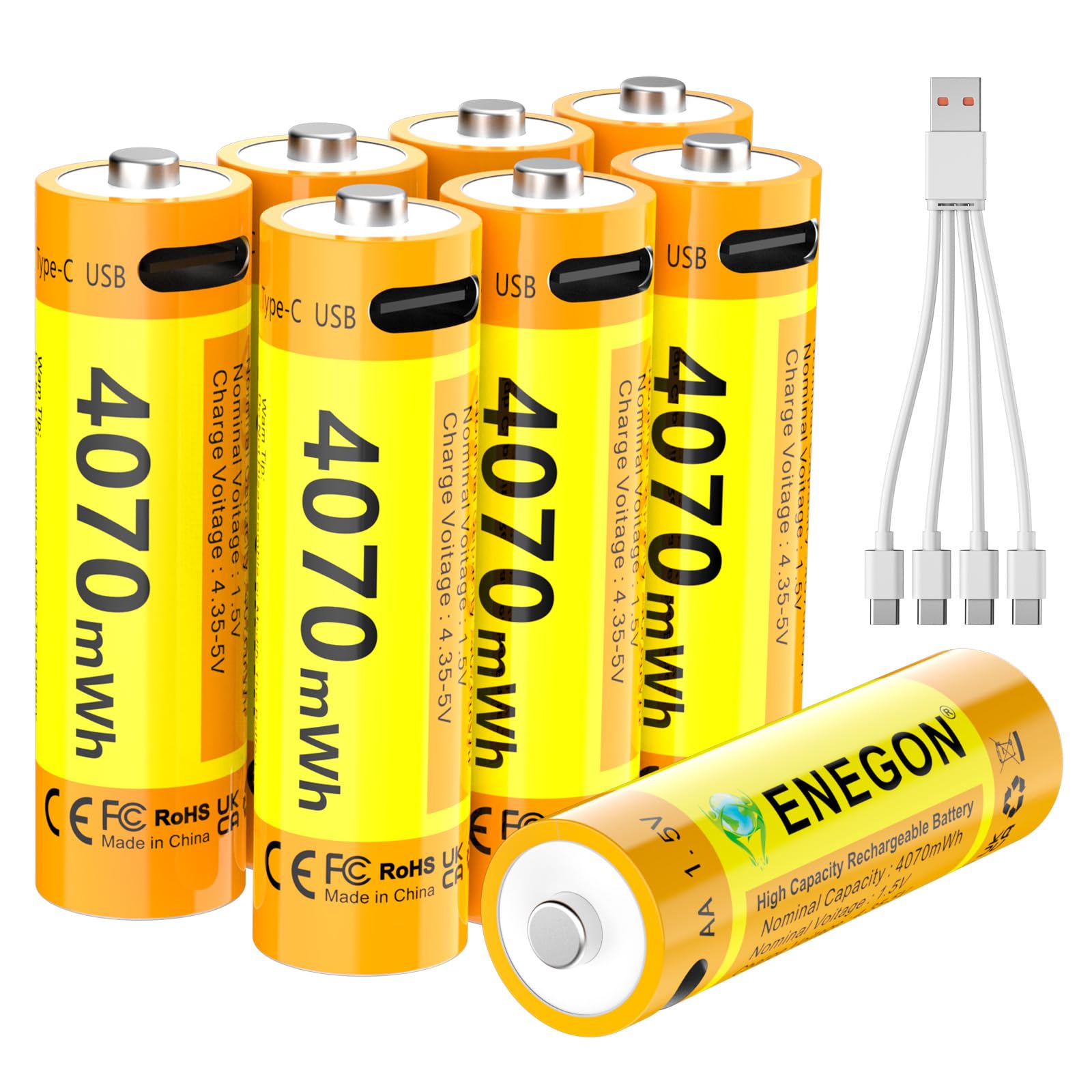
5. ENEGON AA Lithium Batteries 8-Pack
Nearly the top capacity on this list, with a 1-to-4 cable that fills four cells at once.
At 4070 mWh per cell, this pack sits just under the imuto’s 4200mWh ceiling and well above the 3600mWh HW set. The maker claims up to 40% longer runtime than most peers thanks to the higher energy density, and the practical result is fewer mid-week swaps in smart locks, controllers, and security cameras. The 1-to-4 USB-C cable charges four at once, and the manufacturer points out it works from laptops, car chargers, and power banks — so the whole pack refills from one port.
Stable 1.5V constant voltage is the other reason to pick this. Devices that get fussy at lower voltage — formaldehyde and PM2.5 detectors, kids’ electric toys, building-set toys, foam blaster toys — run without the drop-off you get from 1.2V NiMH cells. The high-drain list is broad too: smart locks, Xbox controllers, security cameras, RC cars, GPS units, headlamps, baby monitors, and LED lights.
Here is the honest catch. Charge cycles land at 500+, which is the same tier as the smaller ENEGON pack and well behind the imuto’s 2500+. If you plan to hand these down for years, that cycle count is the number that decides it. For daily-driver cells in a few power-hungry devices, the 4070mWh figure is the one that matters more.
What Makes It Worth It
- 4070 mWh per cell — second only to the imuto on this list for raw capacity
- Steady 1.5V constant voltage suits detectors and voltage-sensitive toys
- 1-to-4 USB-C cable charges four cells from a laptop, car charger, or power bank
- Six layers of protection and 24/7 customer support
The Honest Catch
- 500+ cycles trails the 2500+ rating on the imuto — a shorter long-game
- No charging case included, just the cable and the cells
This is your cell if: you want near-top capacity and a steady 1.5V supply for detectors, locks, and controllers, and you are fine charging from a cable.
Give it a miss if: maximum cycle life is what you are buying for — the imuto doubles down there instead.
6. Coast AA USB-C Rechargeable Batteries, ZITHION-X, 4-Pack

Four cells built to power a TV remote without the flicker-and-heat act some cells pull.
The 2400 mAh rating is modest against the 4000-plus mWh packs here, but Coast is aiming this pack at a different job: steady, flicker-free power for sensitive low-draw electronics. The ZX tune Voltage design keeps the supply clean so devices do not overheat, which is the trait buyers describe — these perform well in low-draw gear like TV remotes, and the USB-C port built into each cell makes topping up a cable-in-the-remote-drawer affair.
A 4-pack with a charging cable is a simpler kit than an 8-slot case. Average charge time runs 2.5 hours for AA, and each cell is rated to replace up to 1000 single-use batteries. The manufacturer also lists a leak-resistant internal design to protect gear in storage — useful for a remote that sits in a drawer for weeks.
Where this falls short is pure capacity and cycle-count clarity. 2400 mAh will not stretch as long in a controller or camera as the imuto’s 4200mWh cells, and the spec sheet lists no charge-cycle figure at all — so if a long cycle life is central to your decision, that number is missing here. For a 4-pack to keep around the house, none of that is a problem.
The case for the Coast: ZX tune Voltage delivers steady power for remotes and clocks, with 2.5-hour USB-C charging and a leak-resistant build for storage.
What you give up: 2400 mAh and an unspecified cycle count put it behind the high-capacity packs for gaming and camera duty.
The right fit: a four-pack for remotes, clocks, and other low-draw gear where steady voltage matters more than raw energy.
Better off elsewhere if: you are feeding controllers, cameras, or anything that expects the biggest capacity figure on the shelf.
7. PHILIPS 8-Pack Rechargeable AA Lithium Batteries, 3600mWh
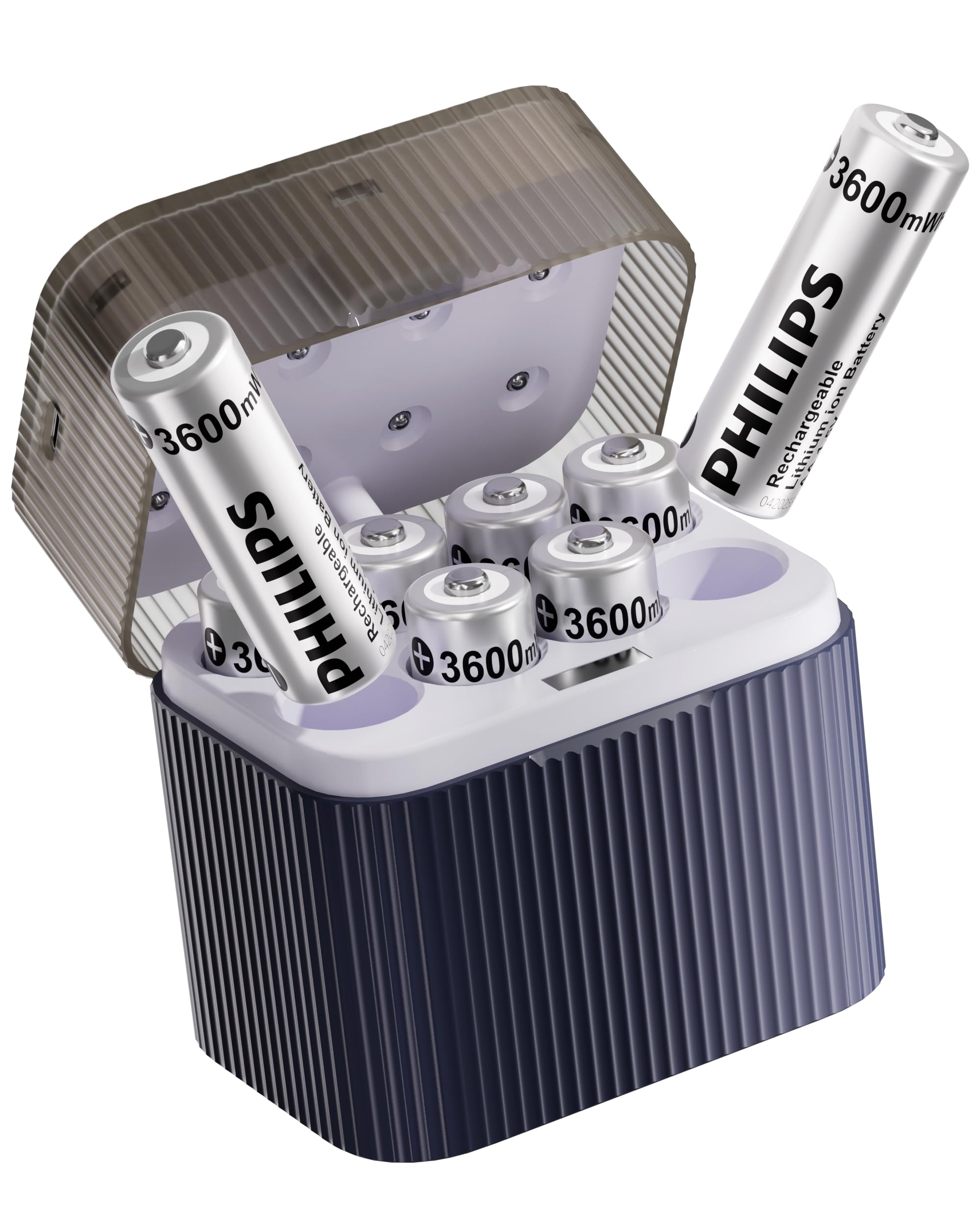
A charging case and storage box in one, with a shell rated to survive a one-meter drop.
Start with the packaging, because it is the differentiator. The 2-in-1 charger doubles as a storage compartment, accepts a Type-C fast-charging port at 5V/2A, and has an identification chip that reads battery status so you are not guessing at charge levels. Real-time LED indicators show progress, full charge, and abnormal alerts. Compared with the HW pack’s loose battery boxes, this is a tidier setup for anyone who stores eight cells between uses.
Underneath, each cell carries 3600 mWh and holds a constant 1.5V from full charge down to complete discharge, which the manufacturer says delivers 40% more endurance than regular NiMH AA cells. Coverage runs to game controllers, flashlights, remotes, voice recorders, and RC toys. The cycle rating of 1200 is a genuine selling point — double the HW pack’s 1000+ and well ahead of the 500-cycle ENEGON cells. The flame-retardant ABS shell is rated to shrug off a 1-meter drop, and the protection covers overcharge, over-discharge, short circuit, and overheating.
The catch is real and worth stating plainly: these are 1.5V cells and the manufacturer explicitly says they are not compatible with 3V devices such as smoke alarms and doorbell cameras. Confirm your device voltage before you buy. The runtime picture is also less settled than the packaging suggests — owners mention excellent quality overall, but battery life draws mixed experience, with some cells performing strongly and occasional reports of early failure. Given the strong quality feedback, treat that as the outlier case rather than the norm.
The draw here: a charger that stores, 1200 cycles, a 1-meter drop-rated ABS shell, and steady 1.5V output — with a built-in status chip that tells you when something is off.
The must-check before buying: not compatible with 3V devices like smoke alarms and doorbell cameras, and runtime consistency is the one area buyers describe as mixed.
Suits you if: you want an organized charging-and-storage case, a long 1200-cycle rating, and steady 1.5V for controllers and remotes.
Steer clear if: you are powering 3V gear — the manufacturer rules these out for smoke alarms and doorbell cameras.
8. volkate 12 Pack Lithium AA Batteries

Twelve cells in a carrying case — enough to refill a whole camera setup in one sitting.
Pack size is the reason this exists. Twelve AA cells at 3960 mWh each, plus a 4-in-1 USB-C cable that charges four simultaneously in 2 hours from any USB supply — AC adapter, power bank, laptop, or a computer. The included carrying case keeps the set together, and the LED on each cell flashes green during charging and goes solid green when done, so you can see status without a separate charger face.
The intended use is clear from the listing: Blink cameras and other security gear, plus flashlights, remotes, controllers, toys, alarm clocks, keyboards, mice, Bluetooth headsets, radios, scales, and sensors. With 1200 recharge cycles per cell, each one stands in for 1200 disposables. That combination of 12 cells at 3960 mWh with a 1200-cycle rating is what makes a whole camera array practical without buying disposables in bulk.
The honest note is runtime consistency. Buyers rate the value highly, but battery life draws mixed experience — some cells run strongly while others drain faster than expected in demanding setups. The charging speed gets mixed feedback too. Factor that in if your cameras sit somewhere inconvenient to reach: a cell that runs short means another climb up the ladder. For devices you can reach easily, the pack size and cycle rating carry it.
Why Twelve Matters
- 12 cells at 3960 mWh each covers a multi-camera setup in one purchase
- 4-in-1 USB-C cable charges four at once in about 2 hours from any USB source
- 1200 recharge cycles per cell — each replaces up to 1200 disposables
- Protection IC guards against overcurrent, overvoltage, overcharge, over-discharge, overheating, and short circuit
What to Budget For
- Battery life is the mixed-feedback area — some cells drain faster than expected
- Charging speed draws mixed reports as well
The right call for: anyone running several Blink cameras or security sensors who wants twelve cells and a carrying case in one go.
Think twice if: your cameras are hard to reach — inconsistent runtime means possible repeat trips.
9. Pale Blue USB Rechargeable AA Batteries, 1700mAh, 4-Pack
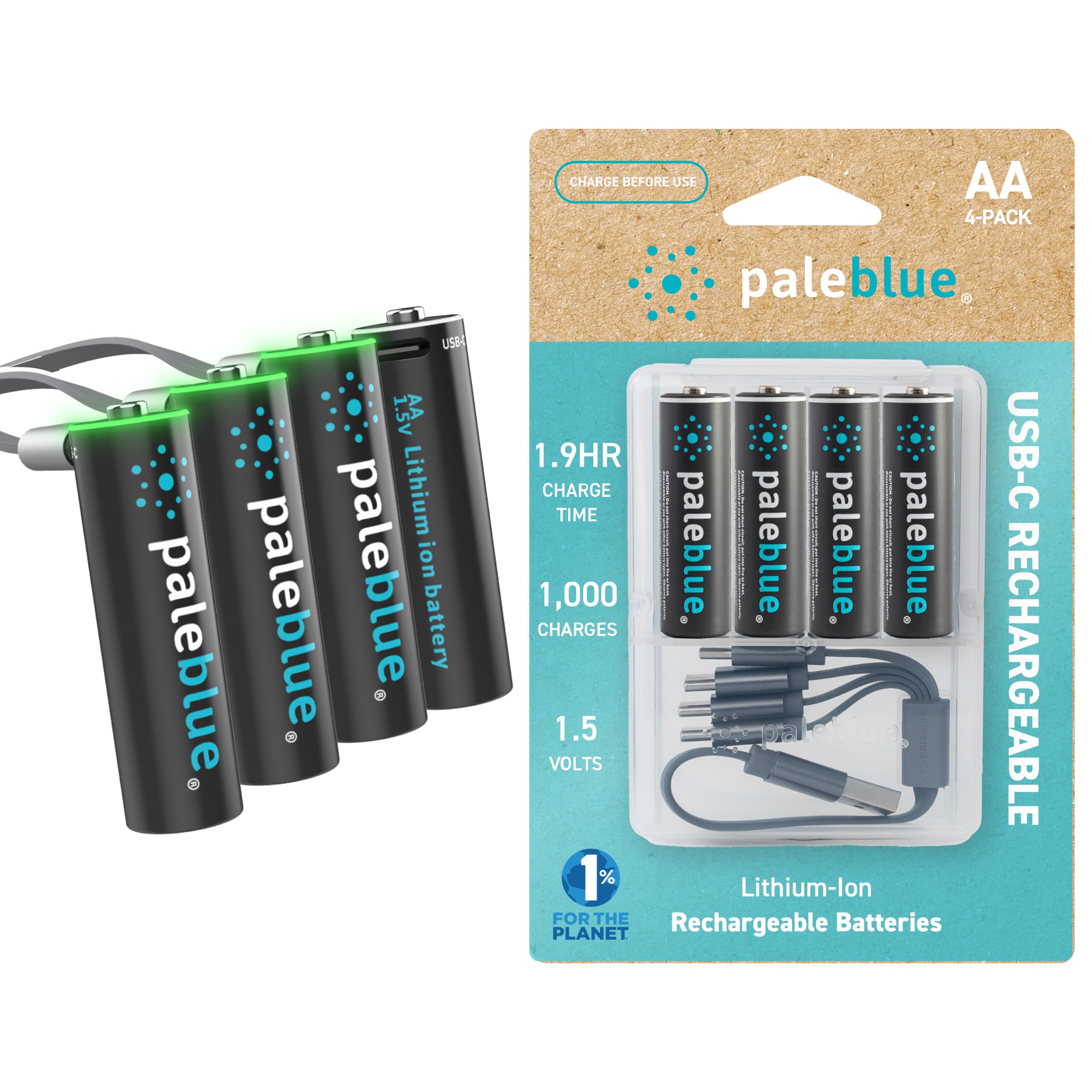
A one-hour refill that beats almost everything here on charge time, not on capacity.
Speed is the whole point. The manufacturer rates a 1-hour charge from a USB-C port with the included cable, and describes the lithium chemistry as charging up to 12x faster than conventional rechargeable batteries. Against the imuto’s 3-hour case cycle and the Coast’s 2.5 hours, that gap is the reason to pick this pack — you plug in four cells over lunch and they are ready for the evening.
The 1700 mAh rating is the smallest AA capacity on this list, so this is not the pack for a Blink camera or a trail cam that needs to run for weeks. It is the pack for controllers, mice, remotes, and lights you cycle through often, where fast turnaround beats long storage. Over 1000 charging cycles back that up, and the on-board smart technology keeps a consistent 1.5V with protection against the failures that ruin expensive electronics. The lithium-ion chemistry matches what is in your phone or laptop, which is why the maker says leaking is not part of the deal.
Where this needs a caveat: runtime in high-drain devices is the mixed-feedback area here, so set expectations around the 1700 mAh figure rather than the cycle count. What is clear is the recharge experience. As the review pages sum it up, these are easy to charge and quick to top up, with the full set of four filled in under an hour. For a 4-pack you keep in rotation, that speed is the feature you will notice daily.
The one-hour win: a 1-hour USB-C refill, 1000+ cycles, and 1.5V lithium-ion chemistry that does not leak — the fastest turnaround on this list.
What it is not: 1700 mAh is the smallest AA capacity here, and runtime in high-drain gear is the mixed-feedback area to plan around.
Go with Pale Blue if: you cycle through controller and remote batteries often and want them back in an hour with no charger dock.
Not your pack if: you need camera-grade runtime — 1700 mAh is a short stint in high-drain devices.
Know the Specs
mWh vs mAh — Which Number to Trust
mWh (milliwatt-hours) measures total energy stored, while mAh (milliamp-hours) measures charge at a given voltage. For comparing cells of the same 1.5V rating, both track together, but mWh is the fairer number across the aisle. A 4200mWh AA runs longer than a 1700mAh cell of the same size because it holds more total energy. Always read the mWh figure on a listing before the mAh one — it is the number that decides how long a device runs between charges.
Why Constant 1.5V Output Matters
Alkaline cells and these lithium cells hold a steady 1.5V until nearly empty. Older NiMH rechargeables sit around 1.2V, and voltage-sensitive gear — scales, thermometers, locks, sensors — reads that lower voltage as a dying battery and either dims or stops. A listing that specifies constant 1.5V output is telling you the cell will behave like an alkaline in your smart lock or kitchen scale. If the device manual specifies 1.5V, pick a cell that matches it.
Charge Cycles and Cell Lifespan
A charge cycle is one full charge-and-drain round. The listed rating — 500, 1000, 1200, or 2500 — is the number of cycles the manufacturer expects the cell to survive before capacity drops noticeably. A 500-cycle cell used weekly lasts about a decade; the same cell used daily has a far shorter run. Higher cycle counts cost more up front but reduce how often you buy replacements, so match the cycle rating to how frequently you swap a given device.
Self-Discharge and Storage
Self-discharge is how much charge a cell loses per unit time just sitting in a drawer. Some listings give a percentage retained after 28 days; others give a monthly rate. Lower loss means you can store a charged cell for months and still use it. If you keep spare cells for remotes or emergency gear, favor a listing that states its self-discharge retention clearly, so you know the cell will still have juice when you grab it.
Common Questions
Do these batteries need a separate charger?
Can I use USB-C rechargeable batteries in a Blink camera?
What is the difference between mWh and mAh on these batteries?
Will these work in a smoke alarm?
How many times can these batteries be recharged?
Why do some of these say constant 1.5V and others do not?
Can I charge these batteries in my laptop or power bank?
Are USB-C rechargeable batteries safe to leave in a device?
Do these leak like standard alkaline batteries?
How fast do these batteries charge compared to a standard charger?
The Bottom Line
For most people, the usb-c rechargeable batteries that make the most sense are the ENEGON 8-Pack AAA Lithium Batteries — a steady 1.5V supply, a one-hour charge from any USB-C port, and a 4-in-1 cable that refills four cells at once, all without a charging dock. It is the cleanest answer for the drawer full of small devices that quietly eat disposables. If your gear needs AA cells with serious runtime, the imuto 4200mWh 8-Pack leads on capacity and on 2500+ cycles, and it brings an 8-slot case that stores as well as it charges. And if razor-fast turnaround is the priority, the Pale Blue 4-Pack gets four cells back to full in an hour — the quickest refill here, provided the devices you are feeding are not the power-hungry kind. Whichever way you go, the crowd favorite on this list — 4.5+ stars across 450+ ratings — is the ENEGON AAA pack, and it earns that spot on the strength of the constant-voltage electronics rather than the headline capacity.
How we choose
We do not accept paid placement. Every pick is matched to a real buyer and a real use-case; we do not hands-on test units.
Sources
Specifications: manufacturer listings and product documentation. Review insights: verified customer reviews, as of November 2026. Pricing: not shown on this page (it changes often); check the current price via the retailer link.
As an Amazon Associate, Tactical Gear Guy earns from qualifying purchases. This does not affect which products we feature.