Specs are compiled from manufacturer listings and verified buyer reviews and can change over time — please confirm the key details on the product page before buying.
You want one swing to finish the round, not five. That depends on head shape and handle length more than raw weight. A dull wedge bounces off a knot and shakes your wrists; a sharp convex bit (an edge that bulges outward) drives through and pops the halves apart. Below are nine manual splitting axes that buyers rate highly. Each one names the job it suits — a firewood stack or a campsite — and where it falls short.
This guide is built by comparing the manufacturers’ published specifications and the patterns across verified customer reviews, so you get each pick’s real strengths and trade-offs instead of marketing spin.
Tall splits, knotted rounds, and camp-sized kindling all ask for a different tool, and the wrong handle length will wear you out before the wood does. That is the whole reason I put together this top rated wood splitting axe breakdown, sorted by what each one truly does best.
Top Picks

How To Choose The Best Top Rated Wood Splitting Axe
You are standing next to a pile of rounds and you want them in the shed, not on the ground in three pieces. The tool that gets you there has to do two jobs: drive into the end grain, and let go cleanly once the round cracks. Everything below is about those two jobs.
Head shape does the splitting, not your arms
A splitting axe carries a wedge-shaped head with a convex bit — convex meaning the edge curves outward so it pushes fibers apart instead of slicing them. That curve is what pops a round open and lets the head slide free. A chopping axe has a thinner profile meant for cutting across grain, and it will bury itself in a round and stay there.
Match handle length to your height and your wood
A 36-inch handle adds swing arc, and more arc means more speed at the head when it lands. That length works in your favor if you are tall or if you are working through big rounds. A 23-inch handle stays out of the brush at a campsite and swings fine at close range, but you will not get the same head speed on a wide round.
Think about head weight before you lift a heavier one
A heavier head hits harder but tires you faster. A mid-weight head suits most firewood duty. If you split in short bursts and value control over raw force, a lighter head is the more pleasant tool. Choose the weight you can swing for a full session, not the heaviest one on the shelf.
Look at the handle material and the sheath
Shock-absorbing composite handles take vibration out of the strike and resist overstrike damage — overstrike being the miss that lands the head on the handle instead of the wood. Hickory handles look better and feel warmer in the cold, but they can be broken by that same miss. On the sheath, leather with a belt hole travels better than a bare blade in the truck bed.
Side-by-Side Comparison
| Model | Best For | Overall Length | Head Weight | Handle Material | Amazon |
|---|---|---|---|---|---|
| Fiskars X27 Super Splitting Axe 36″★ Best Overall | Tall users on large logs | 36″ | 4.3 pounds | Steel and wood | Amazon |
| Fiskars A-Series Super Splitting Axe 36″Top Performer | Medium to large logs | 37.75″ | — | Wood | Amazon |
| ESTWING Double Bit Axe E6-DBABest for Kindling | Kindling and camp chores | 17.19″ | — | Hickory | Amazon |
| Husqvarna Wood Splitting Axe S2800 | Long-haul durability | 27.6″ | 5 pounds | Fiberglass | Amazon |
| 1844 Helko Werk Saxon Heavy Log Splitting Axe | Big rounds and knots | 31″ | 6.3 pounds | American hickory | Amazon |
| GEDORE OX 648 H-2508 Split-Quick | Forged European build | 80 cm handle | — | Hickory | Amazon |
| 27.8″ Splitting Axe with Lichtenberg Handle | Looks and short-range work | 27.8″ | — | Wood | Amazon |
| Gränsfors Bruk Large Splitting Axe 442 | Years of steady firewood | 28″ | 2.5 kg | Wood | Amazon |
| Gränsfors Bruks Small Splitting Axe #441 | Campsite and pack duty | 23.25″ | 3.5 pounds | Wood | Amazon |
Detailed Reviews
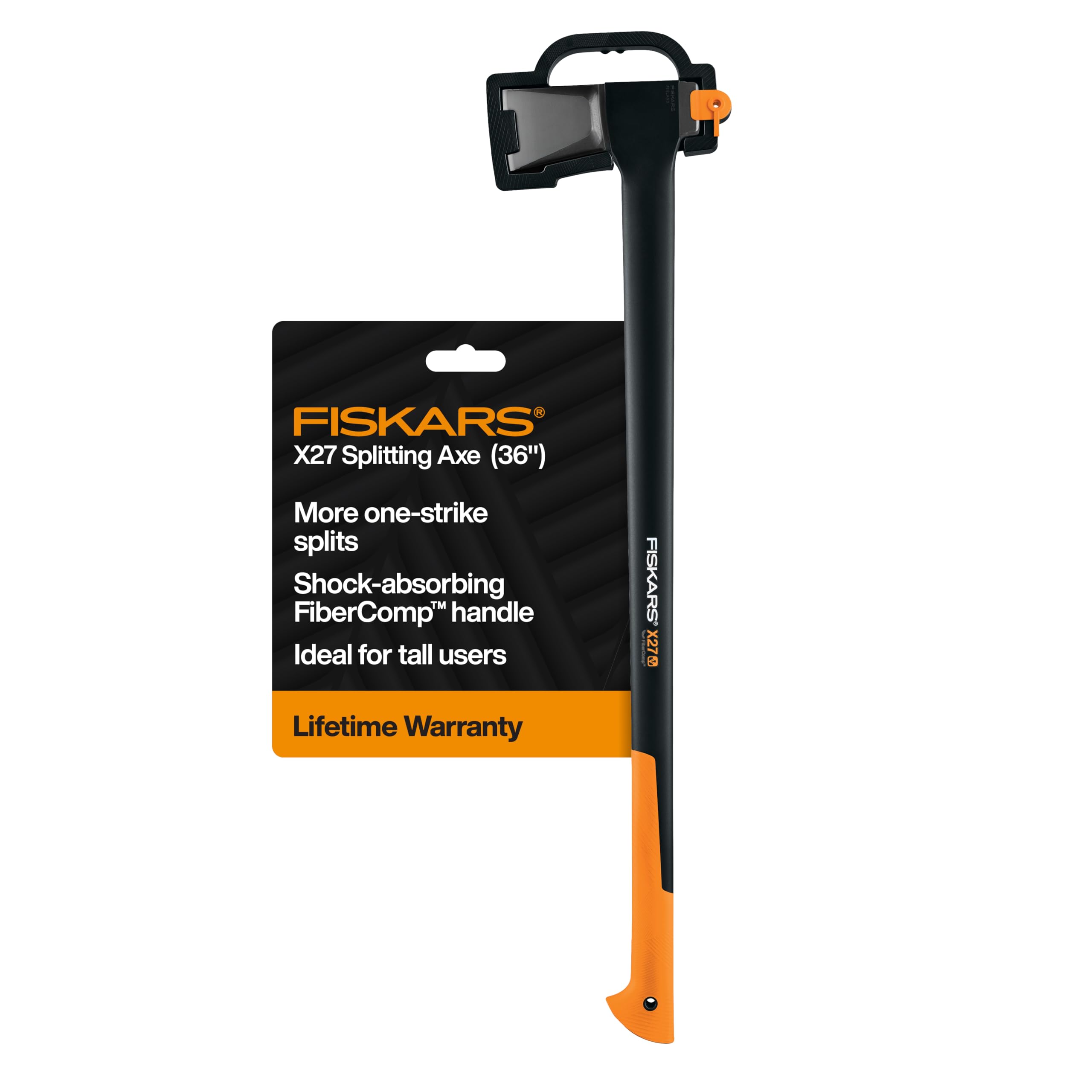
1. Fiskars X27 Super Splitting Axe 36″
Our pick — 4.5+★ from 9,000+ verified ratings; the strongest balance of quality and price.
A 36-inch firewood axe for taller users, with a 4.3-pound convex head that splits clean and holds its edge through the stack.
The X27 earns its spot on one number: a 36-inch handle paired with a 4.3-pound forged head. That long handle builds swing speed on the way down, so the head lands with real force on a wide round. Buyers keep reporting it does the work of a splitting maul (a heavy two-handed sledge-style splitter) while being easier to swing. If you are tall, the 36-inch length keeps your hands from crowding your knees at the bottom of the arc.
What wins people over is the release. The head is hardened forged steel with an advanced bevel convex design — convex meaning the edge curves outward to push the grain apart — so the blade comes back out of the wood instead of sticking. Owners describe rounds coming apart in a single strike and the edge holding its sharpness over long use. The handle is shock-absorbing with a textured non-slip grip, which keeps hand strain down and guards the shaft on a missed overstrike.
The catch is honest and simple: this is a long tool at 36 inches, and at 6.3 pounds overall it is noticeably more to carry and to swing than the 2-pound double bit further down this list. Come down on the handle instead of the wood and you will feel it. For a backyard woodpile and a tall swing, though, this is the one most people should buy first.
What earns the top spot
- 4.3-pound forged head with a convex bevel that splits and then releases cleanly
- 36-inch handle built for taller users and medium-to-large logs
- Shock-absorbing, textured non-slip grip reduces hand strain across a session
- Ships with a protective sheath and a lifetime warranty
Where it asks more of you
- At 6.3 pounds overall it is a lot of tool to swing and carry
- The 36-inch shaft needs room — cramped splitting areas work against it
- A missed strike lands on the handle, so keep your form square
Buy this one if: you stack firewood regularly, you are on the taller side, and you want one axe that handles big rounds without a maul.
Look elsewhere if: you split at a campsite or in tight quarters where a 36-inch swing has nowhere to go.
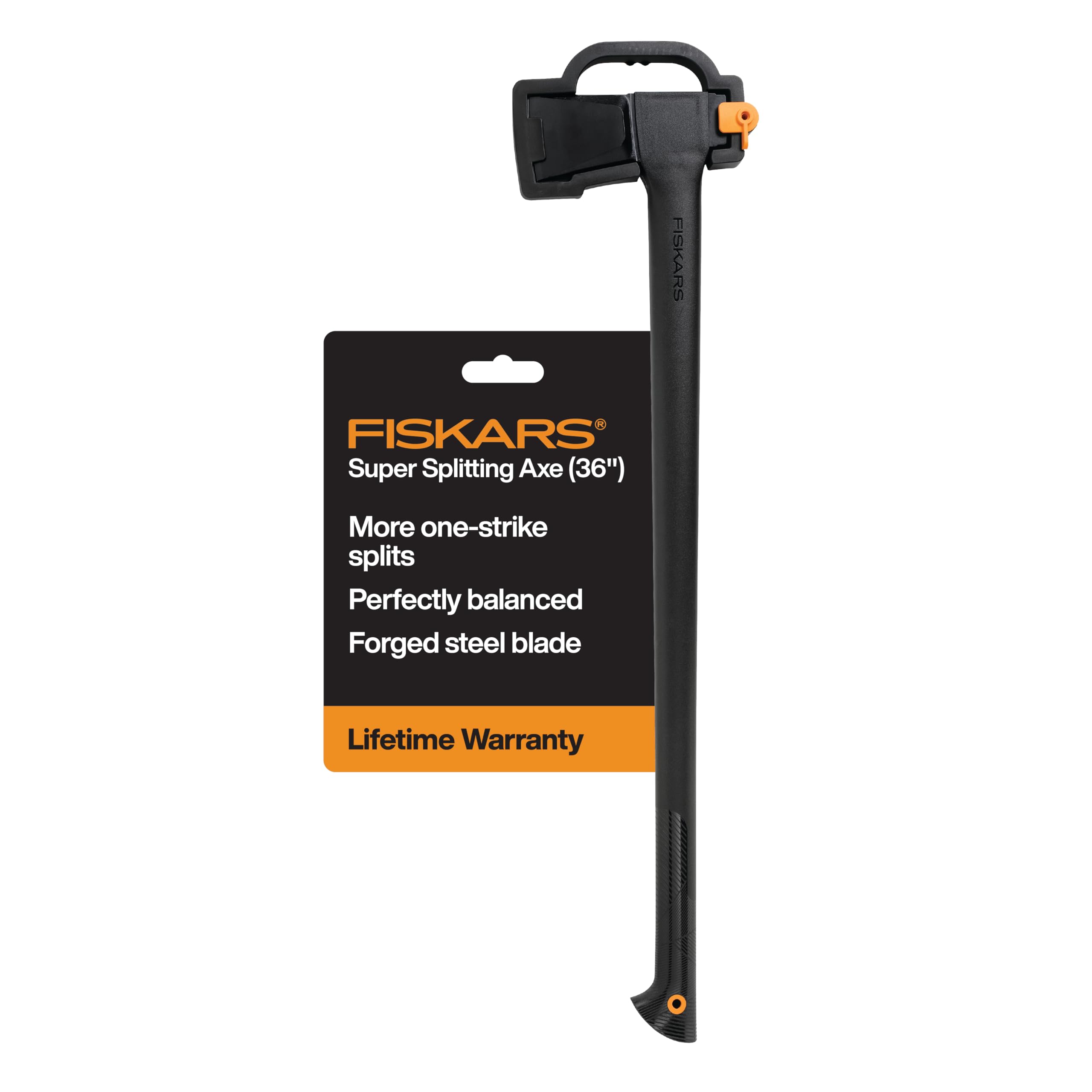
2. Fiskars A-Series Super Splitting Axe 36″
The A-Series takes the same geometry and wraps it around a lighter, steel-strong handle.
The A-Series gives you a more planted tool in the hand: 37.75 inches overall and 9.25 inches wide, against the X27’s 36-inch blade length. It still runs the same 36-inch working handle, so taller users get the same reach. The real difference is the FiberComp shaft — a composite that is lightweight, soaks up shock, and resists overstrike damage (a missed swing that hits the handle) that would ruin a wooden handle.
Quality is the theme that dominates the response to this axe — it is far and away the most-discussed strength, backed by splitting performance and general functionality right behind it. The convex bevel edge carries a low-friction coating, and that coating is what lets the head power through a round and then release instead of gripping. One practical note on the dimensions: that 37.75-inch overall figure measures the packed length, so allow for it in a truck bed or a shed slot.
The one honest wrinkle is durability, which draws a mixed response rather than a uniform cheer — some units have not held up the way the rest of the tool suggests they should. It stays a small slice of an otherwise strong picture. If you are already a Fiskars owner looking for the lighter handle option, this one is worth the look.
Why it holds up: a hardened forged steel blade that keeps its edge season after season, an insert-molded head that resists loosening, and a composite handle that shrugs off the bad miss.
The honest note: durability feedback is split, so buy it as a great splitting tool rather than as an heirloom, and it will treat you well.
Reach for this if: you want the tall-user reach with a handle that forgives a clumsy overstrike.
Think twice if: a wooden handle and a traditional look matter more to you than composite toughness.
3. ESTWING Double Bit Axe, 38 oz Blue Splitting Axe, E6-DBA
Short, light, and built around a vibration-killing grip — the campfire axe, not the woodpile axe.
The E6-DBA is the one that travels best: 17.19 inches long and 2 pounds, the smallest axe on this list. Set it against the Fiskars A-Series at 37.75 inches and the split in purpose is obvious. This is a tool for chopping branches, splitting kindling, and handling small trees — not for driving through a full cord of rounds. The forged steel double-bit head (an edge on both sides) and the hickory handle keep the whole thing feeling traditional.
The feature that carries it is the patented shock reduction grip. Estwing’s patented shock reduction grip cuts impact vibration by 70%, which matters on a 17.19-inch axe where every strike lands in your palm. It holds on in wet conditions too. The head is hand-sharpened and arrives with a ballistic nylon sheath to protect that edge in transit.
Here is the fair limit: a 2-pound head on a 17.19-inch handle will not split a big round the way a long-handled axe does, and it is not meant to. It is the axe you keep by the stove or the fire pit for turning splits into kindling. Set your expectations to camp duty and it delivers exactly what it promises.
Editor’s read: the manufacturing story is real and specific — American-made in Rockford, Illinois since 1923 using American steel — and the double-bit design gives you two edges before you ever sharpen.
Fit note: buy it for kindling, branches, and camp chores, and keep a long-handled axe for the main stack.
The right call for: a stove owner who wants a compact, comfortable axe for making kindling fast.
Not the right call for: splitting large firewood rounds, which want a longer handle and heavier head.
4. 27.8″ Splitting Axe
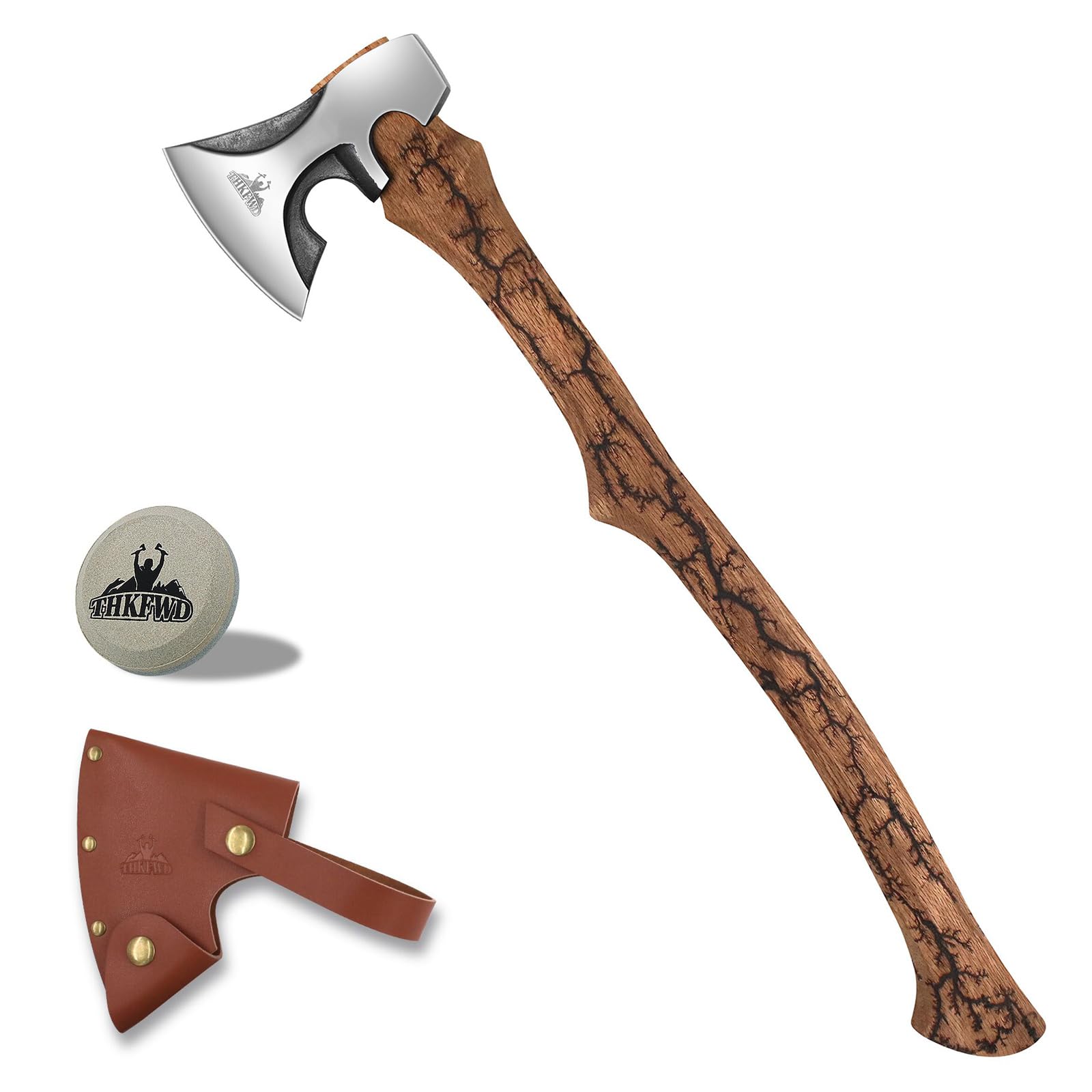
A burn-scorched handle and a carbon steel head — this one is bought for the eyes as much as the edge.
Appearance is the second thing everyone mentions about this axe, and the Lichtenberg pattern burned into the wood handle is the reason. The 1065 high carbon steel head is forged and heat-treated to raise density, and the 5.3-inch blade on a 27.8-inch shaft puts it in middle ground for reach. Its 6.7-inch width is narrower than a broad two-handed axe, which keeps it manageable when you are moving between bonfire and garden work.
The chopping itself holds up: the weighted wedge design and the balanced head-to-shaft ratio do the work on firewood, logs, and kindling, and the fully polished edge can be touched up with a file. That matters, because the recurring gripe is sharpness from the start — buyers report it does not arrive very sharp, so plan a quick honing before the first swing. Expect to spend a few minutes with a file and be rewarded with a good-working tool.
The handle is the honest caveat. Owners mention, “The durability receives mixed feedback – while some find it sturdy, others report the handle breaking on day two of use.” Treat the wooden shaft with respect and avoid overstrike (a missed swing that hits the handle), and the tool gives you the look and the split you paid for.
What you get: a forged carbon steel head, a leather sheath with a belt hole for carrying, and a sharpening stone in the box — a complete kit rather than just an axe.
What to expect: a blade that needs honing on arrival and a wooden handle that rewards careful swings.
Worth it for: the buyer who wants a striking axe for the yard and the fire pit and does not mind five minutes of sharpening.
Pass if: you want a factory-sharp edge and a handle that takes punishment without complaint.
5. Husqvarna Wood Splitting Axe S2800

A five-pound coated head on a 28-inch fiberglass shaft, aimed squarely at larger firewood.
The S2800 puts a 5-pound steel head on a 28-inch blade length, and the extra mass matters on the kind of round that laughs at a lighter tool. Compare that 5-pound head to the 4.3 pounds on the Fiskars X27 and the Husqvarna is clearly the heavier hitter of the two, built to sink into bigger firewood. The head is coated to help it move through the cut rather than drag.
Durability is what people talk about with this axe more than anything else — the theme that runs through the feedback is a tool that survives hard use, including the occasional poor swing. The edge holds, the fiberglass composite handle keeps the weight distributed well, and the balance is described as close to perfect. It arrives with a sheath and a lifetime warranty.
One thing to size before you commit: at 27.6 inches overall and 6.2 pounds, it sits shorter and heavier than the 36-inch Fiskars axes here. That shorter handle means less swing arc, which is a fair trade for control but not the tool for a very tall user chasing head speed. If your rounds are big and you want the mass to do the work, it is a solid pick.
Working strengths: a 5-pound coated steel head, a fiberglass composite handle, and balance that keeps the strike on line.
Worth knowing: the 27.6-inch overall length favors control over reach, so tall swingers should look at the Fiskars pair instead.
Pick it if: you want a heavier head and a shaft that takes abuse from a full woodpile season.
Skip past if: you are tall and want maximum swing speed from a long handle.
6. GEDORE OX 648 H-2508 Axe

An 80-centimeter hickory-handled forged axe for the buyer who wants the tool to outlast the woodpile.
GEDORE builds this one around an 80 cm hickory handle and an alloy steel splitting head, and the company leans on a century of forging work as its calling card. The Split-Quick ROTBAND-Plus design is the model name to remember if you are comparing it against the German names elsewhere in this list. At 4.53 inches wide it is a narrow-profile head, which keeps it nimble on the swing.
This is the pick for someone who treats a splitting axe as an investment rather than a consumable. The stated approach is first-class materials and close attention to every detail — qualified staff, intelligent construction, modern production methods. The hickory handle is the traditional choice, warm in the cold and comfortable through a long session, provided you keep your strikes true.
The trade-off is straightforward. Hickory is a wooden handle, so an overstrike that lands on the shaft instead of the round can damage it, and you should plan to keep it oiled. For anyone who wants that forged feel and the traditional look, this is the premium option in this lineup.
The premium case: forged alloy steel head, an 80 cm hickory handle, and a build story rooted in a century of tool forging.
The premium cost: wood needs care and a clean swing; there is no composite safety net on a missed strike.
Best suited to: the traditionalist who wants a forged European axe and will look after a hickory handle.
Better to pass if: you want a set-and-go composite shaft that shrugs off overstrikes.
7. Helko Werk Saxon Splitting Axe

The Saxon carries maul-level splitting force in a 31-inch axe that still has balance and feel.
This is the axe for the rounds that stop everything else. The head is 6.3 pounds of C50 high carbon steel rated 53-56 HRC (a hardness scale where higher means harder steel), open-face drop forged by hand. Helko rates the 6.3-pound Saxon head at maul-level splitting force while keeping the balance and control of a 31-inch axe. At 31 inches overall and 8.5 pounds total, it is the heaviest tool here — set it next to the 2-pound Estwing double bit and the two are different species entirely.
The head design is the clever part. It is built to deliver powerful strikes without getting stuck or pinched in the wood. A small turnaround hook on the heel of the blade lets you move logs — a genuinely useful detail you rarely see. The handle is grade A American hickory, hand finished and picked for grain orientation and density, with a boiled linseed oil finish and sanded to 150 grit (a fine abrasive grade) for a smooth feel in the hand.
The catch is the obvious one: 8.5 pounds total is a serious tool to swing, and it is best reserved for large rounds and difficult logs rather than long sessions. Customers note it out-splitting an 8-pound maul on hard, knotty rounds and opening large trees in about three chops. It ships with a full grain leather sheath and a 1 oz bottle of Axe Guard oil to keep the steel protected.
Why the hardlogs crowd loves it
- 6.3-pound head forged from C50 high carbon steel at 53-56 HRC
- Head geometry resists sticking and pinching in difficult logs
- Grade A American hickory handle, linseed-oiled and sanded to 150 grit
- Leather sheath and a 1 oz bottle of Axe Guard oil included
Go in with your eyes open
- At 8.5 pounds total, it tires you faster than any other axe here
- Overkill for small rounds and kindling — this is a specialty tool
- Hickory shaft still demands clean strikes
This is your axe if: you face large diameter trees and knotty rounds, and you want one tool that ends the fight.
Leave it on the rack if: your wood is already split or small, because the weight becomes a chore.
8. Gransfors Bruks Splitting Axe 442
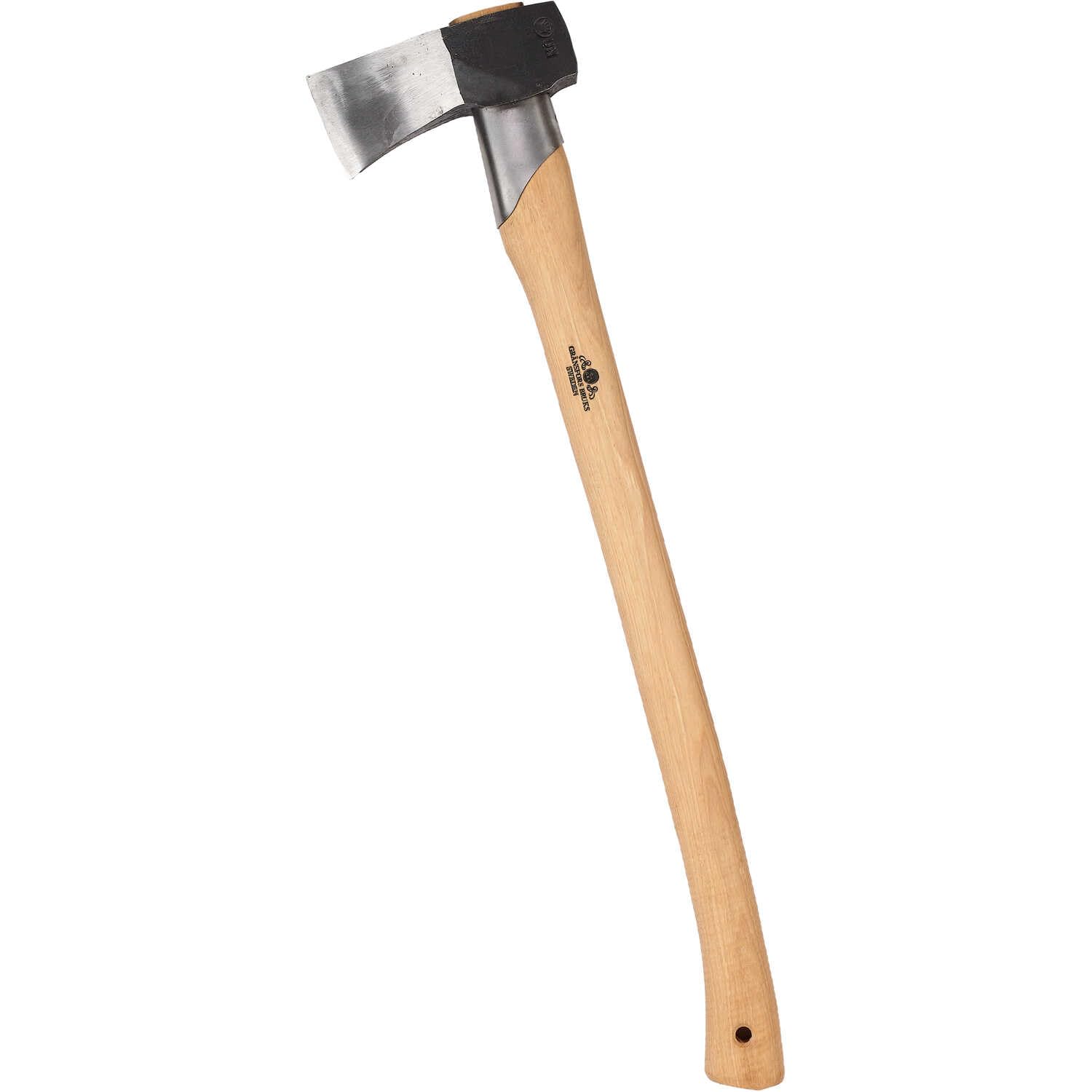
Hand-forged Swedish steel ground to a thin concave bit, made to split every kind of firewood you stack.
The Model 442 runs a 27.5-inch handle and a 5-pound axe weight, and the head is where the craft shows. It is forged and ground to a concave, quite thin blade at the bit — concave meaning the edge profile curves inward behind the cutting face — and that geometry is designed to work through all types of firewood. Build quality is the defining strength of this axe, and owners say it is not a subtle thing.
The word that keeps coming up is heirloom. This is a well-made tool that stays extremely sharp and is easy to handle, and it earns the kind of affection that turns splitting into a pastime for the person holding it. The effectiveness on stubborn wood is real — the feedback specifically calls out super knotty, twisted ponderosa as something it handles well. It comes with a vegetable tanned leather sheath, and the collar guard protects the handle at the head.
Two things to weigh honestly. Value for money and durability both draw a mixed response rather than a clean sweep, so buy this as a crafted object you intend to look after. The thin, concave bit also wants a clean strike — it is a splitting tool, not a maul, and it should not be used as a wedge or struck with one.
What makes it special: a hand-forged concave bit that stays extremely sharp, a 27.5-inch handle, and a leather sheath for transport.
The honest note: durability and value feedback is split, so treat it as a careful-use heirloom rather than an abuse-proof beater.
It fits you if: you want a hand-crafted Swedish splitting axe and you enjoy the ritual of tending a good tool.
You might skip it if: you want a shaft that survives hard, sloppy swings without worry.
9. Gransfors Bruks SMALL SPLITTING AXE Camping New #441

Twenty-three inches of hand-forged Swedish steel for the wood you split at camp, not the cord at home.
The #441 is the travel-sized member of the family: a 23-inch handle, a 3.5-pound head, and a 2.5-inch blade, sized for medium firewood and campfire wood. Put it beside the 37.75-inch Fiskars A-Series and you can see why it is the one you would actually carry to a site. Different jobs, different tools — this one is meant to be packed, swung close, and put away.
Quality is the headline with this axe, followed by how well it functions for its size. It works well for splitting logs, makes light work of building campfires, and holds up in the way a hand-forged axe should. The size draws praise precisely because it delivers real splitting ability in a short package. It ships with a vegetable tanned leather sheath and a Gransfors warranty certificate.
Do not expect it to do what a full-size axe does: it is not built for big diameter rounds, and the small blade length limits how deep a split it can open. The value is also a mixed picture — some buyers consider it worth every cent while others find it a bit expensive. Buy it for the size and the craftsmanship, and it earns its place in the pack.
The compact case: a 3.5-pound head, a 23-inch handle, and a leather sheath that packs down for the truck or the trail.
The limit to weigh: value feedback is split and the short blade suits medium firewood rather than large rounds.
Made for you if: your splitting happens at a campsite and you want real function in a packable axe.
Better to look elsewhere if: you need to break down large rounds and want a long, heavy swing.
Know the Specs
Head weight and what it means at the wood
A heavier head carries more momentum into the round, so it splits thick logs with fewer swings. A lighter head swings faster and tires you less, which suits kindling and short sessions. Match head weight to your rounds and your stamina before you trust a spec sheet.
Handle length and swing arc
A longer handle travels through a bigger arc and lands with more speed, which helps on wide rounds. A shorter handle keeps the tool compact and controllable in tight spaces like a campsite or a small splitting area. Pick the handle length for your height and your splitting space.
Blade geometry and edge release
A convex bit curves outward so the head pushes grain apart and slides free instead of wedging stuck. A thin concave bit cuts deeper into the wood. The finish on the blade, whether a low-friction coating or a polished edge, decides how easily the axe comes back out of a round.
Handle material and durability
Composite and fiberglass handles absorb shock and shrug off an overstrike. Hickory handles feel warmer and look traditional, but a missed strike can crack them. Whichever you pick, plan for the handle to be the part that fails first if you swing carelessly.
Common Questions
Will a 36-inch splitting axe work for a shorter person?
What is the difference between a splitting axe and a chopping axe?
Can I split large rounds with a lighter axe?
How do I stop an axe head from sticking in the log?
Is a hickory handle better than a fiberglass one?
What should I use to sharpen a splitting axe?
Can a splitting axe be used to move logs or strike a wedge?
What handle length suits a campsite versus a backyard woodpile?
Does the sheath material really matter?
How do I keep a wooden splitting axe handle from drying out or cracking?
The Bottom Line
For most people stacking firewood, the top rated wood splitting axe to reach for is the Fiskars X27 Super Splitting Axe 36″ — It holds 4.5+ stars from 9,000+ owners, who overwhelmingly report clean splits, a edge that stays sharp, and an easier swing than a maul. Want the same Fiskars geometry in a composite handle that forgives a clumsy overstrike? The A-Series earns its spot. For a big-round specialist that behaves more like a maul, the Helko Werk Saxon is the one the tough-log crowd keeps recommending. And the Estwing double bit is the axe to keep by the stove for kindling.
How we choose
We do not accept paid placement. Every pick is matched to a real buyer and a real use-case; we do not hands-on test units.
Sources
Specifications: manufacturer listings and product documentation. Review insights: verified customer reviews, as of November 2026. Pricing: not shown on this page (it changes often); check the current price via the retailer link.
As an Amazon Associate, Tactical Gear Guy earns from qualifying purchases. This does not affect which products we feature.