Specs are compiled from manufacturer listings and verified buyer reviews and can change over time — please confirm the key details on the product page before buying.
If you want one answer: buy a radio that still works when the wall outlet dies. That single rule separates a real weather alert radio from a desk radio with a weather button. A mains-only radio dies with the outlet, right when a tornado warning is issued. So the picks below all keep receiving alerts one way or another when the grid drops — through a rechargeable battery, a set of AA cells, a hand crank, or a solar panel. Beyond that, decide if you need S.A.M.E. county decoding or plain NOAA band, and how loud the siren must be.
This guide is built by comparing the manufacturers’ published specifications and the patterns across verified customer reviews, so you get each pick’s real strengths and trade-offs instead of marketing spin.
Below you’ll find a plain-English breakdown of each pick, a comparison table that lines up the specs that actually matter, and a spec guide that translates NOAA, S.A.M.E., and battery ratings into everyday terms. The result is a clear, no-hype shortlist of top rated weather alert radios you can compare side by side in a couple of minutes.
Top Picks

How To Choose The Best Top Rated Weather Alert Radios
Most buyers walk into this category thinking they need a radio. What they actually need is a warning system that survives a power cut. Judge every candidate on three things: how it gets power when the grid is down, which warnings it can decode for your county, and whether the alarm is loud enough to pull you out of sleep.
The alert system matters more than the speaker
A weather radio with plain NOAA band reception plays the forecast you tune into. A radio with S.A.M.E. (Specific Area Message Encoding — a code that tags each warning to a specific county) wakes you automatically when your county is named. That difference matters: a general NOAA radio can alert on a storm two counties away, while a S.A.M.E. model filters that noise and only sounds off for your area.
Match the backup power to where the radio lives
A bedside unit that stays plugged in wants AA battery backup so it keeps running the moment the outlet dies. A backpack or camping radio is better served by a hand crank or a solar panel, because you may be away from power for days. Rechargeable lithium batteries are the smoothest middle path — they also double as a phone charger when your mobile network is struggling.
Check the siren volume and the display in the dark
A siren you can’t hear from the bedroom is useless. Look for a clearly stated siren level and a backlit screen you can read at 2 a.m. without turning on a lamp. A radio with an optional voice broadcast after the tone is easier for a whole household to follow than a siren alone.
Side-by-Side Comparison
| Model | Best For | Battery Capacity | Power Backup Options | Bands | Amazon |
|---|---|---|---|---|---|
| Roxicosly Emergency Weather Radio★ Best Overall | Whole-home blackout kit | 12000 mAh | USB-C, solar, hand crank | AM/FM/NOAA | Amazon |
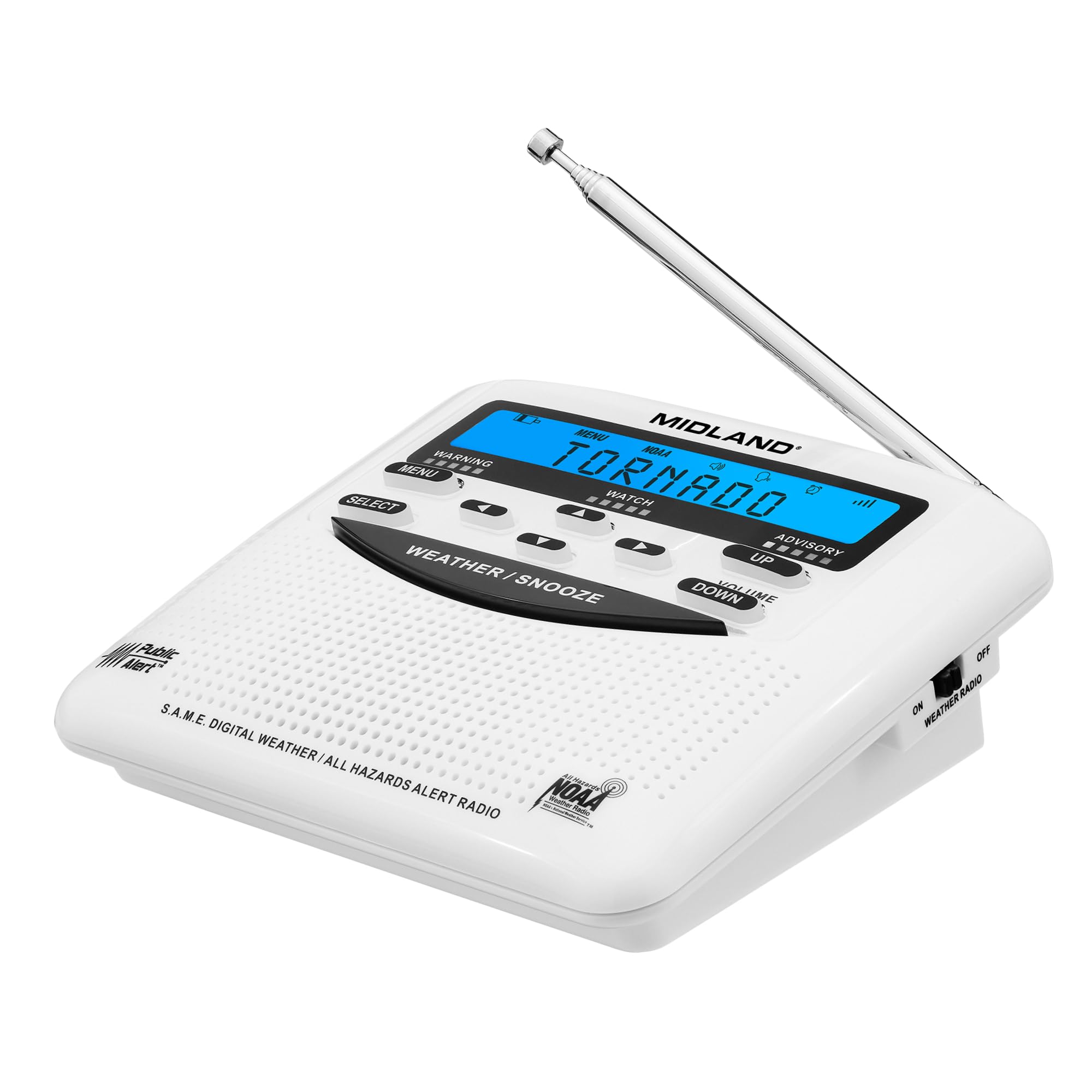
| Midland WR120BMost Trusted Siren | Bedside warning siren | 3 × AA (backup) | AC adapter + AA cells | NOAA with SAME | Amazon |
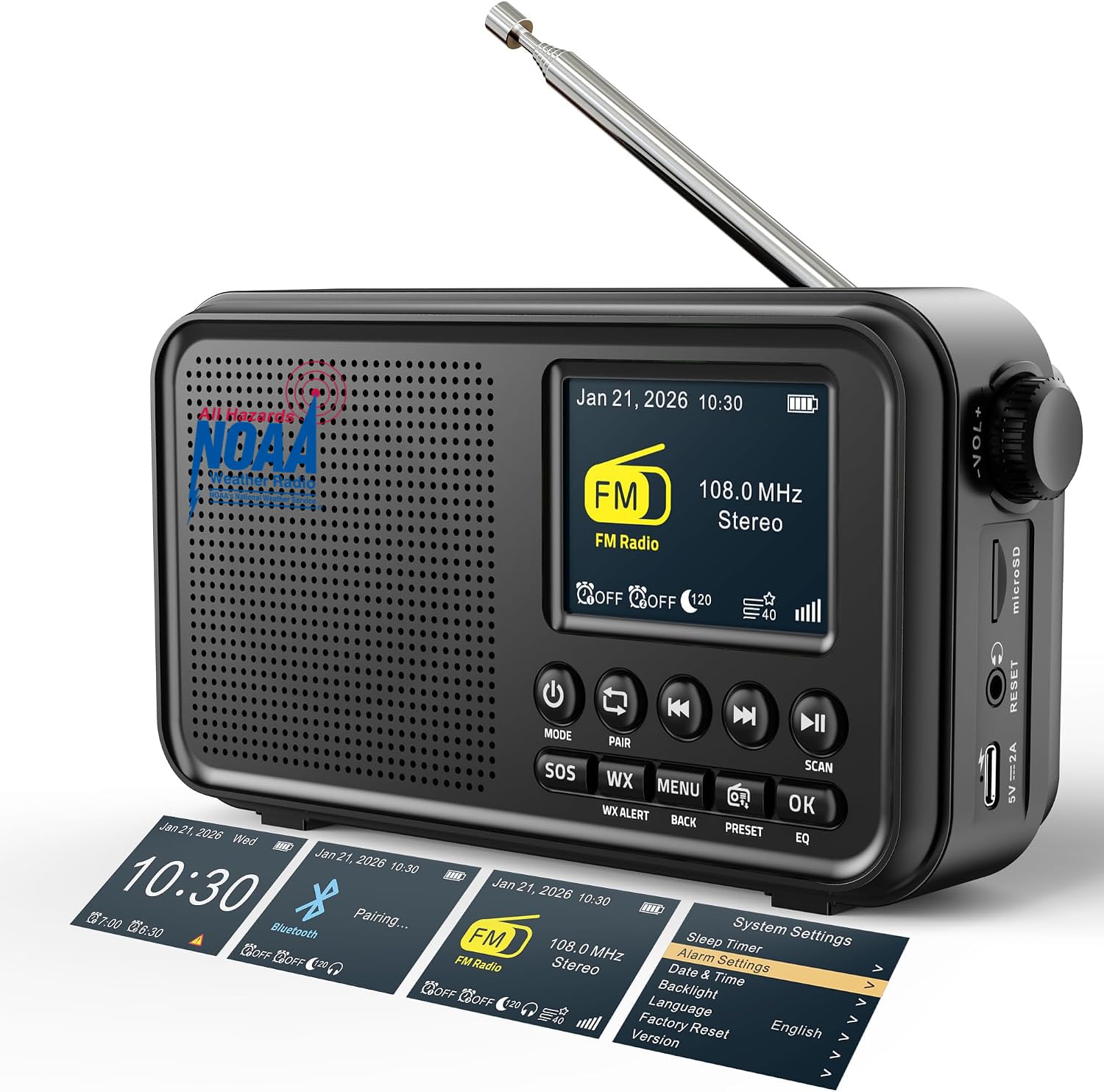
| ROCAM Portable FM/NOAA RadioBest Sound | Everyday listening plus alerts | 3000 mAh | USB-C recharge | FM/NOAA | Amazon |
| Mesqool NOAA Weather Radio | Kitchen counter and alarms | 3000 mAh | USB-C recharge | FM/NOAA | Amazon |
| DreamSky NOAA Emergency Radio | County-specific home alerting | 3 × AA (backup) | Adapter + AA cells | FM/NOAA with S.A.M.E. | Amazon |
| Jazmm Bluetooth Shortwave Radio | Pocket music and news | 1250 mAh | USB-C recharge | AM/FM/SW/NOAA | Amazon |
| Emgykit Hand Crank Radio | Off-grid survival bag | 2000 mAh | USB-C, solar, hand crank | AM/FM/NOAA | Amazon |
| C. Crane CC Skywave 2 | Travel and serious listening | 2 × AA | AA cells (optional adapter) | AM/FM/SW/NOAA/Airband | Amazon |
| ZHIWHIS Pocket Radio | Glovebox and walking | 900 mAh | USB-C recharge | AM/FM/SW/VHF/WB | Amazon |
Detailed Reviews
1. Emergency Weather Radio 12000mAh
Our pick — 4.5+★ from 650+ verified ratings; the strongest balance of quality and price.
A blackout power bank that happens to also pull in every weather warning.
The Roxicosly carries a genuinely large 12000 mAh battery — that’s milliamp-hours, a measure of stored charge — so it can top up your phone and run its lights long after other radios have gone dark. For context, the ZHIWHIS pocket radio further down holds 900 mAh. This one holds far more.
You can charge it three ways: USB-C, an 8500mm² monocrystalline solar panel (a panel made of single-crystal silicon cells that capture more daylight), and a hand crank that the maker says powers calls, light, or news in about a minute of turning. It’s rated IPX6, meaning it shrugs off heavy sprayed water — handy on a campsite but not a claim that it survives being dropped in a lake. The 5W flashlight has an adjustable beam and sits alongside a 12-LED reading lamp, so a blackout doesn’t leave you hunting for a torch.
Owners praise its clear reception, loud alerts, and a solar panel that keeps the 12000 mAh battery topped up. One reviewer noted it working effectively through a storm. The trade-off is bulk: at 824 g and 6.8 inches long, it’s a bag-and-shelf radio, not a pocket one.
What earns it first place
- 12000 mAh battery doubles as a phone charger
- Three backup paths: solar, crank, USB-C
- IPX6 water resistance for outdoor use
- 5W flashlight plus 12-LED reading lamp
Where it asks you to compromise
- 824 g — too heavy for a jacket pocket
- Bigger than a bedside-only radio needs to be
Grab this if: you want one radio that also charges phones and lights a room during a multi-day outage.
Think it over if: you only need a nightstand siren for county warnings — the DreamSky or Midland does that in far less space.
2. Midland WR120B NOAA Weather Radio
The veteran desk radio built for one job: waking you before the storm does.
The case for the Midland is its track record — 4.5+ stars across the largest owner base in this whole list. It runs from the wall outlet day to day and flips to AA cells the instant power drops, so tornado, flash flood, and wildfire warnings still reach your bedroom during a blackout. Its SAME decoding (Specific Area Message Encoding, which ties each alert to a county code) means it filters out warnings for areas that aren’t yours.
Setup is menu-driven in English, Spanish, or French, with oversize buttons and a backlit screen you can read in a dark hallway at 2 a.m. It decodes over sixty event types, from hurricane to amber alerts, and pairs a loud siren with a spoken broadcast and a flashing indicator. The LCD also works as an everyday alarm clock.
The honest caveat is volume. Some owners find the siren nicely loud; others find it too loud during warnings. There’s no rechargeable battery and no phone charging here; it’s a warning device, not a power bank.
Why it sits so high: it does the one thing a weather radio must do — sound a county-specific alarm with battery backup — with the widest owner base and highest score in the set.
Know before you buy: no rechargeable battery, no flashlight, no phone charging. It informs; the Roxicosly above powers.
Made for: a nightstand, kitchen counter, or classroom shelf that needs a reliable county siren.
Wrong tool for: anyone who wants a flashlight and a phone charger in the same box.
3. ROCAM Portable FM Radio NOAA Weather
The radio you’ll actually leave on the kitchen counter all week.
Most weather radios live in a drawer until a storm. The ROCAM earns its counter space by being a decent everyday radio first — an 8W speaker, 6 EQ modes, and Bluetooth 5.0 for podcasts from your phone. Owners praise its functionality first and its FM/NOAA signal reception second. Radio stations come in clearly for most buyers.
The NOAA weather band is built in with weather alerts where coverage allows, and a 120dB SOS siren gives you a way to draw attention when you need it. The 2.4-inch colour display shows station, time, and battery level at a glance. A 3000mAh rechargeable battery runs it cordless, with a Type-C port for topping up.
The thing to know up front: it receives FM and NOAA only. If you want AM or shortwave, look at the Jazmm or C. Crane further down. And alert reception depends on your local coverage, so test it before you rely on it in a storm.
Pick this for: a kitchen or desk that wants clear FM radio plus a NOAA safety net in one unit.
Skip past it if: you need AM talk radio or shortwave — this model covers neither.
4. Mesqool NOAA Weather Radio

A nightstand radio that wakes you with FM, not just a siren.
If your weather radio is also your morning alarm, the Mesqool is the tidier fit. It carries 40 FM presets (saved stations you jump straight to), Auto Scan to find local ones, and a built-in U.S. NOAA weather band with alert monitoring for when weather updates matter. The 8W speaker and six EQ modes — Normal, Pop, Classic, Rock, Jazz, and Bass — cover music, news, and podcasts.
Two independent alarms wake you to FM radio or a buzzer, with snooze and a sleep timer for bedside listening. The 2.4-inch colour display shows time, mode, station, and battery level, with adjustable backlight and menu options in English, Spanish, and French. Bluetooth 5.0 and microSD playback (card not included) mean you’re not tied to Wi-Fi for audio. A 3000mAh rechargeable battery handles cordless use, topped up over USB-C.
The honest framing: the NOAA coverage here is FM-tier weather band and alert monitoring, not the county-filtered SAME alerting the Midland and DreamSky deliver. It’s a home companion first and an emergency siren second.
Where it shines: dual alarms, a sleep timer, and a readable colour screen make it the pick that fits daily life rather than the emergency bin.
The catch: weather alerts depend on local coverage and this model is FM-only — no AM, no shortwave, no SAME county filtering.
Reach for this if: you want one radio for alarm, music, and weather on a bedside table.
Look elsewhere if: you want county-specific automatic warnings — go with the DreamSky.
5. DreamSky NOAA Emergency Weather Radio
County-coded warnings with three ways to sound the alarm.
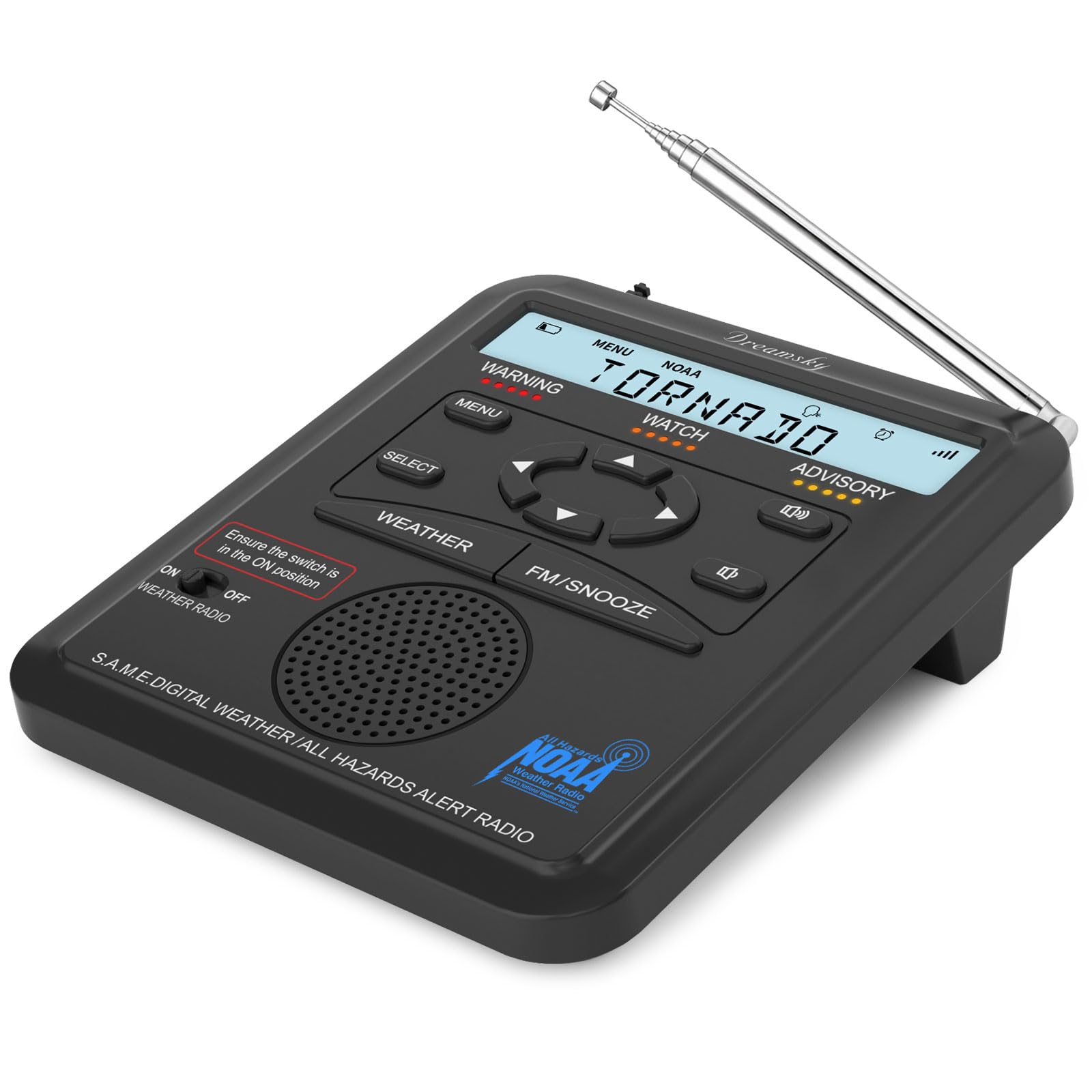
DreamSky leans hard into S.A.M.E. — the same county-coding system the Midland uses — so it locks onto your county and filters out regional broadcasts that aren’t yours. You can program up to 23 customizable county codes, which is useful if you want to track a second home or a family member’s area. It decodes 80+ official NOAA alerts including tornadoes, hurricanes, and earthquakes.
Three alert modes (Voice, Tone, and Display) with colour-coded indicators give you flexibility on how loud you want it. It plugs in for daily use and runs on 3 AA alkaline batteries (not included) during outages. The digital FM side with an alarm clock and snooze means it doubles as a bedside radio, and the LCD has three backlight modes — always on, always off, or on for five seconds.
Owners describe the 8W speaker as loud enough to fill a room indoors. The honest limit: FM reception and the knobs get mixed feedback. Some find tuning smooth; others find the controls fiddly to adjust, so expect to spend a minute dialing in your station rather than tapping a button.
Best match for: a household that wants automatic, county-filtered warnings and a loud siren on a counter.
Bear in mind: AA batteries aren’t included, and the knobs take some getting used to.
6. Bluetooth AM FM Shortwave Radio 1250mAh
Four bands, a belt clip, and a speaker that punches well above its size.
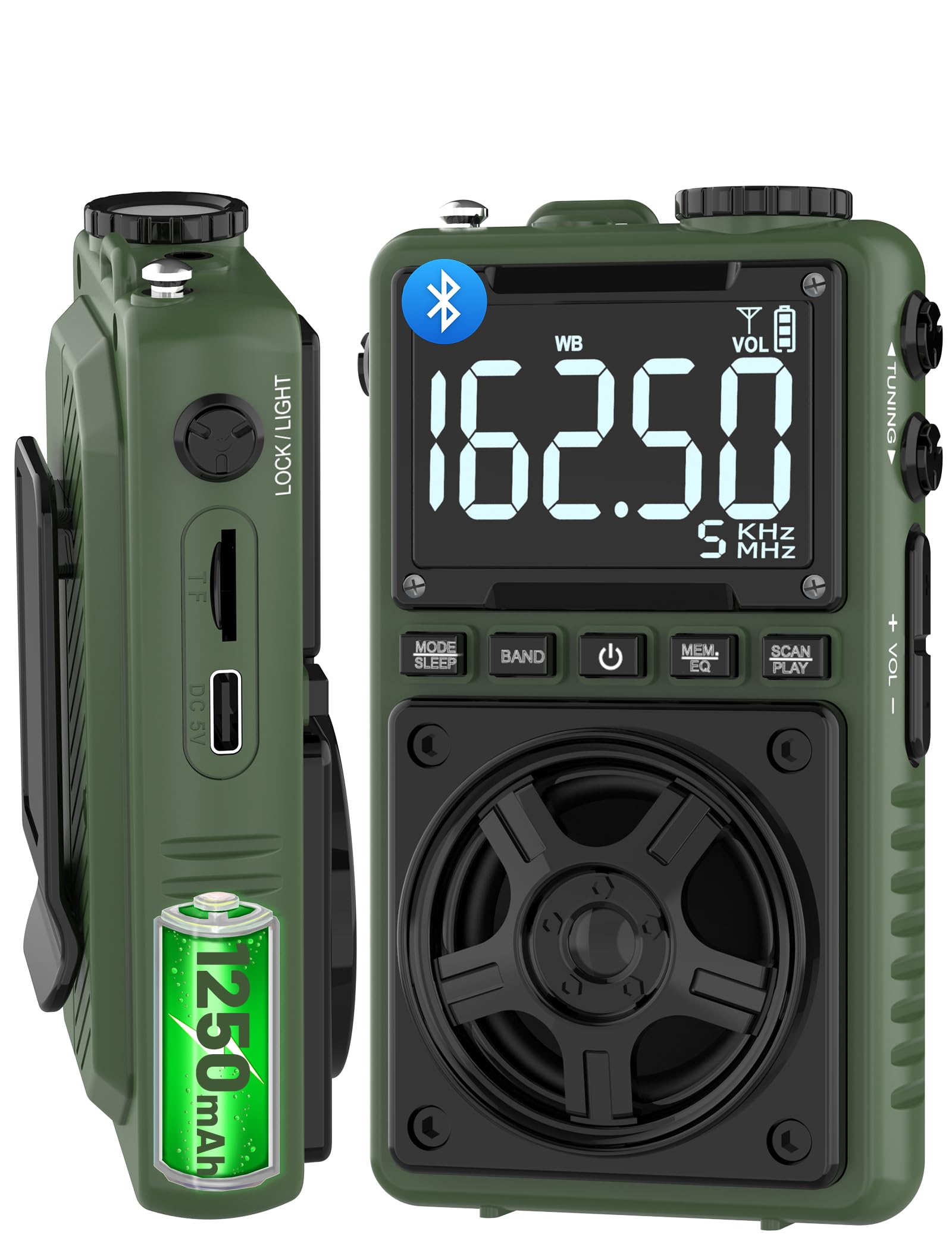
The Jazmm covers the most broadcast ground for its footprint: FM 87-108MHz, AM 520-1710 kHz, shortwave 4.75-21.85MHz, and the NOAA weather band at 162.400-162.550MHz. A DSP chip (a digital signal processor that cleans up weak stations) helps it hold a signal where cheaper radios drift. NOAA alerts arrive in real time, so you get a heads-up before a storm rather than after.
The 1250mAh rechargeable battery is rated for up to 10-12 hours of listening per charge over Type-C. The 5W speaker handles music and talk with six EQ stereo effects, and Bluetooth 5.0 plus a TF card slot (a memory card slot for your own playlists) turn it into a pocket player. There’s a flashlight, a 3.5mm headphone jack, and a back clip with wrist strap for bags and belts. At 352 g, it’s light enough to carry.
Owners praise the 5W speaker’s output for its size, with performance and value close behind. Bluetooth connectivity is the mixed note: a few find pairing less reliable than the radio itself, so treat Bluetooth as a bonus and the radio as the main event.
Why it earns a spot
- AM, FM, shortwave, and NOAA in one pocket radio
- 10-12 hours per charge on 1250mAh
- 5W speaker with six EQ modes
- Bluetooth 5.0, TF card, and flashlight
Where it gives ground
- Bluetooth pairing draws mixed reports
- No hand crank or solar backup
Choose it when: you want shortwave and AM talk radio in a bag you can sling over your shoulder.
Consider the Roxicosly instead if: you need crank or solar power when there’s no outlet at all.
7. Hand Crank Emergency Radio
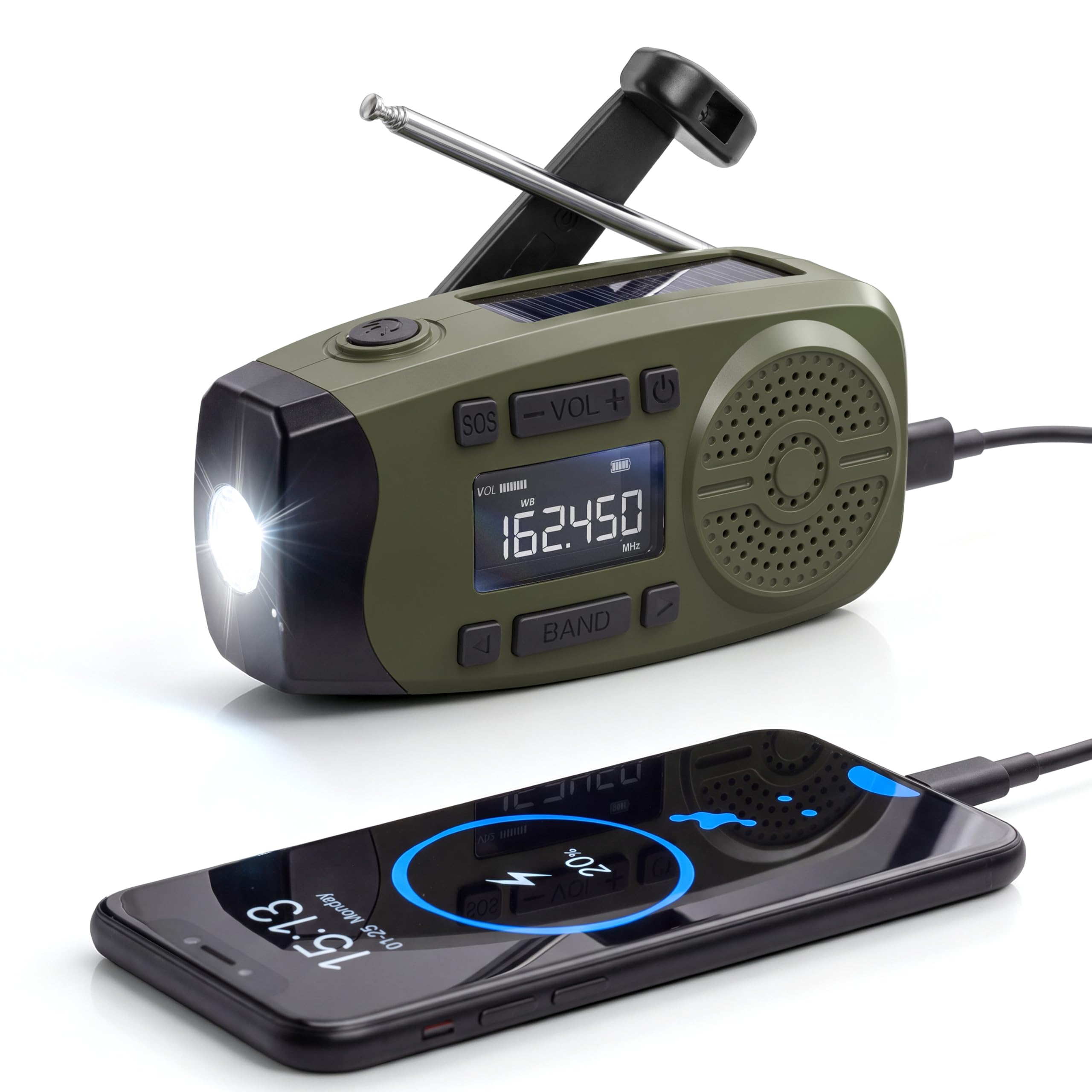
Three ways to power up, one very long body — built for the survival bag.
The Emgykit’s 2000mAh battery recharges three ways: USB-C, a solar panel, or the hand crank. That third path matters when there’s no sun and no outlet — turn the crank and you’re back on the air. The battery can also charge your phone when outlets are down.
An LCD screen shows remaining battery power and the exact station you’re tuned to, readable in bright sun and total darkness. The 1W LED flashlight throws a long-range beam for trails and campsites, and a one-touch SOS mode pairs a siren with a flashing light to signal for help. NOAA weather bands keep you on the official forecast for storms, hurricanes, and floods. At 8.66 inches long, it’s the longest body here — that’s the trade for the crank leverage.
What to like: crank, solar, and USB-C together make it the most outage-proof power path in the set.
The physical reality: its 8.66-inch length and flashlight beam suit a pack, not a shirt pocket.
Suits: a camping kit, a car emergency box, or a home go-bag where power may be gone for days.
Not for: anyone who wants a compact pocket radio — the Jazmm or ZHIWHIS fit a pocket better.
8. C. Crane CC Skywave 2

The travel radio that tunes aviation and shortwave as easily as the local forecast.
The CC Skywave 2 covers AM, FM, NOAA weather with alert, shortwave from 2300 to 26100 kHz, and VHF aviation band — that last one lets you hear air traffic around an airport. A digitally tuned receiver with multiple bandwidth settings and selectable fast or fine tuning gives you control most pocket radios skip. You get direct frequency entry, auto scan and store, 400 memories, and 10 aviation memories you can scan for activity.
Run time is rated around 70 hours on earbuds and about 60 hours on the built-in speaker, on two AA alkaline batteries (not included). At 6.0 oz without batteries, it travels without weighing down a bag. The set includes CC Buds earphones and a faux leather carry case, plus a fold-out back stand and a shortwave antenna jack that can improve reception with an external antenna.
Owners rave most about the sound and reception across all bands — this is the most refined tuner here. But the value and reliability ratings are mixed, and the battery note is honest: on AA cells expect around a week of real use before a change, which is the trade for the flexible tuning.
Worth it for: travellers and radio hobbyists who want aviation and shortwave alongside NOAA alerts.
Weigh the trade: it runs on AA cells only, so pack spares — no crank or solar option here.
9. ZHIWHIS Portable Radio

A shirt-pocket tuner with a wire antenna you can hang out a window.
The ZHIWHIS is the smallest, lightest option here — 0.2 lb and under an inch thick — with a 900mAh battery charged over USB-C. Its 396 presets (99 per band) make it easy to park your favorite stations and jump between them. A 9.85-foot wire antenna clips onto the built-in one for a real reception boost when you’re far from a signal.
It tunes five bands including NOAA weather, and the DSP chip helps pull in weak stations. There’s an alarm clock, sleep timer, and auto power-on, plus a lock button to prevent accidental button presses. It fits a glovebox, backpack, or tackle box and runs for days on a charge.
Sound quality is the standout — owners find it punches above its pocket size — and value gets fair marks. Be realistic about the rest: band performance, reception, and battery life all draw mixed reports, and the weatherband can be fussy in weak-coverage areas. Treat it as a carry-anywhere listener, not your primary home siren.
Why it’s here: the smallest body and longest reach per dollar — 396 presets and a 9.85-foot antenna in a 0.2 lb package.
Set expectations: weatherband reception varies by location, so it’s a backup listener rather than a guaranteed county alarm.
Fits: a glovebox or daypack where you want a tuner that weighs next to nothing.
Not your pick if: you need guaranteed county SAME alerts — the Midland or DreamSky cover that.
Know the Specs
Battery capacity (mAh)
mAh stands for milliamp-hours — a measure of how much stored charge a battery holds. A 12000mAh battery can top up a phone several times over during a blackout; a 900mAh one gives you listening time but little phone charging. More mAh means more capacity, but also more weight.
NOAA weather band and alerts
NOAA is the National Oceanic and Atmospheric Administration, which broadcasts official forecasts and warnings on dedicated weather channels. A radio “with NOAA” tunes those broadcasts; a radio “with alerts” also sounds an alarm when one is issued. Alert reception depends on local coverage, so test it at home.
S.A.M.E. county coding
S.A.M.E. (Specific Area Message Encoding) tags each warning to a specific county code. A S.A.M.E. radio filters out warnings for areas that aren’t yours, so a storm two counties away doesn’t wake you at 3 a.m. You program your county code once, and the radio only fires for that area.
IPX6 water resistance
IPX6 is a water rating for protection against powerful water jets — heavy spray or driving rain. It’s not a full waterproofing claim, so don’t plan to submerge the radio. It simply means a splash on the porch or a downpour on the trail won’t end the broadcast.
Common Questions
Will a NOAA weather radio work without Wi-Fi or a phone signal?
What’s the difference between a NOAA radio and a S.A.M.E. radio?
How many mAh do I need for a blackout?
Can I charge a weather radio with a solar panel on a cloudy day?
How loud is a weather radio alert?
Do these radios need batteries if they plug in?
Can a weather radio receive AM and shortwave too?
Is a hand crank worth having over a rechargeable battery?
How long do AA batteries last in a weather radio?
The Bottom Line
For most people, the winner in top rated weather alert radios is the Roxicosly Emergency Weather Radio — its 12000mAh battery, solar panel, and hand crank make it the one that keeps the whole household powered and informed through a long outage. If you only need a nightstand siren that never sleeps through a county warning, the Midland WR120B is the proven choice. And for a pocket tuner you can carry anywhere, the Jazmm Bluetooth Shortwave Radio packs AM, FM, shortwave, and NOAA into a 352 g body. Whichever you pick, buy it before storm season — not the day the power goes out.
How we choose
We do not accept paid placement. Every pick is matched to a real buyer and a real use-case; we do not hands-on test units.
Sources
Specifications: manufacturer listings and product documentation. Review insights: verified customer reviews, as of November 2026. Pricing: not shown on this page (it changes often); check the current price via the retailer link.
As an Amazon Associate, Tactical Gear Guy earns from qualifying purchases. This does not affect which products we feature.