Specs are compiled from manufacturer listings and verified buyer reviews and can change over time — please confirm the key details on the product page before buying.
You want to know the moment a door or window opens — and a door sensor only earns its place if it fires that alert reliably and keeps running without you babysitting a battery. The picks below all report open/close state wirelessly to your phone app or smart-home hub. One thing to know before you read: this list uses flexible, human-like matching, so not every pick is the exact model you typed into the search bar — each is the nearest same-type sensor that does the same job, so you are never misled.
This guide is built by comparing the manufacturers’ published specifications and the patterns across verified customer reviews, so you get each pick’s real strengths and trade-offs instead of marketing spin.
Battery chemistry and hub requirements decide whether a door sensor runs for years or needs weekly attention.
Top Picks


How To Choose The Best Smart Door Sensor
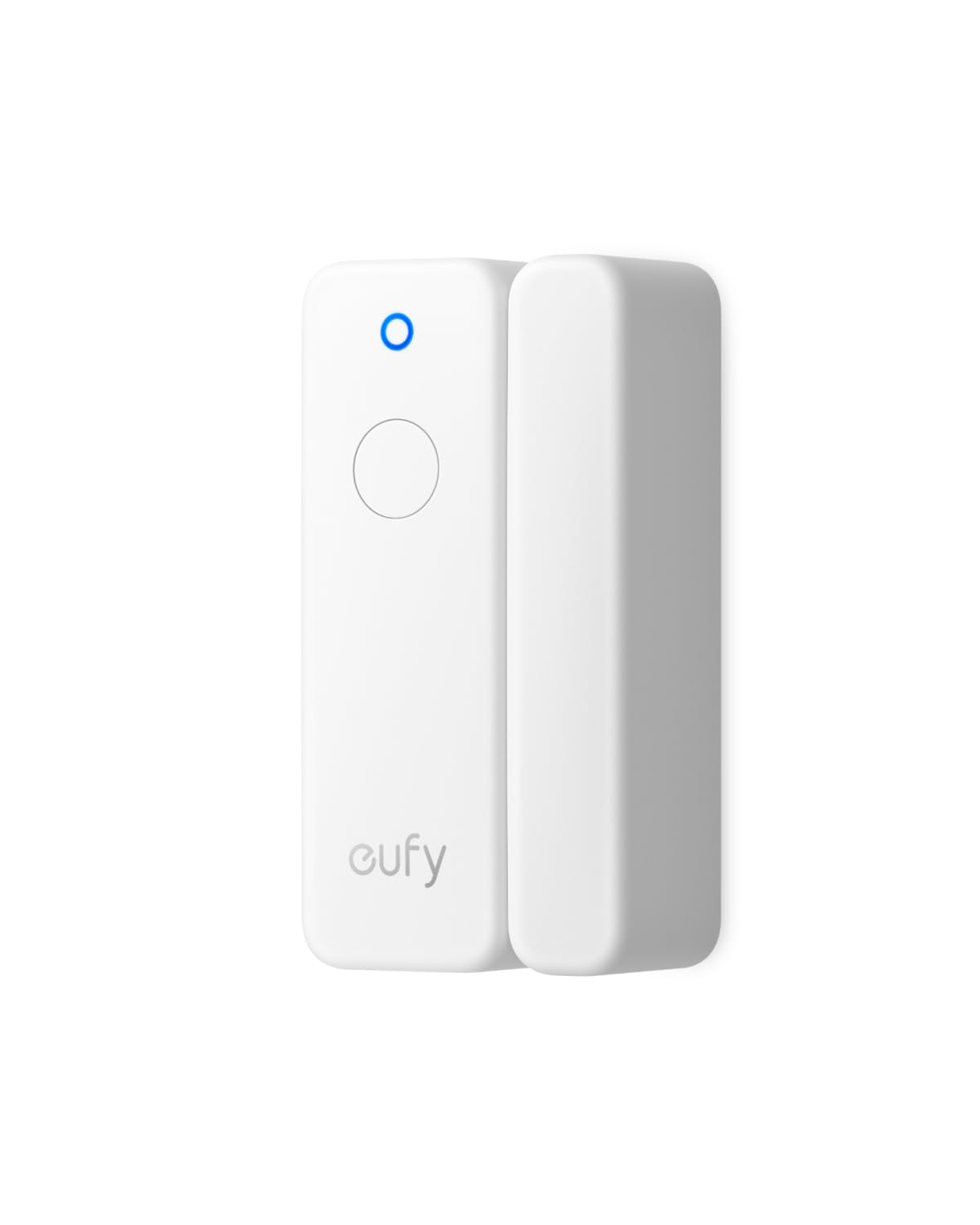
One half sticks to the frame, the other to the door, and the magnet gap tells the app whether the door is open or shut. The real test comes after the adhesive is peeled and the first battery dies.
Start with your hub, not the sensor
The single most common mistake is buying a sensor your system cannot talk to. Some sensors need a base station or hub you plug into your router. Others connect straight to Wi-Fi or through Amazon Sidewalk with no base station at all. A few are Matter-certified, which means they can join Apple Home, Alexa, Google Home or SmartThings through a compatible hub. Check which of those you already own before you look at anything else.
Battery life is a maintenance number, not a marketing one
A sensor sips power, so a coin cell can run for years. The battery chemistry tells you the story: CR2032 coin cells tend to be the shortest-lived, CR123A and CR2 cells last longer, and AAA alkaline cells are the easiest to swap but come out of the pack more often. Fewer replacements means fewer times you have to re-pair a sensor that went flat.
Mounting and the magnet gap
Most sensors install with peel-and-stick adhesive or the included screws. Adhesive is faster and renter-friendly; screws survive a slammed door better. The two halves need to line up within a small gap to read correctly, so measure your frame and your door trim before you commit. Metal doors and windows are a known problem for some Zigbee sensors, so check that note before you buy.
Range and what can block it
Published radio range is measured in open air, which is never your hallway. Walls, appliances and distance from the hub all cut that number down. If the sensor sits at the far end of the house, pick one with a generous open-air figure or plan to add a hub closer to the door.
Side-by-Side Comparison
| Model | Best For | Power / Battery | Range | Hub Needed | Amazon |
|---|---|---|---|---|---|
| Ring Alarm Contact Sensor 2-Pack (2nd Gen)★ Best Overall | Whole-home coverage on a Ring system | 2x 3V CR2032 (approx. 3-year life) | — | Ring Alarm Base Station | Amazon |
| Ring Window & Door SensorNo Hub Needed | No base station, Wi-Fi-drop resilience | Battery powered | — | None (Amazon Sidewalk) | Amazon |
| eufy Security Entry Sensor E20Longest Battery | Least battery swapping | CR123A (up to 5 years) | 656 feet | eufy HomeBase | Amazon |
| Qolsys DW Mini-S | Qolsys IQ Panel owners | 2x CR2032 (up to 5 years) | 600 feet | IQ Panel (319.5 MHz) | Amazon |
| Eve Door & Window (Matter) | Privacy-first, mixed-platform homes | ½ AA ER14250 (replaceable) | — | Matter/Thread hub | Amazon |
| Aeotec SmartThings Multipurpose Sensor | Open/close plus temperature and tilt | Battery powered | 100 meters | Zigbee hub | Amazon |
| Tapo T31 KIT | Multi-door coverage with a chime hub | 3x CR2032 (up to 2 years) | — | Tapo H100 hub | Amazon |
| Philips Hue Secure Contact Sensor | Hue lamp and camera owners | 1x CR2 (included) | — | Hue Bridge | Amazon |
| THIRDREALITY Zigbee Contact Sensor 4 Pack | Covering four openings at once | 2x AAA per sensor (up to 2 years) | — | Zigbee hub / Echo with Zigbee | Amazon |
Detailed Reviews
1. Ring Alarm Contact Sensor 2-Pack – 2nd Gen
Our pick — 4.5+★ from 29,500+ verified ratings; the strongest balance of quality and price.
Two slim sensors, one box, and the least fussy install in the whole lineup.
If you already run a Ring Alarm Base Station, this is the closest thing to a no-brainer here: you get two sensors that mount without tools, so a front door and a back window get covered in the time it takes to make coffee. Each half is slimmer than the first generation, which opens up placement spots that were too tight before. Ring says the battery lasts around three years on the included 3V CR2032 coin cells, so you are not thinking about swaps any time soon.
What wins people over is the tool-free peel-and-stick install. The peel-and-stick mounting lands squarely on door and window frames, and owners describe setup as the work of minutes rather than an afternoon. The trade-off is the one thing you cannot skip: it needs the Ring Alarm Base Station, sold separately, and instant mobile alerts ride on a Ring Protect subscription that is also sold separately. Buy this as a Ring accessory, not as a standalone sensor, and the value makes sense.
The honest caveat sits in the long-term reports: a portion of owners have had units stop reporting after a couple of months. That does not describe most buyers, and the vast majority report trouble-free operation, but it is worth knowing before you outfit every window in the house with one brand.
What earns the top spot
- Two sensors in one pack covers two entry points immediately
- No-tools peel-and-stick mounting suited to door and window frames
- Approximately 3-year battery life on included 3V CR2032 cells
- Slimmer body than the first generation for tighter placement
Where it asks more of you
- Requires a Ring Alarm Base Station, sold separately
- Instant mobile alerts need a Ring Protect subscription
- A minority of long-term reports describe sensors going quiet after a couple of months
Buy this if: you are building out a Ring alarm and want two entry points covered on day one.
Think twice if: you have no Ring base station — this sensor cannot stand alone.
2. Ring Window & Door Sensor
The Ring sensor for people who never bought a Ring alarm — no base station required.
This one sidesteps the biggest barrier of the Alarm sensor above: there is no base station in the shopping cart. It runs on Amazon Sidewalk instead, a low-power network that helps keep sensors connected around your home even when your internet drops, so a cut line does not necessarily mean a silent door. Coverage varies by home, which is the honest fine print on any Sidewalk device.
Installation is the peel-and-stick route, or you can use the included hardware for a more permanent mount — handy on a door that takes a knock. It fits most frames, doors and windows. The Ring app keeps a time-stamped history of door openings, window activity and sensor alerts, so you can see what happened while you were at the office rather than just a bare notification.
Pair it with a Ring doorbell or camera and an open door becomes a moment you can actually look at, not just read about. The catch is that 24/7 Pro Monitoring for break-ins and fires is an extra Ring subscription, sold separately, and it sits at a shorter review history than the top pick because it is the newer model. Owners here consistently praise how simple it is to install and how accurately it tracks openings and closings.
Why it lands second: it covers the exact same job as the Alarm sensor while removing the base-station requirement, which makes it the easier first sensor for a Ring-curious household.
What to plan for: Sidewalk coverage depends on your surroundings, and the time-stamped history lives in the Ring app — no local option is mentioned.
Reach for this one: when you want Ring alerts without owning a Ring alarm system.
Look elsewhere if: you need 24/7 emergency monitoring baked in rather than added on.
3. eufy Security Entry Sensor E20
Five years per battery and a radio that reaches the far end of a big house.
Roughly five years on a single CR123A battery means one replacement, maybe, in the lifetime of the sensor. That is the number that shrinks maintenance to almost nothing, and it is why this one suits houses where doors are scattered far apart. The wireless link is rated to 656 feet open air to a HomeBase, comfortably ahead of the Qolsys DW Mini-S at 600 feet, so a garage-side entry has a fair chance of staying connected to a hub that lives in a front room.
Two details make daily life easier. A bypass button temporarily deactivates this sensor so you can step out without tripping the alarm while every other sensor stays armed. Dual-side detection means the halves can go on either the left or right side of the frame, so an awkward door does not turn into a re-drilling project. It is also one of the more compact bodies out there — the eufy measures 2.88 x 1.54 x 0.85 inches versus the Eve Door & Window at 0.91 x 2.05 x 0.94 inches — and that extra length is where the bigger CR123A cell sits.
What wins people over is the CR123A battery and the 656-foot open-air range. Range is the recurring gripe — a handful of buyers report the link falling short of the open-air figure, which is normal once walls get in the way. And it requires an eufy HomeBase (Mini, 2, 3, or Pro) on a current firmware version, so this is an add-on for eufy households rather than a lone purchase.
The five-year math: a CR123A cell and instant chime alerts through HomeBase, plus automations that can trigger cameras or lights when a door opens — all from one small white block.
The fine print: check your HomeBase model and update it before install, because the sensor will not talk to an outdated hub.
The smart fit: an eufy household with a garage or outbuilding door far from the hub.
Not your sensor if: you are outside the eufy ecosystem or want Matter openness.
4. Qolsys DW Mini-S Wireless Contact Sensor

Built for the Qolsys IQ Panel, with an encrypted signal and a tamper switch that fights back.
If your home security runs on a Qolsys IQ Panel, this is the sensor that speaks its native language. The signal rides S-Line encryption on a 319.5 MHz frequency, which keeps it compatible with legacy systems on that band while keeping transmissions scrambled.
It detects movement over 1 inch, so a door cracked open a hand’s width still registers rather than slipping past. Two CR2032 batteries are included, with up to five years of life claimed and a 600-foot range. For comparison, the eufy above claims 656 feet, so this one gives up a little reach in exchange for the encryption and the IQ Panel fit. Custom names, chimes and voice prompts let each sensor announce itself when triggered, which is a nice touch on a doorbell you actually listen to.
Compatibility is where this one lives or dies. It is not a general-purpose sensor — it is for IQ Panel and Alarm.com setups, so confirm your panel speaks 319.5 MHz before you click. Owners mention it syncs cleanly with existing alarm systems and that it works the moment it is enrolled.
The reasons it earns a slot
- S-Line encrypted signaling on 319.5 MHz
- Tamper switch alerts if the cover is removed
- Up to 5 years on two included CR2032 batteries
- Custom chimes and voice prompts per sensor
The realities to weigh
- Requires a Qolsys IQ Panel or 319.5 MHz system
- 600-foot range trails the eufy E20’s 656 feet
- Not aimed at generic Wi-Fi or Matter hubs
Best for: Qolsys IQ Panel owners who want encrypted, tamper-protected coverage.
Skip if: your hub is Alexa, Google or Apple — this will not join them.
5. Eve Door & Window (Matter)

No cloud, no account, no tracking — just a local Thread sensor that works across platforms.
Matter over Thread is the whole pitch here: this sensor can join Apple Home, Alexa, Google Home or SmartThings through a compatible hub, and it does so without an Eve account or any cloud round-trip. Everything stays local. That is rare in this category, and it is why this pick suits the privacy-conscious buyer who does not want a door-opening logged on someone else’s server.
The physical build is small and light, with a replaceable ½ AA (ER14250 3.6V) battery, and the included quick-start guide walks the pairing. In the Eve app on iOS you can review time and duration statistics, so you can see how long a window was actually left open rather than guessing. It mounts on the door, and automations can trigger other connected devices when the door opens or closes, though that flexibility depends on the platform you use.
The catch is the hub requirement, which is specific and long. Apple users need an Apple TV 4K, HomePod or HomePod mini; SmartThings users need a Hub v3; Alexa users need a compatible Echo or eero; Google users need a Nest Hub or Nest Wifi. Pair this with a home that already has one of those, and it is a strong privacy-first choice. Owners praise the responsiveness and battery life, while a portion report mixed connectivity results if the Thread hub sits too far away.
The trade-off in plain terms: you trade a cloud app’s convenience for local control, and you must already own a Thread-capable hub.
One for the detail people: time and duration statistics in the Eve app turn a simple open/close sensor into a window draught detective.
Suits: mixed-platform homes that want local-only data and no vendor account.
Skip if: you have no Thread hub or you want a chime built in.
6. Aeotec SmartThings Multipurpose Sensor

One sensor that watches the door, the vibration, the tilt and the temperature at once.
Most contact sensors do exactly one thing. This one packs open/close, vibration, orientation, angle (tilt) and temperature into a single plastic block, so it can watch a drawer, a medicine cabinet, a garage door or a window without needing a dedicated sensor for each. The temperature reading spans 32-104° F (0-40° C), which is enough to spot a room that is running cold or a cabinet that is heating up.
Setup is easy, and reliability is the quality that comes up most in owner feedback — it keeps reporting even when the two halves are not perfectly aligned, which is exactly the tolerance a door with a seasonally shifting frame needs. That forgiving alignment makes it a good candidate for older homes where the frame is never quite square. Sensing distance is listed at 100 meters.
The honest caveat is battery drain, which customers note as faster than expected. Owner reports on longevity are the negative outlier here, with several grousing that it drains faster than they would like; budget for more frequent changes than a CR123A-based sensor. Connectivity and adhesion get mixed feedback too — the magnet holds stronger than the adhesive backing, so if the mounting surface is dusty or cold, plan to screw it down rather than trust the tape. It needs a Zigbee hub, with the SmartThings App and an Aeotec or Samsung SmartThings Hub as the smoothest route.
Why you would pick it
- Five functions in one: open/close, vibration, orientation, tilt and temperature
- Temperature range of 32-104° F (0-40° C)
- Keeps reporting when halves are slightly out of line
- Works with SmartThings and other Zigbee hubs
Where it asks you to accept more
- Battery life is the recurring complaint — expect more frequent swaps
- Adhesive is weaker than the magnet, so screw mounting is safer on rough surfaces
- Requires a Zigbee hub; not a Wi-Fi or Matter-first device
Pick it when: you want one sensor to cover a door and a temperature point at the same time.
Pass if: battery swaps are a chore you refuse to repeat often.
7. Tapo Door Sensor Starter KIT (T31)

Three sensors and the chime hub they need, bundled so you can cover the whole ground floor.
Buying one sensor at a time gets expensive fast when every door needs one, and this kit answers that by putting three T110 contact sensors and the H100 hub with built-in chime in one box. The hub is not optional — the sensors talk to it over the Sub-G protocol, a low-power wireless link that Tapo says extends range and stretches connected-device battery life. The hub can handle up to 64 sensors, switches and buttons, so this is a starting point rather than a ceiling.
Each sensor carries an up to 2-year CR2032 battery and mounts with built-in magnets or 3M adhesive, no tools needed. The compact bodies stay out of sight on a frame. A 90dB customizable alarm lives in the hub to deter someone at the door, and the Tapo app keeps full activity history. Pairing the sensors with Tapo cameras or smart lights lets a door opening trigger footage or turn on a light, and Matter certification means the ecosystem can bridge to Alexa, Google Home, Apple HomeKit and SmartThings once you have the right hub.
Two things to know. Notifications are near-instant for most, though the review pages note a ten-to-fifteen-second delay for some phones. And connectivity and mounting both get mixed feedback — a few kits need re-pairing, and the included adhesive is only as good as the surface under it. On balance, owners find it works flawlessly on doors and windows and treat it as strong value for a multi-door house.
The bundle math: three sensors plus the chime hub in one purchase is the fastest way to cover a front door, back door and garage entry, and the hub’s 64-device headroom means there is room to grow.
The one thing to check: confirm the hub is on 2.4 GHz Wi-Fi before setup, since the sensors will not work without it.
Right for: a house with three or more openings that wants a chime and a hub in one go.
Not ideal if: you already own a hub of a different brand.
8. Philips Hue Secure Smart Contact Sensor

For homes already lit by Hue, a sensor that turns a door opening into a hallway light.
The value here is the app you likely already have. If your rooms run on Philips Hue bulbs, this sensor slots into the same Hue app that already controls your lights, cameras and security notifications, so there is no second app to learn. A front door opening can turn on the hallway light — the small everyday automation that makes coming home after dark feel less like a fumble for a switch.
It runs on a single CR2 battery that ships in the box, and it is built for indoor doors and windows. It requires the Hue Bridge, which you almost certainly have if you own Hue lights already. The one thing it does not do is talk to non-Hue ecosystems, so an Apple Home or Alexa-only household gains less from it than a Hue household does.
This is a pick for a specific buyer rather than a broad one. Hue owners describe the sensor as reliable and high quality, with automations tied into routines and useful for keeping an eye on entry points used by guests or older family members. If your smart home is built on Hue, it is the cleanest way to add a door trigger; if it is not, look at the Matter-capable picks instead.
The fit question: does your home already run on Hue? If yes, this is the shortest bridge between a door and a light. If no, its closed ecosystem limits it.
Simple to live with: one CR2 battery, indoor-only, and the Hue app handles setup and review in one place.
Choose it if: your lights, cameras and security already live in the Hue app.
Skip if: you want a sensor that bridges to Apple, Alexa or Google on its own.
9. THIRDREALITY Zigbee Contact Sensor 4 Pack

Four sensors, standard Zigbee, and AAA batteries you can find at any corner store.
Where the rest of this list makes you buy one sensor at a time, this pack covers four openings in a single go. Each sensor runs on two AAA 1.5V alkaline batteries, rated for up to 2 years and simple to swap when they fade. The AAA choice matters if you hate hunting for odd coin cells — you likely have a pack of AAA in a drawer right now. They mount on doors and windows with the included double-sided tape and screws, and there are eight batteries and four tape strips in the box to start.
It is standard Zigbee, so it talks to Echo devices with a built-in Zigbee hub, Home Assistant, SmartThings 2015/2018, Aeotec, Hubitat, Homey, and Third Reality’s own hub and speakers. Pairing is quick: put the device in pairing mode and ask Alexa to discover devices. Through the Third Reality app you can check battery level and read a history of when each opening was detected, and a low-battery email warning goes out if you enable the Alexa skill.
The honest limits: this is indoor use only, and the instructions specifically warn against metal doors and windows, which can interfere with the signal. Some owners also had trouble pairing to Hubitat specifically. Owners find the sensors reliable and well-built, and battery life is one of the brighter spots, but the pack is best for a Zigbee household that does not need Matter bridging today.
Why the four-pack wins
- Four sensors, eight AAA batteries and four tape strips included
- Up to 2 years on standard AAA alkaline cells
- Works with Echo with Zigbee, Home Assistant, SmartThings and more
- Battery level and activity history visible in the app
What to watch for
- Indoor use only, and not for metal doors or windows
- Mixed results for some users pairing with Hubitat
- No Matter option — Zigbee hub required
Best for: a Zigbee home that wants four openings covered without four separate buys.
Steer clear if: your doors are metal or you rely on Matter bridging.
Know the Specs
Battery Life and Cell Type
The cell inside decides how often you climb a ladder. CR2032 coin cells are the most common and tend to be the shortest-lived, so a “2-year” CR2032 sensor means more swaps than a “5-year” CR123A one. CR123A and CR2 cells hold more power and stretch the gap between changes; AAA alkaline cells are the easiest to buy and replace. Always note whether the battery is included — some sensors ship with a starter cell and some do not.
Hub vs. No Hub
A hub acts as the translator between your sensors and your app, and it usually makes the connection more reliable. Ring, eufy, Tapo, Hue and Qolsys each route through their own hub or base station. Some newer sensors skip the hub entirely and use Amazon Sidewalk or Matter over Thread. Before you buy, check which of those you already own — a great sensor that cannot join your hub is a paperweight.
Radio Range and Open-Air Figures
Quoted range is measured in open air, so a 656-foot figure is a ceiling rather than a promise. Walls, metal doors and distance shrink it. If the sensor sits far from the hub, pick a higher figure and plan the path. Some Zigbee sensors specifically warn against metal frames, so check that note for a steel door.
Matter and Thread Explained
Matter is a shared language that lets devices from different brands work together across Apple, Alexa, Google and SmartThings. Thread is the low-power wireless mesh that carries the Matter signal. Both are the reason a Matter sensor can move between platforms without a second purchase. If you expect to switch ecosystem later, a Matter-certified sensor is the safer buy.
Common Questions
Do I need a hub for every smart door sensor?
How long do door sensor batteries actually last?
Will a smart door sensor work on a metal door?
Can a door sensor turn on my lights when I open the door?
What is the difference between Matter and Zigbee sensors?
How far can a door sensor be from its hub?
Do door sensors need a subscription for alerts?
Can I use a door sensor on a window instead?
How do I know the sensor is open or closed right now?
Do smart door sensors need Wi-Fi at home?
The Bottom Line
For most homes already running a Ring alarm, the smart door sensor to start with is the Ring Alarm Contact Sensor 2-Pack, because two slim sensors mount without tools and run around three years on the included CR2032 cells. If you want a Ring sensor without buying a base station, the Ring Window & Door Sensor runs on Amazon Sidewalk and keeps its history in the Ring app. And if you are chasing the longest battery and widest range, the eufy Security Entry Sensor E20 gives you up to 5 years on a CR123A and a 656-foot open-air link — the pick most likely to be forgotten in a good way.
One honest nudge: match the sensor to the hub you already own before anything else. That check decides whether the sensor pairs on the first try or goes back in the box.
How we choose
We do not accept paid placement. Every pick is matched to a real buyer and a real use-case; we do not hands-on test units.
Sources
Specifications: manufacturer listings and product documentation. Review insights: verified customer reviews, as of November 2026. Pricing: not shown on this page (it changes often); check the current price via the retailer link.
As an Amazon Associate, Tactical Gear Guy earns from qualifying purchases. This does not affect which products we feature.