Specs are compiled from manufacturer listings and verified buyer reviews and can change over time — please confirm the key details on the product page before buying.
If you live where the cable company never ran a line, or you are done paying for a connection that crawls at peak hours, a cellular hotspot can be your whole home internet. The trick is picking one that matches your carrier, your square footage, and how many screens run at once — which is what this list sorts out.
This guide is built by comparing the manufacturers’ published specifications and the patterns across verified customer reviews, so you get each pick’s real strengths and trade-offs instead of marketing spin.
You will see which routers handle a full house and which one is really a pocket device, because the wrong pick shows up as dropped video calls and stalled downloads. Here is the honest breakdown every buyer should read before choosing a wireless hotspot for home internet.
Top Picks


How To Choose The Best Wireless Hotspot for Home Internet
A hotspot for home internet is not the same thing as the little battery-powered puck you take on a road trip. A home setup needs a router that pulls a cellular signal in and then spreads Wi-Fi across your rooms, which is why the picks here are mostly gateways with SIM slots and Ethernet ports. Get carrier certification, device capacity, and Wi-Fi standard right, and the rest follows.
Start with your carrier, not the box
A hotspot only works if the router and your carrier speak the same language. Some units are certified to work with specific networks, and a few list certification for AT&T, T-Mobile, and Verizon by name. If your chosen router is only certified for one or two carriers, you will be locked into those. Check that first, because no amount of speed on the box fixes a network that will not activate.
Count your devices before you count gigabytes
Every phone, laptop, tablet, smart TV, and thermostat takes a slot on your network. A router rated for 25 devices is fine for a small apartment, but a busy household with a gaming console and several streamers will want more headroom. The capacity figure is the ceiling, so leave yourself some space above what you actually own today.
Match the Wi-Fi standard to how you live
Wi-Fi 6 is the newer standard, and on these routers it usually means smoother performance when many things connect at once. Older Wi-Fi 5 hardware still works, but it tends to buckle in a crowded home. If you stream in 4K or work from home on video calls all day, lean toward a Wi-Fi 6 unit with strong 5 GHz throughput.
Side-by-Side Comparison
| Model | Best For | Max Devices | Wi-Fi Standard | Data Rate | Amazon |
|---|---|---|---|---|---|
| Cudy 5G AX3000 Router★ Best Overall | Whole-home 5G | 256 | Wi-Fi 6 (5G) | 2976 Mbps | Amazon |
| GL.iNet GL-X3000 (Spitz AX)RV & Rural Pick | RV & rural homes | — | Wi-Fi 6 (5G) | 3000 Mbps | Amazon |
| SIMO Solis PROTravel Companion | Business travel | 20 | Wi-Fi 6E (5G) | — | Amazon |
| GL.iNet GL-XE3000 Puli AX | Power-outage backup | — | Wi-Fi 6 (5G) | 3000 Mbps | Amazon |
| GlocalMe Numen Air 5G | Global travel | 16 | Dual-Band (5G) | 2.5 Gbps | Amazon |
| NETGEAR Orbi 4G LTE | Covering a house | 25 | AC2200 (4G LTE) | 2.2 Gbps | Amazon |
| Franklin JEXtream RG2100 | T-Mobile homes | — | Wi-Fi 6 (5G) | — | Amazon |
| GL.iNet GL-X750V2 (Spitz) | Budget gateway | — | AC750 (4G LTE) | 750 Mbps | Amazon |
| Hitron D60 5G | Failover backup | — | Wi-Fi 6 (5G) | 3.4 Gbps | Amazon |
Detailed Reviews
1. Cudy 5G SA/NSA AX3000 4-Port Gigabit Wi-Fi 6 Router
Our pick — 4.0+★ from 500+ verified ratings; the strongest balance of quality and price.
The whole-house box that handles 256 devices without breaking a sweat.
Here is the number that puts the Cudy ahead of everything else on this list: 256 devices. That figure is the maximum the router can hold on its network at once, and it is the reason this unit earns the top spot for a real household. Every phone, tablet, console, and smart plug in the house gets its own lane. Competing picks like the NETGEAR Orbi cap out at 25 devices, so if you have a busy family or a home office, the Cudy gives you the headroom they do not.
The speed picture backs that up. The Cudy pushes 2402 Mbps on the 5 GHz band and 574 Mbps on the 2.4 GHz band, and its overall data transfer rate is listed at 2976 megabits per second. Put plainly, that means 4K streams on multiple screens at once and quick large-file transfers rather than stutter. The GL.iNet GL-X750V2, by contrast, lists 433 Mbps on 5 GHz — the Cudy leads on that band by a clear margin, which matters when several people are streaming at the same time.
Day to day, what wins people over is the raw performance — wired ports that pull near-gigabit speeds and Wi-Fi range that reaches across a large space. Setup is praised for being simple, and the customization runs deep enough to configure straight in the interface. The honest catch is reliability: it draws the most discussion of any topic around this router, and the picture is mixed, so treat it as a device that rewards a sensible setup and good antenna placement rather than true plug-and-forget. It is the crowd favorite here at 4.0+ stars across 500+ ratings, and for most homes it is the pick that fits best.
What earns it first place
- 256-device capacity leaves room for an entire connected household.
- 2402 Mbps on 5 GHz makes multi-screen 4K streaming comfortable.
- Four Gigabit Ethernet ports plus a configurable WAN/LAN port for wired gear.
- Two Nano SIM slots and four detachable antennas for flexible placement.
The honest trade-off
- Reliability is the most-discussed topic, and reviews are mixed, so antenna placement and a clean setup matter.
- It is a full gateway, not a pocket hotspot — it stays where you plug it in.
Reach for this if: you are replacing home internet for a whole family or a home office and want the device capacity to prove it.
Look elsewhere if: you need something battery-powered to carry between locations.
2. GL.iNet GL-X3000 (Spitz AX) 5G Router
Built for the cabin and the RV pad where the cable never reached.
Six detachable antennas and dual SIM slots are the headline for the GL-X3000. If you live outside reliable wired coverage, that combo lets you aim the signal and switch between the two strongest carriers with automatic failover. It is the router you buy when your location, not your gear, is what limits your connection. The GL.iNet handles 5G under both NSA and SA standards and drops back to 4G LTE and 3G where needed — the fallback that keeps you online when the faster signal thins out.
On raw Wi-Fi it delivers 574 Mbps at 2.4 GHz and 2402 Mbps at 5 GHz, with Wi-Fi 6 and MU-MIMO so several devices stay smooth together. The result is quick to configure and generous on features, with signal quality and 5G speed drawing steady praise. The OpenWrt base gives you more than 5,000 ready-made plug-ins if you like to tune things. One fair caution: some owners run into trouble getting it to connect to T-Mobile 5G, so check that your carrier and plan are among the certified pairings before you rely on it for a rural home link.
Think of this as the twin of the Puli AX below without the built-in battery — you trade the outage backup for a lower asking price and the same broad radio flexibility. At 4.0+ stars it is a strong pick for a remote household, and the multi-WAN support means you can blend Ethernet, repeater, cellular, and tethering into one connection.
The build buyers trust: construction quality is the thing that earns the most confidence here, which suits a device mounted in an RV or a rural home where it has to survive the long haul.
Check this first: carrier compatibility is the one area with real frustration, mostly around T-Mobile 5G, so confirm your network works before committing.
Pick it for: RV owners and rural homes that need dual-SIM flexibility and aimable antennas more than a battery.
Step up to the Puli AX if: you also want power-outage backup built in.
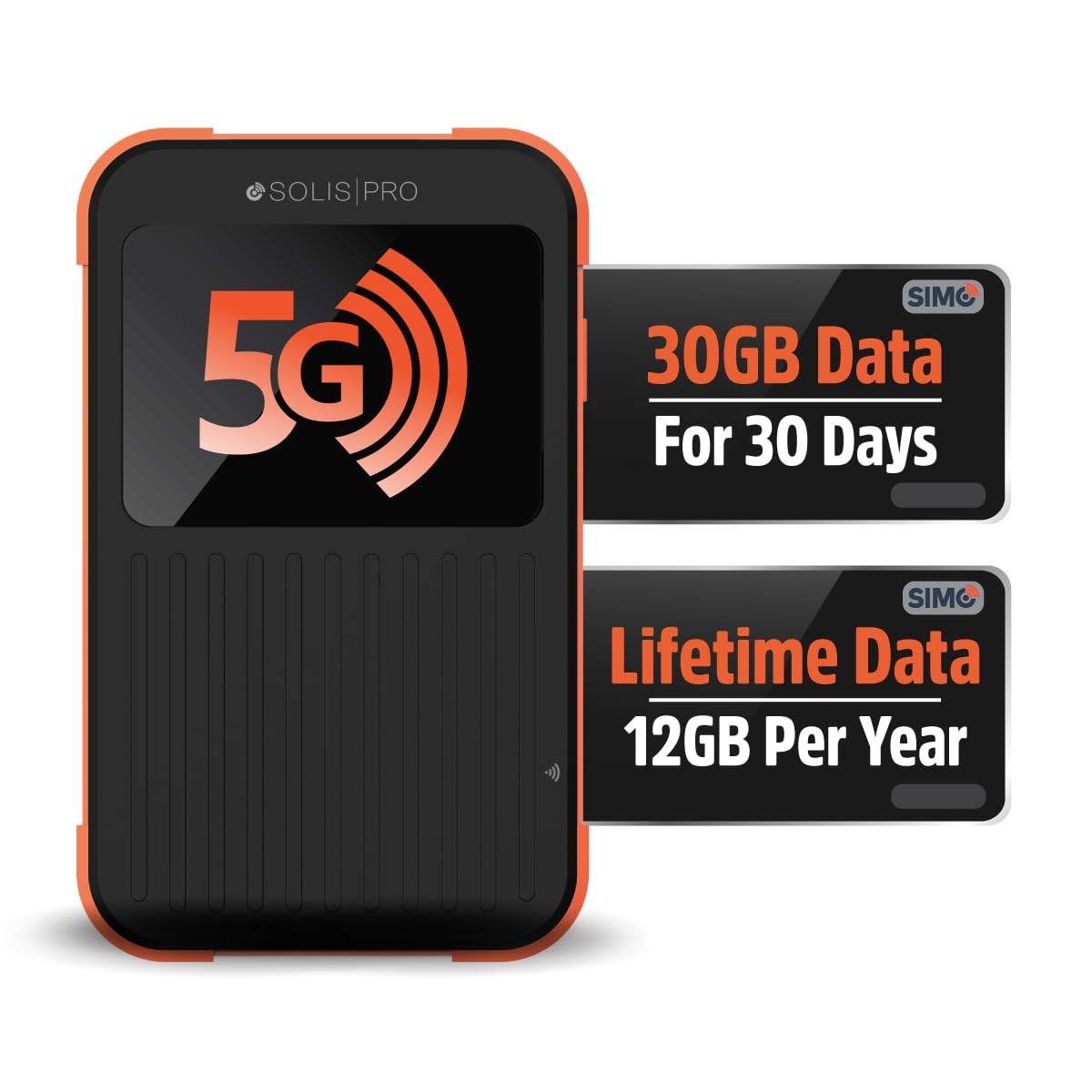
3. SIMO Solis PRO 5G Hotspot with Global Data
One device that lands you online in 140 countries — and charges your phone while it does.
The defining feature of the SIMO Pro is that it comes online without you hunting for a SIM card. It uses SignalScan AI to find the strongest signal across carriers and needs no contract, with coverage in 140 countries across 300+ carriers. For a business traveler hopping between cities and countries, that removes the single most annoying part of staying connected abroad. It supports up to 20 devices at once, so a small team or a family sharing one unit is realistic.
You also get an 8000mAh battery built in — enough to double as a power bank for your phone — plus two data packs included from the start: 1GB every month and a one-time 30GB global pack. The connectivity runs on Wi-Fi 6E, and the hardware includes a 1000 Mbps LAN port for a wired device. What earns the most confidence here is reliability, backed by a huge base of owners, and it is the crowd-favorite portability pick for travel.
The catch is speed consistency. Connectivity and speed draw mixed feedback, with some owners reporting connection trouble on Verizon and slow performance in some spots. The device is also priced as a premium travel tool, and value-for-money is a mixed topic — you are paying for the global convenience, not the cheapest bytes.
Where it shines: no-SIM global access and a power-bank battery make it a natural fit for the traveler who lives out of a bag.
The trade-off: it is not built to be a whole-home router, and speed depends on the carrier it picks, so home use is a secondary job.
Ideal for: frequent travelers who want to land in a new country and be online without buying a local SIM.
Not the one for: a fixed household needing maximum device capacity and consistent high throughput.
4. GL.iNet GL-XE3000 Puli AX 5G Router
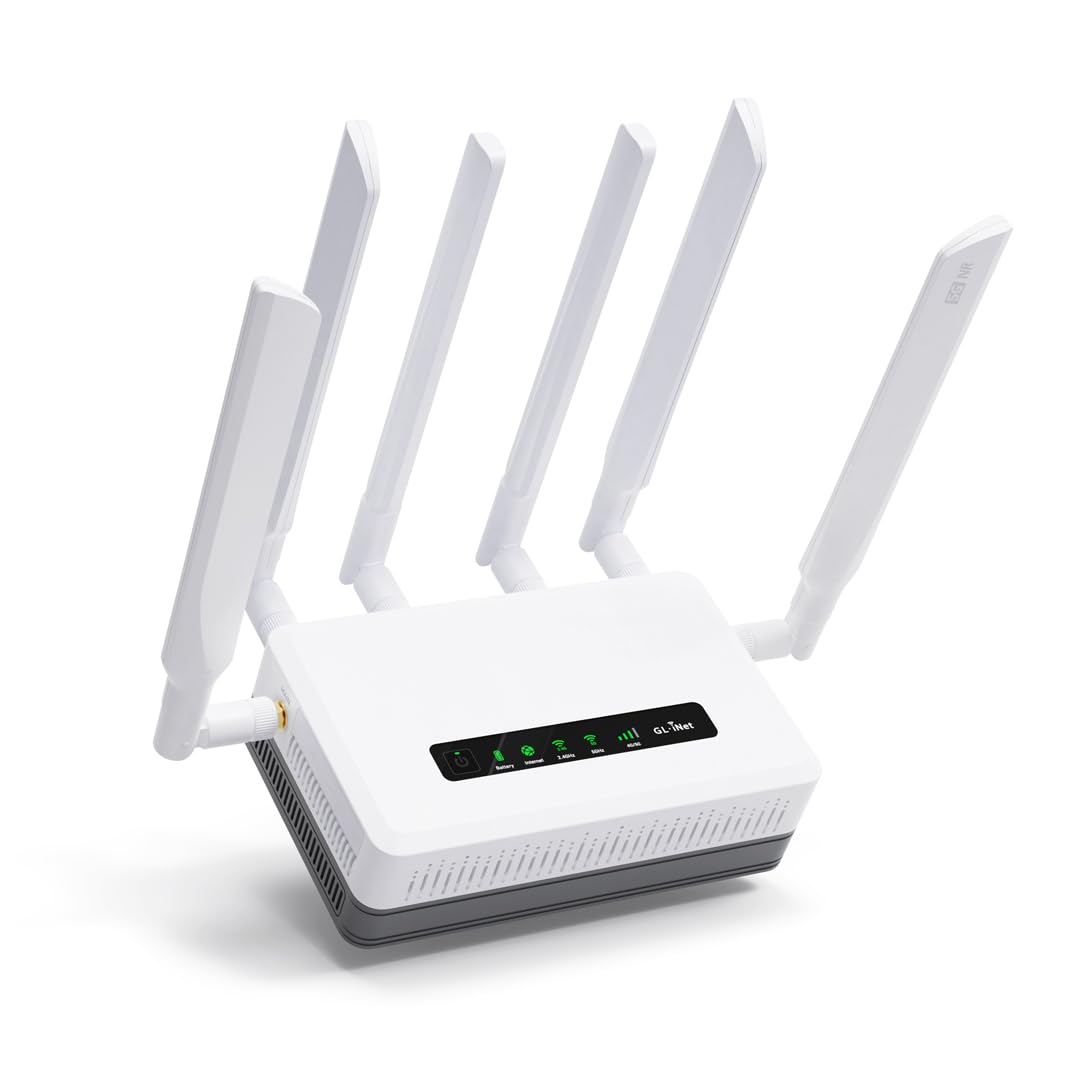
The router that stays online when the power grid goes down.
Most home hotspot routers go dark the moment the power does. The Puli AX carries a built-in 6400mAh battery that runs up to 8 hours, which is the difference between losing internet in a storm and riding straight through it. For a construction site, a temporary office, or a home that sees regular outages, that battery is the whole reason to choose this unit. It still delivers the same 574 Mbps at 2.4 GHz and 2402 Mbps at 5 GHz Wi-Fi 6 speeds with MU-MIMO as its sibling, so the backup does not cost you everyday performance.
Like the Spitz AX it runs on 5G with dual-SIM and automatic failover, plus multi-WAN across Ethernet, repeater, cellular, and tethering with load balancing. Performance and ease of setup hold up, speed and range are strong, and it serves as both a 5G modem and a Wi-Fi router in one box. The customizability runs deep, with more than 5,000 plug-ins on the OpenWrt base. Hardware-wise it adds retractable antennas and a wall-mount kit, making it easy to fix in place.
Compared with the Spitz AX above, the Puli AX costs more precisely because of that battery. If your power is stable, you are paying for backup you may never use. If it is not, this is a fair premium for uninterrupted service. It holds 4.0+ stars and is the pick for anyone who needs internet that survives a power cut.
Why it stands out
- 6400mAh battery runs up to 8 hours so internet survives a power cut.
- Dual-SIM 5G with multi-WAN load balancing for a resilient connection.
- Retractable antennas plus a wall-mount kit for a clean fixed install.
Where it asks more
- The battery is the reason it costs more than the Spitz AX — real money if your power rarely fails.
- Heavier and bulkier than a battery-free gateway, so it wants a shelf rather than a corner.
Best match for: sites, shops, and homes that need to stay online through outages without a separate UPS.
Skip the battery if: your power is stable and you would rather save than carry backup capacity.
5. GlocalMe Numen Air 5G Mobile Hotspot

A pocket hotspot that finds a network in 200+ countries without a SIM card.
The Numen Air solves a very specific problem: getting online in an unfamiliar country without hunting down a local SIM. Its CloudSIM tech picks the best signal automatically across 200+ countries, and you can pay by the day, month, region, or gigabyte with no contract. Speeds reach up to 2.5 Gbps on 5G, and it supports both 2.4 GHz and 5 GHz bands. For a traveler who wants to skip the carrier counter, that is a lot of convenience in a pocket-sized package.
It handles up to 16 devices at once and doubles as a power bank, so your phone gets a top-up too. A 2.4-inch LCD touch screen lets you watch data use, signal strength, and connected devices at a glance. What wins people over most is the performance — it holds up well, and buyers report solid speeds on networks like T-Mobile. Portability and ease of use both land as consistent strengths, and there is a SIM slot if you would rather use your own card.
Think of it as a travel device first. It is not a whole-home gateway, so if your goal is a fixed internet replacement for a house, the Cudy or the GL.iNet boxes serve that better. And while performance earns praise, value-for-money is a mixed point — some find the data plans worth it, others find the ownership cost high. At 4.0+ stars, it is built for a backpack, not a fixed shelf at home.
The travel math: CloudSIM means you are online the moment you land, in a device small enough to slip into a jacket pocket.
Know before you buy: data runs on flexible plans by design, and value-for-money is a split verdict, so budget for ongoing data rather than treating it as a one-time buy.
The right call for: international travelers who want instant connectivity and the freedom to skip SIM shopping.
Better served elsewhere: anyone replacing a home internet line for a full household.
6. NETGEAR Orbi 4G LTE Mesh WiFi Router (LBR20)

Mesh-style coverage for a mid-size house, using LTE instead of a cable line.
The Orbi LBR20 is aimed at the household that wants room-filling Wi-Fi without a cable. It covers up to 2,000 square feet and supports up to 25 devices, delivering up to 2.2 Gbps over AC2200 Wi-Fi. It works with a compatible BYOD data plan certified for AT&T, T-Mobile, and Verizon, and it can serve as your primary connection or a backup. Download speeds reach up to 1.2 Gbps, depending on your service and how close you sit to the nearest tower.
Setup is the part owners consistently like — the Orbi app walks you through it. Fast speeds also draw praise, with download rates that outpace some older cable connections. Two 1G Ethernet ports let you hardwire a console or a streaming box, and you get guest Wi-Fi, WPA2 security, and a one-year limited hardware warranty. The mesh design means you can expand coverage further with additional satellites sold separately — but note the base unit alone covers up to 2,000 square feet, so a very large home will want those add-ons.
At 3.5+ stars, this is the pick where capacity is the honest limit. Its 25-device ceiling versus the Cudy’s 256 devices means a crowded smart home will feel the squeeze. It is best read as a straightforward LTE gateway for a modest household, not a device-heavy one.
Suited to: a single home in the 2,000-square-foot range on one of the three certified carriers that wants easy app setup.
Think twice if: you run dozens of connected devices — the 25-device cap becomes the ceiling fast.
7. Franklin Wireless JEXtream RG2100 (T-Mobile) 5G Hotspot

A straightforward T-Mobile 5G hotspot that also tops up your phone.
If T-Mobile is your network, the JEXtream RG2100 keeps things simple. It is a 5G hotspot with Wi-Fi 6 and a battery inside, in the form of a 5,000mAh rechargeable pack that doubles as a portable charger. That combination suits a small home, an apartment, or a backup line where you want one device to handle connectivity. It connects to the T-Mobile network without the fiddling you sometimes get with multi-carrier gear.
Owners find it reliable, working well as a backup when the primary internet goes down and also handling Google Fi. It is easy to set up, and it is often cheaper than going straight to a carrier for the same job — a value angle many buyers notice. It handles streaming and gaming without drama, and it is designed around the T-Mobile network specifically, so the connection is predictable if that is your carrier.
The one thing to lock in before you buy is that T-Mobile focus — it is not a multi-carrier gateway, so if you are on another network this is not your device. This is a renewed unit, which is worth knowing for the price advantage.
The simple appeal: one network, one device, and a battery that charges your phone — straightforward for a T-Mobile home.
Fit check: it is tied to T-Mobile, so buyers on other carriers should look elsewhere rather than hope it adapts.
Made for: T-Mobile customers who want a fuss-free 5G hotspot with a built-in charger.
Not for you if: you need multi-carrier flexibility or a high device count for a large smart home.
8. GL.iNet GL-X750V2 (Spitz) 4G LTE Router

An affordable 4G gateway for a rural spot that just needs a steady line.
The Spitz is the entry point into GL.iNet’s router family, and it is honest about what it does. It moves a 4G LTE signal into 300 Mbps on 2.4 GHz and 433 Mbps on 5 GHz, with average 4G speeds around 15-20 Mbps depending on your carrier and location. It is certified for AT&T IoT data plans and works with T-Mobile too. For a rural home or an offshore setup that only needs a reliable connection for browsing and calls, that is enough. Compared with the Cudy’s 2402 Mbps on 5 GHz, it is a slower radio — this is a value gateway, not a speed machine.
What owners respect here is the build quality, which earns the strongest confidence of any topic for this model, followed by easy setup and cost-effectiveness. It runs OpenWrt/LEDE pre-installed and open up, so if you like to tinker, the open source base gives you room to expand. There is 128MB of RAM, 16MB of NOR Flash, a microSD slot that takes cards up to 128GB, a USB 2.0 port, and dual Ethernet ports, plus OpenVPN and WireGuard for secure tunneling.
The honest limitation is network compatibility, which is the one area with outright frustration — check your carrier supports it before committing. Signal strength and speed are mixed depending on location. It ships with a two-year warranty and a Quectel EC25-AFFA module pre-installed. At 4.0+ stars, this is a sensible budget gateway for a light-use rural home, not a heavy household.
What it does well
- Solid build quality and simple setup at a budget-friendly price.
- OpenWrt pre-installed for buyers who want to customize.
- microSD slot, USB port, and dual Ethernet for a small wired setup.
What to watch
- Network compatibility is the weakest point — confirm your carrier first.
- 4G-only speeds suit browsing and calls, not heavy multi-device streaming.
Worth it for: a rural or offshore home that needs a cheap, steady 4G connection and does not push heavy bandwidth.
Look up-market if: you need 5G speeds or want to run many devices at once.
9. Hitron D60 5G Cellular Router
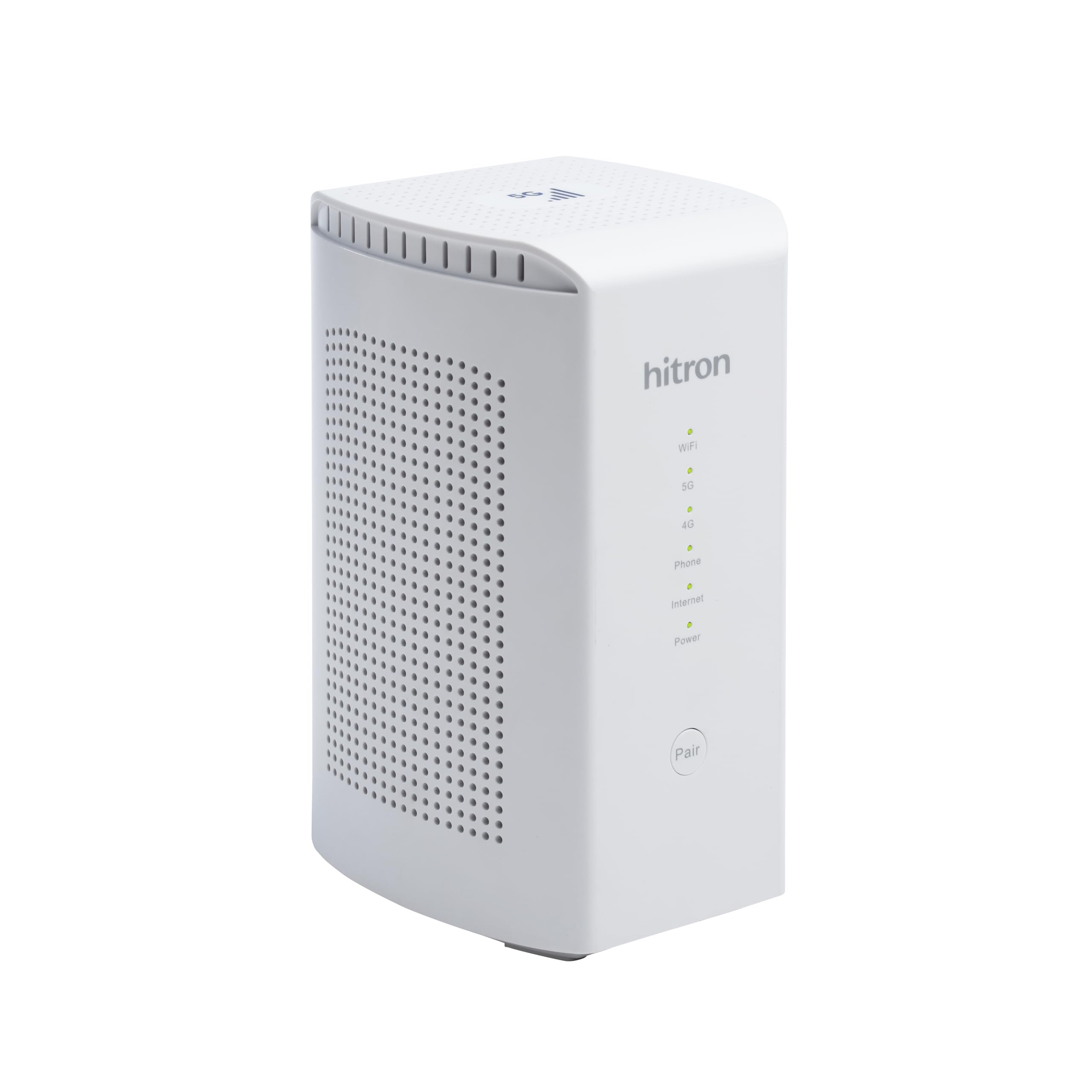
The quiet backup line that kicks in the moment your main connection drops.
The Hitron D60 is built around failover. It takes a Nano SIM and an eSIM for dual failover, so when your main internet goes down, it steps in without you touching anything. That makes it a natural second line for a home or small office where staying online matters more than raw speed. It handles 5G with download speeds up to 3.4 Gbps on 5G NSA and drops back to 4G LTE where needed, and it is certified for T-Mobile, AT&T, and US Cellular — a broad carrier spread for a gateway at this level.
Reliability is what owners value most, with one clear use case standing out: keeping a connection alive when the local WAN fails. It also earns praise for compatibility, and rural buyers find it fits their situation well, alongside solid Mbps speed. It uses AX3000 Wi-Fi 6 with mesh support and internal antennas, and the app handles control. Weighing in around 1.14 kg, it is a set-and-place unit rather than something you move around.
The main thing to know is the carrier requirement — you need a Nano SIM from one of the three certified networks to activate it. The warranty is a short three months, which is worth factoring in if long-term coverage matters to you. At 4.0+ stars, this is the pick for someone deliberately buying a backup line, not a primary whole-home router.
Why it earns a spot: dual SIM and eSIM failover make it a smart second connection that springs to life exactly when needed.
The caveat: a three-month warranty is short for networking gear, so weigh that against the failover convenience.
The fit: homes and small offices that want an automatic cellular backup behind their main line on a certified carrier.
Consider another pick if: you need a primary connection with long warranty coverage and maximum device load.
Know the Specs
Device Capacity
The device count is the maximum number of gadgets the router can keep online at once. Every phone, laptop, TV, and smart plug claims a slot. A rating like 25 devices suits a modest apartment, while 256 gives a busy household plenty of room. Buying above your current count means you will not hit the ceiling when you add one more screen.
Wi-Fi Standard
Wi-Fi 6 and the newer Wi-Fi 6E are the standards that keep many devices smooth together. Older Wi-Fi 5 and AC ratings still work but tend to struggle in a crowded home. Higher 5 GHz speeds — like 2402 Mbps versus 433 Mbps — mean more comfortable 4K streaming on multiple screens at once.
5G SA/NSA and LTE
5G comes in two modes: SA (standalone) and NSA (non-standalone), and a good router handles both. Where 5G signal is thin, the router drops back to 4G LTE to stay online — that fallback is what keeps a rural home connected. Check that your carrier and the router’s certified networks line up before relying on it.
Dual-SIM and Failover
Two SIM slots let you pick the stronger carrier and switch automatically when one signal weakens. Failover means the router jumps to a backup connection, whether a second SIM or your main line, without you intervening. For sites or homes where dropping offline is costly, this is the feature that earns its place.
Common Questions
Will a hotspot router work without a cable internet line?
Do I need a SIM card from a specific carrier?
How many devices can a home hotspot handle at once?
Is 5G faster than 4G for home internet?
Can a hotspot replace my regular home internet entirely?
What does failover mean on these routers?
Do these routers have battery backup for power outages?
Can I use a hotspot router for online gaming and streaming?
Will a hotspot router work in a rural area with weak signal?
What is the difference between a travel hotspot and a home gateway?
The Bottom Line
For most homes, the wireless hotspot for home internet winner is the Cudy 5G AX3000 because its 256-device capacity and 2402 Mbps on 5 GHz give a busy household the room and speed it needs. If you live where signal is the challenge, grab the GL.iNet Spitz AX for its aimable antennas and dual-SIM failover. And for outages you cannot plan around, the GL.iNet Puli AX with its 6400mAh battery is the one to reach for.
Match the pick to your carrier and your device count, and you get a connection that holds up without babysitting.
How we choose
We do not accept paid placement. Every pick is matched to a real buyer and a real use-case; we do not hands-on test units.
Sources
Specifications: manufacturer listings and product documentation. Review insights: verified customer reviews, as of November 2026. Pricing: not shown on this page (it changes often); check the current price via the retailer link.
As an Amazon Associate, Tactical Gear Guy earns from qualifying purchases. This does not affect which products we feature.