Specs are compiled from manufacturer listings and verified buyer reviews and can change over time — please confirm the key details on the product page before buying.
You do not need a generator that needs two people and a ramp to move. The smallest gas generators solve one problem: getting real 120V power into a car trunk, a tent, or a closet shelf without wrecking your back. The picks below run from 30.1 to 51 pounds, and every one is gas-powered — no battery-only or solar-only units in the list.
This guide is built by comparing the manufacturers’ published specifications and the patterns across verified customer reviews, so you get each pick’s real strengths and trade-offs instead of marketing spin.
Weight decides whether a generator leaves the garage, so that is where this list starts. Below you will find honest notes on noise in decibels, run time at partial load, and which units are inverter-style for sensitive electronics. Finding the smallest gas generator that still starts your fridge is the whole goal of this breakdown.
Top Picks


How To Choose The Best Smallest Gas Generator
A small gas generator is a compromise machine. You are trading raw wattage for a weight you can actually lift, so the first decision is what you refuse to give up. Start with the load you must run and work backward toward the lightest box that clears it.
Start with weight, not wattage
Weight decides whether the generator comes with you or stays in the garage. A 30.1-pound unit lifts into a truck bed with one hand. A 51-pound unit is a two-hand carry and a real lift onto a tailgate. If you load and unload alone, treat 40 pounds as your practical ceiling.
Decide if you need inverter power
An inverter generator converts engine output into clean, stable power — the kind that will not damage a laptop, a phone, or a TV. Open-frame conventional units are cheaper but produce rougher power. If your load list is electronics-heavy, pay for the inverter label.
Read the run-time rating as a load figure
Run time is almost always quoted at a fraction of full power, like 25% or 50% load. A 5-hour rating at half load means a much shorter night if you push toward capacity. Match the tank size and run-time number to your longest realistic stretch without a refuel.
Know your fuel mix before you buy
Two-stroke engines take oil mixed into the gasoline, usually at a set ratio, and need no separate oil change. Four-stroke engines have a separate oil sump you fill and check. Mixing fuel at the pump is fine for some buyers and an annoyance for others — decide before you buy.
Side-by-Side Comparison
| Model | Best For | Weight | Max Engine Power | Run Time | Amazon |
|---|---|---|---|---|---|
| Honda EU2200i★ Best Overall | Quiet all-round use | 51 lb | 2200 W | Up to 8.1 hours | Amazon |
| PowerSmart 1200WBudget Champion | Budget tailgating | 34 lb | 1200 W | 5 hours at 50% load | Amazon |
| Aceup Energy 1,200WSmallest Footprint | Cheap RV backup | 35.3 lb | 1000 W | 6 hours at half load | Amazon |
| POXURIO 2450-Watt | Long campout power | 43 lb | 3000 W | Up to 10 hours at 25% | Amazon |
| PowerSmart 2500W Inverter | Sensitive electronics | 39.7 lb | 2500 W | 7.5 hours at 25% | Amazon |
| WEN 56235i | Quiet camp companion | 39 lb | 2350 W | — | Amazon |
| Westinghouse iGen1500c | Lightest carry | 30.1 lb | 1500 W | 12 hours at 0.79 gal | Amazon |
| Champion 2500-Watt | Parallel expansion | 41.9 lb | 2500 W | Up to 11.5 hours | Amazon |
| Honda EU1000i | Smallest footprint | 32.3 lb | — | 3.0 to 6.8 hours | Amazon |
Detailed Reviews
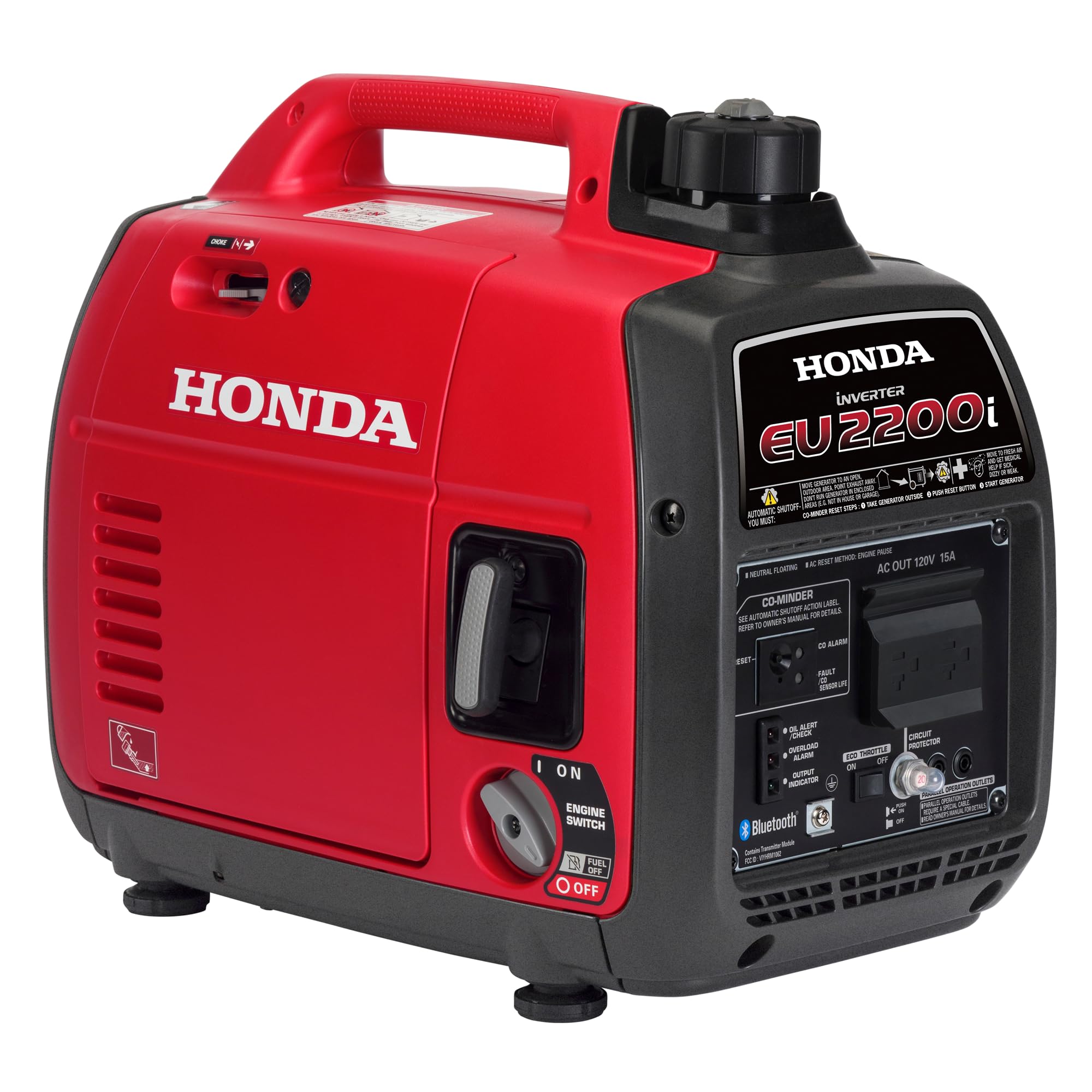
1. Honda EU2200i 2200 Watt Inverter Generator (EU2200ITAN)
Our pick — 4.5+★ from 3,000+ verified ratings; the strongest balance of quality and price.
The 2,200-watt inverter that runs quiet enough to hear your own conversation beside it.
At 48 to 57 dB(A) — decibels being the unit that measures loudness, where normal conversation sits around the middle of that band — this Honda runs at roughly talking volume. That is the single most useful thing about it. Campgrounds with quiet hours, shared RV walls, and close neighbors all get easier to live with. You also get Honda’s CO-MINDER system, which continually samples carbon monoxide levels and shuts the engine down automatically before they climb high.
Weight is where this machine asks something of you. It checks in at 51 pounds, which is a two-hand lift into a truck bed and nothing you want to carry far. Compare it to the PowerSmart 1200W at 34 pounds — 17 pounds heavier, but with 121 cubic centimeters of engine displacement against that unit’s 71, and a 2200-watt maximum against 1200. You are buying the bigger engine and the quieter housing with your back. Its 8.1-hour run time on one tank is the other payoff, and owners routinely describe running it for days between fills.
The Honda’s 3-year residential warranty is longer than most of the budget units here, some of which stop at one year. Bluetooth links it to the My Generator app for remote monitoring, stop control, and service reminders — a genuinely handy extra when the unit sits outside while you are inside. The catch is plain: this is the heaviest pick in this roundup, and it will not bury itself in a closet. The upside is that quiet operation and build quality are the exact two things that draw the most praise from owners.
quiet Honda reliability
- 48–57 dB(A) operation — quiet enough for campground quiet hours
- CO-MINDER cuts the engine automatically when carbon monoxide rises
- 8.1-hour run time on a single tank
- 3-year residential warranty, plus Bluetooth app monitoring
- 121cc 4-stroke engine producing 2200 watts
premium price tag
- 51 pounds — the heaviest unit reviewed here
- Not sold in California
built for: RV owners and campers who want quiet power with automatic shutoff protection and do not mind a two-hand lift.
think twice: you load and unload solo and want something you can swing into a trunk without bracing — the 30-pound class suits you better.
2. PowerSmart 1200W Portable Generator
The entry point: a 34-pound box that starts with a pull and runs a few lights all night.
For a first generator, the spec sheet reads honestly. A 71cc 2-stroke single-cylinder engine (a simple engine that takes oil pre-mixed into the fuel, so there is no separate oil sump to check) delivers 1200 watts of surge power to start a load and 900 watts of running power to keep it going. That covers small appliances, lights, and light power tools. The 1.1-gallon tank holds 5 hours at 50% load, so you can get through a tailgate or a short overnight with one fill.
Carrying it is the reason this pick exists in a “smallest” roundup. At 34 pounds with an integrated handle, it is built for one-handed lift and walk. Set that against the Honda EU2200i’s 51 pounds and the gap is the whole argument. What you give up is engine size and quiet operation — 71cc compared with the Honda’s 121cc displacement, and noise here lands in mixed territory. The engine note is honest about being a working 2-stroke. Buyers describe the motor as doing its job reliably and running past six hours without complaint.
Fuel mixing is the learning curve. This unit runs on a 50:1 gas-to-oil ratio at 87 octane minimum, so you are pre-mixing at the pump or in a can before every fill. Get that ratio wrong and the engine pays for it. The 12V DC output lets you charge a battery, and the included 12V DC cable, oil cup, and spark plug wrench get you running the same day. Every small gas unit here must run outdoors only, never in a tent or garage.
light two-stroke carry: 34 pounds and a built-in handle is the difference between a generator that travels and one that stays home.
mixed fuel hassle: you do the oil measuring, every fill, forever — the 50:1 mix is not optional.
grab this one: a tailgater or DIYer who wants the lightest box that still pushes 900 running watts and does not mind mixing fuel.
pass on it: you want to set a load and forget the fuel math — a 4-stroke unit removes that step.
3. Aceup Energy 1,200W Gas-Powered Generator
A 15-inch-long package you can tuck into an RV storage bay without rearranging the whole trip.
Footprint is this pick’s argument. The case measures 15″L x 12.8″W x 12.6″H, and the clearest way to see that is next to the Honda EU2200i at 21″L x 12.24″W x 19.72″H — the Aceup is shorter on two of its three sides. At 35.3 pounds it also stays in the one-hand carry club.
Its 71cc 2-cycle engine with air cooling and recoil start serves up 1200 peak watts and 900 running watts through a 120V household outlet at 60Hz. The 1.1-gallon tank runs 6 hours at half load. You get a 1-year limited warranty plus free lifetime technical guidance. Buyers describe it as an easy machine to move around and a fit for home backup and RV trips both, with enough output for the essential appliances.
One number to note carefully: the spec sheet lists a 1000-watt maximum engine power against the 1200 peak watts quoted in the product copy. Read the running figure — 900 watts — as your real continuous ceiling rather than either peak number. It is EPA and CARB compliant, which widens where you can legally buy it compared with the Honda units, and the 50:1 mix means no oil changes.
The trade-off is the same 2-stroke story as the PowerSmart above: pre-mixed fuel on every fill. It is worth the extra minute for the smaller case.
fits best: cramped rigs — teardrop trailers, vans, and small trunks where the case size is the deciding factor.
not ideal: you plan to run it through a quiet-hours campground, where 2-stroke engine note stands out.
4. POXURIO 2450-Watt Portable Inverter Generator
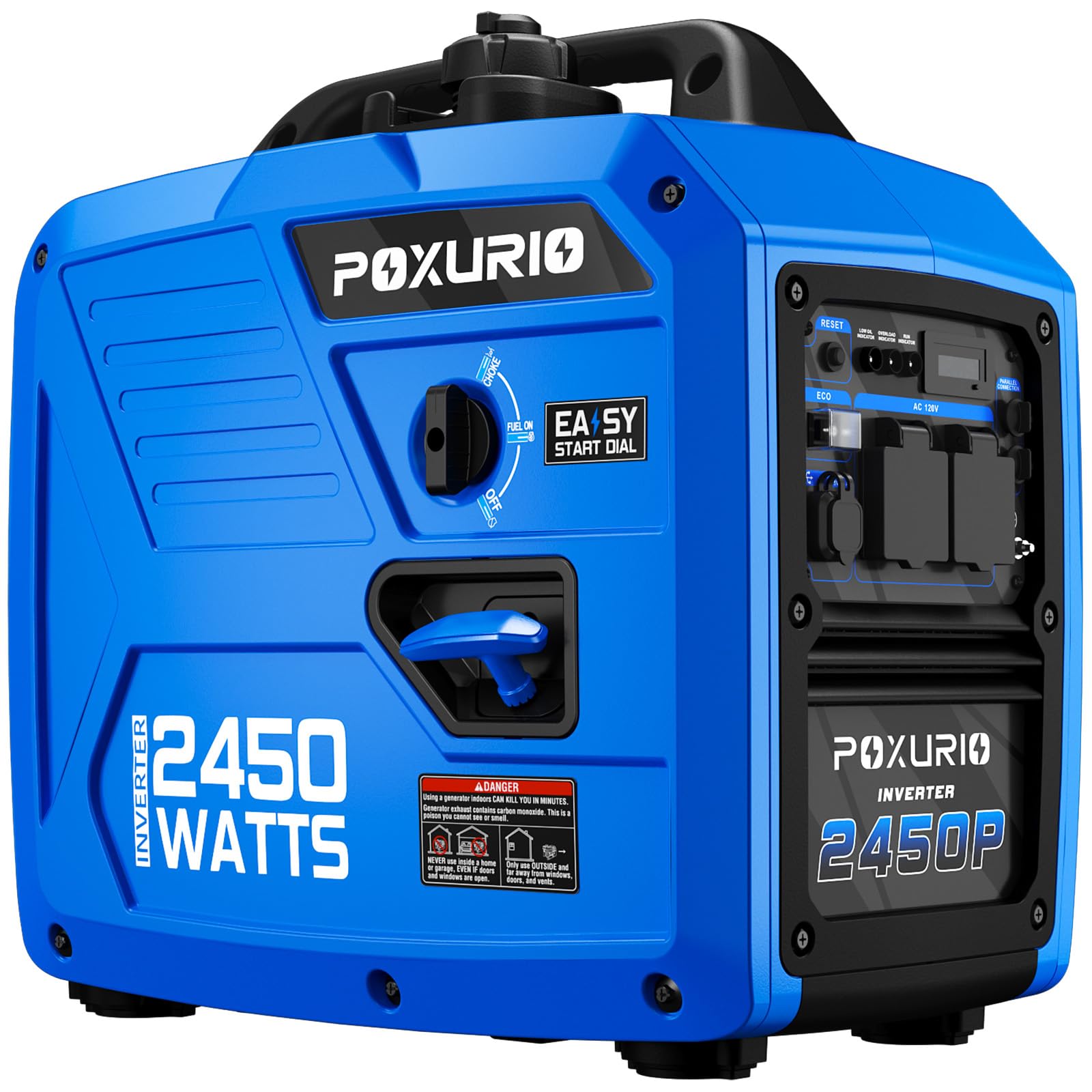
Ten hours on a single tank at quarter load — enough for a full night without a refuel at 2 a.m.
Run time is the standout. A 6L fuel tank keeps this unit going up to 10 hours at 25% load. Set that beside the PowerSmart 1200W’s 5-hour rating at 50% load and you can see the class difference: one is tuned for a full overnight stretch, the other for a shorter session. With a 3000-watt maximum engine rating and 2450 starting watts, its load list reaches sump pumps, power tools, and RV air conditioners. Inverter technology produces a clean, stable sine wave — the smooth power pattern that keeps electronics safe.
Noise sits at 59 decibels, which is about the level of a normal chat a few feet away. That is louder than the Westinghouse iGen1500c’s 52 dBA but quieter than a conventional open-frame unit. At 43 pounds it stays portable without being a featherweight, and owners describe it as easy to start and lighter than they expected for the output.
There is one honest wrinkle in the listing. The customer summary mentions dual-fuel capability, yet the technical data lists gasoline as the fuel type — so plan on gasoline and read any dual-fuel claims with care. Owners also describe performance as better than expected and noise as reasonable, while a smaller share weighs in on long-term durability. Draining the oil when the machine sits unused is the manufacturer’s own advice for extending its life.
quiet overnight runtime: 10 hours at 25% load is a genuine sleep-through-it number, not a marketing hour.
heavier than rivals: confirm the fuel setup on your specific unit before you count on running anything but gasoline.
worth it for: campouts and outage nights where one tank has to last until morning.
look elsewhere: you want the lightest possible carry, since the Westinghouse drops to just over 30 pounds.
5. PowerSmart 2500 Watt Portable Inverter Generator for Camping
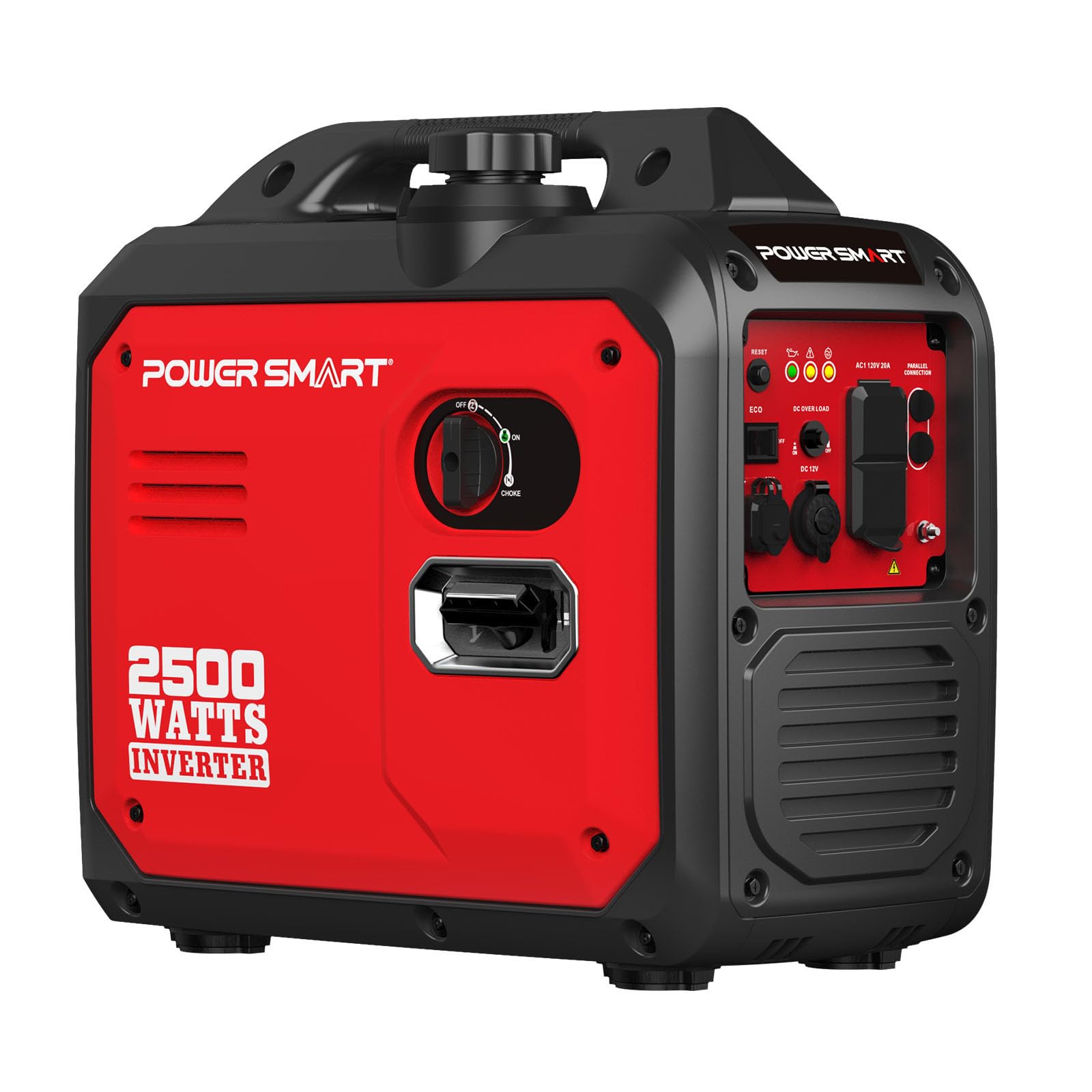
Phone-safe power at 59 dBA from 23 feet, with USB ports and an Eco mode built in.
This is the pick for tent campers who bring laptops and tablets. The 2500 starting watts and 1900 running watts come out clean enough for sensitive electronics, and the control panel is genuinely thoughtful: a 120V 20A 5-20R duplex household outlet (a standard two-plug wall socket), a 12V 8A DC port (a car-style power socket), two 5V 2.1A USB ports, and an Eco mode that trims engine speed to match the load. The USB ports mean you can top up a phone without hunting for a wall adapter.
Run time runs 7.5 hours at 25% load on a 1.06-gallon tank, and noise is pegged at 59 dBA at 23 feet. A 79.8cc 4-stroke engine means you pour in oil separately and never mix fuel — a clear step up in convenience from the 2-stroke budget units above. At 39.7 pounds it is a manageable solo carry.
Cold Start Technology and Low Oil Shutdown are both built in, so the machine protects itself if the oil level drops. The 2-year limited warranty with free lifetime technical support backs it up. If you want the reassurance of the quietest possible number, the Westinghouse edges it at 52 dBA — but for the port selection and the 4-stroke engine, this one is the stronger package.
camp-ready inverter power
- 1900 running watts of clean inverter power for laptops and tablets
- Two 5V 2.1A USB ports and a 12V 8A DC port on the panel
- Eco mode extends the 7.5-hour run time at 25% load
- 79.8cc 4-stroke engine — separate oil, no fuel mixing
- Low Oil Shutdown and Cold Start Technology built in
modest surge limits
- 59 dBA at 23 feet is louder than the quietest picks here
- 39.7 pounds is a solo carry but not a one-hand swing
suits: campers running electronics — laptops, CPAP units, phones — who want an inverter and a 4-stroke engine.
reconsider: your campsite sits close to other tents and quiet is your first priority.
6. WEN 56235i Portable Inverter Generator

A 39-pound inverter with a fuel shut-off valve that empties the carburetor before storage.
That fuel shut-off is a small detail with real consequences. It burns the leftover fuel out of the carburetor before the engine stops, which the maker says boost the generator’s lifespan — the gummy carburetor is the classic killer of a generator left sitting through the off-season. Combine that with 2350 surge watts and 1900 rated watts of clean power, and you have a machine that will charge phones, tablets, televisions, and computers without a wobble in the current.
At 39 pounds with a 79cc 4-stroke engine, it sits in the middle of the small class — lighter than the Honda EU2200i’s 51 pounds and heavier than the Westinghouse’s 30.1. The body measures 17.3″L x 11.5″W x 17.5″H. Outlets include two three-prong 120V receptacles, one 12V DC receptacle, and two 5V USB ports. A two-year warranty covers it.
Quiet operation here is compared by the maker to the sound of a normal conversation, and that reputation holds up — what wins people over is how the engine settles down in economy mode. It starts on the first pull for most owners and has been trusted on hunts and to run a full camper with air conditioning. Power output is the one split note: it is rated 1900 running watts, so buyers expecting more from a 2350-watt label come away puzzled. Size your load to 1900 and this one is steady.
right answer for: a buyer who wants inverter power, a 4-stroke engine, and a storage-protecting fuel shut-off in a 39-pound body.
look past it: you are chasing every available watt — a 2500-watt-rated unit gives more headroom for the same carry weight.
7. Westinghouse iGen1500c Portable Inverter Generator
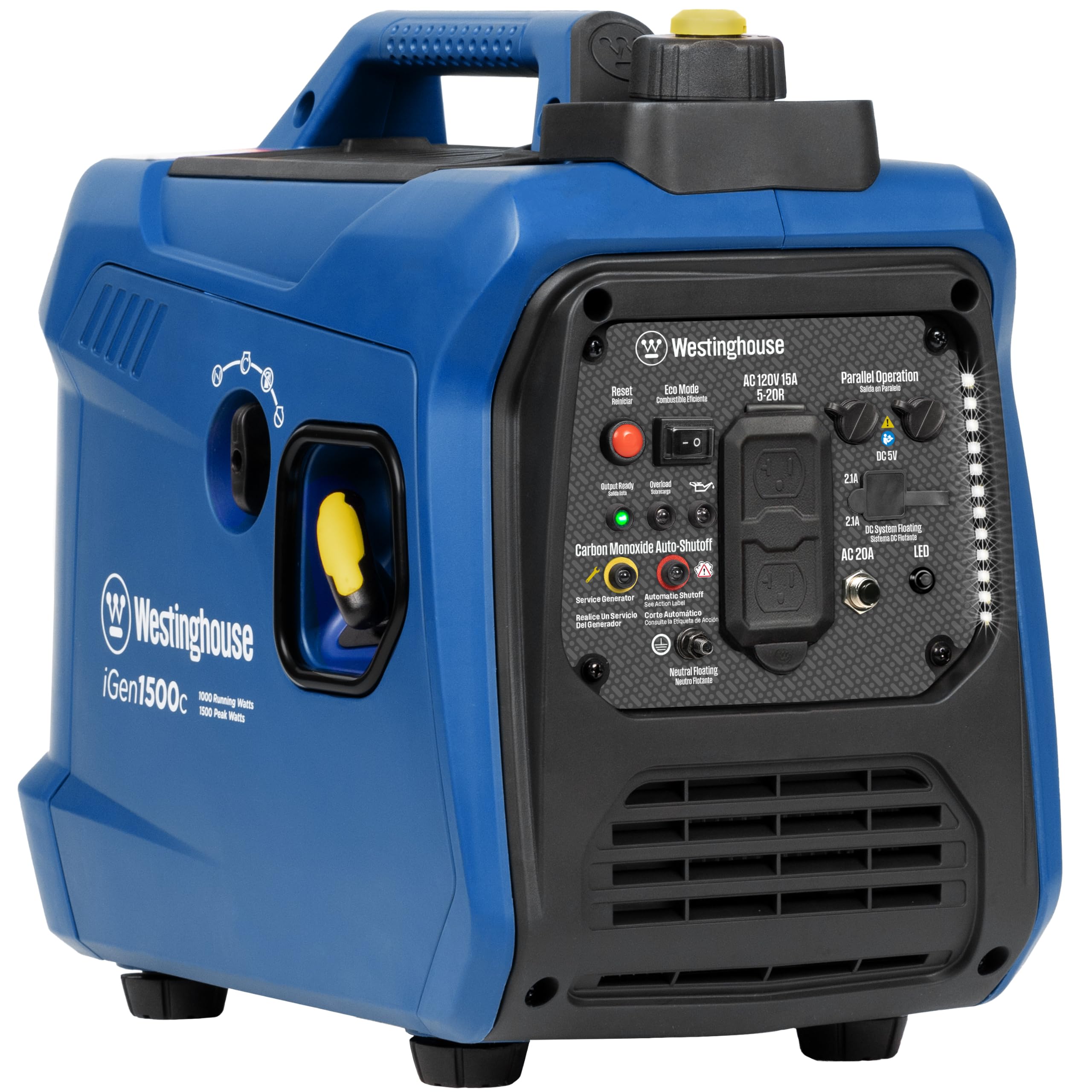
The 30-pound featherweight with a 12-hour run time and a 52 dBA whisper.
Start with the two numbers that define this machine. First, 30.1 pounds — the lightest unit in this comparison and a genuine one-hand carry at 18.5″L x 12.5″W x 17″H. Second, up to 12 hours on a 0.79-gallon tank. Neither of those is a typo, and together they make the iGen1500c the natural pick for anyone who walks their gear in from a parking lot rather than driving right up to the site.
Power is modest by design: 1500 peak watts and 1000 rated watts at less than 3% THD — total harmonic distortion being a measure of how clean the power is, so a low number means electronics are safe. Two 120V 20-amp outlets and two USB outlets handle the panel. Noise runs as low as 52 dBA with an Economy Mode for the quietest stretches. A 56cc 4-stroke engine means separate oil and no fuel mixing.
The CO sensor shuts the engine down if carbon monoxide builds, and a 3-year limited warranty matches the Honda coverage. It is parallel capable — pair it with another parallel-port Westinghouse unit and a Westinghouse parallel cord to raise total output. Owners describe it starting without hesitation and running a refrigerator, and 1000 running watts will not carry a big air conditioner. Size your expectations to that rated number and it satisfies exactly as advertised.
Expect a faint oil or fuel smell when you unbox it. That is the factory test run, not a fault.
featherweight westinghouse: 30.1 pounds against the Honda EU2200i’s 51 is the reason this one goes on every trip and the other one sometimes does not.
small watt ceiling: 1000 rated watts is for essentials — fridge, lights, chargers — not whole-house backup.
choose it: you carry gear on foot and want the lightest inverter in this roundup with the longest run-time-per-gallon figure.
skip it: your load list includes a large RV air conditioner, which needs the higher running wattage of a 2500-class unit.
8. Champion 2500-Watt Ultralight Portable Inverter Generator
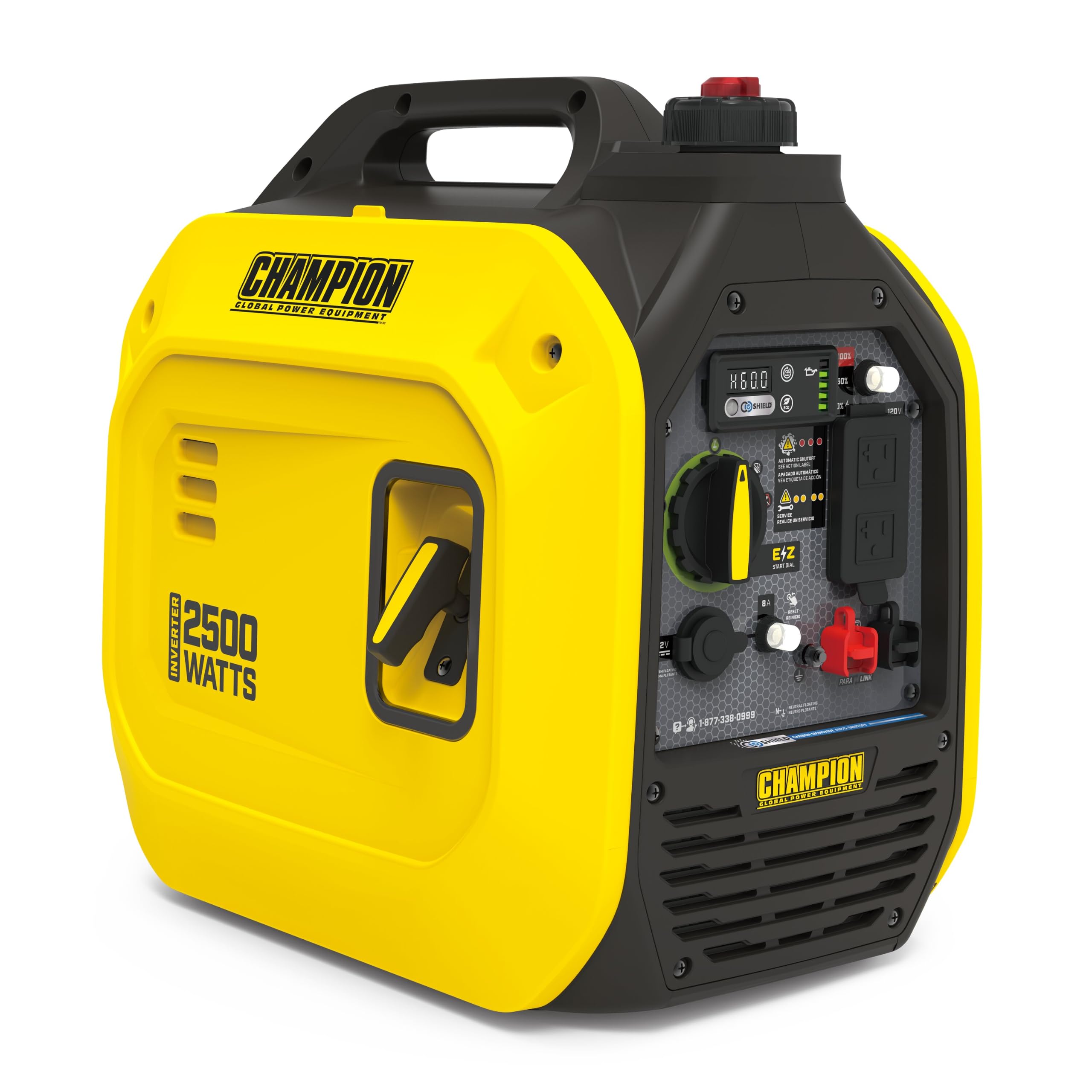
41.9 pounds that doubles its output later — buy one, parallel a second when you need more.
Expansion is the reason to pick this one over a fixed-power box. An optional parallel kit lets you link it to another 2500-watt Champion inverter and double your output power — so the machine you buy today can grow into the load you have in three years. It delivers 2500 starting watts and 1850 running watts at less than 3% THD through a 120V 15.4A household duplex outlet (5-20R), plus a 12V automotive-style outlet and the parallel outlets.
Weight lands at 41.9 pounds with a 79cc 4-stroke engine, and noise is rated 53 dBA from 23 feet. Run time reaches up to 11.5 hours. The CO Shield carbon monoxide auto shutoff system watches the air and kills the engine before levels get dangerous. A 3-year limited warranty comes with free lifetime technical support.
Owners describe it starting easily and producing power exactly as expected, and it has carried multiple devices through an eight-hour stretch. The case measures 17.6″L x 12.6″W x 18.1″H. If you want more running watts without moving up to a heavier inverter, the PowerSmart 2500W gives you 1900 running watts at 39.7 pounds — a few pounds lighter and a slightly higher running figure.
made for: the buyer who wants a sub-42-pound inverter now and a path to double output through a parallel kit later.
less suited: you want the absolute lowest running weight in the 2500-watt class.
9. Honda EU1000i 1000 Watt Inverter Generator (EU1000T1AN)
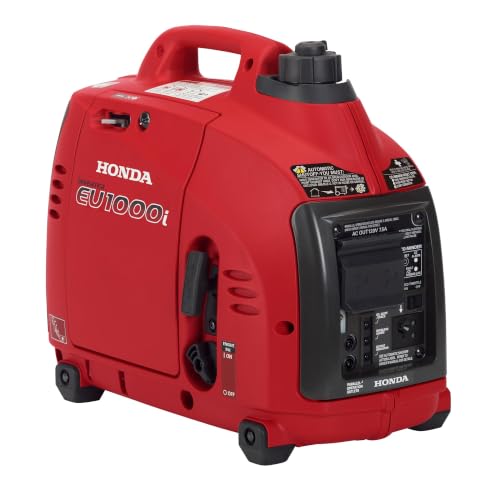
42 to 50 decibels — quieter than a conversation and small enough for a shelf.
This is the low-noise end of the category. Honda rates the EU1000i at 42 to 50 dB(A), the softest figure in this roundup and quieter than the EU2200i’s 48 to 57 band. The body is 18 x 10 x 15 inches, so it fits on a closet shelf between uses. Its Eco Throttle System sips fuel, giving 3.0 to 6.8 hours on a 0.6-gallon tank. The CO-MINDER system shuts the engine down automatically if carbon monoxide climbs, and a 3-year residential warranty backs it.
The power ceiling is where this pick draws its line. It is the smallest-capacity unit here, and buyers report that the output is sometimes not enough — a 1987 pop-up camper gets what it needs, but a fridge plus a hair dryer at the same time will not. Treat this as the lights, fans, TV, chargers, and small power tools generator, exactly as Honda lists it. Note the conflicting weight figures — the description says 29 pounds while the specification sheet lists 32.3 pounds — and plan on the heavier figure when you think about the lift.
What owners praise most is simple: it works, and it works quietly. Functionality and quiet operation are the two things that come up again and again. If you want the smallest gas generator that will not disturb a campground at midnight, this is that machine.
the pick for: light-load campers and backup users who put noise and footprint above wattage.
not the pick for: anyone planning to start a fridge and an AC unit on the same tank — 1000 watts will not do it.
Know the Specs
Weight and Carry
Weight decides whether a generator leaves the garage. Any unit under 40 pounds moves as a one-hand carry, and anything over 50 pounds becomes a two-hand lift onto a tailgate. The Westinghouse iGen1500c at 30.1 pounds and the Honda EU2200i at 51 pounds sit at opposite ends of this class for exactly that reason. A built-in frame handle matters as much as the number on the scale.
Decibels (dB(A))
Decibels measure loudness, and normal conversation sits roughly in the 50s. A generator rated 42 to 50 dB(A) — like the Honda EU1000i — is quieter than talking. A unit at 59 dB(A) is closer to a normal chat a few feet away. Campground quiet hours, shared RV walls, and close neighbors are all decided by this figure.
Inverter vs Conventional Power
An inverter generator converts engine output into clean, stable sine-wave power — the smooth current that will not harm laptops, phones, or TVs. A conventional open-frame unit produces rougher power at a lower cost. A total harmonic distortion (THD) figure under 3% is a sign of clean output; the Westinghouse and Champion units both list that threshold.
Run Time and Load
Run time is almost always stated at a partial load, such as 25% or 50% of capacity. A 10-hour figure at 25% load will shrink fast if you push toward full output. The Aceup Energy’s 6 hours at half load and the PowerSmart 1200W’s 5 hours at 50% load are both quoted that way. Match the number to your longest realistic stretch before a refuel.
2-Stroke vs 4-Stroke Engines
A 2-stroke engine takes oil pre-mixed into the gasoline, usually at a 50:1 ratio, and needs no separate oil change. A 4-stroke engine has its own oil sump you fill and check, with no mixing at the pump. The budget picks here are 2-stroke; the Honda, WEN, Champion, and Westinghouse units are 4-stroke.
Carbon Monoxide Safety
A CO sensor samples carbon monoxide in the air and shuts the engine down automatically before levels become dangerous. Honda’s version is called CO-MINDER, Champion’s is CO Shield, and Westinghouse fits a CO sensor. Any gas generator must always run outdoors, never indoors or in a partially enclosed space, with or without a sensor.
Common Questions
What is the smallest gas generator I can actually carry alone?
How loud is a small gas generator compared to normal conversation?
Can a 1000-watt generator run a refrigerator?
Do I have to mix oil into the gas on a small generator?
How long can a small generator run on one tank of gas?
Is an inverter generator worth it over a regular open-frame unit?
Can I run two small generators together for more power?
Why is a Honda generator not available in California?
What does a generator’s CO sensor actually do?
Why does a new generator smell faintly of fuel when I unbox it?
The Bottom Line
The smallest gas generator that keeps the most buyers satisfied is the Honda EU2200i — the crowd favorite at 4.5+ stars across 3,200+ ratings, with 48 to 57 dB(A) operation, an 8.1-hour run time, and a CO-MINDER shutoff. It is the heaviest pick here at 51 pounds, so if the lift is your real concern, the Westinghouse iGen1500c at 30.1 pounds covers light loads at 52 dBA. Campers who want a 4-stroke inverter for electronics at 39.7 pounds should reach for the PowerSmart 2500W.
How we choose
We do not accept paid placement. Every pick is matched to a real buyer and a real use-case; we do not hands-on test units.
Sources
Specifications: manufacturer listings and product documentation. Review insights: verified customer reviews, as of November 2026. Pricing: not shown on this page (it changes often); check the current price via the retailer link.
As an Amazon Associate, Tactical Gear Guy earns from qualifying purchases. This does not affect which products we feature.