Specs are compiled from manufacturer listings and verified buyer reviews and can change over time — please confirm the key details on the product page before buying.
You need your team to hear you over a crowd, a wind machine, or a live band, and you need it to happen without pressing a button. That open talk path is what a stage manager headset has to deliver. The picks below all put a mic at your mouth and a speaker at one ear, so cues land in real time while your other ear stays on the room. What separates them is how they connect: some run wireless over a two-way radio band, one needs a cable into your console, and the battery figures swing wildly from 6 hours to a full 24.
This guide is built by comparing the manufacturers’ published specifications and the patterns across verified customer reviews, so you get each pick’s real strengths and trade-offs instead of marketing spin.
A stage hand cuing lights and a director calling shots both need the same thing: a talk path that stays open. My pick list covers talk range, battery swaps, and ear comfort for the long day. One pick has already won over a big crowd of buyers, and the spread of options below makes choosing a stage manager headset a matter of matching your crew size and cable reality.
Top Picks

How To Choose The Best Stage Manager Headset
A stage manager headset is not a pair of headphones with a mic bolted on. It is a two-way radio that lives on your head. What matters is how many people can be on the line, how far that line reaches, and what happens when a battery dies halfway through a run. Pick the wrong one and you get a headset that clips a word every time you speak. Or you get one that needs a four-hour charge you do not have between shows.
Full duplex versus push-to-talk
Full duplex means everyone on the channel hears each other at the same moment, like a phone call. Push-to-talk (PTT) means you press a button to open your mic. Full duplex is the feature that matters most for live cues, because a stage manager cannot stop to press a button while a curtain is going up. Several of the picks below offer both: full duplex as the default, with PTT and mute as modes you switch into.
How many headsets can you link
Your crew size drives the choice. Some of these sets ship as a pair and expand from there, and the ceiling matters. A set that tops out at 5 users works for a small live event. One that reaches 11 covers a full film unit. Buy for the biggest crew you realistically run, not just tonight’s two-person show. Expanding later usually costs more than buying the higher-capacity set up front.
Line-of-sight range and why walls matter
Every range figure in this category is stated as line of sight (LOS) — meaning an open path with nothing between the two antennas. A ballroom with clear sightlines and a concrete basement with three doors are different worlds. Treat published LOS numbers as a best case and expect real-world results to fall short once walls, steel, and stairwells join the party.
Side-by-Side Comparison
| Model | Best For | Connection | Battery | Users | Amazon |
|---|---|---|---|---|---|
| SYNCO XTALK X4★ Best Overall | Mid-size events with two teams | Wireless | 24 hours | Up to 5 | Amazon |
| Clearcom Double MuffBest Wired Option | Wiring into a comms console | XLR 4-pin | — | — | Amazon |
| SYNCO XTALK XPRO1 | Single headset, big range | Wireless | 24+ hours | — | Amazon |
| Hollyland Solidcom SE | Two-person video production | Wireless | 12 hours remote | Up to 5 | Amazon |
| COMICA Seekcom S1 | Multi-camera crews, on-set | Wireless | 12 hours | — | Amazon |
| Hollyland Solidcom SE PRO | Growing film crews | Wireless | 10 hours | Up to 11 | Amazon |
| Eartec UL5S | Five-person crews, hands-free | DECT wireless | 6 hours | 5 | Amazon |
Detailed Reviews
1. SYNCO XTALK X4 Wireless Intercom Headset System
Our pick — 4.5+★ from 450+ verified ratings; the strongest balance of quality and price.
Four headsets, a charging station, and a battery that outlasts your whole call sheet.
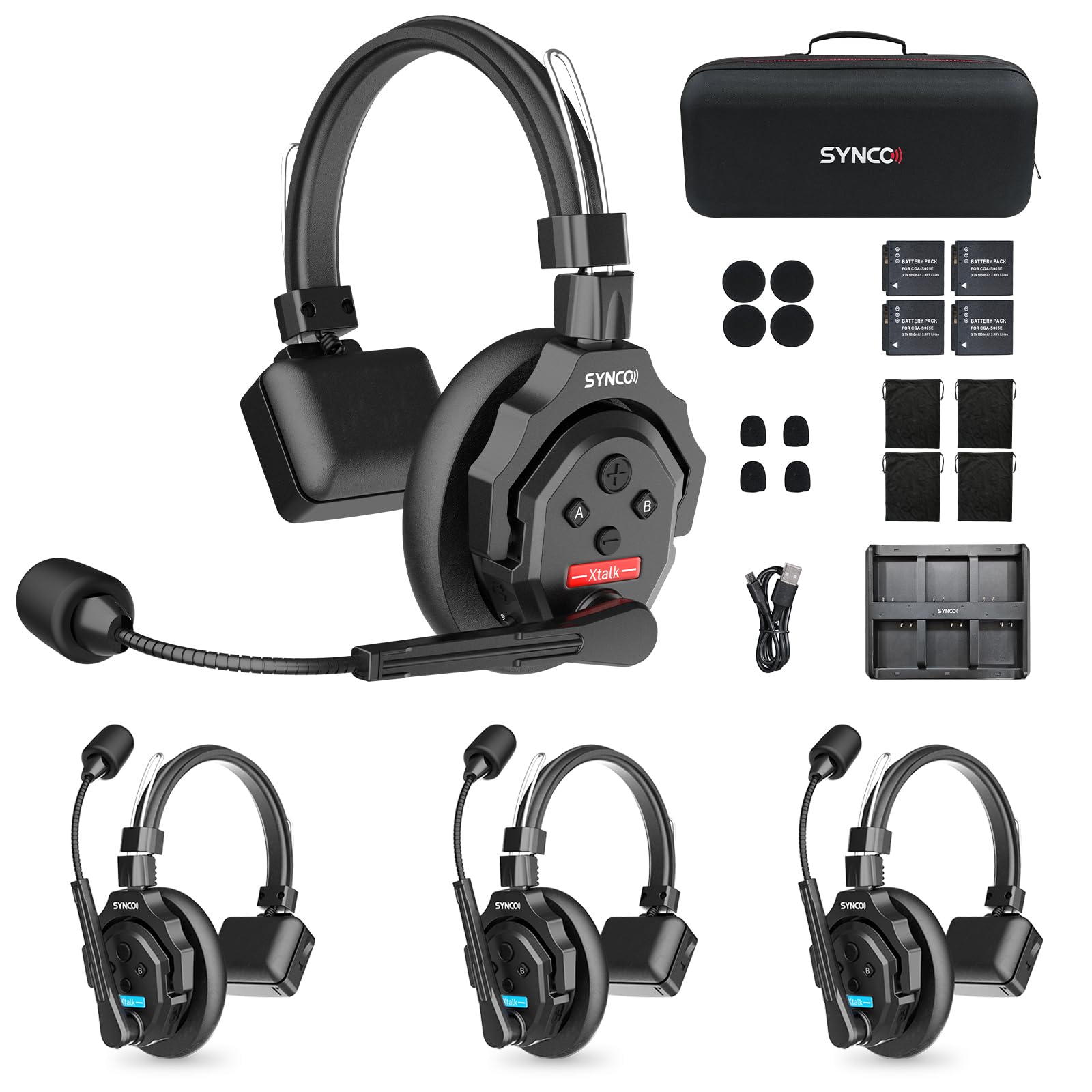
This set arrives as four matched headsets, four rechargeable batteries, and a six-slot charging station in the box, which is the practical reason it takes the top spot. You do not buy a headset and then hunt for packs and a charger — you open one case and hand out four units. Each headset runs up to 24 hours on its replaceable battery, and a spent pack recharges in 2.5 hours. With a 2.5-hour recharge, a spare pack on the six-slot charger rotates in instead of ending someone’s day.
Two crews can work the same show on independent channels without a hub, with any remote set up as the master. Up to 5 people can talk at once, and the connection is full duplex — no button press to break a cue. The audio chain uses AEC noise reduction across a 150Hz-7KHz range, which strips echoes and room reverberation so voices stay readable over a crowd. A 3.5mm port lets field control listen to camera or recorder audio while still talking on comms, which is exactly the job a stage manager juggles during a run.
You can talk the moment it ships, because the set arrives pre-paired and works from the start. The boom arm rotates up to mute and down to talk — a mic-level mute you can do with one finger while your hand holds a script. Hold the B button and the master can cut to domination mode, speaking over everyone with all remotes muted. This is the top pick, so check the lineup: the budget-friendly 2.4GHz Hollyland pair is a smaller, cheaper entry point, but this four-headset kit is the stronger system for a working crew. The catch is line of sight. Keep the crew within sight of each other, and if your venues are full of concrete walls, budget for a hub-free set that reaches further.
Where This One Wins
- Four headsets, four batteries, and a six-slot charger arrive together — a complete crew kit.
- Up to 24 hours per battery with 2.5-hour recharge, so a spare keeps the day running.
- Two independent groups with no hub, and the boom arm mutes on the up-swing.
What To Weigh First
- Wireless range is line of sight, so thick walls and stairwells cut into it.
- Uses a dedicated SYNCO network, so expansion means another SYNCO unit.
Built for: a stage crew of three to five running an event with two teams on separate channels.
Think twice if: your venue is a concrete bunker — sightlines matter here.
2. Clearcom Double Muff Intercom Headphones
Plug this into your console and the wireless battery problem disappears entirely.
If your venue already has a wired comms desk, this is the replacement headset that keeps a channel working. It ends in a female XLR four-pin connector — the standard plug on Clearcom and similar wired intercom systems — so it drops into a belt pack or console that expects that cable. There is no radio, no pairing, and no battery. The cable itself is retractable, which shortens the slack when the headset is hanging off a rail.
You hear the comms line and not the front-of-house mix, because the double-muff design closes off both ears. The faux-leather ear cushions are built to isolate without pressing hard. That matters on a stage where the room is loud. Compared to the wireless SYNCO XT4 above, this is a different tool. The wireless set frees you to walk the stage. This one ties you to a cable in exchange for a signal that never drops out and never needs charging.
The honest limit is the cable plus the desk. It only works where you already have a matching wired intercom system to plug into — it is a replacement headset, not a standalone two-way radio. If you are building a comms setup from nothing, this is not the starting point. If you already run a wired desk, this is a budget-friendly way to put a fresh headset on the operator who needs both ears covered.
Wired simplicity: no battery, no pairing, and a classic XLR four-pin connector — the smallest moving-parts headset in this lineup.
The trade: it depends on an existing wired intercom console, so it is not a standalone wireless system.
Reach for this if: your comms desk already takes an XLR four-pin headset and you want a fresh, double-ear replacement.
Look elsewhere if: you need to roam the stage untethered — pick a wireless set instead.
3. SYNCO XTALK XPRO1 Full Duplex Wireless Intercom Headset

The headset that keeps the line open even when the master unit drops out.
Most wireless intercom systems have one headset that has to be the master, and if that unit loses power, everyone else can stop talking. This one fixes that with a MasterFree 2.0 algorithm (software that keeps the network linked). It holds the network together even when a unit drops out and reconnects it automatically with no extra setup. Two high-gain external antennas push the range out to 500m — far more reach than the 1100ft on the Hollyland SE below. At 500m, a film unit can spread across a large set or a stadium floor.
The battery runs over 24 hours, and it is replaceable, so a swap restores full power instead of waiting on a charge. A 3.5mm monitoring jack lets a director or field controller hear device audio while staying on comms. AEC 2.0 noise reduction cuts echo and room noise across a 150Hz-7kHz range, and Boost Mode adds signal strength when interference creeps in. Each headset weighs 194g, so it sits light on the head over a long day.
What buyers report most is the sheer build and function — quality is the thing they bring up, with the system’s behavior and sound quality filling out the rest. It pairs in one click through SYNCO EasyGo software, and firmware updates arrive over the air. The catch is that this is a single headset, not a kit, so a crew has to buy a unit per operator. For a director or a controller who needs one dependable headset with serious reach, that is a fair trade.
Why It Holds Up
- MasterFree 2.0 keeps the network stable when a unit drops, with no re-pairing.
- Up to 24 hours per replaceable battery and a 2-slot charger.
- 500m range on dual external antennas, with Boost Mode for tough RF environments.
Where It Costs You
- Sold as one headset, so every operator needs their own.
- 194g is comfortable for a session, but heavier than a featherweight single-ear unit.
Go for it when: you want one strong headset for a director or field controller across a big site.
Skip the upgrade if: you only ever run two-person shows where a cheaper pair does the job.
4. Hollyland Solidcom SE Intercom Headset System

Two headsets, a 1,100ft reach, and a mic boom you move to talk.
A master and a remote headset arrive in the box, pre-paired, so a two-person production — a director and a camera operator, say — can be talking in the time it takes to put them on. The 2.4GHz full-duplex system lets both talk at once with no button press, and it holds a stable connection at up to 1,100ft (350m) over open ground. At 1,100ft (350m) over open ground, a camera across a field stays on the line.
Environmental noise cancellation runs on dual mics with a 70dB signal-to-noise ratio — a measure of how far your voice sits above the background hiss. In plain terms, your cue comes through on a windy waterside shoot instead of getting buried. The system also carries water-and-wind resistance, so a rainy exterior does not end communication. The boom rotates to control talking, and a latching design switches between mute and talk with a single press.
The battery is the honest weak point against the top pick: this set gives 12 hours on the remote and 10 hours on the master, next to the 24 hours on the SYNCO XT4. Half the runtime, so bring the charger for long days. The batteries are detachable and support USB-C charging while in use, which softens that. It expands to 5 headsets, and the set is not compatible with the Solidcom C1 or C1 pro, so keep your ecosystem straight if you already own Hollyland gear.
What Earns Its Place
- 1,100ft (350m) range with auto frequency hopping to dodge interference.
- Dual-mic ENC with a 70dB signal-to-noise ratio to keep voices over wind and crowd noise.
- Water and wind resistance, plus USB-C charging while in use.
What To Plan Around
- 12 hours on the remote and 10 hours on the master — carry a charger on long days.
- Not compatible with Solidcom C1 or C1 pro systems, so it will not join that setup.
Pick this when: you run a two-person shoot or a small event and want a pre-paired pair ready on arrival.
Keep looking if: you already own Hollyland C1 gear or need to run crew all day off one charge.
5. COMICA Seekcom S1 Wireless Intercom Headset

The one that shows you signal, battery, and tone at a glance.
You can trade command mid-shoot, because two headset roles, host and guest, switch freely here. On a job-shifting set, a director and a sound recordist can swap host and guest roles mid-shoot. It supports flexible grouping for multi-camera crews. The connection goes out to 1640ft (500m) over open ground on a dual-antenna design that shifts working bands when interference shows up. That matches the 500m reach of the SYNCO XPRO1 above and stretches to a large outdoor set or a live sports shoot.
The audio chain is 24kHz/16bit with a 150Hz-7kHz response, and the on-headset OLED screen shows signal strength, battery, volume, and noise-reduction mode without an external monitor. On a busy show floor, that OLED readout shows a headset dropping on power before it drops a cue. CalMix AI and traditional ENC modes can be toggled so you can switch noise reduction to suit the room. TALK, PTT, and MUTE modes are all there, and a 12-hour battery covers a filming day.
Beyond the headset, there is a 3.5mm audio input, USB-C for PC conferencing and firmware updates, and cascade extension support — so it works as a production intercom or as a desk unit for a PC meeting. A recorder mode with one-click ducking is aimed at sound recordists. The catch is that with few posted reviews, this operates more on spec and features than on a long crowd track record. If OLED feedback and host/guest swapping are what your day needs, that is a good reason to go here.
The feature list: OLED monitoring plus host/guest switching and USB-C — a very flexible headset that reaches 1640ft (500m).
Worth knowing: fewer owners have weighed in so far, so the track record is smaller than the bigger brands on this list.
Made for: multi-camera crews and sound teams who want to see signal and power status at a glance.
Not for you if: you want the reassurance of a big pile of user reviews before you commit.
6. Hollyland Solidcom SE PRO Intercom Headset System

A pair that grows into an 11-person crew without a hub in sight.
Ships as a master and remote pair, and expands to a system of up to 11 users without a hub — the biggest crew capacity in this lineup. Starting as a master-remote pair and scaling to 11 users without a hub suits a show that adds operators. It runs on 1.9GHz rather than the crowded 2.4GHz band, with auto frequency hopping that shifts when it meets interference, and reaches up to 1312ft line of sight. That 1312ft is more reach than the 1100ft on the standard SE version above.
Noise control uses dual mics, with a 150Hz-7kHz response and a boom mic you pull down to talk. Dust and water resistance means rain and splashes do not stop the show. Each package includes extra batteries delivering 10 hours per pack, so a swap keeps the headset alive, and USB-C charging over a power bank works while you are wearing it. The whole headset is built light at under 186g, so it sits easy through long hours of filming.
The point to watch is the radio itself: the SE PRO on 1.9GHz cannot be paired with the Solidcom SE on 2.4GHz, so a mixed inventory needs to be sorted before you buy. If your crew is bigger than a pair but not big enough for a full five-person kit, this fills the middle neatly. The green headband keeps the look subtle and professional.
Capacity that scales: up to 11 users with no hub, 1.9GHz to dodge 2.4GHz traffic, and 1312ft line of sight.
Swap-friendly: extra batteries arrive in the box at 10 hours each, with USB-C charging while in use.
Best for: a production that is growing from a pair to a fuller crew and wants one system to carry it.
Mind the band: 1.9GHz here will not pair with 2.4GHz Solidcom SE units, so keep your system consistent.
7. Eartec UL5S Ultralite HD Wireless Intercom Headset System

Five headsets, five heads-free talkers, and DECT to keep Wi-Fi out of it.
A working five-person crew gets a whole system in one box here: one main headset, four remotes, five rechargeable lithium batteries, a ten-bay multi-port charger, and a softside case. That is a full crew kit with spares — a second battery per headset, so a dead pack swaps out instead of stopping the show. Full duplex means all five talk and listen at once with no buttons, which is the single most important function for a stage crew working live cues.
The radio runs DECT 6.0 on 1.9GHz — a license-free wireless band that stays clear of Wi-Fi and Bluetooth traffic, the kind that so often tramples a 2.4GHz comms line in a busy venue. Range is up to 1,000ft line of sight, with no base station and no FCC license needed. The single-ear headset has a pivoting noise-cancelling mic you can wear on either side, and it auto-mutes when you flip the boom up. The electronics and battery live inside the earcup, and setup pairs in seconds with zero programming.
Runtime is the trade: up to 6 hours of talk time per charge, the shortest figure in this lineup. A long double-show day needs the extra batteries that ship in the kit. A 5-user set at DECT quality (a digital standard that keeps the line clean) is the pro-grade end of this category — a big job, and the price reflects it. For a five-person crew that wants one clean, interference-free system with no base station, that trade buys confidence on a busy show floor.
The Standout Specs
- DECT 6.0 on 1.9GHz avoids Wi-Fi and Bluetooth interference — no FCC license required.
- Up to 1,000ft line of sight with no base station and seconds-long pairing.
- Five headsets, five batteries, a ten-bay charger, and a softside case as one kit.
The Real Limits
- Up to 6 hours per charge is the shortest battery figure here, so plan swaps on double-show days.
- The full DECT five-user kit sits at the premium end of the market.
Picture it on: a five-person stage crew who want one interference-free system with batteries and charger in the case.
You might pass if: you run a two-person show and 6 hours per charge would leave you swapping packs all day.
Know the Specs
Full duplex and antenna type
Full duplex is the ability for every headset on the line to talk and listen at the same moment — like a phone call, not a walkie-talkie. On a live cue you cannot stop to press a button, so this is the core feature. Antenna type is the second layer: a single internal antenna holds a line over a modest set, while dual high-gain external antennas (as on the SYNCO XPRO1) push the range out to 500m. If your crew is spread over a stadium or a large outdoor set, the antenna spec is the one to read carefully.
ENC noise cancellation and frequency response
ENC stands for Environmental Noise Cancellation — circuitry that cancels background sound so your voice stays on top. A 70dB signal-to-noise ratio (as on the Hollyland SE) tells you how far your voice sits above the background hiss. Frequency response works alongside it: a 150Hz-7kHz range is the band that carries human speech, so a headset covering that span reproduces a clear, intelligible human voice. AEC (acoustic echo cancellation) then strips echoes and room reverberation — the bane of a ballroom or a concrete stairwell.
Common Questions
Can I mix a Hollyland Solidcom SE with a Solidcom SE PRO?
What does line-of-sight range actually mean in a venue?
Is a full duplex headset better than push-to-talk for stage work?
Will a wired XLR headset work on my wireless belt pack?
How many headsets does one stage crew actually need?
Can I charge a headset while I am still wearing it?
Do I need a license to run one of these wireless headsets?
How do I mute my mic quickly without looking?
Is 6 hours of battery enough for a full show day?
Can I use a film intercom headset as a PC conference mic?
The Bottom Line
For most stage crews, the stage manager headset that earns its place is the SYNCO XTALK X4. Four headsets, a six-slot charger, and up to 24 hours per replaceable battery arrive as one complete kit. If you want a single strong headset with serious reach, grab the SYNCO XTALK XPRO1 and its 500m range. And for a five-person crew that wants one interference-free DECT system with batteries and charger in the case, reach for the Eartec UL5S. Three kits cover a four-headset stage crew, a single long-range headset, and a five-person DECT system.
How we choose
We do not accept paid placement. Every pick is matched to a real buyer and a real use-case; we do not hands-on test units.
Sources
Specifications: manufacturer listings and product documentation. Review insights: verified customer reviews, as of November 2026. Pricing: not shown on this page (it changes often); check the current price via the retailer link.
As an Amazon Associate, Tactical Gear Guy earns from qualifying purchases. This does not affect which products we feature.