Specs are compiled from manufacturer listings and verified buyer reviews and can change over time — please confirm the key details on the product page before buying.
If your foot slides toward the edge of the shoe every time you push off for a wide ball, the shoe is the problem, not your footwork. Stable tennis shoes are built with a wider base and a support frame that resists sideways roll, so you can plant, pivot and change direction without your ankle fighting the shoe. Below are eight court shoes that actually do that job, sorted by what each one does best.
This guide is built by comparing the manufacturers’ published specifications and the patterns across verified customer reviews, so you get each pick’s real strengths and trade-offs instead of marketing spin.
Some shoes win on a roomy toe box, others on a chassis that locks the heel in place. Weighing width against lateral support is the heart of choosing the right stable tennis shoes for your own feet and court.
Top Picks

How To Choose The Best Stable Tennis Shoes
The biggest mistake buyers make is treating lateral stability as a cushioning question. It is not. A plush midsole can feel lovely standing still, then let your ankle roll the moment you push sideways. Stability comes from the structure around your foot: the sidewall, the heel counter, and how wide the base sits.
Look for a named support piece, not a vague claim
Makers who build real lateral support give the part a name and describe where it sits. Wilson uses a 4D Support Chassis on the Rush Pro Ace, an asymmetrical plate that runs heel to toe and limits supination (the outward roll of your ankle) and torsion. adidas wraps Adituff around the toe area to protect against foot drag. ASICS puts WINGWALL technology in the sidewall on the Gel-Challenger 15. If a listing says only “stable” with no named component, treat that as unproven.
Match the outsole to the surface you actually play on
Court shoes are not surface-agnostic. The Rush Pro Ace uses an all-court Duralast outsole aimed at hard courts. A shoe built for grass looks and grips differently from one built for clay or a hard indoor surface. Buying for the wrong surface is the fastest way to wear an outsole out early or feel like you are skating.
Decide on toe box width before anything else
Width is where otherwise good shoes split the crowd. The Rush Pro Ace runs more spacious than the Rush Pro 4.0. The adidas Courtjam Control 3 splits buyers straight down the middle, with some finding it true to size and others finding it narrow. If you know your feet run wide, pick the shoe that advertises the room up front rather than hoping a size up will fix it.
Side-by-Side Comparison
| Model | Best For | Stability Feature | Court Target | Listed Weight | Amazon |
|---|---|---|---|---|---|
| Wilson Rush Pro Ace★ Best Overall | All-round club player | 4D Support Chassis | Hard court | — | Amazon |
| K-Swiss Ultrashot 3Court Specialist | Aggressive baseliners | 360 Plantar Chassis | Grass | 3 pounds | Amazon |
| adidas Courtjam Control 3Quick-Cut Pick | Fast hard-court rallies | Adituff toe wrap | Hard court | 2.43 pounds | Amazon |
| Wilson Rush Pro Lite | Wide-footed comfort seekers | Curved sole support | All-court | — | Amazon |
| ASICS Game FlyteFoam | Multi-sport all-court play | TRUSSTIC midsole | All-court | 1.44 pounds | Amazon |
| ASICS Gel-Resolution X | Baseline grinders | DYNAWALL midsole | All-court | 1.44 pounds | Amazon |
Detailed Reviews
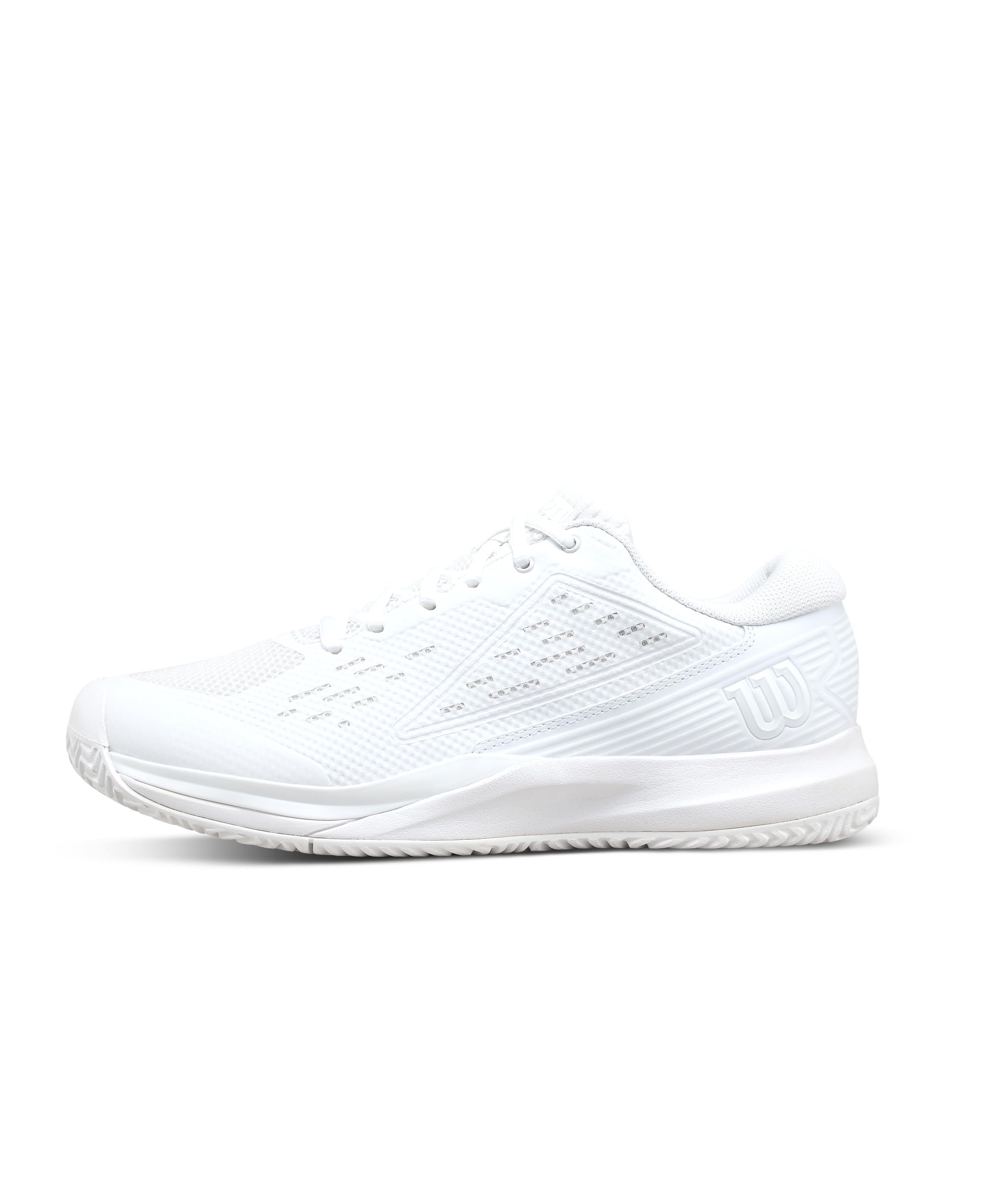
1. Wilson Men’s Rush Pro Ace Tennis Shoes
Our pick — 4.0+★ from 750+ verified ratings; the strongest balance of quality and price.
A wide toe box and a bent chassis that fights your ankle rolling outward.
The Rush Pro Ace is the shoe to buy if you want stability you can feel the second you cut sideways. Wilson’s 4D Support Chassis is an asymmetrical plate running heel to toe, and its whole job is to limit supination and torsion, which is the jargon for your ankle rolling outward and your foot twisting under you. That matters most when you plant to hit a wide forehand, because the plate gives your foot a firm edge to push against instead of rolling over.
The wide toe box is the other reason this shoe sells so well. Wilson states outright that the Ace gives you more room up front than the Rush Pro 4.0, and owners consistently describe the fit as roomy rather than snug. For a recreational tennis or pickleball player who spends two hours a session in the same pair, that extra space at the front is what keeps your toes from jamming on hard stops. Breathable mesh across the upper keeps air moving, and the R-DST+ midsole uses highly compressed EVA to give back some spring on each step.
The trade-off worth knowing: the Duralast outsole is built for hard courts specifically. If you mostly play on clay or grass, this is not the shoe tuned for those surfaces. Fit and comfort win over most players, though the durability picture is genuinely split — plenty of owners get a long run out of them while others wear through sooner than expected.
What earns its place
- The 4D Support Chassis limits supination and torsion — real lateral security on hard stops.
- Wide toe box with more room than the Rush Pro 4.0 — good for wide feet.
- R-DST+ compressed EVA midsole returns energy step to step.
- Breathable mesh upper keeps ventilation up through long sessions.
Where it asks something of you
- Outsole is aimed at hard courts, so it is the wrong tool for grass or soft clay.
- Durability experience varies — some pairs wear faster than others.
Made for: the club or recreational player on a hard court who wants lateral support and a roomy toe box in one shoe.
Think twice if: your home surface is grass or clay.
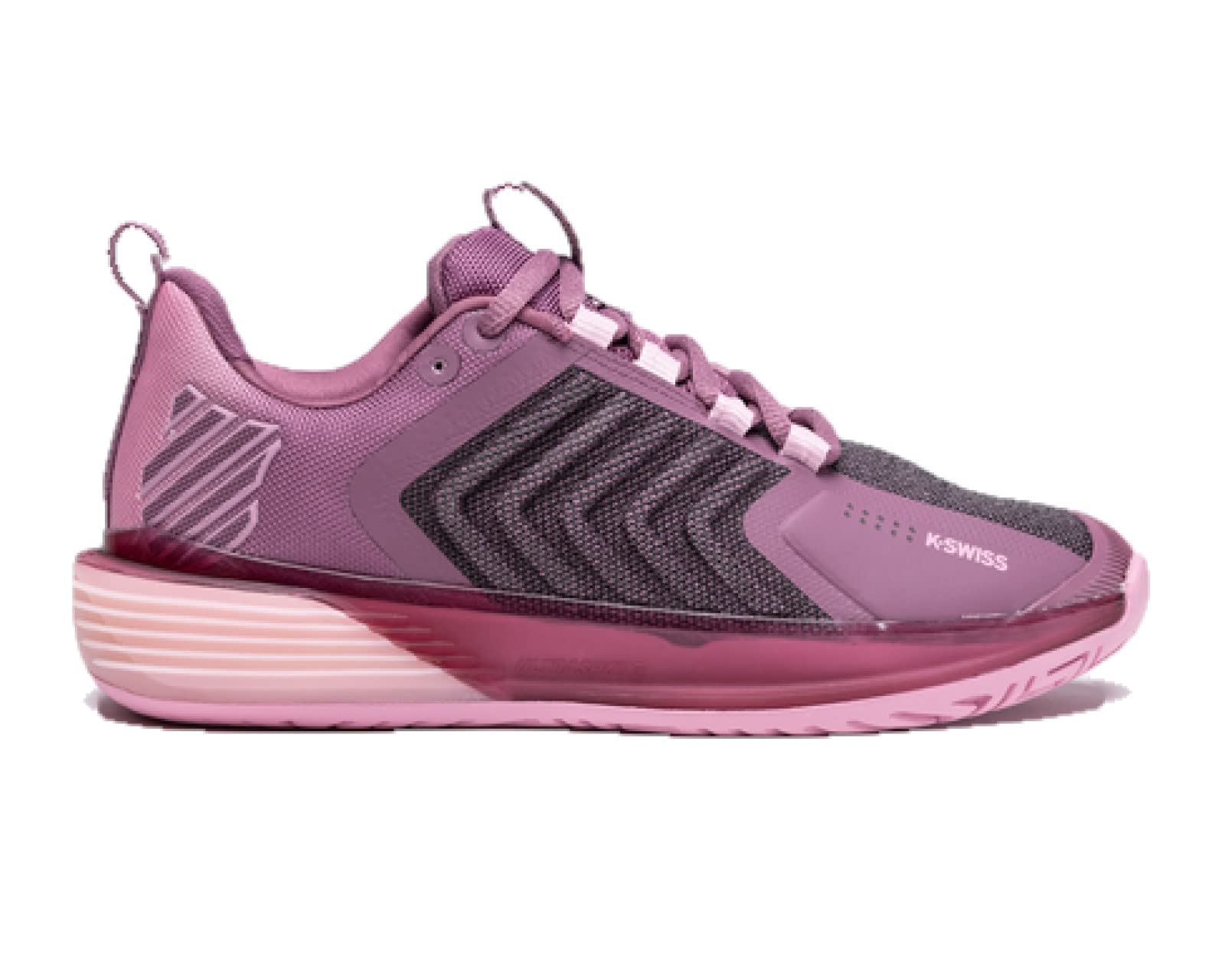
2. K-Swiss Women’s Ultrashot 3 Grass Tennis Shoe
Built for players who want to hit through the ball, not rally around it.
K-Swiss aims this shoe squarely at competitive, aggressive, powerful players, and the part that matters for stability is the 360 Plantar Chassis. That is a support frame running around the underside of the foot, and it gives you a stable platform to load into when you drive off the ground. The Surge 7.0 midsole adds energy return on top of that, so the push you put in comes back through the step.
Here is the number worth flagging before you buy: this shoe carries a listed package weight of 3 pounds. The ASICS Game FlyteFoam, by contrast, lists 1.44 pounds. That is roughly a 2.1 times difference in listed weight, so if you value a light, quick recovery step above a planted, powerful feel, the Game FlyteFoam is the better direction. If you want a shoe that feels anchored under a big swing, the Ultrashot 3 leans your way.
What most impresses buyers is the value — people feel they got a quality shoe with a good look for what they paid. Durability is helped by Dragguard 7.0, a reinforced section aimed at the places your foot scuffs the court. The honest catch sits in the fit: reviews split, with some finding the width better than expected and others finding it runs small. Order a half size up if you are between sizes.
Go for this: a women’s shoe with a 360 Plantar Chassis and a firm, powerful platform for committing to shots.
Look elsewhere if: you are chasing the lightest possible shoe, since this one lists heavier than the Game FlyteFoam.
3. adidas Mens Courtjam Control 3 Tennis Sneakers Shoes – White
Light enough to snap back into position, reinforced where you drag your toe.
If your game is built on sharp cuts and quick changes of direction, the Courtjam Control 3 is tuned for exactly that rhythm. adidas pairs strong support with Bounce cushioning, so the shoe stays light while still giving you something to push against. The listed item weight of 2.43 pounds keeps the shoe out of the heavy, clunky territory that drags your recovery step down.
The detail that will save you money is Adituff, a reinforced wrap around the toe area. That is the spot most players shred first, because your trailing toe drags across the court on the follow-through of every swing. Wrapping that zone means the shoe survives the abuse that usually ends a pair early. The Adiwear outsole underneath is shaped for hard surfaces, so you get grip where a hard-court match actually happens.
Comfort and arch support show up repeatedly in what owners say, and the shoe draws a second glance for its clean white look. Sizing is the one place opinion lands on both sides — some buyers find it true to size, others find it narrow. The honest read: if your feet are wide, this is a shoe to size up in, not a shoe to assume will stretch out. It rewards a player who wants speed over maximum cushioning.
The speed argument: at a listed 2.43 pounds with Adituff armor over the toe, this pairs light court feel with the reinforcement that keeps a hard-court shoe alive.
Reach for it when: hard-court points are won on quick direction changes and you want a light shoe with a protected toe.
Hold off if: you run wide — the sizing splits between true-to-size and narrow.
4. Wilson Men’s Rush Pro Lite Tennis Shoes

The comfort-first Rush Pro for players who want air around their toes.
Wilson calls this the Lite version of the Rush Pro line, and it earns that label through the way it handles your stride. The curved sole supports all three phases of your step and smooths the roll from heel strike to toe off. That is a small thing on one step and a big one over three sets, because the shoe rolls with your stride instead of interrupting it.
The toe box is the headline for wide-footed players. Owners single out the wide toe box and the breathable mesh as the features that keep their feet comfortable deep into a match, and the arch technologies underneath add flexibility alongside the support. Where this differs from the Rush Pro Ace higher up this list: the Ace is the shoe built around a 4D Support Chassis for hard lateral control, while the Lite prioritizes comfort and a smooth roll. Pick by which of those two jobs your game demands.
Stability here is genuinely a split verdict. Some players find the support plenty, while others find it short of what they want when they are really pushing sideways. Durability divides the same way — some pairs hold for months, others give out sooner. This is a shoe for the player whose priority is comfort and a roomy fit, not the one shopping for the firmest lockdown on the court.
Best match for: wide-footed players who want comfort and a smooth heel-to-toe roll more than maximum lateral rigidity.
Look past it if: you want the firmest side support — the Ace above is the stronger pick there.
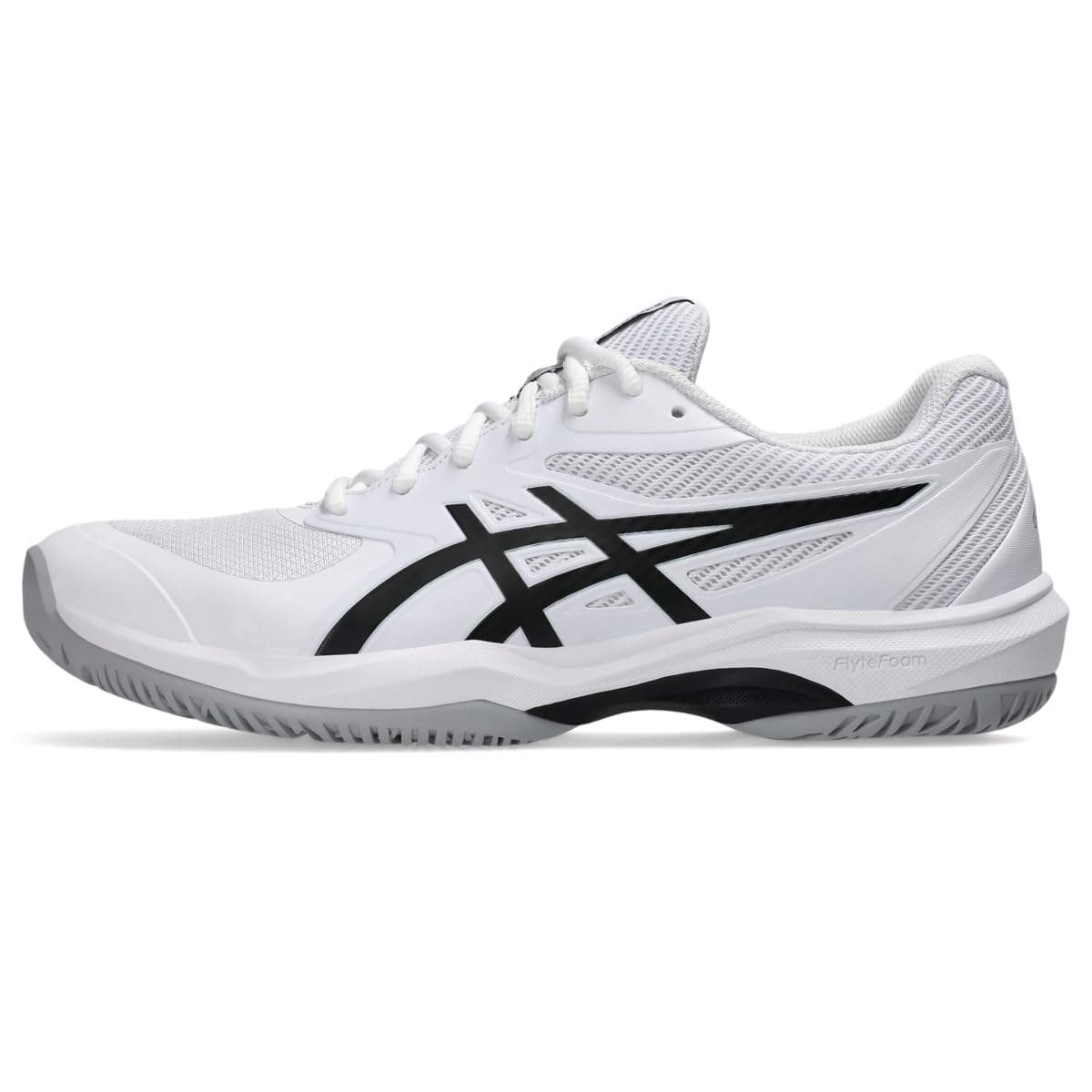
5. ASICS Men’s Game FlyteFoam Tennis Shoes
A 1.44-pound all-court shoe that keeps your feet cool when the point runs long.
The Game FlyteFoam lists at 1.44 pounds. Set that next to the K-Swiss Ultrashot 3 above, which lists 3 pounds, and you have the plainest illustration of the range in this category — a shoe that disappears on your foot versus one you feel with every step. ASICS built this one to be light and flexible for all-court players, and the open mesh upper pushes air through so your feet stay cool in a long rally.
Stability comes from TRUSSTIC technology, a support piece in the midsole that steadies the shoe during abrupt transitions. Overlays of synthetic leather and a PU film add structure on top, so the shoe does not just collapse when you stop hard and change direction. FLYTEFOAM in the midsole supplies the cushioning under that structure, and the outsole is tuned for both flexibility and durability.
Owners use these for tennis and pickleball alike, and they work well on indoor courts too. The fit is the split here, with some players finding it too narrow, and durability is the bigger question mark, with some pairs wearing out within a month. Given how light the shoe is, that wear profile is worth going in with your eyes open — this is a fast, airy shoe, not a tank.
Where it shines: cool, flexible, all-court play at a listed 1.44 pounds, with TRUSSTIC holding the shoe steady through hard stops.
Where to be careful: if your feet run wide or you want a shoe that lasts through heavy weekly mileage, ask for more room and more armor.
The one to grab: all-court and pickleball players who want the lightest, coolest shoe on this list.
Skip past it if: you need a wide fit or you play enough hours that outsole life is your top concern.
6. Wilson Women’s Intrigue Pro Tennis Shoe
Two stability systems built for a player who defends both corners of the court.
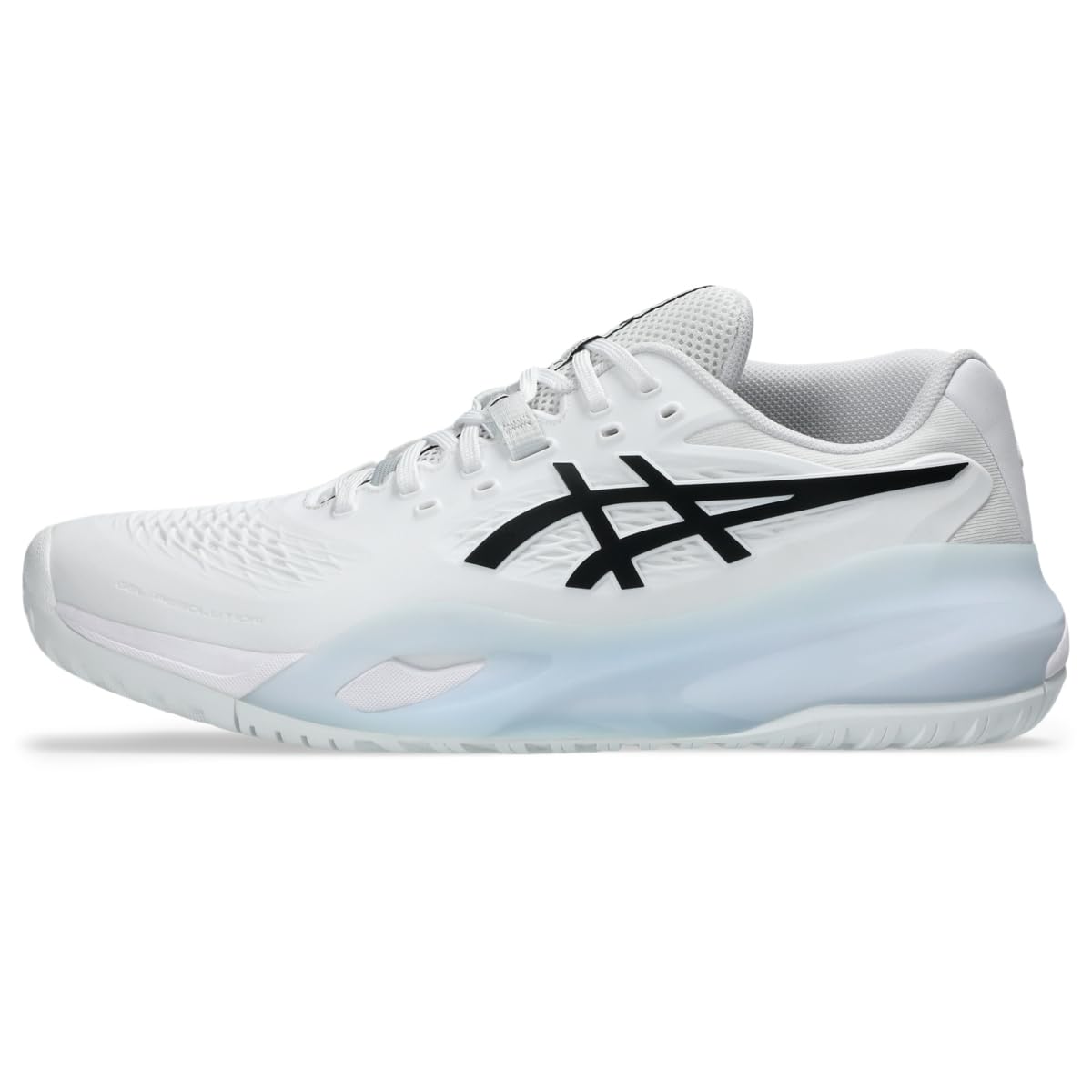
The Gel-Resolution X targets the baseline grinder — the player who runs down every ball and covers both sides of the court. ASICS gives this shoe two pieces of hardware to do that. DYNAWALL is a stability feature in the midsole, and on this model it now extends into the heel, so the support reaches further back on the foot during lateral movement. There is also a two-piece midsole design that improves stability when your foot lands on the court.
There is a second source of steadiness that has nothing to do with the sole. DYNALACING is a lacing setup designed to hold when extra support is needed, giving you a locked-in feel when you make quick transitions. That matters for a shoe built for baseline play, because your feet restart from a dead stop on every corner-to-corner sprint. The shoe lists at 1.44 pounds, which keeps all that support from becoming a burden on recovery steps.
Owners use these for pickleball as readily as tennis, and what holds up in what they say is the stability and mobility together — the shoe moves with you rather than fighting you. The honest picture is more mixed on fit and comfort, with some players finding a good match for a wide mid-foot while others report the shoe feels one size up and causes discomfort. Stiffness stands out as the most common complaint by count. The Resolution X rewards a player who wants lockdown and structure, and asks that player to sort out the size carefully first.
The two-system case: DYNAWALL extending into the heel plus a two-piece midsole makes this the most heavily stabilized shoe on the list for players who live at the baseline.
Built for: baseline grinders and pickleball players who cover the whole width of the court and want structure and lockdown.
Better elsewhere if: you need a soft, broken-in feel from day one or your feet run narrow.
Know the Specs
Support chassis and sidewall technology
A support chassis is a stiff plate or frame built into the shoe that resists twisting and rolling. It is what keeps your foot from sliding over the edge of the sole when you push sideways. Names you will see on this list include the 4D Support Chassis on the Wilson Rush Pro Ace, the 360 Plantar Chassis on the K-Swiss Ultrashot 3, WINGWALL on the Gel-Challenger 15 and DYNAWALL on the Gel-Resolution X. If a listing names no support component, assume the stability comes from the shape of the shoe alone.
Outsole compound and court surface
The outsole is the rubber bottom of the shoe, and makers tune it to a surface. An all-court outsole is a compromise that works reasonably well on several surfaces. A hard-court-specific outsole, like the Duralast on the Rush Pro Ace, grips best on a hard surface. Playing a hard-court outsole on grass or soft clay wears it differently and gives you less grip than a shoe built for that ground.
Listed weight
A shoe’s listed weight tells you how much it will slow your recovery steps. Lighter shoes let you reset faster between shots. In this list you will find the ASICS Game FlyteFoam and Gel-Resolution X at a listed 1.44 pounds, the Gel-Challenger 15 at 1.99 pounds, the adidas Courtjam Control 3 at 2.43 pounds and the K-Swiss Ultrashot 3 at 3 pounds. Weight and lateral rigidity pull in opposite directions, so pick the lighter shoe if recovery speed wins and the stiffer one if side-to-side lockdown does.
Toe box width and fit
The toe box is the space at the front of the shoe where your toes sit. A roomy toe box keeps your toes from jamming on hard stops and helps with wide feet. The Rush Pro Ace gives more room than the Rush Pro 4.0, while the Courtjam Control 3, Gel-Challenger 15 and Intrigue Pro all draw split opinions on width. If you already know your feet are wide, buy the model that advertises a roomy toe box rather than sizing up and hoping.
Common Questions
Do stable tennis shoes stop my ankle rolling on a wide forehand?
Is the K-Swiss Ultrashot 3 built for grass or for hard courts?
How much lighter is the ASICS Game FlyteFoam than the K-Swiss Ultrashot 3?
Will the Wilson Rush Pro Ace fit wide feet?
Can I use tennis shoes for pickleball?
What is the difference between Adituff and Adiwear on the adidas Courtjam Control 3?
Do stable shoes sacrifice comfort?
How long should a tennis shoe outsole last?
Is the Wilson Intrigue Pro genuinely different from a men’s tennis shoe?
What does DYNALACING do on the ASICS Gel-Resolution X?
The Bottom Line
For most players, the stable tennis shoes to start with are the Wilson Rush Pro Ace, because the 4D Support Chassis gives your foot real structure against the sideways roll that causes most ankle trouble, and the wide toe box keeps your toes free. If you want a lightweight, cool all-court shoe and you are not chasing an armor plate, the ASICS Game FlyteFoam is the switch-up. And for pure baseline coverage with the most stability hardware on the list, reach for the ASICS Gel-Resolution X.
How we choose
We do not accept paid placement. Every pick is matched to a real buyer and a real use-case; we do not hands-on test units.
Sources
Specifications: manufacturer listings and product documentation. Review insights: verified customer reviews, as of November 2026. Pricing: not shown on this page (it changes often); check the current price via the retailer link.
As an Amazon Associate, Tactical Gear Guy earns from qualifying purchases. This does not affect which products we feature.