Specs are compiled from manufacturer listings and verified buyer reviews and can change over time — please confirm the key details on the product page before buying.
If you want a big, accurate Saturn V that needs no paint or glue, buy the LEGO Ideas NASA Apollo Saturn V. Pick a plastic scale kit only if you actually enjoy sanding, gluing and painting. The rest of this article explains why those two paths are so different, and which of the nine models here fits your shelf, your patience and your skill level.
This guide is built by comparing the manufacturers’ published specifications and the patterns across verified customer reviews, so you get each pick’s real strengths and trade-offs instead of marketing spin.
Every Saturn V model falls into one of three camps: brick builds, snap-together puzzles, and traditional glue-and-paint kits. Knowing which camp you belong in is half the decision, so the picks below are grouped by build type. This breakdown of the saturn v rocket model covers scale, piece count, material and build effort.
Top Picks


How To Choose The Best Saturn V Rocket Model
The Saturn V is the tallest rocket NASA ever flew, and every model of it lives or dies on one question: how much of that shape survives the build. A kit that ends up looking like a lumpy tube wastes your evening. A kit that keeps the tapered stages, the black-and-white roll pattern and the escape tower is worth the shelf space.
Decide if you want to build or to assemble
“Build” and “assemble” sound like the same thing and are not. Brick sets and snap puzzles go together dry — no glue, no paint, no fumes. Traditional plastic kits like the AMT and Dragon releases require paints, glue and modelling tools to finish, which is a completely different hobby with a completely different skill curve.
Match the scale to where it will live
A 1:110 model stands roughly a meter tall, which dominates a bookshelf and needs real clearance above it. A 1:200 kit is about half that and sits comfortably on a desk or a cabinet top. Measure your space before you fall for a big build — the finished rocket always looks smaller in the listing photo than it does in your hallway.
Check what is in the box versus what you must buy
Some Saturn V kits are complete the moment they arrive. Others need engines, a launch pad, a controller and batteries before the rocket can do anything but sit there. Read the included-components list carefully, because engines, pads and controllers can cost as much as the kit itself.
Look at how the stages separate
The real Saturn V flew in three stages, and the better models let you pull those stages apart to reveal the internals. Removable stages and a detachable lunar module turn a static display into something you can actually demonstrate to a guest. Fixed one-piece shells look fine but hide the engines and internals that make the rocket interesting.
Side-by-Side Comparison
| Model | Best For | Scale | Pieces | Build Type | Amazon |
|---|---|---|---|---|---|
| LEGO Ideas NASA Apollo Saturn V 92176★ Best Overall | Most buyers | ~1:110 | 1,969 | Brick, no glue | Amazon |
| Ravensburger Apollo Saturn V 3D PuzzleFamily Favourite | Family build night | — | 440 | Snap puzzle, no glue | Amazon |
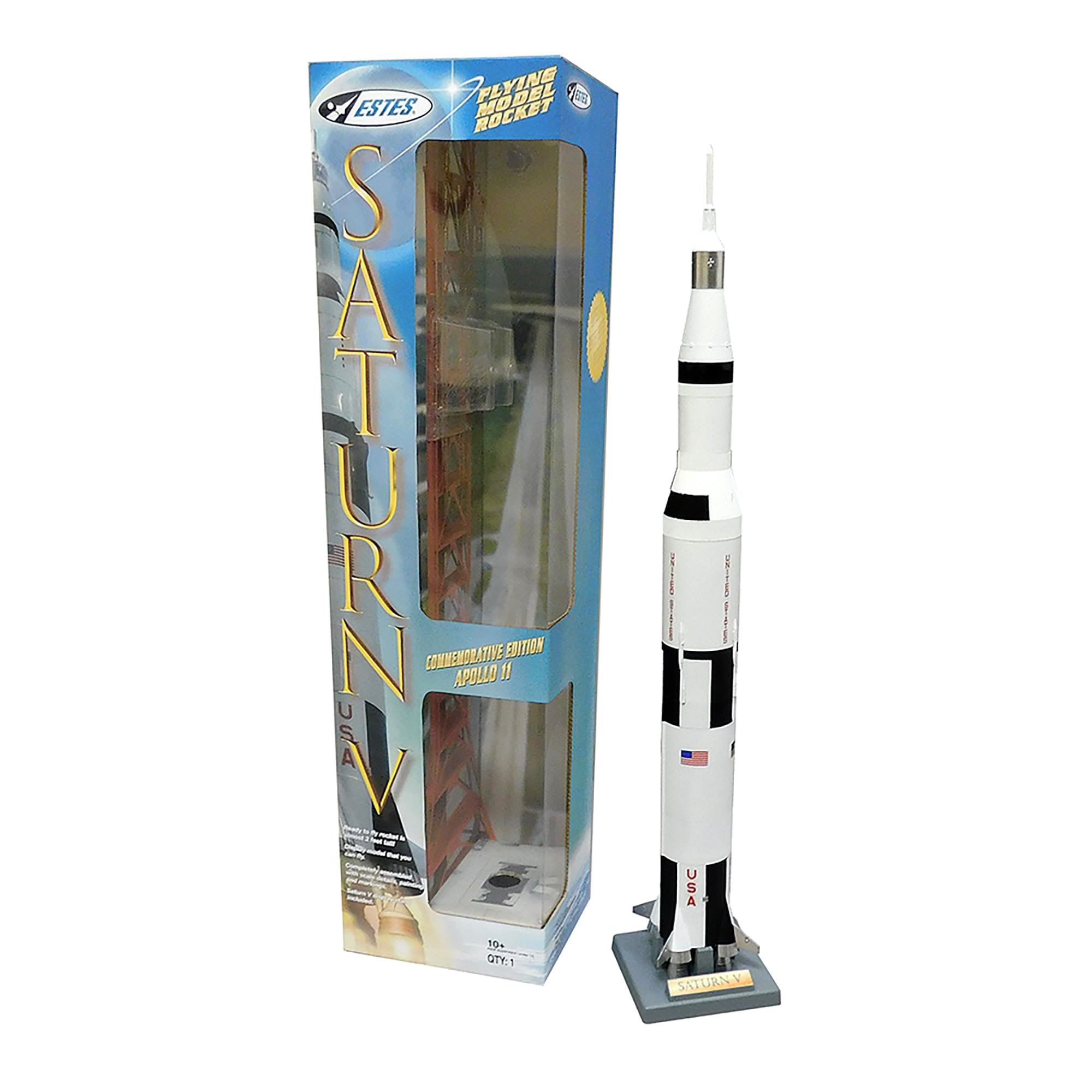
| Estes 2160 Saturn VBest Flier | Actually flying it | 1:200 | — | Pre-built, launchable | Amazon |
| AMT Saturn V 1:200 | Budget plastic kit | 1:200 | — | Glue and paint | Amazon |
| UGEARS NASA Saturn V | Wooden mechanical build | 1:170 | — | Wooden, no glue | Amazon |
| Dragon Models Apollo 11 1/72 | Serious detail work | 1/72 | — | Glue and paint | Amazon |
| Revell 03704 Apollo 11 Saturn V | Large display kit | — | — | Glue and paint | Amazon |
| Revell 00250 Paper Craft | Tight budget, tight space | — | 136 | Self-adhesive paper | Amazon |
| LEGO 92176 Amazon Exclusive | Second display build | ~1:110 | 1,969 | Brick, no glue | Amazon |
Detailed Reviews
1. LEGO Ideas NASA Apollo Saturn V 92176
Our pick — 4.5+★ from 13,000+ verified ratings; the strongest balance of quality and price.
A meter of moon rocket that you snap together dry and never paint.
Here is the number that sells this kit: 1,969 pieces. That figure is not padding — it is the reason the finished rocket hits roughly 1:110 scale and stands over 39 inches (100 cm) tall with a 6-inch (17 cm) diameter. A meter of rocket in your living room is a statement, and it is the closest most of us get to standing under the real thing.
What wins people over is the build quality. It is the crowd favourite here at 4.5+ stars from 13,000+ owners, and the recurring theme in those reviews is that it does not look like LEGO once finished — the textured F-1 engines and smooth curved slopes read as a display model, not a toy. The kit gives you three removable stages (first, S-II second and S-IVB third) plus a launch escape system and the command and service module, so you can pull it apart and show what is inside. Two minifigures and a lunar lander scene complete the set, along with horizontal display stands and a booklet on the Apollo missions.
The honest catch is shelf logistics. Before you commit, measure the clearance above wherever it will stand, because this is a genuinely tall object that eats a bookshelf. The build itself runs long, but it is a dry, glue-free process with no fumes and no sanding, which is exactly why it suits a first-time scale builder who wants accuracy without a modelling bench.
Where the 92176 earns it
- 1,969 pieces produce a roughly 1:110 model over 39 inches tall
- Three removable stages plus launch escape system and CSM
- No paint, glue or tools — a dry brick build
- Horizontal display stands and an Apollo missions booklet included
What to plan around
- Needs serious vertical clearance on a shelf
- A long build session, not an evening project
- Not a launchable rocket — display only
Buy this one: if you want the most accurate Saturn V you can build without touching a paintbrush.
Think twice: if you have no shelf tall enough to clear a meter of rocket.
2. Ravensburger Apollo Saturn V 3D Puzzle
The one you can hand to an eight-year-old and still display proudly afterward.
This is the Saturn V for a rainy Sunday with someone younger at the table. Ravensburger’s Edition packs 440 high-quality plastic pieces into a snap-together build that needs no glue at all — the pieces lock by eye, or by matching the numbers and arrows printed on the reverse side if you want a safety net. Finishing it takes about an afternoon rather than a week, and the separable rocket stages, removable lunar module, command and service modules and three astronaut figurines mean the finished thing has moving parts worth showing off.
Compared with the 1,969-piece LEGO at the top of this list, it is a far shorter project that gets you a recognisable Saturn V in a single sitting. The kit is rated difficulty 4 out of 5 and is aimed at puzzlers aged 8 and up, which is an honest signal: the numbers printed on the back make it manageable, but this is not a mindless build. An English brochure with Apollo mission background comes in the box, so the education angle is not purely decorative.
Where it differs from the bigger brick set is permanence — a snap puzzle is lighter to move but also more delicate if handled roughly, so plan on a spot out of daily reach. It is also heavier than the UGEARS wooden kit at 1200 g versus 400 g, so a shelf edge is fine but a high wobbling bookcase is not.
For the family table: 440 pieces and an afternoon is a realistic pace, and the numbered backs keep younger builders moving without adult rescue every ten minutes.
Where it is honest: the difficulty rating of 4 out of 5 is real — treat it as a shared project, not a solo task for a small child.
Reach for it if: you want an Apollo model the whole household can build together and then keep on display.
Look elsewhere if: you want a heavy, permanent display piece that shrugs off handling.
3. Estes 2160 Saturn V 1:200 Model Rocket Kit
The only rocket here that actually leaves the ground.
Every other model on this list is a shelf object. This one flies. The Estes 2160 arrives decorated and ready to launch at 1:200 scale, with a recovery parachute, a display stand and instructions — you supply the engine. On a C6-3 Estes engine (sold separately) the projected altitude is 200 ft. (61 m), and it also takes a C5-3. The build is effectively done before you open the box, which is exactly what buyers here value most: the model quality and the fact that there is nothing to assemble.
The real-world catch is hardware. To get it off the pad you also need rocket engines, starters, recovery wadding, a launch pad system and 4 high-quality 1.5-volt AA alkaline batteries, none of which are in the kit. Add an Estes Porta-Pad II and Electron Beam Launch Controller to complete the setup. The kit is aimed at ages 10 and up and is built around the NAR model-rocket safety code — an appropriate launch site, a stand-back distance of at least 15 ft., the safety key, a countdown, then flight.
Durability is the honest trade-off of a launchable rocket. A couple of landings on hard ground have left some owners with repairs to make, which is the nature of a light flying model rather than a fault in the design. If you want a permanent display, this is not the one; if you want the countdown, it is the only one here that offers it.
Why it earns its place
- Projected 200 ft. (61 m) on a C6-3 engine, compatible with C5-3
- Pre-built and decorated — display stand and parachute included
- 1:200 scale means a small footprint on a desk
- Genuine launch experience at an age-10-and-up level
The fine print
- Engines, pad, controller and 4 AA batteries all sold separately
- Hard landings can mean repairs after a few flights
- Weighs just 5 ounces, so wind matters
Yes if: the whole point of a Saturn V for you is the launch, not the shelf.
No if: you want a model that never needs fixing after a day out.
4. UGEARS NASA Saturn V Wooden 3D Puzzle

A warm golden-wood Saturn V that feels like a workshop project, not a toy.
UGEARS takes a different material route entirely: plywood boards, rubber bands, fishing line, paraffin wax and sandpaper rather than plastic or ABS brick. The result is a 1:170 scale Saturn V that reads as a handmade ornament on a desk. At 400 g it is markedly lighter than the Ravensburger puzzle’s 1200 g, which makes it easy to move and easy to knock over — worth knowing before it goes near a ledge.
The building experience is where the enthusiasm lives. Craftsmanship gets called top-notch in the best write-ups, and the puzzle is genuinely fun to put together. The honest counterweight is the material. Wood this thin splinters, some pieces have arrived cracked, and fit between parts can be tight or loose from board to board — so a sharp blade and patience with the sandpaper are part of the kit’s real tool list. This is a build for someone who enjoys the process as much as the result.
What it delivers: a 1:170 wooden Saturn V at 400 g, built from plywood, rubber band and wax rather than plastic — a display piece with a different personality from everything else here.
What you should expect: fragile parts and variable fit. Dry-fit before you commit, and keep a craft knife handy.
Worth it for: builders who like working with their hands and want a Saturn V in wood rather than plastic.
Skip it for: a child’s first kit — splintering pieces will frustrate younger hands.
5. AMT Saturn V Rocket 1:200 Scale Model Kit

A classic plastic kit that asks for glue, paint and a steady hand.
AMT’s take is the traditional route: a 1:200 scale plastic kit with pictorial instructions included, aimed at adults who already own the tools. It is not a snap-together model and it is not decorated, so paints, glue and modelling tools go on your shopping list alongside it. In exchange you get an accurate scale model that you finish to your own standard — the plane of detail you reach is entirely down to how much effort you put in.
What is genuinely good here is the core quality of the moulding, and the assembly work is straightforward for anyone with a few kits behind them. The honest note is that value is the most polarised part of this model’s reputation — some builders find it a sound deal and others feel it asks too much for what is in the box. It is the kind of kit that rewards a shopper who has compared options rather than bought on impulse.
For the experienced bench: a 1:200 plastic kit with pictorial instructions, and the quality inside the box is solid.
For the first-timer: skip this one until you have finished a glue-and-paint kit elsewhere — it demands materials that are not included.
Good match for: modellers who want a compact 1:200 Saturn V and already own paints and glue.
Not for: anyone expecting a finished-looking rocket straight from the start.
6. Dragon Models Apollo 11 Saturn V 1/72 Scale Kit

The most detailed Saturn V in this lineup, and the most demanding.
Dragon’s 1/72 kit is where the hobby gets serious. A newly tooled Saturn V carries the S-II second stage with slide-moulded J-2 engines, reproduced propellant lines, and a detailed Apollo launch escape system and command and service module. It arrives as a plastic kit that needs paint and glue, on a circular base, and it is 7.7 pounds of box before you touch it. Nothing here is decorative filler — you are building the hardware.
The size story is the one that impresses most. This is a big model, and there is room on it to add custom detailing if you want to go beyond the instructions. That is precisely the audience: builders who like adding wiring, plates and weathering of their own. What you should not expect is a forgiving first build — mixed feelings about the finished quality have been expressed, and at this pressure the finish depends heavily on the hand holding the airbrush.
If you want a Saturn V that turns heads because of accuracy rather than scale, this earns its position. It is a project for a long winter, not a weekend.
The right buyer: a skilled modeller who wants maximum detail and a canvas for custom work.
The wrong buyer: anyone looking for a paint-free Sunday project — glue and paint are mandatory here.
7. Revell 03704 Apollo 11 Saturn V Rocket Model Kit

A polystyrene build with the kind of stage detail a shelf model rarely shows.
The headline here is a Saturn V that stands 1.14 m tall from a polystyrene kit — and the internals are where the effort went. The power stage carries 5 detailed thrusters, the second stage another 5, and there is a detailed lunar module with one astronaut plus an optional moon display plate for the various operational phases of the Apollo mission. A launch platform with supports and printed tubular parts in thin polystyrene strips add real texture to the finished rocket.
Revell is clear that this is not a toy and is meant for modelling use, which sets expectations correctly: paint and glue are on you. The reward for that work is a display piece with more structural honesty than a solid shell, because the stages and fire protection wall are modelled rather than implied. At 1795 g the finished box is substantial and the parts need gentle handling, especially the thin polystyrene strips.
The case for it: 1.14 m of Saturn V with 5-thruster staging, a detailed lunar module and a phase-by-phase moon display plate.
Plan in advance: this is a modelling project with a low-tolerance finish — thin printed strips and a large assembled height to store.
Choose it if: you want the tallest plastic Saturn V and you enjoy finishing a kit properly.
Pass if: you wanted something to snap together in an evening.
8. Revell 00250 3D Puzzle Apollo 11 Saturn V Paper Craft

The cheapest Saturn V here, and the one that shows the most of the real thing.
The first thing to know is what this is: a self-adhesive paper craft that goes together without scissors or glue, finished at 32.0 x 14.0 inches. That is a big, wide model for a paper kit, and it reproduces even the interior — a genuinely different proposition from a solid plastic shell. The piece count is the flip side: 136 pieces against the LEGO Ideas set’s 1,969. That comparison tells you the honest truth, which is that this is a quick build aimed at a brain-teaser audience rather than an adult display builder.
Expect paper. It tears, it creases, and it will not survive rough handling, because it is not meant to — the product is explicitly an assembly-required craft, not a finished object. Buy it because you want a wide Apollo model in a tight budget bracket or want something to keep a child problem-solving through the afternoon. Do not buy it and compare it to a plastic kit, because that is not the contest it is in.
Reach for it if: you want a large, cheap, glue-free build for a younger orbiter fan.
Leave it if: you want a model to keep on display for years — paper will not hold that promise.
9. LEGO 92176 Ideas NASA Apollo Saturn V and Vehicles Set

The collector’s version of the meter-tall brick rocket, complete with landing site and splashdown scene.
Structurally this is the same 1m-high, roughly 1:110 scale NASA Apollo Saturn V: five modules in the iconic black-and-white checkered pattern, three connected stages, the service and command modules, the lunar module housing and the launch escape system. What makes this release its own thing is the sceneries — a moon landing site with 4 astronaut nano-figures and a USA flag, plus a separate splashdown scene. It also ships as an Amazon-exclusive edition with a display stand.
The detailing is the reason people keep this on a desk permanently. Interior structure built with SNOT techniques (studs not on top, an off-grid building approach) holds everything together, the textured F-1 engines at the base contrast with the smooth curved slopes, and the ‘Q-ball’ at the tip of the launch escape tower is modeled rather than implied. Builders note it looks bigger than expected once assembled — which is true of anything a meter tall, and worth planning for.
Now the honest bit. The bricks are expensive for what is physically in the box, and that is the fair criticism of the line. If you already own the 1,969-piece set at the top of this list, this one duplicates a lot of the rocket itself; the landing and splashdown scenes are the reason to pick this instead.
Go this way if: the moon landing and splashdown scenes are what you want on display alongside the rocket.
skip it if: you own the standard 92176 already and want a different model, not a scene expansion.
Know the Specs
Scale and finished height
Scale is the ratio between your model and the real Saturn V. A 1:110 model is larger than a 1:200 one, so a scale number is really a size decision: the smaller the second number, the bigger the finished rocket. That is why a kit sold at 1:110 can need a meter of clearance while a 1:200 release fits a desk. Always check both the scale and any listed finished height before you buy.
Piece count and build type
Piece count means little on its own — 1,969 brick pieces and 136 paper pieces are not comparable effort. What matters is the type: brick or snap-puzzle kits go together dry with no paint or glue, while traditional plastic kits require both plus modelling tools. Match the build type to your experience first; the piece count is a fine-tuning detail afterward.
Material and durability
ABS brick, snap-together plastic, thin plywood, paper and polystyrene all behave differently. Paper creases and tears, thin wood splinters, polystyrene needs careful handling of thin parts, and brick and plastic puzzle pieces survive handling well. If the model will be touched or moved, material is the spec that decides how long it lasts.
Launch vs display
A display model and a flying model are different products wearing the same name. A launchable rocket needs a compatible engine, a launch pad, a controller, wadding and batteries, and it comes back down under a parachute. A display kit never leaves the shelf. Decide which experience you are buying before you read the engine recommendations.
Common Questions
What is the difference between the LEGO 92176 sets on this list?
Will a Saturn V model fit on a normal bookshelf?
Do these Saturn V kits need glue and paint?
Can the Estes Saturn V really fly?
Which Saturn V model is most accurate to the real rocket?
How long does each build take?
Is a 1:72 Saturn V much bigger than a 1:200 one?
Can I buy a Saturn V model as a gift for a child?
What extra equipment does a flying Saturn V need?
Do the models come with display stands?
The Bottom Line
For most people the saturn v rocket model to buy is the LEGO Ideas NASA Apollo Saturn V 92176, because 1,969 pieces deliver a roughly 1:110 meter-tall rocket with three removable stages and no paint or glue anywhere in the build. If you want a launch, the Estes 2160 is the only kit here that actually flies. And if the landing and splashdown scenes matter to you, the collector LEGO release puts the full Apollo story on your shelf beside the rocket.
How we choose
We do not accept paid placement. Every pick is matched to a real buyer and a real use-case; we do not hands-on test units.
Sources
Specifications: manufacturer listings and product documentation. Review insights: verified customer reviews, as of November 2026. Pricing: not shown on this page (it changes often); check the current price via the retailer link.
As an Amazon Associate, Tactical Gear Guy earns from qualifying purchases. This does not affect which products we feature.