Specs are compiled from manufacturer listings and verified buyer reviews and can change over time — please confirm the key details on the product page before buying.
You already know the failure: a heater hose that swells, hardens, or splits a seam at the worst possible moment — usually in a cold parking lot with steam rolling off the block. The fix is surprisingly simple. Buy a genuinely silicone hose (not a rubber-and-EPDM lookalike), match the inner diameter (ID — the hole the coolant actually travels through) to your fitting, and check two numbers on the listing: working pressure and burst pressure. Those three checks settle the choice. This guide covers the picks that pass that test, explains what each one is actually good at, and tells you which one matches your job.
This guide is built by comparing the manufacturers’ published specifications and the patterns across verified customer reviews, so you get each pick’s real strengths and trade-offs instead of marketing spin.
Below you’ll find honest picks sorted by what each hose actually solves, from budget single-length spools to reinforced kits that survive both 3/4″ and 5/8″ runs. Every pick below is a silicone hose with published specs, sorted by the job it solves.
Top Picks

How To Choose The Best Silicone Heater Hose
Heater hoses fail for predictable reasons: the material hardens, the wall bulges under pressure, or a bend pinches off flow. Everything you should check on a listing maps back to one of those three failure modes. Match the ID, the pressure ratings, and the reinforcement, and the hose outlasts the one it replaced.
Match the inner diameter first, not the outer diameter
The inner diameter (ID) is the hole coolant flows through, and it must sit snug over your hose barb or fitting. A 5/8″ ID (16mm) hose will not seal on a 3/4″ fitting, no matter how tight you crank the clamp. Measure the barb with calipers or check the factory part number before you order. If you’re running a mixed system, a kit that ships with both sizes saves you a second order.
Read both pressure numbers — working and burst
Working pressure is what the hose is designed to live at. Burst pressure is the point where it gives out. A healthy gap between the two means a safety cushion for coolant surges and pressure spikes. A heater circuit typically runs low pressure, but the burst figure tells you how the wall behaves when hot and stressed. When two hoses share a working pressure and one has a much higher burst rating, the higher one is generally the tougher wall.
Check the temperature range and reinforcement
The rubber-and-silicone world lives or dies on heat. A reinforced silicone hose with a polyester fiber or nylon cord layer keeps its shape under engine-bay heat while a plain wall softens and kinks. Look for a temperature range that covers cold starts and full-hot operation — a spread like -67°F to 392°F is common on reinforced silicone. That range tells you the hose stays pliable in winter and won’t soften in summer traffic.
Side-by-Side Comparison
| Model | Best For | Working Pressure | Burst Pressure | Length & ID | Amazon |
|---|---|---|---|---|---|
| EVIL ENERGY 1/2″ Silicone Heater Hose★ Best Overall | Standard 1/2″ coolant runs | 60 psi | 246 psi | 10 ft / 1/2″ | Amazon |
| Uselection 5/8″ ID 10Ft Blue HoseBest for Tight Bends | Jet-ski and tight-radius cooling | 116 psi | 232 psi | 10 ft / 5/8″ | Amazon |
| Meonum 3/4″ & 5/8″ Kit with Clamps | Mixed-size repair kits | 250 psi | 650 psi | 5 ft each / 3/4″ & 5/8″ | Amazon |
| SATUGUOJI 10FT 5/8″ Heater Hose | Hot-water heater and reservoir lines | 60 psi | 232 psi | 10 ft / 5/8″ | Amazon |
| Vibrant Performance 20445 | Vacuum-line and coolant service | — | — | 5 ft / 5/8″ | Amazon |
| bekelan 3/4″ 10FT Blue Hose | Kink-free 3/4″ routing | 116 psi | 232 psi | 10 ft / 3/4″ | Amazon |
| FlexFab 5/8″ Blue Silicone Hi-Temp Hose | Made-in-USA replacement | 125 psi (suggested) | 300 psi | 10 ft / 5/8″ | Amazon |
Detailed Reviews
1. EVIL ENERGY 1/2″ Silicone Heater Hose
Our pick — 4.5+★ from 550+ verified ratings; the strongest balance of quality and price.
The only hose here built to a published SAE 20R3 Class A standard, with 60 psi working and 246 psi burst.
Start with the certification, because almost no budget listing bothers with it. This EVIL ENERGY hose is built to SAE 20R3 Class A — a published automotive hose standard covering how a coolant hose must behave under heat and pressure. That’s the single reason it sits at the top of this list. You get a 10-foot run at 1/2″ ID in black, which suits standard 1/2″ coolant and heater circuits, plus a working pressure of 60 psi and a burst pressure of 246 psi. Those aren’t the biggest numbers in this article, but they’re honest and adequate for a low-pressure heater loop.
The temperature range is the quiet hero here: -67°F to 356°F (-55°C to 180°C). In plain terms, the hose stays flexible through a cold-start morning and doesn’t go soft in a hot, cramped engine bay. The wall is built from an inner and outer silicone layer wrapped around braided polyester fiber, which is what gives it that “bends without kinking” reputation in the reviews. A 50.5mm minimum bend radius means you can route it around tight corners without it collapsing on itself and choking the flow.
What actually wins people over is flexibility — the recurring theme across the review pages is that it bends without kinking and fits cleanly. The honest trade-off: this is a 1/2″ hose, so it’s the wrong pick if your fitting is 5/8″ or 3/4″. A few buyers also report the wall not holding up over the long haul in their experience. Treat this as a great replacement for a 1/2″ run, not a universal one-size answer.
Why It Earns The Top Slot
- Built to SAE 20R3 Class A — a real standard, not a marketing line
- -67°F to 356°F range handles cold starts and hot engine bays
- 50.5mm minimum bend radius keeps the wall from kinking on tight routes
- 10-foot length leaves room for mistakes when you cut to fit
Where It Falls Short
- 1/2″ ID only — wrong fit for 5/8″ or 3/4″ barbs
- Silicone is not rated for fuel, oil, or alcohol lines
- 60 psi working pressure is modest compared to the reinforced kits
Go for it if: you’re replacing a standard 1/2″ heater hose and want a certified, kink-resistant run with enough length to spare.
Double-check first: measure your barb — if it’s 5/8″ or 3/4″, this hose won’t seal no matter how tight the clamp.
2. Uselection 5/8″ Silicone Heater Hose
A 4mm-wall 5/8″ hose rated to 392°F and 116 psi, popular for jet-ski cooling lines.
If you’re routing coolant in a cramped space — a personal watercraft hull, a compact engine bay, an overflow line that curves hard — the wall thickness and heat ceiling matter more than raw length. This Uselection hose gives you a 5/8″ ID (16mm) run of 10 feet with a roughly 0.16″ (4mm) wall. It works up to 116 psi and bursts at 232 psi, which beats the SATUGUOJI 5/8″ above on working pressure (116 vs 60). That pressure headroom is worth having when a hose sits near a pump that pushes hard.
The temperature range of -40°F to 392°F is the standout: the hose stays pliable on cold starts and holds up under hot engine-bay heat. The key thing reviewers keep coming back to is quality — it’s the most-discussed positive on the listing, well ahead of functionality and value. It also has a devoted following for jet-ski cooling specifically, which is a tidy real-world endorsement of the thick wall and coolant-additive resistance. Cut-to-length with a fully-seated barb and a clamp, and it installs without drama.
Here’s the honest catch: flexibility is mixed. Some buyers find it very flexible, others say it’s a touch too soft and mention that it can kink if you route it aggressively. Kink resistance is the same story — fine on gentle curves, less forgiving on a hard 90-degree turn. If your routing is tight and severe, plan your bends carefully or pick a hose with a stated minimum bend radius. For moderate curves and watercraft lines, this is a strong middle-of-the-road pick with real heat headroom.
Heat headroom that shows: a 392°F top end and 116 psi working pressure put it comfortably above the simpler 60 psi hoses here for hot, pump-fed coolant runs.
The routing caution: treat hard bends with respect — this wall is pliable, which helps installation but means a severe turn needs support or a different route.
Reach for this if: you’re cooling a jet ski or working with moderate curves and want thick-wall heat tolerance.
Think twice if: your route demands a hard, sharp bend — go for a hose with a stated bend radius.
3. Meonum 3/4″ & 5/8″ Silicone Heater Hose Kit
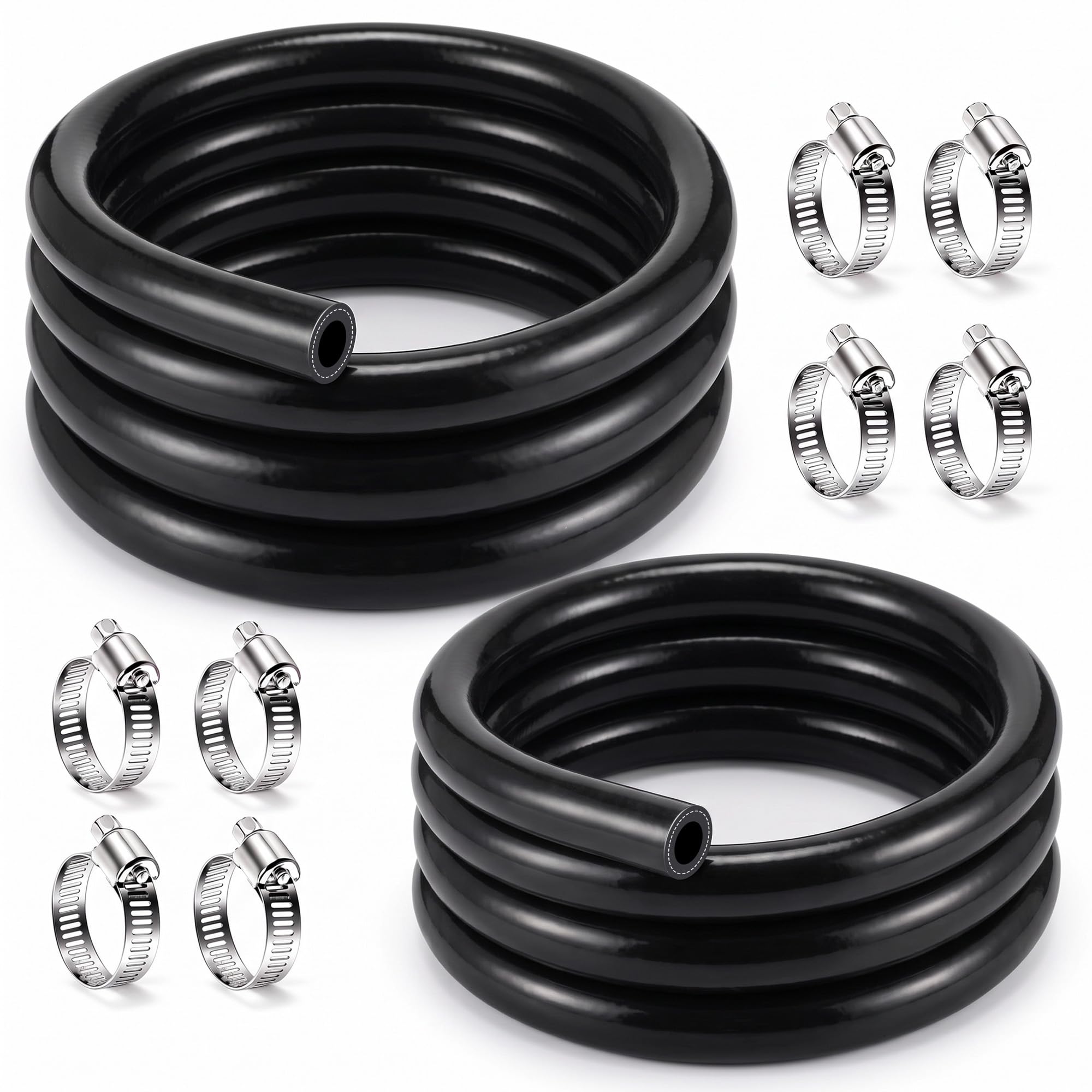
A 3/4″ and 5/8″ hose pair with 8 clamps and a 650 psi burst rating, the highest here.
Numbers first: 650 psi burst pressure and 250 psi working pressure. That burst figure is enormous for a heater hose — the EVIL ENERGY tops out at 246 psi burst and the SATUGUOJI at 232 psi, so the Meonum’s wall is built to take far more before it gives. For anyone who’s had a hose balloon or split under a pressure spike, that margin is the reason to look here. The polyester fiber reinforced cord layer is what carries that load without the wall deforming.
The kit solves the mixed-size problem in one order. You get a 3/4″ ID hose and a 5/8″ ID hose, each 5 feet long, plus 8 clamps. The 3/4″ hose measures 0.74 x 1.09 x 0.16 inch (ID x OD x thickness) and the 5/8″ under it, so you can verify fit before you commit. The temperature range is -58°F to 392°F — broad enough to stay flexible in winter and not soften at full heat. Both hoses trim to length, so custom layouts and heater-core replacements are easy.
At 2.2 pounds for the pair it’s the heaviest pick here, but that’s the reinforced wall doing its job rather than a flaw. The trade-off is simple: you’re getting a low-volume listing with a high-ceiling spec sheet, so you’re trusting the published pressure numbers over a long track record. If you want a true dual-size repair kit with serious burst margin and clamps in the box, this is the one. If you only need a single 5/8″ length, a single-hose pick is simpler.
The Case for the Kit
- 650 psi burst pressure — the highest on this list by a wide margin
- Both 3/4″ and 5/8″ hoses plus 8 clamps in one box
- -58°F to 392°F range with a polyester reinforced cord layer
What to Weigh
- Heavier at 2.2 lb for the pair than single-hose picks
- Few reviews so far — you’re leaning on the published specs
- Overkill if you only need one size
The clincher: 650 psi burst with both common diameters and clamps included makes this the safest one-order repair kit on the page.
The reality check: it’s the heaviest and least-reviewed option here, so it suits buyers who trust the specs and want margin over track record.
4. SATUGUOJI 5/8″ Heater Hose

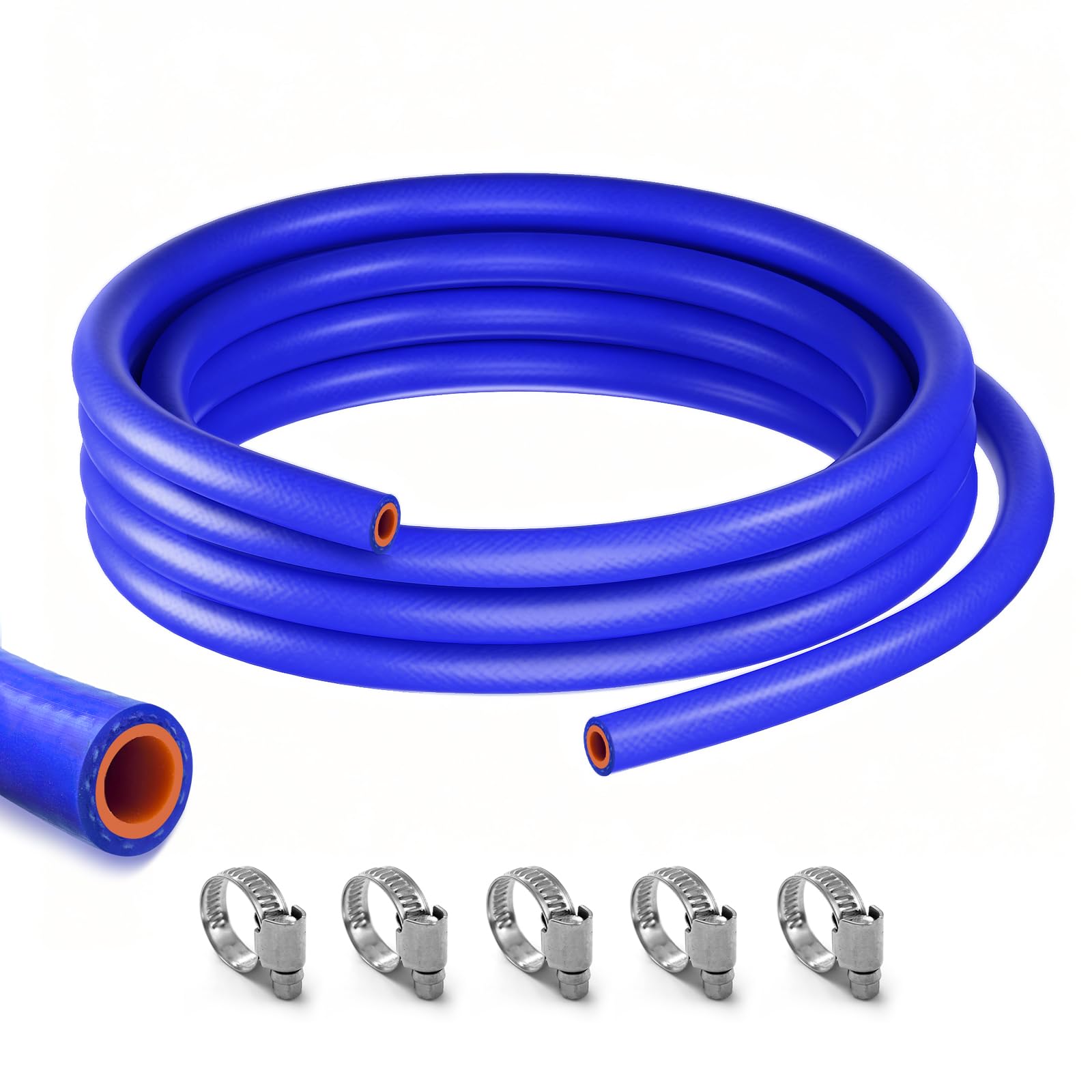
Ten feet of polyester-braided 5/8″ silicone that ships with 5 clamps.
The wall construction is what you notice first: an outer blue silicone layer around an inner orange layer, with a reinforced polyester braid running through it. That braid is the part that matters. It’s what lets the hose keep its shape and resist bulging when hot coolant pushes through — a plain unreinforced wall would soften and sag. The hose runs 10 feet at 5/8″ ID, working pressure 60 psi, burst 232 psi. Those are modest numbers, but they’re honest for a low-pressure heater and overflow circuit.
The clamp bundle is a genuine convenience. It ships with 5 clamps, which means you can cut the length you need and clamp both ends without a second trip to the parts store. What buyers notice most is quality — that’s the top positive theme on the listing — followed by the clamps themselves. Installation is straightforward: cut, slide fully onto the barb, tighten the clamp. The temperature range of -20°C to 220°C covers hot-water heater use and engine-bay heat, and the listing names hot-water heater, radiator-to-overflow, and engine cooling connections as its jobs.
Two things to note. First, this hose is not for oil — the listing is direct about that, since silicone softens and fails in oil service, so keep it to coolant, water, air, and weak acid or alkaline. Second, 60 psi working pressure is the lowest tier in this article, so if your system pushes hard, a higher-pressure pick like the Meonum kit is the safer call. For a hot-water line or an overflow hose with 5/8″ fittings, this is a tidy, clamp-included answer.
Clamps included, choices included: a 10-foot 5/8″ run with 5 clamps covers most heater and overflow replacements in one order.
Keep it to coolant: not for oil service, and the 60 psi working ceiling means high-pressure circuits belong to a tougher pick.
Made for: 5/8″ heater and overflow lines where convenience and a braided, clamp-ready kit win.
Wrong job if: you’re running oil or a high-pressure circuit — both call for different hardware entirely.
5. Vibrant Performance 20445 Silicone Heater Hose

Nylon-reinforced 5/8″ hose rated for both coolant fluid and vacuum-line service.
Most of the hoses here are coolant-only. This Vibrant Performance length carries a dual-service rating: coolant fluid service and vacuum-line service. That second job is the reason it earns a place on the list. A vacuum line sees pressure that pulls inward rather than pushes out, so the wall has to resist collapsing — and the nylon reinforcement handles that where a soft silicone tube would pinch shut. The heat ceiling is -65°F to +350°F, a range that covers everyday engine-bay temperatures with room to spare.
The length is 5 feet at 5/8″ ID versus the 10 feet you get from the SATUGUOJI, so check your run before ordering. On weight, at 1 pound it’s the lightest pick in this article; the Meonum kit runs 2.2 pounds for its pair, so this single length is easy to handle and route. Nylon reinforcement, not polyester, is the structural difference — nylon is the choice for vacuum service because it holds shape under negative pressure, and it also carries the coolant duty without complaint.
The honest limit is the warranty: 30 days. If you want a longer safety net, a hose with a one-year service like the bekelan below is the calmer bet. And the shorter 5-foot length can be tight on a long engine-bay run. But for a 5/8″ coolant line or a vacuum hose that needs to stay open under suction, the dual rating and light weight make this a smart, specific pick.
Standout Strength
- Rated for both coolant fluid and vacuum-line service
- Nylon reinforcement resists collapsing under vacuum
- Lightest pick here at 1 pound, easy to route
Honest Limits
- Only 5 feet — check your run length first
- 30-day warranty is the shortest on this list
- No pressure figures published on the listing
Pick it when: a vacuum line or a 5/8″ coolant run needs a light, nylon-reinforced hose that holds shape under suction.
Pass it over when: you need a long run or want warranty coverage beyond 30 days.
6. bek elan 3/4″ Heater Hose

The reinforced 3/4″ run built with a stated bend radius — so you can plan the route, not pray it holds.
This is the 3/4″ option to beat, and the number that earns it is the 96mm minimum bend radius. A stated bend radius tells you exactly how tight a curve the wall can take before it collapses, which is more than most budget listings give you. The construction backs it up: silicone with a 2-ply polyester reinforcement and a 4mm wall. That reinforced wall keeps the hose in shape while staying flexible enough to route through confined cooling-system spaces. Working pressure is 116 psi and burst is 232 psi, and the temperature range runs -67°F to 392°F.
You get a full 10 feet of 3/4″ ID hose, so there’s room for a long run or a couple of shorter heater connections. The outside diameter is 27mm, versus the EVIL ENERGY’s 20.7mm — that extra wall clearance is the reinforcement at work. It’s rated for coolant, antifreeze, water, and air in heater, radiator, and engine cooling systems, and the listing names a one-year warranty, which is more coverage than most picks here. Cut to length, seat it on the barb, clamp, done.
The catch is the one you’d expect from a low-volume 3/4″ blue hose: there’s no established review pattern to lean on, so the one-year warranty and the published bend radius carry the trust. And the usual silicone rule applies — this is not for oil, fuel, alcohol, or lubricants. If your fitting is 3/4″ and you want a reinforced wall you can route without kinking, the 96mm bend radius makes this the easy choice.
A number you can route by: the stated 96mm bend radius and 2-ply reinforced 4mm wall make a 3/4″ run predictable rather than hopeful.
Power in reserve: 116 psi working and 232 psi burst, plus a one-year warranty, put it well above the entry 60 psi hoses for tough 3/4″ jobs.
The one to take: a reinforced 3/4″ run with a real bend radius and a one-year warranty.
Your call: a 3/4″ fitting needs a 3/4″ hose — this won’t shrink to a 5/8″ barb, and it’s not for oil or fuel.
7. FlexFab 5/8″ Blue Silicone Hi-Temp Hose, 10 Feet

Ten feet of high-temp silicone with 300 psi burst — and it’s made in the USA.
For buyers who want their hose built at home, this is the pick. The FlexFab runs 10 feet of 5/8″ ID blue silicone with a single ply of nylon fiber reinforcement — a simpler construction than the two-ply kits, but backed by a 300 psi burst pressure and a suggested 125 psi working pressure. That burst figure beats the SATUGUOJI’s 232 psi and the Uselection’s 232 psi, which says the single-ply nylon wall still has plenty of strength where it counts. The Flexfab name on the manufacturer line and Made-in-USA origin are the reason this one carries a loyal following.
What stands out in the reviews is flexibility and quality, in roughly equal measure — the recurring note is that it conforms to curves well without kinking. That’s the value of a good silicone wall: it bends around corners without pinching off. At 1.9 pounds it’s light enough to handle easily and route around an engine bay. The 0.95-inch outside diameter is consistent with a 5/8″ ID hose, and a 10-foot length gives you room to cut for multiple connections or a long run.
Two honest notes. First, there’s no published temperature range on this listing, so if you need a stated ceiling like 392°F, a pick that advertises one is safer. Second, single-ply reinforcement is generally less rigid than a two-ply wall, so plan bends with a little more care. Neither undermines what this hose is: a solid, US-made 5/8″ run with real burst headroom and a kink-resistant reputation. For a straightforward 5/8″ replacement, it’s a confident pick.
Strength where it matters: 300 psi burst and a suggested 125 psi working pressure give a 5/8″ run real pressure margin.
Fair caveat: no listed temperature range and a single-ply wall mean you should plan routing and heat exposure with more care.
Worth choosing if: you want a US-made 5/8″ silicone run with high burst headroom and a kink-resistant wall.
Look elsewhere if: you need a published temperature ceiling — this one doesn’t advertise one.
Know the Specs
Inner Diameter (ID) and Wall Thickness
Inner diameter is the bore the coolant flows through, and it has to match your barb exactly. A 5/8″ ID (16mm) hose is a different animal from a 3/4″ one, and mixing them up is the single most common fit failure. Wall thickness — often quoted in millimetres, like a 4mm wall — is the solid silicone between the bore and the outside. A thicker wall generally resists bulging and holds pressure better. Measure the fitting, not the old hose’s outer surface.
Working Pressure vs Burst Pressure
Working pressure is where the hose is meant to operate; burst pressure is the failure point. The gap between them is your safety margin. A hose with a 60 psi working rating and a 232 psi burst is fine for a low-pressure heater loop, while a reinforced kit rated to 250 psi working and 650 psi burst is built for pressure spikes. Always compare like with like — working to working, burst to burst — and leave headroom for the occasional surge at startup.
Reinforcement: Polyester vs Nylon Cord
The cord layer inside the wall is what stops a hose ballooning or collapsing. Polyester fiber reinforcement is common in coolant and heater hoses, keeping the wall stable under heat and pressure. Nylon reinforcement is the choice when the hose also carries vacuum, because it resists inward collapse. A single ply is lighter and more flexible; a two-ply wall is generally stiffer and holds shape better on tight routing. Neither is “best” — match the reinforcement to the job.
Temperature Range and Bend Radius
Temperature range tells you how cold and how hot the hose can go while staying flexible — a spread like -67°F to 392°F is common in reinforced silicone. Bend radius tells you how tight a curve the wall tolerates before it kinks and cuts off flow. If a listing publishes a minimum bend radius, use it to plan your route; if it doesn’t, plan gentler curves. These two figures together define how the hose behaves in a real, cramped engine bay.
Common Questions
Will a 5/8″ silicone heater hose fit a 3/4″ fitting?
What is SAE 20R3 Class A on a heater hose?
Can I use a silicone heater hose for oil or fuel?
What’s the difference between working pressure and burst pressure?
Why does my silicone hose keep kinking?
How hot can a silicone heater hose get before it fails?
Do I need to replace the clamps when I replace the hose?
Is a thicker wall always better for a heater hose?
What length should I order for a heater-hose replacement?
Are the numbers on these hoses safe for a standard cooling system?
The Bottom Line
For most buyers, the silicone heater hose winner is the EVIL ENERGY 1/2″ 10-footer because it’s the rare budget-priced hose that actually meets a real SAE 20R3 Class A standard, stays flexible from -67°F to 356°F, and bends around tight corners without kinking. If you want maximum burst headroom and both common diameters in one box, grab the Meonum kit with its 650 psi burst and 8 clamps. And for a reinforced 3/4″ run you can route confidently, the bek elan 3/4″ hose is the one to reach for, thanks to its 96mm minimum bend radius and one-year warranty.
How we choose
We do not accept paid placement. Every pick is matched to a real buyer and a real use-case; we do not hands-on test units.
Sources
Specifications: manufacturer listings and product documentation. Review insights: verified customer reviews, as of November 2026. Pricing: not shown on this page (it changes often); check the current price via the retailer link.
As an Amazon Associate, Tactical Gear Guy earns from qualifying purchases. This does not affect which products we feature.