Specs are compiled from manufacturer listings and verified buyer reviews and can change over time — please confirm the key details on the product page before buying.
You want a scanner that pairs with your phone, reads the barcode the first time, and does not die halfway through a stock count. The hard part is that cheap models often miss codes and pricier ones bundle features you will never use. This guide separates scanners that hold up on a warehouse floor from ones that only look good in the listing photo, so you can match the scanner to how you actually work.
This guide is built by comparing the manufacturers’ published specifications and the patterns across verified customer reviews, so you get each pick’s real strengths and trade-offs instead of marketing spin.
Start with the sensor and connection modes, then check battery capacity and drop rating. That order keeps you from overpaying for extras while missing the spec that decides whether a scan lands on the first trigger pull. Here is what matters most in a Bluetooth barcode scanner, and which models hold up.
Top Picks


How To Choose The Best Bluetooth Barcode Scanner
A Bluetooth barcode scanner is a barcode reader that sends the scanned code to your phone, tablet or computer over a short-range wireless link instead of a cable. The choice that changes your day most is 1D versus 2D. A 1D scanner reads the striped linear barcodes on product labels. A 2D imager reads those plus square QR codes, PDF417 and Data Matrix, and it can also read a code shown on a phone screen.
Match the sensor to the codes you actually scan
If your work is retail receiving, book scouting or library stock, the striped UPC and ISBN labels are all 1D, so a 1D scanner covers you. If you scan shipping labels, driver’s licences or codes shown on a screen, you need a 2D imager with a CMOS sensor (a tiny camera chip that captures the code as an image). A laser-style 1D head often cannot read a glowing screen at all.
Check the Bluetooth profile before you buy
A scanner talks to your device through a Bluetooth profile, which is the agreed language the two use. HID makes the scanner act like a keyboard and type the code in, which works with almost any app. SPP and BLE are the other common modes and matter when your own software expects them. If an app such as an inventory platform only accepts one mode, a scanner that supports that mode will pair smoothly while a cut-down unit will not.
Read battery capacity as shift time
Battery capacity is given in mAh (milliamp-hours, a measure of stored charge). A bigger number usually means longer runtime between charges. Compare it against how many hours you scan per day, and note whether the scanner can run while charging over USB, which keeps a busy counter from stopping to refuel. A cradle you drop the scanner into between sales is the other easy fix for a shorter battery.
Treat the drop rating and case as part of the tool
Barcode scanners get knocked off counters and dropped on concrete. A stated drop rating and a protective outer case tell you how much punishment the body is built for. A wrist strap or neck strap is cheap insurance against a fall, and vibration or a loud beeper helps you confirm a scan in a noisy room where you cannot hear the usual chirp.
Side-by-Side Comparison
| Model | Best For | Sensor | Battery | Connection Modes | Amazon |
|---|---|---|---|---|---|
| Eyoyo 3-in-1 Portable Mini 1D★ Best Overall | Book scouting and light retail | 1D linear | 1000mAh | Bluetooth, 2.4G, USB wired | Amazon |
| Tera HW0002 2D WirelessBest Value | Mixed 1D and 2D inventory | 640 x 480 CMOS, 1D/2D | 2200mAh | Bluetooth, 2.4G, USB wired | Amazon |
| Inateck BCST-70 1DTop Performer | Rugged long-range scanning | 1D linear | 2600mAh | Bluetooth, USB cable | Amazon |
| Tera HW0009 with Screen | On-device settings control | 1D/2D QR | 2500mAh | Bluetooth, 2.4G, USB wired | Amazon |
| ScanAvenger SA8900 1D/2D | Long-range open-area scanning | 1D/2D imager | 2200mAh | Bluetooth, USB wired | Amazon |
| NADAMOO 2D with Charging Dock | Offline batch scanning | CMOS, 1D/2D | — | Bluetooth, 2.4G, wired | Amazon |
| NETUM E800 2D | Phone-mounted mobile scanning | 1D/2D linear | 1200mAh | Bluetooth | Amazon |
| Zebra Symbol DS2278-SR | Wi-Fi friendly business checkout | 2D/1D imager | — | Bluetooth, USB cable | Amazon |
| Zebra Symbol LI4278 | High-volume retail counters | 1D linear | 3 AAA batteries | Bluetooth, USB cable, wireless | Amazon |
Detailed Reviews
1. Eyoyo 3-in-1 Portable Mini Barcode Scanner
Our pick — 4.5+★ from 850+ verified ratings; the strongest balance of quality and price.
The pocket scanner that booksellers reach for when a shelf of spines needs a fast pass.
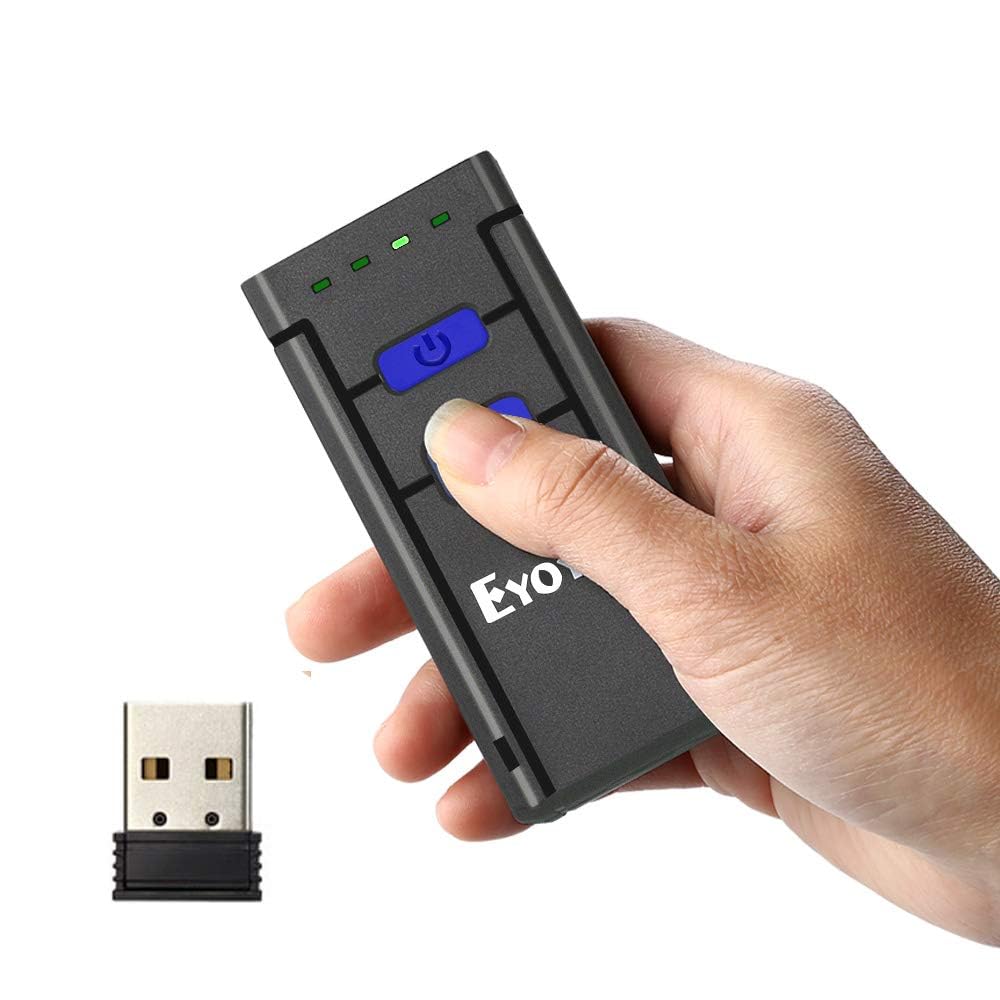
Book scouting and small-shop inventory are where this one makes its case. The mini shape is built to sit in a pocket or bag between scans, so you are not carrying a full-size gun around a warehouse aisle. It also pairs with the ScoutIQ and Scoutly apps that resellers use to check a title against the market, which is the workflow that turned this scanner into a common sight at library sales and thrift stores.
Three connection routes mean one device covers several setups. Bluetooth pairs it with a phone or tablet, 2.4G wireless links it to a desktop or laptop without Bluetooth, and USB wired mode sidesteps interference entirely when you sit at a fixed desk. It supports the HID, BLE and SPP Bluetooth protocols (the languages your software may need), so if your app accepts barcode input through one of them, the scanner slots in without extra drivers. The 1000mAh battery is rated for up to 15 hours of normal use, and you can keep scanning while it charges over USB.
What wins people over is reliability under daily use — buyers report it keeps reading ISBN labels correctly across a long book-scouting shift. It also handles setup that could go wrong, with Bluetooth pairing that owners rarely report trouble with. The trade-off is battery confidence: the runtime is the one area where feedback is split, so a heavier all-day scanning habit is better served by a unit with a larger cell, like the Inateck at 2600mAh. It also reads only 1D striped barcodes, so a QR or screen code is out of reach. Small shops and book resellers get a compact workhorse that fits their app stack.
tiny inventory tagger
- Pocket design plus wrist strap keeps it secure on the move
- Bluetooth, 2.4G and USB wired in one device
- ScoutIQ and Scoutly compatibility suits book scouting
- Runs while charging over USB for uninterrupted scanning
- Custom prefix and suffix digits for tailored output
short battery window
- Hottest concern is battery life under continuous scanning
- 1D-only sensor cannot read QR or screen codes
- Neck strap not included
small stockrooms: you scan striped product or ISBN labels with an app like ScoutIQ and want a pocket-sized scanner with three connection routes.
long shifts: your workflow runs on QR or screen codes, where a 2D imager is the right tool.
2. Tera HW0002 Barcode Scanner
A 2200mAh pouch cell and a live battery gauge — the scanner that tells you when it is running low before checkout stalls.
The battery indicator is the detail that earns this one a slot. It shows remaining power in real time, so staff can plan a charge before a rush instead of finding out at the register that the scanner is flat. Underneath sits a 2200mAh lithium-polymer pouch battery, rated for over 500 charge cycles, which is a shape chosen for steady power delivery rather than the older cylindrical cells.
Scanning covers both barcode families. A 640 x 480 CMOS sensor reads 1D and 2D codes, including printed and digital codes as small as 3 mil, and OCR character recognition lets it read barcodes on ID documents. Three connection modes — USB wired, Bluetooth and the included 2.4G dongle — reach up to 197 ft in open areas. That 197 ft compares with the Inateck’s 115 ft, while the Tera Pro with screen is rated at 328 ft. On weight it sits at 10.5 ounces versus the Inateck’s 7.04 ounces.
For loud floors and busy counters, the adjustable buzzer, switchable vibration and LED give you three ways to confirm a scan landed. The honest note is reliability: the feedback splits between units that run great and units that give out early, so buy from a seller with a clean return path. When it works, it reads 1D and 2D codes like a mid-range imager, and the live battery gauge genuinely helps.
battery level readout: the vibration and adjustable beeper matter on a noisy warehouse floor where you cannot hear a chirp.
wired-only charging: reliability is the uneven part of the story — some units fail early, so keep the receipt handy.
shared counters: retail and warehouse teams that want 1D and 2D reading plus a battery gauge to avoid surprise downtime.
silent aisles: you need flawless long-term reliability above all, since the record here is mixed.
3. Inateck BCST-70 Barcode Scanner
A 2600mAh cell and a case built to bounce off concrete — the endurance pick for a full shift.
Battery and toughness are the two reasons this scanner shows up on so many lists. The 2600mAh cell is the biggest on this page, and a full charge gives 180 days of standby, so it sits ready without needing a top-up between busy stretches. That cell is 2600mAh versus the Eyoyo’s 1000mAh, a gap that matters if you scan all day away from a charger.
The outer TPU protective case is described as twice as thick as similar products, with internal core parts held by triple consolidation treatment. It absorbs repeated 6ft drops to a concrete floor, which is the kind of abuse a warehouse scanner actually takes. At 7.04 ounces it is the lightest of the rugged picks here, so a long shift with it in hand wears less on your wrist.
Setup takes about 3 seconds from the start, across English, German, French, Italian and Spanish keyboards, and it works with POS, iOS, Android, Windows, Mac OS, Linux and Raspberry Pi. The 1D head reads blurry or broken barcodes under strong and dim light. Connection reaches above 115 ft, and editable prefix or suffix settings run to 32 digits, with the ability to hide part of a barcode for privacy at the counter. Accuracy is the part buyers keep praising, including scanning from 20 feet. The catch is scope: it reads 1D only, so QR and screen codes are out. For long-range striped-label scanning in a tough environment, this is the endurance play.
bulk scanning: long shifts and concrete floors — a 6ft drop rating and the largest battery here keep it running.
QR codes: a 1D-only sensor, so screen and QR codes are not on the menu.
4. Tera HW0009 Barcode Scanner
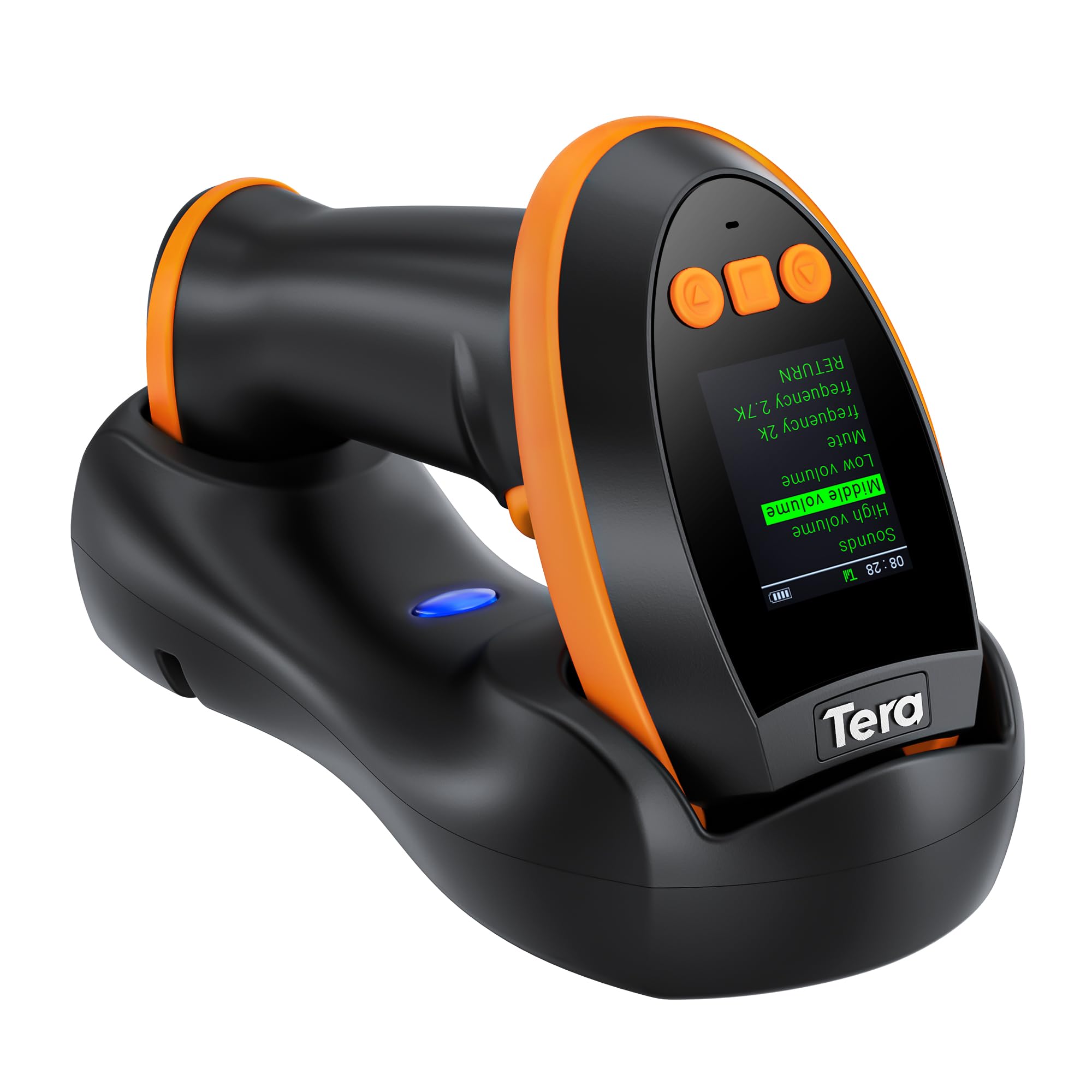
A small screen on the scanner itself, so language, volume and totals are set without a manual.
This is the pick for the person who dislikes digging through configuration barcodes in a manual. A built-in screen lets you set the language, adjust volume, choose the connection and view stored versus total barcode counts, all from the device. For a team that hands scanners between staff, having those controls on the unit saves a lot of setup grief.
Range is the standout number. It reaches 328 ft in a barrier-free space using the 2.4G dongle and 114 ft with obstacles in the way, compared with the plain Tera HW0002 at 197 ft. A 2500mAh battery is backed by a charging cradle, so you drop it in between sessions and it tops up without hunting for a cable. The cradle also holds the built-in 2.4G receiver, so there is no separate dongle to lose. Code coverage is broad: 2D types include QR, Data Matrix, PDF417 (including the code on a driver’s licence), Aztec, Maxicode, Micro QR and Micro PDF417, and the 1D list runs through UPC/EAN, Code 128 and the GS1 family.
The even-handed read is durability. The functionality and setup draw steady praise, but reliability and durability feedback splits, with some units giving out after a couple of months. It sits at 14.72 ounces versus the Inateck’s 7.04 ounces, so a long hand-held shift is more tiring. The carry case is the cradle-plus-screen convenience — worth it if you want on-device control and a charging dock, and less so if you need a rugged body.
onboard screen display
- On-screen settings and barcode totals
- 328 ft open-area range with the 2.4G dongle
- Charging cradle houses the receiver
- Wide 1D and 2D code coverage including PDF417 on licences
pricey upgrade
- Durability feedback is mixed on long-term use
- 14.72 ounces is heavy for all-day handheld work
- Screen and cradle add bulk versus a bare scanner
data checks: you want settings, volume and counts controlled right on the scanner plus a charging dock on the counter.
tight budgets: a rugged, lightweight body matters more than the screen, where the Inateck is the better match.
5. ScanAvenger SA8900 Barcode Scanner

A 493-foot open-air reach and a 20-hour battery — the pick for scanning across a big yard or floor.
If you scan from one end of a space to the other, this is the one to look at. It transmits up to 493 feet with no obstacles in the way, and around 98 ft through medium-density obstacles, compared with the Inateck’s 115 ft and the plain Tera’s 197 ft. The 2200mAh lithium-ion battery supports up to 20 hours of continuous scanning after a full charge, so a long shift rarely needs a mid-way top-up.
It needs no software or app to start. Connect over Bluetooth or USB to a Mac, Windows PC, Android or Apple device, and a POS system, then scan in manual or auto-sense mode. Both barcode families are covered — 1D codes like UPC, EAN, Code128, Code39, Code11 and Codabar, and 2D codes like PDF417, Aztec, Data Matrix, QR and Micro PDF. The notable exclusion is Maxicode. Vibration feedback confirms a scan on a noisy floor, and the 5.46-ounce body is genuinely light in hand.
What raves loudest is build quality, with reliability close behind — owners trust it to keep scanning through drops and long shifts. The one compatibility fact to check first is that it does not work with Square or Shopkeep, so confirm your POS before buying. For a large floor, a yard, or any job where the scanner and the device are far apart, the long reach and all-day battery make it a strong choice.
long range pickup: 493 ft open-air and 98 ft through obstacles let you roam far from the receiver.
setup quirks: it does not work with Square or Shopkeep, so verify your POS before you commit.
warehouse aisles: you scan across a large space and want the longest reach and all-day runtime on this page.
phone pairing: you run Square or Shopkeep, which this scanner does not support.
6. NADAMOO 2D Wireless Barcode Scanner with Charging Dock

Scan far from the receiver, then upload the whole batch later — storage mode sets this one apart.
Offline storage is the reason to notice this scanner. In storage mode it holds up to 100,000 barcodes internally, so you can scan far from the receiver and batch-upload the data when you are back in range. That suits a warehouse walk-through or a stocktake where you roam away from the base, in a way the instant-upload scanners cannot match.
A charging dock keeps the power topped whenever the scanner sits on it. Three connection routes — Bluetooth, a 2.4G base receiver and wired — cover laptops, PCs, phones, tablets, iPhone, iPad and POS, working with Windows XP/7/8/10, Mac OS, Windows Mobile, Android and iOS. Transmission runs up to 50m / 164ft in barrier-free space. The CMOS sensor reads 1D and 2D codes, including QR, PDF417 and Data Matrix, from paper and from screens like a monitor, phone or tablet, which makes up for the screen-reading gap a laser scanner has.
The honest caveat is long-term reliability. Compact size and ease of use land well, but the record on durability is uneven, with some units giving out inside a couple of months. Buy it for the storage-and-dock workflow, and keep a return path open. For batch scanning away from the base, few here match its 100,000-code buffer.
desk stations: roaming stocktakes where you scan out of range and upload a 100,000-code batch later.
travel kits: you need proven long-term durability, since that is the weakest part of its record.
7. NETUM E800 Barcode Scanner

It clips to your phone so you can scan and read the screen at the same time.
This one is designed around the phone. A back clip fixes it to a mobile device, so you can scan a barcode and check the data on your phone in the same motion. It also works standalone as an ordinary Bluetooth scanner, and the small body fits the palm for one-handed operation — useful for retail point of sale, order entry and field service where your other hand is busy.
You can scan both common barcode families with the E800. It reads most 1D codes (the classic single-line barcodes) and 2D codes (square codes that hold more data) — ISBN/UPC/EAN, Code39, Interleaved 2 of 5, Code93, Code 128, Codabar, QR and Data Matrix — from printed labels or from a screen. One gap to know: GS1 codes (the retail and logistics standard) are not supported. It offers Bluetooth HID, SPP and BLE modes (three ways to pair over Bluetooth), so it connects to Windows, Mac OS, Android and iOS. You can use a manual trigger, or continuous scanning, where it reads the barcode as soon as it is detected without pressing the trigger.
Its 1200mAh rechargeable battery is the smallest in this list, rated for more than 8 hours of continuous scanning — so a double shift would need a charge partway through. Scanning is where it pleases: it handles hard-to-read codes, including barcodes like serial numbers and MAC addresses. Reliability is the uneven part, so buy from a source that stands behind it. If you work from a phone and want both hands free, the clip is what separates it from a standard gun-style scanner.
phone pairing ease: the back clip turns your handset and scanner into one unit you can read and trigger together.
modest battery: 8 hours of scanning on a 1200mAh cell means a charger nearby for long days.
mobile setups: field service and phone-based retail where a clip-on scanner keeps one hand free.
all-day runs: you need GS1 codes, which the E800 does not read, or many hours per charge.
8. Zebra Symbol DS2278-SR Barcode Scanner

The business-grade imager that dodges Wi-Fi congestion, with omni-directional scanning so you never line up a code.
Wi-Fi Friendly Mode is the feature no budget scanner here has. Zebra’s proprietary mode keeps the DS2278 operating on channels that are not shared with your WLAN, protecting wireless service levels for staff and customers in a busy store. If you have ever watched a scanner fight your store Wi-Fi, this is the fix.
Scanning range runs from 0.5 in. to 14.5 in. (1.23 cm to 36.8 cm), and the imager scans omni-directionally, so you point and shoot without aligning the code and the head. It arrives pre-configured and works straight from the start with no setup. It ships as a kit — scanner, cradle, battery, USB cable and manual — and pairs over Bluetooth or a USB cable. You can also control the beeper, LED and symbology settings, and read scanned data and model info, from a Windows, Android or iOS host.
The fair caveat is the user experience for less technical staff, where opinions divide, and reliability feedback splits between units that run excellently and units that stop. At 16 ounces it is one of the heavier handhelds here. For a checkout counter inside a Wi-Fi-dense retail space, the channel isolation and omni-directional read are real advantages worth paying for.
busy retail: your store runs busy Wi-Fi and you want a scanner that stays clear of it with hands-free omni-directional reads.
budget buyers: your staff are not tech-savvy, since setup opinions are divided on this one.
9. Zebra Symbol LI4278 Barcode Scanner

A recognised retail counter scanner, sold as a full kit with cradle and cables.
This is the model you are most likely to have seen at a checkout already. It ships as a complete kit with the cradle and USB cables, uses a 35-degree field of view for easy aiming, and connects over Bluetooth or USB cable to a desktop, laptop, tablet or smartphone. At 7.8 ounces, versus the DS2278’s 16 ounces, it helps on a counter staffed through a long shift.
Functionality is the part buyers rely on — it scans 1D labels as expected at the counter, and ease of use reinforces that. The things to weigh are the price and the battery arrangement. It runs on 3 AAA batteries, so you manage disposables or rechargeables yourself rather than plugging in a built-in cell. Reliability feedback is split between units that work as expected and units that give out, and value opinions divide as well.
For a retail counter that wants a familiar scanner from a recognised brand with a cradle and cables in the box, this fits. If you would rather have a built-in rechargeable battery and a charging cradle combined, the Tera HW0009 or NADAMOO cover that in a different way. Otherwise, this is the straightforward counter pick.
legacy systems: a retail counter that wants a known-brand scanner with cradle and cables in one kit.
screen scanning: it runs on 3 AAA batteries and the reliability history is uneven, so plan for replacement cells.
Know the Specs
Sensor: 1D vs 2D
A 1D sensor reads the striped linear barcodes on product labels and ISBNs. A 2D imager uses a CMOS camera chip to capture square codes like QR, PDF417 and Data Matrix, and can also read codes shown on a screen. If you scan shipping labels or digital codes, choose 2D; if you only scan striped labels, 1D covers you at a lower cost.
Battery Capacity in mAh
mAh (milliamp-hours) measures stored charge, so a larger number usually means longer runtime between charges. Compare it to your daily scanning hours, and check whether the scanner can run while charging over USB. A larger cell like the Inateck’s 2600mAh suits all-day work, while a 1000mAh cell such as the Eyoyo’s is better for lighter tasks.
Bluetooth Profiles: HID, SPP, BLE
These are the languages the scanner and your device agree on. HID makes the scanner act like a keyboard and type the code in, which works with nearly any app. SPP and BLE matter when your own software expects them. Check that your app accepts one of the modes the scanner supports before you buy.
Transmission Range and Drop Rating
Range is the distance the scanner can send data before losing the link — longer reach helps when you roam. The drop rating tells you how much a fall the body is built to handle, and a protective case adds to that. A wrist strap or neck strap is cheap insurance against a drop.
Common Questions
Will a Bluetooth barcode scanner work with my phone or tablet app?
Can a 1D scanner read QR codes on a phone screen?
How long does a scanner battery last on a full charge?
Do all these scanners support Square or Shopkeep?
What does offline storage mode do on a barcode scanner?
What is the difference between Bluetooth and 2.4G wireless on these scanners?
How far can a wireless barcode scanner transmit?
Will heavy scanning wear out the scanner body over time?
Can these scanners read codes printed on ID documents or driver’s licences?
The Bottom Line
For most small-business and book-scouting setups, the Eyoyo 3-in-1 Portable Mini 1D is the pick to buy — a pocket-sized scanner with Bluetooth, 2.4G and USB in one body, and app support for ScoutIQ and Scoutly. If you need long-range striped-label scanning that survives hard knocks, the Inateck BCST-70 with its 2600mAh battery and 6ft drop rating is the endurance choice. And for scanning far from the receiver over a large floor, the ScanAvenger SA8900 and its 493 ft reach is the one to reach for.
How we choose
We do not accept paid placement. Every pick is matched to a real buyer and a real use-case; we do not hands-on test units.
Sources
Specifications: manufacturer listings and product documentation. Review insights: verified customer reviews, as of November 2026. Pricing: not shown on this page (it changes often); check the current price via the retailer link.
As an Amazon Associate, Tactical Gear Guy earns from qualifying purchases. This does not affect which products we feature.