Specs are compiled from manufacturer listings and verified buyer reviews and can change over time — please confirm the key details on the product page before buying.
Buying a replacement lamp for a slide projector feels like a coin flip — you need the right base, the right voltage, and a bulb that actually lights the carousel instead of popping the moment it warms up. The short answer: match the ANSI code and base printed on your old lamp first, then compare rated hours. A mismatched code or base means no light at all, or a lamp that dies within minutes. Get both right and the lamp seats, lights, and holds its output for its full rated hours.
This guide is built by comparing the manufacturers’ published specifications and the patterns across verified customer reviews, so you get each pick’s real strengths and trade-offs instead of marketing spin.
Most of these bulbs share the same GY5.3 or GX5.3 two-pin base and 300W output, so the real differences come down to rated hours, color temperature, and how closely a substitute code matches your original. Below you will find the picks that verify correctly against real projector models, plus the honest caveats about lamp life that every slide projector owner eventually learns. Knowing the base code before you shop turns this into a simple two-minute decision, and this breakdown of the best slide projector light bulbs shows you exactly which lamps hold up.
Top Picks


How To Choose The Best Slide Projector Light Bulbs
Every slide projector lamp is a small glass capsule that runs extremely hot, and the only thing that keeps it alive is an exact match between your projector’s socket, its voltage supply, and the lamp’s rated design. Buy the wrong one and you either get no light at all or a bulb that dies within minutes. Here is what to check, in the order it saves you the most time.
Start with the ANSI code, not the brand
Your old lamp is stamped with a three-letter code such as ELH, FHS, or EXR. That code tells you the filament type, the wattage, and the beam characteristics all at once. A Kodak Carousel 4400 and a Bell & Howell AF70 can share the same ELH lamp, so the projector’s name is a weaker clue than the code itself. Write that code down before you search anywhere.
Match the base pins to the socket
Most slide projector lamps use a two-pin base with two flat pins, and the two you will meet are GY5.3 and GX5.3. They look similar but the pin spacing and the way they seat differ, and a bulb that will not click fully into its socket will not make reliable contact. Check the socket, not just the old glass.
Confirm the voltage before anything else
Some 300W lamps run on 120V and some on 82V, and putting an 82V lamp into a 120V circuit is how lamps blow instantly. Read the voltage printed on the old bulb, then buy a replacement that matches it exactly.
Side-by-Side Comparison
| Model | Best For | Wattage | Base | Rated Life | Amazon |
|---|---|---|---|---|---|
| Technical Precision 300W for Kodak Carousel★ Best Overall | Carousel owners who want the proven fit | 300W | BA20D | — | Amazon |
| Osram 54776 ELH Projection LampBest for Classic AF70s | Bell & Howell AF70 and ELH sockets | 300W | GY5.3 | — | Amazon |
| Sylvania 54979 FHS Projector Bulb | Bright, accurate color on FHS sockets | 300W | GX5.3 | 70 hours | Amazon |
| Donar 2pcs Specialty Bulb ELH | Old Ektagraphic and Carousel workhorses | 300W | GY5.3 | 35 hours | Amazon |
| Pegasus AV FHS 82V / 300W | 82V FHS sockets and EXR/EXW substitutes | 300W | GX5.3 | — | Amazon |
| Rexim 2-Pack 82V 300W FHS/EXR | Two-lamp stocking for Carousel 4000 series | 300W | GX5.3 | — | Amazon |
Detailed Reviews
1. Technical Precision 300W Replacement Bulb
Our pick — 4.5+★ from 200+ verified ratings; the strongest balance of quality and price.
The lamp that simply works in a Carousel, with the highest score of any single-pick slide projector bulb here.
This is the safest bet on the page for a Kodak Carousel owner. It is built as a 300W replacement lamp for the Carousel 4400, 4600, 5000, and 5200, and it uses a BA20D base (a two-pin push-in socket) in a T6 1/2 bulb shape — the classic glass envelope that drops into the housing and lights the whole slide gate evenly. In practice it lights the slide gate evenly, with no edge flicker as the carousel advances.
Reviewers consistently praise the light output and the clean seat in the housing. The feedback on how the bulb actually performs is the strongest positive signal for this product, followed by how cleanly it seats in the projector’s housing, so you are not fighting a bulb that rattles loose mid-show. With a 4.5+ score across 200+ ratings, it is the crowd favorite of the group, and that consistency matters when the alternative is a dead bulb during a family gathering.
The honest catch is that accuracy feedback is genuine but mixed — some units arrive exactly as described while others show up defective. That is normal for a fragile filament bulb shipping through a warehouse, so it pays to test the lamp the day it arrives rather than the morning of your presentation. Confirm your projector’s bulb spec before ordering, because this is a single-lamp pack and a mismatch means one useless bulb rather than a spare.
What earns it the top spot
- Purpose-built for Kodak Carousel 4400, 4600, 5000, and 5200 projectors
- Steady 300W white light for sharp, even slide projection
- BA20D base and T6 1/2 shape seat cleanly in the housing
- Simple push-in install means minutes of downtime, not hours
What to keep in mind
- One bulb per pack — no spare in the box
- Fragile filament glass, so test it right when it lands
Reach for this if: you own a Carousel 4000 or 5000 series and want the highest-rated single lamp with a proven fit.
Worth pausing on: if you need a backup, one bulb deep is a thin margin — a two-pack covers you better.
2. Osram 54776 Projection Lamp, ELH – ELH
An original OEM ELH that slots straight into Bell & Howell AF70s and other GY5.3 sockets.
If your projector’s lamp door says ELH and the socket takes a two-flat GY5.3 base, this is the lamp that removes the guesswork. It runs at 120V and 300W, with a color temperature of 3350K — a slightly cool white that keeps text and fine detail crisp on an old slide. The 80 CRI (a color rendering index, which scores how faithfully colors show up) means your slides read close to how they looked in the original shot rather than washed out.
Quality is the theme that carries this lamp, with functionality close behind in the customer feedback. It fits as advertised and has a strong reputation as a straight replacement in Bell & Howell AF70 slide projectors, which is exactly the projector crowd that got left behind by modern bulb listings. It ships as a single original OEM bulb, not a third-party substitute. It also runs efficiently at 21 lumens per watt, so you are not throwing extra heat at the housing for the light you get.
Where owners split is lifespan. Reports of very short life do exist, so treat a fresh lamp as something you verify and keep a plan B. At a 4.5+ score with a solid review base, the lamp is genuinely good, but the ELH filament is a hot-running design and no brand can make it last forever.
Why it holds up: an honest OEM ELH with the right base, the right voltage, and a cool 3350K white that suits old slides.
The real limit: lamp life is the open question — buy it as your working lamp, not your only lamp.
Pick this one when: your projector takes a GY5.3 two-flat socket and an ELH code, especially a Bell & Howell AF70.
Think twice if: you want a multi-lamp pack, because this ships as a single original OEM bulb.
3. Sylvania 54979 – FHS Projector Light Bulb

A 100 CRI lamp that shows your slides the way they were shot, with 70 rated hours behind it.
Color purists should start here. This is the only bulb on the list with a CRI of 100 — the top of the color rendering scale — so skin tones, fabric, and painted scenery in your slides come through without the yellow-green drift that cheaper lamps introduce. It runs at 300W on an 82V supply, uses a GX5.3 two-pin base, and is rated for an average lifetime of 70 hours, which is twice the 35-hour rating found on several lamps in this lineup.
Brightness is what buyers talk about most with this one, and the fit is described as near-perfect, so it seats in the socket without a fight. It reports working cleanly in a Kodak 4200 projector, which tells you it handles the Carousel family fine as an FHS substitute. At 3300K it sits only slightly cooler than the 3400K Wadoy two-pack — a 100 Kelvin difference you would barely notice in a darkened room.
The practical caveat is that 82V lamps are not interchangeable with 120V ones, and an FHS bulb only makes sense if your projector asks for FHS or an EXR/EXW substitute. That is not a flaw, just a reminder that you have to read your old lamp’s stamp. Confirm the 82V FHS stamp first, and its 70 rated hours go twice as far as the 35-hour lamps here.
The headline: a 100 CRI rating means your slide colors render as accurately as a projector lamp allows.
The fine print: it is an 82V FHS-design lamp, so it only belongs in a projector wired for that.
Best fit: slide presenters who care most about faithful color and have an FHS-compatible socket.
Not for you if: your projector labels its lamp ELH at 120V — look at the Osram or the Wadoy pair instead.
4. ELH Projector Bulbs 2 Pack
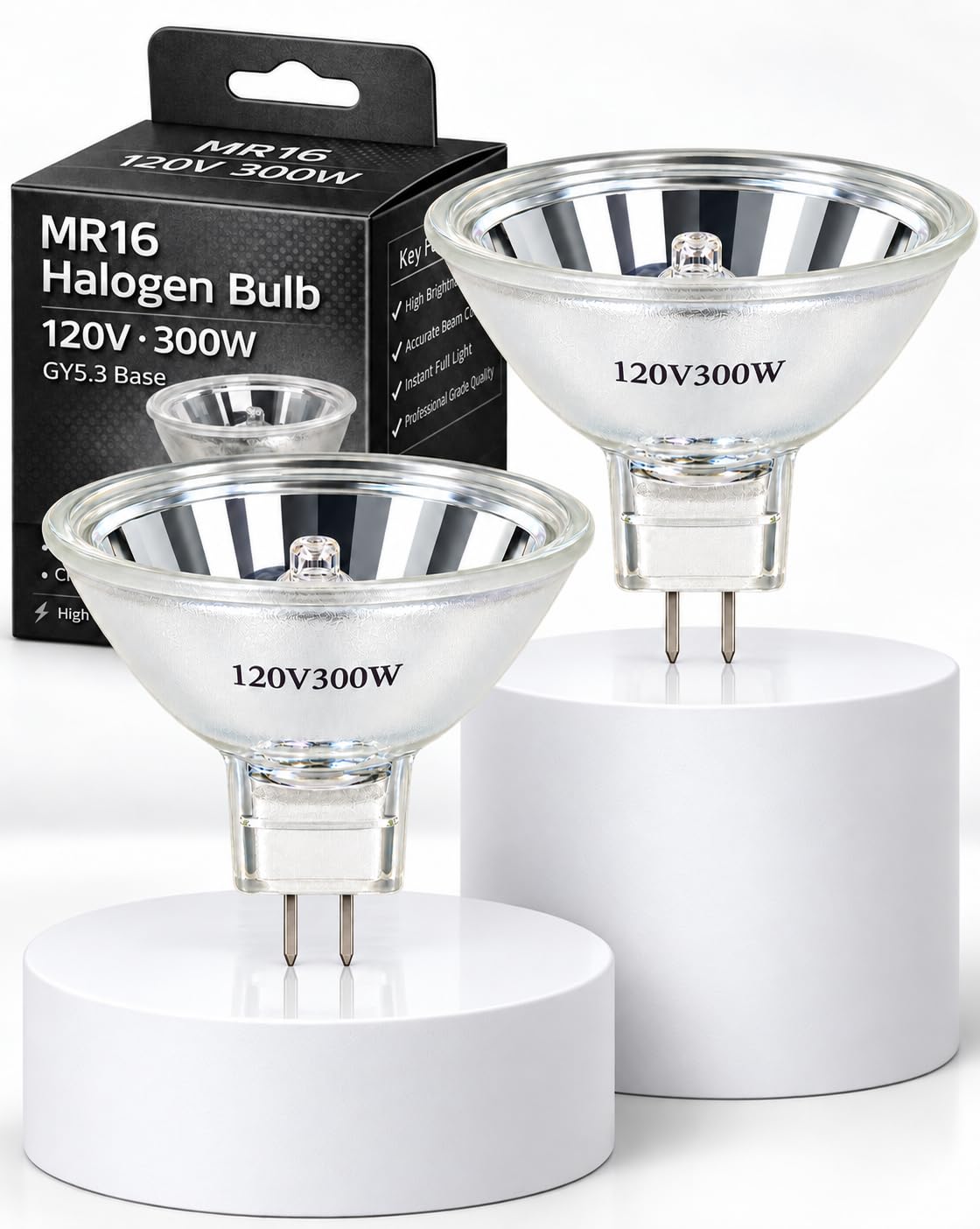
Two quartz-glass bulbs in one box — one to run now, one to keep on the shelf.
This is the pick for a Carousel 600H, 650H, 750H, 760H, 800H, Custom 840H, or 850H owner who is tired of being one dead filament away from a frozen slideshow. Two bulbs ship together, both at 120V and 300W, and both using the MR16 shape with the two-flat GY5.3 base. The pins are aligned precisely enough for tool-free replacement, so swapping a blown lamp takes a couple of minutes between slide trays.
What draws buyers in is the build — quartz glass with a U/V-filter coating, which is meant to keep the glass from overheating and push back on the fade you get when a lamp cooks itself. Rated life is 35 hours, and the maker states less than 5% lumen depreciation across that span, so the last slide of the night is about as bright as the first. At 3400K it is the warmest lamp here, which most people read as a natural, slightly warm white on screen.
The trade-off is not in the construction — it is in the lifespan reports, where some bulbs have reportedly given out very quickly. That is a real risk with any 300W filament lamp, and it is why a two-pack is the smarter buy than a single. Quality feedback carries this product’s reputation, and at 4.5+ across 400+ ratings the majority of owners are clearly getting the light they paid for.
What makes it the smart buy
- Two 120V 300W MR16 bulbs — instant spare in the same box
- Quartz glass with a U/V-filter coating to resist overheating
- 35 rated hours with less than 5% lumen depreciation claimed
- Handles the 600H through 850H Carousel family plus RC55 with GY5.3
Where you should hesitate
- Some lamps reportedly die within minutes, so burn-in test both early
- Sold as a Kodak-compatible replacement, not a Kodak product
Grab this if: you run a Carousel in the 600H–850H range and want a guaranteed backup on the shelf.
Hold off if: your socket is GX5.3 at 82V, because these are 120V GY5.3 lamps only.
5. Donar ELH 120V 300W

Built for the widest spread of old gear — Carousels, Ektagraphic AF bodies, and the Starfiche viewers.
Where the other two-packs stop at the Carousel series, this pair keeps going into the Ektagraphic AF, AF-2, B-2, AF-2K, AF-3, B-2A, and E2 — the slide projectors that schools and AV closets held onto for decades. Both bulbs run an ELH filament at 120V and 300W on a GY5.3 base, with a CC-8 filament (a coiled-coil design that shapes the beam) and a 35-hour rated life.
Reliability is the trait that earns this lamp its place, and accuracy follows close behind — the bulbs show up exactly as listed and seat in most old slide projectors without complaint. What you get is a working bulb that lights an old projector on the first try. And unlike the Osram single above, you get two of them, which is real security when the original bulb is old and the second one is your insurance.
One thing to weigh before ordering: the listing weight reads 12.8 ounces, compared with 2.08 ounces for the Wadoy pair. That is the packaged shipping weight rather than the glass itself, but it hints at a chunkier box — nothing that affects the light, just don’t expect a featherweight envelope. The lamp life notes here are mixed in the usual ELH way, with a second bulb reported burning out within an hour in some cases, so test both early and keep the receipt handy.
Where it shines: the widest model coverage on the page, from Carousel 600H–850H to the whole Ektagraphic AF line.
What to plan for: a 35-hour rated life is short, so two bulbs in the box is the sensible play.
Your pick if: you are reviving an Ektagraphic or Starfiche viewer that other listings ignore.
Look elsewhere if: your projector takes an FHS or 82V lamp, since this is strictly an ELH 120V bulb.
6. Pegasus AV FHS 82V / 300W

The substitute lamp that keeps ancient projectors running when the original EXR and EXW codes are gone.
Some slide projectors are old enough that the lamp code on the door no longer exists in any catalog. This is where the Pegasus AV lamp saves the day: it is an FHS 82V / 300W projection bulb that works as an equivalent substitute for both EXR and EXW slide projector lamps, so a projector built decades ago still has a legal replacement path. It carries an 80 CRI and a dimmable rating, giving you some control over the output.
Compatibility is the whole story, and the feedback backs it up — including reports of it lighting a projector that is 50 years old. That is the kind of fit that makes a collector or a school AV tech keep a spare on hand. Value for money ranks right behind compatibility, because the alternative for an obsolete lamp is a dead projector. If your old lamp says EXW, this is the modern path back to a working show.
Just be clear on what it is not. This is a single bulb, not a pack, and it is an 82V design — putting it in a 120V circuit is asking for a flash and a dead lamp. Read your projector’s supply before you order, and keep a second one in mind if you run shows often.
The selling point: it stands in for both EXR and EXW lamps, which is rare and keeps vintage gear alive.
The catch: single bulb only, and 82V means it belongs solely in an 82V socket.
Buy it for: a projector old enough that its original lamp code is out of print.
skip it if: your lamp is a 120V ELH — this 82V substitute would not survive the circuit.
7. Rexim 2-Pack 82V 300W FHS

The highest-scored lamp here, and you get two of them in 82V FHS/EXR form.
For the Carousel 4000 through 5600 series and the Ektagraphic 320, 4020, and 5020, this two-pack covers the wide end of the Kodak lineup at 82V and 300W. It is an FHS or EXR code lamp on a GX5.3 two-pin base, in an RM13 bulb shape, mounted in the horizontal operating position these projectors expect. Two lamps ship per set, so you can run one and shelve the other without panic.
Quality comes out on top in what buyers report, with functionality and fit close behind — the lamp seats cleanly and does its job in a Kodak Carousel without fuss. It backs that up with a 4.5+ score, the highest rating in this entire group. It also means that when you burn through the first lamp, you already own the fix.
Two honest limits keep it from being a universal answer. It is an 82V design, so a 120V ELH projector cannot use it at all. And it is priced at the top of this lineup, which is fair for a two-pack of a higher-rated lamp but worth weighing if you only need one bulb right now. Confirm your base is GX5.3 rather than GY5.3 before you commit.
Why it ranks at the top of the ratings
- Highest customer score of the seven, at 4.5+ out of 5
- Two lamps per set for the Carousel 4000–5600 family
- FHS or EXR code covers a wide swath of Kodak and Ektagraphic bodies
- GX5.3 base seats cleanly for tool-free swapping
Where it stops short
- 82V only — will not work in a 120V circuit
- Needs a GX5.3 socket, not the GY5.3 used on many ELH lamps
The confident buy if: you run a Carousel 4000-series or Ektagraphic on an 82V FHS/EXR socket and want two top-rated lamps.
The one caution: double-check the socket is GX5.3 before you order, because this pair will not seat in a GY5.3 holder.
Know the Specs
ANSI Codes (ELH, FHS, EXR)
An ANSI code is a three-letter shorthand that bundles the filament type, wattage, and beam design into one identifier. ELH lamps are the common 120V slide projector bulb, while FHS and EXR codes cover 82V designs and can substitute for each other on many projectors. Match the code stamped on your old lamp and you have solved the compatibility puzzle in one step.
Base Type (GY5.3 vs GX5.3)
The base is the two-pin socket end of the lamp. GY5.3 and GX5.3 look similar but are not interchangeable — the pins and seating differ, and a lamp that does not click fully home will make poor contact. Check your projector’s socket, not just the old bulb, before you buy.
Voltage Match (120V vs 82V)
Voltage is the supply the lamp is designed to run on. An 82V lamp in a 120V circuit gets overdriven and dies almost instantly, and a 120V lamp in an 82V circuit will underperform. Read the voltage on your old lamp and match it exactly.
Rated Lamp Hours and Color Temperature
Rated hours estimate how long a lamp runs before output drops off — 35-hour and 70-hour ratings both appear in this lineup. Color temperature, measured in Kelvin, sets the look of the white light: a 3300K lamp reads slightly cool while a 3400K lamp reads warmer. Higher CRI means your slides render color more faithfully.
Common Questions
How do I find the right replacement bulb for my slide projector?
Will a GY5.3 bulb fit a GX5.3 socket?
Can I use an 82V lamp in a 120V projector?
How long do these projector bulbs actually last?
What does the ANSI code on a projector lamp mean?
Is FHS the same as EXR?
How do I install the new bulb without damaging it?
Will a replacement bulb work in an old Ektagraphic or Bell & Howell?
What color temperature should I look for in a slide projector lamp?
Should I buy a single bulb or a two-pack?
The Bottom Line
For most slide projector owners, the slide projector light bulbs winner is the Technical Precision 300W for Kodak Carousel because it pairs a purpose-built BA20D Carousel fit with the highest rating of any single-lamp pick here. If faithful color on an FHS socket matters more, grab the Sylvania 54979 with its 100 CRI and 70 rated hours. And for the widest model spread across old Carousel and Ektagraphic bodies, the Donar two-pack is the one to reach for. Whichever you choose, verify the ANSI code, base, and voltage against your old lamp before you order — that three-minute check is what turns a coin flip into a guaranteed light on the screen.
How we choose
We do not accept paid placement. Every pick is matched to a real buyer and a real use-case; we do not hands-on test units.
Sources
Specifications: manufacturer listings and product documentation. Review insights: verified customer reviews, as of November 2026. Pricing: not shown on this page (it changes often); check the current price via the retailer link.
As an Amazon Associate, Tactical Gear Guy earns from qualifying purchases. This does not affect which products we feature.