Specs are compiled from manufacturer listings and verified buyer reviews and can change over time — please confirm the key details on the product page before buying.
The quick answer: if you want one pair that handles a wet, gritty job site without turning your feet into a swamp, start with the Wolverine Floorhand 6″. It keeps water out with waterproof full-grain leather (leather that sheds rain and puddles), grips slick concrete with a rubber outsole, and cushions a long shift with a removable full-cushion footbed. Below are nine men’s waterproof work shoes, sorted by how well the waterproofing holds up and how they feel after six hours on your feet.
This guide is built by comparing the manufacturers’ published specifications and the patterns across verified customer reviews, so you get each pick’s real strengths and trade-offs instead of marketing spin.
Plenty of boots advertise a waterproof build, but far fewer keep the water out once the heel starts flexing on wet ground. The pair you pick should match your surface, your toe needs, and how long you stand, which is exactly how this list of men’s waterproof work shoes is ranked.
Top Picks


How To Choose The Best Men’s Waterproof Work Shoes
Most buyers get this wrong by buying the shoe with the longest feature list, then discovering the ankle seam is where the water gets in. What actually matters is whether the barrier is a full-grain leather upper, a built-in waterproof membrane, or both — and whether the outsole grips a wet tile floor, not just dry concrete.
Check the waterproof construction, not the label
A waterproof membrane (an inner layer that blocks water from reaching your sock) is different from a water-resistant coating that only shrugs off splashes. Full-grain leather resists water on its own but can seep at the seams and flex points over a long shift. The strongest designs combine both, so look for wording like “waterproof full-grain leather” or a “built-in waterproof isolation layer” in the spec sheet rather than a single “waterproof” claim on the front of the box.
Match toe protection to your site rules
A steel toe (a reinforced metal cap over your toes) takes impact and crush risk, which many industrial sites require. A soft toe (no metal cap, lighter overall) suits work where impact protection is not a documented requirement — delivery, kitchen, light landscaping. Neither is inherently better; it depends on what your site’s safety policy demands. Check every boot’s listed safety standard before you buy.
Look at slip resistance like a safety spec
A slip-resistant rubber outsole is tested against wet, oily surfaces on a measured standard, so it’s worth checking for that language rather than trusting a “non-slip” label on its own. The KEEN Utility Skokie, for example, lists an outsole tested to ASTM F2913-24 and F1677-96 Mark II non-slip standards. If it has no named slip test, it still may grip well — you just have fewer guarantees.
Weigh comfort against duration, not the scale
A 1.9-pound boot like the Floorhand and a heavier 6-inch steel-toe model both have their place. Lighter is easier on you over a short shift with lots of walking. Heavier typically means more support and more structure on ladders and uneven ground. Decide based on how many hours you’re standing and what surface you’re on, not just what feels lightest in the store.
Side-by-Side Comparison
| Model | Best For | Toe Type | Stated Weight | Waterproof Build | Amazon |
|---|---|---|---|---|---|
| Wolverine Floorhand 6″★ Best Overall | All-around wet job site | Soft toe | 1.9 lb | Waterproof full-grain leather | Amazon |
| KAM-LITE Slip-On Steel Toe ChelseaBest Value | Quick on/off safety boots | Steel toe | — | Water-repellent upper | Amazon |
| Mens Slip On Steel Toe (K933)Most Protective | Impact and puncture protection | Steel toe | — | Waterproof | Amazon |
| Non Slip Chef Kitchen Shoe | Kitchen and food service | Not listed | — | Waterproof | Amazon |
| LARNMERN Non Slip Ankle Boot | Long restaurant shifts | Not listed | — | Built-in waterproof isolation layer | Amazon |
| Arch Fit Non Slip Sneaker | Standing all day indoors | Not listed | — | Waterproof sneaker build | Amazon |
| KEEN Utility Skokie Mid | Ladder and roofing work | Soft toe | — | Waterproof leather | Amazon |
| Merrell Windoc Steel Toe Low | Mixed outdoor and job tasks | Steel toe | — | Waterproof full grain leather | Amazon |
| Timberland PRO Pit Boss 6″ | Heavy industrial use | Steel safety toe | 1.83 lb | Waterproof leather | Amazon |
Detailed Reviews
1. Wolverine Men’s Floorhand Waterproof Soft Toe 6″ Boot
Our pick — 4.0+★ from 9,500+ verified ratings; the strongest balance of quality and price.
Full-grain leather, a rubber-grip outsole, and 1.9 pounds of boot that punches far above its price tier.
Start with the number that actually decides whether this boot works for you: 1.9 pounds. That’s a genuine lightweight work boot, and it makes a six-inch leather boot feel like something you can lace up and forget about. Waterproof full-grain leather handles the wet end of things, and a rubber outsole gives you traction on slick concrete — the two features that matter most on a damp job site. A removable full-cushion footbed means you can swap in your own orthotic if the stock insert wears out first.
Reviewers repeatedly single out the solid insole inserts and padded ankle uppers as the build details that hold up. Wolverine has been building boots since its Rockford, Michigan founding, so the work-boot pedigree is real. The real durability story is more mixed. A handful of buyers report their pair fell apart within four months of heavy use, while the majority report years of service. Oiling the leather regularly is what keeps this boot in the years-of-service camp rather than the four-month camp.
The comparison that matters here is against a steel-toe boot at a higher price. This one is a soft toe, so it doesn’t meet toe-impact requirements on the strictest industrial sites. But it’s the better daily wearer if your role is delivery, landscaping, or general maintenance — places where a steel cap isn’t mandated. For a first waterproof work boot where no steel cap is required, this is the safest pick on the list.
What earns its spot
- Waterproof full-grain leather — real water rejection, not just a resistant coating.
- 1.9 lb weight keeps a six-inch leather boot easy to walk in all day.
- Removable full-cushion footbed means you can swap in your own orthotic.
- Rubber outsole gives you traction on wet, slick surfaces.
- Six-inch height protects your ankle without a full tall boot.
Where it falls short
- Not a steel toe — won’t meet toe-impact requirements on strict industrial job sites.
- Durability reports are mixed: some report a pair failing within four months.
- Soft toe means no crush protection if you work around heavy falling material.
Leading pick for most buyers: the everyday wet or messy job where a steel toe isn’t required, and you want a leather boot you can wear all day.
Reconsider if: your site mandates a steel safety toe — you’ll want the Timberland PRO Pit Boss or Merrell Windoc instead.
2. KAM-LITE Slip-On Steel Toe Chelsea Safety Boot
No laces, a steel toe, and a pull-on fit that saves you a minute every time you switch between inside and out.
For anybody who works in a kitchen, a garage, or a warehouse where boots come on and off several times a shift, the Chelsea design with elastic sides is the whole pitch. No laces to tie, no laces to untie, no laces to dry out after a wet day. The laceless Chelsea build is what makes this steel-toe boot quick to live with, at an entry-level price.
Fit is the honest caveat here. Some owners find them comfortable and durable, while others report tightness across the width and foot pain after a long shift. If your foot leans wide, size up before committing. The water-resistant claim also has a mixed track record among buyers — they repel water and are easy to wipe clean, but a few report them not holding up to heavy sustained wet the way a full-grain leather boot would.
This boot earns real loyalty for one reason: steel toe protection at a budget-friendly entry point. That is a genuinely useful combination, and it stands in strong contrast to the Wolverine Floorhand above — which is more waterproof and more comfortable over a long day, but lacks the steel cap and costs more. If clearing your site’s steel-toe rule is the whole requirement, this does it without laces to tie.
The real trade-off: you’re trading a leather-boot’s water protection and long-day comfort for a lighter, no-lace steel-toe boot. If the wet is a splash and not a soak, the trade is fine.
Who should take the leap: anyone who has a strict steel-toe policy and wants to stop tying laces on a concrete floor.
Reach for this if: you need a steel toe at a budget-tier entry point and your shifts involve frequent indoor-to-outdoor switches.
Keep looking if: you have a wide foot or you stand in significant water rather than splashes — this boot’s fit and waterproofing fall short in both areas for some buyers.
3. Mens Slip On Waterproof Steel Toe Work Boots (K933)
Two protection layers most shoes leave out — an impact-resistant toe and a puncture-resistant sole.
Here’s the spec sheet that gets your attention: impact-resistant, puncture-resistant, and waterproof, all in one slip-on boot. Impact and puncture resistance are the specs you notice only on the day they save your foot. The puncture-resistant sole guards against a nail or a sharp edge coming up through the bottom of the shoe, which a standard rubber outsole on a cheaper boot does not promise. The waterproof build keeps the wet from turning into a whole-shift problem.
The honest fit story is where this boot needs care. Some men find it very comfortable from the start, while others report it runs a little big and made their feet hurt after a full shift. The safest bet is to measure carefully and consider going down half a size if you’re between sizes, or add a thicker sock. It’s a newer listing, so long-term durability reports are still thin.
Against the KAM-LITE above, this boot is the protection-first alternative for someone stepping onto debris-heavy ground rather than a kitchen floor. Where that one wins on laces-free convenience, this one wins on sole protection — a genuine safety upgrade. Quality and appearance get favorable read across the review pages; it’s the comfort and sizing that need your attention on day one.
The honest limit: the boot’s biggest asset — stone-hard puncture protection — is also why the sole feels stiffer than a kitchen sneaker. Break-in time matters here.
Best one-line summary: a slip-on steel-toe with genuine sole protection for debris-heavy ground, as long as you get the size right on the first try.
Ideal for: debris-heavy ground and a slip-on steel-toe policy in one shoe.
Not the match if: you want plush, immediate comfort from the start or have a very narrow foot — this boot runs a touch large and some buyers feel it.
4. Non Slip Men’s Waterproof Chef Kitchen Shoe
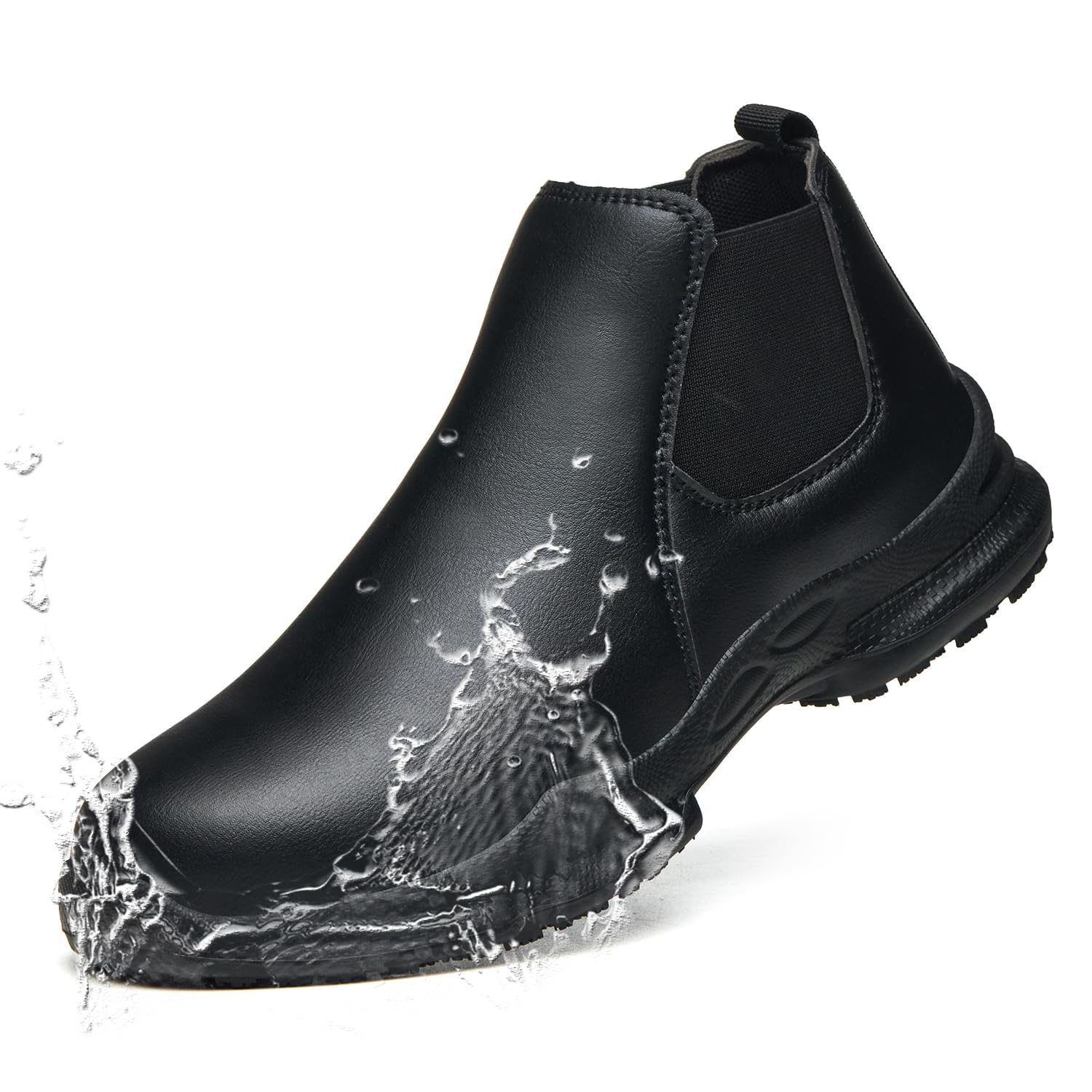
A kitchen-first work shoe that goes light on weight and stays waterproof, but has the thinnest track record on this list.
If your entire shift is standing on a wet tile kitchen floor, you want light and waterproof above all. That combination makes it an easy first work shoe for someone just starting in the industry.
Here’s the honest part. There is limited verified data on this specific shoe — no detailed customer review summary and no reported weight or toe type in the listing. That’s not a reason to write it off; it just means you’re buying from a thinner record than the established picks above. If you’re a frequent buyer who wants proven longevity, the standard-brand boots in this list give you more confirmable information before you buy.
Where the chef shoe earns its place is in simplicity. It’s lightweight, it’s waterproof, it’s non-slip, and it’s in the safest budget tier. For a commuter-to-kitchen shoe that sees wet prep floors every day, that’s enough. If you’re stepping onto a construction site with debris, step up to the Wolverine or the steel-toe picks instead.
Use it for: wet kitchen prep, dish pits, or any daily food-service shift where a lightweight, budget-friendly waterproof shoe is the whole job.
Worth knowing: verified owner data is thinner here than on the flasghip picks — you’re relying on the listed waterproof and non-slip design rather than a long review history.
Go with this one if: you’re outfitting for a kitchen job on a tight budget and need waterproof with non-slip.
Pass if: you need confirmable steel-toe protection or many years of documented durability — this listing has less of both.
5. LARNMERN Men Non Slip Ankle Boots

A mesh restaurant ankle boot with a real waterproof barrier inside — the kitchen shoe that doesn’t swamp you.
What sets this ankle boot apart is the way it handles both hot air and wet floors at once. A built-in waterproof isolation layer keeps liquid from reaching your sock, while a dense mesh upper lets heat out so your feet don’t bake through a full shift. The one-piece tongue stops sand and wind from finding a way in, and a porous cushion sole spreads pressure across the whole foot rather than concentrating it at the heel. If you’ve ever felt a wet floor through a cheap sneaker at hour six of a restaurant shift, this is the build that matters.
Most owner feedback clusters around fit, quality, and how well the sole grips a wet tile floor — buyers describe the traction as sure-footed, and owners mention the boots stay in good shape after months of regular use. The comfort verdict is more divided, with a portion of wearers feeling it’s firmer than a sneaker after a long standing shift. That’s the trade-off a built-in waterproof layer and a cushion sole bring — more structure, slightly less softness underfoot.
Set it against the Non Slip Chef Kitchen Shoe above: this one is pricier but far more proven, with years of restaurant use behind it and a design that addresses both water and heat. The Wolverine above is the stronger pick outdoors; this is the better pick indoors where the floor is wet and the room is warm.
Why restaurant crews pick it
- Built-in waterproof isolation layer — keeps liquid out at the membrane, not just the surface.
- Dense mesh upper lets heat escape through a long standing shift.
- Porous cushion sole disperses pressure across the foot, not just the heel.
- One-piece tongue keeps sand and wind from getting in through the gap.
- Owner reports that they hold up well after months of regular use.
The less-publicized side
- No steel toe — this is a kitchen and restaurant shoe, not a site boot.
- Some wearers find the cushion firmer underfoot than a sneaker after a long shift.
- Waterproofing leans on the inner membrane, so a nick or seam wear can cut it short.
The restaurant specialist: this is the pick for waiting, line cooking, or any shift that alternates wet tile and dry floor all day.
Look elsewhere if: you need toe-impact protection or you work outdoors on rough ground — the mesh build and non-steel toe aren’t built for that.
6. Arch Fit Non Slip Waterproof Work Sneaker

The standing-all-day sneaker: arch support, a waterproof build, and grip proven in a wet kitchen.
The feature that carries this shoe is arch support — the kind of built-in support that lets you stand through a full shift without your feet collapsing inward. Owners consistently report the cushioning and the arch support as the reason they keep coming back. It’s also the shoe most often chosen for the slip resistance: buyers in food service describe it gripping through a wet, greasy kitchen floor, which is the most slip-prone surface many workers face.
Fit is the one point you should be deliberate about. Some men find the fit spot-on, while others report it running a bit snug. A small number find the water resistance less complete than they hoped at the heaviest end of the wet spectrum. That tracks with the shoe being at an entry-to-mid value tier rather than the heavy-duty end — it handles splashes and wet floors, not prolonged soaking.
Compared to the LARNMERN above, this sneaker leans harder on comfort and less on the built-in membrane layer. That makes it the better pick for someone who stands eight hours on a dry-ish surface but needs the occasional wet-floor confidence. It’s not the boot to wear into a puddle repeatedly, but on a kitchen line or a restaurant floor it’s a genuinely comfortable choice, and the slip resistance is the strongest asset.
What wins people over: the arch support plus the grip, which makes it the most convincing pick for a full shift of standing where the floor occasionally gets wet.
Be careful with: sizing — it can run snug, so try your regular size first, and know that the waterproofing is best for splashes rather than deep washdowns.
Suited to: restaurant, nursing, or service shifts where you’re standing all day and the floor gets wet but not flooded.
Not your match for: a site where the toe protection is mandated or where you’re standing in water for extended periods.
7. KEEN Utility Men’s Skokie Mid Waterproof Work Boot

A hiker’s comfort in a work boot, with a 90-degree heel that locks onto a ladder rung.
The feature that separates this boot from the rest is the 90-degree heel — a squared-off back edge that catches a ladder rung so your foot doesn’t slide off when you’re reaching up. If you work roofing, utilities, or maintenance, that’s a small design feature that pays off on every climb. It’s built on KEEN’s Original Fit, which gives extra room for your toes to spread, and the leather comes from tanneries certified by the Leather Working Group.
The safety spec sheet on this boot is the most formally documented in the group. It meets ASTM F3445-24 and F2413-18 M I/75 C/75 MT/75 EH standards, and the midsole meets ASTM D471-06 903# oil and isooctane chemical resistance. The soft toe caps are designed to protect against minor impact but lack secondary crush resistance — so this is a work boot, not a heavy-crush boot. The slip-resistant rubber outsole more than earns its keep; it meets or exceeds ASTM F2913-24 SATRA and F1677-96 Mark II non-slip testing.
The trade-off to know about is sizing. Several wearers report these run small, and the durability feedback on the sole is mixed — some find the boot solid, others report the sole coming loose. Against the Wolverine above, this boot costs more and brings the ladder heel and the certified non-slip outsole with it — a real step up for roof or ladder work. Just size up if you’re between sizes.
Where it wins
- 90-degree heel catches ladder rungs for a secure climb.
- Listed ASTM F2413-18 electrical hazard and impact ratings.
- Outsole tested to ASTM F2913-24 SATRA and F1677-96 Mark II non-slip standards.
- Original Fit gives extra toe room for all-day comfort.
- Leather from Leather Working Group-certified tanneries.
Worth a second look before you buy
- Runs small — size up if you’re on the fence.
- Durability feedback is mixed, with some owners reporting the sole separating.
- Soft toe only — no secondary crush resistance for heavy impact work.
Built for the ladder: roofers, utility workers, and maintenance crews who want the certified slip rating and the 90-degree heel doing the work.
Skip if: your site requires a steel toe or crush-rated toe — this soft-toe version won’t satisfy that requirement.
8. Merrell Men’s Windoc Waterproof Steel Toe Low

Full-grain leather, a steel toe, and an abrasion-resistant heel that survives a rough outdoor job site.
Merrell built this low-cut boot around the same comfort DNA as its hiking boots, but with a steel toe and waterproof full grain leather for the job. The abrasion-resistant heel and toe cap mean the parts of the shoe that scrape against ladders and concrete don’t wear through first. A bellows tongue — the accordion-style flap under the laces — keeps debris out of the top of the shoe. Together, those details make it a work boot that holds up on rough outdoor ground and shifts to job sites.
What holds up on this boot is comfort and build quality; owners consistently find it comfortable, well-made, and durable, with good waterproofing noted. The one honest trade-off in the fit is the arch support: some find it excellent, others want more. Weight is also a mixed note, with a portion of the feedback finding it heavier than expected after a long day. The general fit is described as good.
The premium price signals real materials and a steel toe, which makes this the most protected of the “comfort first” picks. Set against the KEEN Skokie above: Merrell brings the steel toe and full grain leather, while KEEN brings the ladder heel and certified outsole testing. If toe protection is what you need, this is your boot. If ladder work is the whole job, the KEEN above is the more purposeful pick.
The case for it
- Waterproof full grain leather plus a steel toe in one work boot.
- Abrasion-resistant heel and toe cap for rough concrete and ladders.
- Bellows tongue keeps debris out of the shoe top.
- Hiking-boot DNA for comfort over long days.
- Consistently described as well-made and durable.
The honest caveat
- Runs heavier than some buyers expect after a full day.
- Arch support is a mixed experience — some find it lacking.
- It’s at a premium tier, so it’s the pricier pick if you only need basic protection.
Made for: a mixed outdoor and job-site day where you want hiking-boot comfort with a steel toe and full grain leather.
Think twice if: you want a lighter boot for long walking shifts or you need pronounced arch support — this one may feel heavier and less supportive underfoot.
9. Timberland PRO Men’s Pit Boss 6″ Steel Safety Toe Work Boot

The industrial standard: a steel toe, a nylon shock plate, and 1.83 pounds of genuine toughness.
Timberland has been building this boot since 1973, and the Pit Boss carries the same steel-toe DNA. The nylon shock-diffusion plate underfoot gives you torsional rigidity — a technical way of saying the boot doesn’t twist under your foot when you step on uneven ground. The steel toe meets ANSI safety standards and, as the listing points out, is cut with a roomier toe box than other steel-toe boots so your toes aren’t pinched against the cap. The waterproof leather keeps the wet out, and it’s a proper industrial work boot, not a job-site sneaker.
The owner picture matches that build: long stretches of everyday field work, civil engineering sites, and long hours on hard concrete. What buyers consistently praise is the appearance, the construction, and the value — it’s a premium-tier boot with a price that reflects that. The honest caveat is fit and break-in: some find them comfortable from day one, while others find the heel too narrow in the back. And while the construction is solid, a portion of customers note that comfort around the foot requires an adjustment period.
Compare the Pit Boss against the KEEN Skokie above — both are premium-tier, but the Pit Boss wins on raw steel-toe protection and the KEEN wins on ladder-specific design. Against the Wolverine, the Pit Boss is heavier and more structured, with the steel toe the Wolverine lacks. It’s the boot you buy when the work is genuinely heavy and the safety requirement is real.
The one-sentence case: a steel safety toe with a shock-diffusion plate and 1.83 pounds of build that handles heavy industrial work, as long as you’re prepared for a short break-in.
The honest detail to know: heel fit is the recurring note — some feet find it narrow at the back, so try them on over your work socks before the wet season starts.
The heavy-work standard: industrial sites, construction, and field engineering where a real steel toe and a shock plate are non-negotiable.
Better choose something else if: your work is light, your shifts are short, or you want a shoe that feels like a sneaker from the first step — this boot is built to work first.
Know the Specs
Waterproof vs Water Resistant
A waterproof boot uses a full barrier — either a membrane inside or full-grain leather — to stop water from reaching your sock. A water-resistant boot only slows water down and tends to give out in sustained wet. Look for “waterproof” and a named construction detail like “waterproof full-grain leather,” not a vague “water repellent” line on the box.
Steel Toe vs Soft Toe
A steel toe has a metal cap over the toes for impact and crush protection. A soft toe has no metal cap, so the boot is lighter and more flexible. Neither is universal; the choice is dictated by what your job site’s safety policy requires. If no policy applies, a soft toe is usually the more comfortable daily wearer.
Slip Resistance Testing
A slip-resistant outsole is a rubber sole tested against a controlled wet or oily surface, often to a recognized standard like ASTM F2913-24 or F1677-96 Mark II. A “non-slip” label with no named test is a weaker promise. When you can see a test standard on the listing, that’s the real proof of grip on a wet floor.
Weight and Shift Length
Boot weight is listed in pounds, and it’s a real comfort factor over a long shift. A pair that weighs about 1.9 pounds feels heavier underfoot than a 6-inch steel-toe model listed at around 1.83 pounds that carries a steel cap and more structure. Match the weight to how many hours you’re standing and how much walking you do — heavier boots add support but cost you energy late in the day.
Common Questions
Do waterproof work shoes actually stay dry in a downpour?
Can I wear soft-toe work shoes on a job site that requires a steel toe?
How do I stop new waterproof work boots from hurting my feet?
What does 90-degree heel mean on a work boot?
Is a steel toe boot heavier and harder to walk in?
Do slip-resistant work shoes work on wet kitchen tile?
How should I size a slip-on steel toe Chelsea boot?
Is a heavier work boot better for ladders and roofing?
Does the Merrell Windoc or KEEN Skokie offer better toe protection?
Can a work shoe be waterproof and still let my feet breathe?
The Bottom Line
For most men, the men’s waterproof work shoes pick that gets the balance right is the Wolverine Floorhand 6″ — it pairs waterproof full-grain leather with a rubber outsole and a removable cushion footbed, and at 1.9 pounds it stays light enough to wear all day on a wet job site. If you need a steel toe at a budget-tier entry point, grab the KAM-LITE Slip-On Steel Toe Chelsea; if you work ladders and want certified grip, the KEEN Utility Skokie is the one to reach for. And for heavy industrial work where the safety requirement is real, the Timberland PRO Pit Boss is the heavy-duty standard.
How we choose
We do not accept paid placement. Every pick is matched to a real buyer and a real use-case; we do not hands-on test units.
Sources
Specifications: manufacturer listings and product documentation. Review insights: verified customer reviews, as of July 2026. Pricing: not shown on this page (it changes often); check the current price via the retailer link.
As an Amazon Associate, Tactical Gear Guy earns from qualifying purchases. This does not affect which products we feature.