Specs are compiled from manufacturer listings and verified buyer reviews and can change over time — please confirm the key details on the product page before buying.
You strap a bag to the bars, hit a stretch of chipped tarmac, and by the time you reach the trailhead your load has shifted, your bottle is gone, and something is rattling against the frame. The right trekking accessory won’t fix your legs, but it keeps your gear still, dry, and reachable so you stop fixing your setup every ten miles. Below you get nine accessories split by the job they actually do — carrying, storing, or repairing — with the honest trade-off for each one spelled out.
This guide is built by comparing the manufacturers’ published specifications and the patterns across verified customer reviews, so you get each pick’s real strengths and trade-offs instead of marketing spin.
Every option here was checked against published specs and verified owner reviews, and the nine picks below cover the mounts, bags, racks, and tools that hold up on a loaded touring setup. trekking bike accessories are the difference between a ride that flows and one you stop fixing every ten miles.
Top Picks


How To Choose The Best Trekking Bike Accessories
The accessory that fails you on a trekking ride is almost never the one that looked flimsy on the shelf — it is the one mounted in the wrong place, or the one with a volume figure that sounded generous until your helmet was too big to zip inside. Start with the mounting point, not the feature list. A frame-mounted bag sits close to your weight center and barely affects steering, while a front setup needs a sturdier fork interface (the mount where the bag meets the front fork) to stay composed under load. Most buyers underestimate one simple thing: where exactly the accessory will sit, because on a long day you reach into that bag dozens of times and awkward access costs you more time than a slow install ever will.
Match the mount to your bike before anything else
A frame-mounted bag or a top-tube bag works on nearly anything with a tube, and the elastic-cord and strap methods let you fit even a low-profile head tube. Rear racks are stricter. Several models list their limits plainly — soft-tail, carbon fiber, folding, small-wheel, and rear-suspension frames are excluded, because the rack needs a rigid tubular frame to clamp against. Measure your seat tube diameter before you buy. One rack here demands under 1.26in, another accepts 0.85–1.3″, and crossing that line means a return, not a repair.
Water resistance versus real waterproofing
Read the material callout carefully. A PU-coated polyester shell (polyester with a polyurethane coating that sheds water) with a rain cover is water-resistant and handles drizzle fine, while a multi-layer nylon shell with a sealed zipper can take more direct rain. Truly sealed is a different problem again. If you only face showers, water resistance plus a cover does the job and wipes clean afterward; if you ride in serious rain, prioritize a bag that seals its zipper and holds its shape when wet, because a soaking bag on a long ride turns heavy and sags fast.
Load ratings and the rack that carries them
Rack capacity numbers vary wildly — 10 kg up to 115 lb — and they only mean something when the rack is properly installed on a compatible frame. A three-point fixation (three mounting contact points) and adjustable support rods do more for stability than a big number printed on the box. The real question is where the load sits: a rigid base panel and enlarged side wings stop a pannier (a side bag that hangs on the rack) from sagging into spokes, and a quick-release bag mount saves you from unthreading straps every time you stop for coffee. Buy the sturdier rack before you buy the bigger bag, every time.
Side-by-Side Comparison
| Model | Best For | Type | Capacity / Load | Key Spec | Amazon |
|---|---|---|---|---|---|
| XLEADER Pro Bike Speaker★ Best Overall | Music and navigation on the move | Handlebar speaker | — | IPX7, 24 hours | Amazon |
| Rhinowalk Handlebar BagBest Front Storage | Quick-access essentials up front | Handlebar bag | 4.5 liters | 7.36 ounces | Amazon |
| Rhinowalk Top Tube BagBest Frame Mount | Tools and phone on the frame | Frame bag | 1.2 liters | YKK zipper, 6.5in phone | Amazon |
| ROCKBROS 14-in-1 Tool Kit | Trailside repairs | Multi-tool | 14 pieces | 3.68 ounces | Amazon |
| JXFUKAL Rear Rack Bag | Full-day commuting and touring | Rack trunk bag | 13 liters | Rigid panels, rain cover | Amazon |
| PINNAMAX Front Rack | Front cargo on touring bikes | Front rack | 10 kg / 22.05 lbs | 6061-T6 aluminum | Amazon |
| ROCKBROS Rear Rack | Everyday grocery and gear hauling | Rear rack | 55 pounds | 1.43 kg | Amazon |
| YONTUO Rear Rack | Heavy loads and wet rides | Rear rack | 115 pounds | Adjustable 16″-18″ | Amazon |
| Ibera Touring Carrier Plus+ | Long touring with a bag system | Rear rack | 1.7 pounds | Fits 26″-29″, 700c | Amazon |
Detailed Reviews
1. XLEADER Pro Bike Speaker with Handlebar Mount
Our pick — 4.5+★ from 650+ verified ratings; the strongest balance of quality and price.
Thumps along with your ride while wearing a fully waterproof silicone shell.
What most folks underestimate on a long trekking route is how much a steady soundtrack and turn-by-turn navigation lift your mood on hour four, and that is exactly the job of this handlebar speaker. The audio driver is 50 millimeters — a proper rounded speaker unit, not a tinny micro-speaker — and the sound takes up the bulk of what riders talk about. You get a mono output mode, which is fine for roads and rail trails while it keeps the unit light and steady on the bars. A stable handlebar bracket clamps the speaker down so bumpy riding does not throw it off the mount.
The battery is where this thing quietly earns its keep. A 24-hour average life from a 2000 mAh cell means you could start at dawn, ride a full touring day with a lunch stop, and still have playtime left for the campsite. Recharging takes 3 hours via the included Type-C cable, so it is back to full over a dinner break. The Bluetooth V5.4 connection holds out to 66 feet, which means you can leave your phone in the frame bag and still control playback. And the IPX7 rating means the whole unit survives being dunked rather than merely splashed, so an afternoon rainstorm is no drama.
The catch is honest and worth knowing before you buy: putting music on the handlebars is a personal choice, and a single 10W speaker will not match a proper two-speaker stereo at full volume. The shell is silicone, so it swallows a drop but also shows grime after a dusty day and needs a rinse. It is the crowd favorite here at 4.5+ stars across 600+ ratings, and its built-in light doubles as a visibility boost on evening sections.
What the ride confirms
- The 24-hour battery life routinely survives a full touring day, and 3 hours to recharge sits well inside a rest stop.
- IPX7 waterproofing means real rain is a shrug, not a scramble to unhook the unit.
- A rock-solid handlebar bracket keeps the speaker put over rough tarmac and gravel.
- 66-foot Bluetooth range lets your phone stay safely stowed in a frame bag.
Where it will not delight you
- Mono output through one speaker cannot mimic a full stereo setup — fine for podcasts and playlists, thin for bass-heads.
- The silicone shell picks up trail dust and wants a wipe-down.
Grab this one if: you want navigation audio and music reachable on the bars with rainproofing that is not a marketing nicety.
Keep looking if: you expect hi-fi stereo, because the 50 mm single driver plays to mood and voice, not concert bass.
2. Rhinowalk Bike Handlebar Bag
Four and a half liters of front storage that detaches into a shoulder bag.
This handlebar bag is the one you unclip and carry when you stop, because it works double duty as a shoulder bag with the included belt and fixing strap. The capacity sits exactly at 4.5 liters, and that number matters when you compare it to the top-tube bag just below: this holds 4.5 liters where that one carries 1.2 liters, so it swallows a jacket layer, wallet, and phone in the main compartment alone. The main opening measures 6.3″ by 8.3″ by 4.3″ — roomy enough for the small essentials you grab constantly.
The shell is what Rhinowalk calls twill fabric, a three-layer nylon-mesh construction fused at high temperature, and the whole bag weighs 7.36 ounces on the scale. It mounts with buckles on both sides that snap onto the bars, plus an anti-slide strap above and a brake-line fix below to keep things from shifting on descents. The web handle makes it easy to haul once off the bike. It is a solid all-rounder for commuters who want one bag that works on the bike and off.
The honest caveat is the mounting system itself. The strap fix earns more mixed feedback than the bag’s own build quality, which tells you it demands a careful set-up and a check before each ride rather than a mount-and-forget. If you swap bikes often or ride very rough gravel, a bag that uses four hook-and-loop straps on a rigid rack (a rack bag, further down) may suit you better. For steady commuting and light touring, though, this one bags plenty of goods for its weight class.
Build and feel: The twill and nylon-mesh shell shrugs off abrasion, and it scrubs up better than a canvas bag after a muddy week. Buyers consistently point to build quality as the standout trait here.
Room to reason: A 4.5-liter main compartment at 7.36 ounces is a whole lot of storage for very little on the bars, and the belt strap lets you carry it off the bike without empty hands.
Reach for this if: you want one bag that clicks off the bars and becomes your walking-around bag at the trailhead.
Look elsewhere if: you ride rutted gravel that jostles the bars hard — the buckle-and-strap mount is less rigid than a frame-mounted bag.
3. Rhinowalk Top Tube Bag
A slim 1.2-liter frame bag with a sealed zipper and a strap that pins your phone.
A top-tube bag is the quiet hero of a loaded touring bike: it sits on the frame where your hand falls naturally, and it holds the snacks, tool bits, and phone you reach for without letting go of the bars. This one runs 1.2 liters — a fraction of the handlebar bag’s 4.5 liters, but that is the point, because a small frame bag stays out of your knees and does not affect steering. The body is a three-layer build: a water-resistant nylon face, a diamond-mesh middle of overlapping polyester yarns for tear strength, and a polyester fiber base that resists abrasion (surface wear) where it meets the frame.
The detail I would flag first is the YKK water-resistant zipper, with a large custom pull head that you can grab with gloves on. Inside, there is a small mesh pocket for energy gels and a phone-fixing strap rated to hold screens up to 6.5 inches so the phone does not bounce around on rough sections. Two symmetrical side mesh pockets swallow an inner tube and tire levers, and a hidden front opening routes a power-bank cable out for top-ups mid-ride. It mounts two ways — bolted to the top tube screws at 2.56in spacing, or strapped via elastic cord that fits low-profile head tubes.
Here is the trade-off worth thinking through: at 1.2 liters, this bag is not a clothes-hauler. It is a live-items pocket, and if you are packing for an overnight you will still need a rack bag or panniers. What owners talk up most is how it holds its place without creeping — the stability on rough ground is what sells it. A hidden risk is that 2.56in bolt-hole spec: measure before ordering, because if your top tube does not have that spacing you have to fall back on the elastic strap, which is less rock-solid.
The reasons it earns the frame
- YKK water-resistant zipper with a gloved-hand pull head is noticeably smoother than a standard coil zipper.
- Internal phone strap holds screens up to 6.5 inches still, which saves your hand off the bars on descents.
- Side mesh pockets and a hidden cable port keep tools and power banks reachable.
What to weigh first
- The 1.2L volume only covers essentials — plan on a rack for anything bigger.
- The bolt-on option needs a 2.56in top-tube hole spacing, so check your frame before ordering.
Your frame calls for this if: you want tools, gels, and a phone within reach on the top tube without stuffing your jersey pockets.
Skip the bolt-on plan if: your frame lacks the 2.56in spacing — the strap mount works, just with less stiffness.
4. ROCKBROS 14-in-1 Bike Tool Kit
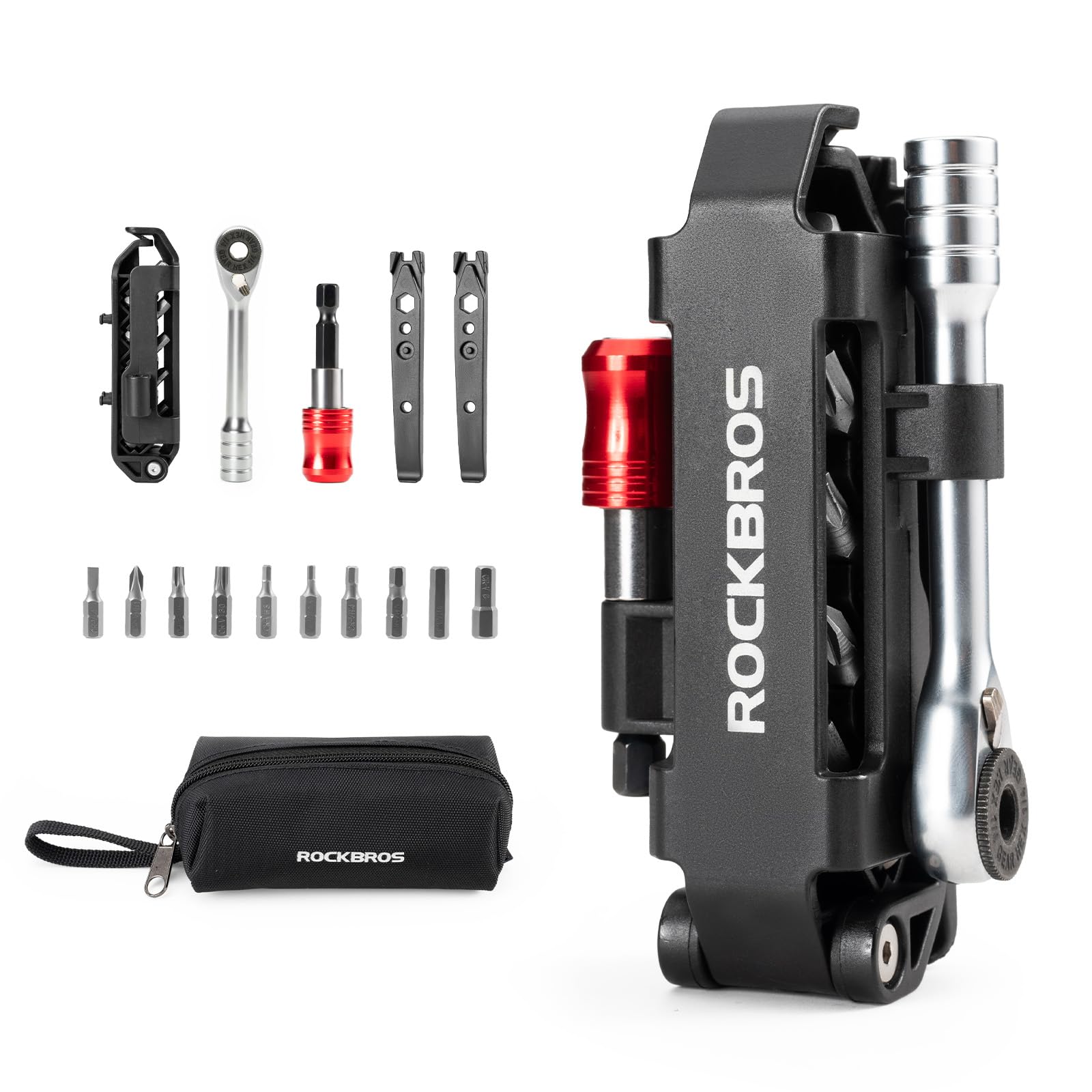
Fourteen tool functions and a ratchet handle packed into a 3.68-ounce pocket kit.
When a trekking ride turns into pushing a bike three miles back to the road, the difference is usually a loose bolt and no tool. This kit puts a reversible ratchet wrench, 10 bits, an adapter, and two tire levers into one folding package. The bit selection is thorough for basic bike maintenance: SL4 and PH1 screwdriver bits, T25 and T30 Torx bits, and H2.5, H3, H4, H5, H6, and H8 hex keys. The ratchet and adapter use magnetic adsorption so the bits do not drop into the gravel at the worst possible moment.
The construction blends aluminum, CRV steel, iron, and nylon, and the folded package measures 4.53″ by 2.17″ by 1.38″ — small enough to drop in a frame bag. At 3.68 ounces it is the featherweight of the whole accessory list; the handlebar bag above weighs 7.36 ounces by comparison, so it is the lighter of the two on the bike. It also handles household jobs like furniture assembly and tightening loose handles, so it earns its keep off the bike too.
What owners single out is the feel of the steel — the ratchet mechanism has a precision the cheaper stamped tools lack, and it holds fast torque without rounding a bolt head. The honest limitation: 10 bits and two tire levers cover the common fixes, but a dedicated chain tool or spoke wrench is not part of the set. That is not a flaw, it is a scope call — this is the inside-the-jersey-pocket tool for roadside tightening, not a full workshop in a bag. Pair it with a top-tube bag and you are covered for most mid-ride hiccups.
Weight-to-function payoff: A 14-piece kit at 3.68 ounces is a genuine no-brainer carry, and the folding footprint of 4.53″ x 2.17″ x 1.38″ slips into even a cramped saddle bag.
The honest limit: It is a tightening-and-adjusting kit — if a chain snaps, this is not the tool that fixes it.
The right add for: any rider who wants a real ratchet and a complete hex range without carrying a whole toolbox.
Not enough on its own for: a serious drivetrain repair — you will still want a dedicated chain tool in the bag.
5. JXFUKAL Rear Rack Bag (13L)
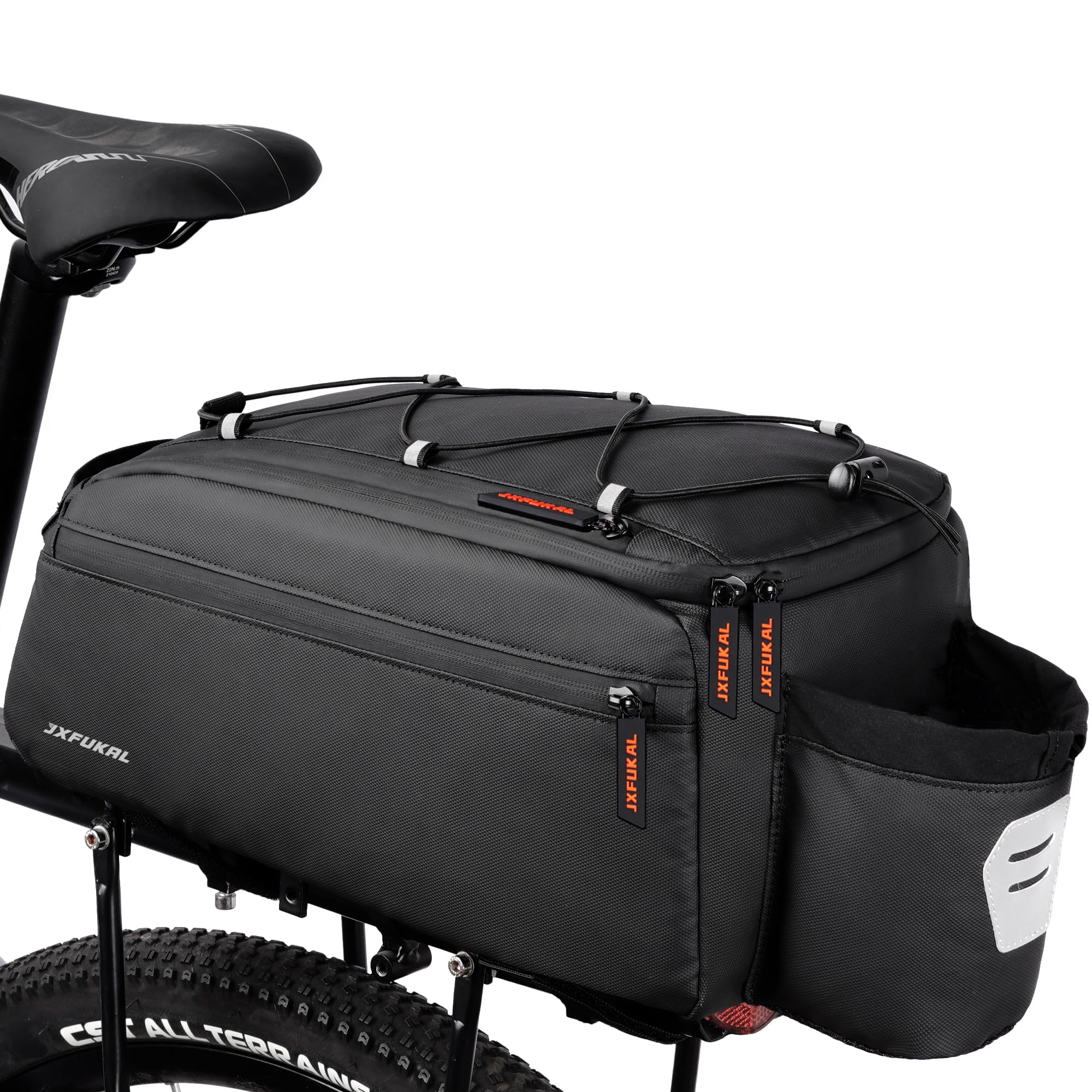
A 13-liter trunk bag with rigid side panels that refuse to sag under load.
What sinks a rack bag on a long day is not a heavy load — it is a soft bag that flops sideways the moment the road turns rough. This one builds its shape in: rigid support panels in both side walls and the base hold it upright through bumpy stretches, so it never sags or leans and the 13L main compartment keeps its volume. The shell is PU-coated polyester (polyester with a polyurethane coating that sheds water), so it wipes clean and handles rain alongside the included rain cover. Inside, a six-zone system does the sorting for you: three inner mesh pockets, a quick-grab top pocket for phone and keys, two zippered side pockets for snacks, an adjustable elastic cord for wet gear, and a dedicated bottle pocket.
Mounting takes seconds with four hook-and-loop straps, and the adjustable sizing fits most racks — mountain, road, e-bike, hybrid, and gravel. It carries a rear strap for a taillight and reflective detailing on all four sides for dark rides. At 13 liters it holds a windbreaker, tools, snacks, and a water bottle without a fight, and the handle lets you grab the whole bag off the rack at a cafe stop. For commuters, the six-zone layout does the sorting for you: tools, snacks, wet gear, and a bottle each get their own pocket.
The honest recurring note in the owner feedback is the strap fit: the velcro holds well on a smooth rack but the bag can shift a touch on one with a tricky surface. That is a mount-geometry issue, not a bag failure, and a cheap bungee solves it quickly. If your rack has a flat top and a clean rail, this is among the most organized 13-liter bags you can strap down.
What earns it the rack
- Rigid side and base panels keep the bag upright so it never side-sags and holds its full 13L.
- The six-zone layout separates wet gear, tools, snacks, and a bottle without a search.
- Rain cover and PU-coated shell handle wet weather, and four reflective sides help at dusk.
Where it needs a little help
- The velcro mount secures well but can shift slightly on an uneven rack surface.
- 13L covers a commute well but will not take a full touring clothes load.
Pick it for: daily commuting and day tours where organization matters more than raw volume.
Pack bigger if: you are touring overnight — this is the around-town bag, not the full pannier replacement.
6. PINNAMAX Front Rack
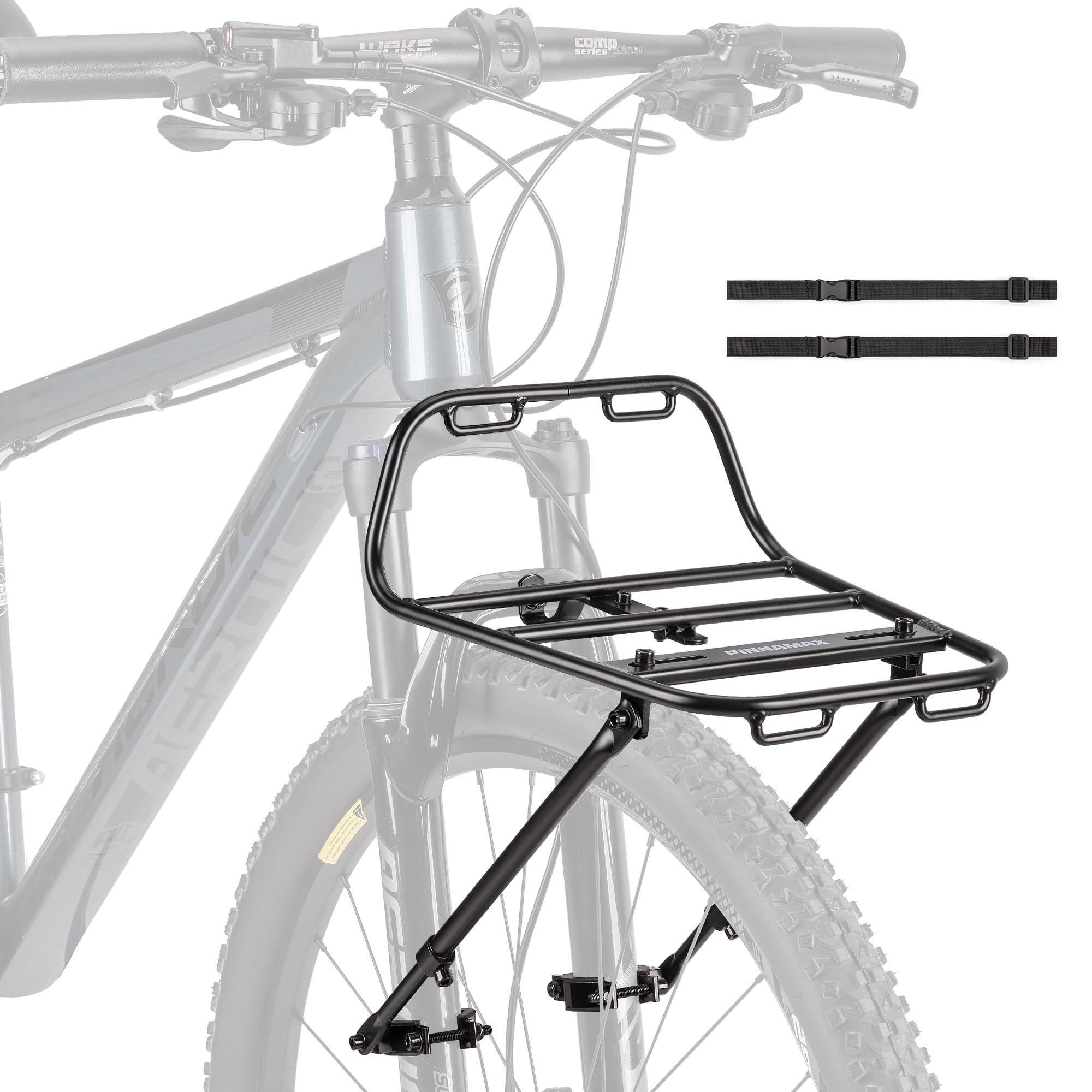
A front cargo platform that turns your fork into a stable load deck.
Front racks are the accessory that separates a touring bike from a commuter, and this one is built for classic front cargo. It is a fork-crown mount with two-piece legs that extend from 11 inches to 15.35 inches, so it adapts to most front forks and can be fitted even without eyelets. The frame is 6061-T6 aluminum — a stiff alloy that resists flex under load — and the maximum recommended load is 10 kg (22.05 lbs). It sits on 26″–29″ and 700c wheel bikes, which covers most mountain, gravel, and touring setups.
The front platform is designed to strap a bag or backpack down, and it carries a fixed basket that adds a stylish edge. There is a good reason for the modest load rating: weight on the front directly affects steering, which is why the manufacturer sets the ceiling where it does. That said, a sleeping mat, a dry bag, or a small front rucksack sits perfectly on this platform with bungee tension. The package ships with all bolts and mounting brackets, and assembly is described as a few minutes with the included instructions.
The honesty on this one is in the 22 lbs ceiling — you are not carrying a full rear-load’s worth up front, so if you need to haul heavy, the rear racks lower down are your answer. A recurring kit complaint is that the front struts can benefit from added tension during the first few rides, so check the fastenings regularly. For the rider who wants to move weight off the rear wheel and keep the front planted, this fork-crown platform is a smart change of geometry.
The build inside the frame: A 6061-T6 aluminum structure keeps stiffness up and weight down, and the struts widen to 15.35 inches so it reaches across most fork crowns.
What to watch on the road: A 22.05-lb ceiling means this platform is for a light load, not a grocery haul — and the struts deserve a tension check early on.
It fits your plan if: you ride gravel or touring bikes and want a front deck for a light bag or dry sack.
Get the rear route instead if: you are carrying heavy cargo — the front rack’s 10 kg ceiling is set low on purpose.
7. ROCKBROS Rear Bike Rack

A 55-pound-capacity rear rack that clamps on and comes off in seconds.
For the commuter who needs grocery runs and gear hauls without a permanent frame modification, this rear rack is the practical choice. It uses a quick-release clamp system so it installs fast and comes off for the weekend, and the aluminum alloy frame with stainless steel screws balances strength with weight. The rated capacity is 55 pounds when properly installed, which is enough for a full pannier setup or a grocery crate. Adjustable support rods let you match the length, height, and angle to your bike frame, and three-point fixation holds it steady in motion.
Where the design earns its keep is the side protection. Dual W-shaped rails keep panniers and bags away from the wheel and spokes, and the elastic cords that come with the rack help secure loose loads. A rear red reflector adds visibility for low-light riding. It is meant for mountain bikes with round seat tubes under 1.26in — but not for soft-tail, carbon-fiber, folding, small-wheel, or rear-suspension bikes, so check your frame before ordering.
The honest sticking point is the instructions and the base fit. The setup can feel cryptic on the first try, and the rack can shift at the base over time, so a re-tighten after the first few rides is wise. The 1.43 kg weight is a trade-off for the load-bearing capability, and on a light road frame you will feel it.
What pays off daily
- The quick-release clamp makes installing and stowing this rack a matter of seconds.
- 55 pounds of rated capacity handles a full commuting load.
- Dual W-shaped side rails keep bags clear of the spokes.
The learning curve
- The instructions can be cryptic for a first-time install.
- The base can shift over rough ground, so re-check the fastenings after the first few rides.
Makes sense for: a commuter who wants a tough, removable rack for groceries and panniers without a permanent install.
Look elsewhere if: you ride a carbon-fiber, folding, or rear-suspension frame — the rack will not fit those safely.
8. YONTUO Rear Bike Rack

A 115-pound-capacity rear platform with a fender to keep your back dry.
If your idea of a trekking accessory is a rack that earns its keep on heavy errands, this one tops the list at 115 pounds rated capacity. It is built from hard aluminum alloy, which keeps the frame light enough not to drag down the bike while delivering that load number. The adjustable structure is the other big selling point: the top panel extends from 16″ to 18″, and the telescopic side support rods reach from 11″ to 15.75″, so you can match the fit to most bicycles. That adjustment range is what makes it a genuine universal fit for the right frame type.
Two features stand out in wet weather. A large rear reflector increases visibility for night rides, and an adjustable, removable fender keeps your back, bags, or panniers dry on muddy roads. The enlarged side wings keep panniers from slipping into the spokes or scraping wheels. Stainless steel screws with anti-loosening and shock-proof nuts hold the rack steady on rough ground. It works with minimum seat tube heights of 2 inches and diameters of 0.85–1.3″.
The honest catch: this rack is not for every bike. Soft-tail, carbon-fiber, folding, small-wheel, and rear-suspension frames are excluded, and the shop pages say so plainly. The assembly can be a pain point for some owners, and buyers sometimes find the fit does not land on their bike, so measure your seat tube diameter first. On a compatible mountain or hybrid frame, though, its 115-pound rating is the highest in this lineup, and the plain fit rules make it the lowest-risk install of the rear racks.
Where the engineering shows: A 115-pound ceiling on a light alloy frame, plus the adjustable 16″–18″ panel and 11″–15.75″ support rods, makes it adaptable across mountain and hybrid bikes.
The line you cannot cross: It rules out carbon, folding, and suspension frames, so compatibility is a real gate before any install.
Built for this if: you ride a rigid mountain or hybrid bike and want the highest load capacity for cargo and panniers.
Cross it off if: your frame is carbon, folding, or rear-suspension — that is a fit rule, not a suggestion.
9. Ibera Touring Carrier Plus+

The frame-mounted rack built for heavier loads and a quick-release bag system.
This is the rack for the rider planning a proper tour, because it is frame-mounted for heavier top and side loads and built to take that weight without complaint. It fits most 26″–29″ bicycle frames and 700c frames, and the height adjusts to dial in fit. The frame is aluminum at 760 g, and the quick-release bag mounting system is what separates it from the field — the Plus carrier accepts IBERA bags alongside IBERA panniers, so you can build a matched luggage setup. Disk-brake mounts are supported, which opens it up to modern frames.
The materials and load philosophy here are different from a value rack. This one is engineered for the long haul and hews to a standard IBERA fit list, so check the model compatibility before you order — if you already run IBERA bags, this carrier slot is the natural base. The 760 g weight is light for a frame-mounted rack, and the height adjustment means you can keep your bags clear of the rear wheel across different frame sizes. It also pairs with a multiple different IBERA models listed in the compatibility chart.
One thing to plan for: this rack’s strength is its system, and if you do not intend to use IBERA bags, the quick-release mount adds less value and a generic rack does the job. And because it is frame-mounted, the list of bikes it will not fit still applies — measure first. But for the loaded touring cyclist who wants a complete pannier-and-bag platform built to carry weight, this carrier is the benchmark against which the others are measured.
The touring platform argument: Frame mounting, disk-brake compatibility, and a 760 g aluminum build make this the most purposeful touring carrier of the group.
Why it is not for everyone: The quick-release bag system pays off only if you use the matching IBERA bags, so a buyer with generic panniers may want a cheaper universal rack instead.
Made for the long haul: a loaded tourer who wants a disk-brake-ready, height-adjustable carrier and will pair it with IBERA’s bag system.
The simple-rack shopper should look back: you lose the quick-release advantage if you are not buying into the matching bags.
Know the Specs
Capacity and volume, in plain terms
A bag rated 1.2 liters or 4.5 liters tells you how much it holds, not how waterproof it is — those are separate specs. A 1.2-litre top-tube bag is the size of a large phone plus tools, while a 4.5-litre handlebar bag takes a jacket layer plus essentials. Read the mounting detail next to the volume, because a big bag that shifts on the bars is worse than a small one that stays put.
Water resistance versus sealed construction
A water-resistant shell like PU-coated polyester with a rain cover shrugs off showers and wipes clean. A sealed or water-resistant zipper adds protection at the weakest point, the closure. For serious rain, look for both a sealed zipper and a multi-layer shell, and expect to pay more in weight for it.
Load rating and mounting style
A rack’s capacity number only holds when the rack is installed correctly on a compatible frame. Frame-mounted racks with three-point fixation and adjustable rods carry heavier and more stable loads than a quick-release clamp. Check seat tube diameter and frame type first — carbon, folding, soft-tail, and rear-suspension frames are often excluded.
Weight of the accessory itself
Carrying weight is different from a product’s weight. A lighter tool keeps a jersey pocket comfortable; a heavier rack can steady a load on the road. Balance the two: a 3.68-ounce multi-tool is a near-free carry, while a 1.43-kilogram rack adds weight you will notice on a climb but earns back in capability.
Common Questions
Will a rear rack fit my bike if it has disc brakes?
Can I put a top-tube bag on a carbon frame?
How much can a front rack safely carry compared to a rear rack?
Is a handlebar bag or a top-tube bag better for long rides?
Will a bike speaker survive heavy rain on a ride?
Do I need a multi-tool if I already carry a small repair kit?
How do I keep a rack bag from shifting on a bumpy ride?
What seat tube size do I need to check before buying a quick-release rack?
Are rear rack bags waterproof enough for a full rainy touring day?
Can I mix bags from different brands on one rack?
The Bottom Line
For most riders building out a loaded setup, the trekking bike accessories winner is the XLEADER Pro Bike Speaker, because it is the one accessory on this list that earns its place on every single ride — navigation audio and music reachable on the bars, 24 hours of playtime from a 2000 mAh cell (milliamp-hours, the battery’s capacity), and an IPX7 shell (a water-resistance rating that survives a dunk in water) that treats rain as a non-event. If your gap is storage, the Rhinowalk Handlebar Bag gives you 4.5 liters that detaches into a shoulder bag at 7.36 ounces on the scale. And for hauling serious weight, the YONTUO Rear Rack carries a 115-pound rating on a light aluminum frame — measure your seat tube first, because that is the one gate you cannot skip. The honest nudge: the speaker has the strongest owner consensus of the group, with sound and battery life winning people over repeatedly, so it is the safest first buy if you are adding only one thing this season.
How we choose
We do not accept paid placement. Every pick is matched to a real buyer and a real use-case; we do not hands-on test units.
Sources
Specifications: manufacturer listings and product documentation. Review insights: verified customer reviews, as of November 2026. Pricing: not shown on this page (it changes often); check the current price via the retailer link.
As an Amazon Associate, Tactical Gear Guy earns from qualifying purchases. This does not affect which products we feature.