Specs are compiled from manufacturer listings and verified buyer reviews and can change over time — please confirm the key details on the product page before buying.
A pull-through tool gets a dull blade cutting again in seconds, a diamond stone gives you a flat, precise edge for years, and an electric belt machine handles everything from pocket knives to garden shears. This guide breaks down the real types of knife sharpeners, what each one actually does to your blade, and which one fits how you cook and carry.
This guide is built by comparing the manufacturers’ published specifications and the patterns across verified customer reviews, so you get each pick’s real strengths and trade-offs instead of marketing spin.
You will see how grit ratings, angle control, and blade support decide whether an edge lasts or chips, and how to match a tool to the knives you already own. My pick for most kitchens is a compact hand tool that hones and sharpens in under a minute, and it leads a shortlist of the types of knife sharpeners worth owning.
Top Picks

How To Choose The Best Types of Knife Sharpeners
The biggest mistake new buyers make is assuming every sharpener does the same job. It does not. A carbide pull-through slot scrapes a new edge fast but removes metal quickly, while a fine ceramic or diamond surface gently realigns an edge that is only slightly dull. Know which one you are buying before you spend.
Match the tool to the knife you actually own
Serrated bread knives need a different approach than a straight chef’s blade. Several of the tools below state plainly that they work on serrated edges, so read that line before you buy. A cheap straight-edge-only sharpener will do nothing useful for a serrated knife.
If you carry a pocket knife daily, portability matters as much as the abrasive. A compact pull-through tool that fits in a pack is worth more to you than a bench stone that lives in a drawer.
Decide if you want speed or control
Electric sharpeners restore an edge in seconds, but you trade some hands-on control for that speed. Manual stones and guided hand tools ask for a few minutes of your time and reward you with a flatter, more precise bevel. Pick electric for speed, manual for control.
Angle guidance is the great equalizer here. A tool that holds the blade at a fixed angle, whether through a slotted V or a set of guides, removes the guesswork that makes freehand sharpening frustrating for beginners.
Weigh grit against your sharpening habits
Coarse grit repairs a nicked or badly dull edge. Fine grit polishes that edge into something that glides through food. Many of the picks below combine both stages in one unit, so you can do the whole job without swapping tools.
Side-by-Side Comparison
| Model | Best For | Sharpener Type | Grit / Stages | Weight | Amazon |
|---|---|---|---|---|---|
| The Edgemaker Knife Sharpener Pro 331★ Best Overall | Fast touch-ups on any blade | Handheld crossed steels | Fine | 4.16 ounces | Amazon |
| Smith’s Pull-Thru Knife SharpenerFastest Results | Pocket and hunting knives on the go | Two-stage pull-through | Coarse carbide + ceramic | 0.1 kg | Amazon |
| Dawnstar Electric Knife SharpenerBest for Busy Kitchens | Whole kitchen in one sitting | Two-stage electric | Coarse + super fine | 1.4 pounds | Amazon |
| SHARPAL 168H Diamond Stone | Hard steels and edge tools | Dual-grit diamond plate | 325 / 1000 grit | 0.62 kg | Amazon |
| Work Sharp Benchtop Whetstone | Beginners learning stone work | Guided water stone | 1000 / 6000 combination | 2.3 pounds | Amazon |
| KING Whetstone Starter Set | Japanese-style finishing | Combination water stone kit | 1000 / 6000 grit | 16 ounces | Amazon |
| VN3 Professional Knife Sharpener | Self-adjusting angle control | Spring-arm guided V | Fine, coarse, medium | 1.9 pounds | Amazon |
| Chef’sChoice UltraHone | Serrated and straight edges | Two-stage diamond electric | 100% diamond, ultra fine | 16 ounces | Amazon |
| Work Sharp Ken Onion Mk2 | Reprofiling and shop tools | Variable-speed belt | Fine belt, 15–30° | 2 pounds | Amazon |
Detailed Reviews
1. The Edgemaker Knife Sharpener Pro 331
Our pick — 4.5+★ from 650+ verified ratings; the strongest balance of quality and price.
Crossed steels that bring a dead blade back in under a minute.
The Edgemaker Pro 331 is the tool that turns sharpening from a chore into a five-second habit. You draw the knife through the crossed steels with mild pressure, and the two rods realign and refresh the edge as you go. That single motion covers both jobs — honing a blade that is just slightly tired and sharpening one that has genuinely gone dull.
What makes it the pick at the top of this list is range. The maker states it works on wavy and serrated knives too, which is rare in a hand tool — most pull-through units only handle straight edges well. The maker also claims it hones and sharpens in under a minute and leaves a smooth, strong edge like a butcher’s steel. The handle is high-impact plastic rated unbreakable, and the steels can be pulled out and rotated to expose fresh sharpening surface. Run it under hot water for one minute to expand the plastic, pull the steels, rotate them, and reinsert.
The honest catch is that this is a maintenance tool, not a rescue tool. A badly chipped edge still needs a coarser abrasive before the Edgemaker can polish it. And the same crossed steels that make it so fast give you less of the mirror-polished finish you would get from a fine stone. At 4.16 ounces it slips into a drawer or a kit bag without complaint.
What earns it the top spot
- Hones and sharpens in one pass, with the maker claiming under a minute per blade.
- Handles wavy and serrated knives as well as straight edges.
- Rotating steels give you fresh abrasive surface instead of a tool that wears out.
- 4.16 ounces, so it travels anywhere.
Where it asks for patience
- Chipped or badly damaged edges need a coarser tool first.
- Crossed-steel action leaves a working edge, not a polished one.
Reach for this if: you cook most nights and want a blade that stays sharp without a ritual — this is the one that earns its drawer space.
Look elsewhere if: you are repairing a chipped edge or chasing a mirror finish, which is a job for the diamond stone further down.
2. Smith’s Pull-Thru Knife Sharpener
Four strokes is the whole pitch, and it holds up.
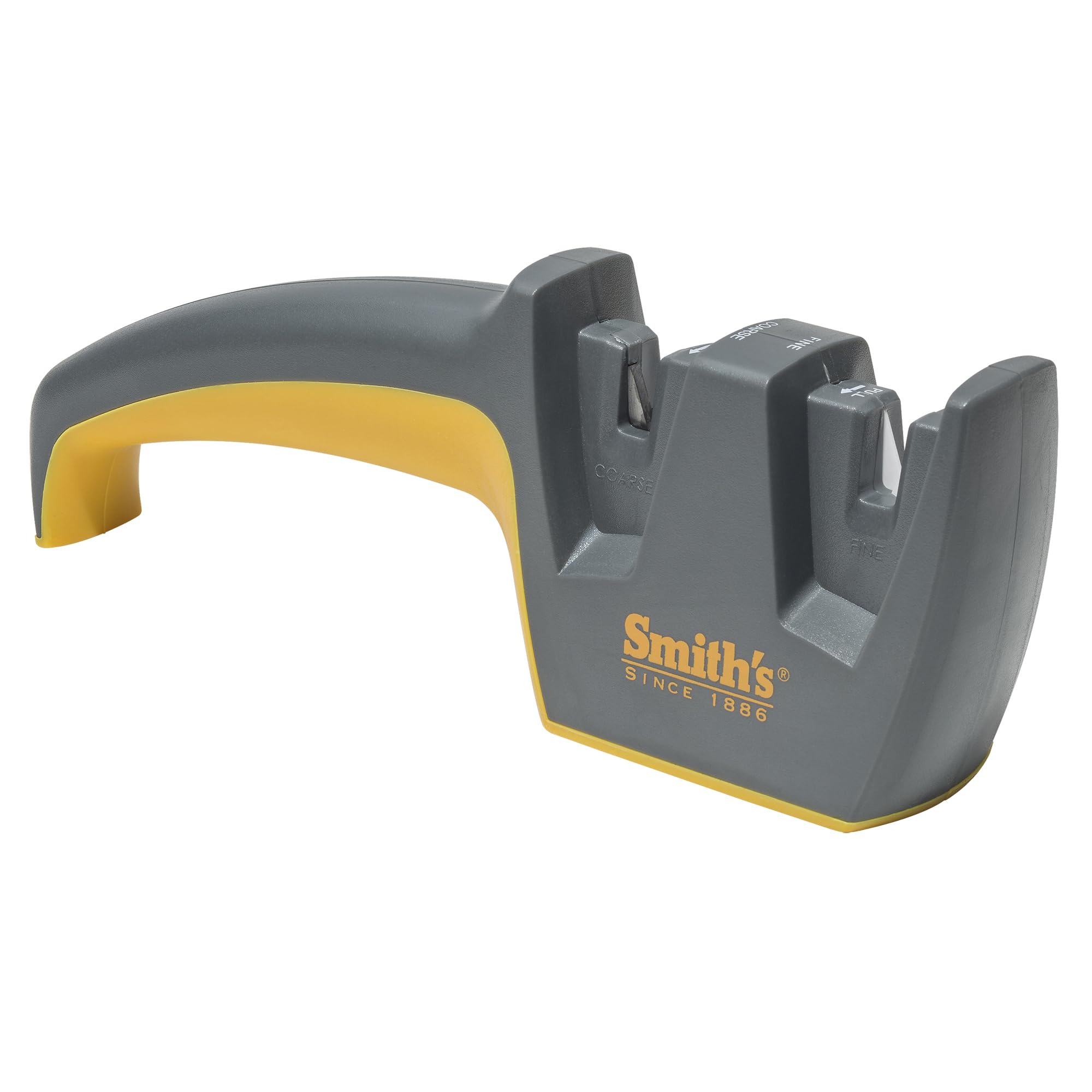
Two slots do two jobs here. The carbide slot is the aggressive one — it scrapes a new edge onto dull or damaged straight-edge blades. The ceramic rods are the finishing side, lightly honing straight or serrated edges without taking off much metal. Both slots have pre-set sharpening angles, so the tool decides the geometry for you and you just pull.
What wins people over is how little fuss it asks for. Buyers report it takes a dull knife to a very sharp one in just four strokes, and the same pull-through format works across kitchen, fillet, hunting, and utility knives. A non-slip rubber base keeps it planted on the counter, and the soft-grip handle is shaped for control while you pull.
Here is the physical reality to weigh: this thing is tiny. Compare that to the Edgemaker above at 11″L x 5″W x 1.25″H and you can see the trade — Smith’s trades surface area for portability. Both the carbide and ceramic components are replaceable, so the unit is not disposable when the abrasive wears.
Carry-friendly build: Replaceable abrasives and a 0.1 kg weight make this the one to keep in a pack, a tackle box, or a truck console.
Best served with straight edges: Ceramic honing works on serrated blades, but the carbide slot is built for straight-edge knives, so treat serrations gently.
Solid buy for: anglers, hunters, and anyone who wants a sharp knife in camp without packing a stone.
Less ideal for: a home cook who wants a broad, stable counter tool — the compact footprint works against you there.
3. Dawnstar Electric Knife Sharpener
Plug it in, pull a dull knife back to razor-sharp in half a minute.
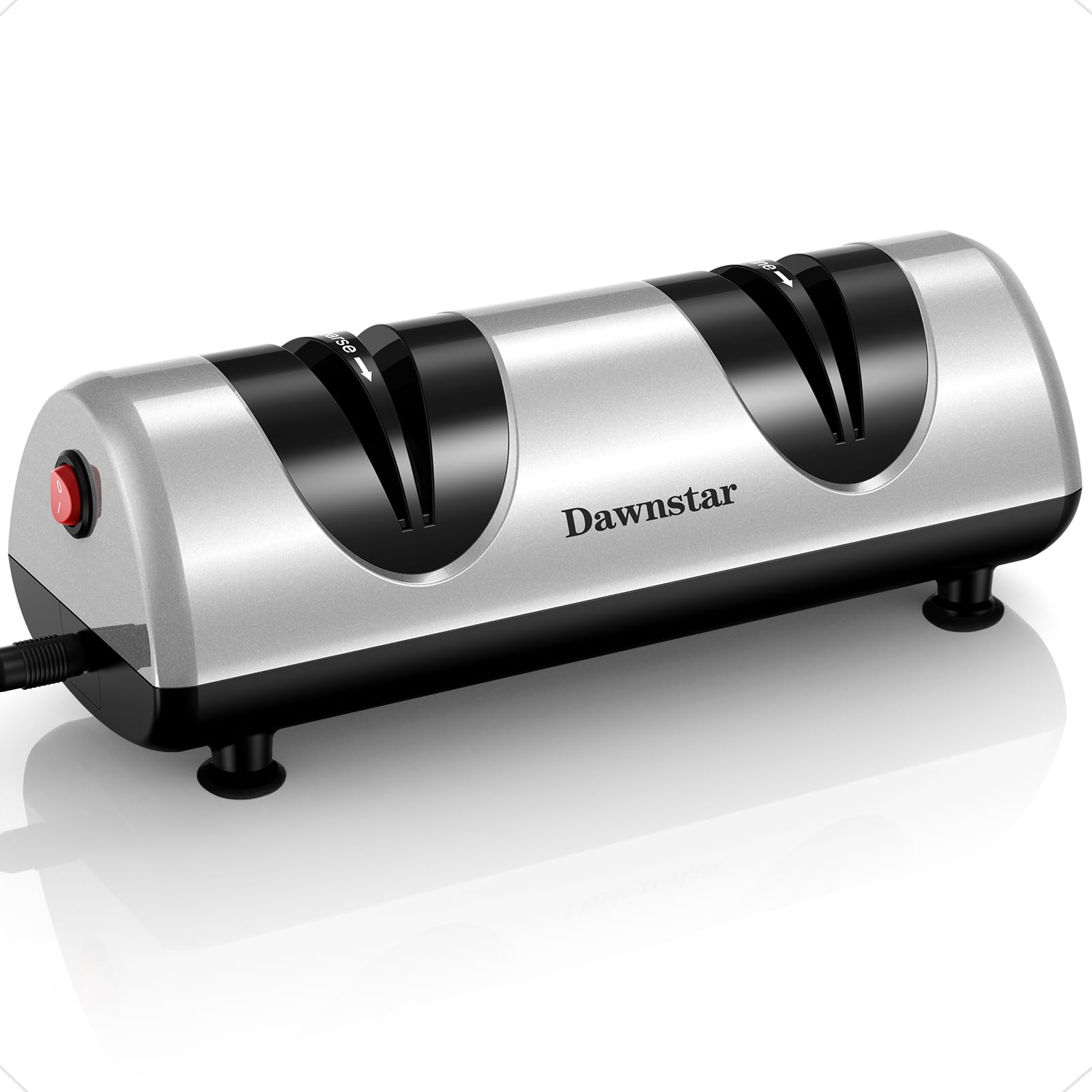
Dawnstar’s selling point is measured in seconds, not passes. Dawnstar claims a 30-second pass restores a dull blade to razor-sharp, versus 10-plus minutes on a manual sharpener. That is the entire argument for going electric, and in a kitchen where the chef’s knife gets used three times a day, it is a persuasive one.
Two stages do the work. The coarse stage shapes the edge fast, and the fine stage polishes off the burr left behind. You glide the blade base-to-tip, roughly 2-5 passes in the coarse stage, then repeat in the fine stage. Each stage has its own metal dust collection box underneath, holding the filings on a magnet so cleanup is a wipe rather than a scrub. The motor is built to run through a whole set of kitchen knives in one sitting without overheating, and it accepts universal 100-240V voltage.
The one honest caution is durability over the long haul. Most owners find it plenty sturdy, but a few report trouble starting quite early — the sharpening itself is not the weak point. Treat it as a solid home appliance rather than a workshop machine, and it will serve a normal kitchen well. The maker backs it with a 12-month free replacement or refund plus an extended 12-month after-sales service.
Where the speed comes from: Two distinct grit stages plus a 30-second cycle mean an entire knife block can be refreshed in one short session.
The upkeep win: Magnet-held dust boxes under each stage catch the metal filings, which is the difference between a clean counter and a gray smear.
Pick it when: you want sharp knives in the time it takes to boil water and have no interest in learning a stone.
Think twice when: you plan to sharpen heavily for years — a manual or belt tool is the longer-lived route.
4. SHARPAL 168H Large Diamond Sharpening Stone
Two grits of monocrystalline diamond that stay flat and work dry.
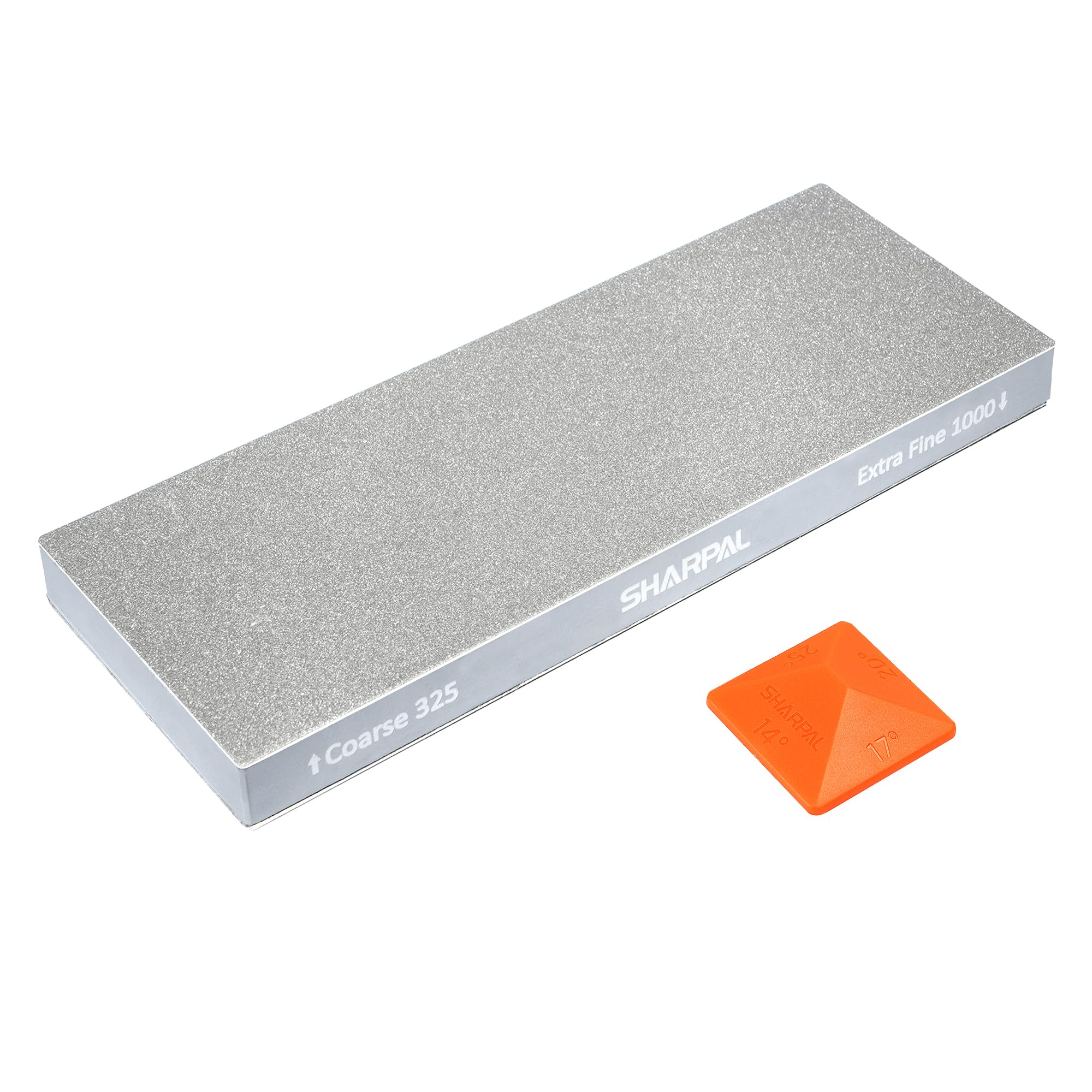
Most stones wear into a dish over time and need flattening. Diamond does not, and that is the whole reason to pay more for it. The SHARPAL 168H is a dual-grit plate: 325 grit (45 micron) on the coarse side to bring back a tired edge, and 1000 grit (15 micron) on the extra-fine side to hone it to a clean finish. Both in one 8″ x 3″ plate.
The diamond handles steels that chew up softer stones — the maker names CPM-series, M390, and Elmax specifically. You can work it dry, with no soaking or water mess, and the MirrorFlat process grinds the surface to a ±0.002 inch flatness so your blade meets the abrasive evenly across its whole length. A 4-angle guide covers 14°, 17°, 20°, and 25°, letting you hold a consistent bevel whether you are setting up a kitchen knife or a chisel. It is not just for knives, either — chisels, plane blades, axes, and hatchets all fall within its range.
Weight is the price of that durability. At 0.62 kg it is a bench tool, and the non-slip pad is there to keep it from skating while you work. The bigger trade is a flat plate means you hold the blade angle by hand, which asks more of a beginner than a guided V-slot does. A few people also find the surface awkward to clean. Worth noting: three-times electroplating is what locks the diamond particles in place, so the abrasive surface stays consistent under firm pressure rather than shedding.
The flatness advantage: A precision-grinding tolerance of ±0.002 inch keeps your sharpening consistent over repeated sessions — no relapping, no dished hollow in the middle.
What it demands: Freehand angle control. A 0.62 kg bench plate and four angle-guide settings reward the patient and punish the rushed.
Built for: the buyer with super-steel knives or woodworking edge tools who is tired of dished water stones.
Not the starter pick: if you have never held a blade at a consistent angle, a guided system will teach you faster.
5. Work Sharp Benchtop Whetstone Knife Sharpener

Stone sharpening with the guesswork taken out of the angle.
Hand sharpening on a whetstone is a skill — this kit makes it a procedure instead. You get a 1000 / 6000 combination water stone, a water-control base that holds it steady, and 15° and 17° sharpening guides that sit on the blade and set your angle for you. Follow the guide, make your passes, and the edge comes out consistent without years of practice behind it.
The 2.3 lb benchtop frame is the feature that will actually change your results. A loose stone slides and chatters; a locked-in one lets you concentrate on the stroke. The corundum abrasive (a hard mineral compound used for sharpening) runs coarse on one side to rebuild a nicked edge and fine on the other for a slicing-sharp finish. Kitchen cutlery, pocket knives, fillet blades, and edged tools are all in scope, which covers most households without needing a second tool.
What it will not do is behave like a pull-through. There is a learning curve, a soaking ritual, and a stone that needs care and eventually flattening. If you want a knife sharp in four strokes with zero technique, this is the wrong buy — but if you want to learn the skill properly on a forgiving setup, the guides are what make it approachable.
Why it works for first-timers
- 15° and 17° guides hold your angle so the edge comes out even.
- 1000 / 6000 combination covers repair and polish in one stone.
- 2.3 lb benchtop base keeps the stone planted while you stroke.
- Handles kitchen knives, pocket knives, fillet blades, and edged tools.
The learning curve you accept
- Needs soaking and a little technique before results get good.
- Slower than an electric or pull-through tool for a quick touch-up.
Chef’s-knife candidate: the cook who wants to actually understand the edge rather than just refresh it.
Wrong tool if: you sharpen in a hurry — this rewards a slow five minutes, not a fast one.
6. KING Whetstone Starter Set

A Japanese-made two-sided stone, plus the holder and cloth to use it right.
KING builds this stone in Japan, and the maker rates its abrasive quality close to a natural whetstone. One side is 1000 grit for the main sharpening work, the other is 6000 for the finishing polish. Flip the stone and you go from shaping to refining without reaching for a second tool.
The kit is what makes it a starter set rather than just a stone. A knife angle holder with two ceramic protective rods on a plastic base does the angle guidance, an original B&B Japan wiping cloth handles the cleanup, and the base keeps everything steady. For Henckels chef’s knives in particular, owners mention it produces ultra-sharp edges. The 16-ounce stone is substantial enough to feel planted but still portable.
Cracks are the caveat worth knowing before you buy. Water stones are brittle by nature, and some units have arrived with cracks in the stone — that is a shipping and material reality, not a flaw in the edge it produces. Store it dry, do not drop it, and it will outlast the box it came in.
The two-grit advantage: 1000 grit shapes, 6000 grit polishes, and the flip between them takes a second — that is the whole point of a combination stone.
Packaged to start: The angle holder, ceramic rods, plastic base, and wiping cloth mean you are not hunting for accessories after the box arrives.
For the finisher: anyone who wants a genuinely polished edge and a stone that will keep earning its place on the counter.
Buy with care if: your kitchen is a hard floor and a hard knock is likely — this stone is brittle and needs a safe home.
7. VN3 Professional Knife Sharpener
Spring-loaded arms that find the angle so you never have to.
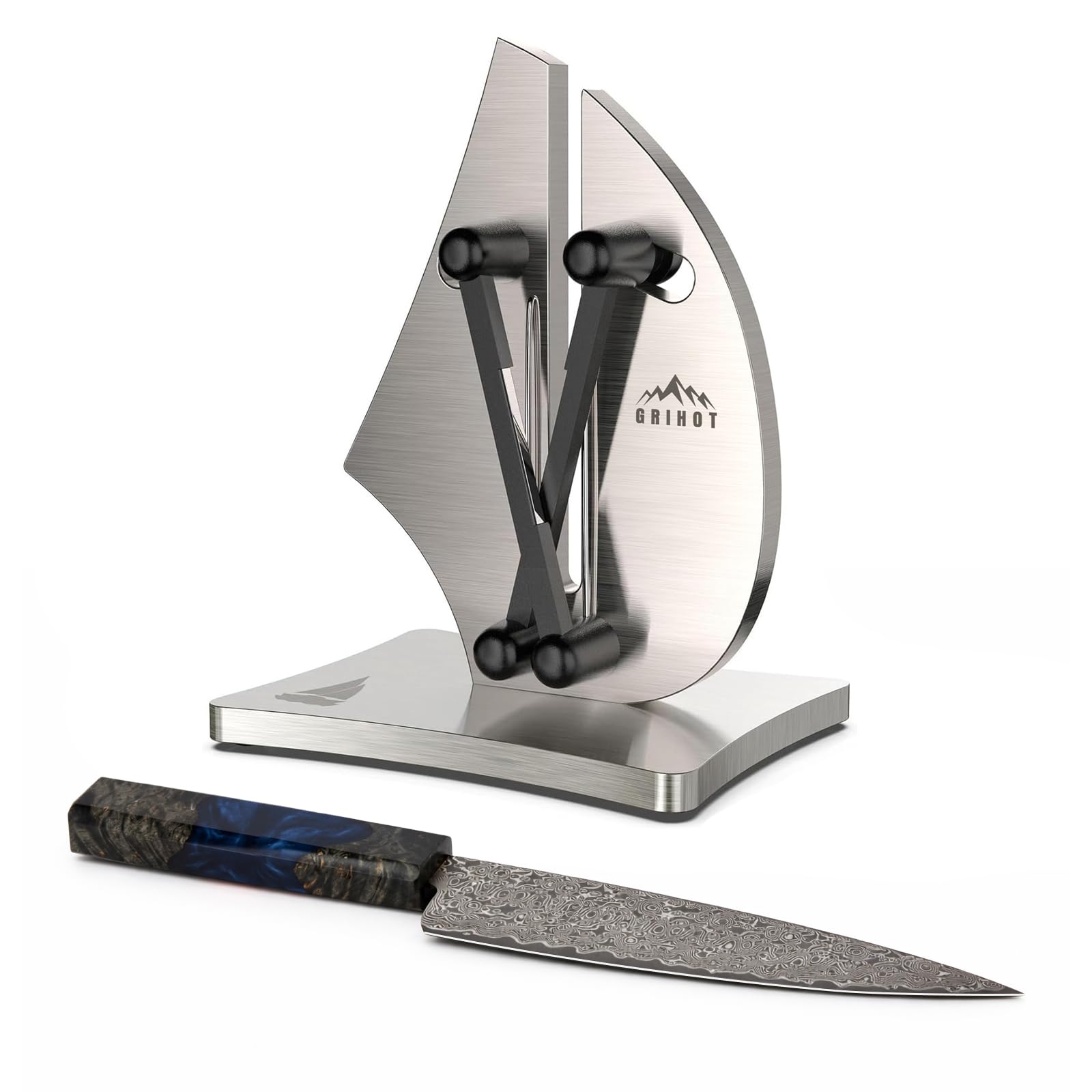
The angle is the hard part of sharpening, and the VN3 removes it from your plate. Tungsten carbide spring arms adjust automatically between 15° and 20° to match whatever blade you feed in. Set the knife into the guided V-shape, pull, and the arms find the correct angle for that knife. No special technique required — the tool’s own phrase is that it finds the angle.
Three modes extend its reach. Pull with the tip down to sharpen a dull blade, tip up to hone a daily edge, and at an angle to work a serrated edge. The body is 304 stainless steel, the sharpening components are Himalayan tungsten steel, and each unit goes through 196+ hours of grinding and polishing before it ships. Functionality is the thing buyers praise most here, followed closely by build quality — the sharpener works across all sizes of straight-edge knives and puts a razor-sharp edge on them quickly. It also happens to look good on the counter, per the sailboat-inspired design.
Durability draws a mixed read, so treat it as a home tool rather than a commercial one. It also relies on pulling through a fixed V, which some cooks prefer to avoid because it removes metal faster than a stone. The 45-month warranty is the cushion: the maker stands behind it that long.
No-technique angle control: 15°–20° auto-adjustment means the right geometry for each blade without a guide or a steady hand.
Built like furniture: 304 stainless steel body and Himalayan tungsten steel components, with a 45-month warranty behind them.
Good match for: the cook who wants consistent edges on a mix of knives without learning freehand work.
Skip if: you want maximum control over how much metal leaves the blade — a guided stone gives you more.
8. Chef’sChoice UltraHone Electric Knife Sharpener

Diamond abrasive in both stages, and it will handle your bread knife.
Most electric sharpeners quietly give up on serrated edges. This one does not — it sharpens both straight-edge and serrated knives, and the maker claims better-than-factory sharpness on straight and serrated edges alike. Both stages use 100% diamond abrasives, with finer micron diamonds in stage two for the polish. Precision angle guides hold the blade at 20 degrees so the geometry stays consistent pull after pull.
Diamond is the headline feature because it cuts hard steel and stays flatter longer than softer abrasives. That means the sharpening surface holds its shape instead of dishing (wearing into a bowl shape). So the edge you get on the first knife is the same profile you get on the tenth. Customers note it works well on serrated blades and is more efficient than hand sharpening. The whole process is fast enough to be genuinely simple to use.
The physical footprint is the trade-off to plan around. At 11.81″L x 3.94″W x 4.25″H it occupies real counter space, and at 16 ounces it stays put rather than traveling to camp. It is a home appliance, not a field tool — but for a kitchen with a full knife block, it covers the widest range of blades of anything on this list.
What it handles for you
- Sharpens serrated and straight-edge knives both, which most electrics skip.
- 100% diamond abrasives in stage one and stage two.
- Precision 20-degree angle guides keep every pass consistent.
- Fast, repeatable results without technique.
What you give up for it
- Takes up real counter space at 11.81 inches long.
- Corded, 16-ounce design lives on a bench — not in a pack.
Choose it for: a home kitchen with a bread knife, a chef’s knife, and no desire to read a sharpening manual.
Not for the road: if you sharpen on trips, the fixed counter format is working against you.
9. Work Sharp Ken Onion Mk2 Electric Knife Sharpener

One flexible belt, 15 to 30 degrees of adjustable angle, any blade you own.
This is the machine you buy when sharpening stops being one chore and becomes the whole drawer. A powered flexible belt sharpens and hones in a single guided pass, restoring a factory-keen edge in minutes without the learning curve of a freehand stone. The adjustable guide dials in a precise, repeatable bevel anywhere from 15 to 30 degrees — fine for delicate kitchen knives, steep enough for thick hunting blades.
Variable speed is the control that matters most. Run the belt slower for a delicate finishing pass on a good chef’s knife, then spin it faster to reprofile a damaged edge on a tool. Quick-change abrasive belts swap in seconds, so moving from coarse repair to a polished finish is a belt change rather than a new machine. Reviewers point out it makes knives razor-sharp and handles everything from small pocket knives to large axes, and the belt replacement process is specifically praised for being easy.
Against the Chef’sChoice above, this is a wider machine with much deeper control — adjustable angle versus fixed, variable speed versus two-stage — but it also asks more of you to get the most out of it. The compact countertop design stores easily between uses, and a 3-year warranty covers it. For the cook who has knives, scissors, garden shears, and a drawer of single-use sharpeners, this replaces the pile.
The whole-drawer answer: Pocket knives, chef cutlery, serrated blades, shears, and garden tools all go through one belt machine.
Control at your fingertips: Variable belt speed and 15°–30° angle adjustment let you decide how aggressive each pass bites.
Worth the shelf space for: the household with a mix of kitchen blades, field knives, and shop tools that all need attention.
Overkill if: you own two kitchen knives and a bread knife — a pull-through or electric home unit covers that far more simply.
Know the Specs
Grit rating
Grit is the size of the abrasive particles — a low number like 325 cuts fast because each particle is coarse and aggressive, while 1000 or 6000 polishes because the particles are fine. Think of grit as sandpaper grade for steel. You would not polish a scratched blade with fine grit alone, and you would not restore a chipped edge with 6000. That is why many stones and electric units combine a coarse stage and a fine stage in one tool.
Sharpening angle
The angle is the slant of the edge relative to the blade side. A shallower angle cuts more cleanly; a steeper one holds up better under hard use. Most kitchen knives sit around the 15 to 20 degree range, and many of the picks here fix that angle for you or let you dial it in. Consistency matters more than the exact number — an edge held at the same angle every pass comes out even, while a wobbling angle leaves a rounded, dull result.
Manual vs electric
Manual is slower but gives you full control and lasts decades with care. Electric is faster and takes the technique out of the job, but it removes metal more quickly and is a corded appliance. If you sharpen once a month and want a sharp knife today, an electric earns its place. If you want a tool that outlives your knife block, a stone or pull-through does.
Straight vs serrated edges
Serrated blades have scalloped teeth that cannot be worked on a flat stone. They need either a rod, a V-slot designed for them, or a machine that explicitly supports them. Check the product’s own description before you assume a sharpener will handle your bread knife — a straight-edge-only tool will simply not do the job.
Common Questions
Will a pull-through sharpener ruin my good chef’s knife?
Can any of these sharpen a serrated bread knife?
How often should I sharpen my kitchen knives?
What does the grit number actually mean on a sharpening stone?
Is an electric sharpener better than a whetstone?
Do diamond stones wear out like water stones?
What angle should I sharpen a western-style kitchen knife at?
Can I sharpen scissors and garden tools with a knife sharpener?
How do I keep a sharpened edge from going dull again quickly?
The Bottom Line
Your choice of knife sharpener depends on how much control you want versus how much time you have. For most kitchens, the Edgemaker Pro 331 is the one: it hones and sharpens in under a minute, handles serrated blades, and takes up nothing in a drawer. If you want a truly polished edge and a stone you can keep forever, the SHARPAL 168H stays flat and works dry. And if you would rather a machine do the whole job across knives and tools, the Work Sharp Ken Onion Mk2 is the one to reach for — a single countertop solution for anyone sorting the types of knife sharpeners.
How we choose
We do not accept paid placement. Every pick is matched to a real buyer and a real use-case; we do not hands-on test units.
Sources
Specifications: manufacturer listings and product documentation. Review insights: verified customer reviews, as of November 2026. Pricing: not shown on this page (it changes often); check the current price via the retailer link.
As an Amazon Associate, Tactical Gear Guy earns from qualifying purchases. This does not affect which products we feature.