Specs are compiled from manufacturer listings and verified buyer reviews and can change over time — please confirm the key details on the product page before buying.
If your well water leaves orange rings in the toilet bowl, stains the laundry, or smells like rotten eggs, the fix is a whole-house filter matched to your specific problem — not a generic pitcher in the fridge. Iron, manganese, sulfur, and sediment each need different media to remove them. This guide breaks down nine systems that are genuinely built for private well supply, so you can match the filter to what’s actually in your water.
This guide is built by comparing the manufacturers’ published specifications and the patterns across verified customer reviews, so you get each pick’s real strengths and trade-offs instead of marketing spin.
Test your well first to learn whether you’re fighting iron, sulfur, or sediment — the right media depends on it. Below you’ll find the best water filters for well water systems, sorted by what each one does best. You can compare them side by side and pick the one that fits your water test.
Top Picks

How To Choose The Best Water Filters for Well Water Systems
Well water is not municipal water, and that one fact drives every buying decision here. City water arrives already treated; your well delivers whatever the aquifer gives it — sand, iron, sulfur gas, manganese, and organic tannins included. A filter that only strips chlorine taste will do nothing for iron staining. So the first job is knowing your water, and the second is matching media to it.
Start With A Water Test, Not A Filter
Test for iron, manganese, hardness, hydrogen sulfide (the rotten-egg gas), pH, and sediment before you buy anything. A system with iron-removal media is wasted money if your only issue is grit. And one caveat worth knowing up front: most of these filters keep dissolved minerals in the water and will not lower total dissolved solids (TDS) — that takes a reverse osmosis stage.
Match The Media To Your Problem
Sediment cartridges trap dirt and rust so the later stages don’t clog. Granular activated carbon (GAC) soaks up chlorine taste, odors, and organic compounds. Carbon block (CTO) catches finer particles and polish. KDF media uses a redox reaction to pull iron and sulfur odor out of the stream. Iron-specific systems add manganese sand or alumina for heavier loads. Pick the media stack that answers your test results.
Flow Rate And Port Size Decide Your Shower Pressure
Flow rate, measured in GPM (gallons per minute), is how much water the system can pass while you’re running a shower and a washing machine at once. Whole-house systems here run from 2.83 gpm up to 20 gpm. Port size — 3/4″ or 1″ NPT — must match your plumbing line. Go too small on either, and you’ll notice weak pressure when two fixtures run together.
Cartridge Life And Capacity Tell You The Real Cost Of Ownership
Capacity is rated in gallons, and filter life in months. A system rated for 100,000 gallons is doing far more work between changes than one rated for 10,000. But actual life depends on your water’s sediment and iron load, so treat the ratings as best-case and plan replacements accordingly. Clear housings help — you can see when a cartridge is loaded up without opening anything.
Side-by-Side Comparison
| Model | Best For | Capacity | Max Flow | Filter Life | Amazon |
|---|---|---|---|---|---|
| iSpring WGB32B-KS★ Best Overall | Heavy metals, whole house | 100,000 gallons | 15 gpm | 1 year | Amazon |
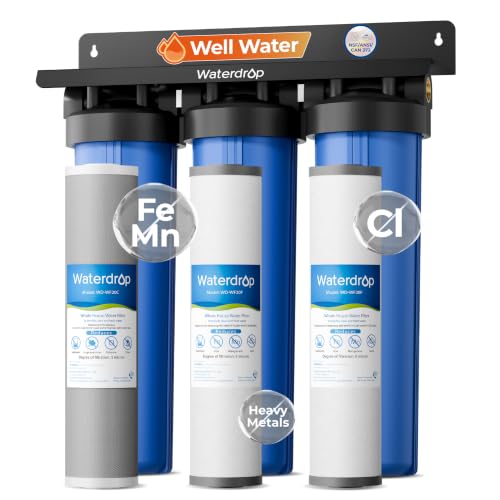
| Waterdrop WHF3T-FGBudget Champion | Certified iron and manganese | 100,000 gallons | 15 gpm | 6 months | Amazon |
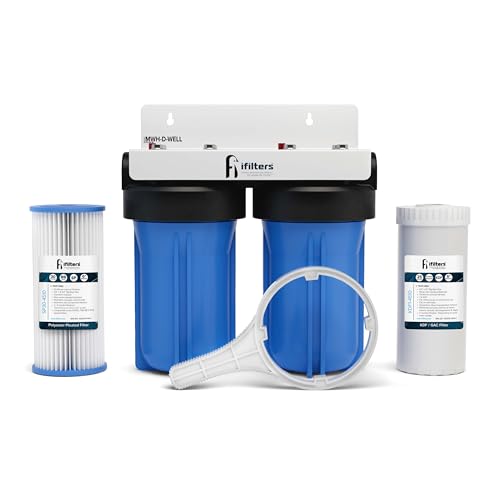
| iFilters MWH-D-WELLMost Versatile | Rust and rotten-egg odor | — | 2.83 gpm | 12 months | Amazon |
| Virego 3-Stage | Budget city-and-well setup | — | 15 gpm | — | Amazon |
| H&G Lifestyles Iron Filter | Iron and sulfur odor | 70,000 gallons | 9 gpm | 3 months | Amazon |
| Reverse Osmosis Revolution WHF-34F5 | Value multi-pack cartridges | 10,000 gallons | — | 4 months | Amazon |
| SimPure DB20P-3 | Clear-housing monitoring | 150,000 gallons | 15 gpm | 3 months | Amazon |
| 3M Aqua-Pure AP904 | Larger homes, easy changes | 100,000 gallons | 20 gpm | Up to 1 year | Amazon |
| iSpring WCFM400K | High-volume iron, set-and-forget | 400,000 gallons | 12 gpm | — | Amazon |
Detailed Reviews
1. iSpring WGB32B-KS Water Filter System
Our pick — 4.5+★ from 200+ verified ratings; the strongest balance of quality and price.
Three stages, 100,000 gallons of service, and a media stack built to pull heavy metals out of hard well water.
This is the pick for a household fighting more than grit — chlorine, lead, mercury, hydrogen sulfide, and pesticides all sit in its crosshairs. That’s the job of the second-stage FG25B-KS cartridge, a 20″ x 4.5″ compound filter. Stage one is a polypropylene sediment filter that catches particles as small as 5 microns, and stage three is a coconut-shell carbon block. Together they’re rated for 100,000 gallons, which the maker frames as a full year for a family of four.
A 15 gpm maximum flow rate keeps pressure steady across the house, and the 1″ NPT inlet and outlet match standard residential plumbing. Weight is the honest catch: 52 pounds of system hanging on your line, which is a two-person lift during installation. Compared to the lighter Reverse Osmosis Revolution unit at 15 pounds, you’re trading easy handling for a much bigger media load. The capacity is 100,000 gallons versus that system’s 10,000 gallons.
Build quality dominates owner feedback by a wide margin. Users describe water that stops smelling of sulfur and losing its chlorine taste within days of install. The recurring gripe is the 1″ connectors, where a minority hit leak issues that need re-taping and a careful torque. The system does not reduce TDS, so if lowering dissolved solids is your goal, you’ll need a reverse osmosis stage downstream. Its 4.5+ stars across 200+ ratings is the highest score here.
What Earns Its Keep
- 100,000-gallon capacity means rarely touching the cartridges
- Three stages: 5-micron sediment, KDF compound, carbon block
- 15 gpm flow across the whole house
- Targets chlorine, lead, mercury, hydrogen sulfide, and pesticides
Where It Pushes Back
- 52 pounds is a real installation lift
- 1″ connectors need careful sealing to avoid drips
- Does not reduce TDS
Built for: a family on a well with chemical and heavy-metal concerns who wants one install and long service.
Look elsewhere if: your plumbing is tight and you can’t manage a 52-pound unit or the 1″ fitting work.
2. Waterdrop WHF3T-FG Water Filter System
Certified iron and manganese removal at a mid-range price, with a 100,000-gallon tank behind it.
If your well test comes back heavy on iron and manganese, this system is the one built around that job. Waterdrop rates it at 95.9% iron and 99.7% manganese reduction through a dedicated iron and manganese cartridge in a 7-stage path. The carbon fiber layer handles the smaller stuff — sediment, rust, sand, chlorine, and odor. Capacity lands at 100,000 gallons, and flow holds 15 gpm through the 1″ inlet and outlet.
The certification trail is where this one earns trust. SGS tested the system, and the media meets NSF/ANSI 42, 61, and 44/53/58 standards, plus NSF/ANSI 372 for lead-free materials. It’s also listed as free of PBTs, BPA, and mercury. Cartridge life splits by stage: change the iron and manganese filter every 6-12 months, and the GAC filter once a year.
Buyers report it works like a name-brand system at a friendlier tier, and they notice better water quality and taste right after install. The honest caveat: some installs leak, and a minority of buyers end up chasing a drip at the connections. Its 100,000-gallon capacity (how much water it treats before you swap the media) matches the iSpring above, so you get the same long run between changes. what separates it is its focus on iron and manganese (metals that stain fixtures and give water a metallic taste). If your water test shows high iron, this is the system built for that result.
Media That Matches Iron: The double iron and manganese cartridge is the reason to choose this over a generic carbon-only stack.
The Leak Watch: Some units need extra attention at the fittings before you call the install done.
Go with it when: your water test shows iron or manganese you want gone without paying premium-tier money.
Think twice if: sulfur gas is your main problem — you want a system rated for H₂S instead.
3. iFilters 4.5 x 10 Filtration System
A rinsable pleated pre-filter that eats heavy grit before the specialty media has to.
Sediment-heavy wells clog ordinary cartridges fast, and that’s exactly the problem this design tackles. The first stage is a washable anti-bacterial pleated pre-filter with a wide surface area for grabbing dirt, rust, sand, and silt. Because you can rinse and reuse it, the expensive media downstream stays cleaner between replacements. Stage two combines GAC and KDF in one housing for chlorine taste, sulfur odor, and iron.
The housings are commercial-grade 4.5″ x 10″ Big Blue-style units with 1″ ports, sized for demanding well water where smaller filters lose flow quickly. Rated service runs up to 50,000 gallons, or 6-12 months depending on your water. Wrench and pressure relief valves come included to make cartridge swaps easier. One spec to plan around: maximum flow rate is 2.83 gpm, which is more suited to a single branch than a whole house demanding high volume.
What holds up in owner experience is the filtration quality itself, followed by how well it works on stubborn well water. The system does not reduce TDS, which iFilters is upfront about. For a house with brutal sediment, the rinse-and-reuse pre-filter is the feature that keeps maintenance costs down. The 4.5″ x 10 housing lets you reorder the same size cartridges easily.
Strong Points On A Gritty Well
- Washable pleated pre-filter extends media life
- GAC and KDF combined in the second stage
- 1″ ports on commercial-grade 4.5″ x 10 housings
- Pressure relief valves for easier changes
Points To Plan Around
- 2.83 gpm max flow limits whole-house volume
- Will not reduce TDS
Right for: a sediment-heavy well where rinsing a pre-filter beats buying cartridges constantly.
Not the pick for: a large home that runs multiple showers and appliances at once.
4. SimPure 3-Stage Pre-Filtration
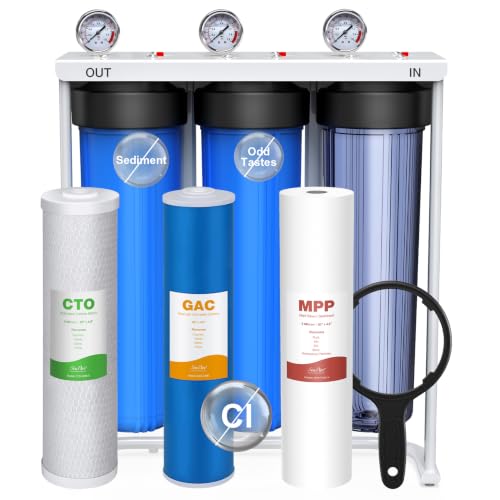
Clear housings let you watch the sediment pile up instead of guessing when to swap cartridges.
The feature that separates this one is simple: two of the three housings are clear, so you can see cartridge wear without disassembling anything. The stack runs MPP for sand, rust, and sediment, GAC for chlorine taste and odd odors, and CTO to catch residual tastes plus stray carbon powder. The 20″ x 4.5″ cartridges carry 150,000 gallons of rated capacity, the most among the cartridge systems here, and 15 gpm flow handles a full house.
Sealing hardware gets attention too, with 2×2 O-rings plus brass fittings and 1″ NPT brass connections. Cartridge life splits: the carbon filter every 3-6 months, and the sediment and GAC filters every 6-12 months. SimPure recommends running it at 25-90 psi and 41-100°F. At 48.5 pounds, it’s a substantial wall-mount install.
Owners describe it as well-built and effective, even on ferric iron, and replacement filters are priced to keep going. Durability is the honest caveat — there are reports of the metal inlet housing cracking and pressure gauges giving out. That’s the trade-off to weigh: the 150,000-gallon capacity beats the iSpring’s 100,000 gallons, but the housing hardware has a soft spot the iSpring doesn’t. Give the inlet a careful install and it holds up well.
Owners praise build quality and performance most, and the clear housings reinforce that confidence.
See-Through Advantage: Clear housings turn cartridge changes from guesswork into a glance.
The Hardware Caveat: Treat the metal inlet housing gently at installation — a fragile spot in an otherwise solid system.
Best fit: a homeowner who wants the longest cartridge capacity here and visual confirmation of when to swap.
Skip if: you’d rather not fuss over an inlet housing that can develop cracks.
5. 3M Aqua-Pure AP904 Filtration System

The easy-change cartridge and the highest flow here, built for larger homes with several bathrooms.
When cartridge changes are the chore you dread, this system answers with 3M’s Sanitary Quick Change design — no filter wrench, no touching the media, up to a year of filter life. It’s rated for homes with three or more bathrooms. Flow climbs to 20 gpm, the highest on this list, and 100,000-gallon capacity covers the long haul. The head is 304 stainless steel, and the media combines an activated carbon block with non-woven pleat filtration.
Certification matters here too: it’s tested to NSF Standard 42 and 372, and the design suits both chlorinated city water and non-chlorinated well supply. The 1″ inlet and outlet connections handle most homes’ pressure demands. At 10.4 pounds, it’s one of the lighter units to hang.
Water quality is the standout in owner experience, with the taste and smell improvements cited again and again. Value, filter life, and water pressure get more mixed reactions, so read those as fair caveats rather than firm endorsements. Compared to the heavy 52-pound iSpring, this is far easier to mount, and its 20 gpm flow outruns the iSpring’s 15 gpm. If easy maintenance and high flow top your list, this is the one.
Why Larger Homes Gravitate Here
- Sanitary Quick Change — no wrench, no media contact
- 20 gpm flow, the highest in this group
- 304 stainless steel head
- Up to 1 year filter life
Where To Set Expectations
- Value and filter life draw mixed reactions from owners
- Water pressure feedback is mixed
Made for: a big household that wants the fastest cartridge swap and a 20 gpm ceiling.
Consider another pick if: your flow needs are modest and you’d rather pay less up front.
6. iSpring WCFM400K Water Filter System

A tank-style system that regenerates itself with air, so dissolved iron and manganese stop being a weekly chore.
This is the pick for heavy, dissolved iron — the kind that stains fixtures and won’t wash out, not just sediment you can trap in a cartridge. It uses air injection and a digital control valve to regenerate the manganese dioxide media automatically, with no chemicals and no salt feed. The media is certified to NSF/ANSI Standard 61, and capacity is a 400,000-gallon rating, far and away the largest in this group.
Setup is a set-and-forget affair once it’s running — you set auto-flush intervals based on your water, and the system handles regeneration itself. It flows 12 gpm. The honest catch is weight and footprint: 104 pounds and 66.8 inches tall is a floor-standing unit that needs committed space and a careful install. There’s also a real limit — it does not remove hydrogen sulfide (H₂S) and iSpring warns H₂S can damage the system. If you have rotten-egg gas along with iron, this isn’t the unit; look for the brand’s H₂S-rated model instead.
Owners describe it as economical over time, effectively pulling dissolved iron and manganese out so water tastes better than bottled. Odor clearing completely after install is a common theme. Where the lighter cartridge systems top out on plain sediment, this one is built to fight the dissolved minerals those can’t touch. It does not reduce TDS.
Space And Weight Reality: A 104-pound, 66.8-inch tank commits floor space — plan its corner before delivery.
The H₂S Blind Spot: This system does not handle rotten-egg sulfur gas, and the maker warns it can be damaged by it.
Choose it for: a well with heavy dissolved iron and manganese but no sulfur gas, where you want automation.
Choose a cartridge system instead if: your water has H₂S or you can’t spare floor space for a tank.
7. 3-Stage Water Filtration System 3/4″ Port
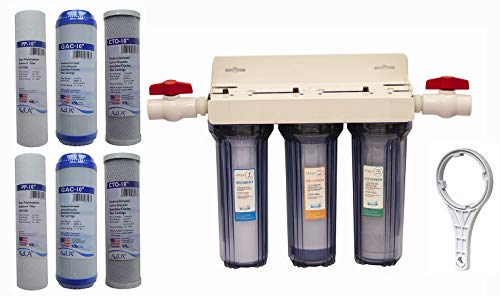
Two full years of cartridges in the box and a quick-connect first stage that makes changes fast.
Value is the whole pitch here. You get the three-stage system plus 2 extra sets of filters as a spare supply — six cartridges total — so replacements don’t sneak up on you. Stage one is a quick-connect 5-micron sediment filter for dust, dirt, silt, sand, rust, and scale. Stage two is a GAC filter for chlorine, radon, and VOCs. Stage three is a CTO block for chlorine and VOCs, including insecticides and pesticides.
Connections are 3/4″ thread, which suits standard residential lines. Capacity is rated at 10,000 gallons, and the recommendation is a filter change every 4-6 months. At 15 pounds it’s easy to handle. The build is US-made, per the maker. The 10,000-gallon rating is far below the iSpring’s 100,000-gallon figure, so this is a system for steady maintenance rather than long stretches between changes.
Owners rate filtration as the highlight — it clears sediment and chlorine as advertised, and taste and smell improve noticeably. Value for money is a close second, which tracks given the spare cartridge supply. Durability is the honest watch point: a minority report the plastic housing cracking over time, so handle it with care and don’t over-torque. Its 4.5+ stars across 700+ ratings show broad buyer satisfaction. For a household that wants budget-tier entry and lots of backup filters, this delivers.
Cartridge Stash: Six cartridges in the box means you’re covered for a couple of years of changes without reordering.
Housing Care: The plastic housing is the weak link — snug it up, don’t crank it.
Right call when: you want a low-entry system with spare filters ready to go.
Not the match if: you need a huge gallon capacity and want the longest gaps between cartridge swaps.
8. H&G Lifestyles IWF003 Iron Filter
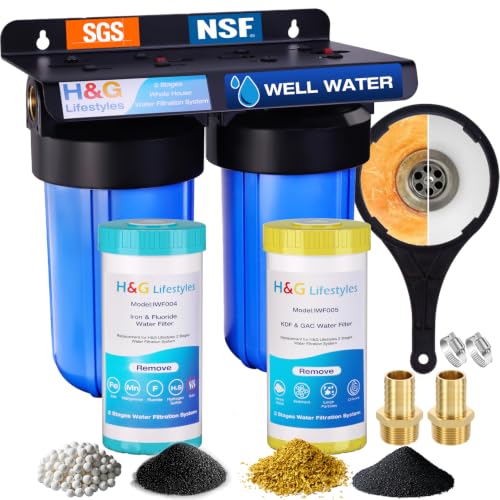
Two media cartridges aimed squarely at iron staining and sulfur smell — and built to take pressure.
This is a system for the classic well-water combo: metallic taste, orange staining, and a faint rotten-egg whiff. It runs dual-stage media — one cartridge packed with manganese sand and activated alumina, the other with KDF and GAC. Together they target iron, manganese, fluoride, chlorine, heavy metals, and hydrogen sulfide (the H₂S that makes sulfur odor). It rates up to 70,000 gallons of filtered water depending on your water and use.
Plumbing hardware gets real attention: 1-inch brass fittings (1″ NPT to 1″ barb) connect to common PEX, and it holds up to 135 PSI max while operating at 20-100 PSI. Flow is 9 gpm, and the operating range spans a 40°F lower temperature. The compact footprint — 14.5″L x 7.5″W x 15.5″H — makes it one of the smaller units to tuck into a utility space. Plan for a cartridge change every 3-6 months.
Owners confirm it handles iron and assorted minerals, and install is described as straightforward. The recurring issue is leakage — a genuine concern worth sealing carefully at the barbs. Compared to the iFilters at 2.83 gpm, this flows 9 gpm, and its 3-6 month replacement cycle is shorter than that system’s up-to-12-month window. Where staining and odor are the enemy and you have modest flow needs, this is a targeted fix.
Aimed At Iron And Sulfur
- Dual media handles iron, manganese, H₂S odor, and metals
- Holds up to 135 PSI max, operates at 20-100 PSI
- 1″ brass fittings bolt to common PEX
- 9 gpm flow
What To Watch
- Leakage comes up as a recurring concern at the fittings
- Shorter 3-6 month cartridge cycle
Reach for this if: orange staining and sulfur odor are your main well water battles.
Look elsewhere if: you need high whole-house flow for multiple fixtures at once.
9. 3-Stage Water Filtration System 0.5 Micron
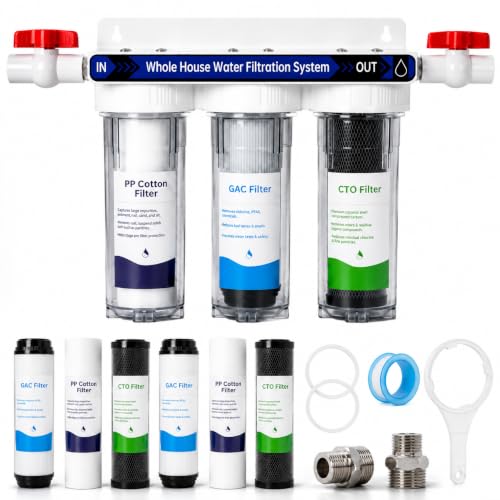
A 0.5-micron first stage, clear housings, and nine cartridges in the box for small-to-medium homes.
The finest sediment rating in this group belongs here — 0.5 micron, paired with a GAC activated carbon filter and a CTO carbon block. That three-stage path traps fine particles and pulls chlorine, taste, and odor, all without electricity or wastewater. It’s rated for both city and well water, so it fits either supply. Two shutoff valves help isolate the system during cartridge changes, and 3/4″ NPT brass inlet and outlet ports support up to 15 gpm with minimal pressure loss.
Maintenance is where it stands out for the tier: 3 complete cartridge sets come in the box, 9 filters total. The transparent housings let you watch sediment build up without opening anything. A housing wrench and plumber’s tape round out the kit. It doesn’t reduce TDS — it keeps dissolved minerals in place.
The 3.5+ star rating on a smaller review base marks it as entry-level: most buyers like it, some don’t. If your well is loaded with iron or manganese, a plain sediment-and-carbon stack won’t solve staining — match it to grit and chlorine taste instead. For a smaller household wanting cheap, replaceable filtration and clear visibility, it does the basic job.
Finer First Stage: 0.5 micron catches grit that coarser cartridges let through.
Know Your Ceiling: No iron or manganese media here — this fights sediment and taste, not staining.
Good for: a small-to-medium home on fairly clean water that needs sediment and chlorine-taste control.
Skip for: wells with heavy iron, manganese, or sulfur problems that need specialty media.
Know the Specs
Micron Rating: How Fine The Mesh
A micron rating tells you the smallest particle a filter cartridge will catch — the lower the number, the finer the mesh. A 5-micron sediment filter stops sand and rust; a 0.5-micron stage catches far finer grit but loads up faster on a dirty well. Match the rating to your sediment level, and put coarse stages first so the fine ones last longer.
GPM And Port Size: Your Pressure Budget
GPM (gallons per minute) is how much water the system can pass while you’re drawing it — run a shower and a washer together and you need headroom. Whole-house systems here range from 2.83 gpm up to 20 gpm. Port size (3/4″ or 1″ NPT) has to match your plumbing line. Undersize either one and pressure drops when several fixtures run.
KDF And Carbon: Different Jobs
Carbon handles taste and chlorine — GAC soaks up odors and organics, and carbon block polishes fine particles. KDF is different: it uses a redox reaction to pull iron and sulfur odor out of the stream. That’s why iron-focused systems pair KDF with specialty media like manganese sand or alumina, while taste-focused systems lean on carbon alone.
Capacity And Filter Life: The Real Cost
Capacity in gallons tells you how much water a system treats between changes; filter life in months tells you the clock. A 400,000-gallon rating and a 10,000-gallon rating live in very different worlds. But actual life depends on your water’s sediment and iron load, so treat the ratings as best-case and watch for slowed flow or returning odor as your change signal.
Common Questions
Will a whole-house filter remove iron stains from my well water?
Do these filters remove the rotten-egg sulfur smell?
Will a well water filter lower my TDS reading?
How often do I change the filter cartridges?
What flow rate do I need for a whole house?
Can I install one of these myself?
Do I need a sediment filter before a carbon filter?
Is a whole-house filter better than a faucet filter for well water?
What pressure can these systems handle?
Why do some well water filters leak at the connectors?
The Bottom Line
The strongest all-around pick for a family on a well is the iSpring WGB32B-KS, because its three-stage, heavy-metal-targeted stack and 100,000-gallon capacity cover chemical and metal concerns in one install. If iron and manganese are what your water test flags, grab the Waterdrop WHF3T-FG for its certified iron and manganese media. And for the biggest dissolved-iron load where you want set-and-forget automation, the tank-style iSpring WCFM400K is the one to reach for — just confirm you have no hydrogen sulfide first. Test your water, match the media, and any of these will change what comes out of every tap.
How we choose
We do not accept paid placement. Every pick is matched to a real buyer and a real use-case; we do not hands-on test units.
Sources
Specifications: manufacturer listings and product documentation. Review insights: verified customer reviews, as of November 2026. Pricing: not shown on this page (it changes often); check the current price via the retailer link.
As an Amazon Associate, Tactical Gear Guy earns from qualifying purchases. This does not affect which products we feature.