Specs are compiled from manufacturer listings and verified buyer reviews and can change over time — please confirm the key details on the product page before buying.
Boots that fit badly will ruin a ski day faster than bad snow — a loose heel means you fight the ski all the way down. The fix is picking the flex and last width that match your foot and how you actually ski, not spending more. This guide covers wide-fit comfort shells for recreational skiers and stiffer all-mountain boots for people chasing faster runs, with the entry systems and heat-moldable liners that separate an easy morning from a painful one.
This guide is built by comparing the manufacturers’ published specifications and the patterns across verified customer reviews, so you get each pick’s real strengths and trade-offs instead of marketing spin.
Below you’ll find six real options sorted by who they suit, each with its flex, last width, and shell material spelled out. The headline is simple: the Head Edge LYT RX HV is the pick that fits the widest range of casual men’s skiers — extra room through the forefoot, a polyurethane shell, and a 30.5 size straight from the factory. Read on for the full best men’s ski boots breakdown, including which pairs demand a heat-mold appointment.
Top Picks

How To Choose The Best Men’s Ski Boots
Most men buy ski boots by the number printed on the shell — and that number is the flex index, not the size. It tells you how hard the boot resists bending forward. A recreational skier on groomed runs does not need a stiff race shell. A strong skier on steep terrain will overpower a soft one. Get the flex wrong and the boot fights you on every turn.
Match flex to how you actually ski
A softer flex bends easily, so it forgives mistakes and keeps your shins happy on gentle terrain. A stiffer flex transfers energy faster and holds an edge at speed, but it demands solid technique. If you ski a handful of days a season and mostly cruise groomers, lean toward the softer end. If you chase speed and carve hard, you’ll want more resistance.
Understand last width before you buy
The “last” is the boot’s internal width, measured in millimeters across the forefoot. A wider last — like the 104-mm fit on the Nordica The Cruise and the Rossignol Evo 70 — gives your toes room to spread. A narrower boot offers more precision but pinches wide feet. High-volume shells add room through the instep too, which helps if you have a tall arch or a thick foot.
Entry systems and liners decide your morning
Rear-entry and soft-flap designs open the boot’s throat wide so your foot slides in without a wrestling match in a cold parking lot. Heat-moldable liners, meanwhile, let a shop shape the foam to your foot. Both add a little weight and cost in exchange for easier entry and a closer liner fit.
Size, shell material, and boot sole compatibility
Men’s boots run on the Mondopoint scale, which is your foot length in centimeters — a 27.5 shell is not the same as a US 10. Check the size printed on the model you’re buying, because some listings ship a single fixed shell. Shell material matters too: polyurethane and TPU absorb shocks and stay warm, while stiffer plastics transmit energy more directly. If you plan to hike or walk in the boot, confirm it accepts a GripWalk sole, since that is usually sold separately.
Side-by-Side Comparison
| Model | Best For | Size | Weight | Last / Fit | Amazon |
|---|---|---|---|---|---|
| Head Edge LYT RX HV★ Best Overall | Wide-footed recreational skiers | 30.5 | 4.31 kg package | High Volume | Amazon |
| Nordica The CruiseEasiest On/Off | Easy on/off comfort | 27.5 | 8.5 pounds | 104-mm last | Amazon |
| Rossignol Evo 70 | All-day relaxed cruising | 30.5 | 10.7 pounds | 104-mm last | Amazon |
| K2 BFC 80 | Hands-free entry | 29.5 | 8 pounds | Heat moldable | Amazon |
| Nordica Sportmachine 3 90 | All-mountain touring | 29.5 | 4.65 kg package | 3D Cork Liner | Amazon |
Detailed Reviews
1. Head Edge LYT RX HV Alpine Ski Boots
Our pick — 4.5+★ from 70+ verified ratings; the strongest balance of quality and price.
The wide-footed comfort shell that ends the toe-crush squeeze
If your last pair left your forefoot throbbing by noon, the Edge LYT RX HV is built for exactly that problem. The “HV” in the name stands for High Volume — it means extra room through the forefoot and instep, which is the zone where most men get pinched. This is a men’s-specific fit with a D shoe width, so it’s cut for a man’s foot rather than a unisex shell squeezed into a men’s box.
The shell is polyurethane, a plastic that soaks up vibration and stays warm when the temperature drops. That matters when you’re standing in a lift line at first light. The package weight comes in at 4.31 kg, giving you a sense of how it travels — noticeably lighter than the Nordica HF 110, which lands at 4.94 kg on the same measure. It ships in a 30.5 Mondopoint size (that’s a men’s-foot length scale measured in centimeters), so check that number before you add it to the cart.
What wins people over here is the fit — it earns more positive specific mentions across feedback than any other trait, with comfort close behind. Skiers describe a boot that holds the foot without squeezing. The honest catch: this is a fixed 30.5 shell, so if you’re smaller than roughly that footprint, this boot won’t be your size. It’s covered by a 1 Year Limited Manufacturer Warranty, which is worth knowing if you’re shelling out for a premium-tier boot.
What skiers get
- High-volume fit opens the forefoot and instep for wider feet.
- Polyurethane shell dampens chatter and stays warm on cold lifts.
- Comfort and fit lead the praise — no squeezing, no hot spots.
- 1 Year Limited Manufacturer Warranty backs the shell.
Where it constrains you
- Ships in one 30.5 size — small and mid-size feet can’t use this pair.
- High-volume fit is generous, so narrow feet will feel it float.
Reach for this if: your feet run wide and you want a shell that doesn’t punish them on groomers.
Look elsewhere if: you need a smaller shell — the fixed 30.5 won’t fit a mid-size foot.
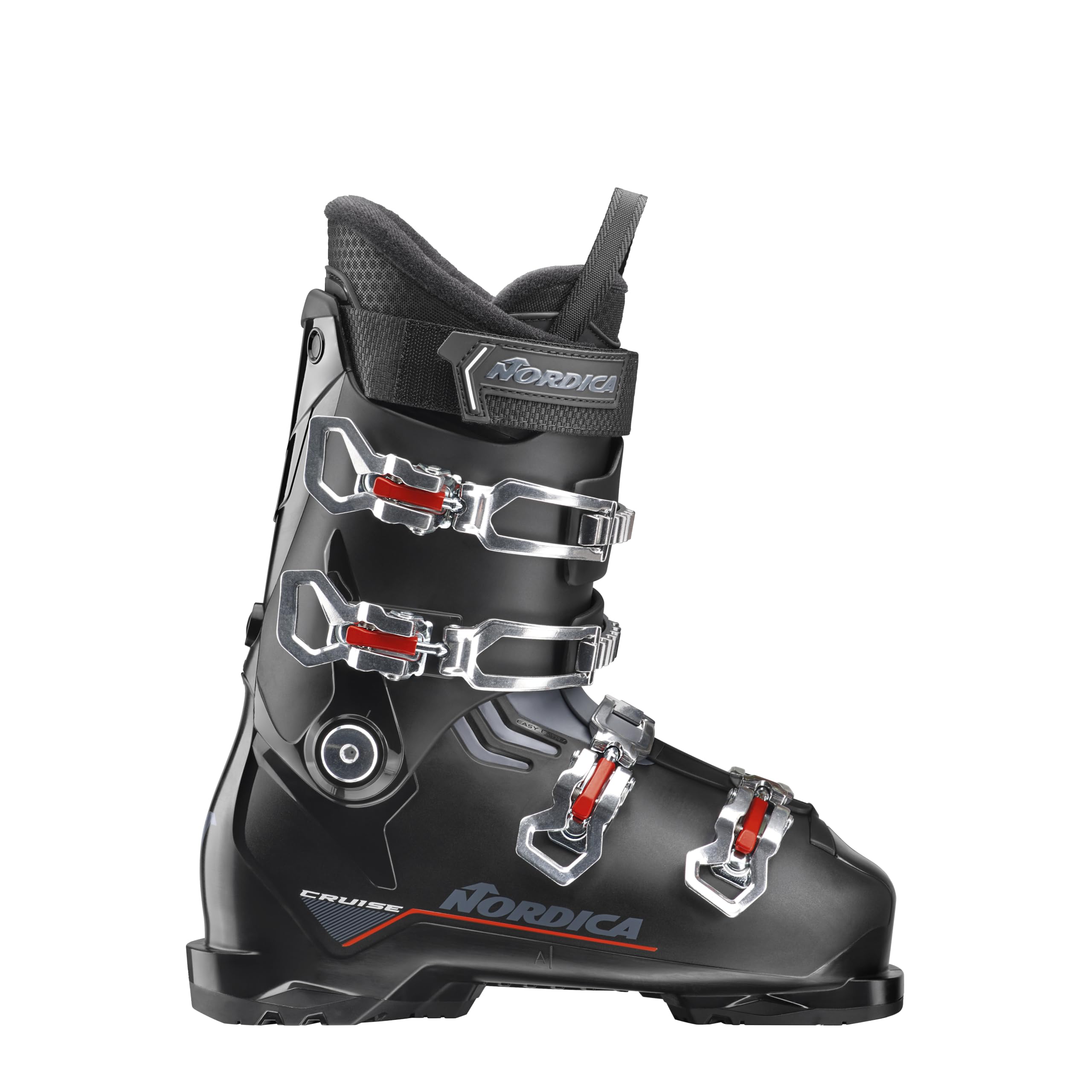
2. Nordica The Cruise Men’s Ski Boots
The boot that slides on like a slipper and forgives wide feet
Nordica built The Cruise around a 104-mm last — that’s the boot’s internal width across the forefoot, and 104 mm sits firmly in the wide-comfort camp. It measures 19 x 14 x 5 inches and weighs 8.5 pounds, making it the lightest pair on this list when compared by item weight against the 10.7-pound Rossignol Evo 70. The reason is the shell: it’s plastic, and it opens wide.
That opening comes from the dual soft flap instep, a pair of flexible plastic inserts built into the boot’s throat. They let the boot open exceptionally wide, so stepping in and out stops being a cold-parking-lot fight. There’s also Instep Volume Control, which lets you raise or lower the boot board by +/- 4mm to fine-tune how much room your instep gets. And the infrared technology lets a shop heat a specific pressure point with a lamp, then use a suction cup to relieve it — a targeted fix for one stubborn hot spot.
Quality is what earns the most praise here, followed closely by comfort, with fit and value rounding it out. Skiers report a boot that doesn’t rub or squeeze. The follow-up question a buyer should ask: that wide 104-mm last and soft-flap design favor comfort over race-day precision, so aggressive carvers may want more shell stiffness.
Wide-entry win: The dual soft flap and Instep Volume Control make this the friendliest boot here for anyone with a high instep or stiff hands.
Trade-off to weigh: The comfort-first 104-mm last trades some precision for room, so it suits cruising more than carving.
Best fit for: skiers who dread wrestling boots on and want a wide, forgiving shell.
Caveat: aggressive skiers who want a locked-in race feel should look at a stiffer option.
3. Rossignol Evo 70 Alpine Ski Boots
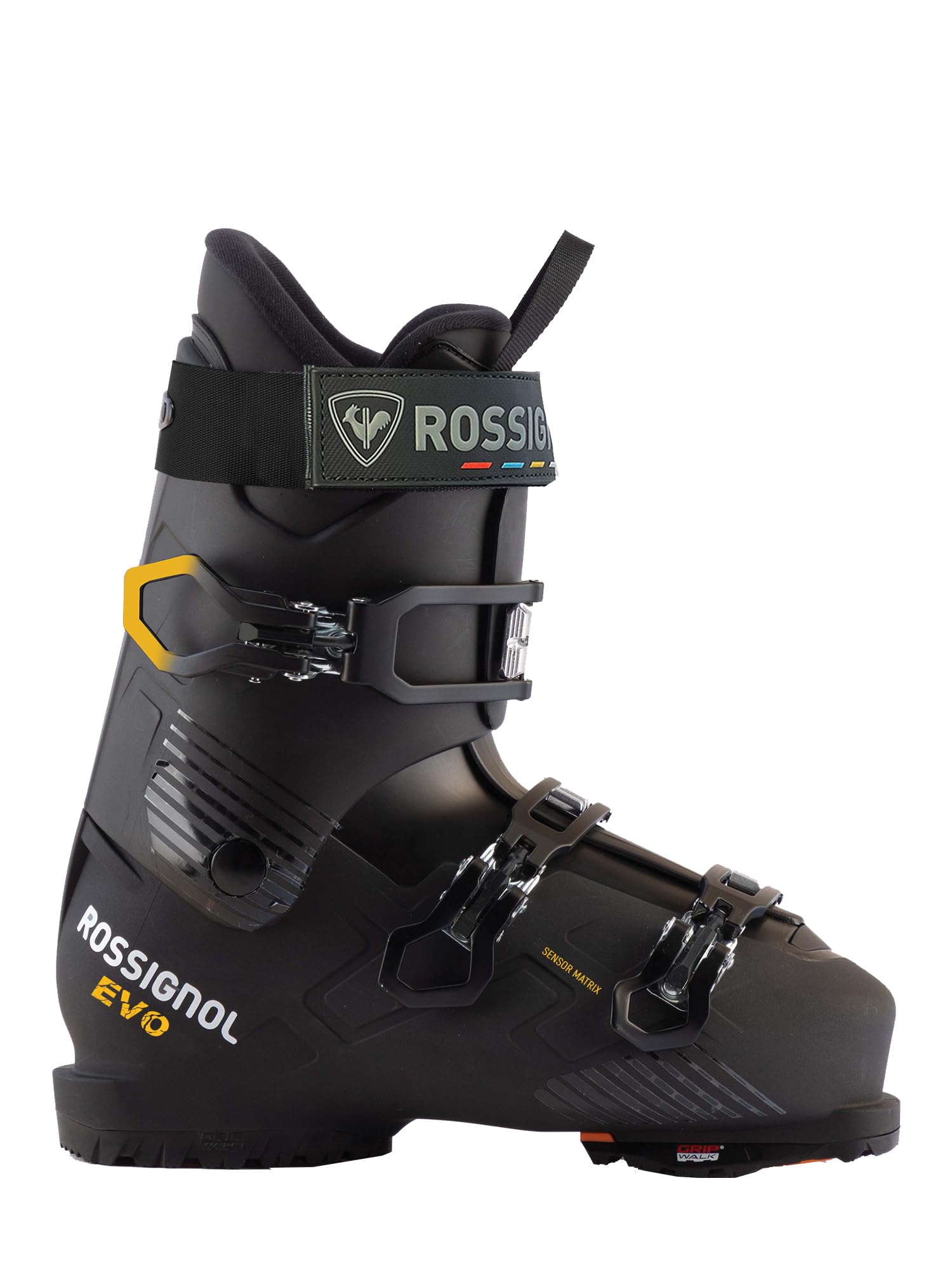
A relaxed 104-mm shell built for long, forgiving days on the hill
Rossignol gives the Evo 70 the same 104-mm last as The Cruise, with a wider forefoot, toe box, and ankle area for generous all-day support. The shell uses Sensor Matrix construction, a ribbed design that trims boot weight while still pushing energy straight to the ski. It comes in a 30.5 size and closes with a ratchet buckle — the ladder-style buckle you ratchet down, which is quick to set with gloves on.
The fit is what skiers praise most here, with comfort right behind it and value close by. Buyers report no shin pain, and the boot doesn’t slip out of the skis underfoot. The custom fit liner has softer padding through the ankle and instep plus a heel-support zone you can lean into. Entry is smooth because the boot overlap opens easily — a real difference when you’re clicking in at a cold lift with stiff fingers.
Here’s the weight reality up front: at 10.7 pounds this is the heavier pair next to the 8-pound K2 BFC 80, so you lose some lightness for that cushioned relaxed fit. The GripWalk sole compatibility is worth flagging — the rubber tread and rockered toe help you walk, but the compatible sole is sold separately, so budget for that if you hike to the lift. A 30.5 shell is the only size offered, which is the one thing that rules it out for smaller feet.
Comfort-forward design
- 104-mm last and wider ankle area suit wider feet and long days.
- Fit and comfort draw the most praise; skiers report no shin pain.
- Sensor Matrix shell trims weight while keeping direct energy transfer.
- Custom fit liner adds softer padding through ankle and instep.
Things to plan for
- Heavier than the lighter K2 claims — 10.7 pounds versus 8 pounds.
- GripWalk sole is sold separately, not included.
- Single 30.5 size limits who can wear it.
Choose it for: cushioned, no-shin-pain days where you’d rather be comfortable than featherlight.
Think twice if: you need a smaller shell or want the walking sole bundled in.
4. K2 BFC 80 Men’s Ski Boots
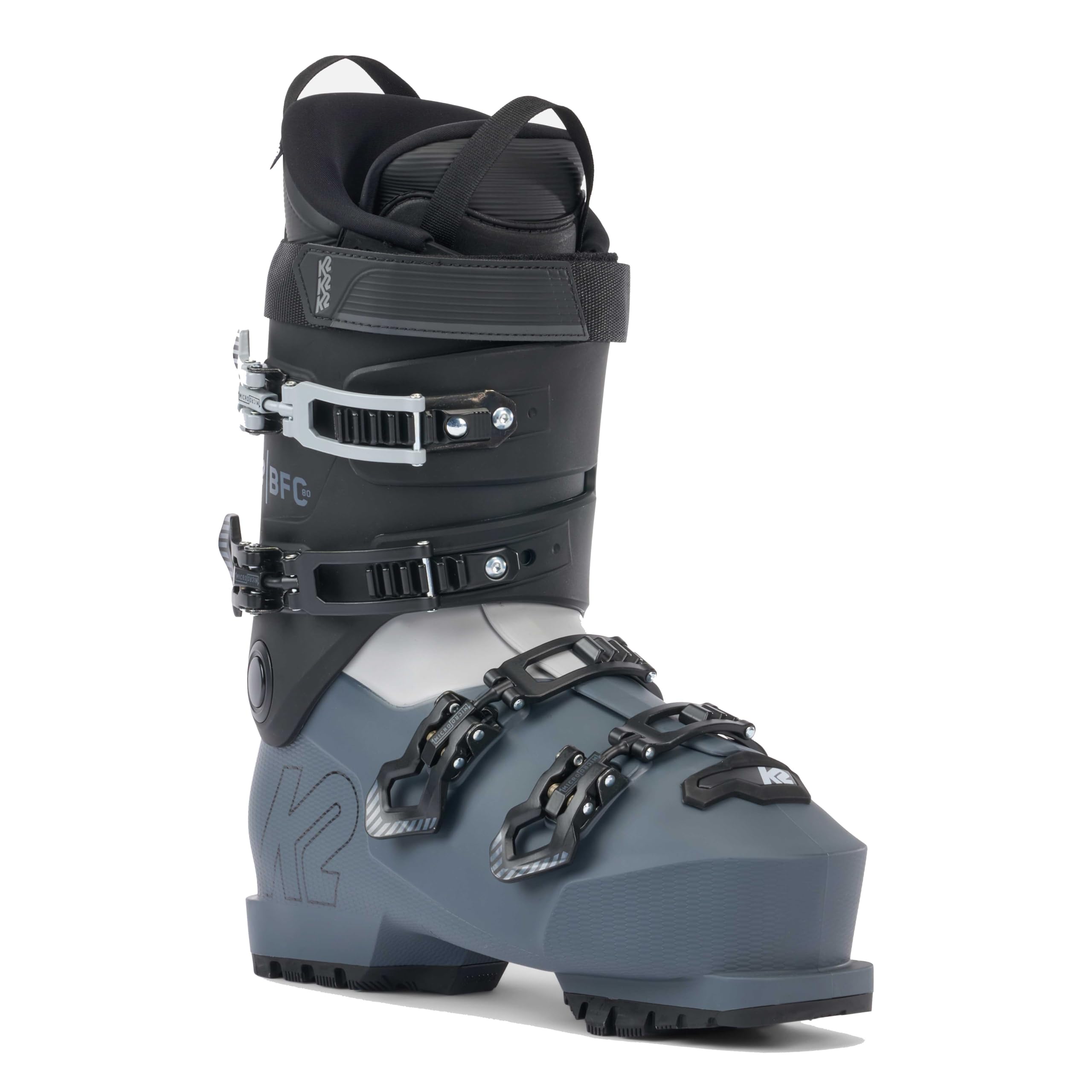
The light 8-pound boot that molds to your foot and steps on hands-free
The K2 BFC 80 leads with two features that solve real gripes: hands-free entry and a fully heat-moldable shell and liner. Hands-free means you can step in without yanking the tongue; heat-moldable means a shop warms the boot and it shapes to your foot, which is the closest thing to a custom fit off the shelf. Its shell is TPU with a PP cuff — TPU being a tough, flexible plastic and PP a stiffer polypropylene for the upper cuff.
At 8 pounds it’s the lighter pair versus the Nordica The Cruise’s 8.5 pounds, so long days on the hill feel less like hauling. It measures 25 x 21 x 6 inches. The BFC designation stands for its comfort-focused fit, and the 29.5 size gives you a mid-range Mondopoint shell to check against your foot length. Quality is the trait skiers call out most, with comfort right behind.
One thing to weigh: the -tier price places it above several comfort shells here, and the heat-molding benefit only shows up if you actually visit a shop to get it done. Skip the shop appointment and the heat-moldable shell stays a stock fit you paid extra for.
Why buyers pick it: Hands-free entry plus a full heat-moldable shell means far less parking-lot wrestling and a fit that adapts to your foot shape.
The catch: The heat-molding payoff only arrives if you book the shop appointment; otherwise you’re paying premium-tier money for a stock fit.
Ideal for: skiers willing to get a shop mold who want the lightest shell here with easy entry.
Not ideal if: you’ll never mold it — you’d be paying for a feature you skip.
5. Nordica Sportmachine 3 90 All-Mountain Touring Ski Boots
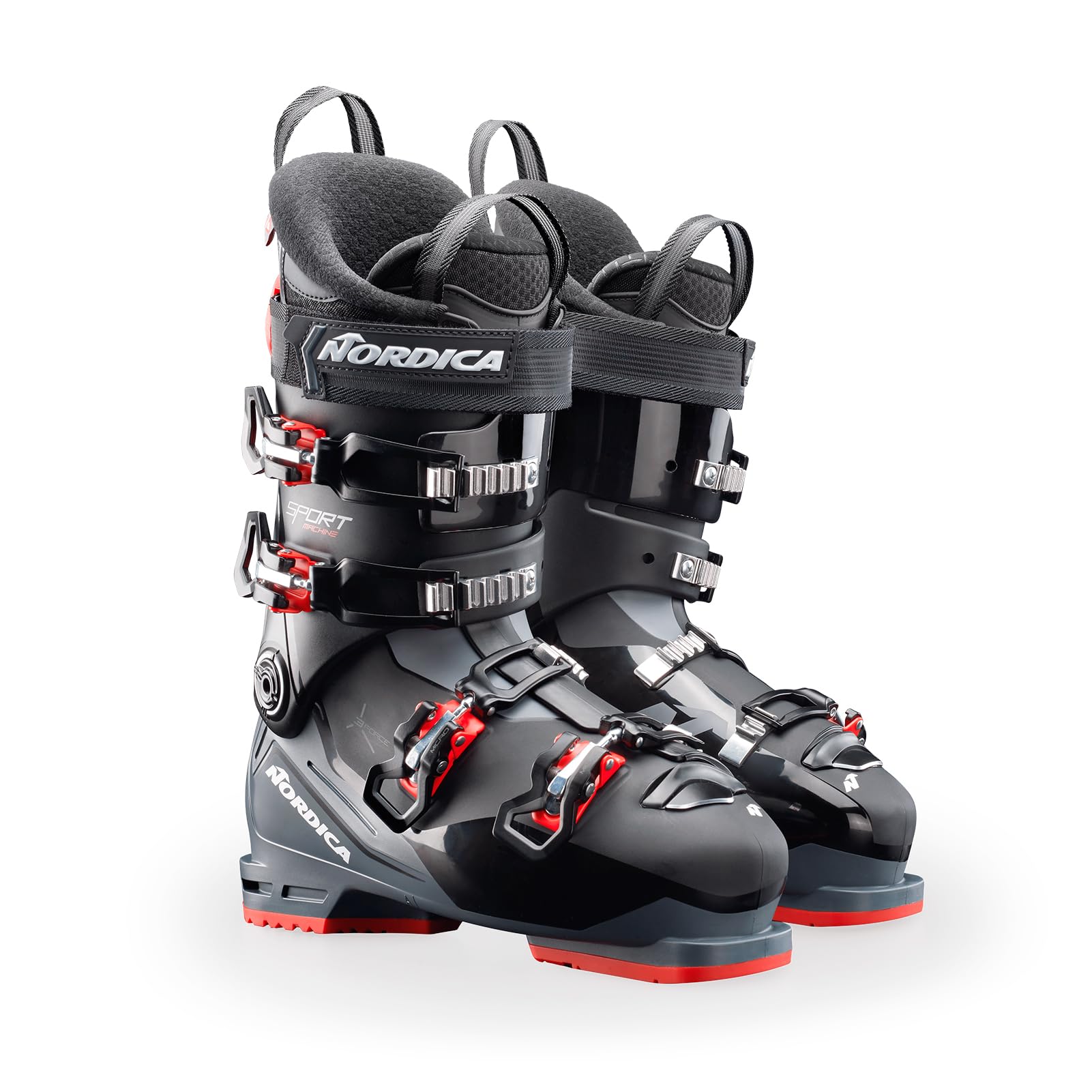
Warm insulation and a cork liner for cold all-mountain days
If your feet turn to ice on the lift, the Sportmachine 3 90 answers with PrimaLoft insulation — a synthetic fill that stays water-resistant and keeps its warmth and light weight even when it gets damp. The 3D Custom Cork Liner adds a cork layer that insulates and wicks moisture, so your foot stays dry and warm through a long day. That combination is the standout reason to pick this boot in cold conditions.
The Tri Force shell uses Nordica’s 3 Force construction, which tightens the link between your foot, the liner, and the shell so your leg’s energy reaches the ski with less loss. That translates to sharper turns and more control. The wider fit and softer shell make it forgiving, and the Adjustable Cuff Profile lets you dial in more cuff volume and shape the fit around your calf. The Dual soft flap instep opens the throat wide for easy entry, the same family of convenience as The Cruise.
The package weight sits at 4.65 kg, putting it between the lighter Head Edge and the heavier Nordica HF 110’s 4.94 kg. This is a premium-tier all-mountain boot, so it asks more of your wallet in exchange for the insulation and cork build. Weigh that premium against how many sub-freezing days you actually ski.
Cold-weather edge: PrimaLoft insulation plus a cork liner is the warmest setup in this lineup — the reason to pay for it in frigid climates.
Money question: The premium-tier build costs more; if you ski in mild weather, those insulated features may be overkill.
Pick it when: you ski in cold climates and want warmth plus an all-mountain energy transfer.
Skip the splurge if: you mostly ski mild conditions and don’t need insulated construction.
Know the Specs
Flex Index
The flex index is a number that tells you how hard the boot resists bending forward. A softer flex bends easily and forgives mistakes, which suits casual and intermediate skiers. A stiffer flex transfers energy faster and holds an edge at speed but demands solid technique. The numbers in this lineup — the Edge LYT RX HV, the K2 BFC 80, the Rossignol Evo 70, and the Nordica Sportmachine 3 90 — each carry a number at the end of their names that signals their place on that scale. Match it to how aggressively you actually ski, not to the highest number you can find.
Last Width and Volume
The last is the boot’s internal width in millimeters, and the volume describes how much room it gives through the forefoot and instep. The Nordica The Cruise and the Rossignol Evo 70 both use a 104-mm last, which lands in the wide-comfort zone. The Nordica HF 110 runs a 102-mm last. The Head Edge LYT RX HV is labeled High Volume, adding room through the forefoot and instep for wide or tall-arched feet. A wider last feels roomier but gives up a little precision. Confirm your measured foot width before picking.
Shell Material
Shell material controls warmth and how the boot feels on snow. The Head Edge LYT RX HV and the Nordica HF 110 use polyurethane, a plastic that dampens vibration and stays warm in the cold. The K2 BFC 80 uses TPU for the shell and PP for the cuff — TPU is tough and flexible, PP is stiffer. The Nordica The Cruise and the Rossignol Evo 70 list plastic shells. Softer materials favor comfort; stiffer plastics transmit energy more directly for sharper response.
Entry Systems and Liners
Rear-entry and soft-flap designs open the boot’s throat so your foot slides in without a fight. The Nordica HF 110 opens 40 degrees and can be open up with a ski pole. The Nordica The Cruise and the Sportmachine 3 90 use a dual soft flap instep that widens the throat. Liners matter too: heat-moldable liners, like the K2 BFC 80’s fully heat-moldable build, let a shop shape the foam to your foot. Cork liners, as on the Nordica Sportmachine 3 90 and HF 110, add insulation and lateral push.
Common Questions
Will a 30.5 Mondopoint boot fit a normal men’s foot?
What does high volume mean on a ski boot?
Can I open a rear-entry boot without bending over?
Do I need a heat-moldable ski boot liner?
What is a GripWalk sole and do these boots come with it?
Will the Nordica The Cruise fit a wide foot?
Are insulated ski boots warmer on the lift?
What flex index suits a beginner versus an expert?
Can I use a touring boot like the Sportmachine 3 90 for regular resort skiing?
The Bottom Line
Most men are best served by the Head Edge LYT RX HV because its high-volume fit solves the forefoot pinch that ruins a ski day, and its polyurethane shell stays warm on the lift. If easy entry is your top priority, the Nordica The Cruise opens wide with its soft-flap instep and lets you tune the instep by +/- 4mm. For cold climates and all-mountain control, the Nordica Sportmachine 3 90 brings PrimaLoft insulation and a cork liner to keep your feet dry. The Head Edge carries a 4.5+ rating, the highest on this list, and pairs it with the widest comfort fit here.
How we choose
We do not accept paid placement. Every pick is matched to a real buyer and a real use-case; we do not hands-on test units.
Sources
Specifications: manufacturer listings and product documentation. Review insights: verified customer reviews, as of November 2026. Pricing: not shown on this page (it changes often); check the current price via the retailer link.
As an Amazon Associate, Tactical Gear Guy earns from qualifying purchases. This does not affect which products we feature.