Specs are compiled from manufacturer listings and verified buyer reviews and can change over time — please confirm the key details on the product page before buying.
If your teammates sound like they are calling from a drive-thru speaker and enemy footsteps arrive as a muddled blur, the fix is usually a wired USB headset with its own digital audio processing and a driver tuned for positional cues. This guide covers nine USB-connected headsets for PC, from budget 7.1 picks to the 24bit/96kHz Corsair HS80, and tells you which one fits your ports, your ears, and the games you actually play.
This guide is built by comparing the manufacturers’ published specifications and the patterns across verified customer reviews, so you get each pick’s real strengths and trade-offs instead of marketing spin.
Because a USB headset carries both audio and voice over one plug, the two things that decide whether you keep it are mic clarity and how the earcups feel after hour three. That is exactly what the picks below are ranked on — which is why the Razer Kraken V4 X, with its retractable cardioid mic and convertible USB-C/USB-A cable, leads this guide to the best USB gaming headset for PC.
Top Picks


How To Choose The Best USB Gaming Headset for PC
The first thing to get right is the plug, not the price: USB-A, USB-C, or a convertible cable that covers both. A USB headset carries its own digital audio signal, so the PC treats it as a separate sound device — which is why you set it as both your output and your input after plugging in. A 3.5mm headset relies on whatever sound chip your motherboard happens to use, and that chip is often the weakest link.
Check the connector before anything else
A USB-A headset plugs into the rectangular port on most desktops and older laptops. A USB-C headset plugs into the smaller oval port on newer laptops and handhelds. Some headsets, like the Razer Kraken V4 X, ship with a convertible cable that covers both. Read the listing carefully: one pick here uses USB-A only and explicitly does not support 3.5mm or Type-C, so confirm your ports match before you buy.
Decide how much surround you actually need
Virtual 7.1 surround sound is software processing that widens the soundstage so you can tell left from right and near from far. It is genuinely useful in first-person shooters, where hearing a reload behind a wall tells you where to aim. It is far less important for strategy games or single-player story titles, where stereo already does the job. Buyers who play competitive FPS should look for a headset with a dedicated surround mode, not just a 7.1 badge.
Weigh driver size against long-session comfort
A 50mm driver is the speaker inside each earcup; a bigger driver generally moves more air, which usually means deeper bass and a wider soundstage. A 40mm driver can still sound excellent and often keeps the headset lighter. Comfort is the factor that decides whether you keep a headset, though: clamp force and cushion material matter more than driver size after hour three. Look for memory foam or protein leather cushions and an adjustable headband, because clamp force is what causes headaches after a few hours of play.
Treat the microphone as half the purchase
You will talk more than you listen in team games, so mic pickup pattern matters as much as driver tuning. A cardioid mic (which picks up sound mostly from the front) rejects keyboard clatter better than a wide open mic. A detachable or retractable boom lets you move the mic close to your mouth for clarity and out of the way when you are not on comms. An inline mute button or a flip-up boom is a small thing until you need it mid-match.
Side-by-Side Comparison
| Model | Best For | Driver Size | Connection | Mic Style | Amazon |
|---|---|---|---|---|---|
| Razer Kraken V4 X★ Best Overall | All-round PC and console | 40 millimeters | Convertible USB-C & USB-A | Retractable cardioid | Amazon |
| FIFINE H13BPStreamer Pick | Streamers and RGB setups | 50 millimeters | USB-A | Noise-canceling boom | Amazon |
| Corsair HS80 RGB USBHi-Fi Pick | Hi-fi audio and comfort | 50 millimeters | USB wired | Omni-directional flip-mute | Amazon |
| EKSA USB Gaming Headset | Multi-device flexibility | — | USB & 3.5mm (removable cords) | Detachable noise-canceling | Amazon |
| Logitech G432 | Big-brand positional audio | 50 millimeters | USB wired | 6mm flip-mute boom | Amazon |
| HAU-37 | Budget light-up setup | 50 millimeters | Gold-plated USB | Bendable boom | Amazon |
| SADES SA902 | Budget 7.1 surround | 40 millimeters | USB wired | Flexible boom | Amazon |
| ETWAR EG100 | Cheapest surround entry | 50 millimeters | USB-A (fixed cable) | Flexible omni-directional | Amazon |
| NUBWO HG03 | FPS on a strict budget | 50 millimeters | USB-A only | Memory-flex noise-canceling | Amazon |
Detailed Reviews
1. Razer Kraken V4 X Wired USB-C & Type A Gaming Headset, Black
Our pick — 4.5+★ from 750+ verified ratings; the strongest balance of quality and price.
One headset that already fits whatever port your desk has today.
This is the pick for the player who moves the headset between a tower, a laptop, and a console. The cable is convertible between USB-C and USB-A, so the same headset plugs into a modern laptop one minute and a desktop the next. No adapter drawer, no second headset.
Razer’s patented three-part 40mm driver is the technical heart of it. The design splits the driver into sections so highs, mids, and lows each stay clean instead of turning into one muddy wall. Those 40mm drivers are smaller than the 50mm units in the ETWAR EG100, and in practice the ETWAR has the bigger driver, while the Kraken’s three-part construction is aimed at clarity rather than raw bass output. Expect punch you can feel, not a bass cannon.
The retractable cardioid mic is the crowd favorite, and the design explains why. Cardioid pickup listens mostly to the front, so your voice comes through while fan noise and keyboard clatter drop away. The boom retracts into the earcup when you are not talking, which protects it and keeps the headset neat. Hybrid fabric and leatherette cushions cover the 7.1 surround processing, and Chroma RGB rounds out the look.
The recurring gripe is uneven long-term durability — a small share of units see the mic stop responding over time, so treat the retract mechanism gently. Sound quality opinions split more than any other point, which means it rewards tuning to your own ears rather than trusting the badge. The comfortable memory foam and the mostly-praised build quality are what keep most people happy.
Where it wins
- Convertible USB-C and USB-A cable covers PC, console, Steam Deck, and phone without an adapter.
- Retractable cardioid mic keeps your voice forward and stows away cleanly.
- 7.1 surround sound and hybrid memory foam cushions for long sessions.
Where it asks for care
- 40mm drivers give up some low-end weight to the 50mm picks in this list.
- A small number of units see the mic fail over months of use, so baby the retract button.
- Sound quality divides opinion, so plan on a little EQ work.
Buy it if: you want one headset that already fits every port on your desk and a mic that hides itself.
Trade-off to accept: the 40mm driver trades some sub-bass for clarity compared to the bigger-driver picks below.
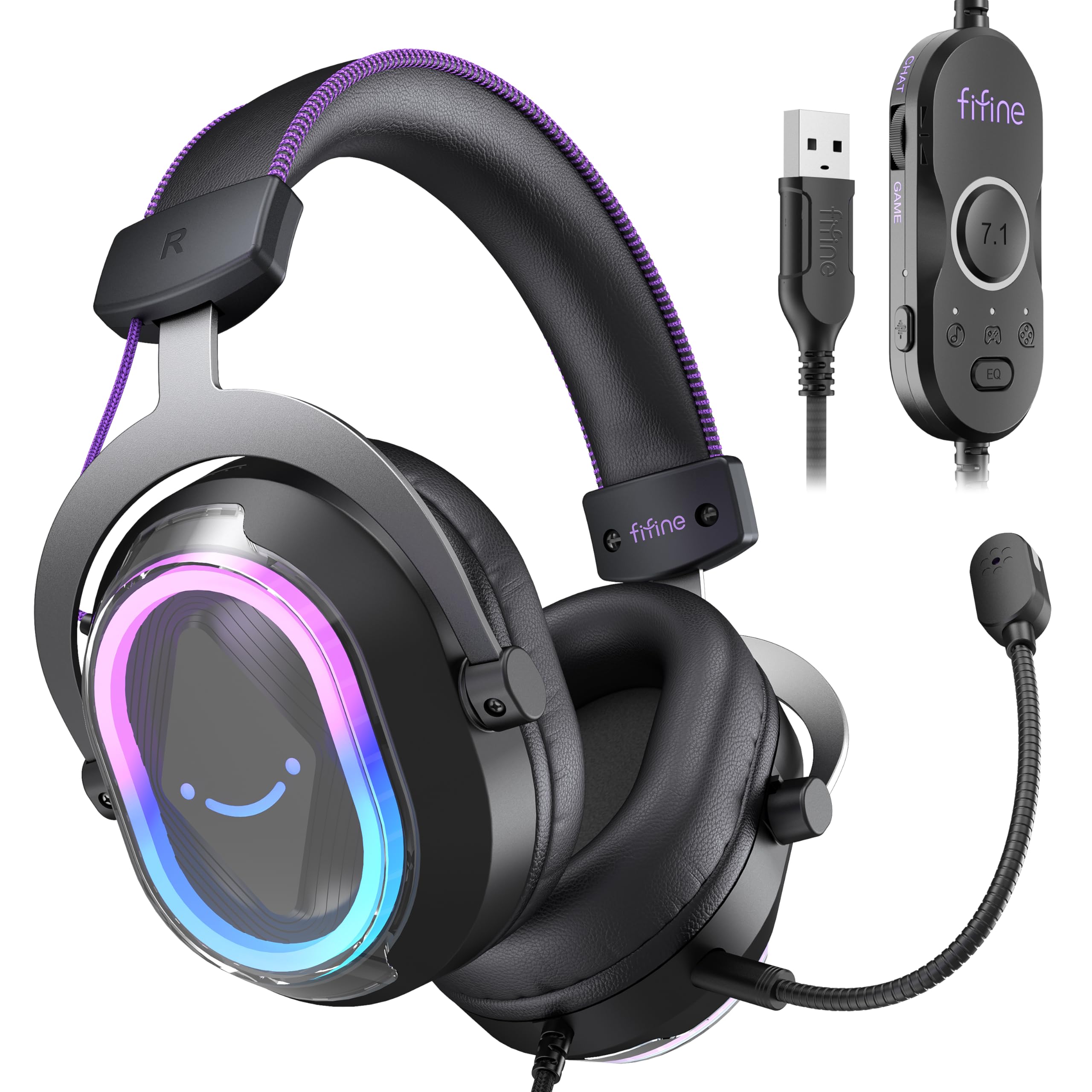
2. FIFINE H13BP Wired USB Gaming Headset
A translucent RGB shell built for the camera, backed by a serious audio driver.
Sound quality is what wins people over here, and the hardware backs it up: a 50mm dynamic driver tuned to keep highs, mids, and lows distinct, with 7.1 surround sound on top. In a firefight that translates to a reload you can place behind you and footsteps you can follow instead of guess at. It is the same 50mm driver class as the bigger-name picks, which is a lot of driver for the mid-range tier.
Then there is the look. A rhombus shell with transparent earcups and 11 selectable lighting modes makes it one of the few headsets here that is designed to be seen on stream. A long press of the switch button turns the lights off when you want to go dark. The 7.55ft braided cable gives you room to move without dragging the tower, and the in-line control box puts 7.1, volume, EQ modes, and game/chat balance within thumb reach — the game/chat slider is the part that separates it from cheaper inline wheels.
The honest limit is the connection: it is USB-A, it supports Windows and Mac OS, and it is not compatible with Xbox or PS controllers. The closed-back cups and protein skin memory foam pads keep pressure off your ears through long sessions, and the mic mutes with a red indicator light so you know when you are live. If your setup is a desktop or a PS5 with a free USB-A port, there is no gap to worry about.
Why it tops the premium mids: a 50mm driver, 11 lighting modes, and a game/chat balance control in one headset covers both the performance and the stream aesthetic.
The catch to plan for: USB-A only, and the listing is clear about no Xbox or controller support — check your port situation before you commit.
Reach for this if: you stream or record and want the headset to look the part while the 50mm driver does the audio work.
Look elsewhere if: you game on Xbox or plug into a controller, because this one counts on a USB-A port on the device itself.
3. Corsair HS80 RGB USB Wired PC Gaming Headset – Black
Custom-tuned 50mm neodymium drivers with a frequency range that reaches well past hearing.
The spec that matters here is the frequency range: 20Hz to 40,000Hz. You cannot hear past roughly 20kHz, so the top of that range is headroom, not a feature you will consciously notice. What you will notice is the 24bit/96kHz high-fidelity audio over the USB connection, which is a step above the processing in the budget picks and gives the 50mm high-density neodymium drivers more detail to work with.
Comfort is the second story. A floating headband design spreads weight across the top of your head instead of clamping your temples, and the memory foam earpads wear a breathable microfiber cloth exterior rather than leather. That cloth surface is the detail that keeps a long session from turning into a sweat trap. The omni-directional mic captures voice with a flip-up mute and a built-in LED indicator, so you can see at a glance whether you are broadcasting.
Where it divides people is sound signature. Some love the speaker tuning, others find it not to their taste, which is the nature of a headset with a strong point of view. This is the premium pick for the player who wants the cleanest audio chain in this group and does not mind paying for it. If you mostly want loud bass, the FIFINE is the easier fit.
The detail that justifies the tier: 24bit/96kHz over USB plus a 20Hz-40,000Hz range is the most resolving audio path on this list.
What you are signing up for: a mic that flips up rather than detaches, and a sound signature some ears will not love.
Pick this one when: clean, detailed audio matters more to you than bass slam, and you want the comfiest earpads in the premium tier.
Keep looking if: you want a detachable mic for solo listening, since this one uses a flip-up mute instead.
4. EKSA USB Gaming Headset

Two removable cords mean this headset follows you from desktop to phone.
Most USB headsets lock you into one connection. This one ships with both a USB cord and a 3.5mm cord, and you swap between them. That turns it into a headset for your PC, your PS4 or PS5, your Xbox One, and a mobile device, all with the same earcups. The catch is baked into the design: 7.1 virtual surround sound only works on PC with the USB cable, so on the 3.5mm cord you get plain stereo.
The detachable noise-canceling mic is the part that earns its place. A unidirectional pickup pattern reduces background noise and focuses on your voice, and the one-key mute switch and volume adjustment sit within reach. When you are playing solo, you pull the mic off entirely and the headset becomes a pair of headphones. Soft memory protein earmuffs and an adjustable headband that balances weight distribution keep clamp force down, so the hours pass without pressure building on your head.
Plenty of owners call this the best headset they have owned, with comfort and noise cancellation carrying the praise. Reliability is the split point — a portion of units stop working, and mic quality opinions divide, so factor in the 2-year warranty as your safety net. That warranty is longer than most budget headsets offer, which softens the risk considerably.
What no other pick here does: removable USB and 3.5mm cords plus a detachable mic make this the one headset that fits the widest range of devices.
The honest caveat: the 7.1 surround is PC-and-USB only, and reliability reports are mixed enough that the 2-year warranty is worth noting.
Best for: households where one headset has to serve a PC, a console, and a phone.
Think twice if: you want surround sound on a console, because the 7.1 is tied to the USB cord on PC.
5. Logitech G432 Wired Gaming Headset – Black
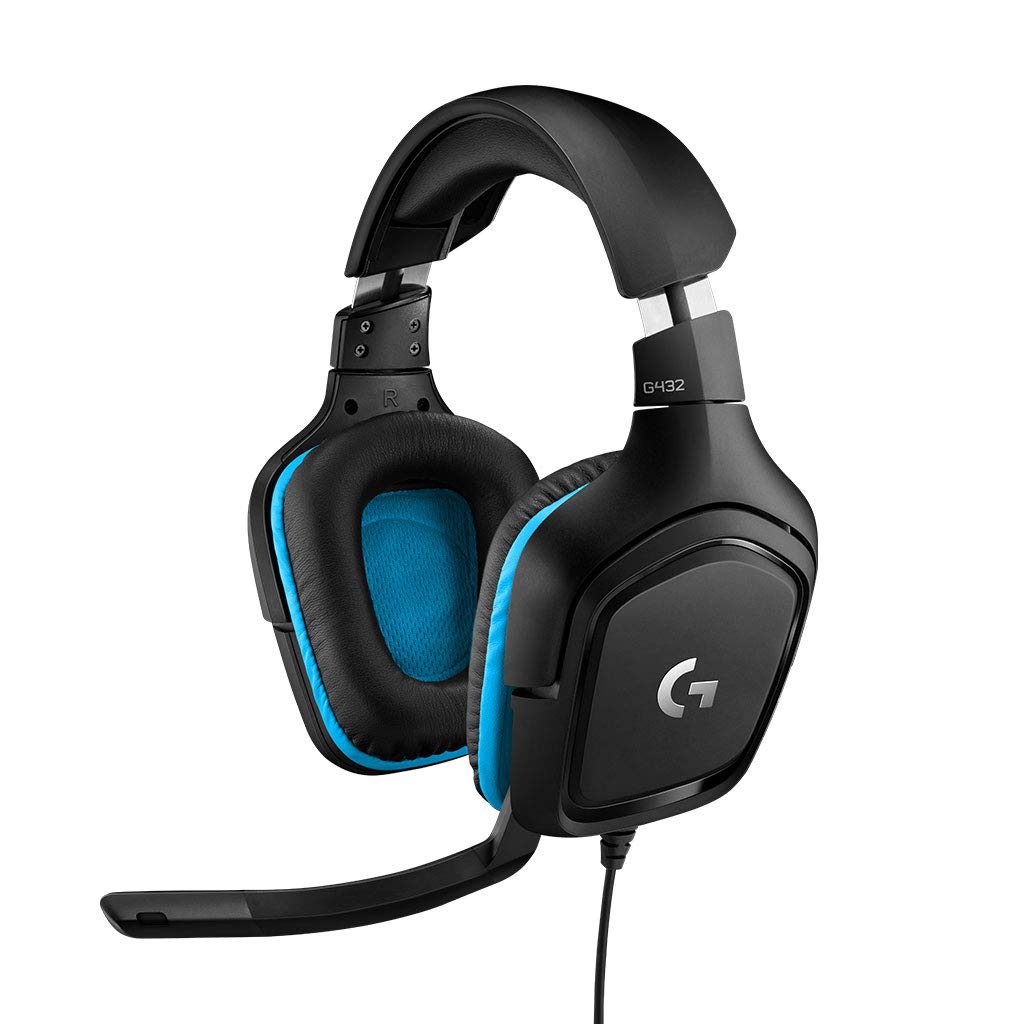
The established name that puts positional clarity and a big mic boom in the same package.
Fifty-millimeter audio drivers do the heavy lifting, and DTS Headphone:X 2.0 adds three-dimensional positional processing on top. That processing goes beyond 7.1 channels, so height cues and rear cues arrive as separate directions rather than blended into one flat plane. One important detail: DTS Headphone:X 2.0 requires Logitech G HUB software, so budget ten minutes to install and set it up before you judge the sound.
The 6mm boom mic is bigger than most here, and it mutes when flipped up — a physical gesture that is faster than hunting for a mute button when someone walks into the room. The earcups rotate up to 90 degrees, which means they lie flat for desk storage or around your neck. Premium leatherette covers the pads and headband, and the design keeps pressure off your ears during long sessions.
This is the cautious choice for a buyer who trusts a known brand and wants compatibility across PC, Mac, PS4, Xbox One, and Nintendo Switch. The trade-off shows over time — a share of units stop working months in — so it is best treated as a dependable everyday headset that you replace rather than an heirloom. For value in the mid tier, the name recognition and software support are the real draws.
What earns the spot
- DTS Headphone:X 2.0 gives positional clarity past standard 7.1 channels via G HUB software.
- Large 6mm boom mic with flip-up mute for fast, physical muting.
- 90-degree rotating earcups and leatherette padding for comfortable storage and wear.
What to weigh
- Surround processing requires the G HUB install, so it is not pure plug-and-play.
- Long-term durability is the weak point, with some units failing months in.
Worth it for: players who want a familiar brand, broad console compatibility, and DTS positional audio without premium pricing.
Not the one for: anyone who wants to skip software setup and get surround the moment they plug in.
6. SADES SA902 Stereo Gaming Headset 7.1 USB Surround Sound

A budget-focused build with a 7.1 surround chip doing the directional work.
Sades uses its own high-performance decoding chip to create a 7.1 channel surround field over USB, and that is the whole pitch for a first surround headset. The 360-degree field is meant to let you hear what you cannot see, which is the entry-level version of the positional audio premium picks deliver. The driver size is 40mm, so do not expect the low-end heft of the 50mm units, but for a first step into surround it is a sensible place to start.
Build is where Sades made real choices. Four reinforced padded headband segments give you height adjustment for a fitting fit, and the protein leather ear cushions are specified for ventilation through long sessions. Closed earcups cut out external noise without the hollow seashell effect some headsets produce — a detail that matters during quiet story sections. An inline remote handles sound and mic, and the microphone boom is flexible for exact positioning.
Reliability and durability both draw a lot of favorable comment, and quality is the most-praised trait overall. A small number of units see the earmuffs come loose over time, which is the one wear item to watch. Compatibility is broad: Windows XP through 8.1, with drivers ready to download, plus generic Mac use with no drivers needed.
What makes the budget case: a dedicated 7.1 decoding chip, closed earcups, and a four-piece adjustable headband for an entry-tier price.
What you give up: 40mm drivers rather than 50mm, so bass is polite rather than heavy, and a few units lose an earmuff with age.
Try this if: you want your first taste of 7.1 surround without leaving the budget tier.
Pass if: deep bass is a must, because the 40mm drivers are not voiced that way.
7. HAU-37 USB Gaming Headset
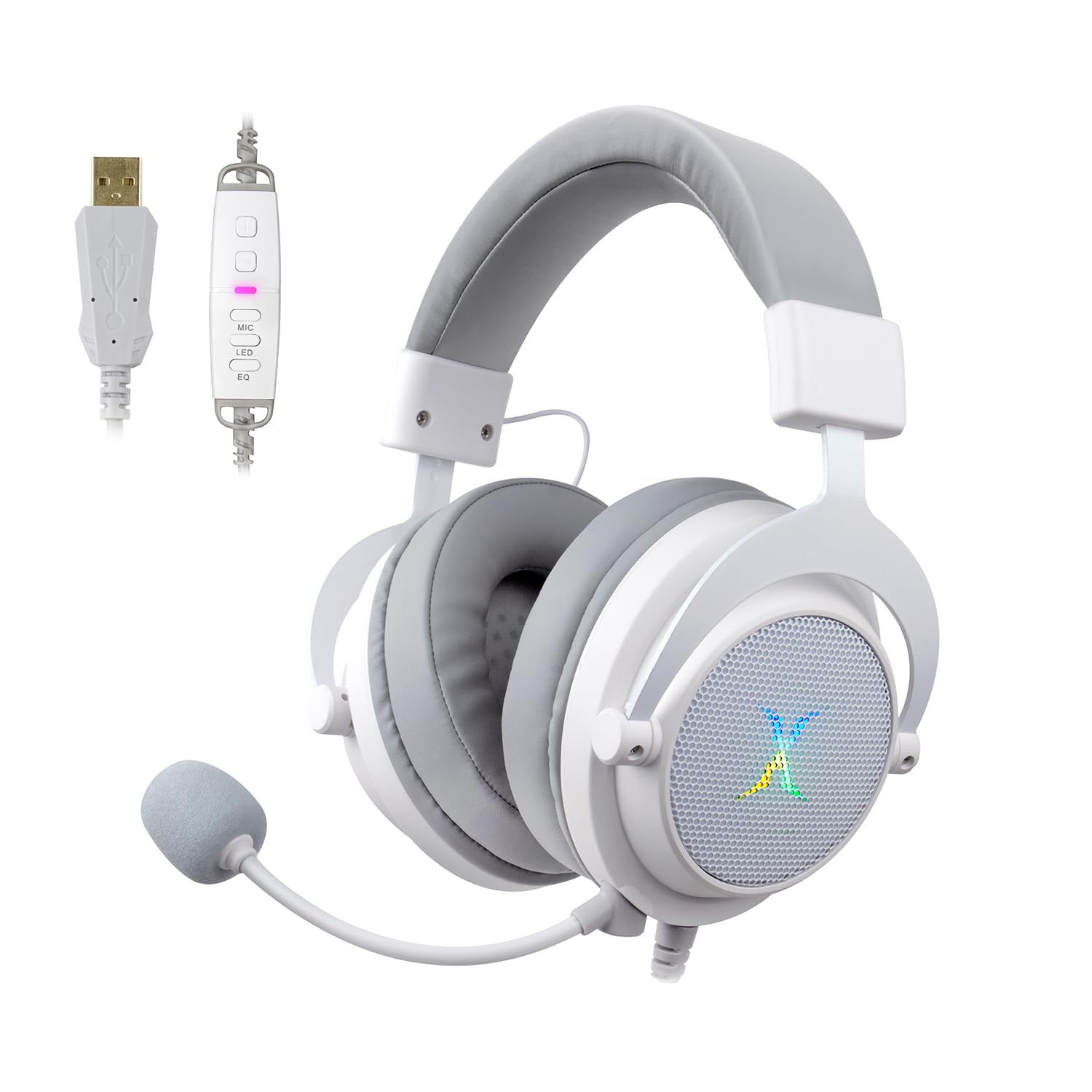
Fifty-millimeter drivers and an RGB light show without spending much.
The HAU-37 puts a 50mm dynamic driver in the budget tier, paired with a virtual 7.1 surround effect. That combination of driver size and surround is the reason to look at it. The tuned driver aims at clear highs, balanced mids, and deep lows for games, music, and movies, and the frequency response tops out at 20kHz — standard for a headset, and the point where the audible range ends anyway.
The inline multifunctional controller is unusually busy for the tier: 4 sound field settings and 4 lighting effects to switch between, plus mic on/off and volume. A bendable microphone adjusts to your mouth position and is specified to minimize background noise. The gold-plated USB connector and braided cable handle plug-and-play without extra drivers, and the tangle-free cable design means you are not untangling it every morning. An adjustable headband and large over-ear cushions are built to fit all head sizes.
One limit lives in the software. The downloadable driver that open up the extra sound EQ settings only supports the Windows operating system, so Mac users get the hardware but not the tuning options. For a budget pick, the spec sheet reads like a mid-range product, and the white shell stands out on a dark desk.
The standout number: a 50mm driver at the budget tier is the headlining spec, matched with 4 sound fields and 4 lighting effects on the inline box.
The limit to know: the EQ driver is Windows-only, so Mac owners are stuck with default tuning.
A strong fit for: Windows gamers who want 50mm drivers and adjustable RGB without a big outlay.
Not ideal for: Mac players who want the extra EQ customization.
8. ETWAR EG100 USB Wired Gaming Headset, 7.1 Surround Sound

The entry point to virtual surround, with the biggest drivers in the budget bracket.
ETWAR builds a USB 7.1 audio chipset inside the headset itself, so the surround processing happens in the hardware rather than on a software layer. The 50mm strong-bass driver units measure 50 millimeters to the Razer Kraken V4 X’s 40 millimeters, so if raw driver size is your deciding metric, the ETWAR wins that head-to-head. The 5.0mm PVC cable is fixed rather than detachable.
Compatibility runs through the USB jack to PC, PS4, PS5, Laptop, and Mac, and the listing is clear that it does not work with Xbox. There is no driver required — it is plug-and-play. The omni-directional noise-cancelling mic is flexible for angle adjustment and is built to deliver clear comms in-game or on chat. A retractable leather headband and protein over-ear pads are specified for air permeability to keep heat and sweat down, and RGB lighting on the headset marks it as a gaming-first look.
Two sides show up in owner experience. Sound quality earns generous praise, with clear treble getting a specific mention, and the general sense is that it works well for the price. The mic and noise cancellation draw mixed reactions — a portion report a constant buzzing noise — so if crystal-clean voice is critical, the FIFINE or the Kraken are the safer calls. The 2-year warranty is a comfort at this tier.
The driver argument: a built-in 7.1 chipset plus 50mm bass drivers makes it the most surround-heavy headset in the cheapest bracket.
The gamble to know: mic performance is the split point, and some units buzz — vocal clarity is not this pick’s strength.
Choose it for: a plug-and-play surround headset with the largest drivers money can buy in this bracket.
Skip the upgrade if: you already own a 50mm headset and find the sound lacking, since the step up here is subtle.
9. NUBWO HG03 Wired Gaming Headset
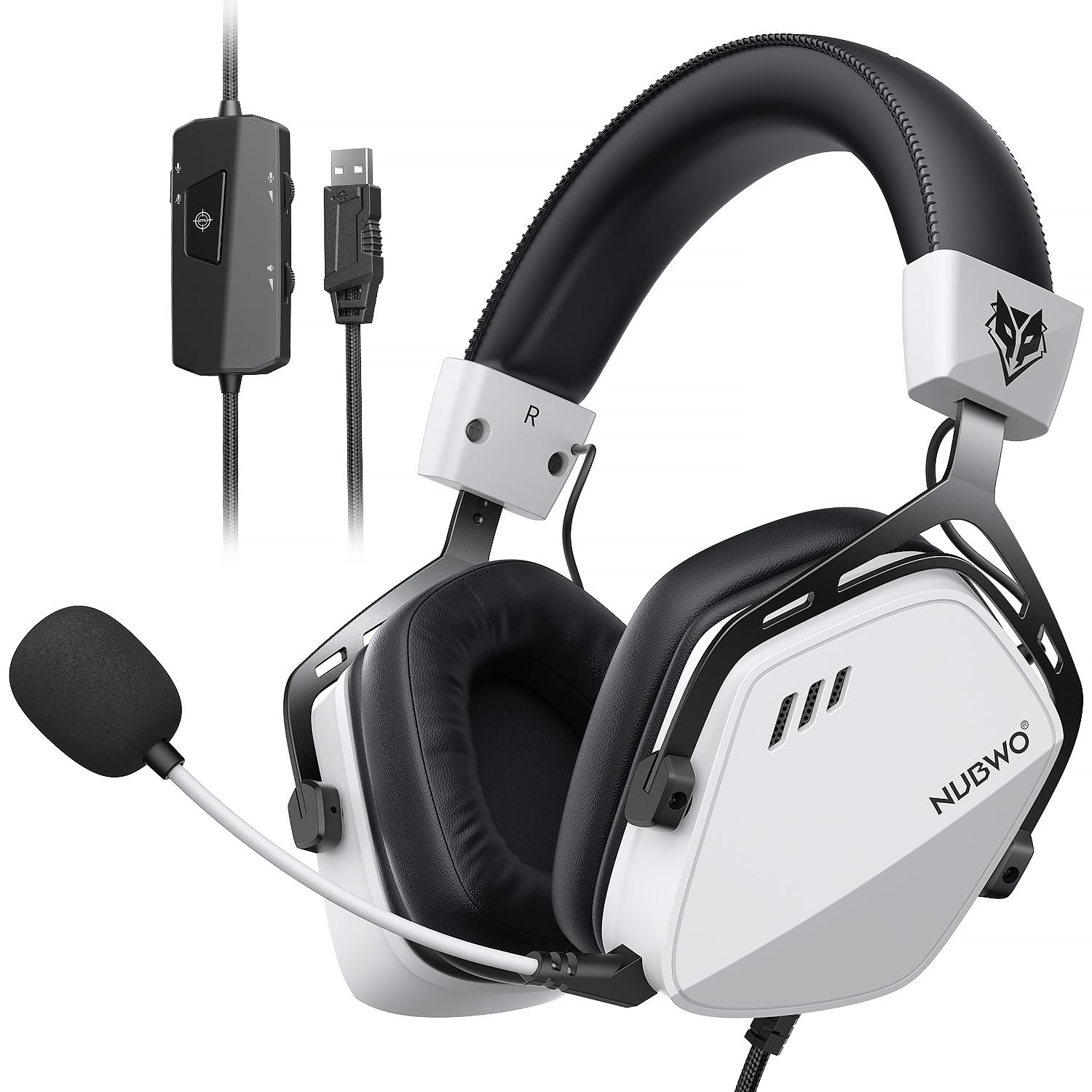
A dedicated FPS button at 280 grams, for players who weigh the headset and the aim.
The one-click FPS mode is the defining idea. One press activates a processing mode that lifts high frequencies so reloads and footsteps pop out of the mix. That is a narrower focus than the general 7.1 of the ETWAR or the SADES — the HG03 is built around the FPS genre specifically, with 3D spatial audio layering in directional cues you can follow behind, above, and to the side.
Weight is the reason to consider it for long play. The headset weighs 280 grams, and the lightweight aluminum headband is built to keep clamp force moderate rather than skull-crushing. Breathable fabric-wrapped memory foam ear cushions are specified to stay cool through long sessions, which is the detail that matters when you have played through a summer afternoon. The 50mm driver puts it in the same class as the budget picks above.
The NUBWO’s memory-steel core boom mic holds whatever angle you set it to. An in-line controller gives volume on a scroll wheel, mic volume, and an instant mute switch without a menu dive. The build quality is the consistent strength in owner experience, with sound and comfort following close behind, and volume control a recurring point of praise. Reliability is where the story splits — a portion of units stop working after long use, and that is the risk you accept at this price. The NUBWO HG03 needs USB-A only; it does not support 3.5mm or Type-C, so laptop owners without that port need an adapter.
What makes it different: the one-click FPS mode and the 280g build put it in a different lane from the general-purpose budget picks.
The fine print: USB-A only, and long-term reliability is not certain — worth knowing before you count on it for a full season.
Made for: FPS players on a tight budget who want a light headset and a one-button audio mode change.
Best paired with: a desktop or older laptop that has a USB-A port, since Type-C and 3.5mm are not supported.
Know the Specs
Driver Size, Explained
The driver (the speaker inside each earcup) comes in sizes like 40mm and 50mm. A bigger driver usually means more air moved and more bass weight, while a smaller one can keep the headset lighter. In this list the 50mm picks generally carry more low-end thump, and the 40mm Razer Kraken V4 X relies on a three-part driver design for clarity instead.
Virtual 7.1 Surround
7.1 surround sound is software processing that makes stereo audio feel like it comes from all around you. It helps most in shooters, where direction tells you where to look. It is only as good as the audio source and the headset’s processing chip — which is why the ETWAR’s dedicated USB chipset is note versus a plain stereo headset.
Mic Pickup Patterns
A cardioid mic listens mostly from the front and rejects sides and rear, so keyboard clatter fades. An omni-directional mic picks up from all directions and is more forgiving of head movement. A detachable or retractable boom lets you move the mic close for clarity or out of the way between sessions. Match the pattern to how you play: quiet room and close mic for comms-heavy teams, omni for a relaxed head position.
USB vs 3.5mm
A USB headset carries digital audio directly and usually brings its own processing, so it behaves the same on any PC with a free port. A 3.5mm headset depends on your motherboard’s sound chip, which can introduce hiss or weak output. For the cleanest voice and the most consistent surround, USB is the more predictable connection — and a convertible USB-C and USB-A cable covers more devices than either alone.
Common Questions
Will a USB gaming headset work on a PS5 or Xbox?
Is virtual 7.1 surround worth it for competitive FPS?
What is the difference between 40mm and 50mm drivers?
Do I need to install software for surround sound?
Can I use a USB gaming headset on a laptop with only USB-C ports?
How do I stop my mic from picking up keyboard noise?
Are detachable mics better than fixed ones?
How long should a wired USB headset last?
Do USB headsets need a special sound card?
Is a 50mm driver always better than 40mm?
The Bottom Line
The strongest all-rounder in this group is the Razer Kraken V4 X, because its convertible USB-C and USB-A cable, retractable cardioid mic, and 7.1 surround cover PC, console, and handheld in one package. If you stream and want the headset to look the part, the FIFINE H13BP brings a 50mm driver, 11 lighting modes, and a game/chat balance control. For the cleanest audio chain and the comfiest cloth earpads, the Corsair HS80 RGB USB is the premium step up. And if the budget is the deciding factor, the SADES SA902 gives you a 7.1 surround chip and a four-piece adjustable headband with no sacrifice in the basics.
How we choose
We do not accept paid placement. Every pick is matched to a real buyer and a real use-case; we do not hands-on test units.
Sources
Specifications: manufacturer listings and product documentation. Review insights: verified customer reviews, as of November 2026. Pricing: not shown on this page (it changes often); check the current price via the retailer link.
As an Amazon Associate, Tactical Gear Guy earns from qualifying purchases. This does not affect which products we feature.